

Crypto leverage trading platform development is the work of building an exchange where traders put down a small deposit and open a much bigger trade. Leverage is where most crypto trading now happens, so it is one of the most wanted features on any exchange. But it is also the riskiest part to build, because a weak risk engine can turn traders’ losses into your losses.
This guide shows you how a leverage platform works, from margin and liquidation to the insurance fund. You will see worked numbers, the modules you need, the rules in each major market as of October 2026, the steps to build and launch, and what it costs.
In this guide:
- How leverage really works: margin, liquidation and how far the price can move at each leverage level.
- The core modules: pre-trade checks, matching engine, mark price, liquidation engine, insurance fund and ADL.
- Rules by country: where you can and cannot offer leverage to retail traders in 2026.
- Build paths and cost: white label vs custom, with launch times and budget ranges.
- Features and risks: what traders expect, and what to test before launch.
Launch Your Crypto Leverage Trading Platform — Faster Than Ever!
Build a world-class margin & futures trading platform with our MVP System.
- Speed to Market: Go live 90% faster with pre-built leverage modules.
- Advanced Trading Engine: Ultra-fast matching for spot, margin & perpetuals.
- Risk Control Tools: Built-in liquidation, funding rate, and position management.
- Profit-Ready: Earn from fees, funding, and copy trading features.
Get your free branded demo in 48 hours — no payment, no commitment.
Book a Free Demo and see how our Leverage Trading Platform Script can take you from idea to live in just 8-12 weeks.
What Is Crypto Leverage Trading Platform Development?
Crypto leverage trading platform development is the process of building a crypto trading system where users trade with borrowed funds to grow their market exposure. A leverage trading platform includes core parts such as margin math, liquidation logic, risk controls, real-time price feeds and secure wallets. These platforms power futures, perpetual contracts and margin trading. They must handle high trading volume, sharp price swings and the rules of each market they serve.
Here is the idea in one line. A trader deposits $1,000 as margin and picks 10x leverage. The platform then lets them hold a $10,000 position. If the price rises 5%, they gain $500, or 50% of their deposit. If it falls 5%, they lose the same $500. So leverage grows gains and losses alike.
How Does Leverage Trading Work on a Crypto Platform?
Every leveraged trade rests on a few numbers that your platform has to track in real time:
- Initial margin: The deposit needed to open a trade. At 10x, it is 10% of the position. At 50x, it is just 2%.
- Maintenance margin: The least equity needed to keep the trade open. It is often under 1% of the position on major pairs, and it rises in tiers as positions grow.
- Mark price: A fair price built from several exchanges. Your platform uses it, not the last trade on your own book, to decide when a trade is in danger.
- Liquidation: When the trader’s equity drops below that minimum, the platform closes the trade before the loss goes past the deposit.
The higher the leverage, the smaller the price move that wipes out the deposit. The chart below shows how fast that safety gap shrinks.
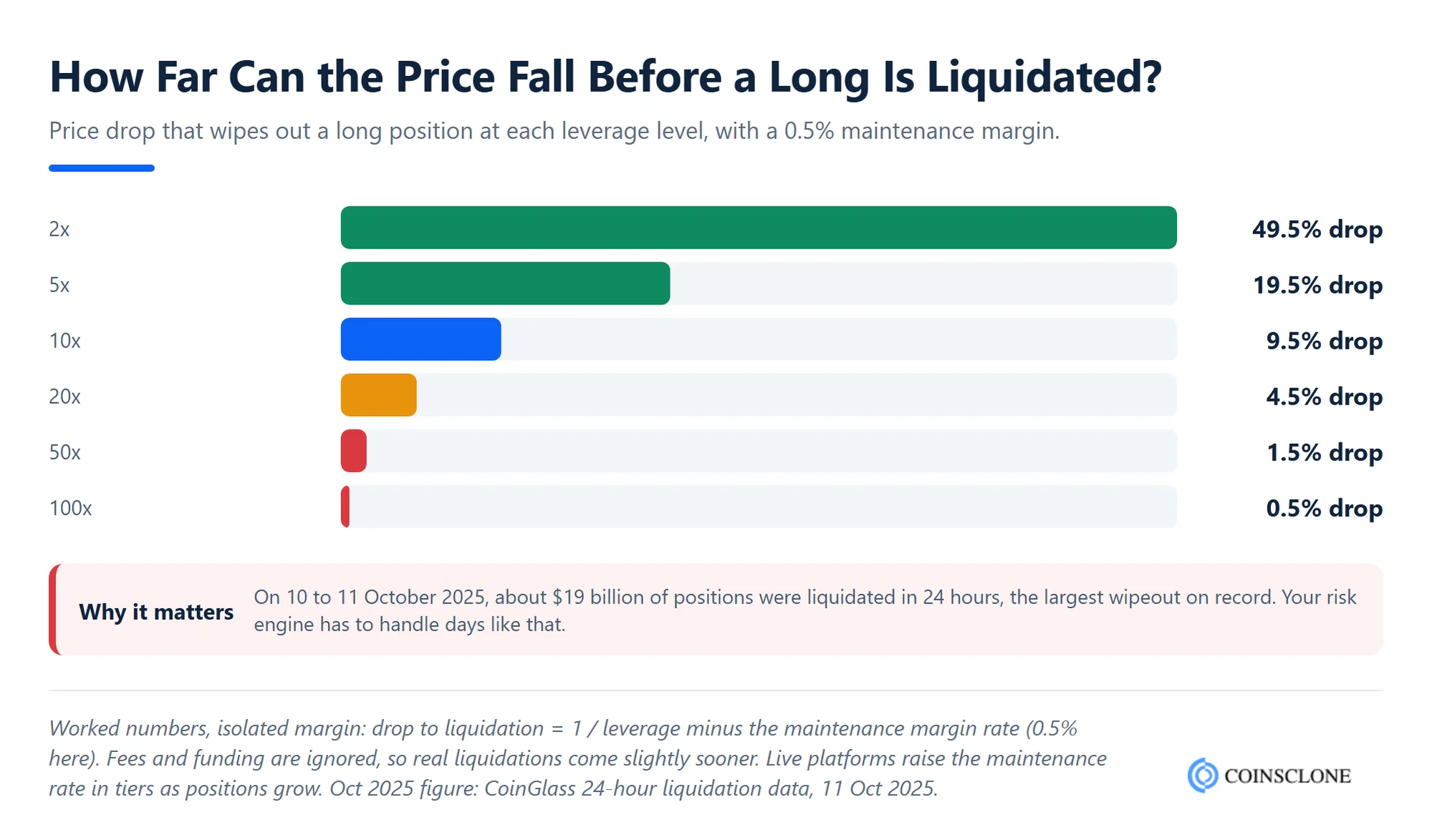
At 100x, a 0.5% dip can close the trade. Crypto prices often move that much in minutes. That is why big exchanges limit high leverage for new users. For example, since 7 December 2025, Binance blocks leverage above 20x for the first 30 days of a futures account. Your platform should be able to set the same kind of caps per user group.
Days of stress show why this matters. On 10 to 11 October 2025, about $19 billion of trades were liquidated in 24 hours across the market, and more than 1.6 million traders were hit, per CoinGlass data. On days like that, a fair mark price and stepwise liquidations are what keep bad closes down.
Isolated Margin vs Cross Margin
Most leverage platforms offer two margin modes, and you should build both:
- Isolated margin: Each trade has its own margin. If it is liquidated, the trader loses only that margin, and other trades stay safe.
- Cross margin: All trades share the account balance. This lowers the risk of a single liquidation, but one big loss can drain the whole account.
On-chain venues work the same way. For example, Hyperliquid uses cross margin by default. It sets the maintenance margin at half of the initial margin at max leverage.
Leverage Trading vs Margin Trading: What Is the Difference?
People often use the two terms as if they mean the same thing. They are close, but they are not the same. Margin is the deposit that backs the trade. Leverage is how many times bigger the trade is than that deposit. Every leveraged trade needs margin, so no one trades on leverage without putting up funds of their own.
The real split is in the product type. Here is how the common leverage products compare:
| Product | How it works | Typical leverage | What your platform must run |
| Spot margin trading | The trader borrows coins or stablecoins and buys or sells real assets | 2x to 10x | Lending pool, hourly interest, margin calls |
| Futures | A contract to buy or sell at a set date; no coins change hands until settlement | 10x to 100x or more, lower for big positions | Contract specs, settlement, mark price |
| Perpetual futures (perps) | Futures with no expiry; a funding payment keeps the price close to spot | 10x to 100x or more, lower for big positions | Funding rate engine, insurance fund, ADL |
| Spot trading (for contrast) | The trader uses only their own balance | 1x | Matching engine and wallets only |
If spot margin is your main product, our guide to margin trading exchange development covers the lending side in depth. For futures, perps and options, see our crypto derivatives exchange development services.
Why Should You Create a Crypto Leverage Trading Platform?
Leverage is where most crypto trading volume sits. In August 2026, centralized exchanges handled $4.29 trillion in trades, and derivatives made up $3.40 trillion of that, or 79.3%, per the CoinDesk Data exchange review. Spot trading was only $891 billion.
On-chain leverage is growing too. Monthly volume on on-chain perp exchanges hit $1.36 trillion in October 2025 and was still $699 billion in March 2026, per DefiLlama data reported by Cointelegraph. Hyperliquid alone handled about 34% of the top 10 venues’ volume in that period.
A leverage platform also earns from more sources than a spot exchange:
- Trading fees: Maker and taker fees on every opened and closed position. Leveraged trades are bigger, so each fee is bigger too.
- Borrowing interest: On spot margin, traders pay interest on what they borrow, often billed by the hour.
- Liquidation fees: When the engine closes a trade, it charges a fee. Part of it often goes to the insurance fund.
- Listing and API fees: New markets, VIP tiers and pro API access for trading firms.
Note that funding payments on perps move between long and short traders. They are not platform income, though you can charge a small fee on them in some designs.
In short, the demand is large. But the leaders are strong, so a new platform wins by serving a region, a type of trader or a product the big names do not offer.
How Does a Crypto Leverage Trading Platform Work?
Under the hood, each leveraged order passes the same chain of parts. The diagram shows the path, from the moment a trader clicks “buy” to the safety net that kicks in during a crash.
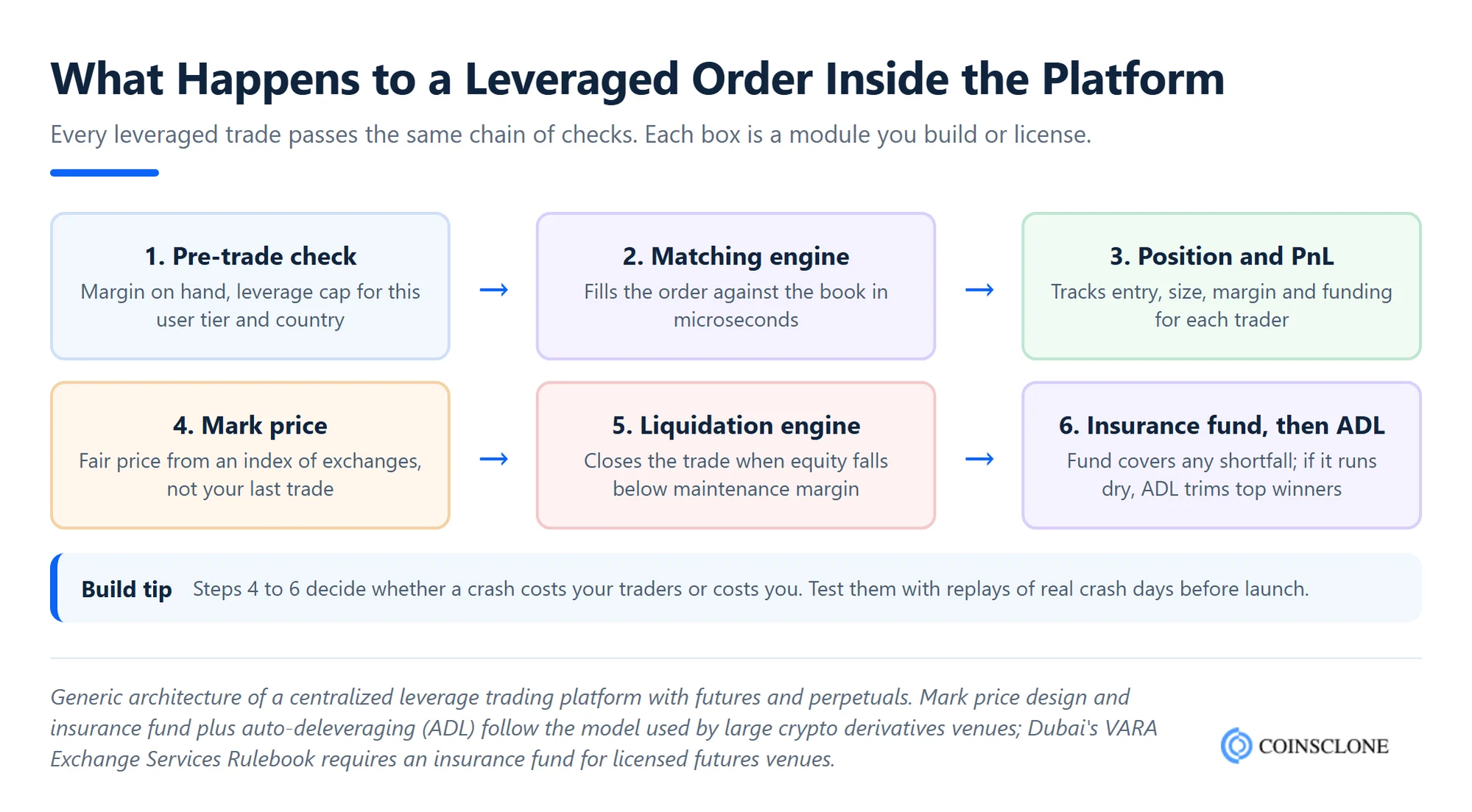
Here is what each module does:
- Pre-trade check: Confirms the trader has enough margin and that the leverage fits the cap for their user group and country.
- Matching engine: Pairs buy and sell orders in microseconds. It must stay fast when volume spikes tenfold.
- Position and PnL tracking: Keeps live profit and loss, margin level and funding for every open trade.
- Mark price and index: Builds a fair price from several exchanges, so one large order on your book cannot set off false liquidations.
- Liquidation engine: Takes over trades below maintenance margin and closes them in steps, not all at once.
- Insurance fund and auto-deleveraging (ADL): If a trade closes past its bankruptcy price, the fund covers the gap. If the fund runs dry, ADL trims the top winning trades on the other side. Good platforms show each user their ADL rank.
Around these sit the wallet system, KYC, the admin panel and the trader app. Market depth matters as much as code, so plan your crypto liquidity providers before launch day.
How To Create A Crypto Leverage Trading Platform?
Building a leverage trading platform gets easier when you pick the right build path and the right team. There are three main paths, and each fits a different budget and goal.
Building From Scratch
This is the path if you want a one-of-a-kind leverage exchange. You take part in every stage, from the first design to the final test. You can test your own ideas with expert help, such as a new margin model or a custom risk engine. However, the process takes longer because everything starts from the base. So the cost of a custom leverage platform is also higher.
Using a White Label Solution
White label crypto leverage trading platforms are ready-made exchanges that come with tested trading, margin and liquidation tools. You add your brand, markets and fee rules, then launch. At Coinsclone, a white label exchange goes live in 4 to 6 weeks, or 7 to 10 weeks with fiat rails. With futures and perps added, our builds take 8 to 12 weeks. You can add more features later at a lower cost.
Among these paths, white label software wins on cost and time to market. The risk engine has also already been through real market stress, which is hard to match with new code. Still, the best choice depends on your goals.
Building an On-Chain Perpetual DEX
The third path is a non-custodial perp DEX, where traders keep control of their funds and trades settle on-chain. This model grew fast after Hyperliquid’s success. It changes your rules picture and your tech stack, since smart contracts and oracles replace parts of the central engine. If this fits you, read how to create a perpetual DEX like Hyperliquid.
Steps To Consider While Creating A Crypto Trading Platform With Leverage
Here are the key steps to follow when you create a crypto leverage trading platform.
Analyze the Market: Before you start, study your market. Learn what traders want from a leverage platform, which products they use and what rules apply where they live. Pick your first country based on the rules, not only on demand.
Prepare the Prerequisites: List your tools, tech stack, licence plan, marketing plan and budget. Include funds for the insurance fund and market makers, not just the build. Get advice from legal and finance experts if you are not sure.
Set the Risk Rules: Decide on max leverage for each market and the margin tiers. Then pick your price sources, the liquidation steps and the size of the insurance fund. These rules shape the whole build, so fix them early.
Design the UI/UX: Design the front end, back end and app layouts. Show liquidation price, margin level and ADL rank clearly, so traders always know their risk.
Complete the Build: This is the core stage. The team builds the matching engine, risk engine, leverage features, wallets and payment links. Security controls go in at this stage too.
Test the Platform: Test security, speed, scale and upgrades, and fix every bug. Replay real crash days, such as October 2025, to check that liquidations, the insurance fund and ADL hold up.
Launch and Market: Once the platform is ready, launch in your first market. Then promote your leverage exchange and add markets and countries as licences allow.
These steps make the path clear. Still, building fair risk controls, meeting the rules and making the platform easy to use takes real skill. A team that has built trading platforms before can help you avoid costly mistakes.
Coinsclone is a leading Crypto Exchange Development Company with a team of skilled developers. We have built crypto exchanges with leverage, margin and futures trading since 2018. Our research team keeps up with market trends, so your crypto trading platform with leverage stays current and meets your goals.
Key Features Of Our Crypto Leverage Trading Platform
Here are the main features of our leverage platform.
Adjustable Leverage Caps: Set max leverage per market, per user group and per country, from 1x up to the limit your licence allows. You can lower caps for new users, as large exchanges do.
Isolated and Cross Margin: Traders choose how much of their balance backs each trade, and the risk engine tracks both modes in real time.
Advanced Order Types: Market, limit, stop-loss, take-profit, reduce-only and conditional orders help traders manage risk and trade with ease.
Fair Mark Price: An index built from several exchanges protects traders from false liquidations caused by one large order.
Stepwise Liquidation Engine: The engine closes large trades in parts, which lowers market impact and protects the insurance fund.
Insurance Fund and ADL: These cover shortfalls in a crash, so one trader’s loss never becomes the platform’s debt.
Funding Rate Engine: For perps, it works out and settles funding between longs and shorts on a set schedule.
Strong Security: 2FA login, SSL, strong encryption, multisig cold wallets and safe-address lists for payouts keep funds and accounts safe.
Multi-Crypto Support: Support for many coins and stablecoins adds trading pairs and more trades, so you can catch more market chances.
Powerful Admin Panel: Admins watch platform activity, risk levels, the insurance fund and trade details. They can also handle disputes raised by traders.
Easy-to-Use Screens: Clean screens show liquidation price, margin level and PnL at a glance, on web and mobile.
Risk Alerts: Traders get alerts on margin level, balance updates and nearby liquidation, so they can add margin or close trades in time.
API Access: REST and WebSocket APIs let trading bots, market makers and other apps connect to the platform.
24/7 Customer Support: Built-in support tools help you handle disputes, give quick help and share updates with users.
With these features, you can launch a crypto leverage trading platform with modern tools, strong security and smooth trading for your users.
Crypto Leverage Trading Rules by Country in 2026
Building the software is legal almost everywhere. Letting the public trade on leverage is not. Rules for retail traders differ a lot between countries, so check them before you choose your first market. Here is the picture as of October 2026:
| Market | Regulator | What it means for a leverage platform |
| United States | CFTC | Leveraged crypto for retail must run through CFTC-registered firms. Coinbase launched perpetual-style futures for US traders in July 2025 with up to 10x leverage, and Kraken opened regulated spot margin in May 2026. |
| United Kingdom | FCA | The ban on selling crypto derivatives to retail clients, in force since January 2021, still stands. Retail crypto borrowing rules start on 25 October 2027. |
| European Union | ESMA and national regulators | MiCA covers spot crypto, not derivatives. Futures and perps fall under MiFID II, and retail crypto CFDs are capped at 2:1. |
| Australia | ASIC | Retail crypto CFDs are capped at 2:1 under ASIC’s product intervention order, which runs to 23 May 2027. ASIC is consulting on whether to extend it. |
| Canada | CSA | Under the 2023 pre-registration undertakings, crypto trading platforms may not offer margin or leverage to Canadian clients. |
| Singapore | MAS | Licensed crypto firms may not offer credit, margin or leverage to retail customers. |
| Dubai | VARA | Margin and derivatives need explicit approval, client fit checks, separate margin accounts and an insurance fund for futures venues. |
So most new leverage platforms start with professional traders, or in a market with clear rules. Then they open leverage to more users, country by country, as licences allow. That is why we build country blocks, KYC tiers and leverage caps per user group into the core. Always confirm the details with a local lawyer before launch.
Key Considerations for Leverage Trading Crypto Platforms
Before you create a crypto exchange with leverage trading, know the hard parts. This helps you plan for the money and tech hurdles before you start.
Security: Guard a leverage platform with extra care, because hot wallets and margin balances are big targets. We use proven security controls and audits to guard the platform against attacks.
Rules and Licences: A leverage platform must follow local and global rules, from KYC and AML to leverage caps. Plan your licence path first, so you can grow without legal trouble.
Liquidity: Thin order books make liquidations worse, because forced closes push the price further. Our platform supports many coins and connects to market makers, so traders get deep books and fair fills.
Third-Party Links: Wallets, payment gateways, price feeds and KYC tools all need to work together. Our team checks the security and fit of every link before it goes live.
Risk Management: This is the heart of a leverage platform. It covers margin alerts, liquidation steps, the insurance fund and ADL. Strong risk tools protect traders and keep the platform solvent, even on the worst days.
These are the main factors that shape a leverage trading platform. At Coinsclone, we build the needed features and security modules to handle each of them.
How Much Does It Cost to Build a Crypto Leverage Trading Platform?
The cost depends mostly on the build path. Published 2026 agency cost guides put a white label exchange at about $15,000 to $60,000. A custom leverage or margin trading exchange usually costs about $80,000 to $300,000. Large multi-asset platforms built for big firms can pass $700,000.
| Build path | Typical cost (USD) | Time to launch |
| White label exchange with leverage modules | $15,000 to $60,000 | 4 to 6 weeks for the exchange; 8 to 12 weeks with futures and perps |
| Custom leverage trading platform | $80,000 to $300,000 | 6 to 9 months or more |
| Institutional, multi-asset platform | $300,000 to $700,000+ | 12 months or more |
Launch times come from Coinsclone’s published delivery times. Cost ranges reflect published 2026 agency cost guides.
The build is only part of the budget. You also need money for the insurance fund, a licence in each market, KYC checks, price feeds, market makers and security audits. For a full breakdown, see our guide to the cost to develop a cryptocurrency exchange.
Why Is Coinsclone Ideal For Creating A Crypto Leverage Trading Platform?
To create a crypto trading platform with leverage, tech skill and funding are just the start. Building a platform that keeps traders safe on crash days takes real experience and market know-how. That is why Coinsclone is a strong partner for crypto leverage trading platform development.
We have been building in the crypto space since 2018, with 350+ platforms delivered for 200+ clients across 20 industries. We build crypto exchanges with leverage, margin, futures, spot and more. Our White Label Crypto Exchange Software with leverage trading has powered many growing exchange businesses. We use proven tech stacks and test every risk module under stress, so your platform meets your goals. Share your needs with our blockchain experts, and let us build your leverage trading platform together.
Frequently Asked Questions
What is crypto leverage trading platform development?
Crypto leverage trading platform development means building software that lets traders open trades larger than their own balance by using leverage. The platform manages margin rules, profit and loss, liquidation levels and risk controls based on market moves.
How does a crypto leverage trading platform work?
A crypto leverage trading platform lets users borrow funds from the system to grow their trade size. The platform tracks each trader’s margin, applies leverage ratios, watches prices in real time and starts a liquidation if losses reach the allowed limit.
What features are required in a crypto leverage trading platform?
A crypto leverage trading platform needs:
- Margin and leverage controls
- Real-time price feeds and a fair mark price
- A liquidation engine
- An insurance fund and ADL
- An order matching engine
- Wallet and fund management
- User position tracking
These features keep the platform stable when markets swing hard.
What leverage ratios are supported in crypto trading platforms?
Most crypto leverage trading platforms support ratios such as 2x, 5x, 10x, 20x or higher, based on platform rules and market conditions. Spot margin usually runs from 2x to 10x, while futures and perps can go higher on large exchanges. Higher leverage grows both profit and risk, so platforms enforce margin and liquidation rules to limit losses.
What is liquidation in a crypto leverage trading platform?
Liquidation happens when a trader’s losses reach the margin limit set by the platform. The system then closes the position to stop further loss. The liquidation engine is a key part of crypto leverage trading platform development, because it protects both users and the platform.
Is a crypto leverage trading platform different from a spot trading platform?
Yes. A leverage platform is more complex than a spot platform. It adds margin math, borrowed funds, liquidation logic, an insurance fund and advanced risk controls. Spot trading platforms only let users trade with their available balance.
What tech is used in crypto leverage trading platform development?
Crypto leverage trading platforms are built with:
- Fast backend frameworks
- Real-time market data APIs
- Secure wallet systems
- Matching engines
- Risk and margin calculation engines
These tools help ensure fast trades, accurate numbers and a stable system.
Is crypto leverage trading legal in the US and the UK?
In the US, yes, but only through firms registered with the CFTC, such as Coinbase’s futures unit and Kraken’s regulated margin. In the UK, firms may not sell crypto derivatives to retail clients, a ban in force since January 2021. Australia and the EU cap retail crypto CFDs at 2:1. Canada bars platforms from giving margin or leverage to people who live there. Always check local rules before you launch.
How much does it cost to build a crypto leverage trading platform?
A white label leverage platform costs about $15,000 to $60,000 and can launch in weeks. A custom build usually costs $80,000 to $300,000 and takes 6 to 9 months or more. Also set money aside for the insurance fund, licences, market makers and audits.
Launch Your Crypto Leverage Trading Platform — Faster Than Ever!
Build a world-class margin & futures trading platform with our MVP System.
- Speed to Market: Go live 90% faster with pre-built leverage modules.
- Advanced Trading Engine: Ultra-fast matching for spot, margin & perpetuals.
- Risk Control Tools: Built-in liquidation, funding rate, and position management.
- Profit-Ready: Earn from fees, funding, and copy trading features.
Get your free branded demo in 48 hours — no payment, no commitment.
Book a Free Demo and see how our Leverage Trading Platform Script can take you from idea to live in just 8-12 weeks.