

Most people think crypto exchanges make money from trading fees. That is true, but it is only half the story. In the second quarter of 2026, Coinbase earned $1.2 billion in revenue, and less than half of it came from trading fees. The rest came from stablecoins, staking, lending and subscriptions.
So how do crypto exchanges make money? They charge a small fee on every trade, and they build many other income streams around their users’ funds and activity. In this guide, we explain the 12 main revenue models, show how a real exchange’s income splits, compare how centralized and decentralized exchanges keep their fees, and show what this means if you plan to start an exchange.
See How Do Crypto Exchanges Make Money?
Build your own exchange and tap into these revenue streams — faster than you think.
- Trading Fees : Every buy, sell, and swap earns commissions.
- Staking & Yield : Earn from users locking up assets on your platform.
- Spread & Liquidity : Profit from market-making and liquidity provision.
- Premium Features : White-label services, VIP tiers, and more.
Our MVP Exchange System helps you launch 90% faster — complete with wallets, liquidity, and revenue modules.
Book a Free Demo to see how you can launch your branded crypto exchange in just 8-12 weeks — and start earning from Day 1.
Understanding the Crypto Exchange Business Model
A crypto exchange is a marketplace where people buy, sell and trade cryptocurrencies such as Bitcoin, Ethereum and stablecoins. It matches buyers with sellers and earns money from the trades and the services around them. There are two main types:
- Centralized exchanges (CEXs) such as Binance, Coinbase and Kraken work like a stock broker and a bank in one. They hold users’ funds, match orders on their own systems, and charge fees for trading and other services.
- Decentralized exchanges (DEXs) such as Uniswap and Hyperliquid run on smart contracts or their own blockchains. Users keep their funds in their own wallets. Fees go to liquidity providers, the protocol, or both.
The business model rests on three things: trading volume, the amount of money users keep on the platform, and how many services each user uses. The more users trade and the more they hold, the more the exchange earns.
For startups, creating a crypto exchange means planning this revenue mix from day one, not just launching a trading screen.
How Do Crypto Exchanges Make Money in 2026?
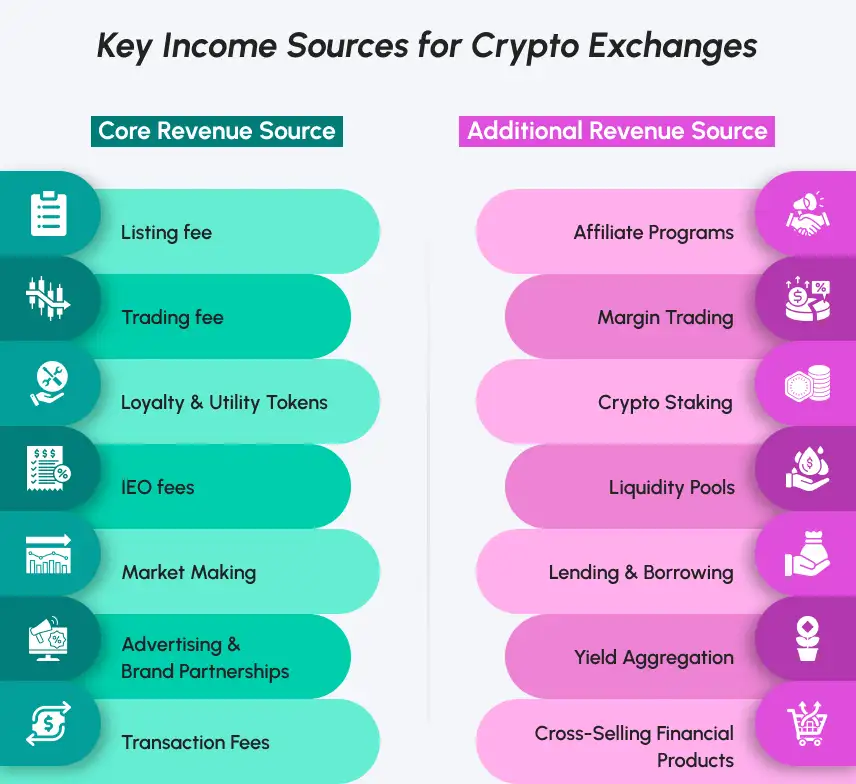
Here are the main ways crypto exchanges make money:
- Trading fees
- Spreads
- Derivatives and margin trading
- Stablecoin and interest income
- Staking commissions
- Listing fees
- Launchpad and IEO fees
- Withdrawal and network fees
- Exchange tokens
- Lending and borrowing
- Subscriptions and premium services
- Affiliate, API and partnership income
1. Trading Fees
Trading fees are the core income for most exchanges. The exchange takes a small percentage of every trade. Most use a maker-taker model: “makers” who add orders to the order book pay less, and “takers” who fill existing orders pay more. This rewards traders who bring liquidity.
Fees fall as a trader’s monthly volume rises. Binance’s standard spot fee is 0.10%, and most large exchanges start between 0.05% and 0.40%, with some promotions at zero. Our guide to the crypto exchanges with the lowest fees compares current rates.
2. Spreads
Many exchanges and apps offer a simple “buy” button that shows one price. That price often includes a spread, a small markup over the market price. Beginners pay it without noticing, so it can earn more than the visible fee. This is how some “zero-fee” apps make money.
3. Derivatives and Margin Trading
Futures, perpetuals and options now make up most crypto trading volume. Traders pay fees on these trades, and on leveraged positions they also pay funding or interest. Margin trading lets users borrow to trade larger positions, and the exchange charges interest on the loan. Running a crypto derivatives exchange or adding margin trading is one of the biggest revenue levers for a growing exchange.
4. Stablecoin and Interest Income
Users leave cash and stablecoins on exchanges. That money earns interest. Coinbase earns a share of the interest on USDC reserves through its partnership with Circle. In Q2 2026, this stablecoin revenue alone was $292 million, almost half as much as its trading fees. Average USDC held in Coinbase products reached a record $20 billion.
For smaller exchanges, the same idea applies at a smaller scale: user balances can earn interest in low-risk products, within the rules of your licence.
5. Staking Commissions
Exchanges stake coins such as ETH and SOL for users and keep a share of the rewards. Coinbase earned $83 million from blockchain rewards in Q2 2026. Staking is popular with users because it pays them for holding, and it earns the exchange a steady cut. See how to build a staking platform.
6. Listing Fees
New token projects want to be listed, because a listing brings buyers and liquidity. Some exchanges charge for this, or ask for tokens for marketing and airdrops. Large exchanges such as Coinbase say they do not charge listing fees, because their brand depends on listing quality projects. Smaller exchanges often charge, but a reputation for listing weak tokens can hurt user trust.
7. Launchpad and IEO Fees
An Initial Exchange Offering (IEO) is a token sale run by an exchange on its own launchpad. The project pays a fee or a share of tokens, and the exchange’s users get early access. Binance Launchpad made this model famous. You can add one with an IEO development or crypto launchpad module.
8. Withdrawal and Network Fees
When users withdraw crypto, the exchange pays a network fee to the blockchain. Many exchanges charge a flat withdrawal fee that is a little higher than the real network cost. Fiat deposits and withdrawals by card or bank transfer can also carry fees.
9. Exchange Tokens
Many exchanges issue their own token, such as BNB (Binance), OKB (OKX) or BGB (Bitget). Holders get fee discounts and other perks. The token keeps users loyal, and the exchange often holds a large share of its supply, which can rise in value. Some exchanges use part of their profits to buy back and burn their token.
10. Lending and Borrowing
Exchanges can run lending products where users lend coins for interest and others borrow against collateral. The exchange earns the gap between the two rates. Coinbase earned $66 million from interest and finance fees in Q2 2026, helped by record DeFi lending balances. Read more about DeFi lending and borrowing platform development.
11. Subscriptions and Premium Services
Some exchanges sell monthly plans with zero-fee trading, higher rewards or better support. Coinbase One is the best-known example, and it reached a record number of paid subscribers in Q2 2026. Other premium services include advanced charts, trading bots, copy trading and tax reports.
12. Affiliate, API and Partnership Income
Exchanges earn from partners too. They sell market data and API access to trading firms, run OTC desks for large trades, offer white label or “exchange as a service” setups to other businesses, and earn commissions from card, payment and on-ramp partners. Affiliate programs cost money, but they bring new traders who pay fees for years.
What a Real Exchange’s Revenue Looks Like
Coinbase is the largest exchange that publishes full accounts, so it shows how the revenue models above fit together. Here is its revenue for the quarter to 30 June 2026:
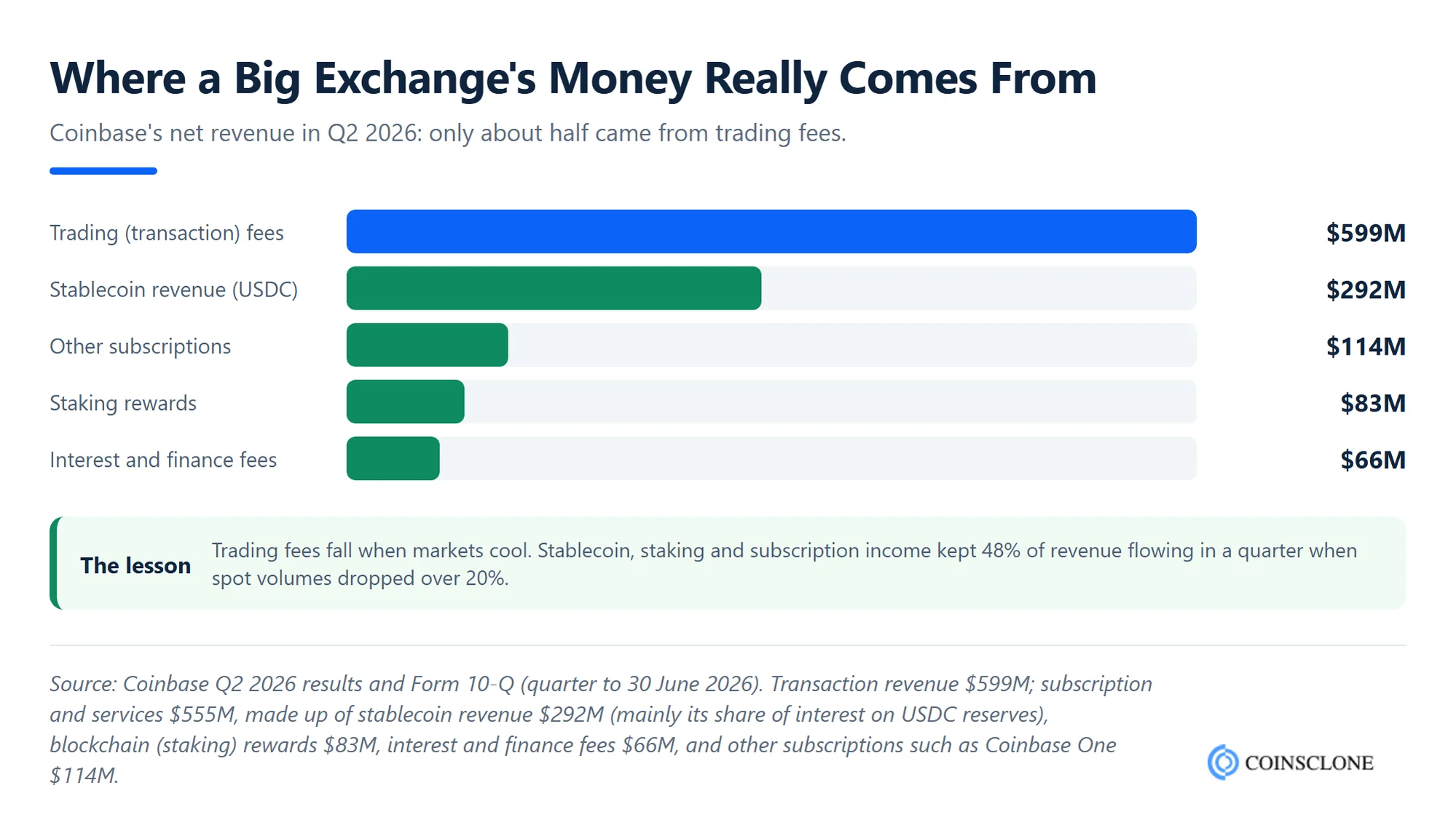
Two lessons stand out:
- Trading fees swing with the market. In Q2 2026, industry spot volume fell more than 20% and Coinbase’s revenue dropped 14% from the previous quarter.
- Other income keeps the lights on. Subscription and services revenue was 48% of net revenue, and Coinbase stayed profitable on an adjusted EBITDA basis ($208 million), even though it reported a net loss of $359 million after other charges.
For a new exchange, the takeaway is simple: plan more than one revenue stream from the start.
How Do Decentralized Exchanges Make Money?
A DEX has no company holding user funds, so its revenue works differently. Every trade pays a fee, but who keeps that fee depends on the design:
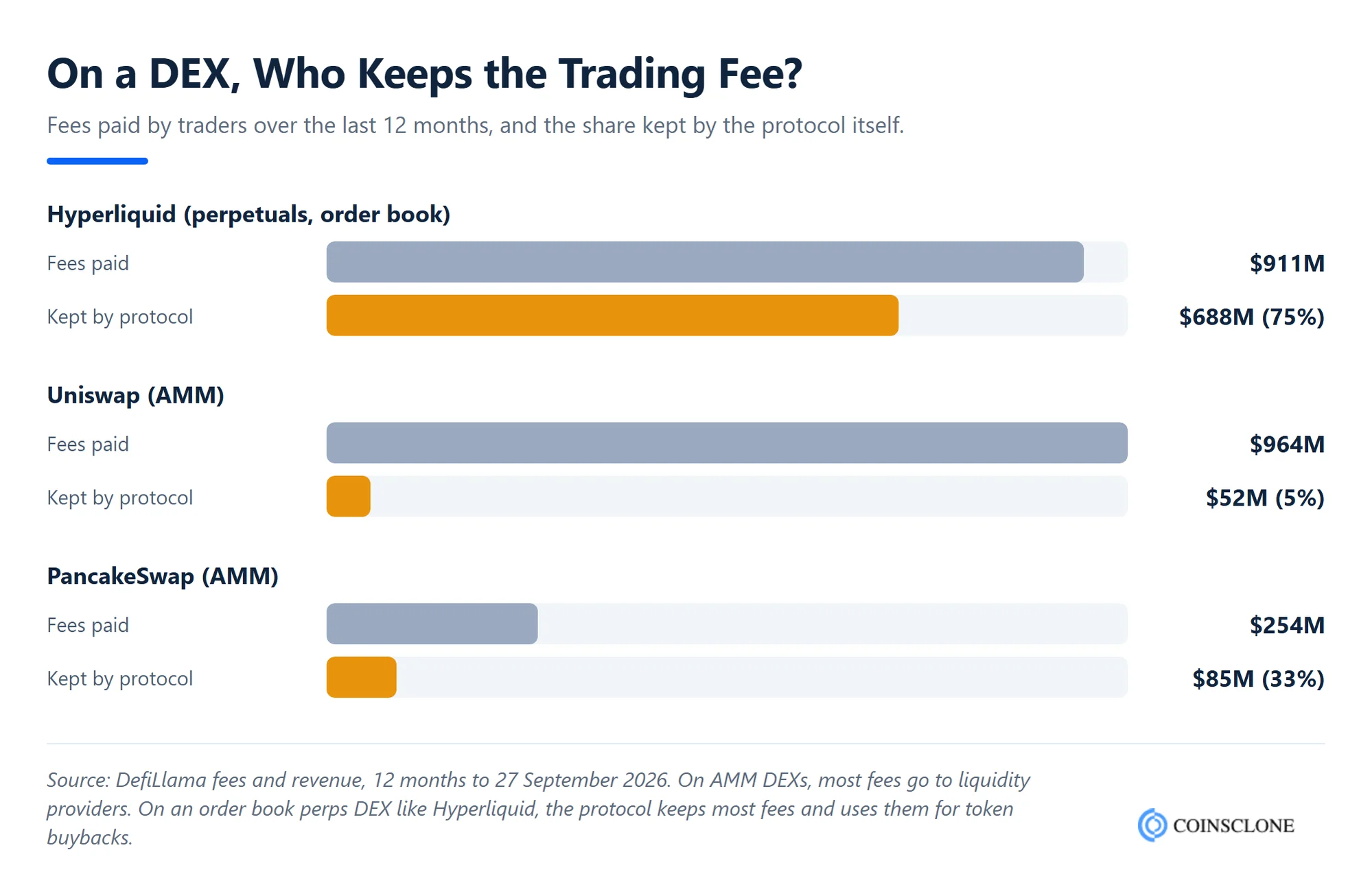
- AMM DEXs such as Uniswap and PancakeSwap pay most fees to liquidity providers, who supply the tokens for trading. The protocol keeps a small share through a “fee switch”.
- Order book DEXs such as Hyperliquid keep most fees at the protocol level and use them to buy back their token.
- Aggregators earn a small fee for routing trades across many DEXs.
CEX vs DEX Revenue Models at a Glance
| Revenue source | Centralized exchange (CEX) | Decentralized exchange (DEX) |
| Trading fees | Kept by the exchange | Mostly paid to liquidity providers on AMMs |
| Spreads | Common on simple buy screens | Set by the market and the pool |
| Interest on user funds | Yes, on cash and stablecoin balances | No, users hold their own funds |
| Staking and lending | Offered as exchange products | Offered through separate protocols |
| Listing fees | Some exchanges charge | None, anyone can create a pool |
| Token buybacks | Some exchange tokens | Common, funded by protocol fees |
| Licensing costs | High | Lower, but rising in some regions |
DEX teams also earn from token treasuries, launchpads and front-end fees on their own apps. To build one, see our guide to decentralized exchange development.
How Much Do Crypto Exchanges Make?
It depends on size and market conditions, but the numbers can be large:
- Coinbase: about $1.2 billion in revenue in Q2 2026 alone.
- Hyperliquid: about $911 million in trading fees over the 12 months to September 2026, of which the protocol kept about $688 million.
- Uniswap: about $964 million in fees over the same 12 months, most of it paid to liquidity providers.
A small exchange earns far less, but the maths is the same. As a rough example, an exchange with $5 million in daily trading volume and an average fee of 0.10% earns about $5,000 a day in trading fees, or about $1.8 million a year, before any other revenue.
How Profitable Is It to Run a Crypto Exchange?
A crypto exchange can be very profitable, but profit depends on factors you must plan for:
- Liquidity: Traders leave if spreads are wide. New exchanges often need a market maker or shared liquidity.
- Security: One hack can end an exchange. Bybit lost about $1.5 billion in February 2025, and smaller exchanges have closed after far smaller losses.
- Compliance: Licences, KYC/AML and audits are ongoing costs, and rules such as MiCA in the EU now apply.
- Competition: Big exchanges charge very low fees, so a new exchange needs a clear niche, such as a region, a currency or a type of trader.
- Market cycles: Revenue can fall fast in quiet markets, which is why non-trading income matters.
Our guide on whether owning a crypto exchange is profitable goes deeper, and our crypto exchange business plan guide helps you model the numbers.
Which Revenue Models Should a New Exchange Start With?
You do not need all 12 models on day one. A practical order is:
- Trading fees with maker-taker tiers: your core income from the first trade.
- Withdrawal and fiat fees: simple and expected by users.
- Staking: easy to add and popular with holders.
- Referral program: turns users into your marketing team.
- Derivatives or margin: once you have liquidity and the right licence.
- Launchpad, exchange token and subscriptions: once you have a loyal user base.
Coinsclone’s published timeline for a white label crypto exchange is 4 to 6 weeks, so you can launch with the core models and add the rest as you grow. See the white label crypto exchange cost guide for budgets.
Why Coinsclone Is the Right Partner to Build Your Crypto Exchange
Coinsclone is a cryptocurrency exchange development company that has delivered more than 350 blockchain platforms for over 200 clients. We build exchanges with every revenue model in this guide ready to switch on: maker-taker fee tiers, spot and derivatives trading, margin, staking, launchpads, exchange tokens, referral programs and OTC desks.
Whether you want a white label exchange that launches in weeks or a custom trading platform, we help you plan the revenue mix, the liquidity setup and the security from the start, and we support you after launch.
See How Do Crypto Exchanges Make Money?
Build your own exchange and tap into these revenue streams — faster than you think.
- Trading Fees : Every buy, sell, and swap earns commissions.
- Staking & Yield : Earn from users locking up assets on your platform.
- Spread & Liquidity : Profit from market-making and liquidity provision.
- Premium Features : White-label services, VIP tiers, and more.
Our MVP Exchange System helps you launch 90% faster — complete with wallets, liquidity, and revenue modules.
Book a Free Demo to see how you can launch your branded crypto exchange in just 8-12 weeks — and start earning from Day 1.
Frequently Asked Questions
How do crypto exchanges make money?
Mainly from trading fees, plus spreads, derivatives and margin interest, withdrawal fees, listing and launchpad fees, staking commissions, interest on user balances, exchange tokens, subscriptions and partnerships.
How do crypto exchanges make money without charging fees?
“Zero-fee” exchanges usually earn through spreads built into the price, interest on user balances, staking, lending, listings and paid subscriptions. Some also earn by routing orders to market makers.
How much do crypto exchanges make?
Large exchanges earn billions a year. Coinbase reported about $1.2 billion in revenue in Q2 2026. A small exchange with $5 million in daily volume at a 0.10% fee earns about $1.8 million a year from trading fees alone.
How do decentralized exchanges make money?
Traders pay a fee on each swap. On AMM DEXs, most of it goes to liquidity providers and a small share to the protocol. Order book DEXs such as Hyperliquid keep most of the fee and use it for token buybacks.
How much does it cost to start a crypto exchange in 2026?
It depends on the model, features, licences and liquidity. A white label exchange is the fastest route, with a published timeline of 4 to 6 weeks at Coinsclone. See our guide to the cost to start a crypto exchange for a full breakdown.
What is the most profitable part of a crypto exchange?
Trading fees are the biggest, especially on derivatives. But steady income such as stablecoin interest, staking and subscriptions is what keeps an exchange profitable when trading slows.
Which crypto exchange is the most profitable?
Binance is the largest by volume but does not publish full accounts. Among exchanges that do, Coinbase is the biggest. Among DEXs, Hyperliquid keeps the most fee revenue.
How can users make money on a crypto exchange?
Users earn by trading, staking, lending, joining launchpads or using referral programs. All carry risk, especially leveraged trading.