
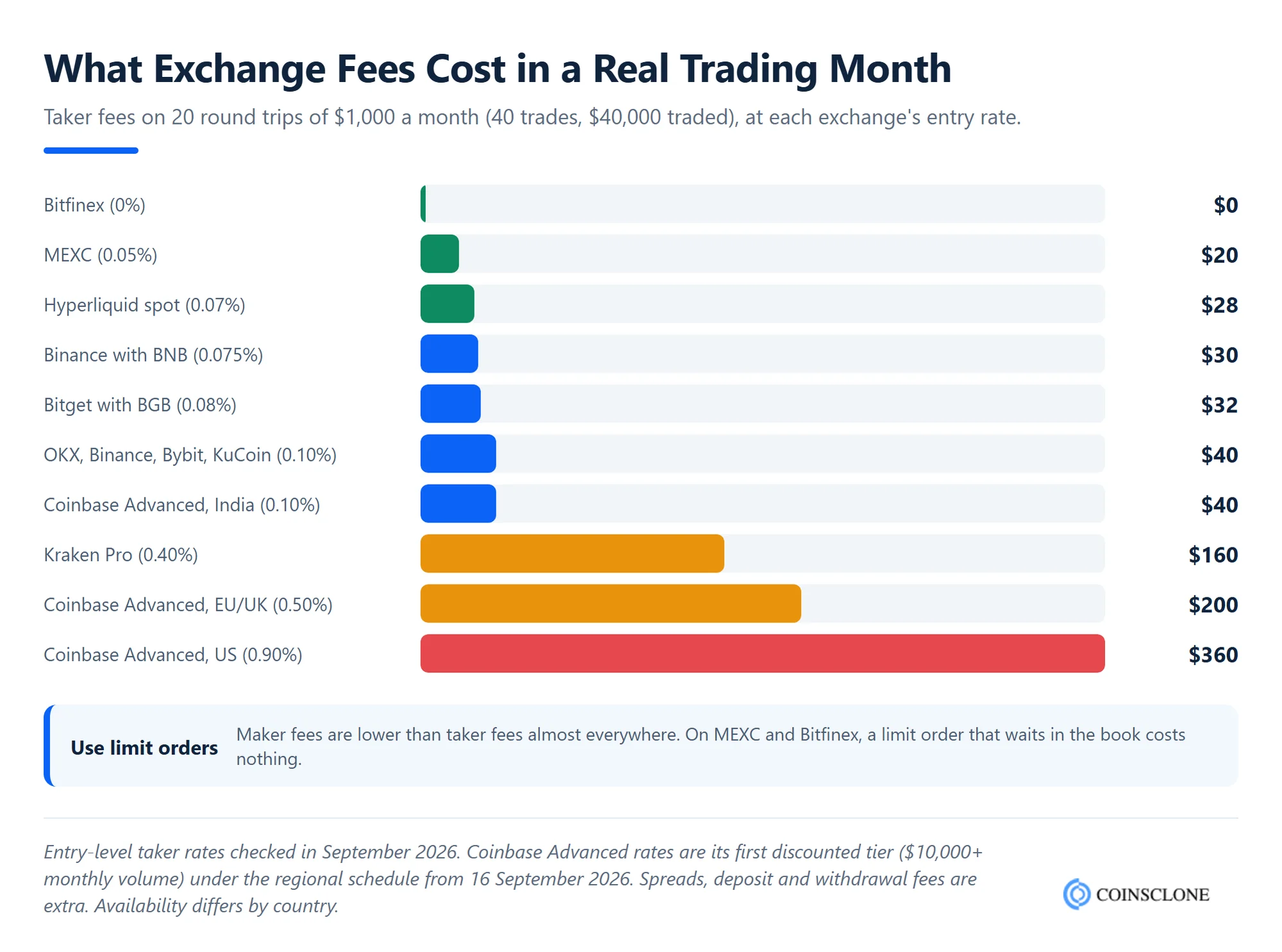
A 0.1% trading fee sounds tiny. But trade $1,000 forty times in a month and it becomes $40. At 0.9% it becomes $360. For active traders, the exchange you choose can matter more than the coins you pick.
Fees also changed a lot in the last year. Bitfinex dropped trading fees to zero for every customer in December 2025, and Coinbase moved to region-based pricing on 16 September 2026. So which crypto exchange has the lowest fees? We checked the entry-level rates of the major exchanges in September 2026 and ranked them below, with the costs that do not show up in the headline fee.
Trade Smarter on the Crypto Platform with the Lowest Fees!
Your gateway to faster, cheaper crypto trading — built to scale.
- Ultra-Low Fees: Keep more of your profits with industry-leading low commissions.
- Lightning Execution : Fast trades, zero lag — perfect for active traders.
- Secure & Scalable : Bank-grade protection and 24/7 uptime
- All-in-One Dashboard: Trade, stake, and earn — all in one place.
Get a free branded demo of your trading platform in just 48 hours — no cost, no commitment.
Book Your Free Demo and see how you can launch a high-performance, low-fee crypto exchange in 8-12 weeks.
10 Best Crypto Exchanges With the Lowest Fees in 2026
Ranked by the base spot taker fee a new user pays, before volume discounts. Maker fees apply when your limit order waits in the order book; taker fees apply when your order fills straight away.
| Exchange | Spot maker fee | Spot taker fee | Ways to pay less |
| Bitfinex | 0% | 0% | Already zero on spot, margin and derivatives |
| MEXC | 0% | 0.05% | 50% off when holding MX |
| Hyperliquid (DEX) | 0.04% | 0.07% | Volume tiers and HYPE staking |
| OKX | 0.08% | 0.10% | Volume tiers |
| Binance | 0.10% | 0.10% | 25% off when paying in BNB |
| Bitget | 0.10% | 0.10% | 20% off when paying in BGB |
| Bybit | 0.10% | 0.10% | VIP tiers |
| KuCoin | 0.10% | 0.10% | Class A coins; VIP tiers |
| Kraken Pro | 0.25% | 0.40% | Volume or assets held on Kraken |
| Coinbase Advanced | 0.09% to 0.50% | 0.10% to 0.90% | Depends on your region and volume |
Rates checked in September 2026 from each exchange’s fee pages and announcements. Fees change often, and not every exchange serves every country.
1. Bitfinex
Bitfinex is one of the oldest crypto exchanges, founded in 2012, and it is now the cheapest major exchange to trade on. On 17 December 2025 it set trading fees to zero for all eligible customers, for both makers and takers, on spot, margin, derivatives and OTC trades. There is no volume requirement and no announced end date.
- Fees: 0% maker, 0% taker.
- Best for: active traders who want the lowest possible trading cost.
- Watch out for: Bitfinex does not serve US residents, and withdrawal fees still apply.
2. MEXC
MEXC is a global exchange known for listing new tokens early. It charges 0% maker fees and 0.05% taker fees on spot trades, and users holding at least 500 MX tokens get a further 50% off.
- Fees: 0% maker, 0.05% taker.
- Best for: altcoin traders and anyone who mostly uses limit orders.
- Watch out for: MEXC is not licensed in many countries, including the US.
3. Hyperliquid
Hyperliquid is a decentralized exchange with its own blockchain and an on-chain order book. You trade from your own wallet, and there is no gas fee per order. Base fees are 0.04% maker and 0.07% taker on spot, and 0.015% maker and 0.045% taker on perpetual futures.
- Fees: 0.04% / 0.07% spot; 0.015% / 0.045% perps.
- Best for: traders who want low fees without handing coins to an exchange.
- Watch out for: no fiat deposits; you need USDC in a wallet first.
4. OKX
OKX is a global exchange with deep spot and derivatives markets and a built-in Web3 wallet. Regular users pay 0.08% maker and 0.10% taker on spot, falling with volume.
- Fees: 0.08% maker, 0.10% taker.
- Best for: traders who want both exchange and on-chain trading in one app.
- Watch out for: not available in every country.
5. Binance
Binance is the world’s largest crypto exchange by trading volume. Regular users pay 0.10% maker and 0.10% taker on spot, or 0.075% each when paying fees in BNB.
- Fees: 0.10% / 0.10%, or 0.075% with BNB.
- Best for: the widest choice of coins and the deepest liquidity.
- Watch out for: US users must use the separate Binance.US, which has its own fees.
6. Bitget
Bitget is a fast-growing exchange strong in copy trading and derivatives. Spot fees start at 0.10% maker and taker, with a 20% discount when you pay in its BGB token.
- Fees: 0.10% / 0.10%, or 0.08% with BGB.
- Best for: copy traders and derivatives traders.
- Watch out for: availability varies by region.
7. Bybit
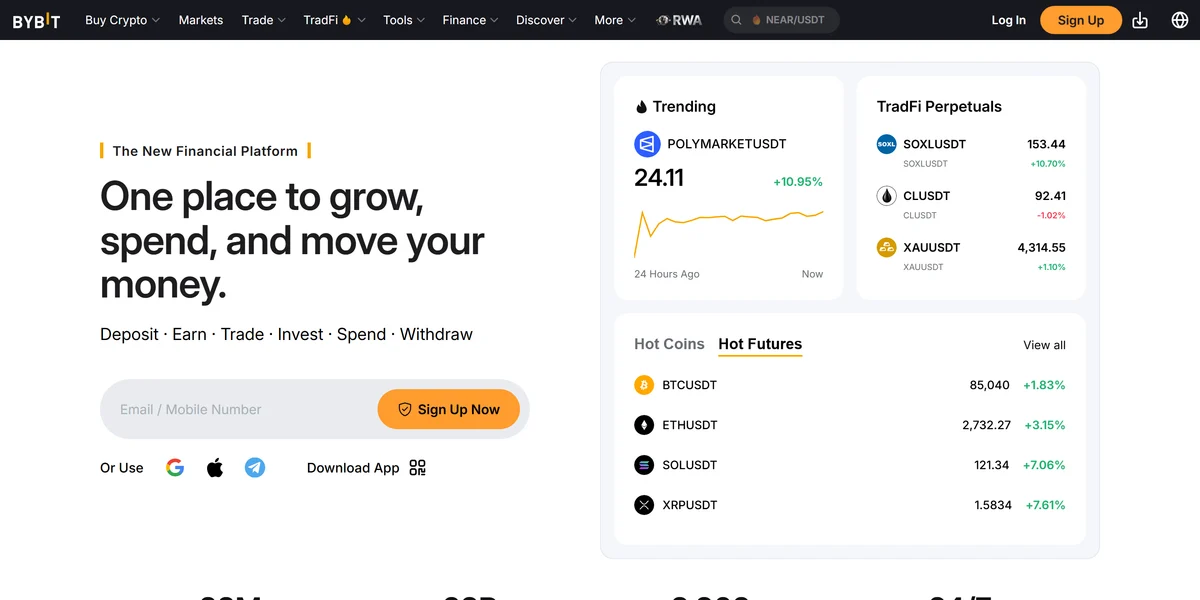
Bybit is a large derivatives and spot exchange. Non-VIP users pay 0.10% maker and taker on spot, with lower rates for higher VIP tiers.
- Fees: 0.10% / 0.10%.
- Best for: futures traders who also trade spot.
- Watch out for: not available to US users.
8. KuCoin
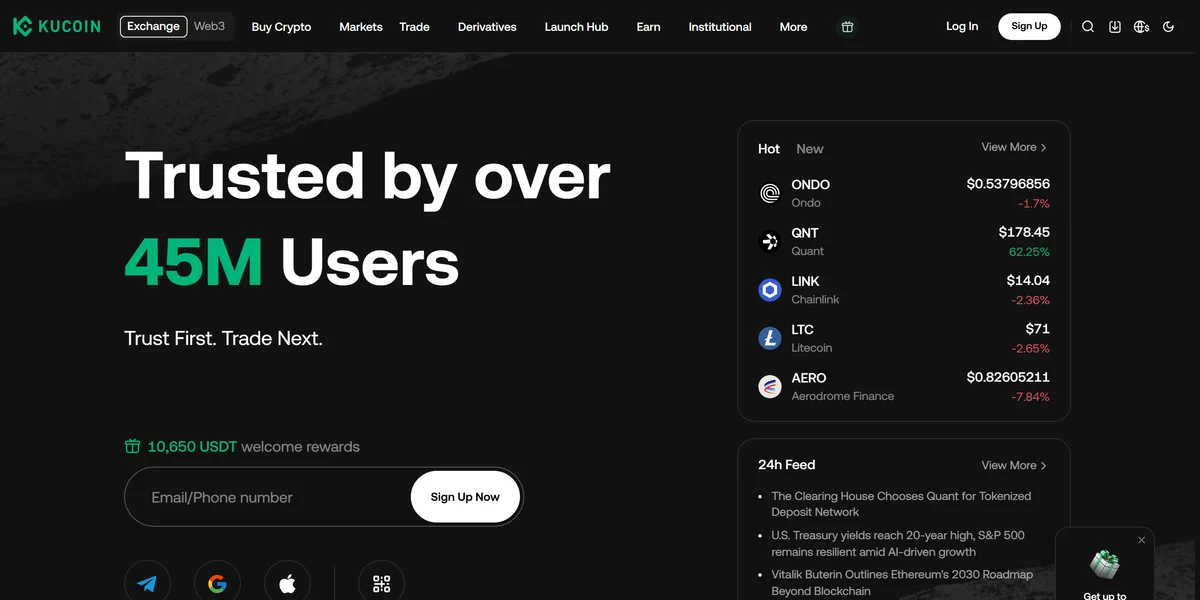
KuCoin lists a very wide range of altcoins. Its base spot fee is 0.10% for makers and takers on Class A coins; some smaller coins sit in higher fee classes.
- Fees: 0.10% / 0.10% on Class A coins.
- Best for: finding smaller altcoins.
- Watch out for: KuCoin left the US market in 2025 as part of a settlement with the US Department of Justice.
9. Kraken Pro
Kraken is a long-running, regulated exchange that serves the US and Europe. Kraken Pro’s base tier, under $10,000 in monthly volume, charges 0.25% maker and 0.40% taker, falling to 0.20% and 0.35% above $10,000. Since July 2026, your tier can also be set by the value of assets you hold on Kraken.
- Fees: 0.25% / 0.40% at the base tier.
- Best for: US and European traders who want a regulated exchange.
- Watch out for: the simple buy button in the Kraken app costs more than Kraken Pro.
10. Coinbase Advanced
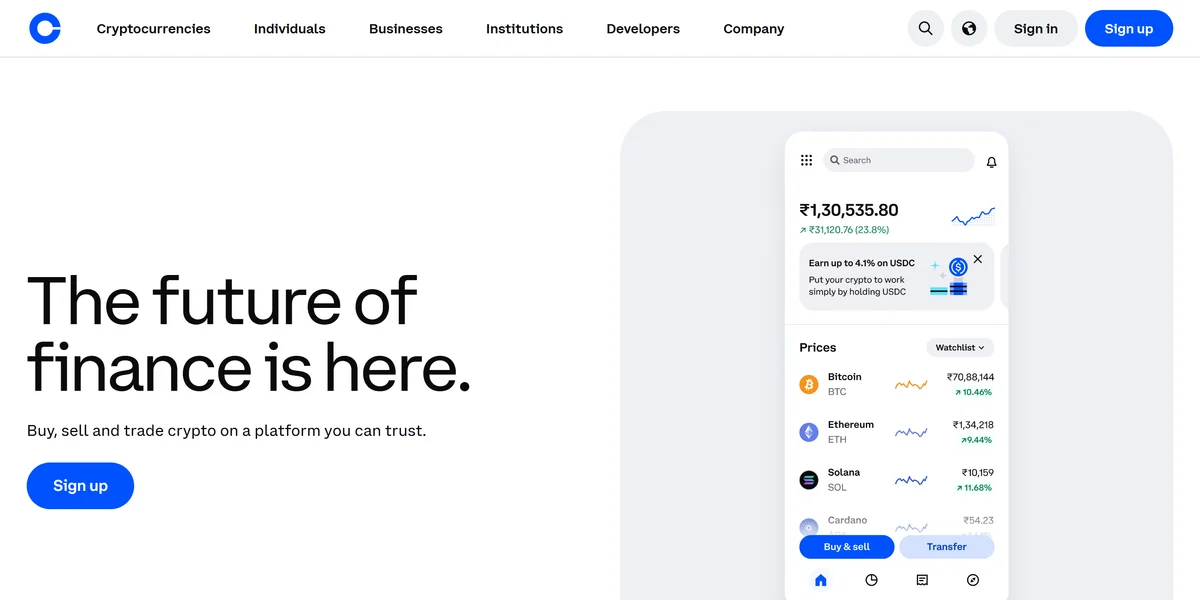
Coinbase is the largest US-listed crypto exchange. On 16 September 2026 it moved Coinbase Advanced to region-based fees and lowered the volume needed for its first discounted tier to $10,000. At that tier, fees are 0.09% maker and 0.10% taker in markets such as India and Brazil, 0.25% and 0.50% in the EU and UK, and 0.50% and 0.90% in the US.
- Fees: 0.09% / 0.10% up to 0.50% / 0.90%, depending on region.
- Best for: US users who value regulation and simple apps; low-cost for users in India and Brazil.
- Watch out for: the simple buy button in the main Coinbase app costs much more than Advanced.
Hidden Costs Beyond the Trading Fee
The fee table is only part of what you pay. Check these before you choose:
- Spread: “instant buy” and “convert” screens often price in a spread of 0.5% or more on top of, or instead of, a fee.
- Deposit fees: card deposits usually cost 1% to 4%; bank transfers are often free.
- Withdrawal fees: each crypto withdrawal carries a network fee, and some exchanges add their own charge.
- Funding fees: on perpetual futures, you pay or receive a funding fee every few hours.
- Conversion fees: paying fees in a platform token saves money but ties you to that token’s price.
A Worked Example: What Fees Cost You in a Year
Small percentages add up. Here is what a trader who places $10,000 of trades a month pays over a year at different taker rates:
| Taker fee | Cost per month on $10,000 | Cost per year |
| 0% (maker orders on MEXC or Bitfinex) | $0 | $0 |
| 0.05% | $5 | $60 |
| 0.075% (Binance with BNB) | $7.50 | $90 |
| 0.10% (Binance, OKX, Bybit, KuCoin) | $10 | $120 |
| 0.40% (Kraken Pro entry taker) | $40 | $480 |
| 0.90% (Coinbase Advanced, US, $10k tier) | $90 | $1,080 |
The gap between the cheapest and the most expensive option is more than $1,000 a year on the same trading. For active traders, the exchange you choose can matter more than the coins you pick.
Low-Fee Exchanges vs Decentralized Exchanges
Decentralized exchanges (DEXs) charge a pool fee instead of a maker or taker fee. On Uniswap, pools use fee tiers of 0.01%, 0.05%, 0.30% or 1%, and major pairs such as ETH-USDC often trade in the 0.05% pool. On top of that you pay a network (gas) fee, which is a few cents on layer 2s such as Base and Arbitrum but can be several dollars on Ethereum mainnet.
- When a DEX is cheaper: Larger trades on layer 2s, where a 0.05% pool fee plus cents of gas beats a 0.10% taker fee.
- When a CEX is cheaper: Small or frequent trades, limit orders with zero maker fees, and pairs that have thin liquidity on-chain.
- Hidden DEX costs: Price impact on thin pools and MEV “sandwich” attacks can cost more than the fee itself. Using an aggregator with MEV protection reduces both.
See our list of the best decentralized exchanges for on-chain options.
Why Do Crypto Exchanges Charge Fees?
Fees pay for running the exchange: the matching engine, wallets, security, liquidity, customer support and compliance. They are also the exchange’s main income. That is why exchanges compete hard on fees for new users and then reward volume with discounts.
Want to see the business side? Our guide on how crypto exchanges make money explains every revenue stream.
Types of Fees You Pay on a Crypto Exchange
- Trading fees: maker and taker fees on every order.
- Deposit fees: charges for funding your account, mainly by card.
- Withdrawal fees: network and service fees when you move assets out.
- Swap or convert fees: charges for instant conversions between coins.
- Spread: the gap between the buy and sell price on simple buy screens.
- Network (gas) fees: paid to the blockchain, not the exchange.
- Premium fees: rare, for extra services or accounts.
How to Pay the Lowest Crypto Trading Fees
- Use the pro trading screen: Coinbase Advanced and Kraken Pro cost far less than the simple buy buttons in their apps.
- Use limit orders: maker fees are lower, and on MEXC and Bitfinex they are zero.
- Pay fees in the platform token: BNB on Binance and BGB on Bitget cut fees by 25% and 20%.
- Move with volume: higher tiers bring lower rates, and some exchanges now count assets held, not just trading.
- Fund by bank transfer: avoid card deposit fees.
- Batch withdrawals: fewer, larger withdrawals mean fewer network fees.
- Check the network: withdraw on a low-fee network, such as a layer 2 or Tron for USDT, when your wallet supports it.
Best Low-Fee Crypto Exchange by Country
- United States: Kraken Pro and Coinbase Advanced are the main regulated options; Bitfinex, Bybit, MEXC and KuCoin do not serve US residents.
- European Union and UK: Kraken Pro, Coinbase Advanced (0.25% maker, 0.50% taker at its first tier) and Bitfinex where eligible.
- India: Coinbase Advanced’s international rates (0.09% maker, 0.10% taker) are among the lowest; see our list of the best crypto exchanges in India for FIU-registered local options.
- Everywhere else: Bitfinex, MEXC, OKX, Binance and Bitget lead on price where they are available.
What Happened to Some Older “Lowest Fee” Picks?
- Paxful closed on 1 November 2025.
- Huobi now trades as HTX.
- Bitstamp is now owned by Robinhood.
- Poloniex was acquired in 2019 by a group backed by Justin Sun and is no longer US-based.
If a list still recommends these under their old names, its fee data is likely out of date too.
Launch Your Own Low-Fee Crypto Exchange
Low fees attract traders, but they only work as a business when volume is high. If you are planning your own exchange, our guide to white label crypto exchange cost shows the trading volume needed to break even at different fee levels.
Coinsclone is a cryptocurrency exchange development company that has delivered more than 350 blockchain platforms for over 200 clients. We build exchanges with flexible fee tiers, token discounts and maker rebates, so you can compete on price and still earn. Explore our Binance clone script for a proven model.
Trade Smarter on the Crypto Platform with the Lowest Fees!
Your gateway to faster, cheaper crypto trading — built to scale.
- Ultra-Low Fees: Keep more of your profits with industry-leading low commissions.
- Lightning Execution : Fast trades, zero lag — perfect for active traders.
- Secure & Scalable : Bank-grade protection and 24/7 uptime
- All-in-One Dashboard: Trade, stake, and earn — all in one place.
Get a free branded demo of your trading platform in just 48 hours — no cost, no commitment.
Book Your Free Demo and see how you can launch a high-performance, low-fee crypto exchange in 8-12 weeks.
Frequently Asked Questions
Which crypto exchange has the lowest fees?
Bitfinex, which has charged zero trading fees on spot, margin and derivatives since December 2025. MEXC is next, with 0% maker and 0.05% taker fees on spot. Availability depends on your country.
What is the cheapest crypto exchange in the US?
Among exchanges that serve US residents, Kraken Pro starts at 0.25% maker and 0.40% taker. Coinbase Advanced’s first discounted tier charges 0.50% maker and 0.90% taker for US users under its September 2026 schedule.
Which crypto app has the lowest fees?
For app users, Bitfinex and MEXC have the lowest trading fees. On Coinbase and Kraken, use the Advanced or Pro screens inside the app, which cost far less than the simple buy button.
What is the difference between maker and taker fees?
A maker places a limit order that waits in the order book and adds liquidity. A taker places an order that fills straight away and removes liquidity. Makers usually pay less.
What is the best crypto trading app in India with low fees?
Coinbase Advanced’s international schedule charges 0.09% maker and 0.10% taker in India. Local FIU-registered exchanges such as CoinDCX and CoinSwitch also compete on price. All Indian trades carry the 1% TDS.
Do crypto exchanges charge deposit fees?
Crypto deposits are usually free apart from the network fee you pay to send them. Bank transfers are often free, while card deposits typically cost 1% to 4%.
How can I avoid crypto withdrawal fees?
You cannot avoid the network fee, but you can reduce it by withdrawing less often, choosing a low-fee network such as a layer 2 or Tron for USDT when your wallet supports it, and comparing each exchange’s own withdrawal charge.
Is it cheaper to trade on a DEX or a centralized exchange?
For small and frequent trades, a centralized exchange with low maker and taker fees is usually cheaper. For larger trades on low-fee networks such as Base or Arbitrum, a DEX pool fee of 0.05% plus a few cents of gas can be cheaper.
Are zero-fee crypto exchanges really free?
The trading fee can be zero, but you still pay spreads on simple buy screens, network fees on withdrawals and, on some platforms, deposit fees. Check the full cost, not just the headline fee.