
This guide ranks the 20 best NFT marketplace clone scripts in 2026, from OpenSea and Blur to Axie Infinity and NBA Top Shot. For each one, you see the business you would copy: what kind of market it is, which chain it runs on, what the original charges and whether it is still open. We checked every fee and status against each platform’s own site or a trusted report on 2 October 2026.
A clone script saves you from building a marketplace line by line. But the model you copy decides your fees, your users and your launch plan. So after the list, we explain what sits inside an NFT marketplace clone script, how to pick a model, how the platform earns, and what a launch costs in time and money.
In this guide:
- The 20 best NFT marketplace clone scripts, with a side by side table of the originals and their fees
- Which originals have shut down since 2024, and what that means for your clone
- A simple decision tree to match a clone to your business plan
- What one $1,000 sale earns under each fee model
- Cost and launch time, from a 4 week white label to a multi-chain build
Build Your Own NFT Marketplace with Our NFT Marketplace Clone Script
NFT Marketplace Software — built for instant scalability.
- One-Click Deployment: Launch your ready-to-go NFT marketplace clone.
- Smart Contract Ready: Audited contracts for safe NFT trading.
- Custom Ecosystem: Add your tokenomics, payment modes, and UI.
- Built-in Monetization: Earn from trades, NFT mints, and premium listings.
See a free branded demo of your NFT marketplace in 48 hours — before you invest a cent.
Book a Free Demo to see how our NFT Marketplace Clone Script accelerates your launch from concept to live platform in just 8–12 weeks.
20 Best NFT Marketplace Clone Scripts in 2026
The 20 best NFT marketplace clone scripts in 2026 cover five kinds of models: open markets, curated art, Solana markets, game and sports apps, and brands built on rare items. The last five entries copy platforms that have closed. Their models still sell, but you should know why the originals stopped before you copy them.
The Original Platforms Compared
The table shows the business behind each clone. The fee is what the original charges today, so it tells you where your own pricing can sit. Fees and status come from each platform’s help pages or trusted news reports, checked on 2 October 2026.
| # | Clone of | Model | Main chain | Original’s fee | Status, Oct 2026 |
| 1 | OpenSea | Open market | Ethereum, Base, Solana and more | 1% per sale | Live |
| 2 | Blur | Pro trader market | Ethereum, Blast | 0% | Live |
| 3 | Magic Eden | Open market | Solana | 2% per trade | Live, Solana only since March 2026 |
| 4 | Rarible | Open, multi-chain market | Ethereum, Base, Polygon, Solana | 2% seller fee (1.5% on Solana) | Live, new owner in 2026 |
| 5 | LooksRare | Community market | Ethereum | 0.5% to stakers | Live |
| 6 | SuperRare | Curated art | Ethereum | 15% primary, 3% buyer fee | Live |
| 7 | Solanart | Open market | Solana | Custom fees | Live, legacy brand |
| 8 | SolSea | Creator market with licences | Solana | 2%, 0% for stakers | Live |
| 9 | Axie Infinity | Game asset market | Ronin | 4.25% | Live |
| 10 | The Sandbox | Metaverse land and items | Ethereum, Polygon | Varies | Live |
| 11 | Enjin | Game asset network | Enjin Blockchain | Varies | Live |
| 12 | Sorare | Fantasy sports cards | Solana | Varies | Live, moved to Solana in 2025 |
| 13 | NBA Top Shot | Licensed sports moments | Flow | 5% per sale | Live |
| 14 | CryptoPunks | Collectible brand | Ethereum | Market fees | Live, run by a nonprofit since 2025 |
| 15 | Bored Ape Yacht Club | Members club brand | Ethereum | Market fees | Live |
| 16 | ZED RUN | NFT horse racing | Ethereum, then Base | n/a | Closed Feb 2025 |
| 17 | Binance NFT | Exchange-run market | BNB Chain, Ethereum | 1% at launch | Closed July 2026 |
| 18 | Coinbase NFT | Exchange-run market | Ethereum, Base | n/a | Closed Aug 2024 |
| 19 | Foundation | Curated art | Ethereum | n/a | Closed April 2026 |
| 20 | Nifty Gateway | Premium drops | Ethereum | n/a | Closed Feb 2026 |
1. OpenSea Clone Script
An OpenSea clone script is a ready-made NFT marketplace that works like OpenSea, one of the largest open markets for NFTs. Anyone can mint, list, buy, bid and sell, and users trade with their own wallets. The script comes with stores, NFT listings, activity tracking and sales stats.
OpenSea now runs on many chains and added Solana NFT trading in August 2026. Its fee is 1% per sale, and 10% on primary drop mints. That simple model is the one most clones copy.
Best suited for: founders who want a broad, open market for every kind of NFT.
2. Blur Clone Script
A Blur clone script copies the marketplace built for pro NFT traders. Blur shows prices from many markets in one place, so users can sweep floors, bid on whole collections and track the market in real time. Users can buy, sell, mint, bid and list NFTs, and the script adds built-in aggregator tools.
Blur charges a 0% marketplace fee and earns its place through speed and liquidity instead. Many NFT sets still pay the artist at least 0.5% per sale. Blur also runs Blend, a lending tool that lets users borrow against NFTs.
Best suited for: teams that want to win active traders with low fees, fast tools and NFT lending.
3. Magic Eden Clone Script
A Magic Eden clone script copies the largest NFT marketplace on Solana. Users get new mints through a launchpad, resale trading, offers and fast, cheap trades. The script includes collection pages, rarity filters and wallet support for Phantom and other Solana wallets.
Magic Eden charges 2% on each trade. In March 2026 it closed its Bitcoin and EVM markets to focus on Solana, which brings most of its volume. That tells you a lot: one chain done well can beat many chains done poorly.
Best suited for: startups that want a fast, low cost marketplace on Solana.
4. Rarible Clone Script
A Rarible clone script is ready software for an NFT market that runs on many chains, like Rarible. Users can mint, buy, sell and trade NFTs and rare collectibles, and creators can set royalties on each item. The script also covers community storefronts, so brands can run their own branded market.
Rarible charges a 2% seller fee on Ethereum, Base and Polygon, and 1.5% on Solana. In 2026 its brand was bought by IMPOSSIBLE, which added graded trading cards. If you want to compare it with the market leader, read our OpenSea vs Rarible guide.
Best suited for: creators and brands who want a multi-chain market with their own storefront.
5. LooksRare Clone Script
A LooksRare clone script is ready software to launch an NFT market owned by its users, like LooksRare, on the chain you choose. LooksRare pays its users a share of the market’s income, which builds a loyal trading community.
Its protocol fee is a fixed 0.5% on each sale, and that fee goes to LOOKS token stakers. A clone lets you copy this model: a token, staking and trading rewards that give users a reason to stay.
Best suited for: projects that want a token-driven market where users share in the fees.
6. SuperRare Clone Script
A SuperRare clone script helps you build a curated art market, where only approved artists can sell. Collectors buy one-off works, and artists earn a cut each time their work sells again. The script runs on Ethereum, so users can mint, buy and sell Ethereum-based NFTs, and you can change the design and rules to suit your idea.
SuperRare takes a 15% commission on first sales, charges buyers a 3% fee and pays artists 10% on resales. Curation lets a market charge more, but you need a strong art team to keep quality high.
Best suited for: art brands and galleries that want fewer, higher-value sales.
7. Solanart Clone Script
The Solanart clone script lets you build a fast, low cost NFT marketplace on Solana. Solanart was the first full NFT market on Solana. It still runs a launchpad, on-chain chat and NFT loans, and it lets each listing set custom fees.
Today Solanart is a legacy brand, and most Solana trading has moved to Magic Eden and Tensor. A clone gives you its proven tools, but you will need sharper marketing and lower fees to win users back.
Best suited for: Solana communities that want their own market with loans and a launchpad.
8. SolSea Clone Script
A SolSea clone script helps you launch a creator-first NFT platform with licences built in. SolSea lets creators attach a licence to each NFT when they mint it, so buyers know what rights they get. That makes it a good fit for artists, brands and anyone who sells digital rights.
SolSea charges a 2% fee, which drops to 0% for users who stake 100,000 of its AART token. That pairing of fees and staking is a simple loyalty model you can copy.
Best suited for: platforms that sell NFTs with clear usage rights, such as art, music and brand assets.
9. Axie Infinity Clone Script
The Axie Infinity clone script helps you build a game with its own NFT market. Players raise, battle and breed cute creatures called Axies, and they trade them as NFTs. The clone gives you the base for a play-to-earn game, with a marketplace, breeding logic and in-game tokens.
Axie runs on Ronin, its own gaming chain, and takes a 4.25% marketplace fee that funds its Community Treasury. Its biggest lesson is about balance: a game economy needs ways to spend tokens, not just earn them.
Best suited for: game studios that want NFTs as in-game items with a trading market.
10. Sandbox Clone Script
The Sandbox clone script gives you a metaverse NFT platform built around games and virtual land. Users can buy, sell and earn from virtual objects and in-game items. The Sandbox has 166,464 LAND parcels, and owners build games and spaces on them.
The script supports play-to-earn ideas, community tools and items that work across games. It suits brands that want a virtual world, not just a store.
Best suited for: brands and studios that want virtual land, avatars and user-made games.
11. Enjin Clone Script
With the Enjin clone script, you can target NFT gaming and useful digital items. Enjin lets game makers create, manage and trade NFTs on its own blockchain, and each NFT can be backed by ENJ tokens, which gives it a base value.
The clone covers wallet tools, asset creation and items that move between games. It suits studios that care more about in-game use than about collectibles.
Best suited for: game studios that need a full system for in-game items across several titles.
12. Sorare Clone Script
A Sorare clone script is ready-made software that copies Sorare, the fantasy sports game with NFT player cards. Users collect cards, build teams and win rewards based on how real players perform each week.
In October 2025, Sorare moved its cards from StarkEx to Solana to get faster, cheaper trades. If you plan a sports game, chain choice and official licences matter as much as the code.
Best suited for: sports and fantasy game startups with access to player or league rights.
13. NBA Top Shot Clone Script
With the NBA Top Shot clone script, you can build a fan-friendly market for sports highlights. Users buy packs of video “moments,” trade them and complete sets. Sign-up is simple, and users can pay with cards, which makes it easy for people new to crypto.
NBA Top Shot runs on the Flow blockchain and takes a 5% fee on each sale. Packs, drops and set rewards keep fans coming back.
Best suited for: sports leagues, clubs and media brands with licensed content.
14. CryptoPunks Clone Script
Build an NFT market like CryptoPunks if your plan rests on rare items with a long track record. CryptoPunks is a set of 10,000 pixel characters from 2017, one of the first NFT projects. Its model is simple: a small, fixed supply, open trading, and a full record of who owned each item.
In May 2025, Yuga Labs sold the CryptoPunks rights to the Infinite Node Foundation, a nonprofit for digital art. A clone copies the scarcity model, not the name or the art.
Best suited for: collectible projects that want a small, high-value set with its own trading page.
15. Bored Ape Yacht Club Clone Script
The Bored Ape Yacht Club clone script helps you launch an NFT platform built around community and members-only access. BAYC is a set of 10,000 ape avatars, and owning one opens events, perks and later drops.
Brands can use this model for loyalty clubs, with members-only access, rewards and voting tools. Income comes from the first sale, royalties on resales and paid member events.
Best suited for: brands that want a loyalty club where the NFT is the membership card.
16. ZED RUN Clone Script
The ZED RUN clone script lets you create a digital horse racing platform. Users own, breed and race NFT horses, and each horse has its own traits and bloodline.
The original closed on 28 February 2025 and came back as ZED Champions on Base, which ended its racing season in May 2026. The lesson: a racing game needs steady new players, not just breeding. If you copy it, plan rewards that do not depend on new buyers alone.
Best suited for: gaming studios with a clear plan for player growth and a balanced economy.
17. Binance NFT Marketplace Clone Script
A Binance NFT marketplace clone script copies the exchange-run NFT market Binance launched in 2021, with mystery boxes, premium drops and a 1% fee. Users can buy, sell and mint NFTs on BNB Chain with a clean, simple interface.
Binance closed its NFT service on 3 July 2026 and moved users’ NFTs to Binance Wallet. The model still works for exchanges and wallets that want NFTs inside their own app, where users already have funds.
Best suited for: crypto exchanges and wallet apps that want to add NFT drops for existing users.
18. Coinbase NFT Marketplace Clone Script
A Coinbase NFT marketplace clone script fits a compliant, easy NFT market for mainstream users. It focuses on safe wallet links and simple sign-up with both card and crypto payments.
Coinbase paused its NFT market in July 2024 and closed it on 1 August 2024. Still, the model of a trusted brand with a simple checkout is useful for fintech firms that already pass KYC checks on their users.
Best suited for: regulated fintech and payment firms that want NFTs for a non-crypto audience.
19. Foundation Clone Script
A Foundation clone script helps you build a premium NFT market for fine digital art. It supports artist-first drops, hand-picked sales and auctions, so it suits brands that want serious collectors.
Foundation shut down for good on 15 April 2026. Curated art markets live or die by sales volume, so if you copy this model, add more income than auction fees alone, such as paid drops or brand partnerships.
Best suited for: galleries and art brands with their own collector base.
20. Nifty Gateway Clone Script
If you want a curated NFT market built on premium drops and branded collections, choose the Nifty Gateway clone script. It supports timed releases, limited editions and card payments, which brought in mainstream collectors.
Nifty Gateway closed in February 2026. Its timed drops and card checkout are still worth copying for brand and celebrity projects, as long as you have a plan for demand after the first drop.
Best suited for: brands, artists and media firms that sell timed, limited drops.
You can get each model above as a ready clone script from Coinsclone, and mix features from several of them in one market.
What Is an NFT Marketplace Clone Script?
An NFT marketplace clone script is ready-to-launch software that copies the main features of a known NFT marketplace. It includes the smart contracts, the website or app, the admin panel and the wallet links. You add your own brand, chains, fees and rules, then go live in weeks instead of months.
A clone copies how a platform works, not its name, logo or content. So you get a tested design for listing, buying, bidding and royalties, with your own look on top. The trading rules depend on the blockchain you pick, and you can change most of the code to suit your plan.
Most founders choose a clone script because it cuts the time and risk of a build from scratch. You can get a complete NFT marketplace clone script from Coinsclone, ready to brand and launch. If you are new to the topic, start with our guide on what an NFT marketplace is and how it works.
How to Choose the Right NFT Marketplace Clone Script
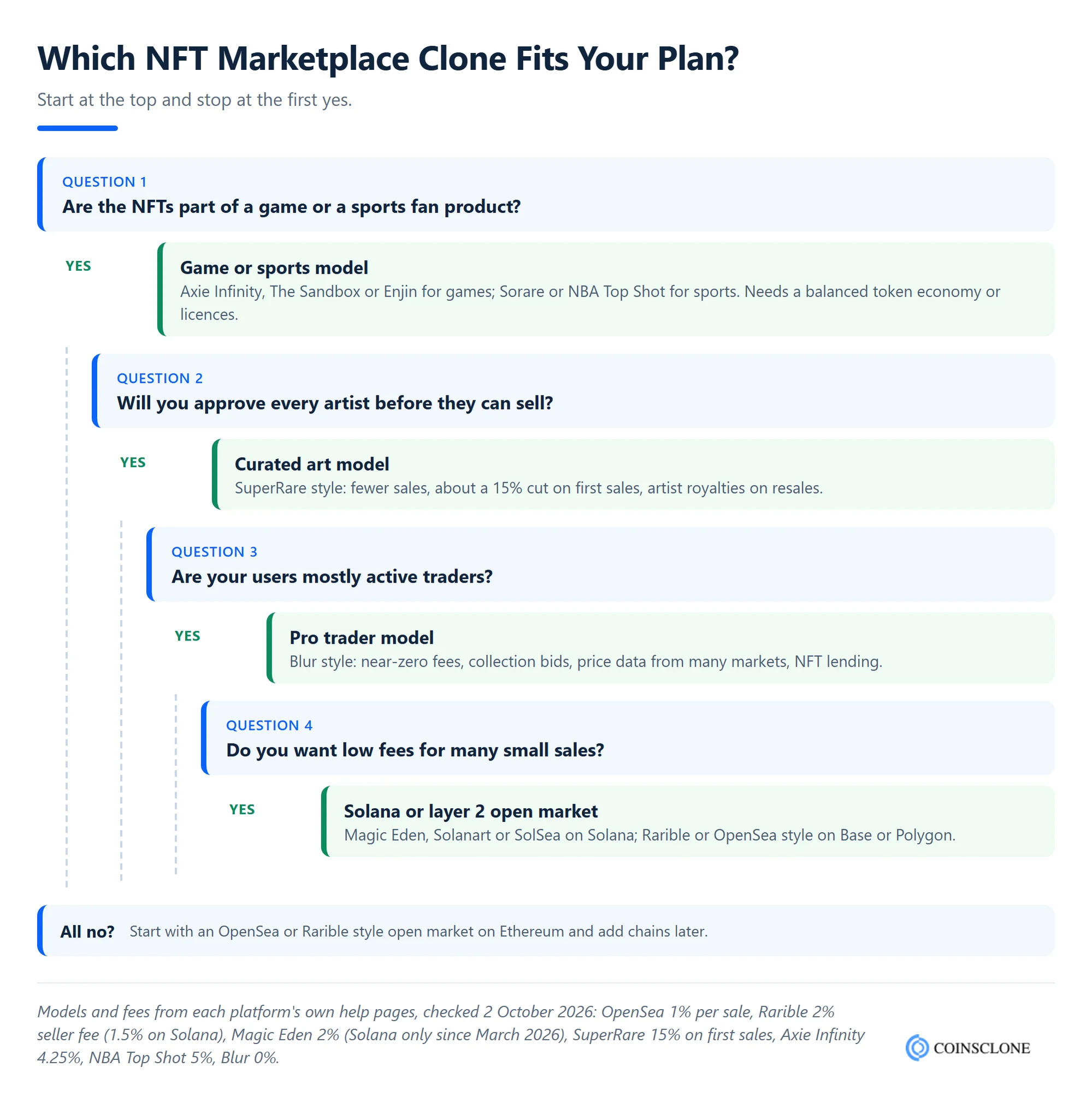
The best clone is the one that matches your users, not the one with the biggest name. Start with three questions.
- Who sells? If anyone can list, you need an open market like OpenSea, Rarible or Magic Eden. If you approve sellers, you need a curated model like SuperRare.
- What do people buy? Art and rare items suit a plain market. Game items and sports cards suit a game-first model like Axie Infinity, Sorare or NBA Top Shot.
- How do you earn? Open markets earn a small fee on many sales. Curated and licensed markets earn a bigger cut on fewer sales.
Next, pick the chain. Solana and layer 2 chains such as Base and Polygon keep fees low for small sales. Ethereum still suits costly art and top collections. For a deeper look, read our guide to the top blockchains for an NFT marketplace.
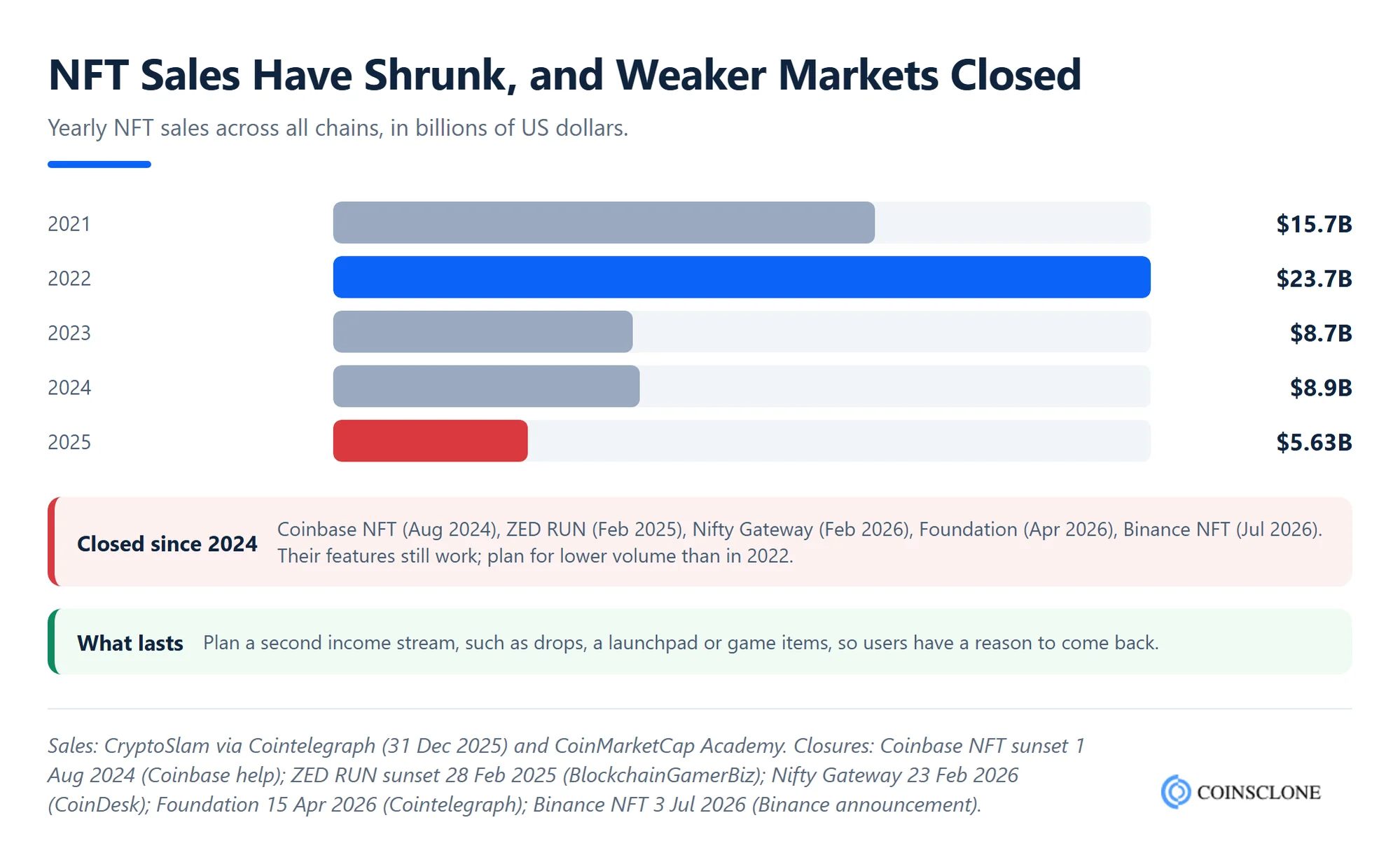
Last, check if the original is still open. Five of the 20 platforms above have closed. Their features still work, but their closures show you which risks to plan for: low volume, weak game economies and reliance on a single brand.
Clone Script vs White Label vs Custom Build
These three terms often get mixed up. Here is how they differ in practice.
| Option | What you get | Typical launch time | Best for |
| Clone script | The features and flow of a named platform, with your brand | 4 to 13 weeks | Founders who know which model they want to copy |
| White label | A ready product you rebrand, with set features | 2 to 6 weeks | Fast launches and tests |
| Custom build | Your own design from the ground up | 2 to 8 months | New ideas no platform covers yet |
In practice, most providers build clones and white label products on the same tested base. So the real choice is how much you want to change before launch.
Elite Features of Our NFT Marketplace Clone Software
Here are the main features you get with our white label NFT marketplace clone software.
- Virtual gallery
- Buy and bid on NFTs
- Fixed price sales, timed auctions and offers
- A cut for the artist on each resale
- Filter and search
- Support for many crypto wallets
- Multiple blockchain support
- Bidding history
- Storefront
- Support for loyalty programs
- Highly secured admin panel
- Activity tracking
- Admin profit management
- Multi-lingual support and more
These core functions come as a complete package in our software. You can also change any of them to suit your plan. The script supports the main NFT standards: ERC-721 and ERC-1155 on Ethereum and EVM chains, BEP-721 on BNB Chain, and Metaplex standards on Solana. See our guide to NFT standards to choose the right one.
How an NFT Marketplace Clone Makes Money
Every model in the list earns from fees, but the rates differ a lot. The chart below works out what each original earns from one $1,000 sale.
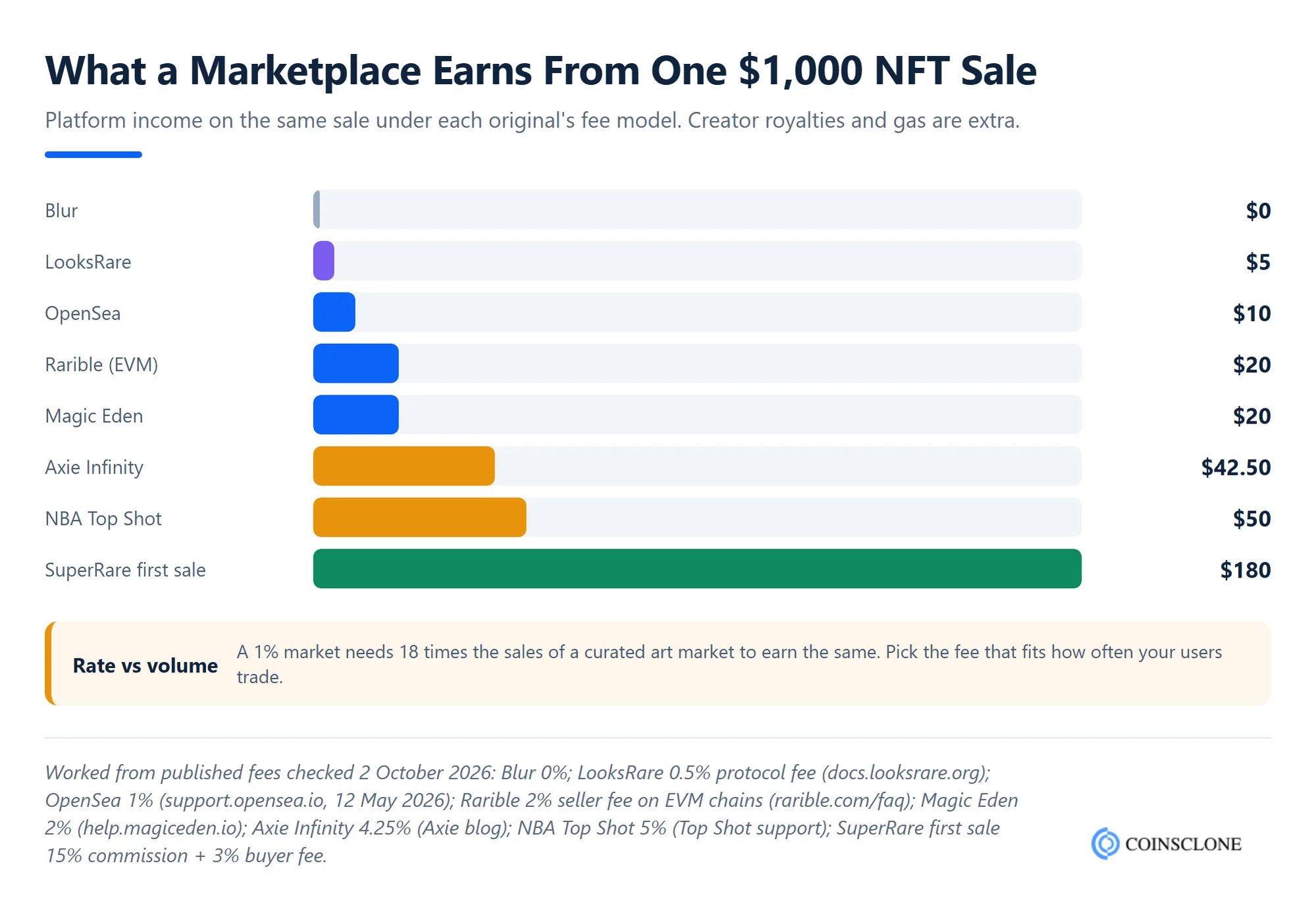
The gap is wide. Blur takes nothing, while a curated first sale on SuperRare brings in $180. Here are the main ways your clone can earn:
- Trading fees: a cut of each sale, usually 0.5% to 5%.
- Primary sale fees: a bigger share of first sales and drops, such as OpenSea’s 10% on drop mints.
- Listing and featured spots: paid placement on the home page or in search.
- Launchpad fees: a fee or share for helping new collections mint.
- Minting and gas fees: a small charge when users create NFTs on your platform.
- Token and staking: a platform token, as with LooksRare or SolSea, that rewards loyal users.
Fees only work with volume. NFT sales fell to $5.63 billion in 2025, down 37% on 2024, and the average sale dropped to $96, according to CryptoSlam data. So plan several income streams, not one. Our guide on the NFT marketplace revenue model goes deeper.
Why Should Startups Use an NFT Marketplace Clone Script?
A tested clone script gives startups and founders clear gains. Here are the main ones.
Quick Deployment
You can launch a white label NFT marketplace in about 4 to 6 weeks, or a standard custom build in 9 to 13 weeks. That speed is a key reason to choose a clone script, because you can test your idea with real users sooner.
Customization
The big advantage of a clone script is how easy it is to change. You can tailor the UI/UX, design and features to your business. You can also add or remove modules as your plan changes.
Affordable
Building from scratch takes months of design, coding and testing, which costs a lot. A clone script is already built and tested, so it saves both money and time. Published 2026 agency cost guides put a white label or clone build at about $10,000 to $30,000, against $80,000 to $150,000 or more for a full custom platform.
Interoperability
The clone software works on the main chains, such as Ethereum, BNB Chain, Polygon, Base and Solana. It also works with the wallets users already have, such as MetaMask, Trust Wallet, Coinbase Wallet and Phantom.
Global Access
An NFT marketplace lets you reach buyers and creators all over the world. So you can build your brand and a loyal community on a large scale, fast.
Add-On Functions
Our NFT marketplace clone scripts come with rich features and the latest tools. We include a modern interface, audited smart contracts and strong security, so your platform runs fast and stays safe.
How Much Does an NFT Marketplace Clone Script Cost?
Cost depends on how much you change and how many chains you support. Published 2026 agency cost guides give these market ranges:
| Build type | Typical cost | Typical time |
| White label or clone script | $10,000 to $30,000 | 2 to 6 weeks |
| Custom MVP | $20,000 to $45,000 | 2 to 3 months |
| Mid-tier platform | $40,000 to $80,000 | 3 to 5 months |
| Enterprise platform | $80,000 to $150,000+ | 5 to 8 months |
Plan for running costs too. Hosting, NFT file storage, KYC checks and updates usually cost 15% to 25% of the build each year. A smart contract audit is a must before launch.
At Coinsclone, a white label NFT marketplace goes live in 4 to 6 weeks. A standard build takes 9 to 13 weeks, a marketplace with a launchpad takes 4 to 7 months, and a multi-chain platform takes 6 to 11 months. For a full breakdown, read our guide on NFT marketplace development cost.
Rules and Risks to Check Before Launch
A clone script handles the code, but you still need to plan for rules and risks.
- Brand and content rights: copy features, never a platform’s name, logo, art or player images. Sports and media models need licences from the rights holder.
- KYC and payments: if you take card payments or hold user funds, you will likely need KYC checks and a payments partner.
- EU rules: the EU’s MiCA law leaves out one-of-a-kind NFTs. Large series or split NFTs that act like tokens may still fall under it.
- Smart contract safety: have your contracts audited, and use tested code for listings, auctions and royalties.
- Royalty rules: decide early if artist royalties are optional or required, because it shapes who will list with you.
Why Prefer the NFT Marketplace Clone Script from Coinsclone?
As a trusted NFT marketplace development company, Coinsclone offers modern NFT clone software with all the key features. Our clone script helps you launch an NFT marketplace quickly and within your budget. You can change every part of our white label software, and launch on your own timeline.
Coinsclone has built blockchain products since 2018, with 350+ platforms delivered for 200+ clients across 20 industries. Our team has skilled blockchain coders, UI and UX designers, crypto experts and analysts, so each part of your market gets expert care.
We also keep your plans private and sign an NDA (Non-Disclosure Agreement). Tell us which model on this list fits your plan, and we will show you a live demo before you commit. Book a call with our team today, and let us build your NFT marketplace together.
Frequently Asked Questions
What is an NFT marketplace clone script?
It is ready-made software that copies the features of a known NFT marketplace, such as OpenSea, Rarible or Magic Eden. You add your brand, chains and fees, then launch your own marketplace in weeks instead of months.
Which is the best NFT marketplace clone script?
It depends on your plan. An OpenSea or Rarible clone suits an open market for all kinds of NFTs. A Magic Eden clone suits Solana. A SuperRare clone suits curated art, and an Axie Infinity or NBA Top Shot clone suits games and sports.
Can we make changes to the NFT marketplace clone script?
Yes. You can change the design, features, fees, chains and wallets. Most teams add their own brand and a few custom features before launch, then keep adding modules over time.
What is the price of an NFT marketplace clone script?
Published 2026 agency cost guides put a white label or clone build at about $10,000 to $30,000. A custom MVP costs $20,000 to $45,000, and an enterprise platform $80,000 to $150,000 or more. Audits, apps and extra chains add to the cost.
How long does it take to launch an NFT marketplace with a clone script?
A white label marketplace can go live in about 4 to 6 weeks. A standard build takes about 9 to 13 weeks. Adding a launchpad or many chains takes several months.
What blockchains does an NFT marketplace clone script support?
Most scripts run on Ethereum, BNB Chain, Polygon, Base and Solana, and many add Arbitrum or Avalanche. You can launch on one chain first and add more later.
What industries can use an NFT marketplace clone script?
Art, music, games, sports, fashion, tickets, rare items and real estate all use NFT markets. The model you copy should match the industry, such as SuperRare for art or NBA Top Shot for sports.
Do you have NFT marketplace clone script demos?
Yes. Coinsclone shows a live demo of the model you choose, so you can test the buyer, seller and admin flows before you commit.
Build Your Own NFT Marketplace with Our NFT Marketplace Clone Script
NFT Marketplace Software — built for instant scalability.
- One-Click Deployment: Launch your ready-to-go NFT marketplace clone.
- Smart Contract Ready: Audited contracts for safe NFT trading.
- Custom Ecosystem: Add your tokenomics, payment modes, and UI.
- Built-in Monetization: Earn from trades, NFT mints, and premium listings.
See a free branded demo of your NFT marketplace in 48 hours — before you invest a cent.
Book a Free Demo to see how our NFT Marketplace Clone Script accelerates your launch from concept to live platform in just 8–12 weeks.