
A Sandbox clone script is ready-made software for launching a metaverse game like The Sandbox, where players build worlds, make voxel items and trade them as NFTs. This guide explains what the script includes, how the game works, how it makes money and what it costs to launch in 2026.
It also covers what most pages selling this script skip: where The Sandbox itself stands today. The game cut about half its staff in 2025, and its SAND token trades about 99% below its peak. Yet its creator tools and brand deals are still going, and a new AI game builder launches this quarter. So you get the features and the build plan, plus the lessons from The Sandbox’s own numbers.
In this guide:
- What a Sandbox clone script is and what ships in it
- The Sandbox in 2026: layoffs, the SAND price and the new AI Studio
- How the 5% fee model works, with a worked example
- Which Sandbox clone model to build, plus cost and launch time
- Features, tech stack, launch steps and legal checks
Launch Your Own Immersive Sandbox Clone Script Metaverse Platform
Sandbox Clone Script — build a full 3D NFT metaverse gaming platform.
- Voxel‑Based Creation: Users build avatars, items, and environments with VoxEdit tools.
- In‑Built NFT Marketplace: Buy, sell, and trade voxel assets and land parcels seamlessly.
- Advanced Token Economy: LAND, ASSET, and native tokens power your platform.
- Cost‑Effective Launch: Pre‑built software lets you deploy your metaverse game quickly.
See a free branded demo of your NFT marketplace in 48 hours — before you invest a cent.
Book a Free Demo to discover how Sandbox Clone Script can help you launch in just 8–12 weeks.
What Is a Sandbox Clone Script?
A Sandbox clone script is a pre-built software package to launch a working NFT metaverse game like The Sandbox. It copies the core of the original: a world map split into LAND plots, a voxel editor for 3D items, a no-code game builder, an NFT marketplace and a native token. You add your own brand, art, rules and fees.
It suits founders who want The Sandbox’s core model without building every part from zero. With the Sandbox clone software from Coinsclone, you get every main revenue stream ready, from your native token to the built-in NFT marketplace.
Keep in mind that a clone copies the mechanics, not the brand. “The Sandbox”, its LAND map, its art and its partner IP belong to Animoca Brands and its partners. Your game needs its own name and look.
The Sandbox in 2026: Where the Original Stands
The Sandbox began as a mobile game and became one of the best-known blockchain metaverse games after Animoca Brands bought it in 2018. Its map holds a fixed 166,464 LANDs, according to The Sandbox whitepaper. LAND, avatars and voxel items are NFTs, and SAND is the in-game currency. The first LAND presales sold out in hours in late 2019 and early 2020.
Then the hype faded. Here is what happened next:
- November 2021: SAND hit its all-time high of $8.40, according to CoinGecko.
- August 2025: The Sandbox restructured and cut staff. French outlet The Big Whale reported that more than half of about 250 staff were let go. Co-founder Arthur Madrid moved from CEO to chairman, Sébastien Borget became global ambassador, and Animoca’s Robby Yung took over as CEO. Borget said AI tools let a smaller team ship content faster, and that SAND, LAND and NFTs “remain unchanged”.
- October 2025: SANDchain, an Ethereum layer 2 built on ZKsync’s ZK Stack with SAND as its gas token, opened its testnet. Its mainnet was expected in 2026.
- March 2026: The Sandbox opened a playtest for The Sandbox NEXT, a mobile battle royale built on Unreal Engine. Players keep their identity and assets from the main game.
- August 2026: The team announced a new LAND roadmap. Games published on a LAND get catalog placement by LAND tier and a bigger revenue share. Later, LAND owners will host and curate other creators’ games.
- Q4 2026: The Sandbox Studio, an AI-powered tool for building multiplayer voxel games for web and mobile, is in beta. The team says on its official blog that the public launch is planned for the end of October 2026.
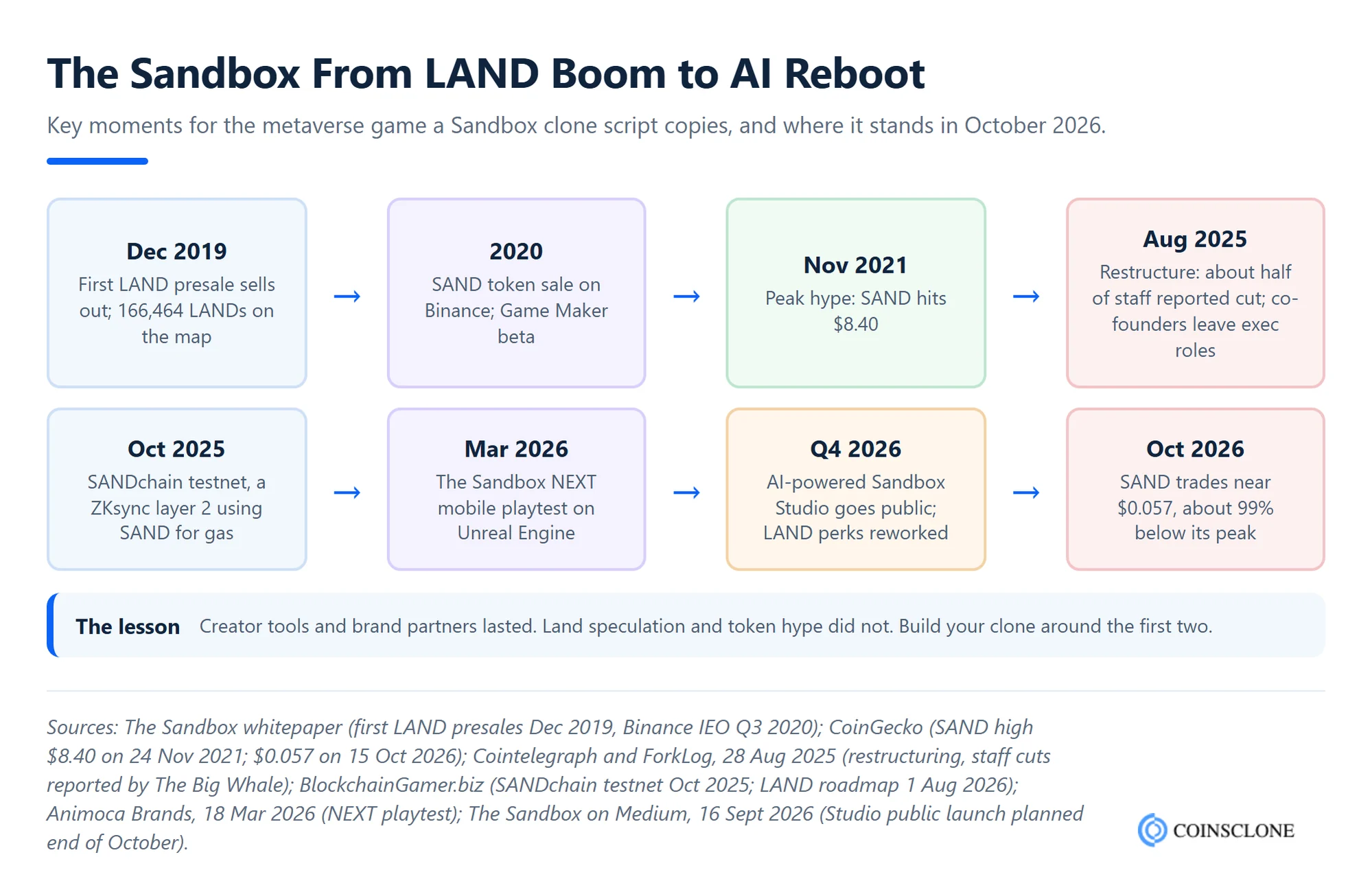
On 15 October 2026, SAND traded near $0.057, with a market cap of about $166 million, per CoinGecko. That is roughly 99% below its 2021 peak.
So, is The Sandbox dead? No. The game, its marketplace and its creator program are still running, and it is shipping new tools. However, it is a much smaller business than in 2021, and land speculation no longer drives it. That matters for anyone planning a Sandbox clone in 2026.
What Still Works in the Sandbox Model in 2026
The Sandbox’s history is a free test run for your own game. Here is what to keep and what to change.
What worked:
- Creator tools: VoxEdit and Game Maker let non-coders make items and games. The Sandbox is now doubling down on this with AI tools in Studio and a partnership with Meshy AI for 3D models.
- Brand partners: The Sandbox lists more than 400 brand and IP partners. Branded worlds bring in fans who would never buy a token first.
- Seasons and events: Timed seasons with quests and rewards gave players a reason to return each week.
- Fixed land supply: A capped map made LAND scarce and gave owners a stake in the world.
What broke:
- Land as a bet: When LAND was mainly a bet on rising prices, its value fell with the market. The 2026 roadmap tries to fix this by tying LAND to publishing and hosting.
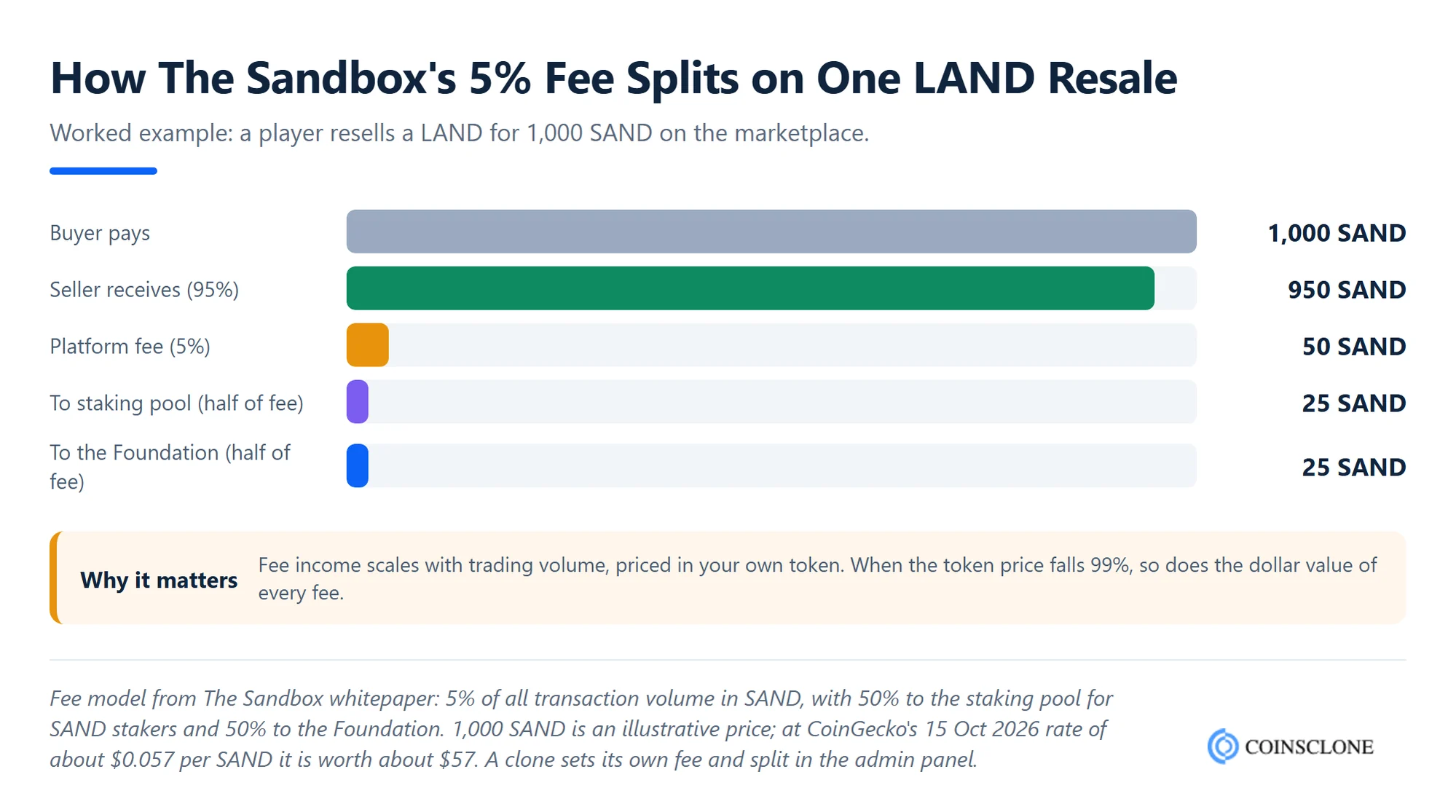
- Revenue tied to the token price: Fees are paid in SAND. When SAND fell 99%, the dollar value of every fee fell with it.
- A large team for a small audience: The 2025 cuts show the cost base had grown faster than the player base.
In short, build for creators and fans first. Treat land as a publishing right, not a bet, and price key fees in a way that survives a falling token.
Which Sandbox Clone Model Should You Build?
A Sandbox clone script can launch three quite different products. Pick one before you start, because it changes the scope, cost and launch time.
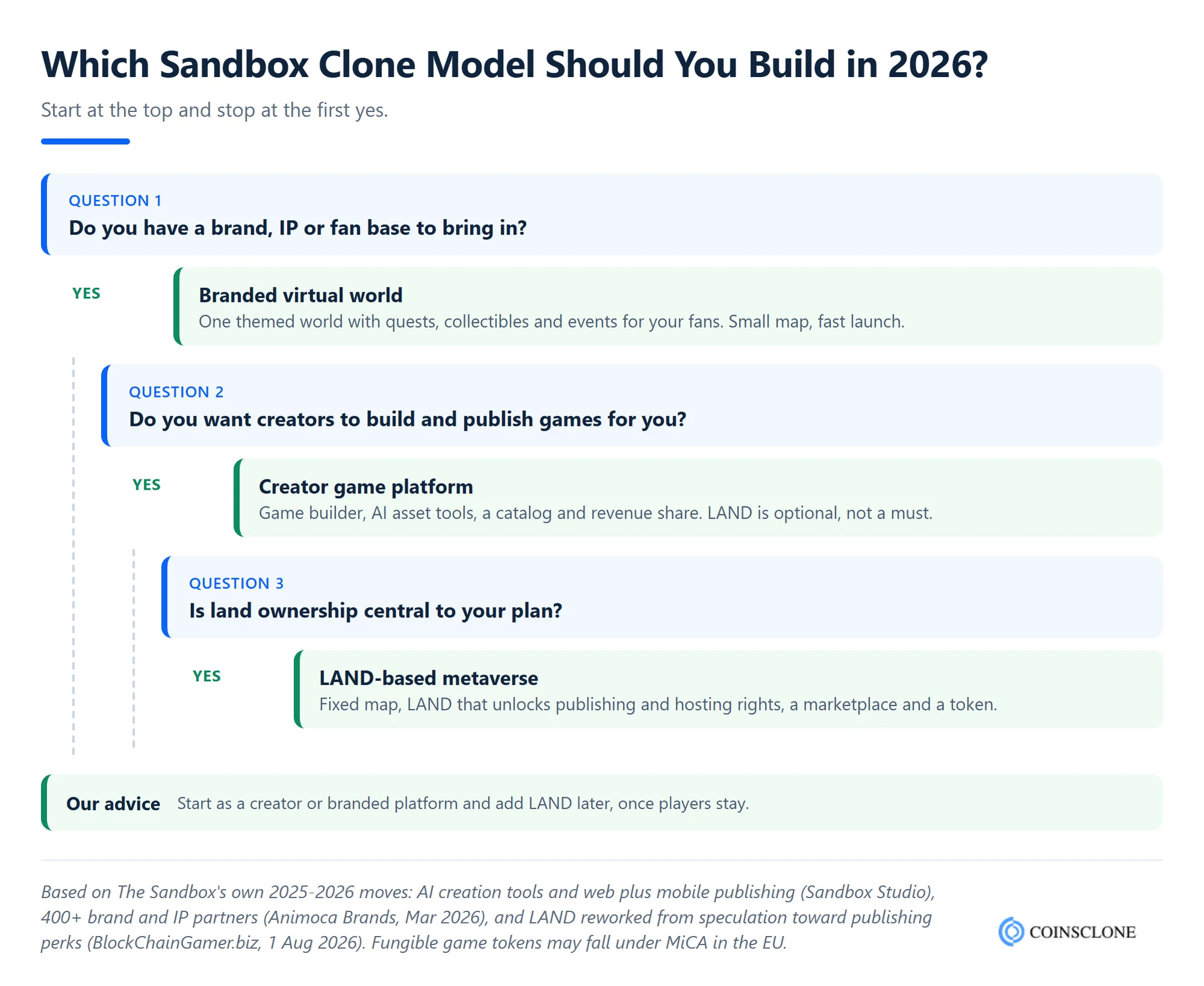
- Branded virtual world: One themed world for a brand, club or creator, with quests, collectibles and events. It has the smallest scope and the fastest launch.
- Creator game platform: A game builder, asset tools, a game catalog and revenue share for creators. This is where The Sandbox itself is heading with Studio.
- LAND-based metaverse: The full model, with a fixed map, LAND sales, a marketplace and a token. It is the biggest build and needs the most players to work.
For a crypto-native land world closer to Decentraland’s model, see our Decentraland clone script.
How Sandbox Clone Script Benefits Startups
New founders want a fast, low-risk way to start. That is why many choose our Sandbox clone software over a build from scratch. It is flexible and easy to change for your business needs. Here are the main benefits of using our clone script to build a platform like The Sandbox.
- Faster launch: The core modules are built and tested, so you start from a working game.
- Lower cost: You pay to customise, not to build every part from zero.
- Built-in NFT marketplace: Players can trade items and land from day one.
- Easy to change: You set the rules, fees, art, chains and tokens.
- Room to grow: The system scales as your player base grows.
- Lower risk: Tested code means fewer surprises at launch.
- Strong security: Secure smart contracts and audited code paths.
- Global reach: Multi-language and multi-wallet support.
These benefits only pay off when the features behind them are strong. So let us look at the features next.
Features of Our Sandbox Clone Software
Features decide whether players stay. Our Sandbox clone software has the following core and security features for a safe NFT metaverse game.
Core Features of Our Sandbox Clone
Voxel Editor (like VoxEdit): A 3D modeling tool where users create and animate voxel models. They can make avatars, animals, vehicles, tools, buildings and landscapes, then mint them as NFTs.
Built-in NFT Marketplace: Like the one in The Sandbox, users can sell, buy and trade voxel items, avatars and LAND here. Prices are set in your native token, and you set the marketplace fee.
No-Code Game Maker: Users build their own games and experiences on a LAND without coding. They can place items, add rules and quests, and publish the game for others to play.
AI Asset Tools (add-on): Like The Sandbox’s 2026 Studio, you can add AI tools that turn a text prompt or image into a 3D model. This cuts the time from idea to playable content.
Token Set: Like The Sandbox, you can run several token types. SAND is an ERC-20 currency, LAND is an ERC-721 NFT, and ASSETS (voxel items) use ERC-1155. The original also used GEMS and CATALYSTS, two ERC-20 tokens burned to set an item’s rarity and traits when it is minted. You can keep this set or simplify it. Our guide to metaverse token development explains the options.
LAND and ESTATES: Users can buy LAND plots and join nearby plots into larger ESTATES. You decide the map size, plot prices and what owning land unlocks.
Creator Fund: Like The Sandbox’s Game Maker Fund, you can set aside a grant pool to pay artists and studios to build early content. This fills your world before players arrive.
Seasons and Quests: Timed seasons with quests, a battle pass and rewards keep players coming back.
Security Features of Our Sandbox Clone Script
- SSL protection
- End-to-end encryption
- Multi-factor login
- Protected API connections
- Audited smart contracts
- Optional KYC
With these features, the Sandbox clone script stays secure and can handle busy game days. Next, let us see how it works.
How Our Sandbox Clone Software Works
Our Sandbox clone software works much like the original game, with your own design and gameplay. Here is the step-by-step flow.
- A user signs up and connects a wallet such as MetaMask, or uses a built-in email wallet.
- The user buys your native token on an exchange, a DEX pool or with a card through an on-ramp.
- The user buys LAND in a sale or auction, or buys it from another player on the marketplace. Each LAND is an ERC-721 NFT.
- Creators make voxel items in the editor and mint them as NFTs. They sell them on the built-in marketplace.
- Landowners and creators use the Game Maker to build games and experiences on their LAND.
- Players explore the world, play games, finish quests and collect rewards.
- Every trade on the marketplace pays a small fee in your token, which funds staking rewards and the platform.
- Items and LAND can also be traded on outside NFT marketplaces such as OpenSea, if you allow it.
This is how our Sandbox clone software runs once you deploy it. Next, let us look at how it makes money.
How a Sandbox-Style Game Makes Money
The Sandbox’s own fee model is a useful benchmark. According to its whitepaper, The Sandbox charges 5% on all transaction volume carried out in SAND. That includes LAND sales and rentals, NFT trades, in-game payments and subscriptions. Half of the fee goes to the staking pool as rewards for SAND stakers. The other half goes to the Foundation, which funds the wider ecosystem, such as creator grants.
For your own Sandbox clone, you can mix several revenue streams:
- LAND sales: Sell plots in timed drops or auctions. LAND sales were The Sandbox’s first source of income.
- Marketplace fees: A cut of every item, avatar and LAND resale on your NFT marketplace.
- Primary NFT sales: Sell avatars, wearables and branded items in limited drops.
- Season passes: Paid battle passes and premium quests.
- Brand partnerships: Charge brands to build and run their own worlds inside your game.
- Creator revenue share: Take a share of what creators earn from games published on your platform.
- Token treasury: Hold part of the token supply in a treasury to fund growth and rewards.
A balanced mix keeps you safe when one stream slows. Do not rely on token price gains. Coinsclone can set each fee in the admin panel, so you can test and adjust them after launch.
Tech Stack of a Sandbox Clone
The tech stack decides how your world looks, how many players it holds and how much each trade costs. Here are the main parts.
| Layer | Common choices | Why it matters |
| Game engine | Unity or Unreal Engine | The Sandbox ran on Unity for years; its 2026 mobile game uses Unreal |
| Voxel editor | Custom editor, desktop and web | Lets players make items without 3D skills |
| Blockchain | Ethereum, Polygon, Base, BNB Chain, or your own layer 2 | Low fees matter, as games create many small trades |
| Token standards | ERC-20, ERC-721, ERC-1155 | Currency, LAND and game items |
| Storage | IPFS or Arweave for NFT files | Keeps item files online even if a server goes down |
| Wallets | MetaMask, Trust Wallet, Coinbase Wallet, email wallets | Email wallets help non-crypto players join |
| Back end | Game servers, matchmaking, a database | Multiplayer sessions and player data |
The Sandbox added a Polygon bridge for LAND and SAND in 2022 to cut fees, and in 2025 its team backed SANDchain, a separate layer 2 whose mainnet was expected in 2026. For a new game, a low-fee chain or layer 2 is usually the right start. Our guide to NFT standards compares the token options.
Clone Script vs Building From Scratch
Many founders ask whether to buy a clone script or build their own game. Here is how the two compare.
| Factor | Sandbox clone script | Build from scratch |
| Launch time | Weeks to a few months | Many months to over a year |
| Cost | Lower; you pay to customise | Six figures and up |
| Risk | Tested modules | Every part is new and untested |
| Uniqueness | Custom art, rules and tokens on a proven base | Fully unique design |
| Best for | Startups, brands, fast market tests | Funded studios with a large team |
For most startups, a clone script is the safer first step. You can launch, learn from real players and add custom parts later.
Steps to Launch Your Sandbox Clone
Here is a simple plan to take your Sandbox-style game from idea to launch.
- Choose your model: Branded world, creator platform or full LAND metaverse.
- Design the economy: Set your token supply, fees, LAND supply and rewards. Plan for a falling token price.
- Pick the chain and wallets: Choose a low-fee chain and add email wallets for new players.
- Brand and customise: Add your art, map, avatars and rules to the script.
- Fill the world: Use a creator fund and brand deals so players find things to do on day one.
- Test and audit: Run full game tests and an outside smart contract audit.
- Launch and run seasons: Go live with a first season of quests and rewards, then improve from player data.
Licences and Legal Checks Before You Launch
A Sandbox clone mixes gaming, NFTs and money. Check these points with a lawyer before launch.
- Tokens may be regulated: A game token sold to the public can count as a financial product in some markets. In the EU, the MiCA rules can apply to tokens that are not unique NFTs.
- Do not copy the brand: Use your own name, map, art and logo. A clone copies the mechanics, not the trademark.
- Brand IP needs licences: If you add famous brands or characters, sign licence deals first, as The Sandbox did with its partners.
- Plan for change: Write terms that explain what happens to player items and LAND if the game changes or ends.
Cost and Launch Time for a Sandbox Clone Script
The cost depends on which model you build and how much you change. In published 2026 agency cost guides, a white label NFT marketplace core costs about $10,000 to $30,000. A mid-size metaverse game built from scratch costs about $200,000 to $500,000, and sandbox-style simulation games range from about $100,000 to $1 million. A smart contract audit adds about $5,000 to $25,000, and iOS and Android apps add about $15,000 to $60,000. Our NFT marketplace development cost guide breaks these parts down.
| Part | What it covers | Typical cost or time |
| NFT marketplace core | Item and LAND listings, sales, wallet connect | $10,000 to $30,000; 4 to 6 weeks at Coinsclone |
| Minting and tokens | Item minting, LAND and token contracts | 7 to 10 weeks at Coinsclone with minting |
| 3D world, voxel editor and game maker | Map, editor, no-code builder, multiplayer | Scoped per project |
| Smart contract audit | Outside security review | $5,000 to $25,000 |
| Mobile apps | iOS and Android | $15,000 to $60,000 |
Your biggest choice is the 3D world. A branded world with a small map is much faster to build than a full game maker and multiplayer engine. Many teams launch with a smaller world and add tools once players stay.
Leverage Our Highly Customizable Sandbox Clone to Match Your Vision!!
Why Choose Coinsclone for Your Sandbox Clone Software?
Coinsclone is a blockchain development company that has built blockchain products since 2018. We have delivered 350+ platforms for 200+ clients across 20 industries. Our Sandbox clone script comes with a voxel editor, a game maker, a marketplace and a token set ready to brand, and we test every release before it goes live.
We also build White Label NFT Marketplace Software for teams that want to start with trading and add a game later. Our team runs several checks to make sure the platform works well, and we stay on hand after launch. Get in touch with our team to turn your metaverse game idea into a live product.
If you want a different game model, see our Axie Infinity clone script for creature battles, our Zed Run clone script for NFT racing or our GameFi clone script for a gaming hub. We also offer NFT marketplace clone scripts such as the Opensea Clone Script and the Rarible Clone Script.
Launch Your Own Immersive Sandbox Clone Script Metaverse Platform
Sandbox Clone Script — build a full 3D NFT metaverse gaming platform.
- Voxel‑Based Creation: Users build avatars, items, and environments with VoxEdit tools.
- In‑Built NFT Marketplace: Buy, sell, and trade voxel assets and land parcels seamlessly.
- Advanced Token Economy: LAND, ASSET, and native tokens power your platform.
- Cost‑Effective Launch: Pre‑built software lets you deploy your metaverse game quickly.
See a free branded demo of your NFT marketplace in 48 hours — before you invest a cent.
Book a Free Demo to discover how Sandbox Clone Script can help you launch in just 8–12 weeks.
Frequently Asked Questions
What is a Sandbox Clone Script?
A Sandbox clone script is ready-made software that copies the core of The Sandbox metaverse game. It lets a business launch its own virtual world where users create, own and trade digital items and LAND, and build games and experiences.
Is The Sandbox dead in 2026?
No. The Sandbox is still running in October 2026. It cut about half its staff in August 2025, and SAND trades about 99% below its 2021 peak. However, it launched SANDchain’s testnet in October 2025, ran a mobile playtest for The Sandbox NEXT in March 2026, and plans to open its AI-powered Studio to the public at the end of October 2026.
Can a Sandbox clone script be customized?
Yes. You can change the map, LAND supply, items, avatars, token set, fees, rules and branding. You can also add AI asset tools, seasons, email wallets and mobile apps.
Is a Sandbox Clone Script suitable for launching virtual worlds and digital spaces?
Yes. A Sandbox clone script is built for virtual worlds where users explore digital spaces, interact with items and join events. You can start with one themed world and grow it into a larger map over time.
Can businesses create their own branded virtual world using a Sandbox Clone Script?
Yes. Businesses can build fully branded virtual worlds with a Sandbox clone script. The platform can reflect their own themes, characters and community events, much like the brand worlds inside The Sandbox.
How long does it take to develop a Sandbox Clone Script?
At Coinsclone, a white label NFT marketplace core goes live in 4 to 6 weeks, or 7 to 10 weeks with minting. The 3D world, voxel editor and game maker add time on top, and we confirm the full timeline once the scope is set.