
A crypto exchange clone script is ready-made software that copies the features of a known exchange, such as Binance or Coinbase, so you can launch your own trading platform in weeks. The best crypto exchange clone scripts in 2026 copy Binance, Coinbase, Bybit, OKX, Bitget, Gate, KuCoin, Upbit, Kraken and Hyperliquid, and each one fits a different market.
For each cryptocurrency exchange clone script below, you see what it copies, its core features, who it suits and how it makes money. We also checked how each original exchange is doing today, using CoinGecko data and public reports from October 2026. After the list, we compare the scripts, flag the famous exchanges that have closed, and explain what a script costs, how long it takes and what the law asks of you.
In this guide:
- The 10 best crypto exchange clone scripts, each with features, business model and the best fit
- How the original exchanges are doing in 2026, and which ones have shut down
- How a clone script works, and whether it is safe for a real business
- What a clone script costs and how long it takes, compared with white label and custom builds
- Licences you need and the questions to ask a script provider
Launch Faster with Our Crypto Exchange Clone Scripts!
Build your Crypto Exchange platform — the smart way.
- Ready-Made Architecture: Proven exchange framework, instantly deployable
- Built-In Liquidity: Smooth trading from day one
- Advanced Security Stack: KYC, 2FA, encrypted wallets
- Revenue-Ready: Earn from Spot, futures, staking & listing fees
Get a free branded demo of your exchange within 48 hours — before you invest anything.
Book a Free Demo and see how our Crypto Exchange Clone Scripts can take you from concept to live trading platform in just weeks.
10 Best Crypto Exchange Clone Scripts in 2026
Here is the list of top crypto exchange clone scripts that startups and fintech founders choose in 2026. Each one copies a different business, so the right pick depends on your market, your users and the products you want to sell.
- Binance clone script: a full global exchange with spot, futures and earn products
- Coinbase clone script: a simple, rules-first exchange for beginners
- Bybit clone script: a derivatives exchange built on perpetual contracts
- OKX clone script: an all-in-one exchange with a built-in Web3 wallet
- Bitget clone script: futures plus copy trading
- Gate clone script: the longest coin list and new token launches
- KuCoin clone script: an altcoin exchange with bots and earn products
- Upbit clone script: a local-currency exchange for one regulated market
- Kraken clone script: a licensed exchange with strong fiat rails
- Hyperliquid clone script: an on-chain perpetual futures exchange
How the Original Exchanges Are Doing in 2026
Before you copy a model, check how the real business is doing. The table uses CoinGecko’s exchange data, checked on 9 October 2026 with bitcoin at about $82,600. Volume changes every day, so treat it as a size guide, not a fixed rank.
| Clone of | Founded | Model | CoinGecko trust score | 24h spot volume | Coins listed |
| Binance | 2017 | Full exchange, global | 10/10 | ~$13.8B | 507 |
| Coinbase | 2012 | Rules-first, US-listed | 10/10 | ~$3.2B | 404 |
| Bybit | 2018 | Derivatives first | 9/10 | ~$2.6B | 392 |
| OKX | 2017 | Exchange plus Web3 wallet | 10/10 | ~$3.2B | 308 |
| Bitget | 2018 | Futures and copy trading | 9/10 | ~$1.2B | 820 |
| Gate | 2013 | Long coin list, global | 9/10 | ~$2.5B | 1,513 |
| KuCoin | 2017 | Altcoins, bots, earn | 9/10 | ~$1.9B | 832 |
| Upbit | 2017 | KRW exchange, Korea | 8/10 | ~$1.3B | 350 |
| Kraken | 2011 | Licensed, fiat heavy | 10/10 | ~$2.1B | 734 |
| Hyperliquid | 2023 | On-chain perpetuals | n/a (DEX) | ~$8.7B perps | n/a |
Hyperliquid’s figure is 24 hour perpetual futures volume from its own public API on 9 October 2026, so it is not a like-for-like match with the spot numbers above it. Now let us get to know each script one by one.
1. Binance Clone Script
A Binance clone script is ready-made crypto exchange software that copies the core of Binance, the world’s largest crypto exchange. It brings over the trading engine, liquidity system and advanced tools of the original. So startups can launch a high-volume exchange without building the system from scratch.
Binance still leads by a wide margin. It handles about $13.8 billion of spot trades a day on CoinGecko, and it reported more than 320 million registered users in July 2026. But it has no MiCA licence, so since 1 July 2026 it cannot take new users in the EU, as Cointelegraph reported. If Europe is your market, pair a Binance clone with a MiCA licence plan from day one.
Core Features
- High-speed matching engine
- Spot, margin and futures trading
- Multi-currency wallet integration
- Liquidity API links
- Advanced trading charts and order types
- Earn, launchpad and P2P add-ons
Best For: Startups that target global crypto traders and want a high trading volume platform.
Business Model
- Trading fees (maker and taker fees)
- Token listing fees
- Margin trading interest
- Futures trading fees
- Premium membership features
Why Choose This Script? It suits businesses that want a feature-rich, strong exchange that can grow with extra modules over time.
2. Coinbase Clone Script
A Coinbase clone script is pre-built crypto exchange software inspired by Coinbase, the best-known rules-first exchange in the US. It copies the simple interface, easy buy and sell flow and strong compliance tools of the original.
Unlike other clone scripts, this one puts simplicity, security and easy onboarding first. Coinbase holds a MiCA licence in the EU through Luxembourg. It also shows why insider controls matter. In May 2025, it disclosed that criminals had bribed overseas support agents to copy customer data. The breach hit less than 1% of monthly users and was expected to cost $180 million to $400 million. So a good Coinbase clone limits what support staff can see.
Core Features
- Simple buy and sell flow
- Fiat-to-crypto payment gateway links
- User-friendly dashboard
- Transaction history and portfolio tracking
- Admin panel for compliance checks
- 2FA, encryption and role-based staff access
Best For: Startups that focus on regulated markets and first-time crypto buyers.
Business Model
- Transaction fees on buy and sell trades
- Spread-based pricing
- Withdrawal fees
- Custody services for institutions
- Premium subscription plans
Why Choose This Script? It is the right choice for a business that puts security, compliance and ease of use first. It gives you a strong base for launching a licensed exchange with confidence.
3. Bybit Clone Script
A Bybit clone script is derivatives-focused crypto exchange software that lets startups launch a platform like Bybit. Unlike basic spot exchanges, it is built for fast order matching, perpetual contracts, margin trading and leveraged products. It is a good fit for startups that target professional traders.
Bybit trades about $2.6 billion a day in spot on CoinGecko, and Bybit EU holds a MiCA licence from Austria. It also survived the largest crypto theft on record. About $1.5 billion was taken on 21 February 2025 in an attack the FBI tied to North Korea. The attackers tricked the screen used to sign a cold wallet transfer, so wallet signing is the part of a Bybit clone to test hardest.
Core Features
- High-performance matching engine
- Futures and perpetual contract trading
- Margin trading with leverage limits
- Advanced order types (limit, market, stop-limit)
- Liquidation engine and insurance fund
- Real-time price charts and analytics
Best For: Founders who want an advanced trading platform for professional traders.
Business Model
- Futures trading fees
- Funding and margin interest
- Liquidation fees
- VIP membership tiers
- Listing fees for new tokens
Why Choose This Script? It is the right pick for startups that aim to attract experienced traders and earn steady futures income from them.
4. OKX Clone Script
The OKX clone script is a tailor-made crypto exchange solution that copies the features of OKX, a multi-product trading platform. It supports spot, derivatives, staking and margin trading in one app, just like the original. So startups can launch an all-in-one exchange that serves both traders and everyday users.
OKX trades about $3.2 billion a day in spot on CoinGecko and holds a MiCA licence through Malta. Its built-in Web3 wallet, which links users to DeFi apps, is the feature that sets it apart from most exchanges.
Core Features
- Spot, margin and futures trading
- Built-in Web3 wallet and DEX access
- Staking and earn modules
- Liquidity API support
- Advanced order types and trading charts
- Risk management and liquidation system
Best For: Startups that want a multi-service exchange with several income streams.
Business Model
- Spot trading fees
- Futures and derivatives fees
- Margin interest
- Staking service fees
- Token listing charges
Why Choose This Script? If you want a complete exchange rather than a basic trading platform, the OKX clone script is the right choice.
5. Bitget Clone Script
A Bitget clone script is feature-rich crypto exchange software modelled on Bitget. It pairs advanced trading products with social trading, where users copy the trades of top traders automatically. So it helps new founders build an exchange that draws both expert and beginner traders.
Bitget says it has about 120 million users. On 24 September 2026, attackers took about $387.5 million from its hot and warm wallets. Bitget said they got in through zero-day flaws in two third-party security devices, then used stolen staff logins to send fake withdrawal orders. Cold storage was safe, and Bitget’s user protection fund covered the loss. The lesson for buyers is clear: check every outside device and service that touches your wallets.
Core Features
- Copy trading module
- High-speed order matching engine
- Leverage and margin trading
- Multi-currency wallet integration
- Admin dashboard with trader management controls
Best For: Startups that want a community-driven exchange for both retail and pro traders.
Business Model
- Trading fees
- Copy trading profit share
- Margin interest
- Futures trading fees
- VIP membership tiers
Why Choose This Script? It lets you build a lively trading community where users trade on their own or follow others, which lifts engagement and income.
6. Gate Clone Script
A Gate clone script is ready-to-deploy exchange software that helps startups launch a secure, multi-asset trading platform. It is inspired by Gate, the exchange formerly known as Gate.io, which moved to the gate.com domain with a new brand in May 2025.
Gate is known for its very long coin list. It lists 1,513 coins on CoinGecko, more than any other exchange in this guide, and trades about $2.5 billion a day in spot. So this clone suits founders who want new tokens early.
Core Features
- A large number of trading pairs
- Token listing management system
- Startup and IEO launchpad module
- Liquidity API links
- Advanced charting tools
Best For: Founders who want a community-based exchange that lists new tokens often.
Business Model
- Trading fees
- Token listing charges
- IEO launchpad fees
- Margin interest
- Premium membership plans
Why Choose This Script? If you want an exchange with a wide range of assets and token listing deals, the Gate clone script is the right choice.
7. KuCoin Clone Script
A KuCoin clone script is pre-built trading software that helps you build an exchange like KuCoin. It copies KuCoin’s spot, margin, futures, staking and reward programs. It is also built to handle heavy user traffic, large trading volumes and many coin pairs.
KuCoin lists 832 coins and trades about $1.9 billion a day in spot on CoinGecko. Its history also carries a warning. In January 2025, its operator pleaded guilty in the US to running an unlicensed money transmitting business and agreed to pay more than $297 million. Prosecutors said it did not ask users for ID until 2023. Its EU arm later won a MiCA licence in Austria in November 2025. Even so, the Austrian regulator barred it from taking new customers in February 2026 until it filled key anti-money laundering roles. So build KYC and AML into a KuCoin clone from day one.
Core Features
- Staking and earn modules
- Trading bots
- Multi-currency wallet integration
- Liquidity API links
- Advanced order types and charting tools
- Referral and reward systems
Best For: Startups that want a multi-service exchange for professional and altcoin traders.
Business Model
- Trading fees
- Margin interest
- Futures trading charges
- Staking service fees
- Referral and promotion programs
Why Choose This Script? It gives you a feature-rich exchange with many ways to trade, which helps you reach a broad community of users.
8. Upbit Clone Script
An Upbit clone script is a ready-to-launch exchange solution for a secure, high-liquidity and rules-first trading platform. It is modelled on Upbit, South Korea’s largest crypto exchange, which trades in Korean won. It supports fiat-to-crypto trading and KYC and AML checks to meet local rules.
Upbit trades about $1.3 billion a day in spot on CoinGecko. In November 2025, Naver Financial agreed to take over its operator, Dunamu, in a share swap worth about $10.3 billion. The same week, a hot wallet breach on 27 November 2025 drained Solana-based tokens worth about $30 million. Upbit covered the loss from its own funds, and its cold wallets were untouched.
Core Features
- Fiat-to-crypto payment gateway links
- Secure wallet management with hot and cold tiers
- KYC and AML compliance module
- Real-time trading charts and analytics
- Multi-layer security
- Admin panel with monitoring controls
Best For: Startups that want a compliance-ready exchange for one country and its local currency.
Business Model
- Trading fees
- Fiat deposit and withdrawal charges
- Token listing fees
- Services for institutions
- Premium trading features
Why Choose This Script? With this clone script, startups build trust in a regulated market and run a stable exchange designed for long-term growth.
9. Kraken Clone Script
A Kraken clone script is pre-built software modelled on Kraken, one of the oldest exchanges still running. Kraken has operated since 2011, holds a MiCA licence from the Central Bank of Ireland and keeps a 10 out of 10 trust score on CoinGecko. Its strengths are fiat rails, licences and regular proof of reserves checks, which let users confirm the exchange holds their funds.
Core Features
- Deposits and withdrawals in many fiat currencies
- Multi-factor sign-in and account locks
- Cold storage for most funds
- OTC desk for large trades
- Detailed audit logs
- Spot, margin and futures trading
Best For: Companies that put safety and rules first and plan to apply for licences in strict markets.
Business Model
- Trading fees
- Instant buy spreads
- Margin and futures fees
- OTC desk fees
- Staking service fees
Why Choose This Script? It suits founders who want to win trust in regulated markets, where banks and regulators expect strong controls from day one.
10. Hyperliquid Clone Script
A Hyperliquid clone script is software for building an on-chain perpetual futures exchange like Hyperliquid. Unlike the other nine, it is a decentralized exchange. Users trade from their own wallets, while a fully on-chain order book matches trades on a dedicated blockchain.
Hyperliquid is the fastest-growing model on this list. On 9 October 2026, its own API showed about $8.7 billion of perpetual trades in 24 hours and about $12 billion in open positions. Its base fees are 0.045% for takers and 0.015% for makers. To learn how it works, read our guide to Hyperliquid’s architecture.
Core Features
- On-chain central limit order book
- Perpetual futures with set leverage limits per asset
- Wallet sign-in with no custody of user funds
- Liquidation engine and community liquidity vault
- Trading APIs for bots and market makers
Best For: Founders who want a self-custody futures exchange for crypto-native traders.
Business Model
- Maker and taker trading fees
- Builder fees from partner front ends
- Market listing fees
- Liquidity vault returns
Why Choose This Script? It lets you enter the fast-growing on-chain futures market without holding user funds, which changes your custody risk.
Thus, these are the best cryptocurrency exchange clone scripts on the market in 2026. If you only want centralized models, see our separate ranking of the top centralized exchange clone scripts. Before you compare them, it helps to know which famous names are missing from this list, and why.
Which Exchange Clones Should You Avoid Copying in 2026?
Avoid copying an exchange that has closed, unless you only want its model and not its brand story. Several names that still appear in older clone script lists no longer run a live business:
| Exchange | Model | Status in October 2026 |
| LocalBitcoins | P2P cash and bank trades | Closed. It stopped trading in February 2023, citing market conditions |
| Paxful | P2P marketplace | Suspended its marketplace in April 2023, after key staff left and US rules got tighter |
| BitMart | Spot and futures, many altcoins | Winding down. It set 26 August 2026 as the end of trading and 31 January 2027 as its closing date, per Cointelegraph |
| FTX | Derivatives and spot | Bankrupt since November 2022 |
| Bittrex | Spot, US and global | US arm closed in 2023, and Bittrex Global wound down in December 2023 |
The models behind these names still work, though. P2P trading did not die with LocalBitcoins and Paxful. It moved to the P2P desks of large exchanges and to new local platforms. So a LocalBitcoins clone script or a Paxful clone script still makes sense in cash-heavy markets, as long as you add escrow, KYC and dispute tools. In the same way, a BitMart clone script gives you a long coin list, but plan your licences and reserves better than the original did.
Which Crypto Exchange Clone Script Should You Choose?
Choose by your market and your users first, then by budget. For startups and investors, choosing a cryptocurrency exchange clone script is not just about features. It is about budget, target audience, income potential and growth.
| Clone Script | Market Positioning | Revenue Potential | Investment Level | Growth Scalability |
| Binance Clone | Global full-scale exchange | Very High | High | Very High |
| Coinbase Clone | Compliance-first exchange | Moderate to High | Medium | High (regulated markets) |
| Bybit Clone | Derivatives-focused platform | High | Medium to High | High |
| OKX Clone | Multi-service ecosystem | Very High | High | Very High |
| Bitget Clone | Copy trading and derivatives | High | Medium | High |
| Gate Clone | Altcoin-heavy exchange | Moderate to High | Medium | High (new token growth) |
| KuCoin Clone | Community-driven exchange | High | Medium | High |
| Upbit Clone | Fiat-integrated local exchange | Moderate | Medium | Stable and compliance-driven |
| Kraken Clone | Licensed, fiat-heavy exchange | Moderate to High | High | High (regulated markets) |
| Hyperliquid Clone | On-chain perpetuals DEX | High | Medium to High | High (crypto-native traders) |
Thus, from this comparison, here are some insights for startups like you:
- Large global exchange: the Binance or OKX models offer strong scalability.
- Regulated, trust-focused platform: the Coinbase, Kraken or Upbit models fit best.
- Derivatives and pro trading: the Bybit or Bitget models suit you, or Hyperliquid if you want self-custody.
- Altcoin traders and new token projects: the Gate or KuCoin models give you the most freedom.
What is a Cryptocurrency Exchange Clone Script?
A cryptocurrency exchange clone script is ready-made software that copies the core features of a popular crypto exchange. It has everything you need to start an exchange: a trading engine, a user dashboard, an admin panel, wallets, liquidity links and security tools.
It is not a basic website template but a full, working trading system. Businesses can change the design, branding, coins, fee rates and extra features to fit their target market. It copies features, not the original’s code, name or logo. So for startups, it removes the need to build an exchange from the ground up.
In simple terms, a crypto exchange clone script speeds up your launch without cutting core trading features.
Clone Script vs White Label vs Ready-Made Crypto Exchange Platform
These three terms overlap, and many sellers use them as if they mean the same thing. The real difference is what the software is modelled on and how much of it you can change.
| Option | What it means | Best for |
| Clone script | Software that copies the feature set of one named exchange, such as Binance or Bybit | Founders who want a proven product shape to follow |
| White label exchange | A tested exchange platform you rebrand, without copying one brand | Firms that want their own product mix from day one |
| Ready-made crypto exchange platform | The broad term for both: software that is built and tested before you buy it | Anyone who wants to launch in weeks, not months |
In practice, a good provider builds all three on the same core: a matching engine, wallets, KYC, liquidity links and an admin panel. So the label matters less than three questions. Can you change the features? Do you own the code? And who keeps it secure after launch? Our guide to white label crypto exchange cost shows how the price changes with each choice.
Why Use a Clone Script Instead of Building an Exchange From Scratch?
Building a crypto exchange from the ground up needs deep skills, a large budget and a long timeline. Published 2026 agency cost guides put a custom build at about 9 to 14 months. A clone script, by contrast, offers these benefits:
- Faster launch: go live in weeks instead of waiting most of a year for a custom build.
- Lower cost: spend less on coding, testing, servers and ongoing upkeep.
- Ready trading core: get a tested trading engine, wallets, liquidity API and admin panel from day one.
- Easy to customize: change the design, coins and features to match your business model and users.
- Less technical risk: use a tested, stable base instead of building complex systems from zero.
Thus, a clone script gives you a practical, secure and scalable way to launch your exchange. Still, the script is only the start. The next step is to see what happens inside it every time a user trades.
How Does a Crypto Exchange Clone Script Work?
A clone script runs the same basic steps for every trade, whether it copies Binance or Upbit. A user signs up, deposits funds, places an order, gets matched, and later withdraws. The brand you copy mostly changes the products on top, not this core.
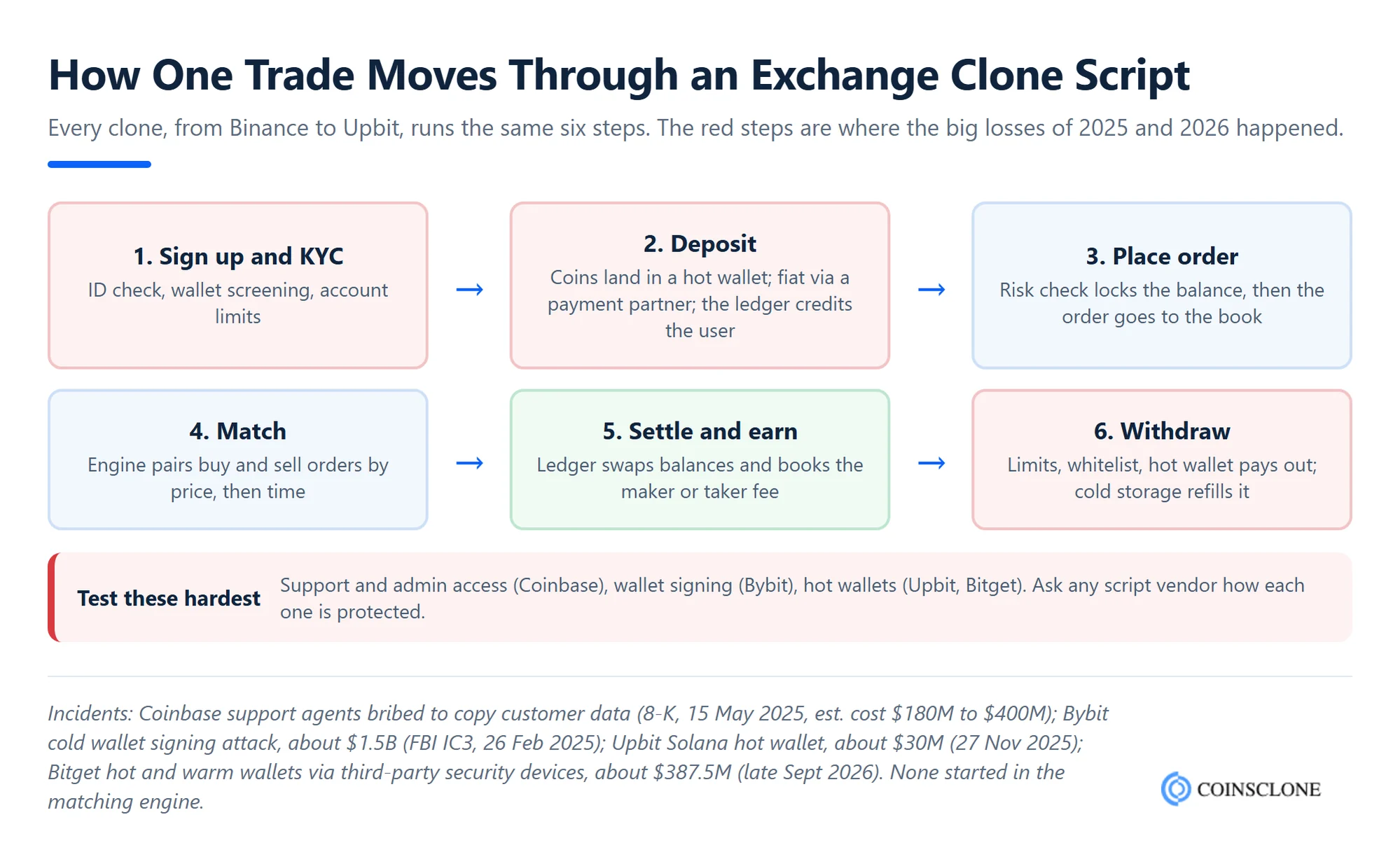
The diagram shows a pattern worth knowing. None of the large losses of 2025 and 2026 started in the trading engine. They started with staff access, wallet signing and hot wallets. So when you see a demo, spend less time on the charts and more on wallet controls:
- Wallet tiers: keep most funds in cold or MPC storage, with only daily needs in the hot wallet.
- Signing checks: confirm large transfers on a second, separate device before anyone signs.
- Staff access: give support staff only the data they need, and log every view.
- Ledger checks: match the internal ledger against real on-chain balances every few minutes.
Good liquidity matters too, since new exchanges start with empty order books. Our guide to crypto liquidity providers explains the options.
Is a Crypto Exchange Clone Script Safe for a Real Business?
Yes, if you own the code, it has passed a recent outside audit, and your wallet setup is sound. The risk lies less in the clone idea than in who built it and who keeps it up to date.
Founders asked exactly this on Reddit in January 2026, in a thread on whether a crypto exchange clone is safe for a real business. The problems people shared were old code, no security review, little control over wallet logic or the matching engine, and slowdowns once real volume arrived. Another founder’s post from March 2026 adds two more: weak liquidity and “included” features that later turned out to be paid add-ons.
So test a script the way an attacker or a busy market would:
- Code ownership: get the full source code and the right to change it, in writing.
- Audit: ask for a third-party security audit from the last 12 months.
- Load test: ask to see the engine run at your expected peak, not just in a demo.
- Wallet controls: check cold storage, signing checks and staff access, the weak points in the big 2025 and 2026 hacks.
- Clear price list: get every module and add-on priced before you sign.
What Are the Biggest Challenges With a Clone Script After Launch?
The biggest challenges are security, compliance and real customisation, in that order. That was the question in an October 2025 thread on Binance clone scripts. Security work never ends, because attackers target hot wallets and staff logins. Compliance grows as you add countries, since each one has its own KYC and reporting rules. And a script that only lets you change colours and the logo will hold you back once you need new products.
Are Free or Open Source Crypto Exchange Scripts Worth Using?
Rarely, for a business that will hold real customer funds. Free and open source exchange code on GitHub or cheap code marketplaces can help you learn how an exchange works. But it seldom comes with audits, updates, support or licence-ready KYC tools.
Watch for three traps:
- Hidden costs: you still pay for servers, security audits, liquidity and a team to maintain the code.
- Licence terms: some open source licences require you to publish the changes you make.
- Pirated “nulled” scripts: cracked copies of paid scripts can carry backdoors, so never run one near user funds.
If budget is the issue, a white label or clone script with a clear support plan is often the cheaper route once you count audits and upkeep.
How Much Does a Crypto Exchange Clone Script Cost?
A crypto exchange clone script or white label exchange costs about $15,000 to $60,000 in 2026. A custom MVP costs about $100,000 to $200,000, and a full custom exchange costs $250,000 to $500,000 or more. These are the ranges in published 2026 agency cost guides.
The price depends on scope more than on the brand you copy. A spot exchange with one fiat currency costs far less than a futures exchange with mobile apps and several bank links.
| Route | What you get | Typical cost (2026 market) | Time to launch |
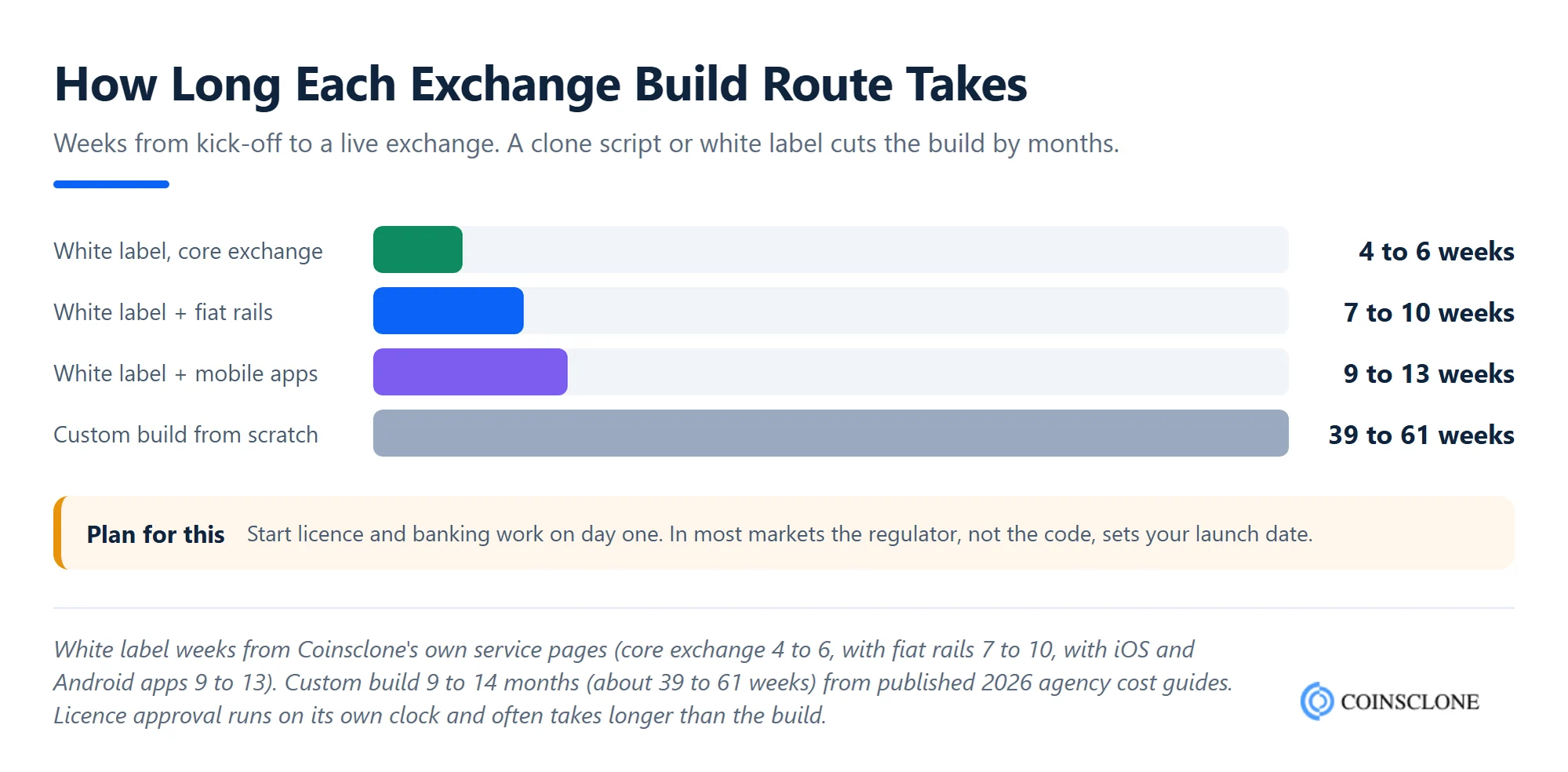
| Clone script or white label | Ready-made software modelled on a named exchange, branded for you | About $15,000 to $60,000 | 4 to 6 weeks (7 to 10 with fiat rails, 9 to 13 with mobile apps) |
| Custom MVP | Your own code with core trading features only | About $100,000 to $200,000 | 6 to 9 months |
| Full custom exchange | Your own design and code from the ground up | About $250,000 to $500,000+ | 9 to 14 months |
How Much Does It Cost to Build a Crypto Exchange From Scratch?
Building from scratch costs about $250,000 to $500,000 or more for the software alone. That was the question in a September 2025 Reddit thread on the cost to create a crypto exchange from scratch, where one answer put the total at $2 million to $4 million once systems, compliance staff and lawyers were added. Both views can be right: the code is one cost, and running a licensed business is another.
Plan for running costs on top. These include servers, market makers, KYC checks, security audits and support staff. Our full guide on the cost to develop a cryptocurrency exchange breaks down each line.
Time matters as much as money. The chart below shows how much faster a clone or white label route is than a custom build.
Is a Crypto Exchange Clone Script Legal?
Yes. A clone script copies features, not a brand’s code, name or logo, so the software itself is legal to buy and use. What needs a licence is running the exchange, and the rules depend on where your users live. We cover this in our post on whether clone scripts are legal and in our crypto license guide.
- European Union: MiCA’s transition period ended on 1 July 2026, so only licensed firms can serve EU users. Even Binance cannot sign up new EU users without a licence. A trading platform needs at least EUR 150,000 in capital under MiCA.
- United States: register with FinCEN as a money services business, then get state money transmitter licences. New York adds its BitLicense.
- United Kingdom: the FCA opened its crypto licence window on 30 September 2026. It runs to 28 February 2027, and the new rules start on 25 October 2027.
- Dubai: VARA charges AED 100,000 to apply for an exchange licence.
- India: exchanges must register with FIU-IND and follow its anti-money laundering rules.
The KuCoin case above shows what happens when an exchange skips these steps. So start licence and banking work at the same time as the build.
How to Choose a Crypto Exchange Clone Script Provider
The success of your exchange does not depend only on the script. It also depends on the skills, track record and long-term support of the provider. So choosing the right provider is a key decision for startups. Weigh these factors before you sign:
- Experience: ask how many live exchanges the provider has built, and talk to one of their clients.
- Customization: check that you can change features, not just colours and the logo.
- Security: ask for a recent third-party audit, and how wallets, signing and staff access are protected.
- Compliance support: look for built-in KYC, AML, wallet screening and crypto Travel Rule tools.
- Source code: confirm who owns the code after launch and whether you get full access.
- Scale: ask how many orders a second the engine handles in tests.
- Support: get post-launch support, updates and response times in writing.
By weighing these points, you can pick a provider that fits your business goals. One such provider in the market is Coinsclone.
Build Your Crypto Exchange Clone Script With Coinsclone
Coinsclone is a leading cryptocurrency exchange clone script provider that has built crypto platforms since 2018. We have delivered 350+ platforms for 200+ clients across 20 industries. We build secure, fast and fully customizable exchange clone scripts for startups, founders and financial firms. Our solutions come with a tested matching engine, liquidity links, layered wallet security and compliance-ready modules, so you can launch with confidence in busy markets.
More importantly, we don’t just provide software; we offer end-to-end cryptocurrency exchange development support.
What sets us apart is our planning. We shape the exchange around your target market and your niche, whether that is a multi-asset platform, a fiat-first exchange or a futures platform.
From planning to launch and post-launch support, our team guides you at every stage. A white label exchange goes live in 4 to 6 weeks, 7 to 10 weeks with fiat rails, or 9 to 13 weeks with mobile apps. So you reach the market sooner with less risk.
If you are ready to build a secure and scalable crypto exchange, our team is ready to support you at every stage.
Take the next step. Launch your crypto exchange with confidence.
Frequently Asked Questions
What is a crypto exchange clone script?
It is ready-made software that copies the features of a known exchange, such as Binance, Coinbase or Kraken. You add your brand, coins and fees, then launch your own exchange in weeks instead of months.
Which is the best cryptocurrency exchange clone script in 2026?
It depends on your plan. A Binance or OKX clone suits a full global exchange. Bybit and Bitget clones suit futures and copy trading. Coinbase, Kraken and Upbit clones suit licensed, fiat-first markets, and a Hyperliquid clone suits on-chain futures.
How much does a crypto exchange clone script cost?
Published 2026 agency cost guides put a clone script or white label exchange at about $15,000 to $60,000. A custom MVP costs about $100,000 to $200,000, and a full custom exchange costs $250,000 to $500,000 or more. Plan for running costs such as servers, liquidity and KYC checks on top.
How long does it take to launch an exchange with a clone script?
A white label exchange takes about 4 to 6 weeks. Adding fiat rails takes it to 7 to 10 weeks, and adding mobile apps to 9 to 13 weeks. Licences can take longer, so start them early.
Is a crypto exchange clone script legal?
Yes. The script copies features, not a brand’s code, name or logo. Running the exchange is what needs a licence, under rules such as MiCA in the EU or FinCEN and state licences in the US.
Is a crypto exchange clone script safe?
It is safe when you own the code, it has a recent third-party audit, and most funds sit in cold storage with strict signing checks. The large losses of 2025 and 2026 came from wallets and staff access, not from the clone idea.
Can I use a free or open source crypto exchange script?
You can use one to learn, but rarely to run a real business. Free code seldom comes with audits, updates or support, and pirated scripts can hide backdoors. Budget for an audit and a team before any free code goes near user funds.
Launch Faster with Our Crypto Exchange Clone Scripts!
Build your Crypto Exchange platform — the smart way.
- Ready-Made Architecture: Proven exchange framework, instantly deployable
- Built-In Liquidity: Smooth trading from day one
- Advanced Security Stack: KYC, 2FA, encrypted wallets
- Revenue-Ready: Earn from Spot, futures, staking & listing fees
Get a free branded demo of your exchange within 48 hours — before you invest anything.
Book a Free Demo and see how our Crypto Exchange Clone Scripts can take you from concept to live trading platform in just weeks.