
In July 2026, the FATF reported that 83% of the countries it surveyed now have Travel Rule laws for crypto, up from 73% a year earlier. For crypto exchanges, wallets and payment firms, the Travel Rule is no longer a future problem. It applies to transfers you process today.
The rule sounds simple: when you send crypto for a customer, the sender’s and receiver’s details must travel with it, just like a bank wire. In practice, it touches every part of a platform, from onboarding to withdrawals, and the details change by country.
This guide explains the crypto Travel Rule: what it requires, the thresholds by country, how a Travel Rule transfer works step by step, the protocols and tools exchanges use, and how to build compliance into your platform.
What Is the Crypto Travel Rule?
The crypto Travel Rule requires crypto service providers (VASPs) to collect, check and share information about the sender and receiver of a crypto transfer. It comes from the FATF’s Recommendation 16, first written for bank wires, which the FATF applied to crypto in 2019.
When a customer sends crypto from one exchange to another, the sending exchange must pass along:
- About the sender (originator): name, account number or wallet address, and in many cases an address, ID number or date and place of birth.
- About the receiver (beneficiary): name and account number or wallet address.
The receiving exchange must check that data, screen it, and keep records. The goal is to stop money laundering, sanctions evasion and terrorist financing through crypto.
Who Must Follow the Travel Rule?
The Travel Rule applies to regulated crypto businesses, including:
- Centralized crypto exchanges and brokers.
- Custodial wallet providers.
- Crypto payment gateways and processors that move funds for clients.
- P2P platforms where the platform holds funds in escrow.
- OTC desks and other firms transferring crypto for customers.
Users of self-hosted wallets are not bound by the rule themselves, but exchanges sending to or receiving from those wallets still have duties.
Crypto Travel Rule Thresholds by Country
The FATF standard sets a USD or EUR 1,000 threshold, but many countries go further. Here is how the main markets compare.
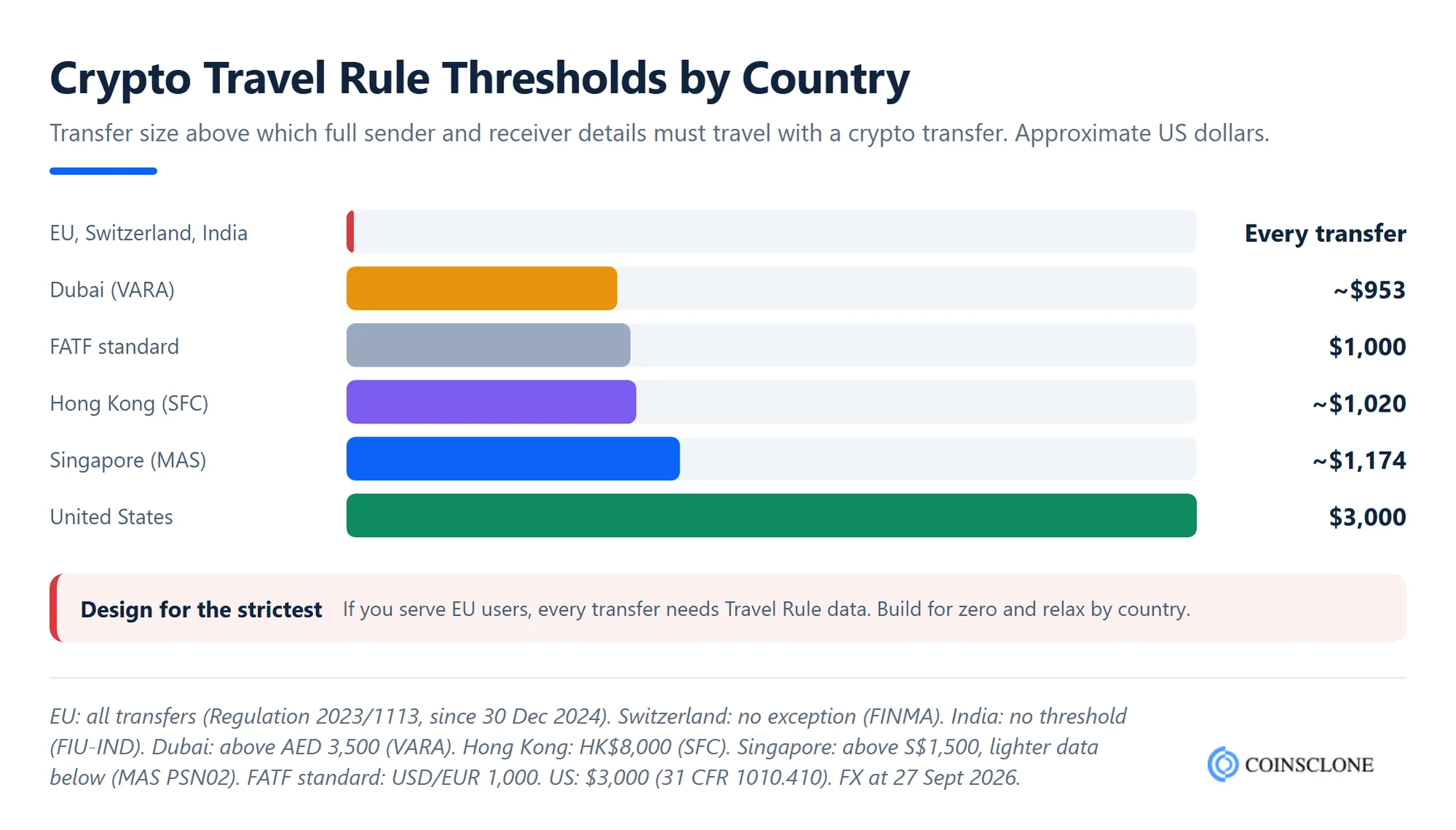
| Jurisdiction | Threshold | Notes |
| European Union | No threshold | Regulation 2023/1113 applies to every crypto transfer since 30 Dec 2024 |
| Switzerland | No exception | FINMA applies it to all transfers, including to external wallets |
| India | No threshold | FIU-IND rules for VDA service providers |
| Dubai (VARA) | Above AED 3,500 | Plans for unhosted wallets required |
| Hong Kong (SFC) | HK$8,000 | Lighter data below the threshold |
| Singapore (MAS) | S$1,500 | Names and account numbers below; full data above |
| United States | $3,000 | FinCEN guidance applies the funds rule to crypto |
| Canada | No minimum for sending | FINTRAC; record-keeping from CAD 1,000 |
| Japan | Notification duty | Applies to countries Japan names as having similar rules |
The practical rule: if you serve EU customers, build for zero. Every transfer needs Travel Rule data, and you can relax the checks where local law allows.
How Does a Travel Rule Transfer Work?
A Travel Rule transfer adds a data step alongside the on-chain transfer.
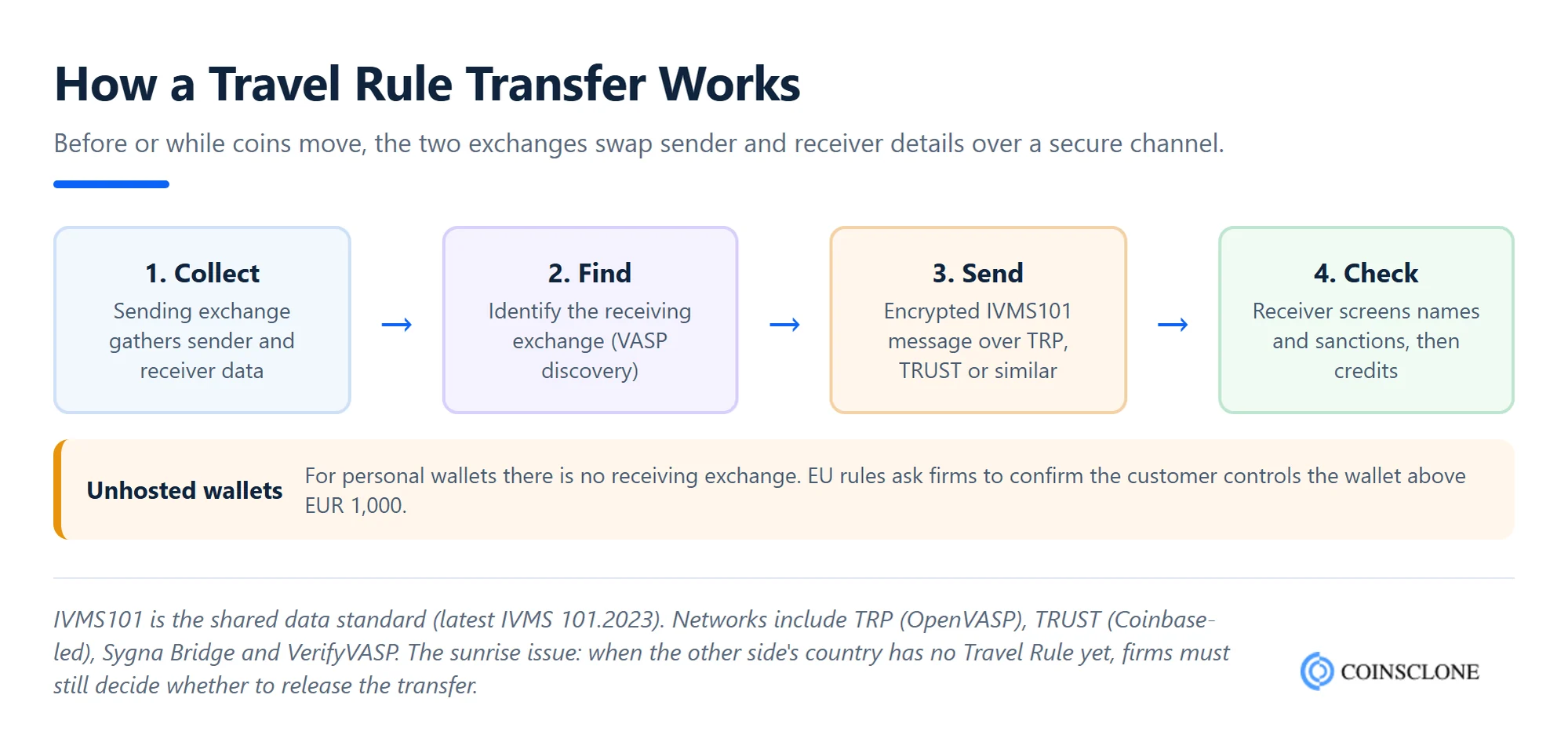
- Collect: the sending exchange gathers the sender’s details from its KYC records and the receiver’s details from the customer.
- Find the counterparty: it works out which exchange owns the destination address, a step known as VASP discovery.
- Send the data: it sends an encrypted message with the sender and receiver details, using the shared IVMS101 data format, over a Travel Rule network.
- Check: the receiving exchange confirms the receiver is its customer, screens names against sanctions lists and decides whether to credit the funds.
- Keep records: both sides store the data for audits.
Transfers to self-hosted wallets follow a different path, since there is no receiving exchange. In the EU, above EUR 1,000, the exchange must check that its customer owns or controls the wallet. The EBA accepts methods such as a small test transfer or signing a message with the wallet.
What Is the Sunrise Issue?
The Travel Rule only works when both sides follow it. The sunrise issue is the gap when the receiving exchange sits in a country that has not yet brought in the rule, or does not support a compatible network.
The FCA has told UK firms to weigh the Travel Rule status of the other side’s country before releasing funds. In practice, exchanges set a policy: send with extra checks, hold the transfer, or refuse it, depending on risk. With 83% of surveyed countries now covered, the gap is closing, but it has not closed.
Travel Rule Protocols and Tools
Exchanges do not email each other customer data. They use Travel Rule networks and tools, most built on the IVMS101 data standard, first released in 2020.
- TRP (Travel Rule Protocol): an open, free protocol run by the OpenVASP Association for direct, encrypted exchange between VASPs.
- TRUST: a Coinbase-led network of exchanges.
- Sygna Bridge: an API-based network that connects to other protocols.
- VerifyVASP: a network popular in Asia.
- Vendor platforms: compliance firms that connect many networks through one API, often bundled with transaction monitoring.
Because no single network connects everyone, most exchanges plug into more than one, or use a vendor that bridges them.
Launch a Compliance-Ready Crypto Exchange
Crypto Exchange Development — done right.
- Travel Rule Ready: Hooks for leading Travel Rule networks and IVMS101 data.
- KYC and KYT: Identity checks and transaction monitoring built in.
- Proof of Reserves: Publish reserves your users and regulators can check.
- Revenue Engine: Earn from trading fees, listings, staking and more.
Get a free branded demo of your exchange in just 48 hours — before spending a single dollar.
Book a Free Demo to see how our white label exchange can take you from idea to live platform in as little as 4 – 6 weeks.
What Else Belongs in a Crypto Compliance Stack?
The Travel Rule is one part of a wider compliance setup. A licensed exchange usually runs:
- KYC and KYB: identity checks for people and businesses at onboarding.
- KYT (know your transaction): blockchain analytics that score the risk of incoming and outgoing funds.
- Sanctions screening: checks against lists such as OFAC’s. OFAC’s guidance for the crypto industry covers screening and IP blocking.
- Travel Rule messaging: the data exchange described above.
- Proof of reserves: public proof that customer assets are fully backed. Binance and Kraken both publish Merkle tree-based proofs.
- Record-keeping and reporting: suspicious activity reports and audit trails.
Our crypto license guide explains which licences bring these duties in each country.
How Does the Travel Rule Affect Payment Gateways, Wallets and P2P Platforms?
Exchanges get most of the attention, but the rule reaches further.
Crypto payment gateways. When a stablecoin payment gateway or other gateway receives crypto for a merchant and then pays it out, it is moving value for clients. In the EU, that makes it a crypto-asset service provider with Travel Rule duties on both the incoming payment and the payout. Gateways need sender data from the paying wallet’s provider, or a self-hosted wallet check, and must pass merchant details on payouts.
Custodial wallets. A wallet app that holds keys for users is treated like an exchange for Travel Rule purposes. Every send to another provider needs the data exchange. Non-custodial wallet software is generally outside the rule, because the provider never moves funds.
P2P platforms with escrow. When the platform holds the seller’s coins in escrow and releases them, it is part of the transfer chain. Deposits into escrow and withdrawals out of it need Travel Rule handling.
OTC desks. Large trades usually settle between known parties, but the desk still needs the data when it sends to or receives from another provider.
How Much Does Travel Rule Compliance Cost?
Costs fall into three parts:
- Network and vendor fees: most Travel Rule vendors charge by transfer volume or a yearly fee. Few publish prices, so expect a quote.
- Engineering: adding receiver fields to withdrawal flows, connecting to networks, handling replies and storing records. Built in from the start, this is a modest project; bolted on later, it can take months.
- Operations: staff to review held transfers, answer requests from other exchanges and handle sunrise cases.
The cheapest path is to design for it early. Platforms that treat the Travel Rule as part of the withdrawal flow, not an add-on, spend far less over time.
What Happens If You Ignore the Travel Rule?
Direct fines for Travel Rule gaps are still rare. The FATF found that many countries have not yet taken enforcement action. But weak AML controls, which include the Travel Rule, have led to some of the largest penalties in crypto:
- Binance pleaded guilty in November 2023 and agreed to pay $4.3 billion over AML and sanctions failures.
- OKX pleaded guilty in February 2025 and agreed to pay more than $504 million for operating without a licence and weak AML checks.
Beyond fines, missing Travel Rule support can cost you banking partners, exchange integrations and your licence application.
How to Build Travel Rule Compliance Into Your Exchange
- Map your countries. List where your customers are and each country’s threshold and data rules.
- Set the strictest default. If you serve the EU, collect Travel Rule data on every transfer.
- Capture data at the right step. Ask for receiver details on the withdrawal screen, and store sender details from KYC.
- Connect to networks. Integrate one or more Travel Rule protocols, or a vendor that bridges them.
- Handle self-hosted wallets. Add wallet ownership checks such as message signing.
- Write a sunrise policy. Decide what happens when the other side cannot receive data.
- Log everything. Keep records for audits and regulator reviews.
A white label crypto exchange with compliance hooks built in saves months of this work, because the data fields, screening steps and logs are already in place.
Frequently Asked Questions
What is the crypto Travel Rule?
It is a rule that requires crypto service providers to collect and share the sender’s and receiver’s details with crypto transfers, so the information travels with the funds, as it does with bank wires.
What is the Travel Rule threshold?
The FATF standard is USD or EUR 1,000. The EU, Switzerland and India apply it to every transfer. The US threshold is $3,000, Singapore’s is S$1,500 and Hong Kong’s is HK$8,000.
Does the Travel Rule apply to self-hosted wallets?
The wallet owner has no duty, but the exchange does. In the EU, for transfers above EUR 1,000 to or from a self-hosted wallet, the exchange must check that its customer owns or controls that wallet.
What is IVMS101?
IVMS101 is the shared data format for Travel Rule messages. It defines how sender and receiver details are structured so different exchanges and networks can read them.
What is the sunrise issue?
It is the gap when one side of a transfer is in a country without Travel Rule laws, or cannot receive the data. Exchanges set a risk-based policy for these transfers.
Which Travel Rule protocols do exchanges use?
Common options include TRP from OpenVASP, TRUST led by Coinbase, Sygna Bridge and VerifyVASP. Many exchanges connect to several, or use a vendor that bridges them.
When did the EU Travel Rule start?
The EU Transfer of Funds Regulation began applying to crypto on 30 December 2024, with no minimum amount.
What happens if an exchange ignores the Travel Rule?
It risks fines, losing banking partners and failing licence reviews. Large AML cases, such as Binance’s $4.3 billion settlement, show how costly weak compliance can be.