
This guide ranks the 10 biggest AI crypto tokens in 2026 and explains what each one actually does. You will see each token’s market cap, the job it does inside its network and how far it sits from its peak. We checked every figure against CoinGecko and each project’s own site on 2 October 2026.
AI crypto tokens are now a $26 billion corner of the market. Some pay for real GPU time, AI models or data. Others just carry “AI” in the name. So this guide also shows you how to tell the two apart, the risks most lists skip and what to plan if you want to build an AI token of your own.
In this guide:
- The 10 best AI crypto tokens in 2026, with a side by side table of market caps and uses
- The five types of AI tokens, from GPU networks to AI agents
- How an AI token earns its value, shown step by step with Render as the example
- The risks, including how far most AI tokens trade below their highs
- How to build an AI token, and which token model fits your AI product
Discover the Future of Crypto — Powered by the Best AI Tokens
AI Token Development — done right.
- Smart Utility:Build tokens with AI-driven utility and real-world use cases.
- Scalable Architecture:Designed for high performance and seamless integration.
- Custom Branding:Your AI token, your ecosystem, your vision.
- Monetization Ready:Enable staking, governance, and DeFi utilities from day one.
See a free concept demo of your AI token in 48 hours — before you invest a cent.
Book a Free Demo to explore how our AI Token Development Platform can help you launch the next generation of intelligent crypto assets.
10 Best AI Crypto Tokens in 2026
The 10 best AI crypto tokens in 2026 are NEAR, Bittensor (TAO), Internet Computer (ICP), Venice (VVV), Render (RENDER), Artificial Superintelligence Alliance (FET), Virtuals Protocol (VIRTUAL), Grass (GRASS), The Graph (GRT) and Akash (AKT). We ranked them by market cap, then kept only tokens whose network sells or rewards a real AI service.
- NEAR: a fast layer 1 blockchain that has put AI agents at the center of its plan
- Bittensor (TAO): an open network where AI models compete for rewards
- Internet Computer (ICP): a blockchain that hosts full apps, now with an AI app builder
- Venice (VVV): private AI chat and API access, paid for by staking
- Render (RENDER): a marketplace for GPU power, for 3D work and AI jobs
- Artificial Superintelligence Alliance (FET): AI agents, the token that absorbed SingularityNET’s AGIX
- Virtuals Protocol (VIRTUAL): a launchpad and market for tokenized AI agents
- Grass (GRASS): people share spare internet bandwidth to collect public web data for AI
- The Graph (GRT): the data layer that apps and AI agents query for blockchain data
- Akash (AKT): a cloud marketplace that rents out GPUs and servers
AI Crypto Tokens Compared
The table sets the 10 side by side. Market cap and price come from CoinGecko’s AI category at 08:09 UTC on 2 October 2026. Prices change by the minute, so treat these as a snapshot.
| # | Token | Market cap | Price | Type | What the token pays for |
| 1 | NEAR | $6.50B | $4.97 | AI-ready layer 1 | Fees, staking, AI agent apps |
| 2 | Bittensor (TAO) | $3.52B | $310 | Model network | Rewards for AI models and validators |
| 3 | Internet Computer (ICP) | $1.84B | $3.30 | AI-ready layer 1 | Compute “cycles” for on-chain apps |
| 4 | Venice (VVV) | $1.40B | $29.06 | AI app | Staked for a share of daily AI usage |
| 5 | Render (RENDER) | $1.02B | $1.98 | GPU compute | Burned to pay for render and AI jobs |
| 6 | ASI Alliance (FET) | $549M | $0.24 | AI agents | Agent fees, staking, governance |
| 7 | Virtuals (VIRTUAL) | $541M | $0.82 | AI agents | Pairs with every agent token launched |
| 8 | Grass (GRASS) | $498M | $0.71 | AI data | Rewards for bandwidth, staking |
| 9 | The Graph (GRT) | $319M | $0.029 | AI data | Query fees, indexer staking |
| 10 | Akash (AKT) | $201M | $0.67 | GPU compute | Cloud and GPU leases, staking |
This list is for research, not financial advice. AI tokens swing hard, and a high market cap does not mean a token is safe or will keep its value.
1. NEAR Protocol (NEAR)
NEAR is the largest AI crypto token, at about $6.5 billion. It is a layer 1 blockchain built for speed and low fees, and it now pitches itself as “the blockchain for AI”. The link is real: co-founder Illia Polosukhin co-wrote “Attention Is All You Need”, the 2017 Google paper behind today’s large language models.
NEAR’s AI work runs through NEAR AI, which builds tools for private, user-owned AI agents. Its “intents” system also lets an agent state a goal, such as “swap this token for that one”, and lets the network find the best route across chains.
- Token use: gas fees, staking to secure the network and paying for apps built on NEAR
- Watch for: most NEAR fees still come from general crypto use, not AI, so judge the AI story by real agent usage
2. Bittensor (TAO)
Bittensor is the purest AI play on this list. It is a network of “subnets”, and each subnet is a contest for one AI task, such as text, images, compute or data. Miners supply models or work, validators score them, and the best work earns new TAO. About 129 subnets were active in late 2026.
TAO copies Bitcoin’s supply design. There is a hard cap of 21 million, no pre-mine and no investor share. The first halving on 14 December 2025 cut new issuance from 7,200 to 3,600 TAO a day. Since the dynamic TAO upgrade, each subnet also has its own token, and the market’s demand for that token decides how much TAO the subnet earns.
- Token use: rewards for miners and validators, staking into subnets, network fees
- Watch for: subnet tokens are thin and volatile, and some subnets earn more from rewards than from paying users
3. Internet Computer (ICP)
Internet Computer is a blockchain that can host a whole app, front end and data included, rather than just its smart contracts. Apps burn ICP to buy “cycles”, the fuel that runs them.
Its AI angle is Caffeine, an app builder that DFINITY launched on 15 July 2025. You describe an app in plain words, and an AI agent writes it and deploys it on ICP. That ties AI use straight to ICP demand, because every app it builds burns cycles.
- Token use: cycles for compute and storage, staking in the network’s governance system
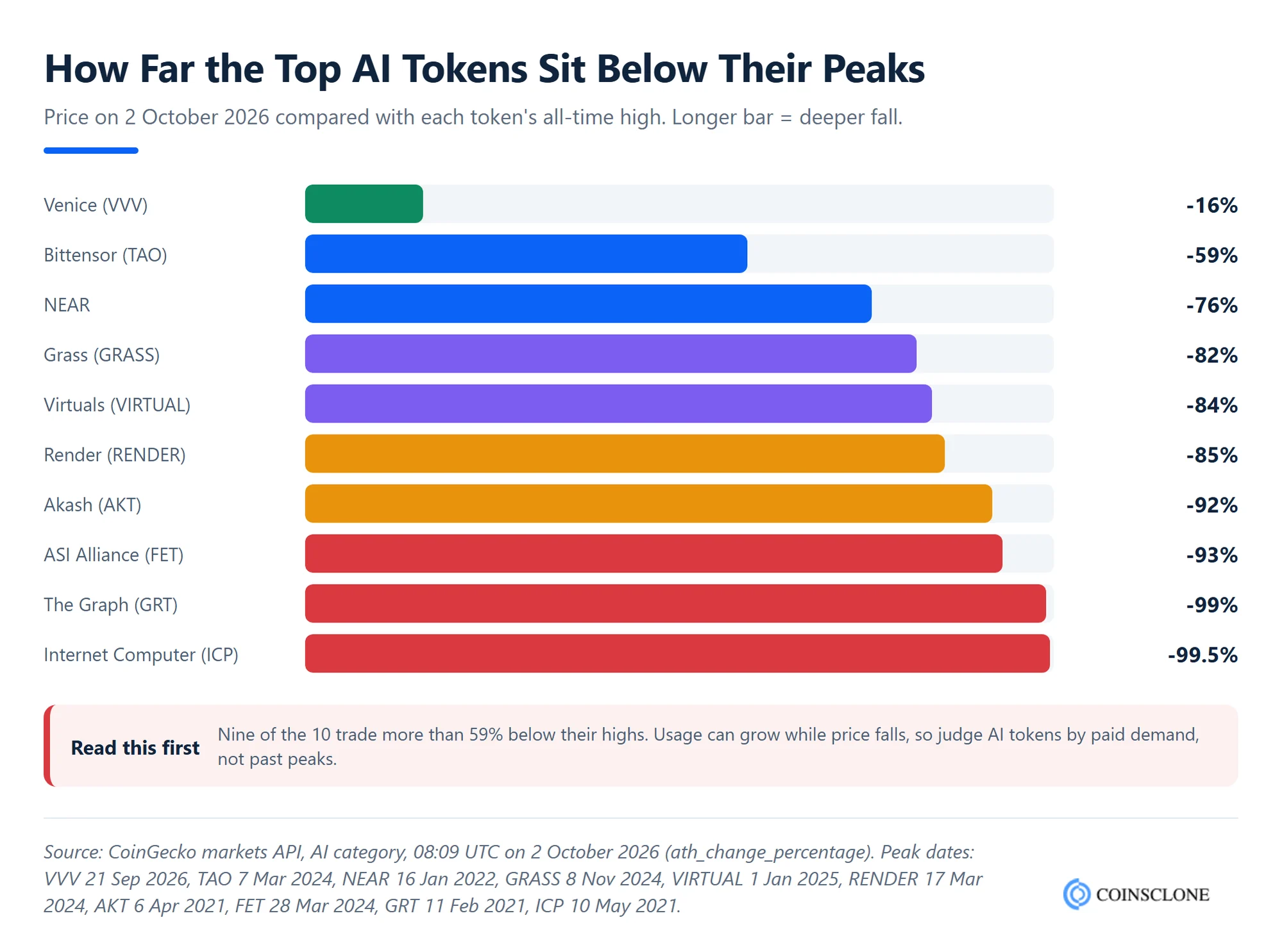
- Watch for: ICP trades more than 99% below its 2021 high, the deepest fall on this list
4. Venice (VVV)
Venice is a private AI app. It offers chat, image and code models without storing your prompts. Its VVV token runs on Base, Coinbase’s layer 2 network, and it works like a membership rather than a payment.
Here is how it works. If you stake VVV, you get a matching share of Venice’s daily API capacity: stake 1% of all staked VVV, get 1% of the capacity. Staked VVV can also mint DIEM, a token worth $1 of AI use per day. In turn, part of Venice’s revenue buys back and burns VVV. That design is why the VVV launch post says stakers can use the Venice API “without paying per request”.
- Token use: staking for API access, minting DIEM, staking rewards
- Watch for: VVV hit a record $34.53 on 21 September 2026, so it carries the most recent run-up on this list
5. Render (RENDER)
Render is a marketplace for GPU power. Artists and studios send 3D and video jobs to it, and owners of idle GPUs do the work. In 2025 it added a subnet for AI jobs, and in 2026 its community voted to bring in Salad’s large pool of consumer GPUs.
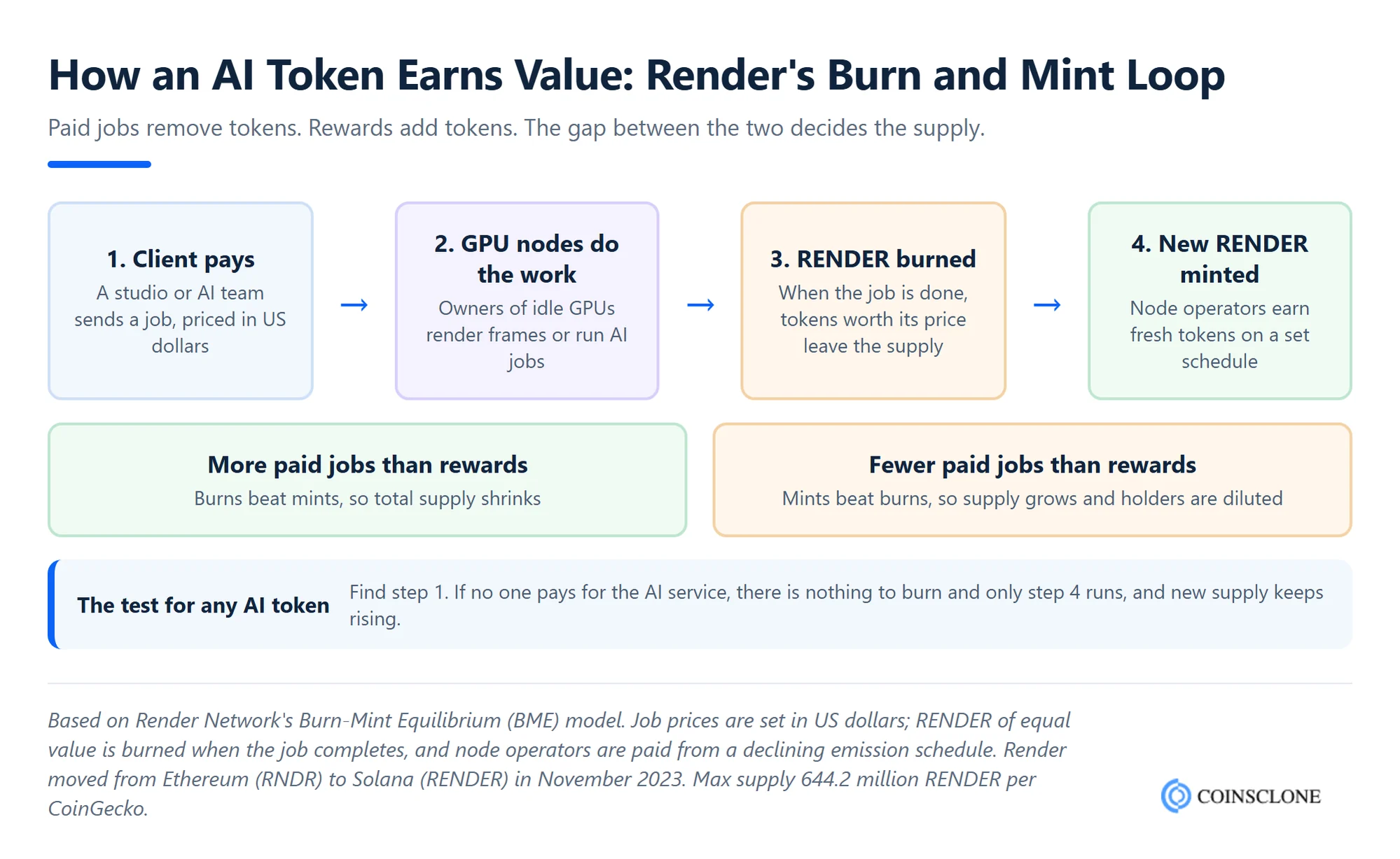
The token moved from Ethereum (where it was called RNDR) to Solana in November 2023, so older guides that say “RNDR” are out of date. Render uses a “burn and mint” model: clients pay in dollar terms, RENDER worth that amount is burned, and GPU owners earn newly minted RENDER. The diagram in the next section shows the full loop.
- Token use: burned to pay for jobs, earned by GPU node operators
- Watch for: network usage grew in 2025 while the price fell, a reminder that usage and price do not move together
6. Artificial Superintelligence Alliance (FET)
FET is the token of the Artificial Superintelligence Alliance, formed in 2024 by Fetch.ai, SingularityNET and Ocean Protocol. In July 2024, AGIX and OCEAN holders swapped into FET, so SingularityNET’s AGIX no longer trades as its own token.
The alliance has since shrunk. Ocean Protocol announced its exit on 9 October 2025 after a public dispute. Fetch.ai’s side still builds agent tools, including Agentverse for finding and running AI agents.
- Token use: fees for agent services, staking, governance
- Watch for: FET is down about 93% from its March 2024 high, partly due to large sales by former alliance members
7. Virtuals Protocol (VIRTUAL)
Virtuals is a launchpad and market for AI agents. Anyone can create an agent and give it its own token, and every agent token trades against VIRTUAL. When an agent’s token raises 42,000 VIRTUAL, it “graduates” to a normal Uniswap pool, per the Virtuals whitepaper.
Its Agent Commerce Protocol lets agents hire and pay each other on-chain. Virtuals started on Base and has since spread to more chains.
- Token use: the base pair for every agent token, launch fees, staking as veVIRTUAL
- Watch for: most agent tokens are tiny and fail, and VIRTUAL rises and falls with launch activity
8. Grass (GRASS)
Grass pays people for their spare internet bandwidth. You run an app or browser extension, and the network uses your connection to collect public web data. AI labs need that data to train models. Grass says more than 8.5 million people take part.
GRASS runs on Solana. Users earn points for uptime and for the traffic they carry, and points turn into token rewards.
- Token use: rewards for bandwidth, staking to secure the network
- Watch for: the business depends on buyers paying for scraped data, a market with fast-changing rules
9. The Graph (GRT)
The Graph turns raw blockchain data into feeds that apps can query, called subgraphs. Its site reports more than 1.27 trillion queries served for over 75,000 projects across 60+ networks. That data now also feeds AI agents and trading tools that need clean on-chain data.
Old lists call this token “GRAX”. The correct ticker is GRT.
- Token use: query fees, staking by indexers, delegation and curation
- Watch for: GRT trades about 99% below its 2021 peak, and its AI role is one use among many
10. Akash Network (AKT)
Akash is an open cloud where anyone can rent out servers and GPUs. It competes on price: its homepage lists an Nvidia H100 at $1.33 an hour against $3.93 on AWS. AI teams use it to train and run models without a long cloud contract.
- Token use: paying for leases, staking to secure the network, governance
- Watch for: it is the smallest token here, so prices can move hard on low volume
What Are AI Crypto Tokens?
AI crypto tokens are digital assets that pay for, reward or govern an artificial intelligence service on a blockchain. The service might be GPU time, a trained model, a data feed or an AI agent. The token is how users pay and how the people who supply the work get paid.
Think of it this way. A normal cloud firm owns the GPUs and bills you in dollars. An AI token network lets thousands of owners pool their GPUs, models or data, and the token handles the billing and rewards between strangers.
Not every token with “AI” in its name works like this. Some only add a chatbot to a meme coin. A real AI token has a clear job inside a working product, and you can check that job by looking at usage, not price. If you are new to the token side, our guide on crypto coins vs tokens explains the basics.
Types of AI Crypto Tokens
Most AI tokens fit one of five types. The type tells you where the token’s demand should come from.
- GPU compute networks: rent out graphics cards for AI training and rendering. Examples: Render, Akash.
- Model and intelligence networks: reward people who supply AI models or results. Example: Bittensor.
- AI agent platforms: let users create, fund and trade AI agents. Examples: ASI Alliance (FET), Virtuals.
- AI data networks: collect, clean or serve the data AI needs. Examples: Grass, The Graph.
- AI-ready blockchains and apps: chains and apps that run AI tools on-chain. Examples: NEAR, ICP, Venice.
CoinGecko’s own sub-categories show the split. On 2 October 2026, AI agent tokens were worth about $4.2 billion in total, while the wider DePIN group, which includes GPU and bandwidth networks, was worth about $11.2 billion.
How Do AI Crypto Tokens Work?
An AI token works when real customers pay for the service and that payment touches the token. Render is the clearest example, because its burn and mint loop is public.
First, a client sends a job and pays a price set in dollars. Next, GPU owners do the work. When the job is done, RENDER worth that price is burned, so it leaves the supply for good. Then the GPU owners earn newly minted RENDER on a set schedule. As a result, when paid usage burns more tokens than the schedule mints, the total supply shrinks.
Other designs follow the same idea. Venice links access to staked VVV and burns tokens with revenue. Bittensor pays fixed new TAO each day, and the market decides which subnets earn it. In every case, ask one question: does someone pay for the AI service, or do rewards come only from new tokens?
Benefits of AI Crypto Tokens
AI tokens solve some real problems for both users and suppliers of AI.
Cheaper Access to Compute
GPU networks pool idle hardware from many owners. As a result, a team can rent a powerful GPU by the hour, often below big cloud prices, with no long contract.
Open Markets for AI Work
On networks like Bittensor, anyone with a good model can earn, not just large labs. Validators score the work, and the best work is paid more.
Payments Between AI Agents
Agents can hold tokens and pay each other for tasks without a bank account. Virtuals and the ASI Alliance both build tools for this.
Transparent Rules
Supply, fees and rewards live in smart contracts, so anyone can check them. That makes it easier to spot a token that mints far more than it burns.
Always On
Like the rest of crypto, these networks run 24/7. In addition, AI trading bots built on them can watch prices and act around the clock. If that is your angle, see our guide to crypto trading bot development.
Risks of AI Crypto Tokens
The chart above shows the main risk in one view. Nine of the 10 tokens trade more than 59% below their all-time highs. Only Venice, which peaked in September 2026, is near its top.
- Price swings: AI tokens tend to move faster than Bitcoin in both directions, and news about big AI firms can drive them for days.
- Hype over usage: a token can rise on the AI story while its network has few paying users.
- Inflation: if rewards come from new tokens and not from fees, holders slowly lose their share.
- Thin trading: smaller tokens, agent tokens and subnet tokens can be hard to sell without moving the price.
- Partner risk: alliances can break, as the Ocean Protocol exit showed in 2025.
- Rules: many countries are still writing rules for both AI and crypto, and data scraping faces its own legal tests.
- Fake AI tokens: copycats use popular names and logos. Always check the contract address on the project’s own site.
How to Evaluate an AI Crypto Token
Use this short checklist before you trust an AI token’s story.
- Find the product: can you use it today, and does it need the token to work?
- Check paid usage: look for fees, jobs or burns from real customers, not just rewards.
- Read the supply plan: how many tokens exist, how many unlock soon and who holds them?
- Compare burns and mints: does usage remove tokens faster than rewards add them?
- Check the team and code: look for audits, public code and a steady release record.
- Check liquidity: daily trading volume should be large enough for the size you plan to trade.
AI Tokens vs AI Meme Coins
AI tokens and AI meme coins can look alike on a price chart, but they work very differently.
| AI token | AI meme coin | |
| Purpose | Pays for or rewards an AI service | Community and attention |
| Demand comes from | Users of the product | Social media and trends |
| What you can check | Usage, fees, burns, nodes | Holders, volume, social buzz |
| Typical life span | Tied to the product | Often weeks or months |
AIdoge, which older lists included, is a good example of the meme side. It used AI for meme images, but its token had little use beyond trading.
Tokens That Left This List
Our 2024 list included several tokens that are not AI tokens or no longer trade on their own.
- AGIX (SingularityNET): merged into FET in July 2024. Holders swapped at a set rate.
- RNDR: not gone, but renamed. It became RENDER on Solana in November 2023.
- SOL, SHIB, SNX and INJ: large tokens, but their networks are not built around AI. They are general blockchains, meme coins or DeFi tokens.
- ROSE (Oasis): a privacy chain with some AI tools, but too small a share of its use to make this list.
- AIdoge: an AI meme coin with little use outside trading.
How to Create an AI Crypto Token
Many founders read lists like this one because they want to launch an AI token of their own. The work splits into six steps.
- Pick the AI job: decide what the token pays for, such as GPU time, model output, data or agent access.
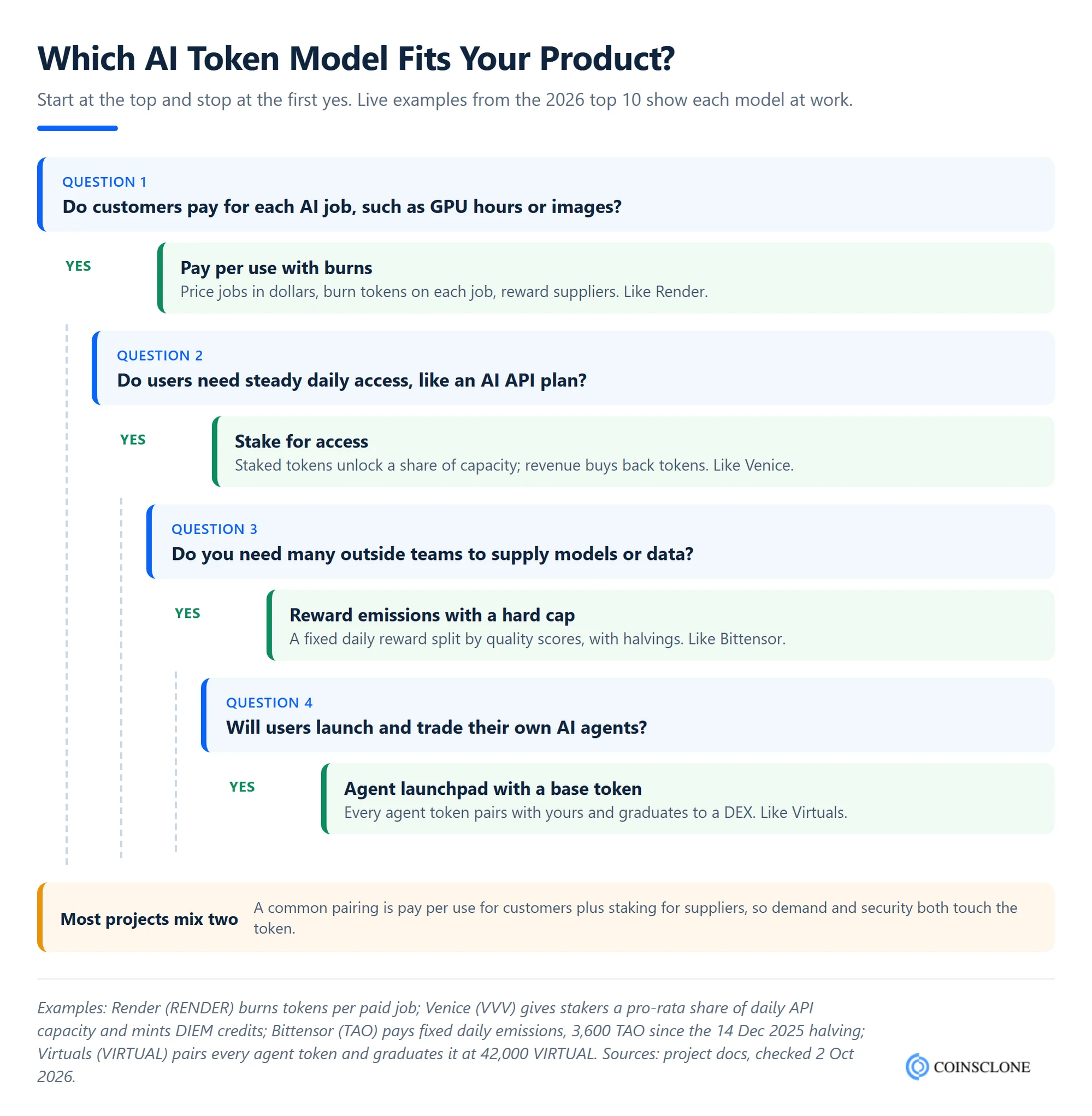
- Choose the model: pay-per-use with burns, stake-for-access or reward emissions. The decision tree below helps.
- Choose the chain: Ethereum and its layer 2s such as Base, Solana or BNB Chain, based on fees and where your users are.
- Write and audit the contracts: token, staking, burns and vesting, all checked by an outside auditor.
- Plan the supply: cap, unlocks, team share and rewards, written down in a public tokenomics paper.
- Launch and list: a token sale or launchpad, then DEX pools and exchange listings.
Our step-by-step guide on how to create a crypto token covers each stage in detail, and the cost to create a crypto token guide breaks down the budget.
Features to Build Into an AI Token
These smart contract features give you control over supply and safety. Pick the ones your model needs.
- Mintable: lets the contract create new tokens, for example to pay rewards on a set schedule.
- Capped: sets a hard limit on total supply, as Bittensor does with 21 million TAO.
- Burnable: removes tokens from supply when users pay for a service, which helps offset rewards.
- Pausable: lets an admin stop transfers during an emergency, such as an exploit.
- Blacklist: blocks known bad addresses from buying or selling the token.
- Staking and vesting: locks tokens for access or rewards, and releases team tokens slowly.
AI Token Development Services From Coinsclone
Coinsclone has built blockchain products since 2018, with 350+ platforms delivered for 200+ clients across 20 industries. Our AI token development services cover the full path from idea to listing.
- AI token creation: contracts for pay-per-use, staking or reward models on the chain you choose.
- Integration: connecting the token to your AI app, GPU network or agent platform.
- Audit support: testing and review before launch, plus fixes after.
- Listing support: DEX pools, exchange applications and market launch plans.
- Token launch platforms: your own crypto launchpad for AI or agent token sales.
- Consulting: tokenomics, white paper writing and smart contract support.
If you are planning an AI token, our team can help you pick the model and the chain before you write a line of code.
Conclusion
The best AI crypto tokens in 2026 are the ones tied to a product people pay for: GPU time on Render and Akash, models on Bittensor, private AI on Venice and agent markets on Virtuals and FET. The sector is worth about $26 billion, yet most of its tokens still sit far below their highs. So read the usage, not just the chart. And if you plan to build one, start with the AI job your token pays for, then let that shape the supply.
Frequently Asked Questions
What are AI crypto tokens?
AI crypto tokens are digital assets that pay for, reward or govern an AI service on a blockchain. Examples include RENDER for GPU time, TAO for AI models and VIRTUAL for AI agents.
Which AI crypto token is the biggest?
NEAR is the largest by market cap at about $6.5 billion on 2 October 2026, per CoinGecko. Bittensor (TAO) is second at about $3.5 billion and is the largest token built only for AI.
Are AI crypto tokens a good investment?
They are high risk. Nine of the 10 biggest AI tokens trade more than half below their all-time highs. Some have growing usage, but price does not always follow. This is not financial advice; only risk money you can afford to lose.
How do AI tokens generate value?
They gain value when real users pay for the AI service and that payment touches the token, for example through burns, staking for access or fees paid to stakers. Tokens that only pay rewards from new supply tend to lose value over time.
What is the difference between AI tokens and AI meme coins?
An AI token pays for or rewards a working AI service. An AI meme coin uses AI as a theme, and its demand comes mainly from social media. You can check an AI token’s usage; a meme coin has little to check.
What are the biggest risks of AI crypto?
The main risks are sharp price swings, hype that runs ahead of usage, token inflation, thin trading in small tokens, broken partnerships and changing rules on AI and crypto.
How do I evaluate an AI token beyond the hype?
Check that the product works and needs the token, look for paid usage and burns, read the supply and unlock plan, look for audits and public code, and make sure there is enough trading volume.
Discover the Future of Crypto — Powered by the Best AI Tokens
AI Token Development — done right.
- Smart Utility:Build tokens with AI-driven utility and real-world use cases.
- Scalable Architecture:Designed for high performance and seamless integration.
- Custom Branding:Your AI token, your ecosystem, your vision.
- Monetization Ready:Enable staking, governance, and DeFi utilities from day one.
See a free concept demo of your AI token in 48 hours — before you invest a cent.
Book a Free Demo to explore how our AI Token Development Platform can help you launch the next generation of intelligent crypto assets.