

Where do crypto payment gateways actually earn their keep? This guide walks through 10 real use cases of crypto payment gateways in 2026, from online stores and travel sites to payroll, charity and property deals. For each one, you get a named example, the numbers behind it and the reason it works.
We also show how a gateway moves money, what it costs next to a card payment and where crypto checkout adds little. So by the end, you will know which use case fits your business, and whether to plug in a gateway or build your own.
In this guide:
- 10 use cases of crypto payment gateways, each with a real company example
- What a crypto payment costs a merchant next to a foreign card, at published 2026 rates
- Where real stablecoin payment volume went in 2025
- A three-question test to find the use case that fits your business
- The limits and rules to plan for before you launch
Discover How Our Crypto Payment Gateway Unlocks Real-World Use Cases
Crypto Payment Gateway — powering seamless crypto transactions.
- Accept Global Payments : Instantly process crypto from anywhere.
- E-Commerce & Retail : Integrate easily with your store, online or offline.
- Custom Tokens & Wallets : Support multiple coins and your own token.
- Revenue Opportunities : Earn via transaction fees, subscriptions, and more.
Explore a free demo of our crypto payment gateway in 48 hours — no commitment needed.
Book a Free Demo to see how our gateway can transform your business payments and unlock new revenue streams.
10 Real-World Use Cases of Crypto Payment Gateways in 2026
Crypto payments have moved well past early adopters. In a PayPal survey run with the National Cryptocurrency Association in January 2026, 39% of US merchants said they take crypto. And 88% said buyers had asked for it. Also, on 1 Oct 2026, USD stablecoins in use hit about $310.7 billion, per DefiLlama.
Stablecoins now carry most of this growth. They are tokens such as USDC and USDT that track the US dollar, so the price does not swing while a payment is in flight. At BitPay, for example, stablecoins made up 40% of payment volume in 2025, up from 30% a year earlier. Here are the use cases where gateways are doing real work.
1. E-Commerce and Online Retail
Online stores were the first home of crypto checkout, and the biggest platforms now offer it. Store owners add a crypto option to reach buyers abroad, cut card fees on foreign orders and avoid chargeback fraud.
Who does it: In June 2025, Shopify teamed up with Coinbase and Stripe to let merchants accept USDC on the Base network through Shopify Payments. Merchants get their local currency by default, with no foreign transaction or exchange fees, or they can claim the USDC into their own wallet.
However, the gain depends on your buyers. If most of your orders are local card sales, crypto checkout will save you very little. It pays off when a large share of orders comes from abroad.
2. Cross-Border B2B Payments
Paying a supplier in another country through banks can take days and pass through several middle banks, each taking a cut. With a crypto gateway, a firm can send stablecoins that land in minutes, at any hour. The receiver then cashes out in local money.
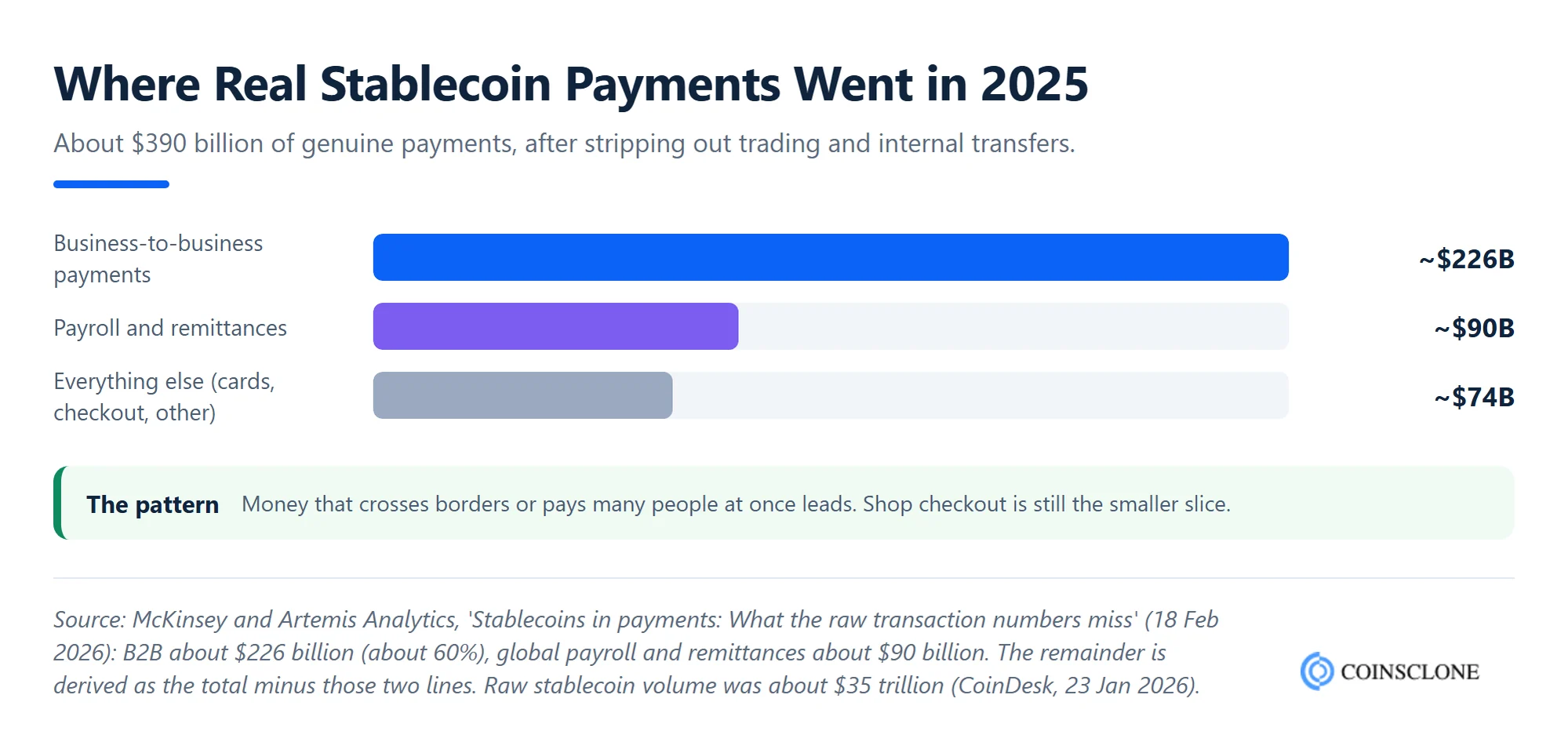
This is now the largest real use case. A McKinsey and Artemis study found about $390 billion of genuine stablecoin payments in 2025, and B2B made up about $226 billion of it, roughly 60%. The chart below shows the split.
3. Payroll, Contractor and Seller Payouts
Gateways do not only take money in. They also pay it out, which suits marketplaces, gig platforms and firms with remote staff. Instead of one bank wire per person, the business sends stablecoins to hundreds of wallets in a single run.
The data backs this up. Payroll and remittances made up about $90 billion of real stablecoin payments in 2025, per the same McKinsey study. At BitPay, payouts grew to 19% of all transactions in 2025, up from 13% in 2024, with an average payout of $170. For comparison, the World Bank puts the global average cost of sending money abroad at 6.36% of the amount sent (Q3 2025).
4. Gaming and Virtual Worlds
Game studios and Web3 worlds use crypto payment gateways too. Players buy games, skins, in-game coins and passes with crypto, which helps in regions where card payments often fail. As a result, studios can reach those players without wiring up dozens of local payment methods.
Who does it: In August 2023, the game payments platform Xsolla added Crypto.com Pay to its Pay Station, which handles in-game purchases across 200+ countries and regions. Small payments are where stablecoins on low-fee networks help most, since a fixed card fee can eat a large part of a $2 purchase. That said, play-to-earn reward models have shrunk sharply since 2022, so build around purchases, not token rewards.
5. Finance, Fintech and Card Settlement
Fintech apps, crypto exchanges and wallets use gateways to let users top up, pay bills and move funds between crypto and bank accounts. Banks and card networks are now part of this too, settling with each other in stablecoins.
Who does it: Visa now settles over $20 billion a year in stablecoins, at its September 2026 run rate. That is up more than 15 times in a year, and more than 160 card programs linked to stablecoins are live. In addition, PayPal’s Pay with Crypto, launched in July 2025, lets US merchants accept 100+ cryptocurrencies and get paid in US dollars.
For a fintech, a gateway is often the bridge between its app and the wider crypto world. It handles wallet top-ups, conversions and payouts, while the bank side runs as usual.
6. Charity and Donations
NGOs, charities and trusts accept crypto because donors around the world can give in minutes, without bank or country barriers. Every gift is traceable on-chain, so donors can see where funds went. In many countries, donating crypto that has risen in value can also be tax-efficient for the donor.
Who does it: The Giving Block’s 2026 annual report says it processed more than $100 million in crypto donations in 2025, up 66% on 2024. The mean crypto gift was $11,019 across 22,343 gifts, far above most online gifts. So for a charity, crypto is a route to big gifts, not a gimmick.
7. Travel and Hospitality
Travel suits crypto well because buyers are often abroad and booking values are high. Travellers can pay for hotels, flights and tours with no FX or foreign card fees. Travel firms, in turn, reach a global, crypto-holding audience.
Who does it: Travala, a booking site built for crypto, takes more than 100 coins as well as cards. It reported more than $113 million in booking revenue in 2025, a new annual record, and added car rentals from about 1,700 brands in early 2026.
8. Real Estate and Large-Ticket Purchases
For big deals like homes, cars and luxury goods, crypto replaces slow bank wires across borders. The gateway or escrow service holds the funds, checks the buyer and records the transfer, while both sides can track it.
Who does it: Propy, a licensed real estate platform running since 2017, offers crypto escrow with Coinbase and says it has handled over $4 billion in deals. In May 2026, CNBC reported it was putting $100 million into buying title and escrow firms to bring more closings on-chain. In the car world, Ferrari extended crypto payments to its European dealers in July 2024, after a US launch with BitPay. Its dealers never touch crypto, because the payment is converted to fiat at once.
Note that paying for property with crypto is different from owning a token of it. If you want to sell shares of a building instead, see our guide to RWA tokenization platform development.
9. Healthcare and Medical Tourism
Healthcare is an early but real use case, mostly for international patients. Medical tourists often face currency exchange costs and foreign card fees on large bills. A stablecoin checkout lets them pay before or after treatment in one step.
Who does it: In October 2025, Korean firm Affirmation said patients at its partner hospitals could pay their bills in USDT through a LINE mini app. The firm runs Chat Doc, a site for foreign patients, and aims at visitors from Japan, Taiwan and Thailand. Most hospitals still do not accept crypto, so treat this as a niche for clinics with many overseas patients.
10. Subscriptions, SaaS and AI Agent Payments
Software and media firms can now bill subscriptions in stablecoins. This helps where foreign card payments fail often. Stripe supports stablecoin payments for invoices and repeat billing, and pays the merchant out in local money. Stripe caps each customer payment at US$10,000, though, so large invoices still need another route.
A newer use case is machine-to-machine payments. Coinbase’s open x402 standard lets an API charge per request using the web’s “402 Payment Required” code, most often paid in USDC. As a result, AI agents can pay for data or tools without a human card on file. It is still early, so prototype it rather than bet the business on it.
Beyond these 10, each field shapes its gateway to fit its own needs. A White Label Crypto Payment Gateway has become the go-to option here, since it lets a business launch under its own brand and adjust features without starting from zero.
Curious to see which crypto payment gateways are leading the way? Check out our detailed guide on the top crypto payment gateways and see which solutions could work best for your business.
How a Crypto Payment Gateway Works
In simple terms, a crypto payment gateway is the bridge between a buyer’s crypto wallet and a merchant’s account. It creates the payment request, watches the blockchain and tells the store when the order is paid. Here is the working process of a crypto payment gateway, step by step.
- Step 1, checkout: The buyer picks “pay with crypto” and chooses a coin and network, such as USDC on Base or Bitcoin.
- Step 2, quote and rate lock: The gateway shows the exact amount and a pay-to address or QR code. It locks the exchange rate for a short window. BitPay invoices, for example, stay valid for 15 minutes.
- Step 3, payment detection: The buyer sends the funds from their wallet. Then the gateway spots the payment on-chain and waits for enough blocks to confirm it, based on the chain and amount.
- Step 4, confirmation: The gateway marks the order as paid and sends a signed message (a webhook) to the store. Both buyer and merchant get a receipt.
- Step 5, settlement: The merchant gets the funds as crypto, stablecoins or local money, as they choose.
Within minutes, the crypto payment is complete and recorded on the blockchain. Gateways also send real-time updates, alerts and reports for each payment. If you plan on developing a crypto payment gateway of your own, these five steps are the core you must get right. Our guide on how to integrate a crypto payment gateway shows how stores plug one in.
What Crypto Payments Cost Compared With Cards
Fees are a big reason businesses look at crypto payments. So how do the numbers compare? Take one $100 order from an overseas buyer. On Stripe’s standard US pricing, a foreign card that needs currency conversion costs 2.9% + 30c, plus 1.5% and 1%, which comes to $5.70. Published crypto rates are much lower, as the chart shows.
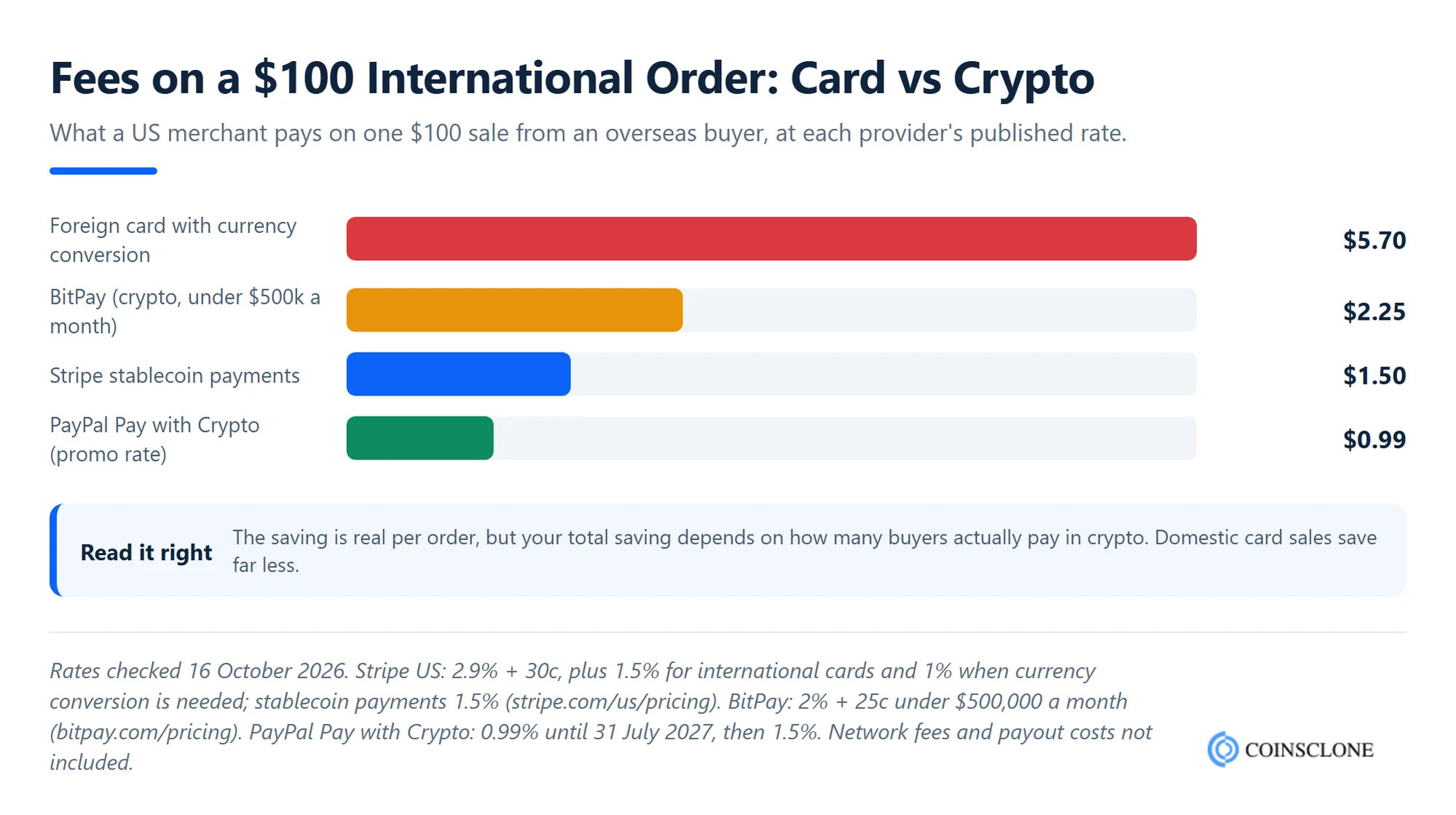
BitPay charges 2% + 25c under $500,000 a month, falling to 1% + 25c above $1 million. Stripe charges 1.5% for stablecoin payments. PayPal charges 0.99% for Pay with Crypto until 31 July 2027, and 1.5% after that.
Two points keep these numbers honest. First, network fees and payout fees can add a little on top. Second, your total saving depends on how many buyers actually pay in crypto. A store with mostly local card buyers will save far less than a travel site selling abroad.
Why Use a Crypto Payment Gateway? 5 Key Gains
A crypto payment gateway brings clear gains for merchants, buyers and platforms. Here are the main ones.
Smooth Payments
With a crypto payment gateway, users can send a single payment or a bulk batch of payouts in one flow. If an error occurs, such as a wrong amount, the gateway flags it so the merchant can top it up or refund it. In a market without a central help desk, this support layer is a real plus for users.
Also, young users on games and Web3 apps can spend the crypto they already hold. In turn, this brings new buyers to merchants.
New Markets
Crypto opens markets that cards and banks serve poorly, such as buyers in countries where foreign cards fail. Unlike card payments, a confirmed crypto payment cannot be charged back. This removes the “friendly fraud” where a buyer gets the goods and then disputes the charge. Refunds still happen, but as a new payment the merchant sends.
Meanwhile, price swings are handled by settlement, not by the coin. A merchant can take stablecoins, or have the gateway swap each payment into local money at once. That way, a falling Bitcoin price never hits the merchant’s revenue.
Lower Transaction Fees
Cards and banks charge high fees on foreign and high-value payments, as the cost section above shows. Crypto gateways cut these costs because there are fewer middle banks between buyer and merchant. For a business with many foreign orders or payouts, the saving can be large.
Faster Payouts
With crypto, users can pay at any hour, even on weekends and bank holidays. Funds arrive in minutes, not days. This is a better option for travel, healthcare and gaming, where time matters. Businesses that handle high volumes also gain from faster cash flow.
Stronger Security and Clear Records
Each payment is recorded on a public blockchain, so both sides can check it. Good gateways add cold storage, signed webhooks, address screening and anti-money-laundering checks. However, security depends on how the gateway is built and run, not on the blockchain alone. Our guide on how to secure a crypto payment gateway covers the controls in detail.
As these gains grow, many startups now see a gateway as a business in its own right. Due to the recent trends in the crypto payment gateway industry, demand for them has grown fast.
Now that you know the gains, see how these gateways differ from card and bank systems. Our side-by-side guide >> Traditional vs Crypto Payment Gateway shows which model fits your needs.
Which Use Case Fits Your Business?
Not every business gains the same from crypto payments. It comes down to three things: whether you pay people abroad, how large and cross-border your sales are, and whether customers already ask for crypto. Use the test below to find your starting point.
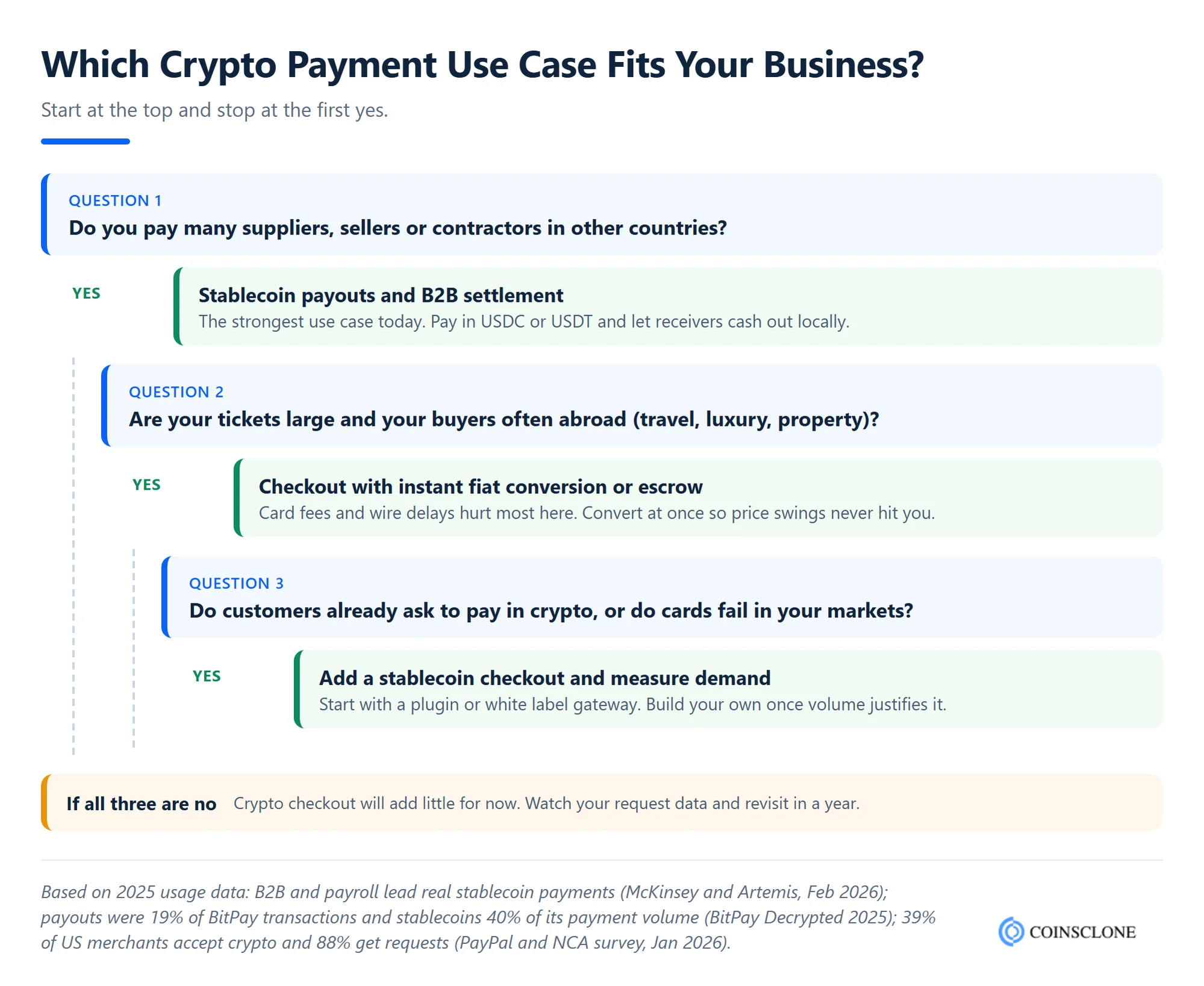
In short, payouts and B2B transfers lead today. Large cross-border sales come next. Domestic, low-value retail gains the least, so test demand there before you invest.
Limits and Rules to Plan For
Crypto payments solve real problems, but they also bring new ones. Plan for these before you launch.
- Price swings: Coins like Bitcoin can move a lot within an hour. Settle in stablecoins or convert at once if you do not want that risk.
- Refunds and wrong payments: Buyers sometimes pay too little, too much, too late or on the wrong network. You need a clear refund flow for each case.
- Payment limits: Some providers cap payment size. Stripe, for one, caps each stablecoin payment at US$10,000.
- Licences: In the EU, firms that hold or transfer crypto for clients need a CASP licence under MiCA, and the transition periods ended by 1 July 2026 at the latest. In the US, a gateway that moves money for others must often sign up with FinCEN as a money service firm.
- Travel Rule: In the EU, sender and receiver details must travel with every crypto transfer between firms since 30 December 2024.
- Stablecoin rules: The US GENIUS Act, signed on 18 July 2025, sets federal rules for payment stablecoin issuers. It takes effect by 18 January 2027 at the latest, so favour stablecoins from issuers that will qualify.
- Taxes: In many countries, spending crypto is taxed for the buyer, and the merchant must book the sale at its value on the day.
These limits do not rule crypto out. However, they decide which features of a crypto payment gateway you need, such as instant swaps to cash, refund tools and KYC checks.
A Crypto Payment Gateway as a Business Idea
From the use cases above, it is clear that crypto payment gateways play a growing role in how money moves. That opens two paths. You can accept crypto to cut costs and reach new buyers. Or you can build your own gateway and sell it as a service to other firms, earning a fee on each payment.
Building your own gateway is not a small project, so plan the budget with care. Our breakdown of the cost to develop a crypto payment gateway covers the main cost factors. If you want to follow a proven model, a BitPay clone script gives you a ready base to adapt.
Many firms build crypto payment gateways. Choose one based on their track record with payment products, their security practices and how well they know the rules in your market.
Build Your Crypto Payment Gateway with Coinsclone
Coinsclone has been building crypto products since 2018 and has delivered 350+ platforms for 200+ clients across 20 industries. Our team builds gateways for each use case in this guide, from stablecoin checkout and bulk payouts to fiat settlement. A standard gateway takes 6 to 9 weeks to launch, and a build with fiat settlement takes 10 to 14 weeks. Talk to our crypto payment gateway development company team about the use case you want to serve.
Wrapping Up
Crypto payment gateways are no longer a test. They are real tools for real firms. In 2026, the strongest use cases are B2B transfers across borders, payroll and payouts, travel, big-ticket sales and gifts to charity. Online stores, games, clinics and subscriptions are growing behind them.
Moving early can give you an edge as payments go online and cross borders. Start with the use case that fits your customers, settle in a way that removes price risk, and scale from there. With all aspects of crypto payment platforms in view, the decision is now in your hands.
Discover How Our Crypto Payment Gateway Unlocks Real-World Use Cases
Crypto Payment Gateway — powering seamless crypto transactions.
- Accept Global Payments : Instantly process crypto from anywhere.
- E-Commerce & Retail : Integrate easily with your store, online or offline.
- Custom Tokens & Wallets : Support multiple coins and your own token.
- Revenue Opportunities : Earn via transaction fees, subscriptions, and more.
Explore a free demo of our crypto payment gateway in 48 hours — no commitment needed.
Book a Free Demo to see how our gateway can transform your business payments and unlock new revenue streams.
Frequently Asked Questions
What are the main use cases of crypto payment gateways?
The main use cases are B2B transfers across borders, payroll and payouts, and online store checkout. Travel, big buys such as homes and cars, charity, games and subscriptions follow. In 2025, B2B payments made up about 60% of real stablecoin payment volume, per McKinsey and Artemis.
Which industries use crypto payment gateways the most?
Online shops, travel, games, luxury goods, fintech and charities are among the most active. Payouts are growing fastest: they made up 19% of BitPay’s transactions in 2025, up from 13% in 2024.
How much does a crypto payment gateway charge?
Most gateways charge about 1% to 2% per payment. BitPay charges 2% + 25c under $500,000 a month, Stripe charges 1.5% for stablecoin payments, and PayPal charges 0.99% for Pay with Crypto until 31 July 2027. Network and payout fees can add a little on top.
Are crypto payments legal for businesses?
In most major markets, yes, if you follow local rules. In the US, gateways that handle funds for others usually register with FinCEN, and in the EU they need a MiCA licence. A few countries, such as China, ban crypto payments, so check the rules where you and your customers operate.
Why should businesses use a crypto payment gateway?
A gateway lets a business accept crypto without handling wallets or blockchains itself. It brings lower fees on foreign payments, no card chargebacks, faster settlement and access to buyers who hold crypto. Settling in stablecoins or local currency removes most of the price risk.