

Planning to build your own crypto payment gateway, but not sure which features to pack in? You are not alone. The features of a crypto payment gateway decide whether merchants trust it, whether payments clear on time and whether the business can grow. Many startups copy a basic feature list and then find gaps once real merchants arrive.
This guide lists each feature a crypto payment gateway needs in 2026, in four groups: core, security, business and add-on. It also shows which ones to build at launch and which can wait, how a payment flows through them, and which new rules now shape the product.
In this guide:
- A full checklist of crypto payment gateway features, with what to build first
- How one payment moves through the gateway, step by step
- How to pick a custody model (custodial, non-custodial or MPC)
- The 2026 compliance features: MiCA, the Travel Rule and the GENIUS Act
- A short checklist to test any gateway’s features before you choose or build
See How a Powerful Crypto Payment Gateway Can Accelerate Your Launch
Crypto Payment Gateway Development — done right.
- Multi-Crypto & Blockchain Support: Accept Bitcoin, Ethereum, and more across multiple networks.
- Wallets & Auto-Processing: Pre-integrated wallets, instant payment detection.
- Easy Merchant Integration: Ready-to-use APIs, plugins, and checkout tools.
- Brand & Customization: Your branding, supported coins, fees, and settlement rules.
- Revenue Engine: Earn through transaction fees, merchant subscriptions, and auto-conversion.
💬 See a free branded demo of your crypto payment gateway in 48 hours — before you invest a cent.
👉 Book a Free Demo to discover how our crypto payment gateway solution can take you from idea to a live, transaction-ready platform in just 8 to 12 weeks.
Features of a Crypto Payment Gateway: The Full Checklist
Features of a crypto payment gateway fall into four groups. Core features take and confirm payments. Security features protect funds and data. Business features help merchants run their stores. Add-on features set you apart once the basics work well.
Here is the full list at a glance. The last column shows where each feature usually fits in the build plan.
| Group | Feature | What it does | When to build |
| Core | Multi-coin and stablecoin support | Accepts BTC, ETH, USDT, USDC and more across chains | Launch |
| Core | Invoices with a locked rate | Fixes the price for a short window, such as 15 minutes | Launch |
| Core | Payment detection and confirmations | Watches the chain and marks the order paid | Launch |
| Core | Auto conversion and settlement options | Pays the merchant in crypto, stablecoins, fiat or a mix | Launch (crypto), later (fiat) |
| Core | Underpayment, overpayment and refunds | Handles wrong amounts and returns funds | Launch |
| Security | 2FA, encryption and role access | Locks down logins and data | Launch |
| Security | Hot and cold wallets, multi-sig or MPC | Keeps most funds offline and splits signing power | Launch |
| Security | KYC, KYB, AML and address screening | Checks merchants and blocks risky funds | Launch |
| Business | Merchant dashboard and reports | Shows payments, balances and exports | Launch |
| Business | API, webhooks, SDKs and sandbox | Lets developers connect stores and apps | Launch |
| Business | Plugins and payment links | Adds checkout to Shopify, WooCommerce or an email | Phase 2 |
| Business | Payouts and mass payouts | Pays sellers, staff or partners | Phase 2 |
| Business | White label | Lets partners run the gateway under their own brand | Phase 2 |
| Add-on | AI fraud scoring | Flags odd payment patterns | Phase 2 |
| Add-on | QR and point-of-sale payments | Lets shops take crypto in person | Phase 2 |
| Add-on | Lightning and smart network routing | Picks the fastest, cheapest chain | Phase 2 |
| Add-on | AI agent payments (x402) | Lets software agents pay per request | Phase 3 |
Build order reflects a typical launch plan. Your market, licence and merchant type may change it.
The rest of this guide explains each feature, how it fits into a real payment and what it means for your build.
What is a Crypto Payment Gateway?
A crypto payment gateway is a service that lets a business take crypto as payment for goods and services. It creates a payment request, watches the blockchain for the money, confirms it and then pays out the merchant in crypto, stablecoins or local currency. It sits between the buyer’s wallet and the merchant’s account, much as Stripe or PayPal does for cards.
Merchants use crypto gateways to reach buyers worldwide, settle faster than bank wires and avoid card chargebacks. Demand is real. In a PayPal and National Cryptocurrency Association survey from January 2026, 39% of US merchants said they take crypto. And 88% said buyers had asked them to.
Stablecoins drive much of this growth. DefiLlama data puts US dollar stablecoins at about $310.7 billion on 1 October 2026. So a gateway that takes only bitcoin now misses most of the money that moves on-chain for payments.
To see why the features matter, it helps to follow one payment from checkout to the merchant’s bank.
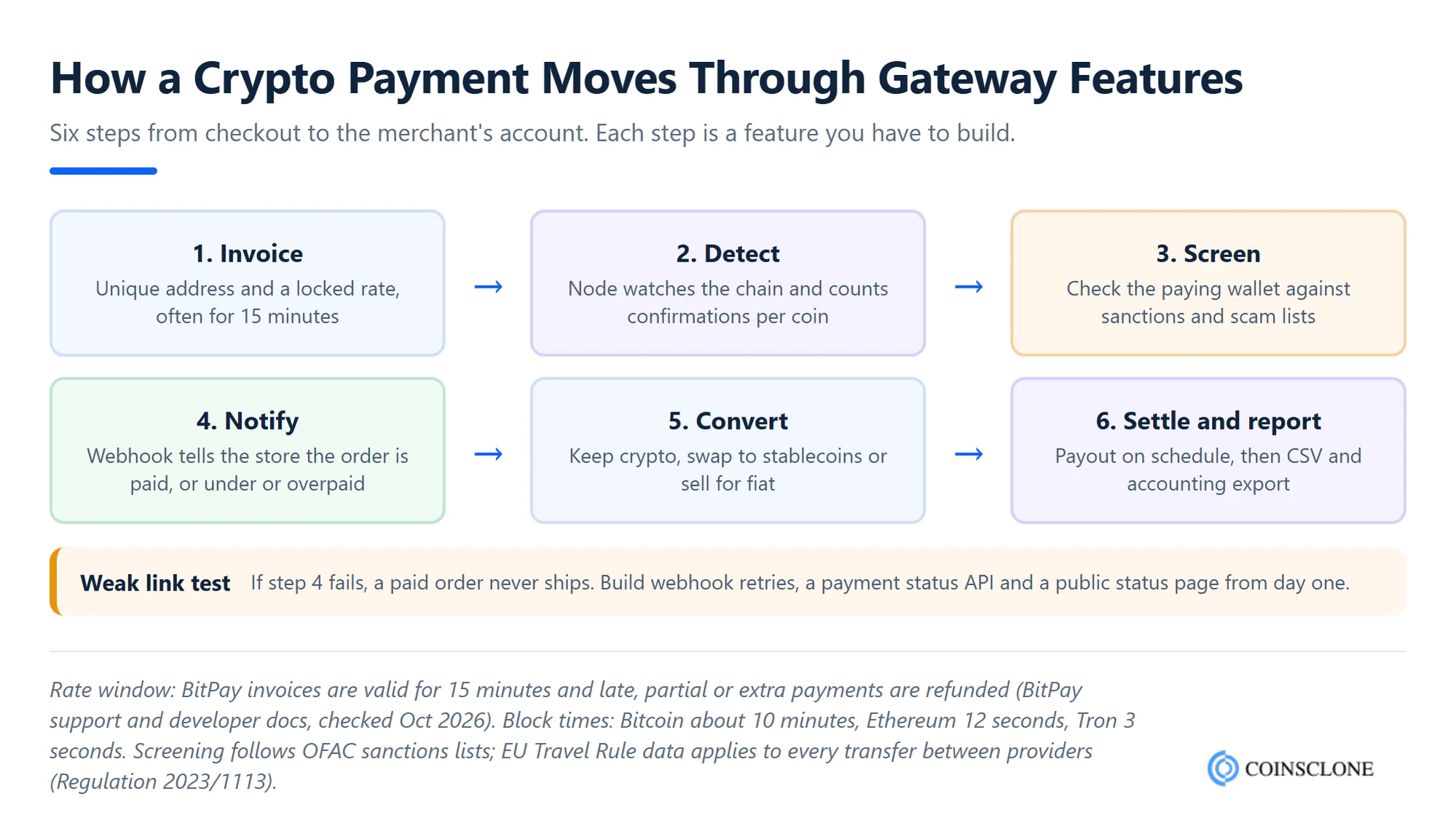
Each step in that flow is a feature. If one is weak, the whole payment feels slow or unsafe. To see how this differs from card payments, read our guide on crypto vs traditional payment gateways.
Why Features Matter in a Crypto Payment Gateway?
The features of a crypto payment gateway decide its future. Two gateways can use the same blockchains and still win or lose merchants based on what they offer around the payment. Here is why the right features matter so much.
- Lower running costs: Auto detection, conversion and payouts cut manual work. As a result, your team can serve more merchants without hiring at the same pace.
- Trust and loyalty: Merchants hand you their revenue. Strong security, such as two-factor login, encryption and cold storage, shows them their funds are safe.
- Compliance: Built-in KYC, AML and Travel Rule checks keep you in line with 2026 rules. In the EU, a gateway that holds or swaps crypto for clients now needs a MiCA licence.
- Competitive edge: Merchants compare gateways on fees, coins, payout speed and plugins. A complete feature set helps you win those side-by-side tests.
- Room to grow: A modular design lets you add new chains, payout types and markets without rebuilding the core.
In short, features power trust, uptime and profit. Now let us look at each one in detail.
Top Features to Consider Before You Build a Crypto Payment Gateway
Before you pick a build partner, get clear on the purpose of your gateway, the merchants you serve and the features they need. Here is each group in detail.
Core Features
Core features are the base of every crypto payment gateway. They take the payment, confirm it and pay the merchant.
- Multi-coin, multi-chain and stablecoin support: Buyers want to pay with what they hold. That means Bitcoin, Ether, USDT and USDC on chains such as Ethereum, Tron, Solana, Base and Polygon. For USDT on Tron, use TRC-20, the current token standard.
- Invoices with a locked rate: The gateway fixes the crypto amount for a short time so price swings do not hit the buyer or the merchant. BitPay, for example, keeps an invoice valid for 15 minutes and declines and refunds payments sent after that.
- Real-time payment detection: The gateway watches the chain, spots the payment and confirms it. Speed depends on the chain. A Bitcoin block takes about 10 minutes, an Ethereum slot 12 seconds and a Tron block 3 seconds. So let merchants set how many confirmations each coin needs.
- Auto conversion and payout choices: Merchants can keep crypto, swap it to stablecoins or turn it into cash at the time of sale. This protects them from price swings and helps them pay bills in fiat.
- Underpayment, overpayment and refund handling: Buyers sometimes send too little, too much or too late. A good gateway flags the gap, asks for the rest or refunds the extra. Since crypto has no card-style chargebacks, a clear refund flow is the only way to fix mistakes.
- Wallet options: Offer hot wallets for daily flow and cold storage for reserves. Let merchants choose a custodial account or payouts straight to their own wallet. We cover how to pick a model in the custody section below.
- Smart contract automation: On EVM chains, smart contracts can split payments, run escrow and release funds when rules are met. This cuts manual steps and errors.
Want to see which gateways have these features? See our top crypto payment gateways comparison.
Security Features
Strong security is a must for a crypto payment gateway. One breach can end the business, and hackers know gateways hold large sums. Chainalysis counted about $3.4 billion stolen from crypto services in 2025. These features belong in every build.
- Two-factor authentication and role access: Every login needs a second factor. Role-based access means a support agent cannot move funds, and an admin action needs a second approval.
- End-to-end encryption: Encrypt data as it moves and where it is stored, so buyer details and API keys stay private even if a server is hacked.
- Hot and cold wallet split: Keep only what you need for daily payouts in hot wallets. Store the rest offline in cold storage.
- Multi-sig or MPC signing: Split signing power so that no single person or server can move funds alone. Our MPC wallet development guide explains how key shares work.
- DDoS protection and uptime monitoring: Attack traffic should not take checkout offline. Pair DDoS shields with a public status page so that merchants can see uptime.
- KYC, KYB and AML checks: Verify merchants (KYB) and, where rules require, buyers (KYC). Then watch the flow of funds for signs of money laundering.
- Address screening: Check incoming funds against sanctions lists and known scam or hack wallets before you credit the merchant.
Want to go further? Read our expert guide with tips to secure a crypto payment gateway.
Business Features of a Crypto Payment Gateway
Gateways serve buyers, but merchants pay the fees. These features make your gateway easy for a shop to run each day.
- Merchant dashboard: A clean dashboard shows every payment, its status, balances and payouts. It should let merchants search, filter and export without help.
- API, webhooks, SDKs and sandbox: Developers need clear docs, a REST API and webhooks that tell the store when an order is paid. A sandbox that works like the live system lets them test before they go live.
- Plugins and payment links: Ready plugins for Shopify, WooCommerce and Magento add crypto checkout in minutes. Payment links and invoices let service firms get paid by email or chat. Our guide on how to integrate a crypto payment gateway walks through each method.
- Payment analytics: Show which coins, chains and countries bring the most sales, and where buyers drop off. This helps merchants make smarter choices.
- Reconciliation and accounting exports: Merchants must match every payment to an order and report it for tax. Exports in CSV, plus links to accounting tools, save hours each month.
- Payouts and mass payouts: Marketplaces, gaming sites and gig platforms pay many people at once. Bulk payouts in stablecoins turn the gateway into a two-way money tool.
- Fee and settlement settings: Let admins set fees per merchant, choose who pays the network fee and schedule payouts daily or weekly.
- White label: With white label crypto payment gateway solutions, banks, PSPs and partners run the gateway under their own brand.
Before you lock the feature list, plan your budget with our cost to develop a crypto payment gateway breakdown.
Add-on Features
Once the core works, add-on features help your gateway stand out. Pick them based on the merchants you serve.
- AI-powered fraud detection: Machine learning models score each payment and flag odd patterns, such as many small payments from new wallets. As a result, your risk team spends time only on real threats.
- Dynamic QR code payments: Each order gets its own QR code with the amount built in. This works well for shops, cafes and point-of-sale terminals.
- Lightning and smart network routing: Route each payment to the fastest, cheapest network the buyer can use. Bitcoin’s Lightning Network makes small payments near instant; Square, for example, began taking bitcoin over Lightning in November 2025.
- Loyalty rewards: Cashback or token rewards for repeat buyers help merchants bring people back.
- Mobile apps: iOS and Android apps let merchants track sales and take in-store payments from a phone.
- AI agent payments: Software agents now pay for data and services on their own. Coinbase’s open x402 standard handles these pay-per-request payments. Chainalysis counted 100 million x402 payments on Base by the end of March 2026.
For a look at where these features are heading, read our crypto payment gateway trends and predictions.
Custody Model: The Feature That Shapes All the Others
The biggest feature choice is not a button on the dashboard. It is who holds the money. Your custody model shapes your licence, how you guard funds and the merchants you can serve.
- Custodial: The gateway holds merchant funds, then converts and pays them out. This is the easiest model for merchants and lets you offer fiat settlement. However, you hold client assets, so you need a licence in most markets and strong custody security.
- Non-custodial: Payments go straight to the merchant’s own wallet. You never hold the funds, so the risk and licence burden are lower. Self-hosted tools such as BTCPay Server work this way. The trade-off is that fiat conversion and refunds are harder to offer.
- MPC or multi-sig (hybrid): Signing power is split between the merchant, the gateway and sometimes a third party. No one can move funds alone. This model suits larger merchants who want control with team approvals.
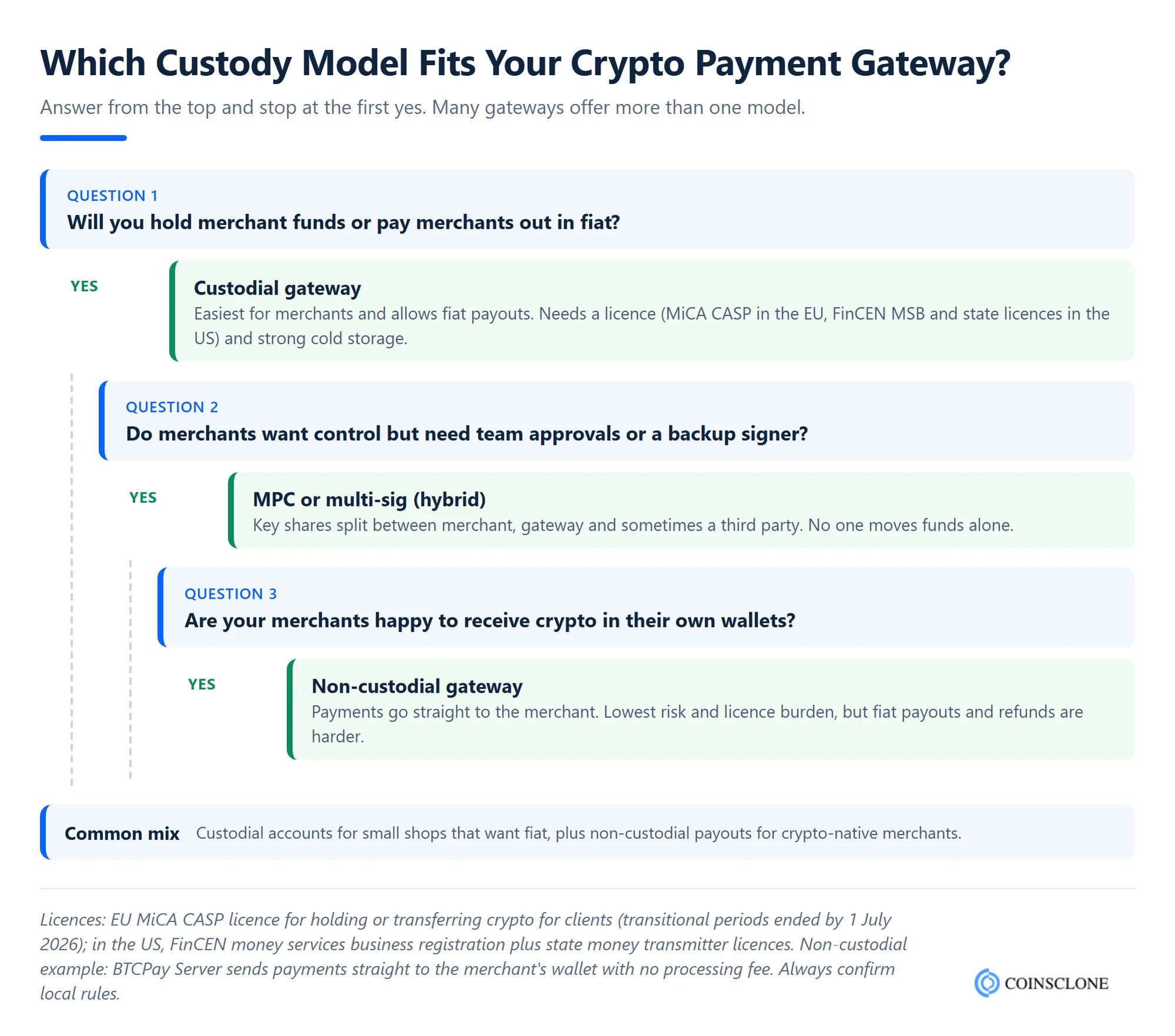
Many gateways mix models. For example, they hold funds for small shops that want fiat, and pay crypto-native merchants straight to their own wallets.
Compliance Features a Crypto Payment Gateway Needs in 2026
Rules for crypto payments got much clearer between 2024 and 2026. So meeting them is now part of the product, not just a legal task. Here is what your gateway must support.
- MiCA licensing (EU): Under MiCA, firms that hold, swap or transfer crypto for clients need a CASP licence. The grace periods in each member state ended by 1 July 2026 at the latest.
- Travel Rule data: Since 30 December 2024, the EU Transfer of Funds rules have required sender and receiver details on each crypto transfer between firms. The FATF standard sets a USD/EUR 1,000 threshold, and many countries follow it.
- Stablecoin rules (US): The GENIUS Act, signed on 18 July 2025, set federal rules for payment stablecoin issuers. It takes effect by 18 January 2027 at the latest. So gateways should favour stablecoins from licensed issuers.
- KYB, KYC and sanctions screening: Verify each merchant, screen wallets against sanctions lists and keep records for audits.
- Tax and audit reports: Exports that show the value of each payment on the day it was received help merchants report income correctly.
Rules differ by country, so build these checks as parts you can switch on per market.
How to Check a Gateway’s Features Before You Choose or Build
Whether you are choosing a gateway or briefing a build team, test these points. They show whether a feature list holds up in real use.
- All-in fee: Add the headline fee, the conversion spread and payout fees. Most gateways charge about 1% to 2% per payment. For example, BitPay charges 2% plus 25 cents below $500,000 a month.
- Settlement speed and currencies: Check how fast funds reach the merchant and in which currencies.
- Coins and chains: Make sure USDT and USDC are supported on low-fee chains, not just Ethereum.
- Refund and wrong-amount flows: Send a test underpayment and overpayment in the sandbox and see what happens.
- Uptime proof: Look for a public status page and a written uptime promise.
- Developer tools: Check the API docs, webhook retries and sandbox before you sign.
- Licences: Confirm the licences the gateway holds in the markets you sell to.
If you want to own these features instead of renting them, our step-by-step guide shows how to build a crypto payment gateway from scratch.
Partner with Coinsclone to Build a Feature-Rich Crypto Payment Gateway
In a crowded market, the gateway with the right features wins merchants. Knowing the features of a crypto payment gateway is the first step. The second is picking a build partner who can ship them securely and on time.
Coinsclone is a leading Crypto Payment Gateway Development Company. We have been building crypto products since 2018 and have delivered 350+ platforms for 200+ clients across 20 industries. Our gateways ship with multi-coin and stablecoin support, custody choices, merchant dashboards, plugins and ready compliance tools.
A standard crypto payment gateway takes 6 to 9 weeks to launch with us. A build with fiat settlement takes 10 to 14 weeks. Share your feature list, and our team will map it to a clear plan and timeline.
See How a Powerful Crypto Payment Gateway Can Accelerate Your Launch
Crypto Payment Gateway Development — done right.
- Multi-Crypto & Blockchain Support: Accept Bitcoin, Ethereum, and more across multiple networks..
- Wallets & Auto-Processing: Pre-integrated wallets, instant payment detection.
- Easy Merchant Integration: Ready-to-use APIs, plugins, and checkout tools.
- Brand & Customization: Your branding, supported coins, fees, and settlement rules.
- Revenue Engine: Earn through transaction fees, merchant subscriptions, and auto-conversion.
💬 See a free branded demo of your crypto payment gateway in 48 hours — before you invest a cent.
👉 Book a Free Demo to discover how our crypto payment gateway solution can take you from idea to a live, transaction-ready platform in just 8 to 12 weeks.
Frequently Asked Questions
What are the key features of a crypto payment gateway?
The core features take and confirm payments. They include support for many coins and stablecoins, invoices with a locked rate, fast payment detection, auto conversion to fiat and refunds. On top of that, you need security features such as 2FA, cold storage and multi-sig or MPC signing. Business features include a merchant dashboard, API and webhooks, plugins and payouts.
How does a crypto payment gateway handle price volatility?
It locks the exchange rate on each invoice for a short window, often about 15 minutes. Then it can convert the payment to stablecoins or local currency at once. This way, the merchant receives the amount they priced, even if the coin’s price moves later.
Should a crypto payment gateway be custodial or non-custodial?
It depends on your merchants and your licence. Custodial gateways can offer fiat payouts and simple refunds, but they need a licence and must guard funds well. Non-custodial gateways send funds straight to the merchant’s wallet, which lowers risk. Many gateways offer both, or use MPC to split control.
How many cryptocurrencies should a gateway support?
Start with the coins most buyers use: Bitcoin, Ethereum, USDT and USDC on low-fee chains. Then add more based on merchant demand. A short list that works well beats a long list with slow or broken chains.
Can crypto payments be charged back or refunded?
Crypto payments cannot be charged back like card payments, because blockchain transfers are final. However, a gateway can send a refund as a new transaction. That is why a clear refund flow for wrong amounts and returns is a core feature.
What compliance rules apply to crypto payment gateways?
In the EU, gateways that hold or transfer crypto for clients need a MiCA CASP licence and must send Travel Rule data on transfers. In the US, most gateways sign up with FinCEN as money services firms, and the GENIUS Act sets stablecoin rules. Every market also expects KYC, AML and sanctions checks.
How long does it take to build a crypto payment gateway?
It depends on the features. At Coinsclone, a standard crypto payment gateway takes 6 to 9 weeks, and a build with fiat settlement takes 10 to 14 weeks. Custom features such as mobile apps or new chains can add time.