

Remember when everyone wondered what on earth you’d do with a crypto payment gateway? It’s funny now, isn’t it, how fast the world caught on. In 2026, Visa settles billions in stablecoins, Square sellers take bitcoin at the till, and AI agents pay for data on their own. This guide covers the crypto payment gateway trends shaping 2026 and the predictions that will shape the next few years.
You will get the real market numbers, the ten trends that matter right now, and ten predictions with dates where we have them. We also cover the risks that could slow things down and a short checklist to keep your gateway ready for what comes next. Every figure comes from a named, dated source, so you can plan with it.
In this guide:
- The market in numbers: what the main research firms say the gateway market is worth, and why their forecasts differ.
- 10 trends in 2026: from stablecoin settlement to crypto checkout inside PayPal, Stripe, Shopify and Square.
- 10 predictions: AI agent payments, new stablecoin rules in January 2027, CBDCs, tap to pay and more.
- The risks: rules, hacks, custody and user friction, with real 2025 and 2026 data.
- A future-proof checklist for founders who plan to build or upgrade a gateway.
Discover How to Build a Secure Crypto Payment Gateway
Crypto Payment Gateway Development — done right.
- Security First : Implement robust encryption and multi-layered protection.
- Seamless Integration : Pre-built modules for wallets, transactions, and APIs.
- Custom Branding : Your design, your tokens, your user experience.
- Revenue Ready : Support crypto payments, subscriptions, and merchant fees.
Learn practical tips to secure your crypto gateway before going live.
Book a Free Demo to explore how our development expertise can make your payment gateway secure, compliant, and ready for business in just a few weeks.
Crypto Payment Gateway Trends 2026: The Market in Numbers
The crypto payment gateway market has grown fast over the past few years. As Bitcoin and stablecoins spread, more businesses wanted a simple way to take them. A crypto payment gateway does that job. It takes the coin from the buyer, confirms it on the blockchain, and pays the seller in crypto or local money.
So how big is the market? It depends on who you ask. The main research firms agree on the direction but not on the size.
The Business Research Company puts the crypto payment gateway market at $2.39 billion in 2026, growing to $4.74 billion by 2030. That is an 18.7% yearly growth rate.
Here is how three of the most cited reports compare:
| Research firm | 2025 or 2026 size | Long-run forecast | Yearly growth |
| The Business Research Company (Sept 2026) | $2.39B in 2026 | $4.74B by 2030 | 18.7% |
| Future Market Insights | $1.9B in 2026 | $6.85B by 2036 | 13.6% |
| Market Research Future | $1.71B in 2025 | $8.81B by 2035 | 17.8% |
Why do they differ? Each firm counts a slightly different thing. Some count only gateway fees. Others add software, services and on-chain tools. Either way, every forecast points to a market that will at least double within a decade.
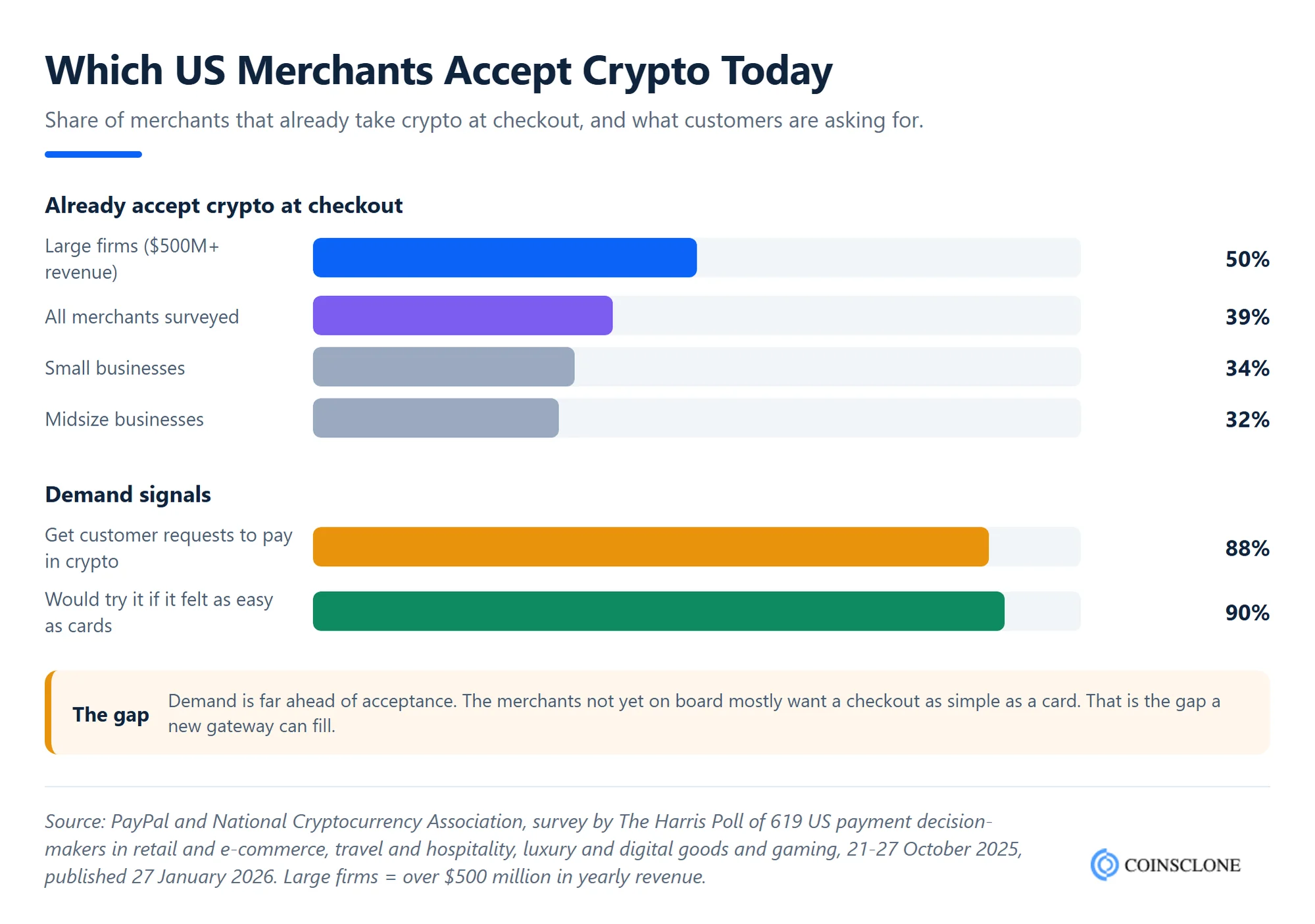
Demand from shops backs this up. In a PayPal survey of 619 US payment leaders, 39% of merchants already take crypto at checkout. What’s more, 88% say customers ask to pay with crypto. Lower fees, faster payouts and global reach make gateways a good fit for firms of all sizes.
The players have changed too. Coinbase Commerce, once a top name, shut its portal on 31 March 2026. Its merchants moved to Coinbase Business, which holds funds for them and serves only US and Singapore firms. Still, BitPay, NOWPayments and CoinGate serve merchants worldwide, and big card and fintech brands now compete in the same space. You can compare them in our list of top crypto payment gateways.
As the crypto payment market grows, it helps to know how it differs from card payments. Check out our in-depth guide, Crypto vs Traditional Payment Gateway, to see the fees, speed and risk of each side by side.
10 Current Crypto Payment Gateway Trends
These are the trends you can already see in live products in 2026. Each one changes what merchants expect from a gateway, and so what a new gateway must offer.
1. Stablecoins Become the Main Way to Pay
Stablecoins are coins pegged to a currency such as the US dollar. A few years ago they were a prediction. Today they are the default for most business payments, because the price does not swing while the payment clears. Data from DefiLlama shows $310.7 billion in US dollar stablecoins in use on 1 Oct 2026.
As a result, most new gateways now settle in USDC or USDT, even when the buyer pays in Bitcoin or Ether. For a merchant, that means crypto speed without crypto price risk.
2. Big Payment Brands Build Crypto Into Checkout
The biggest shift of the past year is who offers crypto checkout. It is no longer only crypto firms:
- PayPal: launched Pay with Crypto in July 2025 for US merchants, with 100+ coins. Its 0.99% launch rate ran for the first year, to 31 July 2026, and the standard rate is now 1.5%.
- Stripe: accepts USDC on Ethereum, Solana, Polygon, Base and its own Tempo chain, which went live on 18 March 2026.
- Shopify: has taken USDC on Base through Shopify Payments since June 2025.
- Square: has let US sellers (outside New York) take bitcoin over the Lightning Network since 10 Nov 2025. It charges no fee until the end of 2026 and 1% after that, per Square’s own press release.
For new gateways, this raises the bar. Merchants now compare you with brands they already trust. So a new gateway must win on niche, region, fees or features such as payouts and multi-chain support.
3. More Merchants Accept Crypto Payments
Paying with crypto is becoming normal. In the PayPal survey, half of firms with over $500 million in yearly sales take crypto, against 34% of small firms. Among merchants who accept it, crypto makes up more than 26% of sales, and 72% saw those sales grow over the past year.
As trust grows and clearer rules arrive, more industries will follow. Travel, gaming, digital goods and luxury retail lead the way today.
4. Many Coins, Many Chains, One Checkout
Just a few years back, businesses had to pick one or two coins to accept. Now buyers expect to pay with whatever they hold, on whatever chain they use. So gateways now take coins from many chains and swap them for you. The buyer pays in any supported coin, and the merchant receives one currency, most often a stablecoin or local money.
This flexibility removes friction at checkout. It also cuts the merchant’s reliance on a single coin or chain.
5. QR Codes and Lightning in Physical Stores
QR code payments remain the simplest way to pay with crypto in person. The buyer scans a code with a phone wallet, and the payment starts. Today, top crypto payment gateways make QR codes easy to create, so shops can print or show them on screen.
Speed used to be the problem, since Bitcoin blocks take about 10 minutes. The Lightning Network fixes that. Square now shows a Lightning QR code at the till, and the buyer pays from any Lightning wallet in seconds.
6. Easier Checkout With Less Wallet Hassle
Checkout ease decides whether buyers use crypto at all. In the PayPal survey, 90% of merchants said they would try crypto if it felt as easy as paying by card. That is why gateways now offer one-click checkout pages, wallet buttons and plugins for WooCommerce and Shopify.
Smart wallets help too. With Ethereum’s EIP-7702 upgrade (live since May 2025), a normal wallet can act like a smart account. As a result, apps can pay the gas fee for users and bundle steps into one tap.
7. Mobile-First Gateways
Most crypto payments now start on a phone. Mobile apps let users pay, track transactions and manage funds in one place. Features such as Face ID login and push alerts when a payment lands make the experience safer and simpler.
For merchants, mobile apps also mean a POS on any phone or tablet. So a gateway without a strong mobile app now looks outdated.
8. Subscriptions and Monthly Crypto Billing
Subscription products have their own loyal audience, and crypto now fits into them. Gateways send repeat invoices, and smart contract wallets can approve set amounts on a schedule. This lets SaaS tools, streaming apps and clubs bill in stablecoins each month.
In short, you can offer subscription content and simply take crypto as payment. This widens payment options without changing the product.
9. DeFi Rails Behind the Checkout
DeFi (decentralized finance) tools now run in the background of many gateways. On-chain swaps convert the buyer’s coin into the merchant’s chosen stablecoin within seconds. Other tools let firms park spare cash in Treasury bill tokens. When creating a crypto payment gateway, these DeFi tools cut costs and reduce reliance on middlemen.
But the merchant hardly sees any of this. The best gateways hide DeFi behind a simple checkout and a clean dashboard.
10. Compliance Moves Into the Gateway
Rules have caught up with crypto payments. In the EU, MiCA’s transition period for crypto firms ended on 1 July 2026. In the US, the GENIUS Act set the first federal rules for payment stablecoins in July 2025. As a result, gateways now build compliance into the product: business checks (KYB), wallet screening, Travel Rule data and tax reports.
For founders, this changes the build. Compliance is no longer an add-on after launch. It shapes the design from day one.
As these trends show, the market is changing fast, and businesses want flexible, low-cost options. This is where a white label crypto payment gateway becomes a strong choice. But what lies ahead? Let’s look at the predictions that will shape the future of crypto payment gateways.
10 Crypto Payment Gateway Predictions for 2027 and Beyond
This section lists the shifts we expect next, based on live pilots, new rules and public company plans. Some are close to certain. Others are early bets.
1. AI Agents Will Pay for Things on Their Own
AI agents that book, buy and pay are moving from demos to real use. Coinbase’s open x402 standard lets an agent pay for a web service in USDC with a single request. Data from Chainalysis shows x402 passed 100 million transactions on Base by early 2026. Stripe and Tempo launched a similar Machine Payments Protocol in March 2026.
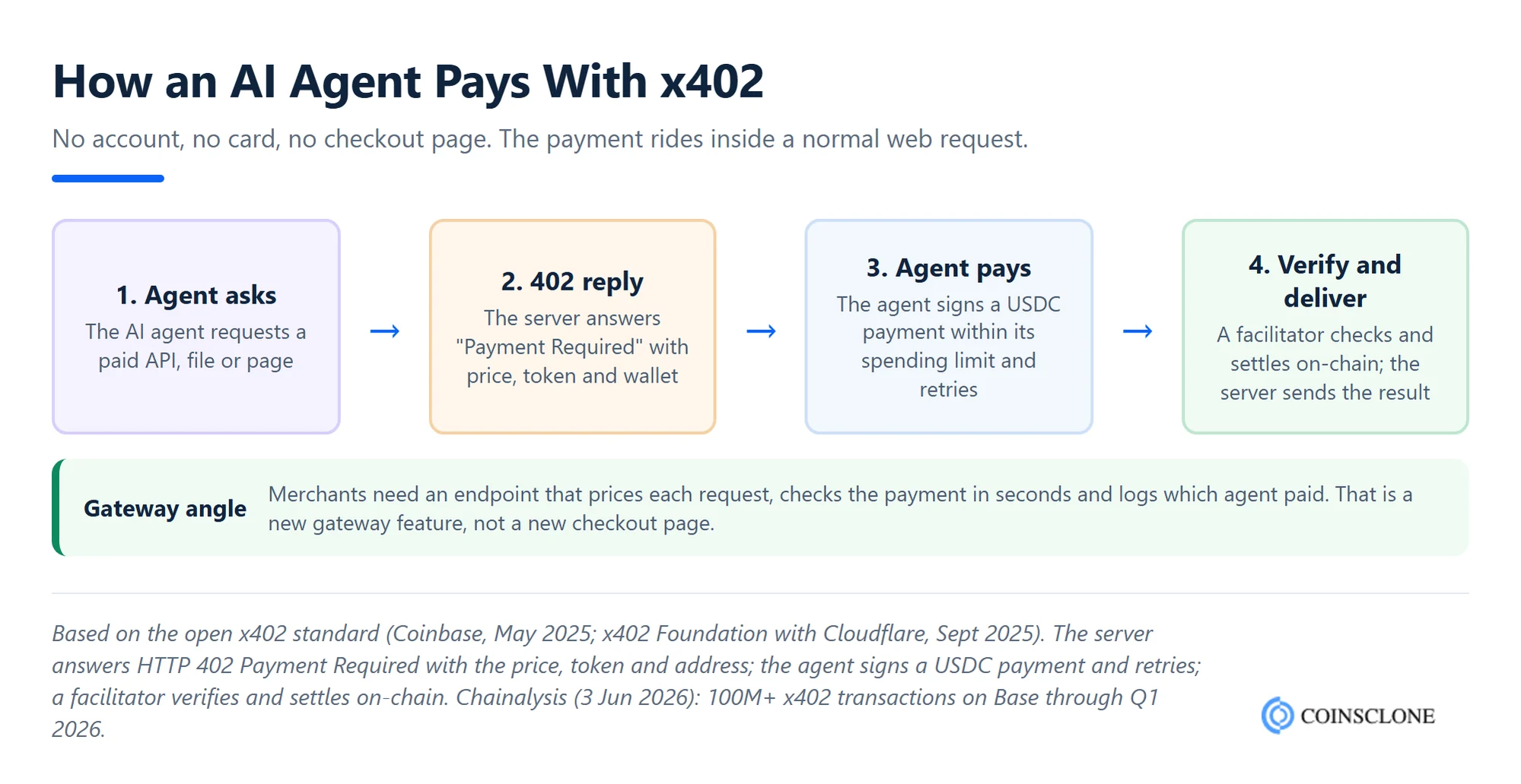
Voice assistants are part of this too. You won’t need a special voice system. You will just ask your assistant to buy something, and its agent will pay through a gateway. So we expect gateways to add agent payment endpoints, spending limits and clear logs of what each agent bought.
2. Stablecoins Under Clear Rules Become the Norm
The GENIUS Act takes effect no later than 18 January 2027. From then on, payment stablecoins in the US must come from approved issuers, backed one to one by cash and other safe, short-term assets. The EU’s MiCA law sets much the same rules.
As a result, merchants will trust stablecoin payments more, and banks will feel safer joining in. We expect gateways to favor regulated coins and to show buyers which coins meet these rules.
3. Card Networks Will Settle More in Stablecoins
Visa is the clearest sign of where settlement is heading. On 8 Sept 2026, Visa said its stablecoin settlement volume passed a $20 billion yearly run rate, up more than 15 times in a year. It also runs 160+ stablecoin-linked card programs.
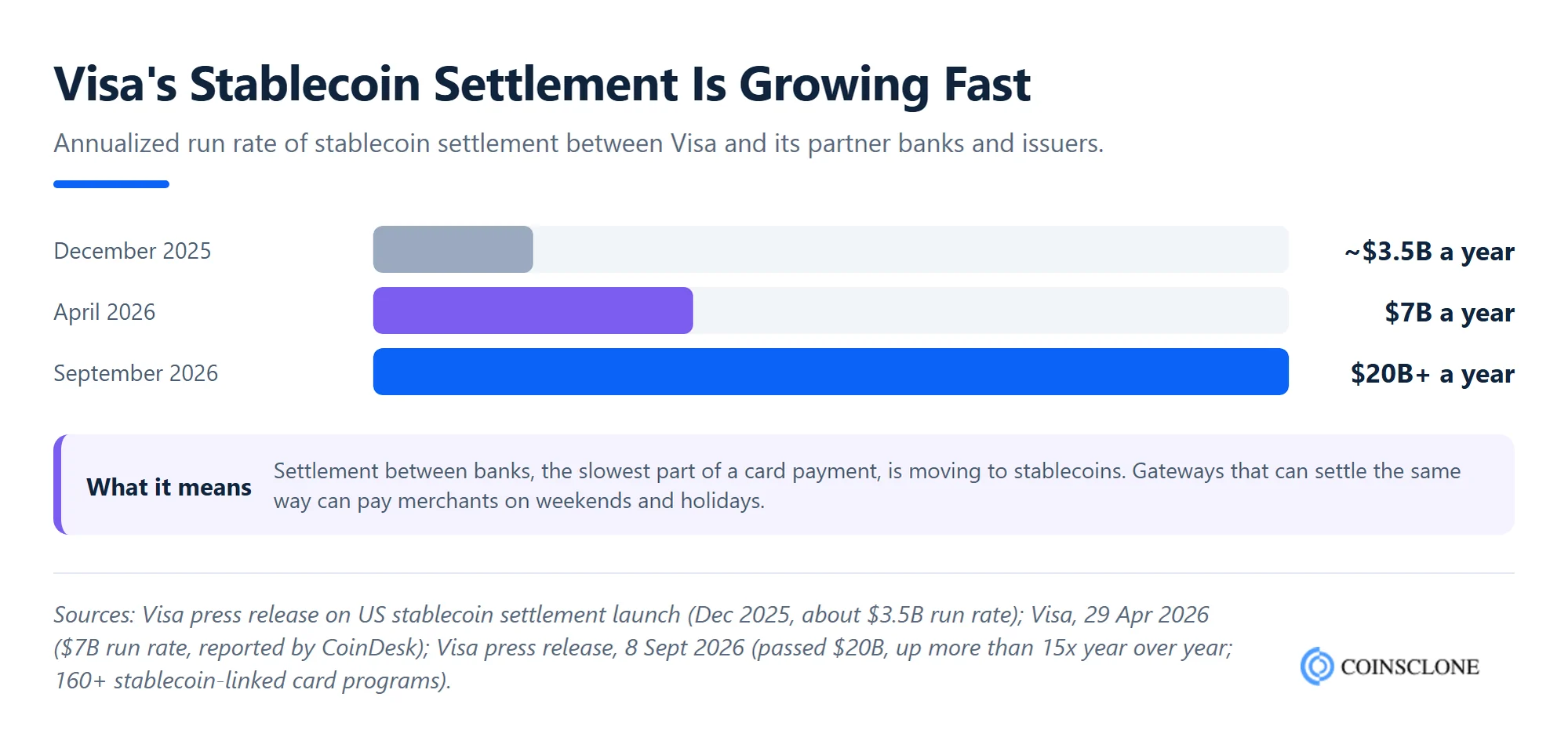
So banks and card issuers will settle with each other in stablecoins, often on weekends and holidays. Gateways that can plug into these rails will offer faster payouts than card firms.
4. Tap to Pay With Crypto Everywhere
The pandemic changed how we pay, and contactless became the norm. NFC (Near Field Communication) lets you pay by holding a phone or card near a reader. With 160+ stablecoin-linked card programs on Visa alone, crypto holders can already tap to pay at millions of shops.
Direct crypto tap to pay has started too. On Square’s newer registers, buyers can pay in bitcoin by holding a Lightning wallet phone near the reader. Next, we expect this inside more wallet apps, with the gateway converting at the moment of sale. The shop sees a normal payment, and the buyer spends crypto.
5. One Gateway for Web, App, Store and Payouts
To serve each kind of business, gateways will offer one platform for all channels. That means e-commerce plugins, in-app payments, point-of-sale (POS) apps and mass payouts in one dashboard. As a result, buyers can skip slow card and bank systems and pay faster.
Payouts matter here too. Firms now pay staff and suppliers abroad in stablecoins. So we expect gateways to handle money in and money out, not only checkout.
6. Passkeys and Biometrics Replace Seed Phrases
Biometric login is set to become standard in crypto payment security. Fingerprint and face scans, tied to passkeys stored on the device, add a strong layer of protection. This cuts fraud and account theft, a key part of the security of a crypto payment gateway.
At the same time, smart accounts let users recover wallets without a seed phrase. We expect most consumer wallets to work this way by 2028, which removes one of the biggest barriers for new users.
7. Paying With Tokenized Assets
Tokenization turns real-world assets like Treasury bills, real estate and stocks into tokens on a blockchain. RWA.xyz data shows over $38 billion in tokenized assets on public chains in Oct 2026, led by Treasury bill funds. You can learn more in our guide to real world asset tokenization.
Soon, businesses may pay suppliers straight from a tokenized money market fund, earning yield until the moment they pay. Gateways that support these tokens will win treasury and B2B clients.
8. Smart Contracts Will Run More of the Payment
Smart contracts are self-running programs on a blockchain. In payments, they can hold funds in escrow, split a sale between sellers, release a payment on delivery or stream pay by the second. They remove manual steps and middlemen, which lowers cost.
We expect marketplaces and B2B platforms to lead here. A single smart contract can replace an escrow agent, a payout team and a reconciliation tool.
9. CBDCs Will Grow, But Unevenly
Central Bank Digital Currencies (CBDCs) are a digital form of a country’s own money, issued by its central bank. The Atlantic Council’s tracker counts 146 countries looking into one, but only three have fully launched: the Bahamas, Jamaica and Nigeria.
The picture differs by region. In Jan 2025, a White House order banned a US CBDC. In Europe, lawmakers backed the digital euro law in June 2026, and the ECB plans a pilot in 2027. So gateways in Europe and Asia should plan for CBDCs. US gateways can stick with stablecoins that meet the new rules.
10. Machine-to-Machine and IoT Payments
The IoT (Internet of Things) means devices that connect to the internet, from cars to smart meters. Combine them with crypto, and devices can pay each other. For instance, an electric car could pay a charging station by the minute. Or imagine your TV paying your streaming bill on its own while you relax on the couch.
Smart contracts and tools like x402 make this work, because they handle payments of a few cents at a very low cost. Card fees make tiny payments like these unprofitable, so crypto has a real edge here.
Now, as these predictions show, the future is full of potential. One question remains: what could slow it all down?
Risks That Could Slow These Trends
Not every trend will play out as planned. Here are the main risks to watch:
- Rules that change: GENIUS Act rules are still being written, and each country moves at its own pace. A gateway that works in one market may need new licences in the next.
- Hacks and theft: Chainalysis reports that $3.4 billion was stolen from crypto services in 2025, including about $1.5 billion from the Bybit hack. Gateways that hold funds are a target.
- Custody shifts: When Coinbase Commerce closed in March 2026, merchants outside the US and Singapore had to move fast. Using just one firm for payments is a real risk.
- User friction: Wallets, gas fees and wrong-network errors still confuse new users. Until checkout is as easy as a card, many buyers will stick with cards.
- Price swings: Bitcoin and Ether still move a lot. Stablecoin payouts and instant swaps solve most of this, but merchants must switch them on.
In short, the trends are real, but the winners will be gateways that handle rules, safety and ease of use well.
How Can You Position Yourself in This Growing Competition?
In this fast-moving market, launching your own crypto payment platform is one of the best ways to stay ahead. Looking at these trends, one thing is clear: none of this will slow down soon. As crypto spreads, card and bank systems may struggle to keep up with buyers who want to pay in crypto. A well-designed crypto payment gateway can fill that gap.
Also, a crypto gateway pays out in real time, without the delays of old-style banks. As rules settle and tools improve, businesses that build crypto payment networks now will be best placed to grow. Here is a short checklist to make your gateway future-proof:
- Stablecoin payouts: Take USDC and USDT on many chains, and pay out in stablecoins or local money.
- Multi-chain checkout: Support Bitcoin with Lightning, Ethereum and its layer 2s, Solana and Tron.
- Compliance built in: KYB onboarding, wallet screening, Travel Rule data and tax exports.
- Agent-ready APIs: Endpoints and spending limits for AI agent payments such as x402.
- Every channel: Web plugins, mobile SDKs, POS apps and mass payouts in one dashboard.
- Tight security: MPC or multisig wallets, signed webhooks and frequent audits.
Planning features in detail? Our guide to the features of a crypto payment gateway covers each one. But how do you turn this plan into a live product? That’s where Coinsclone comes in.
What is the Role of Coinsclone in Crypto Payment Gateway Development?
Coinsclone is a trusted crypto payment gateway development company that has built crypto and blockchain products since 2018. We have delivered 350+ platforms for 200+ clients across 20 industries. Our team of blockchain developers and business experts plans each project with you, step by step.
With our white label solutions and clone scripts, you can launch the payment gateway you have in mind. Our white label crypto payment gateway comes fully branded to match your business. A standard gateway goes live in 6 to 9 weeks, or 10 to 14 weeks with fiat settlement. Whether you want a fully custom build or a ready-to-launch one, we have the skills and the range to deliver.
Other Related Article,
What are the Use Cases of the Crypto Payment Gateway Platform?
Frequently Asked Questions
What is the future of crypto payment gateways?
The future is stablecoin-first, regulated and built into mainstream checkout. Visa now settles over $20 billion a year in stablecoins, and PayPal, Stripe, Shopify and Square all offer crypto payments. Next, expect AI agent payments, tap to pay with crypto and new US stablecoin rules from January 2027.
How big is the crypto payment gateway market in 2026?
Estimates range from about $1.9 billion to $2.39 billion for 2026. The Business Research Company expects $4.74 billion by 2030, growing 18.7% a year. Future Market Insights forecasts $6.85 billion by 2036.
Are stablecoins the future of crypto payments?
For business payments, yes. Stablecoins hold a steady value, settle in seconds and avoid price swings. That is why most gateways now settle in USDC or USDT. DefiLlama counts over $310 billion in US dollar stablecoins in use as of 1 Oct 2026.
How many businesses accept crypto payments?
In a PayPal survey published in Jan 2026, 39% of US merchants said they take crypto at checkout. Among large firms with more than $500 million in revenue, the figure was 50%.
What is the biggest risk for crypto payment gateways?
Security and changing rules are the two biggest risks. Hackers stole $3.4 billion from crypto services in 2025, per Chainalysis. At the same time, new laws such as MiCA in the EU and the GENIUS Act in the US mean gateways must build compliance into the product.
Is the future of crypto payments happening now or still hype?
It is real now, mostly for business payments sent across borders. Square sellers take bitcoin over Lightning, Shopify takes USDC, and Visa settles with banks in stablecoins. Everyday shopping with crypto is still small, but it is growing as checkout gets easier.
Discover How to Build a Secure Crypto Payment Gateway
Crypto Payment Gateway Development — done right.
- Security First : Implement robust encryption and multi-layered protection.
- Seamless Integration : Pre-built modules for wallets, transactions, and APIs.
- Custom Branding : Your design, your tokens, your user experience.
- Revenue Ready : Support crypto payments, subscriptions, and merchant fees.
Learn practical tips to secure your crypto gateway before going live.
Book a Free Demo to explore how our development expertise can make your payment gateway secure, compliant, and ready for business in just a few weeks.