

Thinking of launching your own crypto payment gateway? Then the first thing you need is a clear number. In 2026, the cost to develop a crypto payment gateway runs from about $20,000 for a white label launch to $300,000 or more for a custom platform built from scratch. Where you land depends on the build path, the number of chains, your compliance needs and who builds it.
This guide breaks that number down so you can plan a budget you can trust. You will see the price of each build path, the cost of each part of the gateway, what it costs to run each month and what compliance adds. You will also see when owning a gateway beats paying a processor 1% to 2% on every sale.
In this guide:
- Price by build path: white label, custom white label and full custom build, with time to launch.
- Price by component: payment engine, wallets, chains, APIs, dashboards, KYC and audits.
- Running and compliance costs: nodes, hosting, KYC checks, licences and yearly upkeep.
- Build or pay a processor: a worked example that shows the monthly volume where owning pays off.
- Ways to spend less: practical tips to cut cost without cutting security.
See How Our MVP System Cuts Down Your Crypto Payment Gateway Development Cost
Crypto Payment Gateway Development — done smarter.
- MVP System : Launch your payment gateway 90% faster, at half the cost.
- Ready-Made Modules : Wallets, invoicing, and API integration — all pre-built.
- Brand Customization : Your logo, your UI, your currency support.
- Revenue Engine : Earn from transaction fees, merchant onboarding, and premium APIs.
Get a free cost breakdown & live demo of your payment gateway — before spending a cent.
Book a Free Demo to discover how our MVP System helps you build a fully functional crypto payment gateway in just 8 – 12 weeks.
Cost to Develop a Crypto Payment Gateway in 2026
The cost to develop a crypto payment gateway in 2026 starts at about $20,000 to $60,000 for a white label gateway with core features. A custom white label gateway costs about $40,000 to $100,000, and a fully custom gateway built from scratch costs $100,000 to $300,000 or more.
These are the ranges payment gateway development firms publish in their 2026 price guides. They vary so much because “a gateway” can mean a branded copy of tested software or a brand new payment system. So the build path is the first and biggest cost decision you make.
| Build path | Typical cost (USD) | Time to launch | Best suited for |
| White label, core features | $20,000 to $60,000 | 6 to 9 weeks | Startups that want to test the market fast |
| White label, custom | $40,000 to $100,000 | 10 to 14 weeks with fiat settlement | Firms that need their own brand, more chains and fiat payouts |
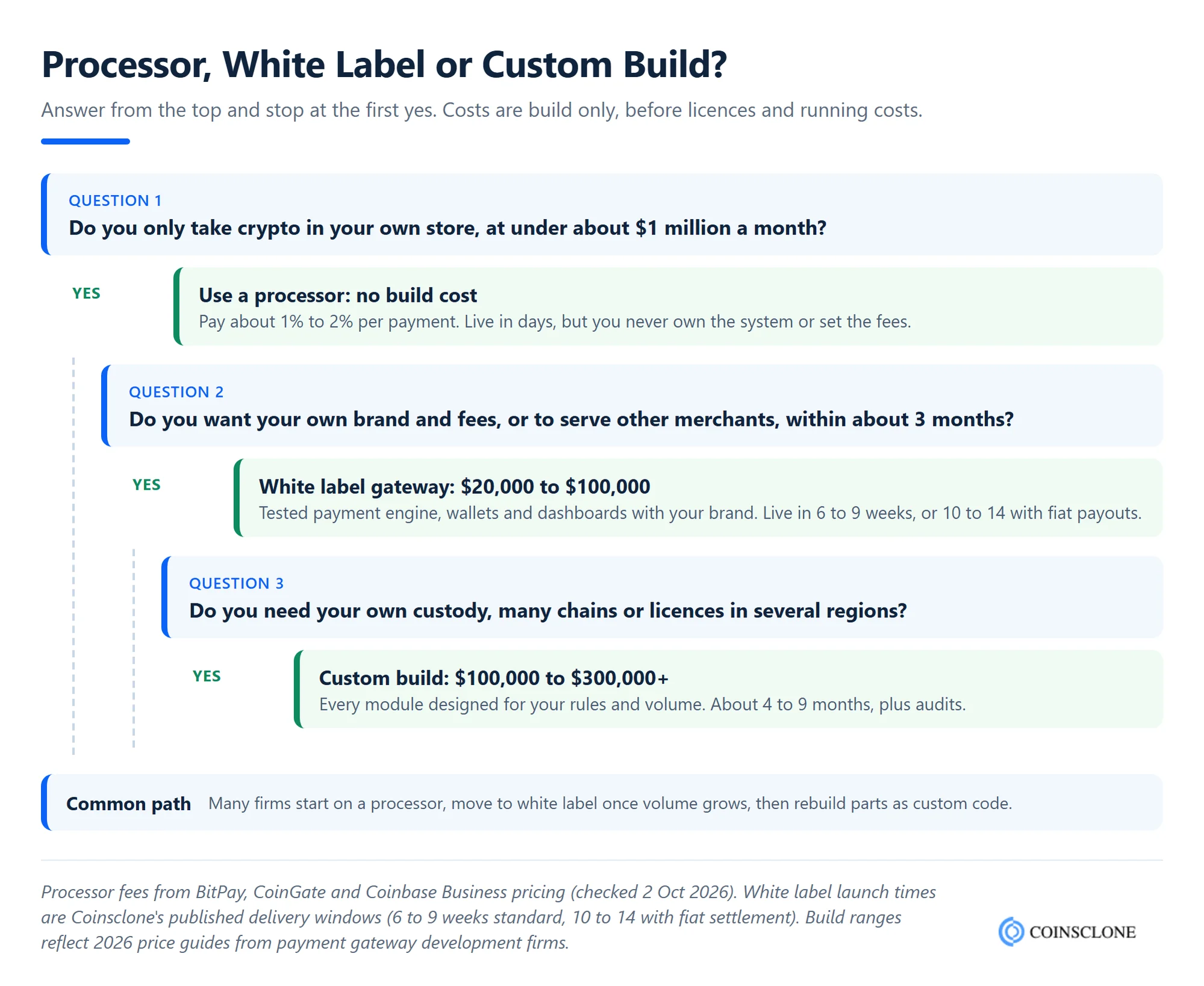
| Custom build from scratch | $100,000 to $300,000+ | 4 to 9 months | Funded firms with special rules, volume or custody needs |
White label launch times are Coinsclone’s published delivery windows. Cost ranges reflect 2026 price guides from payment gateway development firms. Checked October 2026.
For context, Stripe puts a traditional card payment gateway MVP at $150,000 to $250,000. A crypto gateway can cost less because it does not need card network approval or a bank to hold funds. Instead, it needs strong wallet security and blockchain tools.
Cost Breakdown Based on Development Approach
1. White Label / MVP / Clone Script
Basic Features
A white label or MVP crypto payment gateway with core features costs about $20,000 to $60,000. Core features include wallet setup, payment links and invoices, payment tracking on the blockchain, basic security and a merchant dashboard.
This option suits startups that want to test their idea fast. You launch with tested code, keep the budget under control and add features once real merchants use it.
Customised Features
Next comes the customised white label gateway. Here you add features such as many chains, stablecoin payments, fiat payouts to bank accounts, advanced reports, your own design, plugins for online stores or extra security layers. As a result, the cost usually rises to $40,000 to $100,000.
This path balances speed and freedom. You still build on a tested base, but your gateway looks and works in its own way.
2. Built From Scratch (Custom Features)
A build from scratch means you design the system, write each core part, add safety and legal layers and plan for growth from day one. The cost for this approach usually falls between $100,000 and $300,000, and large multi-region platforms can go higher.
This option is best for firms with special needs that ready-made software cannot meet. Think of their own custody setup, licences in many regions or very high payment volume.
Core Feature Implementation
Features are the base of a successful crypto payment gateway, and they take a large share of the budget. Complex features need a stronger tech stack and a more senior team, so each one adds cost.
Along with features, the team must add security from the start. Merchants and their buyers will only trust a gateway that keeps funds safe. So start with the features your first merchants need, then add more once you see real demand.
Looking for the right features to add? Before you fix your budget, read our guide to The Unskippable Features to Build a Powerful Crypto Payment Gateway. It will help you plan smarter and avoid costly rework.
Platform Testing
Testing also has a clear effect on cost. To make sure the gateway is safe, fast and easy to use, it must pass several test stages:
- Functional testing: every payment, refund and payout works as planned.
- Security audits: outside experts check smart contracts, wallets and servers for weak spots.
- Integration testing: store plugins, APIs and webhooks work with real merchant systems.
- Load testing: the gateway stays fast during sales peaks.
- User acceptance testing (UAT): real users try the gateway before launch.
This work needs QA engineers, time and tools, which add to the project cost. Outside audits and penetration tests alone often cost $15,000 to $50,000. However, skipping tests is far more costly. Hackers stole over $3.4 billion from crypto services in 2025, according to Chainalysis. A gateway holds funds for many merchants, so it is a prime target.
These are the primary drivers of the build cost. Next, let us look at what each part of the gateway costs.
Crypto Payment Gateway Cost Breakdown by Component
A crypto payment gateway is a set of modules that work together. The table below shows what each one does and what it typically costs. A white label gateway reuses most of these modules, which is why it costs far less than the totals here.
| Component | What it covers | Basic build (USD) | Advanced build (USD) |
| Payment processing core | Invoices, unique payment addresses, tracking confirmations, webhooks | $15,000 to $25,000 | $40,000 to $80,000 |
| Wallet system | Hot and cold wallets, moving funds to safe storage, key management | $8,000 to $15,000 | $20,000 to $40,000 |
| Blockchain support (per chain) | Node or RPC link, token standards such as ERC-20 and TRC-20 | $3,000 to $8,000 | $8,000 to $20,000 |
| Merchant API, SDKs and plugins | REST API, webhooks, WooCommerce and Shopify plugins | $5,000 to $10,000 | $15,000 to $30,000 |
| Merchant dashboard and admin panel | Payments, refunds, reports, fee settings, user roles | $8,000 to $20,000 | $20,000 to $50,000 |
| UI/UX design | Checkout page, payment widget, dashboards, mobile views | $8,000 to $20,000 | $25,000 to $40,000 |
| Compliance tools | KYC and KYB checks, AML screening, Travel Rule messages | $8,000 to $15,000 | $15,000 to $25,000 |
| Security audits and testing | Smart contract audit, penetration test, load tests | $15,000 to $25,000 | $25,000 to $50,000 |
| Fiat settlement (optional) | Crypto to fiat conversion and bank payouts through a partner | $10,000 to $20,000 | $20,000 to $40,000 |
Ranges compiled from 2026 price guides published by payment gateway development firms. They are planning figures, not a quote.
Two lines move the total most. First, each extra blockchain adds its own integration and testing. Second, fiat settlement needs a licensed banking or exchange partner, which adds both build time and legal work.
Monthly Running Costs of a Crypto Payment Gateway
The build cost is only the start. A live gateway has bills every month, and many founders plan for the launch but not for the year after it. Here are the main running costs to budget for:
- Nodes or RPC providers: about $500 to $3,000 a month for three chains, or $5,000 to $15,000 to set up your own nodes.
- Cloud hosting: about $800 to $3,000 a month on AWS or Google Cloud, plus DDoS protection and monitoring.
- KYC checks: per check pricing, such as Sumsub’s $1.35 to $1.85 per verification, with the higher Compliance plan aimed at regulated firms like gateways.
- Network fees: gas paid to move funds from payment addresses to safe storage, often $500 to $3,000 a month.
- Upkeep and upgrades: about 15% to 25% of the build cost each year for fixes, new chains and new rules.
- Support: a team that answers merchants and handles stuck or partial payments.
As a rough guide, a lean white label gateway costs about $5,000 to $15,000 a month to run in its first year. That figure grows with volume, chains and the number of merchants you serve.
Compliance and Licence Costs for a Crypto Payment Gateway
In most countries, a gateway that holds, swaps or sends funds for others needs a licence. So compliance is a real cost line, not an afterthought. The rules depend on where you launch:
- United States: FinCEN money services business registration has no federal fee. But most states need their own money transmitter licence, with fees, bonds and legal work in each one. The GENIUS Act, signed on 18 July 2025, now sets federal rules for payment stablecoins.
- European Union: under MiCA, a firm that only transfers crypto needs at least EUR 50,000 in capital. A firm that holds funds or swaps crypto for euros needs EUR 125,000. The grace period ended on 1 July 2026, so each gateway that serves the EU now needs a full licence.
- Travel Rule: most regions now ask gateways to send sender and receiver details with transfers. In the EU this applies to every transfer, and in the US it starts at $3,000.
- Legal setup: policies, terms, AML programmes and legal review often cost $10,000 to $50,000 before launch.
To see licence fees country by country, read our crypto license guide. Many startups also cut this cost by working with a licensed partner for custody and fiat payouts at first.
Build Your Own Gateway or Pay a Processor?
Many firms ask a simple question before they build: why not just use a processor? It is a fair question, and the answer depends on your volume and your goals.
Processors take a fee on each payment. For example, BitPay charges 2% plus $0.25 under $500,000 a month, falling to 1% plus $0.25 above $1 million. CoinGate charges 1% per transaction, and Coinbase Business also charges 1%. These fees look small, but they grow with every sale, and you never own the system.
Owning a gateway flips that model. You pay to build and run it, but you set your own fees, keep the data and can serve other merchants for a fee. In other words, the gateway becomes a product, not a cost.
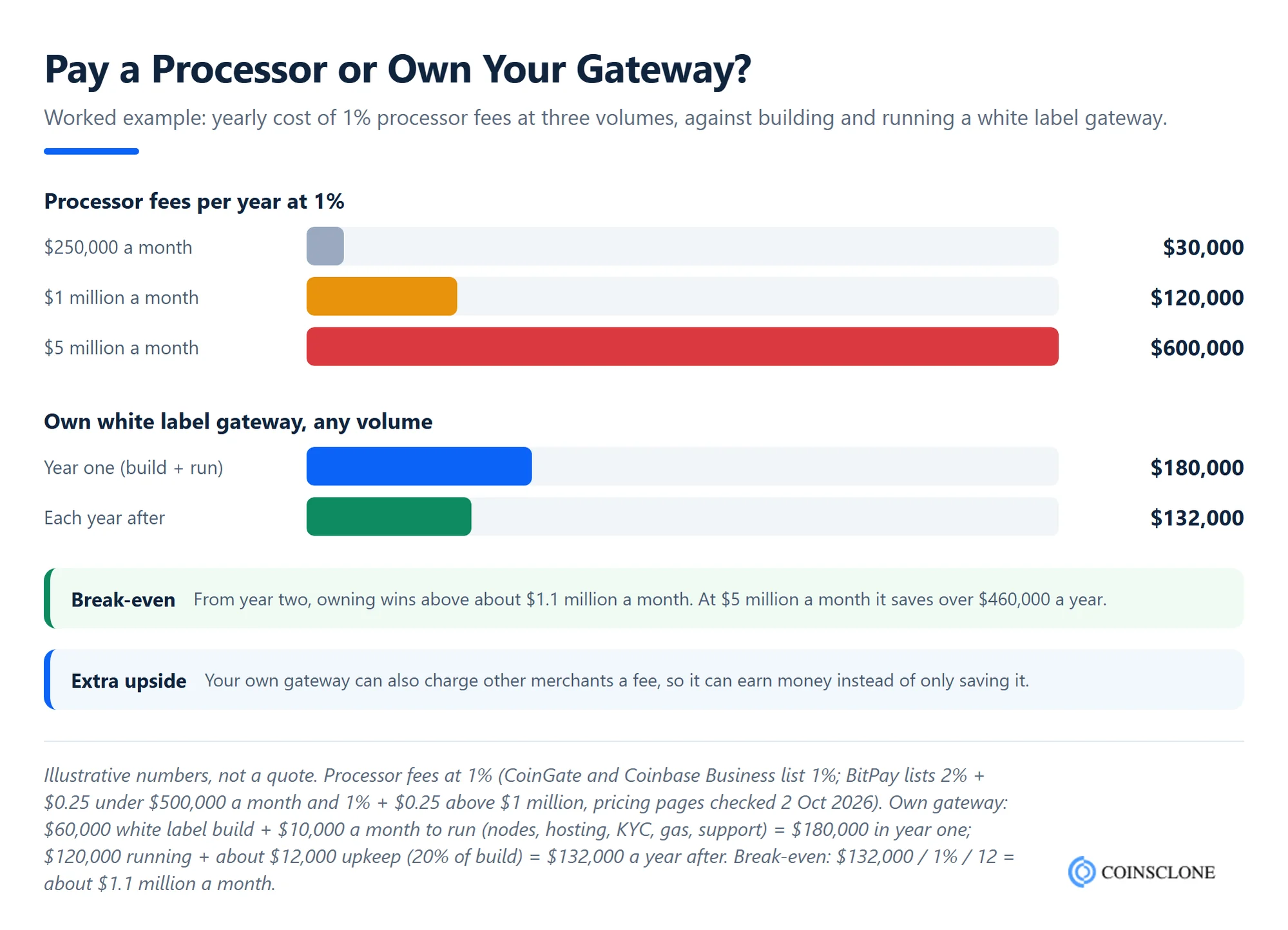
So here is a simple rule. If you only accept crypto in one store and process less than about $1.1 million a month, a processor is usually cheaper. However, if you process more, want your own brand or plan to charge other merchants, building your own gateway pays off. To compare the leading processors and their fees, see our list of the best crypto payment gateways.
How Long Does It Take to Build a Crypto Payment Gateway?
Time is money in any build, since you pay the team for every week of work. Here is how long each path usually takes:
- White label gateway: 6 to 9 weeks for a standard launch, or 10 to 14 weeks with fiat payouts. These are Coinsclone’s own published times.
- Custom MVP: about 4 to 6 months, including design, core build, audits and testing.
- Full custom platform: 6 to 9 months or more, especially with many chains and licences.
An outside security audit adds about 4 to 6 weeks to any path, so plan for it early. Licence approval can take longer than the build itself, so start the legal work in parallel.
Key Factors That Influence Crypto Payment Gateway Development Costs
Many factors shape the final cost of a crypto payment gateway. Some of them act as hidden costs, so it helps to list them all before you set a budget.
Project Complexity
The main driver is how complex the project is. Complexity depends on the number of features, the level of custom work, the number of chains and the volume you plan to handle. A simple gateway for one store costs far less than a platform built for thousands of merchants.
For instance, if you want to compete with top gateways such as BitPay or CoinGate, you need many features from day one. As a result, your budget will rise.
Regulatory Compliance
Adding KYC and AML checks and following money rules adds licence fees, legal fees and costs for outside checks. Each country and region has its own rules for crypto payments, as the compliance section above shows.
So costs change with the place you launch. Get legal advice early to avoid fines and delays later.
UI/UX Customization
Good design builds trust in your brand. Merchants want a clean dashboard, and buyers want a checkout that takes seconds. A good design takes time and skill, so it takes a fair share of the budget.
Responsive pages, dark and light modes and simple dashboards all add design hours and testing. So agree on the key screens first and skip the extras for launch.
API Integrations
Today, most gateways link to exchanges, wallets, store platforms and bookkeeping tools. Some of these services charge setup or licence fees, and every link needs build and test time.
Gateways also link to price feeds, fiat payment partners and KYC firms. So these links take a large share of the total cost. Our guide on how to integrate a crypto payment gateway shows how merchants connect to one.
Tech Stack Choice
The choice of tech stack also shapes the budget. Your frontend, backend and smart contract tools all affect the cost. Fast, low-fee chains such as Tron, Solana or Base can also change the cost and how well the gateway scales.
You can build the gateway as a web app, a mobile app or both. Each extra app adds design, build and testing time, so it helps to start with web and add mobile later.
Choice Of Blockchain
Each blockchain has its own speed, fees, developer tools and community. Most crypto payments today use stablecoins. DefiLlama counts over $310 billion in USD stablecoins on 1 October 2026. So most gateways start with USDT and USDC on a few low-fee chains, then add Bitcoin and Ethereum.
Since the blockchain is the base of the whole gateway, pick it with care. Every extra chain adds build, testing and running cost.
Team Location
Where your team works changes the hourly rate a lot. Clutch’s 2026 pricing data shows that coders in the US mostly charge $50 to $99 an hour, as do teams in Poland. Teams in India and Ukraine mostly charge $25 to $49 an hour. The same project can therefore cost half as much with the right team, as long as they have real crypto payment experience.
Post-Launch Maintenance
Once your gateway goes live, the work does not stop. Upkeep keeps the gateway safe, reliable and up to date. After launch, bug fixes, new features, speed tuning and new chains all add cost, often 15% to 25% of the build cost each year.
These are the leading cost factors for a crypto payment gateway. You can keep them in check with good planning. Create a crypto payment gateway with help from an expert team to avoid technical trouble.
Next, here are some tips to lower the cost of building a crypto payment gateway.
Cost-Saving Tips For Building A Crypto Payment Gateway
When you plan your budget, you can cut out needless costs with careful planning. Here are some steps to build for less.
- Use a pre-built solution: Building from scratch costs more. So it is often smarter to choose a white label crypto payment gateway that is ready, tested and easy to customise.
- Pick a low-fee blockchain: A blockchain with low network fees cuts your running costs over time.
- Use open-source tools: Free, open code helps you avoid licence fees.
- Work with experienced developers: Experts build faster and help you avoid costly mistakes.
- Limit features at launch: Do not add too many features, trendy design extras or rare security add-ons before you have merchants.
- Plan for growth: Before you build, make sure the design can handle future growth in users and volume.
- Start with an MVP: Launch a small first version to test the gateway with real merchants.
With these steps, you can cut costs and still launch a strong crypto payment gateway. Also, take care when you pick your build team.
The right company is also a key cost factor. Choose one based on client reviews, testimonials and past crypto projects. One firm that has helped many startups grow is Coinsclone.
How Coinsclone Builds Crypto Payment Gateways at a Fair Cost
Coinsclone is a leading crypto payment gateway development company. Since 2018, we have delivered 350+ platforms for 200+ clients across 20 industries. Our team builds white label and custom gateways. A standard white label gateway goes live in 6 to 9 weeks, or 10 to 14 weeks with fiat payouts.
- Ready-made and custom builds at a fair cost
- In-house expert team for smooth development
- Easy API integrations with a proven tech stack
- Long-term support with regular upgrades
We also offer crypto token creation, crypto exchange and NFT services. Even after your project goes live, our team stays with you for support and upgrades.
Start your crypto payment business with our team today!
Disclaimer: The costs and prices in this blog are for guidance only. They are not a quotation. The cost may change based on your project needs, services and custom work. These details are not official Coinsclone price disclosures. Please contact our team for a cost quote built for your project.
Frequently Asked Questions
How much does it cost to develop a crypto payment gateway?
In 2026, a white label crypto payment gateway costs about $20,000 to $60,000. A custom white label gateway costs about $40,000 to $100,000, and a custom build from scratch costs $100,000 to $300,000 or more. On top of that, plan for running costs of about $5,000 to $15,000 a month and yearly upkeep of 15% to 25% of the build cost.
How much does it cost to develop a payment gateway?
A traditional card payment gateway costs much more. Stripe puts a card gateway MVP at $150,000 to $250,000. It needs card network sign-off, bank partners and strict PCI DSS checks. A crypto gateway skips the card networks, so a white label version can launch for a fraction of that.
How to create a crypto payment gateway?
First, choose your target market, coins and chains. Next, pick a build path, either white label or custom. Then build the payment engine, wallets, merchant API and dashboards, add KYC and AML tools, and run security audits before launch. Our step-by-step guide on how to create a crypto payment gateway covers each stage in detail.
How long does it take to build a crypto payment gateway?
A white label gateway takes about 6 to 9 weeks, or 10 to 14 weeks with fiat settlement. A custom gateway usually takes 4 to 9 months. A security audit adds about 4 to 6 weeks, and licences can take longer than the build.
What are the top crypto payment gateway companies?
Well-known names include BitPay, CoinGate, Coinbase Business, NOWPayments and CoinPayments. Stripe now takes stablecoins too. Their fees mostly range from 0.5% to 2% per payment. See our full list of the best crypto payment gateways for fees and features side by side.
How much does it cost to develop a crypto wallet app?
A crypto wallet app costs less than a full gateway, since it has fewer modules. A white label wallet can launch in 3 to 5 weeks, while a custom wallet takes 8 to 12 weeks. Read our crypto wallet development cost guide for a full breakdown.
Is it cheaper to build a crypto payment gateway or use a processor?
It depends on your volume. Processors charge about 1% to 2% per payment, so at $1 million a month you pay about $120,000 a year in fees at 1%. In our worked example, a lean white label gateway costs about $180,000 in year one and about $132,000 a year after that. So above about $1.1 million a month, or if you plan to serve other merchants, owning your gateway usually pays off.
See How Our MVP System Cuts Down Your Crypto Payment Gateway Development Cost
Crypto Payment Gateway Development — done smarter.
- MVP System : Launch your payment gateway 90% faster, at half the cost.
- Ready-Made Modules : Wallets, invoicing, and API integration — all pre-built.
- Brand Customization : Your logo, your UI, your currency support.
- Revenue Engine : Earn from transaction fees, merchant onboarding, and premium APIs.
Get a free cost breakdown & live demo of your payment gateway — before spending a cent.
Book a Free Demo to discover how our MVP System helps you build a fully functional crypto payment gateway in just 8 to 12 weeks.