
The Optimism native token, OP, is the governance token of OP Mainnet, one of the busiest layer-2 networks on Ethereum. Many guides still describe it with 2022 facts. Some even say it pays gas or secures the chain through staking. Neither is true. This guide gives you the real picture as of 16 October 2026: what OP is, how the network behind it works, and what changed this year.
It is also a builder’s guide. If you plan to launch your own token on Optimism, you will learn which path fits, the steps we follow, the usual market costs and the risks to plan for. By the end, you can decide whether Optimism is the right home for your token.
In this guide:
- Status check: OP price, supply, chain security stage and the big 2026 events, all dated and sourced.
- How it works: where ETH fees go, how batches reach Ethereum, and where the OP token fits in.
- Tokenomics: who received the 4.29 billion OP, and how much is circulating today.
- Build plan: a decision tree for native, bridged or multi-chain tokens, plus steps and costs.
See How Our MVP System Can Launch Your Optimism-Based Token Faster
Optimism Native Token Development — done right.
- MVP System:Launch your Optimism-native token 90% faster.
- Smart Contracts: Pre-audited and optimized for scalability on Optimism.
- Custom Branding: Your token, your utilities, your ecosystem.
- DeFi Ready:Seamless integration with DEXs, staking, and liquidity pools.
See a free branded demo of your Optimism token platform in 48 hours — before you invest a cent.
Book a Free Demo to discover how our Optimism Token Development System can take you from concept to launch in just 2–4 weeks.
What Is the Optimism Native Token (OP)?
The Optimism native token (OP) is the ERC-20 voting token of the Optimism Collective, the group that runs OP Mainnet and the wider set of OP Stack chains. It is called “native” because it was created on OP Mainnet itself. It lives at the built-in address 0x4200000000000000000000000000000000000042 on that chain, as CoinGecko’s OP token page confirms.
Optimism is a layer-2 network for Ethereum. It was built to fix Ethereum’s scaling problem: when the main chain gets busy, fees rise and transactions slow down. Optimism runs transactions off the main chain, bundles them, and posts the data back to Ethereum. Users get much lower fees while still relying on Ethereum for security. The network is fully compatible with the Ethereum Virtual Machine (EVM), so the same contracts, wallets and tools work on both.
Here is the point most guides get wrong. OP does not pay for gas. Every fee on OP Mainnet is paid in ETH, as the Optimism transaction fee docs state. OP holders vote on upgrades, grants and the treasury instead, and so shape the future of the network.
Optimism native token development, in turn, means building your own token on OP Mainnet (or another OP Stack chain). In most cases that is an ERC-20 token like OP, with your own rules for supply, voting, rewards or utility.
Also Read – erc20 token development
OP Token Status in 2026: Key Facts
Here is where OP and its network stand, checked on 16 October 2026.
| Fact | Value (16 Oct 2026) | Source |
| Price | About $0.138 | CoinGecko |
| Market cap and rank | About $317 million, rank 141 | CoinGecko |
| All-time high | $4.84 (6 March 2024) | CoinGecko |
| All-time low | $0.0807 (18 August 2026) | CoinGecko |
| Circulating supply | 2.30 billion OP of 4.29 billion | CoinGecko |
| Gas token | ETH, not OP | Optimism docs |
| Security stage | Stage 1 optimistic rollup | L2BEAT |
| Value secured on OP Mainnet | About $2.01 billion | L2BEAT |
The year so far:
- January 2026, buybacks: The Foundation proposed using half of all Superchain income to buy back OP each month for a year, in its OP Token Buybacks post. The network had earned 5,868 ETH over the prior twelve months. Token holders approved the plan on 28 January with 84.4% support, as a 12-month pilot from February.
- February 2026, Base steps back: Coinbase’s Base, the largest OP Stack chain, announced on 18 February that it will move to its own code base. It stays compatible with the OP Stack for now and remains a paying support customer of OP Labs. OP fell about 4% in the next 24 hours.
- July and September 2026, upgrades: The Karst network upgrade went live on OP Mainnet on 8 July 2026, per the Optimism network upgrade registry. In September, Upgrade 20 brought new “super root” dispute games, a step toward native cross-chain messaging between OP Stack chains.
- August 2026, price low: OP hit its all-time low of $0.0807 on 18 August. It was still down about 70% over the year in mid-October, even after a 50% rise over the past 30 days.
What this means for builders: the price of OP and the strength of OP Mainnet as a place to build are two separate things. Your users pay gas in ETH, so a weak OP price does not raise your costs. It does matter if you plan to hold OP or rely on OP grants.
Who Created Optimism?
Optimism was created by OP Labs PBC (first known as Optimism PBC), a public benefit firm set up in 2019 by Jinglan Wang, Karl Floersch and Kevin Ho. The OP token launched on 31 May 2022 with a first airdrop to more than 230,000 early users.
In 2023 the main chain was renamed OP Mainnet to fit the “Superchain” idea: many chains built on the same open-source OP Stack, sharing upgrades and revenue. The same year, the Bedrock upgrade rebuilt the network’s core design. That is why older guides that describe a “Canonical Transaction Chain” are now out of date.
How Does the Optimism Native Token Work?
The factor that keeps Optimism in the spotlight is its design: it is an optimistic rollup. It groups many layer-2 transactions into one batch and posts that batch to Ethereum’s main network (layer 1). The network “optimistically” assumes each batch is valid. Anyone can then challenge a wrong result during a set window. This takes load off Ethereum. As a result,
- transactions confirm faster
- fees per transaction drop sharply
- the main chain stays free for other work
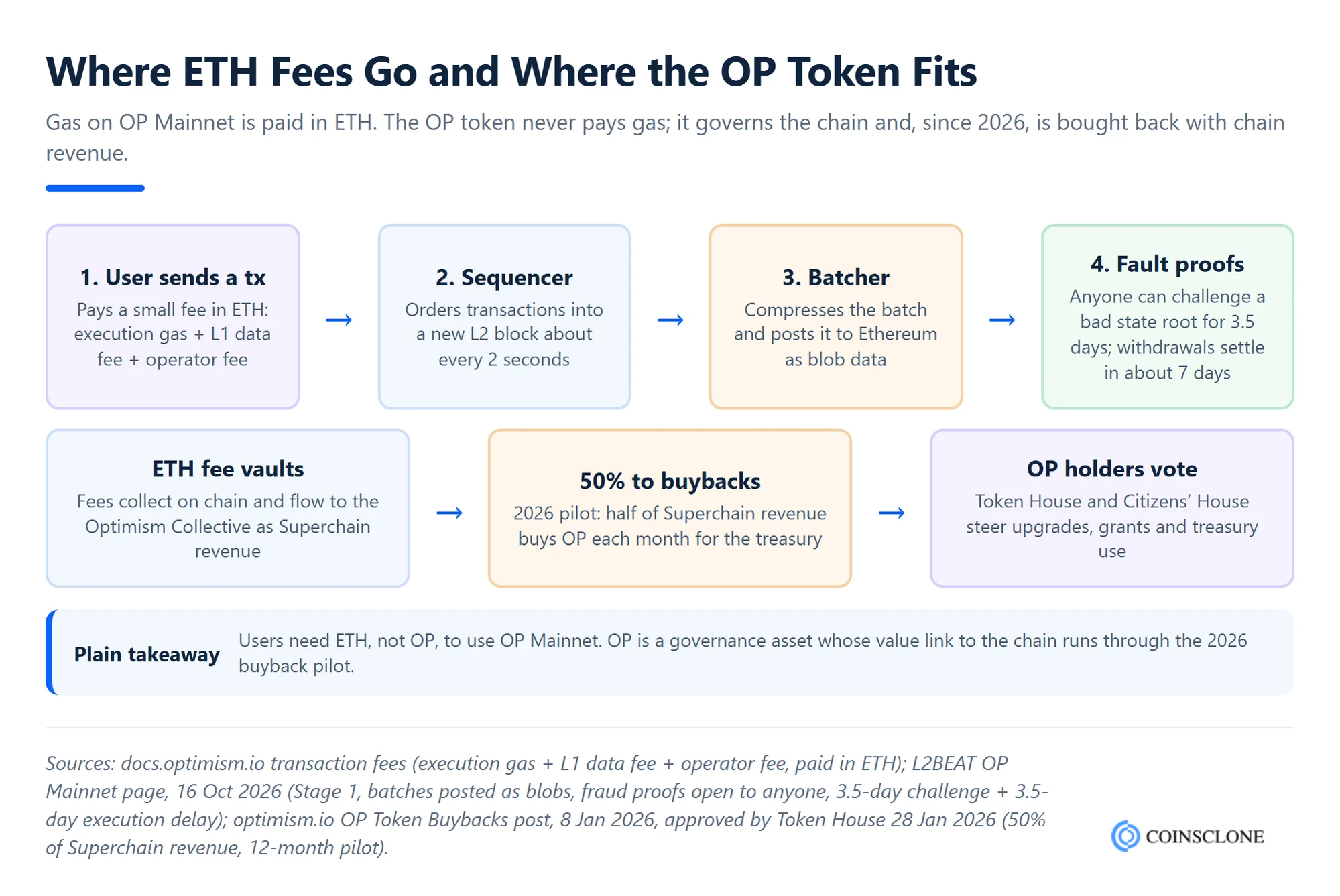
The network has four main parts. Each one maps to a step in the chart above.
Block Production
The Sequencer is the part that orders transactions and builds new blocks, about one every two seconds. Today OP Mainnet runs a single sequencer, which keeps it fast. If the sequencer ever fails or blocks users, they can still force their transactions in through Ethereum within 12 hours, as L2BEAT’s OP Mainnet review explains.
Data Posting
A tool called the batcher compresses the transactions and posts them to Ethereum as “blob” data, a cheaper data format Ethereum added in 2024. Because the data is published on Ethereum, anyone can check it and rebuild the chain’s state. Your token balances do not depend on Optimism’s own servers alone.
Block Execution
Nodes rebuild the chain in two ways. The rollup node reads the batches posted on layer 1 and derives each layer-2 block from them. The execution engine, a lightly changed Ethereum client, then runs each block. Nodes can also sync faster by sharing blocks peer to peer.
Fault Proofs
From time to time, a proposer posts a summary of the chain’s state to Ethereum. Since 10 June 2024, anyone can challenge a wrong summary with a fault proof. That window lasts 3.5 days, and withdrawals to Ethereum then wait another 3.5 days. So moving funds back to layer 1 through the official bridge takes about seven days.
This is how the network stays both cheap and safe. The OP token sits above all this as a voting tool. It does not run the machine; its holders decide how the machine changes.
What Is the OP Token Used For?
OP has three real jobs in 2026, and two jobs it does not have.
What OP does:
- Governance: OP holders vote in the Token House on upgrades, grants and treasury use, or hand their votes to a delegate. The Citizens’ House, made up of chosen community members, votes on public goods funding.
- Upgrade veto: Under the current rules in the Optimism governance docs, core teams draft each upgrade and a Developer Advisory Board reviews it. Then a 7-day veto period starts, in which tokenholders, chains, apps and users can block it.
- Funding and rewards: The Collective pays builders in OP through grants and Retro Funding, which rewards projects after they prove their impact. OP also went to users through several airdrops.
What OP does not do:
- No gas: All fees on OP Mainnet are paid in ETH.
- No staking for security: Fault proofs and Ethereum secure the chain. There is no OP staking that protects the network.
The 2026 buyback adds a new link between OP and the network’s income. Fees are collected in ETH, half of that revenue now buys OP for the treasury, and holders decide what happens to those tokens next.
OP Tokenomics: Supply and Who Got It
OP started with a genesis supply of 4,294,967,296 tokens. Token holders can vote to mint up to 2% new supply a year, as the inflation proposal on the forum shows. In October 2026, CoinGecko still lists the total at that first figure.
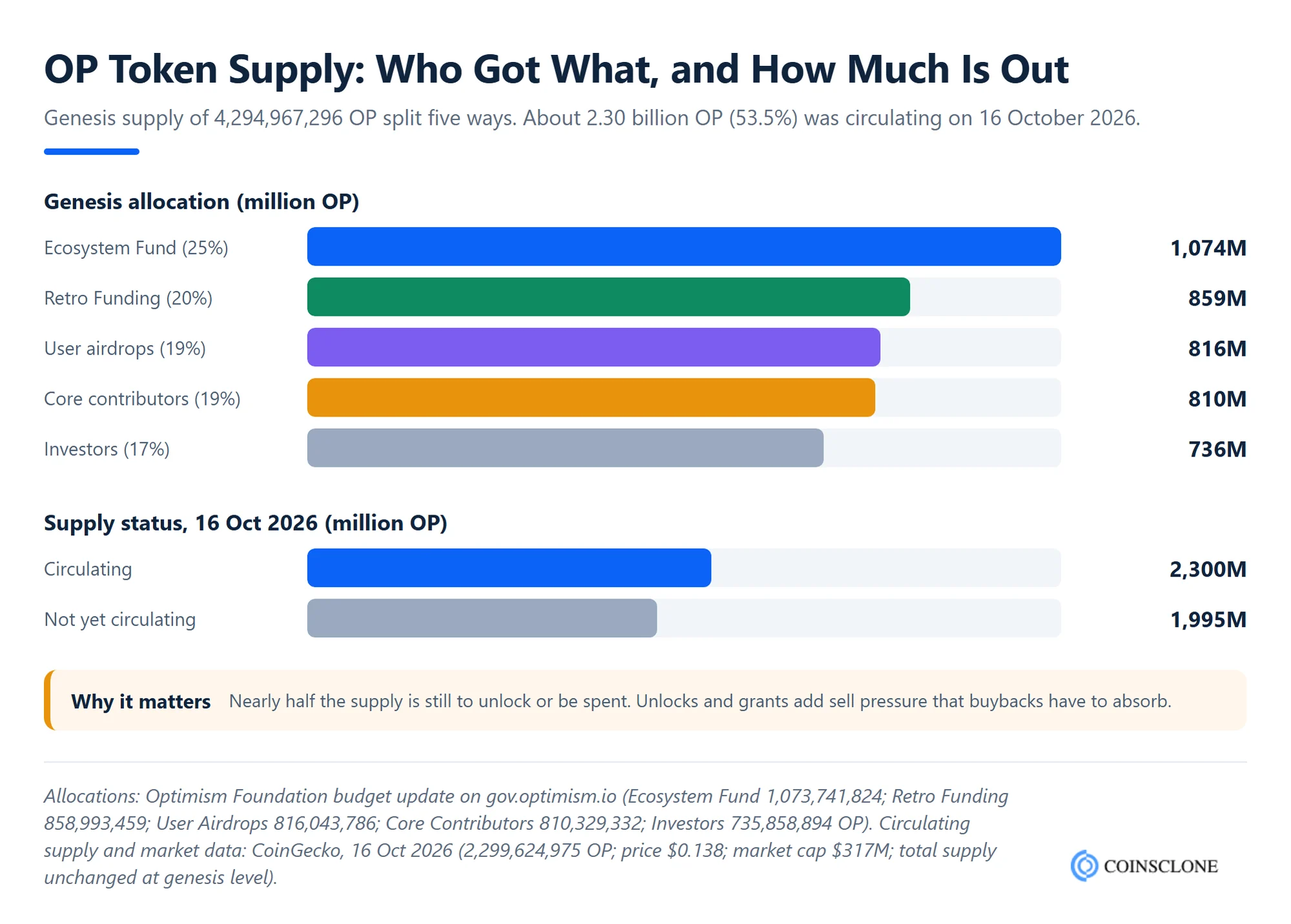
The split is simple. A quarter went to the Ecosystem Fund for grants and growth, a fifth to Retro Funding, and the rest to users, the core team and early investors. About 53.5% of the supply was circulating on 16 October 2026. The rest is still locked or held for future grants and airdrops.
Lesson for your own token: OP shows how much of a governance token’s supply goes to long-term programs. If you design your own Optimism token, plan your vesting, grants and unlocks with the same care. Large unlocks can weigh on price long after launch.
What Are the Benefits of Building a Token on Optimism?
Even after knowing how the network works, you may still be weighing whether to build on it. These are the real benefits for a token project in 2026.
Low fees: Users pay a small fee in ETH. It covers the work done, the cost of posting data to Ethereum and a tiny operator fee. That is far less than the same action on Ethereum mainnet.
Full EVM support: Your Solidity code, MetaMask and tools like Hardhat or Foundry all work just as they do on Ethereum.
Strong security: All chain data lives on Ethereum, and anyone can submit a fault proof. L2BEAT rates OP Mainnet a Stage 1 rollup.
Fast confirmations: New blocks arrive about every two seconds, so trading, gaming and payment apps feel quick to users.
Liquidity and reach: OP Mainnet secures about $2 billion in assets, and its tokens can appear on the Superchain Token List that wallets and bridges use.
Builder funding: Retro Funding and grants can reward projects that bring real value to the network.
A path to your own chain: If your project grows, the same OP Stack lets you launch your own rollup later.
Risks and Limits to Weigh
A fair plan looks at the downsides too.
- Slow official withdrawals: Moving funds back to Ethereum through the native bridge takes about seven days. Most users rely on fast third-party bridges instead.
- A single sequencer: One operator orders blocks today. Users can force transactions through Ethereum, but only after a delay.
- Upgrade power: L2BEAT notes that the Security Council can push emergency upgrades without a waiting period for users to exit. That is a key reason OP Mainnet is Stage 1, not Stage 2.
- Ecosystem shifts: Base’s move to its own code base shows that large chains can step away from the Superchain. That changes shared revenue and the buyback budget behind OP.
- Token price risk: OP fell about 70% over the past year. Any treasury that holds OP carries that risk.
Optimism Native Token Development: How to Create a Token on Optimism
To create an effective Optimism token, you first need to pick the right launch path. The chart below shows the four options and when each one fits.
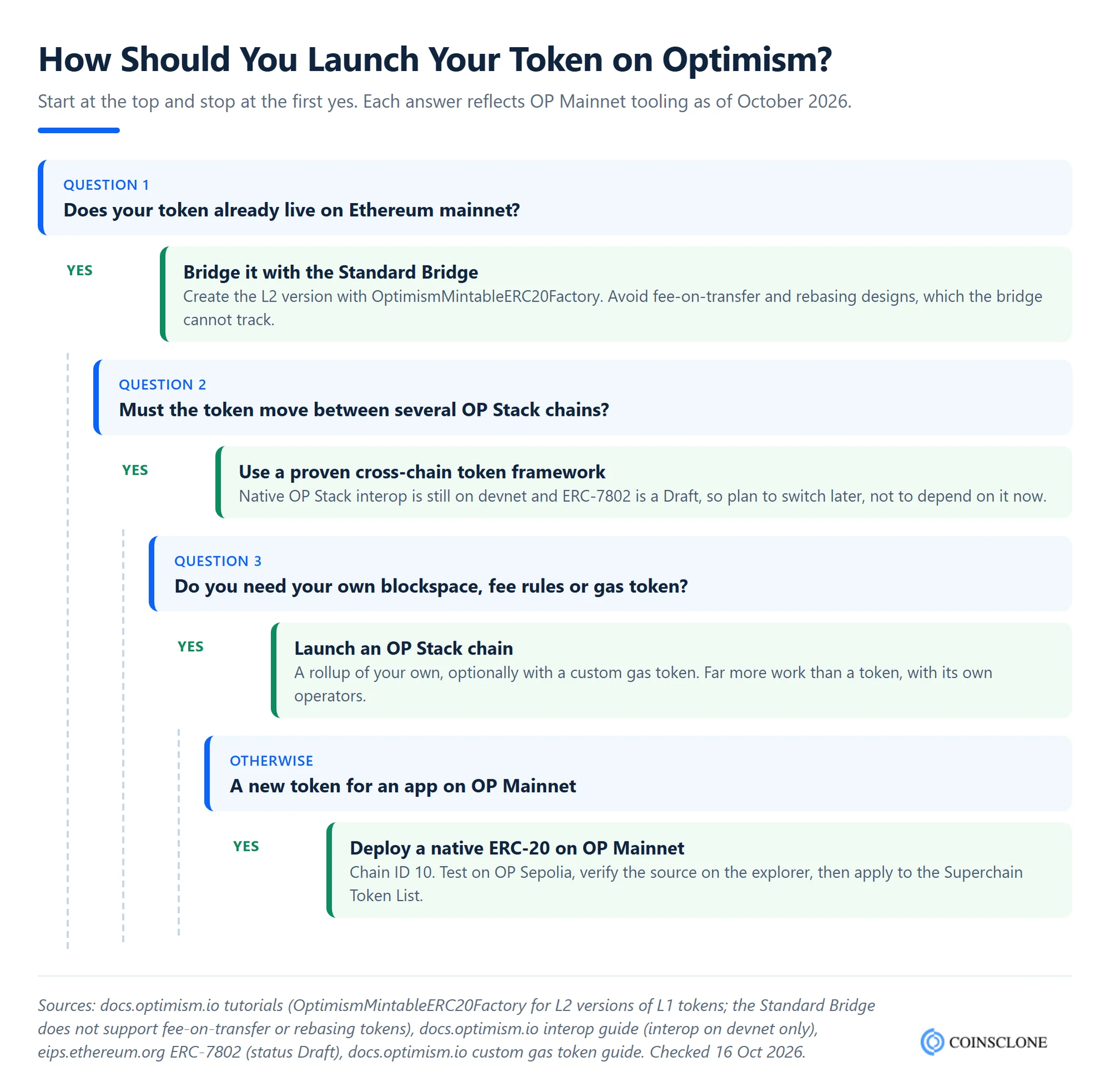
Two points matter most. If your token already lives on Ethereum, you make its layer-2 copy with a factory contract. The Optimism guide to creating an L2 token for the Standard Bridge shows each step. That bridge cannot handle fee-on-transfer or rebasing tokens. If you want one token across many OP Stack chains, note that native interop is still on devnet and the ERC-7802 cross-chain token standard is still a Draft. Plan for it, but do not build your launch on it yet.
For a new token on OP Mainnet, this is the process we follow:
- Plan the token: Define its purpose, supply, minting rules, voting rights and vesting. A governance token like OP needs delegation and voting from day one.
- Write the contracts: Build on audited OpenZeppelin ERC-20 code. Add extensions only where you need them, such as votes, permit, caps or pausing.
- Test on OP Sepolia: Deploy to the OP Sepolia test network, get free test ETH from a faucet and try every function, including odd cases.
- Audit: Have the contracts reviewed by an independent security firm and fix every finding before launch.
- Deploy on OP Mainnet: Deploy to chain ID 10, paying gas in ETH. Put admin keys in a multisig wallet, not a single wallet.
- Verify and list: Publish the source code on the block explorer, then apply to the Superchain Token List so wallets and bridges show your token.
- Launch liquidity: Add a trading pool on a DEX, set up any staking or rewards contracts, and publish your token details.
- Support and upgrades: Watch the contracts, track OP Stack network upgrades and respond fast to any issue.
Freelancer or a full team? You can build an Optimism token in two ways. A freelancer may cost less. But you may not be sure of their skill with Solidity and OP Stack tools, or that they will be there when a bug shows up. A crypto token development company brings a full team of developers, testers and project leads. You can also customise the token to your business needs and get support and maintenance after launch.
If your token is meant for voting, read our guide to DAO token development. For the general steps on any chain, see how to create a crypto token.
Optimism Token Development Cost
Cost depends on how much you build around the token. A basic ERC-20 contract on OP Mainnet is a small piece of work. Voting, vesting, staking, bridging and DEX launches take more time.
Published 2026 agency cost guides put a standard ERC-20 or BEP-20 token at about $5,000 to $15,000 to build, and a feature-rich token with staking or vesting at about $20,000 to $80,000. Published 2026 audit price guides put a simple token audit at roughly $5,000 to $15,000, with complex DeFi systems far higher. An Optimism token usually lands in the same ranges. The gas to deploy on OP Mainnet is small next to these figures, because fees on the network are a fraction of Ethereum’s.
For a full breakdown, read our guide to the cost to create a crypto token.
How to Get OP Tokens
If you need OP for voting, for a treasury or to test governance tools, there are three common ways to get it:
- Buy it on an exchange: OP trades on most large centralised exchanges and on DEXs that run on OP Mainnet.
- Earn it: Builders can receive OP through grants and Retro Funding rounds. Past airdrops rewarded active users.
- Bridge it: OP lives on OP Mainnet, so make sure you send it on the right network. Always check a token’s contract address before you trade it.
This is not investment advice. OP is a volatile asset, so do your own research before you buy.
What Makes Coinsclone the Right Choice for Optimism Token Development?
Coinsclone is a blockchain development company that has been building since 2018. We have delivered 350+ platforms for 200+ clients across 20 industries. Our developers and testers work with you through each phase, from token design to launch and support.
With our Optimism native token development services, we build the token around your goals: supply rules, voting, vesting, staking and DEX launch. We test every contract on OP Sepolia, prepare it for audit and deploy it with secure multisig admin keys. As an Ethereum token development company, we also build ERC-20, ERC-721 and ERC-1155 tokens on other EVM chains.
So, if you are ready to launch a token on Optimism, contact our team and get a live demo.
Frequently Asked Questions
What is the OP token used for?
OP is used for governance. Holders vote in the Token House, or delegate their votes, on upgrades, grants and treasury use. The Collective also pays builders in OP through grants and Retro Funding. Under a 12-month pilot that began in February 2026, half of Superchain revenue buys back OP. OP is not used to pay gas.
Who created Optimism?
OP Labs PBC created Optimism. The company was founded in 2019 by Jinglan Wang, Karl Floersch and Kevin Ho. Today the Optimism Foundation and OP holders steer the network.
What is the total supply of OP?
The genesis supply was 4,294,967,296 OP. On 16 October 2026, CoinGecko showed about 2.30 billion OP in circulation, around 53.5% of the total. Governance can vote to add up to 2% new supply a year.
Is OP an ERC-20 token?
Yes. OP is an ERC-20 token that lives on OP Mainnet at the address 0x4200000000000000000000000000000000000042. Any token you build on Optimism can use the same ERC-20 standard, so it works with common wallets, DEXs and tools.
How do I get OP tokens?
You can buy OP on most large exchanges or on DEXs on OP Mainnet. Builders can earn it through grants and Retro Funding, and past airdrops gave OP to early users. Always confirm you are on OP Mainnet and check the contract address before you trade.
How does the Optimism network work?
Optimism is a rollup. A sequencer orders transactions into blocks, a batcher posts the data to Ethereum, and anyone can challenge a wrong result with a fault proof within 3.5 days. Users pay low fees in ETH while Ethereum keeps the data safe.
See How Our MVP System Can Launch Your Optimism-Based Token Faster
Optimism Native Token Development — done right.
- MVP System:Launch your Optimism-native token 90% faster.
- Smart Contracts: Pre-audited and optimized for scalability on Optimism.
- Custom Branding: Your token, your utilities, your ecosystem.
- DeFi Ready:Seamless integration with DEXs, staking, and liquidity pools.
See a free branded demo of your Optimism token platform in 48 hours — before you invest a cent.
Book a Free Demo to discover how our Optimism Token Development System can take you from concept to launch in just 2–4 weeks.