
This guide explains NFT sports marketplace development from first idea to launch. You will see how a sports NFT marketplace works, which models still earn money in 2026, the features fans expect, the rules you must follow, and what a build costs. We also show where the big names stand today, because NBA Top Shot, NFL ALL DAY and Sorare have all changed since the 2021 boom.
The market is smaller than it was, but it has not gone away. Licensed cards, fantasy games and vaulted real cards still trade each day. So the real question is not “should I build one?” but “which model fits the rights I hold?” The second half of this guide helps you answer that and plan the build.
In this guide:
- What an NFT sports marketplace is and how a sale works on one
- The current status of NBA Top Shot, NFL ALL DAY, Sorare, Panini and Courtyard, with the lessons each one teaches
- A simple test to pick the right model: moments, fantasy cards, vaulted cards or tickets
- Features, legal risks, costs and build stages for your own platform
- Which blockchain suits which kind of sports NFT
Launch Your Own NFT Sports Marketplace Today
NFT Sports Marketplace Development — build your custom trading platform for sports NFTs.
- White-Label Solution: Launch quickly with pre-built core modules.
- Fan Engagement Tools: Boost interactions through NFT collectibles.
- Multi-Revenue Options: Earn via auctions, drops, and resales.
- Secure Infrastructure: Blockchain-based transactions ensure trust.
See a free branded demo of your NFT marketplace in 48 hours — before you invest a cent.
Book a Free Demo to discover how NFT Sports Marketplace Development can help you launch in just 8–12 weeks.
NFT Sports Marketplace Development
NFT sports marketplace development is the process of building a blockchain site where sports NFTs are made, bought, sold and traded. These NFTs can be player cards, match clips, fantasy game cards or other sports items. Smart contracts track who owns what, pay royalties and record every trade in the open. That builds trust for fans, athletes and clubs. So a good build team joins sports data, NFT standards and a blockchain that can grow, to support fast trading, fantasy play and lasting ownership.
How an NFT Sports Marketplace Works
In simple terms, the platform turns a sports asset into a token that only one wallet can own at a time. Here is the usual flow:
- Rights first: The platform signs a licence with a league, a players’ union, a club or an athlete. Without it, you cannot sell their names, logos or footage.
- Minting: The team turns each clip, card or item into an NFT, usually as a numbered edition (for example, 1 of 99).
- Primary sale: Fans buy packs or single items with a card or crypto. Money from this first sale goes to the platform and the rights holder.
- Resale: Owners list items on the marketplace. A smart contract moves the token and the payment at the same moment, and the platform keeps a fee.
- Utility: Owners use their NFTs in games, challenges, ticket offers or rewards, which gives them a reason to keep collecting.
Sports NFT Platforms in 2026: What Still Works
Before you plan a build, it helps to know what happened to the platforms everyone copied. Several changed course in the last two years. Here is where they stand as of October 2026.
| Platform | Model | Blockchain | Status in October 2026 |
| NBA Top Shot | Licensed video “Moments” | Flow | Active. 2025-26 season added rookie autographs and 1-of-1 signed Moments; 5% fee per sale |
| NFL ALL DAY | Licensed video “Moments” | Flow | No new Moments since 13 May 2026; old Moments still trade; Dapper Labs says a new NFL product is coming |
| Sorare | Fantasy game with player cards | Solana (moved from StarkEx in late 2025) | Active for football, MLB and NBA; UK gambling trial set for June 2027 |
| Panini Blockchain | Licensed digital trading cards | Panini chain, bridge to Ethereum | Active; bridge opened 30 March 2026 with OpenSea as its on-chain marketplace |
| Courtyard | Vaulted physical cards as NFTs | Polygon | Active; the top-selling NFT collection in the week to 3 October 2026, with $7.31M in sales |
NBA Top Shot: still running, now with autographs
NBA Top Shot is still the best-known sports NFT marketplace. Its 2025-26 roadmap added autographs on rookie Moments, signed 1-of-1 Moments for players such as Cooper Flagg, and “on-chain permanence” for every collectible. The marketplace charges a 5% fee on each sale and nothing to list. Lesson: fans stay when the product keeps adding new things to collect, not only new drops.
NFL ALL DAY: no new Moments
On 13 May 2026, Dapper Labs stopped issuing new NFL ALL DAY Moments. Old Moments still trade, and Dapper says it is working on the “next evolution” of NFL collectibles. Lesson: a licensed product can pause even when the licence holder is a market leader. So plan what happens to owners’ items if drops stop.
Sorare: moved to Solana
Sorare moved its cards from StarkEx to Solana in late 2025 and moved ETH balances to Base, as its help center explains. It now runs football, MLB and NBA games. But the UK Gambling Commission has charged Sorare with running gambling without a licence. The trial is set for June 2027. Lesson: a chain is not forever, and fantasy games with prizes can fall under gambling law.
Panini and Courtyard: cards are back
Panini opened a bridge from its own chain to Ethereum on 30 March 2026, so fans can hold cards in their own wallets and sell them on OpenSea. Meanwhile, Courtyard stores real graded cards in secure vaults and sells them as NFTs on Polygon with 0% marketplace fees. CryptoSlam data shows it led all NFT sets by weekly sales in early October 2026. Lesson: fans pay most for things tied to something real, such as a card they can hold or a wallet they control.
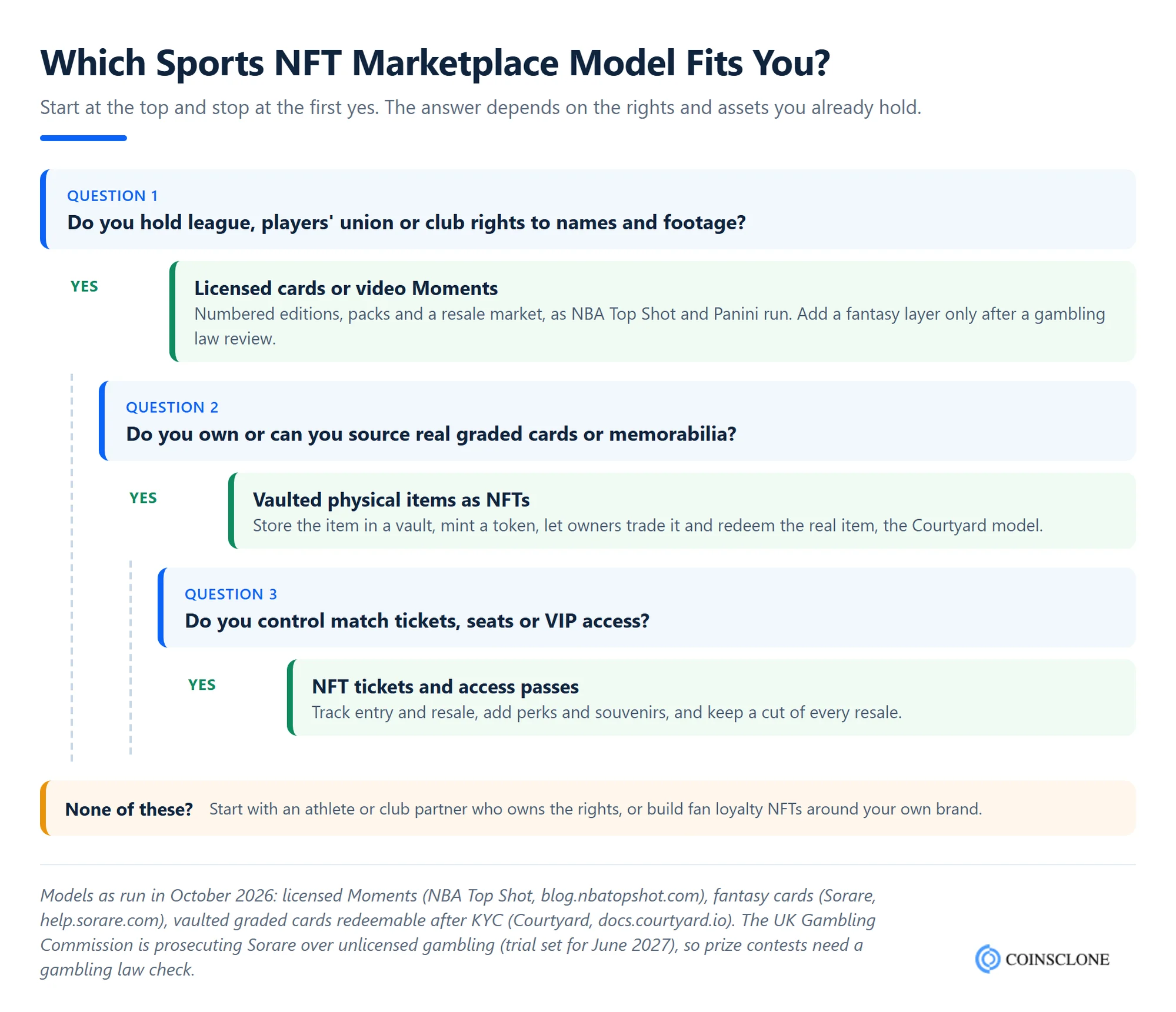
So the most active sports NFT models today are licensed digital cards, fantasy games and vaulted physical cards. The next step is to match one of them to what you own.
Ways to Build an NFT Sports Marketplace
Your build approach affects cost, time to market, scale and how much you can change later. Here are three build methods for different business needs.
Development from Scratch
This approach suits large firms or startups aiming for long-term growth. Developers build the whole site, from UI/UX to smart contracts, APIs and blockchain links, all shaped to your brand. So it is ideal for those seeking a premium, fully branded sports platform. However, it costs more and takes longer than the other options.
White Label NFT Marketplace Software
White Label NFT Marketplace Software is a pre-built solution with the core features and standards of an NFT platform. Businesses add their own branding, logo, colours, UI/UX and fonts to make it unique. Founders like it because it is flexible and already tested. As a result, white label software gives startups a fast, low-risk way into NFT sports marketplace development.
Hire NFT Developers
Hiring NFT marketplace developers lets you build a sports NFT site shaped to your plan, needs and growth goals. A team of your own builds the site structure, smart contracts, UI/UX and links to other tools to fit your model and fans.
This approach suits firms and startups that value flexibility and long-term growth. So success depends on balancing speed, custom work and cost.
Now that you have seen the main build approaches, let us look at the features that make an NFT sports marketplace worth using.
Attractive Features of the NFT Sports Marketplace
We pick features by looking at what fans need and what makes the platform easy to use. Here are the ones that matter most for a sports NFT marketplace.
- Advanced filters: Search by player, team, season, rarity, serial number and price.
- Online bidding: Auctions and offers for rare items, plus fixed-price listings.
- Card and crypto payments: Most sports fans are new to crypto, so card checkout and embedded wallets with email login remove the biggest drop-off point.
- Crypto wallets: Support for self-custody wallets for fans who want to hold items themselves.
- Leaderboards: Rank fans by sets filled or score to keep them coming back.
- Storefront: Branded pages for clubs, leagues and athletes.
- Ratings and price history: Recent sales and floor prices so buyers can judge value.
- Tracking: The full owner history of each item.
- Drop queue: A waiting room for big pack drops, so the site stays up when thousands of fans arrive at once.
- Dynamic NFTs: Cards that update with real player stats after each game.
- Wash-trade checks: Flags for accounts that trade with themselves to fake volume.
- Voting: Holders vote on club or fan group choices.
These features make your platform easier and safer to use. So you may wonder how to bring them to life quickly. Ready-to-launch clone scripts are one answer.
Our Ready-to-Launch NFT Sports Marketplace Clone Scripts
Our NFT sports marketplace clone scripts give you a proven structure based on known platform designs. They include core features, smart contracts and user flows, so you can launch faster with a model fans already know.
NBA Top Shot Clone Script
The NBA Top Shot Clone Script copies the core of a moments market, where each NFT is a sports highlight or big game play. It covers NFT drops, marketplace trading, wallet links and ownership records. So you can sell limited-edition moments and still pick your own blockchain, design and market rules. The NFL ALL DAY pause is a reminder to plan for long-term value, such as challenges, rewards and set goals, not only new drops.
Sorare Clone Script
The Sorare Clone Script supports NFT marketplaces built around fantasy sports and digital trading cards. It covers card minting, user-owned NFT cards, league play and scoring based on real match data. This model suits platforms that mix NFT ownership with gameplay, where fans build teams and compete each week. For a wider look at the game side, see our guide to blockchain fantasy sports apps.
With a solid marketplace in place, a mobile app is the next way to reach fans.
Mobile App for an NFT Sports Marketplace
Mobile apps keep fans active and coming back, because they make access quick and easy. Push alerts, live updates and safe in-app wallets bring people back often. With a simple, familiar mobile screen, users can browse, buy and manage NFTs at any time, which lifts daily use.
Apps also serve fans, collectors and traders in different ways. Fans can follow teams, get exclusive collectibles and hear about new drops first. Collectors can store, show and swap NFTs with ease. Meanwhile, traders can track prices, follow live drops and complete trades in minutes. Our NFT marketplace app development team builds these apps for iOS and Android.
Next, let us look at the use cases that make these platforms work for fans, collectors and traders.
Use Cases of NFT Sports Marketplace
NFT sports marketplaces offer many ways for fans, athletes and brands to connect and create value. These platforms go beyond trading. They open new experiences inside the sports community.
Here are the key use cases:
- Trading cards: Athlete and team cards as tokens, so fans own rare cards online, as Panini and Sorare do.
- Video moments: Licensed highlight clips sold as numbered editions, the NBA Top Shot model.
- Vaulted physical cards: Real graded cards kept in a vault and traded as NFTs, which fans can redeem for the physical card, the Courtyard model.
- Gear: NFT caps, shoes and jerseys mix fashion and fandom, so brands can earn from popular player kit.
- Signed items: Signed bats, balls and trophies can be turned into tokens to fight fakes and prove who owns them.
- Event tickets: NFT tickets make entry and resale easier to track and add perks like online keepsakes. Our guide to NFT ticketing marketplace development covers this model in full.
- Access passes: VIP NFTs give holders first pick of new kits, online meetups and backstage visits, which builds loyalty.
Business Benefits of an NFT Sports Platform
A sports NFT platform gives you several ways to earn and grow. Here are the main benefits of running a platform like this.
Ownership and Value
It lets sports fans trade items such as signed gear and cards. NFTs can represent videos, highlights, virtual trading cards and more. So fans can own rare digital items and buy, sell and trade them in an open market. So each sports item has proof of who owns it. But value is never sure. Prices of many 2021 collectibles have fallen a long way, so sell the experience, not a promise of profit.
Credibility and Verification
Fake items are a big problem in the sports memorabilia market. Counterfeit shirts, balls and cards hurt both value and trust. A sports NFT market fixes this, because the blockchain acts as proof of who owns each item. Each NFT is unique and keeps a record of every past owner, so buyers can trace it back to its maker. The vaulted card model goes one step further, because the physical item and its token are checked and stored together.
Stronger Fan Loyalty
A sports NFT platform can bring fans closer with one-of-a-kind perks. NFTs can unlock unseen videos, player meetups and virtual meet-and-greets. This gives fans a stronger bond with their teams and athletes, which builds loyalty and a sense of belonging. If loyalty is your main goal, see our guide to NFT loyalty platform development.
Global Reach and Market Expansion
Sports have always brought the world together, and NFTs remove the limits of geography. Because the marketplace runs on a blockchain, fans anywhere can join. A fan in India can own NFTs of players from Europe, and a collector in the U.S. can trade NFTs of players from leagues in Asia, all on the same marketplace. That wider access helps you win users and spread income across regions, as long as your licences cover those regions.
Revenue Generation
NFT sports marketplaces create new income for sports organisations, athletes and platform owners. Here are the main ways they earn:
- Primary sales: Packs and drops, shared between the platform and the rights holder.
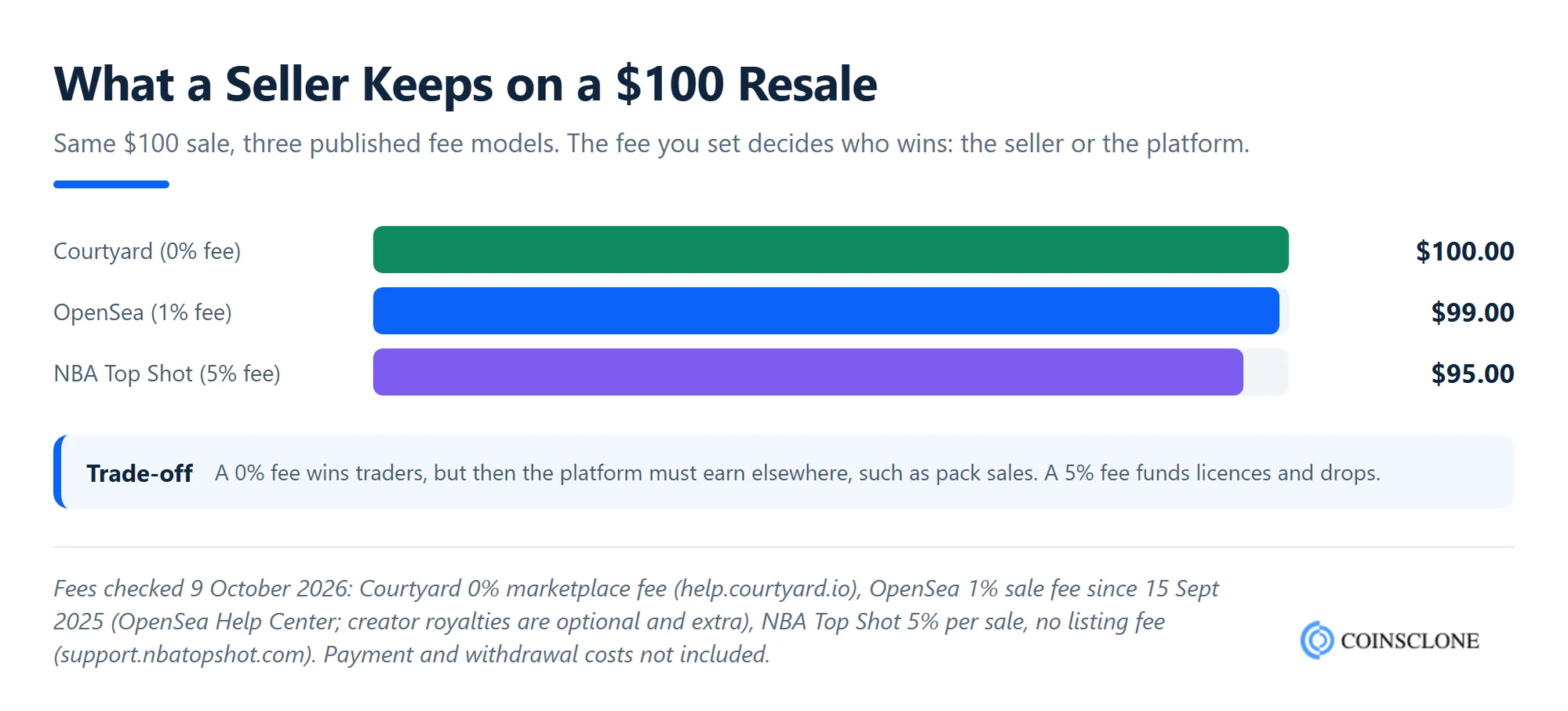
- Secondary sales: A fee on each resale, such as NBA Top Shot’s 5%, plus royalties for the rights holder where your contracts allow.
- Packs and services: Pack sales, vaulting, grading and premium memberships. Courtyard charges 0% on resales and sells packs instead.
For a full breakdown of fee and royalty options, read our guide to the NFT marketplace revenue model.
Challenges of Building an NFT Sports Marketplace
Every sports NFT project faces the same few problems. Planning for them early saves money later.
- Rights and licences: You need written rights for every name, logo, face and clip. League, union, club and athlete rights are often separate deals.
- Fan onboarding: Many fans have never used a wallet. Seed phrases, gas fees and crypto-only checkout lose buyers before the first sale.
- Drop-day traffic: A popular pack drop can bring thousands of users in seconds. Without a queue and strong servers, the site goes down at the worst moment.
- Fake volume: CryptoSlam flagged $85.7M of the $118.6M in Polygon NFT sales over the 30 days to 9 October 2026 as wash trades. So build checks that spot self-trading before it misleads your buyers.
- Long-term value: If drops stop, owners still want their items to mean something. Games, rewards and redemption keep value alive.
Laws and Rules for an NFT Sports Marketplace
Following the law is a must for any NFT sports marketplace, because rules on crypto assets, content rights and online payments differ by country. Following local rules lowers your legal risk, protects users and builds long-term trust. Two real cases show what is at stake:
- Securities claims: US buyers sued Dapper Labs, claiming NBA Top Shot Moments were unregistered securities. The case settled for $4 million, and Dapper agreed to business changes.
- Gambling law: The UK Gambling Commission charged Sorare with running gambling without a licence. The trial is now set for June 2027.
To stay safe, NFT sports marketplace development must cover these points:
- Asset type: How finance laws treat your NFTs. In the EU, MiCA leaves out unique NFTs, but large series or fractional NFTs may still fall under it.
- IP rights: Proper rights to turn sports clips, logos and player photos into tokens.
- Licensing requirements: Deals with leagues, players’ unions, teams or athletes for each region you sell in.
- Gambling rules: If fans pay to enter contests for prizes, check gambling and fantasy sports laws in every target market.
- KYC and AML: ID checks and trade checks, most of all for costly cards and card payments.
- Consumer protection: Clear pack odds, refund terms and what happens to items if the platform or licence ends.
Compliance shapes your budget, so let us look at what an NFT sports marketplace costs.
Development Cost of NFT Sports Marketplace
There is no single price, because cost depends on the model, the features and the number of blockchains. Published 2026 agency cost guides start sports NFT builds at around $40,000. A focused first version with minting, resale and fan wallets often takes 12 to 18 weeks.
A custom-built NFT sports marketplace costs more because it is designed from the ground up. The budget goes on system design, smart contracts, custom screens and security testing. Extra work goes into planning for scale, picking a blockchain and compliance checks. Dynamic NFTs, fantasy game engines, card payments and drop queues each add to the bill.
White-label and clone script solutions cost less because the core structure is already built and tested. Minting, trading and wallet modules are ready, so the work is mostly branding, setup and custom features. That shorter cycle helps businesses launch sooner with a budget they can predict. For a full cost breakdown, see our guide to NFT marketplace development cost.
Now that you know the cost drivers, here are the main build stages.
Stages of NFT Sports Marketplace Development
Building an NFT sports marketplace needs a clear plan to ensure safe trading, a smooth user experience and room to grow. Each stage links platform features to sports use cases, user needs and stability.
- Plan the project: Set business goals, target fans, NFT types, licences, trading models and blockchains to create a clear roadmap.
- Design the platform: Plan the site structure, including minting, listings, wallets, payments and admin tools.
- Build and connect: Build core functions such as minting, owner tracking, payments, sports data feeds and blockchain links.
- UI/UX design for sports fans: Design simple, lively screens that help fans, collectors and traders use the site with ease.
- Testing and security review: Test performance under drop-day load, fix bugs and audit smart contracts, data and user assets.
- Deployment and ongoing support: Launch the platform, watch performance and ship updates to support growth and new features.
Once you know the stages, choosing the right blockchain becomes the next key decision.
Supported Blockchains to Develop NFT Sports Marketplace
The blockchain you choose shapes speed, cost, scale and user experience. Different chains suit different goals, so match the chain to your fans and your model. For a data-led comparison, read our guide to the top blockchains for NFT marketplaces.
- Ethereum based NFT marketplace: The most trusted chain, with mature NFT standards (ERC-721 and ERC-1155) and the deepest pool of buyers. Panini’s bridge sends its cards here.
- NFT Marketplace on Polygon: Low fees, and it works with Ethereum tools. Courtyard’s vaulted cards trade here.
- NFT marketplace on Solana: Fast and cheap, with compressed NFTs for millions of low-cost items. Sorare moved here in late 2025.
- NFT marketplace on Flow: Built for consumer collectibles and home to NBA Top Shot and NFL ALL DAY. It recovered from a $3.9M exploit in December 2025.
- NFT Marketplace on Avalanche: Quick finality and the option to run your own chain for a large brand.
- BNB Chain based NFT marketplace: Low fees and a wide range of wallets.
Choosing the right partner is key to your NFT sports marketplace’s success. With a reliable team, you can turn your idea into a working product.
Why Choose Coinsclone for the NFT Sports Marketplace Development?
Coinsclone is a leading NFT Marketplace Development Company. We help startups launch sports NFT platforms. To build a platform that lasts, you need the right guidance on model, rights, features and chain. We help you shape the idea, then launch it with our white-label NFT marketplace software, set up for your exact needs.
We have been building blockchain products since 2018, with 350+ platforms delivered for 200+ clients across 20 industries. Our team builds moments markets, fantasy card games, ticket sites and vaulted-card models on the chain that fits your fans. So reach out to get a free demo of our white-label solution.
Frequently Asked Questions
What is NFT sports marketplace development?
NFT sports marketplace development means building a site where sports items are turned into NFTs and traded on a blockchain. These assets include player cards, team collectibles, game highlights and fantasy sports items. Smart contracts move items between owners, pay royalties and log each trade.
How does an NFT sports marketplace work?
An NFT sports marketplace mints sports assets as NFTs on a blockchain. Users connect a wallet or sign in with email, browse listings and trade NFTs through smart contracts. Each sale is logged on-chain, so anyone can see who owns what, past prices and royalty payments.
Is NBA Top Shot still active?
Yes. NBA Top Shot is active in 2026 and launched a 2025-26 season with rookie autographs and signed 1-of-1 Moments. Its sister product NFL ALL DAY stopped issuing new Moments on 13 May 2026, but existing Moments still trade.
What are NFT sports cards?
NFT sports cards are digital trading cards of players or teams, stored as tokens on a blockchain. Some exist only online, like Panini and Sorare cards. Others, like Courtyard’s, represent a real graded card kept in a vault that the owner can redeem.
What is the role of smart contracts in NFT sports platforms?
Smart contracts mint NFTs, move them between owners, pay royalties and apply the site’s rules on their own. They remove middlemen, reduce errors and make sure creators and athletes receive agreed earnings where royalties apply.
Is NFT sports marketplace development secure?
Security depends on smart contract audits, safe wallet setup and blockchain choice. A well-built NFT sports marketplace uses audited contracts, encrypted user data and open on-chain records to reduce fraud and price manipulation.
What does an NFT sports marketplace development company do?
A build team for an NFT sports marketplace designs and builds the tech side of the platform. This covers the choice of blockchain, smart contracts, NFT standards, screen design and planning for growth.
Launch Your Own NFT Sports Marketplace Today
NFT Sports Marketplace Development — build your custom trading platform for sports NFTs.
- White-Label Solution: Launch quickly with pre-built core modules.
- Fan Engagement Tools: Boost interactions through NFT collectibles.
- Multi-Revenue Options: Earn via auctions, drops, and resales.
- Secure Infrastructure: Blockchain-based transactions ensure trust.
See a free branded demo of your NFT marketplace in 48 hours — before you invest a cent.
Book a Free Demo to discover how NFT Sports Marketplace Development can help you launch in just 8–12 weeks.