
A Zengo wallet clone script is ready-made software for launching a crypto wallet like Zengo: a self-custody app with no seed phrase, where MPC (multi-party computation) splits signing between the user’s phone and your server. This guide explains what the script includes, how the seedless model works, and where Zengo itself stands in October 2026, now that eToro owns it.
You will also see how the wallet signs and recovers without a seed phrase, what it costs and how long it takes to launch, the ways a Zengo-style wallet earns money, and the risks and legal points to clear first. By the end, you will know which kind of Zengo-like wallet fits your business and what it takes to build one.
In this guide:
- What a Zengo wallet clone script includes, for users and for admins
- Zengo’s status in 2026: the eToro deal, 2+ million users and its paid plans
- How a 2-of-2 MPC wallet signs and recovers, shown step by step
- 2026 cost bands, launch weeks and a decision tree for your build path
- Revenue streams with real fee benchmarks, plus the safety and legal checks before launch
See How Our MVP System Can Launch Your Zengo-like MPC Crypto Wallet Faster
MPC Crypto Wallet Development — done right.
- MVP System: Launch your Zengo-like wallet 90% faster.
- Pre-Built Modules: MPC security, multi-asset support, and seamless UX—no coding needed.
- Brand & Customization: Your design, your tokens, your ecosystem.
- Revenue Engine: Earn from transaction fees, swaps, and staking features.
Get a free branded demo of your Zengo-style wallet in 48 hours — before you invest a cent.
Book a Free Demo to discover how our Zengo Wallet Clone can take you from idea to live wallet in just 8-12 weeks.
What Is a Zengo Wallet Clone Script?
The Zengo wallet clone script is a ready-to-launch software package that copies the main features of the Zengo crypto wallet. Like Zengo, it is a non-custodial MPC wallet. Users hold and manage their own crypto, and they never have to write down a seed phrase.
The script ships with the user app, the admin panel and the MPC signing engine already built and tested. So you skip the hardest part of a wallet build: key handling and transaction signing. Your team then spends its time on your brand, chains, revenue streams and extra features.
Even though the clone has the same core features as the Zengo MPC wallet, you can change every part of it. You can add or remove modules, set your own fees and design your own screens. It also works as a white label MPC wallet base for exchanges, fintech apps and Web3 brands that want their own wallet.
A Zengo clone script usually covers three layers:
- MPC wallet core: two key shares made on separate machines, joint signing and support for many blockchains.
- User app: iOS and Android apps with face login, send and receive, swaps, NFTs and portfolio views.
- Admin panel: user insights, security monitoring, fee settings and support tools.
With our Zengo wallet clone, startups can launch at a lower cost than a build from scratch. To see how the MPC layer is designed in depth, read our guide to MPC wallet development.
Zengo in 2026: Where the Original Stands
Before you copy a wallet, check that its model still works. Zengo is active and growing in October 2026, but it now has a new owner. Here is what we confirmed at the source.
- Background: Zengo was founded in 2018 in Tel Aviv, and it launched one of the first consumer MPC wallets in 2019. It says on its own site that it has secured more than 2 million wallets since 2018 and that no Zengo wallet has ever been hacked.
- New owner: on 15 April 2026, eToro agreed to buy Zengo. eToro’s first quarter 2026 results confirm that the deal closed on 30 April 2026. The price was not disclosed; CoinDesk reported it at about $70 million.
- Separate wallet: eToro says the Zengo wallet stays separate from its regulated exchange services. Zengo users still deal with Web3 apps directly, and eToro plans to add tokenized assets, prediction markets and perpetuals.
- Coverage: Zengo supports more than 1,000 assets, including Bitcoin, Ethereum, Solana, TRON, stablecoins and NFTs. It needs no ID documents to open a wallet.
- Paid plans: the free app is the entry point. Zengo Pro adds Legacy Transfer (an inheritance-style handover), Theft Guard, a Web3 firewall, up to 5 separate wallets and up to 50% off crypto purchases. The US App Store lists Pro purchases from $19.99 to $129.99.
- Business wallets: Zengo now sells treasury wallets for companies at $2,999 and $4,999 a year, with approval rules, spending limits and compliance tools on the same 2-of-2 MPC base.
So the Zengo model is alive, and a large broker paid real money for it. A clone in 2026 should copy that full picture: a free seedless app, a paid safety tier and a business wallet, not just the 2021 feature list.
Why Should You Launch a Crypto Wallet Like Zengo Wallet?
People choose a crypto wallet like Zengo because it removes the seed phrase, uses MPC security and keeps the app simple. A Zengo wallet clone script built on the same logic gives your users strong protection, seedless access and an easy interface that cuts sign-up drop-offs. With a Zengo Wallet Clone Script, your brand can run a safe, seedless wallet that grows with both new Web3 users and active traders.
- No seed phrase stress: users sign in with their face and email, not 24 words on paper.
- No single point of failure: MPC splits signing, so a thief with one share cannot move funds.
- Easy for beginners: fewer steps at sign-up means fewer users give up.
- High trust: Zengo’s record shows users will pay for safety they can feel.
- Web3 ready: many chains, swaps and DApp access in one app.
The market backs this up. eToro, a broker with more than 40 million registered users, bought Zengo to add self-custody to its platform. That is a strong sign that seedless wallets are moving into the mainstream.
Why Choose Zengo Wallet Clone Script For Business Over Other Development Methods?
Crypto wallets are the entry point to the whole crypto industry, so demand for safe wallets stays high. MPC wallets like Zengo have won global attention with their features. Safe, non-custodial wallets like Zengo help business owners enter the crypto market with a product users trust.
The Zengo Wallet Clone Script gives you a ready-made MPC wallet base that cuts build time, cost and technical risk. It is built for custom features, your own branding and a fast launch, without giving up security.
Hence, creating a cryptocurrency wallet like Zengo offers you a wide range of business benefits. Some of them are:
Cost-Effective Solution
A Zengo crypto wallet clone script, MVP or white label Zengo wallet clone lets startups launch a wallet quickly and at a lower cost. Building a custom MPC wallet from scratch is expensive: published 2026 market estimates put an MVP at about $80,000 to $150,000 and a mid-level product at $150,000 to $300,000. A clone reuses a tested MPC core, so it sits well below those figures. Our full crypto wallet development cost guide breaks down each line.
Time-Saving Software
With Coinsclone, a white label wallet launches in about 3 to 5 weeks, and a custom wallet takes about 8 to 12 weeks. A custom MPC build from scratch usually takes several months, plus audits.
Customizable
Even though the Zengo wallet clone is already built, you can change it with add-on modules and core features. This gives startups the freedom to shape their product around features that already work. It also works as a White Label Crypto Wallet Framework, so you can launch faster with full control of the design.
Brand Identity
By offering Zengo’s proven, seedless features under your own name, you can win global users and build trust in your crypto wallet business.
MPC-Powered Security
With MPC, the most common support problems shrink: lost seed phrases, locked accounts and stolen keys. Fewer support tickets and stronger security free your team to focus on growth and user experience. Admins can then spend more time adding modules and testing new features.
Through these benefits, the Zengo wallet clone script stands out from other ways of building a wallet. It is a strong choice for startups that want to succeed in the crypto space.
How a Zengo-Style MPC Wallet Signs and Recovers
This is the part buyers ask about most, so here is the model in plain words. A normal wallet has one private key, backed up as a seed phrase. Lose the phrase and the funds are gone; leak it and a thief takes everything.
Zengo uses a 2-of-2 MPC setup instead. When a user creates a wallet, the phone and your server each make their own secret share. The two shares are made separately and never meet. To send crypto, both sides run a short joint protocol that produces a valid signature. A full private key never exists in one place, so there is nothing for a hacker to steal in one go.
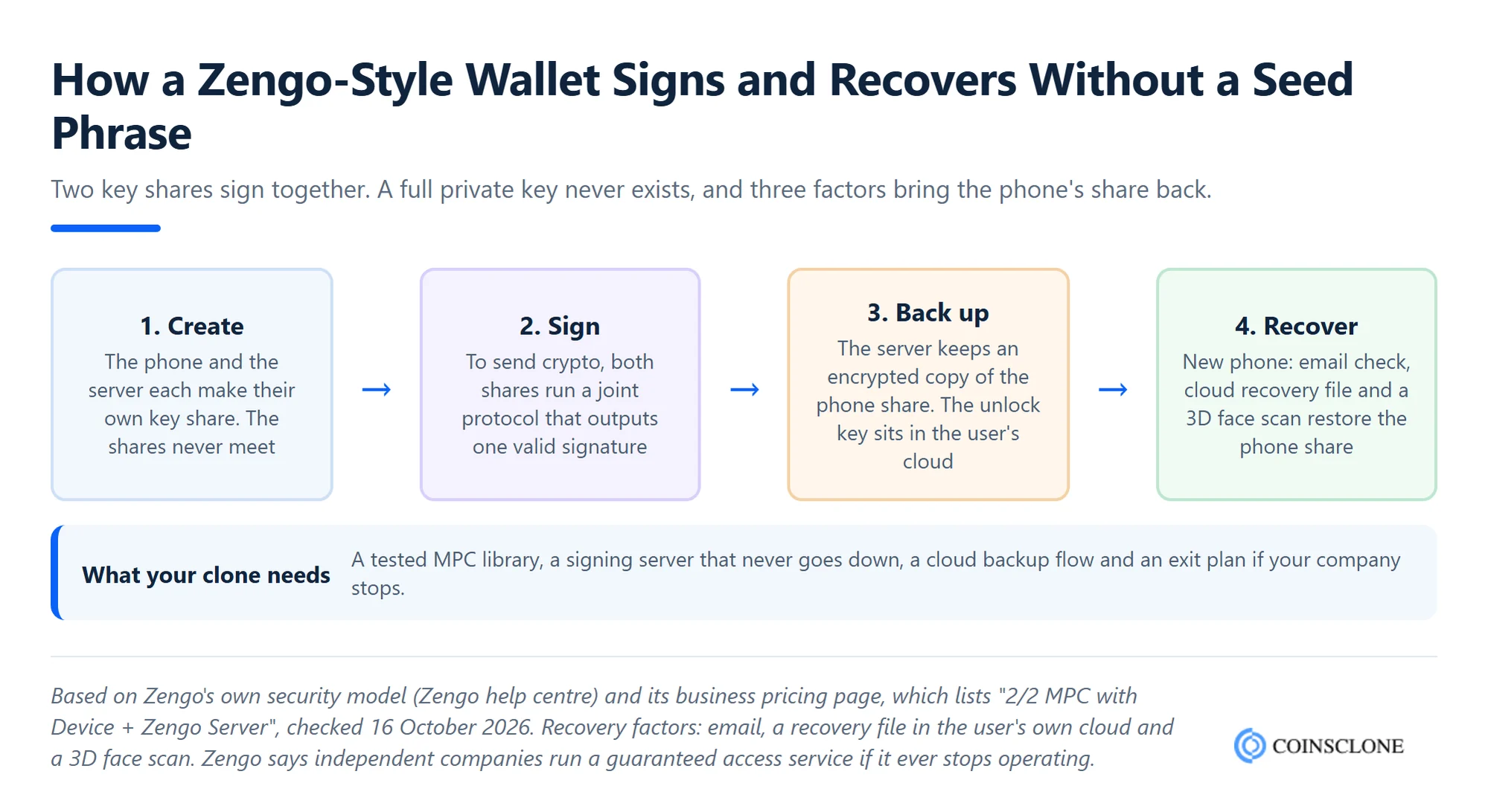
Recovery follows Zengo’s three factors. Your server keeps an encrypted copy of the device share, but it cannot use it. The key that unlocks it sits in the user’s own iCloud, Google Drive or Dropbox. On a new phone, the user proves their email, opens the cloud recovery file and passes a 3D face scan, and the device share comes back.
One more piece matters for trust: what happens if your company stops running. Zengo says a guaranteed access service, run by independent companies, would let users reach and move their funds without Zengo. Your clone should plan the same kind of exit path from day one, as our guide to custodial vs non-custodial wallets explains.
Exponential Features Of Our Zengo Wallet Clone
The Zengo crypto wallet clone script comes with many core features, and it keeps pace with new trends. Some of the top Crypto Wallet features of our Zengo wallet clone are:
User Features
The user side is built for smooth onboarding, seedless key creation, easy crypto management and safe login. The app stays simple, even for users with no blockchain knowledge.
- Smooth onboarding and login with email and face scan
- MPC-based wallet creation without seed phrases
- Many chains and coins in one wallet
- Safe send, receive and swap options
- NFT storage and viewing, with a spam filter
- Real-time alerts and notifications
- In-app portfolio tracking
- Face or fingerprint unlock for extra safety
- 24/7 in-app support chat
Admin Features
The admin panel focuses on safe management, compliance control, analytics and flexible settings. It gives your team clear oversight and stable operations.
- Central admin dashboard
- User access controls
- MPC signing service and security monitoring
- Activity charts and reports
- DApp and API integration management
- Fraud detection and compliance tools
- Wallet settings and customisation
- Multi-level admin access
Security Features of Our Zengo Wallet Clone Software
Our whole MVP Zengo Wallet Clone is built on MPC cryptography, which removes seed phrases and the single point of failure. Layered security protects transactions and APIs, and it keeps operations ready for compliance checks.
- End-to-end MPC cryptography
- Seedless safety with no single point of failure
- Biometric and multi-factor login
- Anti-phishing checks and clear transaction previews
- Encrypted API traffic
- DDoS, XSS and SQL injection protection
- Compliance-ready design
MPC is strong, but it is not magic. Three risks need a plan:
- Code flaws: in August 2023, Fireblocks researchers disclosed BitForge, a set of flaws in common MPC code used by more than 15 wallet providers, Zengo among them. All were patched before going public, but the lesson stands: use audited, current libraries and get the build reviewed.
- Server uptime: in a 2-of-2 wallet, users cannot sign if your server share is offline. Run the signing service across regions and monitor it all the time.
- Fake signing requests: most thefts today trick users into signing a bad transaction. A Web3 firewall and plain-language previews block most of them.
Zengo even ran a public hacking challenge in January 2024, with 10 BTC in a wallet for anyone who could break it. You do not need a stunt like that, but outside audits before launch are a must. For a full checklist, see our guide to crypto wallet security.
Add-On Modules of Coinsclone’s Zengo Wallet Clone Script
Apart from the core features, you can add extra modules to your Zengo Wallet Clone for more traction and user engagement.
- 3D FaceLock: a three-dimensional face scan that checks a live person is present, for stronger login and recovery.
- 3FA Recovery: three factors (email, face scan and a recovery file in the user’s cloud) restore the wallet on a new device.
- Multi-crypto support: add Bitcoin, Ethereum, Solana, TRON, stablecoins and other tokens on the chains your users want.
- NFT Wallet: a separate space to store, view and protect NFTs.
- Crypto Staking: users can stake supported coins for rewards from inside the app.
- Legacy Transfer: like Zengo Pro, let users name someone who receives their crypto if they stop using the wallet.
- Theft Guard: require a fresh face scan before large or unusual transfers.
- Business Approvals: team wallets with roles, spending limits and approval rules, like Zengo’s business plans.
Along with these, our team can add other crypto wallet app features that suit your business needs. But here comes the important query,
‘Who offers the best Zengo wallet clone script?’
Coinsclone offers a Zengo wallet clone script that helps you launch a crypto wallet like Zengo, built your way. Our crypto wallet team supports you from the first demo to launch and beyond.
How Does Our Zengo Wallet Clone Work?
Let’s look at how the admin and user panels work in our Zengo Wallet Clone Script. With rich features and back-end tools, crypto transactions run smoothly from end to end.
User Panel:
The Zengo crypto wallet clone script has a simple interface that makes transactions quick, with no complex steps.
- Registration: users sign up with an email and a face scan. No seed phrase or ID documents are needed for a self-custody wallet. KYC only applies when users buy crypto with cards or bank transfers through a licensed partner.
- MPC wallet creation: after onboarding, the phone and the wallet server each make their own key share. One share stays on the user’s device and the other sits on your server.
- Crypto Transactions: users send, receive, stake and swap tokens. Each one is signed jointly by the two shares.
- Biometric Login and Recovery: face login protects daily use. If users lose their phone, they restore the wallet with their email, their cloud recovery file and a face scan.
- Ticket Raising: when users face any issue, they raise a ticket in the app, and your support team responds.
Admin Panel:
The admin dashboard of the Zengo wallet clone is built with strong security rules and solid back-end tools.
- User Management: admins see new users, active wallets and overall activity.
- Security Monitoring: since the clone is an MPC wallet, admins watch the signing service, failed logins and risky transactions.
- Revenue Module Settings: admins set and change swap fees, plan prices and partner splits.
- Analytics: the team views live wallet activity in one place.
- Reporting: detailed reports on app usage, transactions and active users.
This is how a Zengo wallet clone works for both users and admins. If you are still weighing a crypto wallet like Zengo, the next sections cover what we deliver, the cost and the business case.
What We Deliver
Zengo Wallet Clone App
A complete MPC-powered Zengo Wallet Clone app with a clean UI, seedless security and multi-chain support. The app loads fast, is easy to move around in and shows the user’s portfolio in real time. Its seedless login and MPC-based key protection are its core selling points.
Key Deliverables:
- Fully working MPC crypto wallet app
- Seedless login with a smooth UI/UX
- Real-time portfolio insights
- Multi-chain and multi-asset support
- Custom branding and design options
White Label Zengo Wallet Clone Script
The white label Zengo Wallet clone script gives you full branding freedom on a pre-built MPC base. Businesses can change features, add Web3 modules and launch faster without technical roadblocks.
Key Deliverables:
- Customizable white label MPC wallet framework
- Your own themes, UI and feature set
- Quick launch without long build delays
- Scalable design for large user traffic
- Web3, DeFi and NFT integration support
How Much Does a Zengo Wallet Clone Cost in 2026?
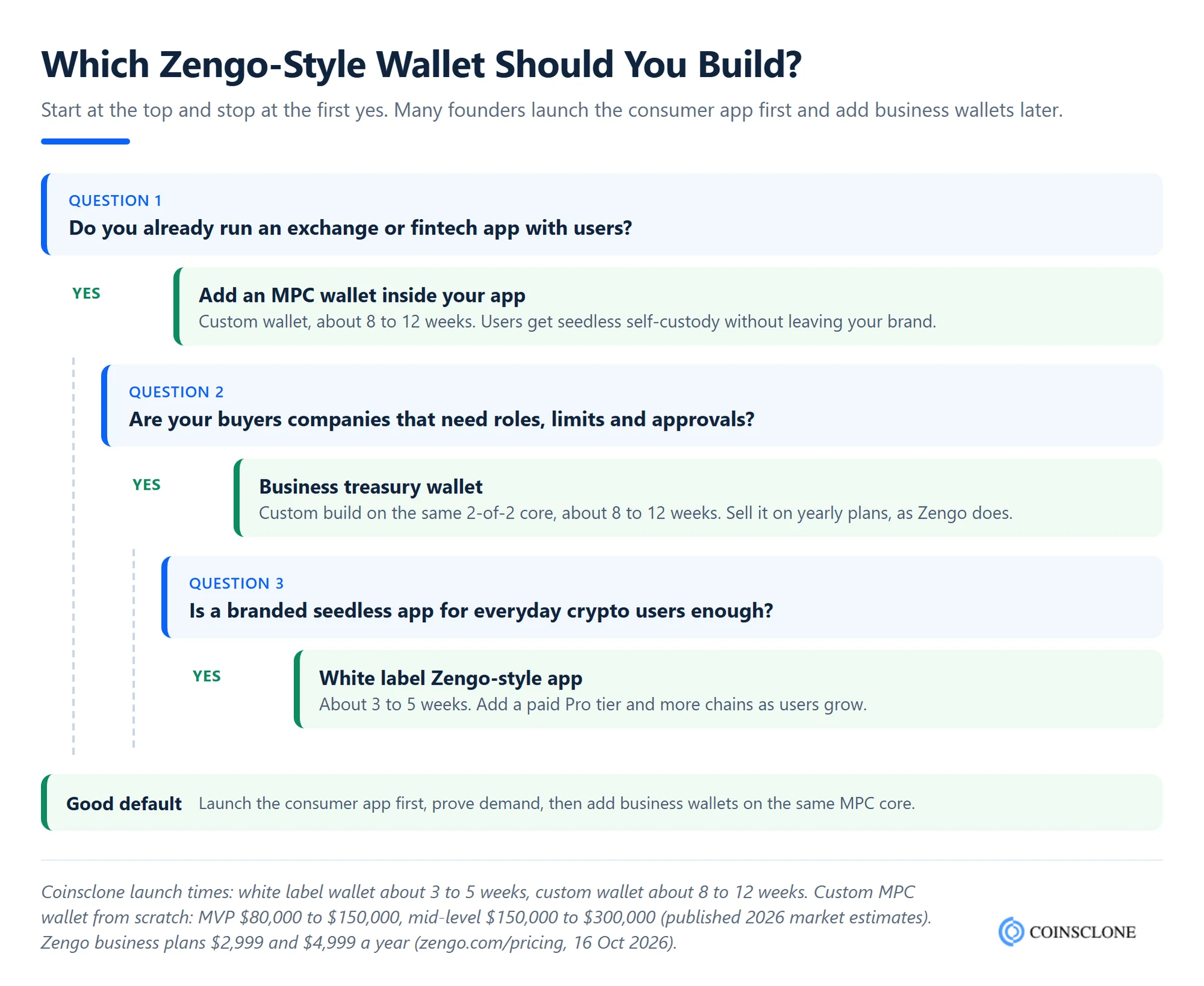
Cost depends on how much you change and how many chains you support. MPC wallets cost more than basic wallets, because the signing service, key-share storage and audits are extra work. Published 2026 market estimates put a custom MPC wallet MVP at about $80,000 to $150,000, a mid-level product at $150,000 to $300,000 and enterprise custody at $300,000 or more.
A clone script cuts both cost and time, because the MPC core is already built and tested. Here is how the main paths compare:
| Build path | Typical launch time | Cost level |
| Coinsclone white label Zengo-style wallet | About 3 to 5 weeks | Lowest; the MPC core is reused |
| Coinsclone custom Zengo-style wallet | About 8 to 12 weeks | Mid; you pay for the custom parts only |
| Custom MPC wallet from scratch (market) | Several months, plus audits | $80,000 to $300,000+ |
| Wallet-as-a-service SDK in your app | Days to a few weeks | Low upfront, then monthly per-user fees |
Not sure which version you need? Use this decision tree.
Also plan for running costs after launch. These include the signing servers, node and data APIs, app store fees, yearly audits, support and updates. For a line-by-line view, see our crypto wallet cost breakdown.
Steps to Launch Your Zengo Clone Wallet
Here is the path most of our wallet projects follow, from first call to live app.
- Pick your market and model: consumer app, business wallet or both, and which chains you need first.
- Plan custody and recovery: decide who holds the second share, how users recover and what happens if your company stops.
- Brand and design: set your own name, logo, screens and onboarding flow.
- Configure the script: add chains, swap partners, on-ramps, fees and plan prices.
- Test and audit: run security tests, an outside audit of the MPC code and a beta with real users.
- Launch and grow: publish to the app stores, watch the admin dashboard and add paid features as users ask for them.
Once live, keep updating. Chains change, new tokens arrive and app stores update their rules every year.
Benefits of Using Coinsclone’s Zengo Wallet Clone Script
Coinsclone’s Zengo Wallet clone script cuts launch time, raises security and gives you full control of the product. It keeps operations smooth, works with Web3 and scales at a fair cost.
- Faster launch: a ready MPC setup, live in weeks.
- Seedless, enterprise-grade security: no phrase to lose or leak.
- Full branding freedom: your name, design and features.
- Multi-chain support: many coins and tokens in one app.
- Mobile and web: iOS, Android and a web dashboard.
- Web3 and DApp access: swaps, staking and NFTs built in.
- Lower cost: a tested core instead of a build from scratch.
Revenue Opportunities With Zengo Wallet Clone Script
A wallet is free for users, so you need a clear revenue plan from day one. Zengo itself shows a three-part model: a free app, a paid safety tier and paid business wallets. Our MVP Zengo wallet clone script supports all of these, plus the usual wallet income streams.
- Swap and transaction fees: earn a small share of every in-app swap. For scale, MetaMask charges 0.875%, Phantom 0.85% and Zerion 0.67% on swaps, while Trust Wallet adds no service fee.
- Premium subscriptions: sell a Pro tier with inheritance, theft protection and lower fees, as Zengo does from $19.99.
- Business wallet plans: charge companies a yearly fee for team wallets, as Zengo does at $2,999 and $4,999 a year.
- Fiat on and off ramp: collect referral fees when users buy or sell crypto through a partner.
- Staking services: keep a share of staking rewards. MetaMask, for example, keeps 15% of rewards in its pooled staking.
- NFT-related charges: fees on NFT transfers or featured drops.
- Referral and affiliate rewards: earn a cut when users join partner apps and services.
- Sponsored listings: charge projects for featured placement, clearly marked as sponsored.
Your real income depends on how active your users are and what your partners charge. Swaps usually lead, and paid safety features suit an MPC wallet well, because safety is why users came. For more detail, see our guide on how crypto wallets make money.
Legal Points to Clear Before You Launch
A clone script copies features, not a brand. Two legal points matter most.
- Brand and design: never use Zengo’s name, logo or look. “Zengo clone” describes the feature set; your app must carry your own name and design, or you risk trademark claims and app store removal. Copycat wallets are also a common phishing trick, so a clearly different brand protects your users too.
- Custody rules: MPC describes how signing works, not who owns the funds. If your company can move user funds on its own, you run a custodial wallet. In the US, FinCEN’s 2019 guidance says firms that only provide self-custody wallet software are not money transmitters. In the EU, MiCA treats holding crypto for clients as a licensed service.
In a 2-of-2 design like Zengo, your server share alone cannot sign, which keeps the wallet on the self-custody side. Fiat features, such as card buys and bank payouts, follow payment rules, so most wallets use a licensed partner for them. Our post on whether clone scripts are legal to use covers the rest. Then get legal advice in each market you serve.
Frequently Asked Questions
Who owns Zengo?
eToro owns Zengo. It announced the deal on 15 April 2026, and the purchase closed on 30 April 2026. The price was not disclosed, though CoinDesk reported it at about $70 million. The Zengo wallet stays separate from eToro’s regulated services.
Is Zengo a custodial or non-custodial wallet?
Zengo is non-custodial. The phone holds one key share and Zengo’s server holds the other, and neither can move funds alone. A Zengo wallet clone script follows the same model, so your company cannot move user funds by itself.
Does Zengo have a seed phrase?
No. Zengo uses MPC instead of a seed phrase. Users recover their wallet with three factors: their email, a recovery file stored in their own cloud account and a 3D face scan.
Is Zengo safe?
Zengo says no Zengo wallet has been hacked since 2018. Its MPC code is open source and audited, and the flaws found by the 2023 BitForge research were patched before they went public. For your own clone, outside audits, a reliable signing server and strong phishing warnings matter most.
What happens if Zengo shuts down?
Zengo says a guaranteed access service, run by independent companies, would let users reach and move their crypto without Zengo. If you build a Zengo-style wallet, plan your own exit path the same way before launch.
How long does it take to launch a Zengo wallet clone?
With Coinsclone, a white label Zengo-style wallet launches in about 3 to 5 weeks. A custom wallet takes about 8 to 12 weeks. Extra chains, business approval tools and fiat partners add time.
How many cryptocurrencies does a Zengo clone support?
As many as you choose to add. Zengo itself supports more than 1,000 assets across Bitcoin, Ethereum, Solana, TRON and other chains. Most clones launch with the major chains and stablecoins, then add more as users ask.
Why Do You Choose Coinsclone To Adopt The Zengo Wallet Clone?
Coinsclone is a leading Cryptocurrency wallet development company known for safe, ready-to-launch crypto wallet software. Since 2018, we have delivered 350+ platforms for 200+ clients across 20 industries. Our wallet team helps you launch with strong MPC security, seedless login and flexible features, so you deliver a Web3 wallet users trust. We also help you shape the business plan that lets you compete.
If you want to compare Zengo with other wallet models first, see our list of the best crypto wallet clone scripts. When you are ready, kickstart your crypto wallet with our Zengo wallet clone script. We also offer post-launch support and maintenance, so your wallet stays ahead in the market.
Contact our expert team to get your customised quotation!
See How Our MVP System Can Launch Your Zengo-like MPC Crypto Wallet Faster
MPC Crypto Wallet Development — done right.
- MVP System: Launch your Zengo-like wallet 90% faster.
- Pre-Built Modules: MPC security, multi-asset support, and seamless UX—no coding needed.
- Brand & Customization: Your design, your tokens, your ecosystem.
- Revenue Engine: Earn from transaction fees, swaps, and staking features.
Get a free branded demo of your Zengo-style wallet in 48 hours — before you invest a cent.
Book a Free Demo to discover how our Zengo Wallet Clone can take you from idea to live wallet in just 8-12 weeks.