
Do you know? The global cryptocurrency exchange market, which was valued at roughly USD 43.8 billion in 2024, is projected to climb to over USD 54.8 billion in 2026, supported by rising institutional adoption and growing global demand. Amid this rapid growth and fierce competition, Coinbase crypto exchange stands out. In past years, Coinbase boasts a user base of about 120 million monthly users and remains one of the top globally recognized platforms.
Over the past decade, Coinbase has transformed from a modest Bitcoin-buying app into one of the world’s most trusted and revenue-diverse crypto companies. While many aspiring exchanges focus purely on trading fees, Coinbase’s success comes from something much deeper — a multi-layered business model built on trust, compliance, and diversified monetization.
Understanding how Coinbase makes money gives startups a blueprint to design sustainable revenue streams from day one. With market volatility, regulatory pressure, and intense competition, depending on a single income source can quickly become a startup’s biggest risk. But Coinbase has solved this risk by expanding its revenue streams that work in both bull and bear markets.
So, this article breaks down Coinbase’s revenue model in a practical, founder-friendly way and how to develop it easily for startups like you!
See How Coinbase Really Makes Money — and How You Can Too?
Discover the business model behind one of the world’s most successful crypto exchanges.
- Trading Fees : Learn how Coinbase earns millions from every buy and sell.
- Staking & Subscriptions : Explore recurring revenue from staking, custody, and premium accounts.
- Institutional Services : Understand how Coinbase attracts and profits from big investors.
- Revenue Diversification : See how Coinbase expands beyond trading into payments, DeFi, and more.
Want to build a Coinbase-like exchange with the same money-making model?
Book a Free Demo to see how our MVP System can launch your crypto platform fast — complete with trading, staking, and revenue modules in 8-12 weeks.
Coinbase Business Model – An Overview
For startups trying to understand the mechanics behind a top-tier crypto exchange, Coinbase offers one of the clearest and most strategic business models in the industry. At its core, Coinbase operates as a two-sided marketplace — connecting retail traders, institutional investors, and liquidity providers within a secure, regulated environment.
But unlike many exchanges that rely almost entirely on transaction fees, Coinbase has built a multi-layered ecosystem designed to maximize lifetime value (LTV) while minimizing reliance on volatile trading conditions. Coinbase’s model is built around three pillars:
- Marketplace + Infrastructure : Coinbase provides an easy way for users to buy, sell, and store crypto. The company essentially monetizes convenience, trust, and accessibility.
- Diversified Revenue Layers : Coinbase earns through staking, custody, subscriptions, blockchain rewards even when market activity slows down.
- Ecosystem & Network Effects : Once users enter the Coinbase ecosystem, they’re encouraged to use additional products to increase user retention.
Thus, Coinbase is a perfect example of how a crypto exchange can make money beyond simple trading aspects into a financial platform. Now, Let us get to know..
How Does Coinbase Make Money? (All Revenue Streams Explained)
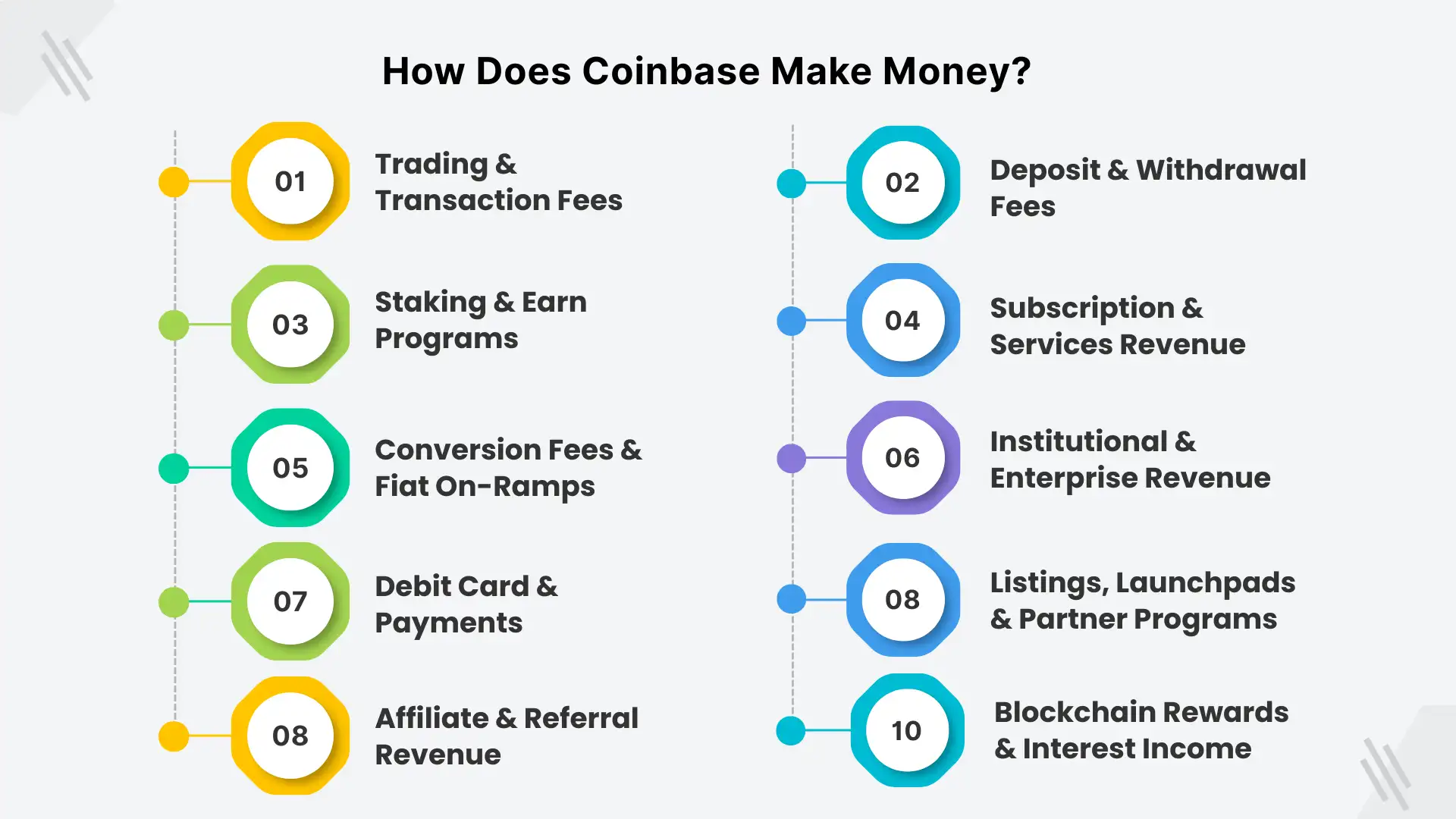
Coinbase primarily makes money through trading fees, spreads, and deposit/withdrawal charges. In addition, this exchange also earns revenue from staking services, launchpad offerings, and other partnership and affiliate programs. Here is the list of foremost revenue streams of Coinbase Crypto Exchange.
- Trading & Transaction Fees
- Deposit & Withdrawal Fees
- Staking & Earn Programs
- Subscription & Services Revenue
- Conversion Fees & Fiat On-Ramps
- Institutional & Enterprise Revenue
- Debit Card & Payments
- Listings, Launchpads & Partner Programs
- Affiliate & Referral Revenue
- Blockchain Rewards & Interest Income
Let’s explore each of these revenue generating ways in detail.
1. Trading & Transaction Fees
Trading Fees are the primary source of every cryptocurrency exchange platform. Coinbase charges a trading fee for the purchase and sale of cryptocurrencies, with a fee of 0.5%. It is applied to all cryptocurrency purchases and sales. Based on the token value, price, blockchain, total transactions, etc, the transaction fee may differ. The trading fees will be the primary contributor to other revenue sources of the Coinbase platform.
2. Deposit & Withdrawal Fees
The transaction of cryptocurrency processing has risen in the past few years since many traders wish to send and receive their crypto by transacting from one platform to another. By utilizing this process, Coinbase charges for transactions, so users pay a total transaction fee of 4% to Coinbase for all cryptocurrency withdrawals.
As Coinbase is a centralized exchange platform, users can withdraw their cryptocurrency and transfer it to their non-custodial wallet. For each withdrawal and deposit, fees are collected.
3. Staking & Earn Programs
Through Coinbase’s staking service, users can stake assets like Ethereum, Solana, and other PoS tokens directly within the platform. In return, they earn staking rewards — and Coinbase takes a percentage of those rewards as a service fee.
Coinbase also operates “Earn” programs, where users complete educational tasks about a token to receive small rewards. While these initiatives generate modest revenue, they significantly boost user engagement and retention.
4. Subscription & Services Revenue
Coinbase has built steady, predictable income through subscription-based products. The flagship offering, Coinbase One, gives users benefits like zero trading fees, enhanced security, and priority support for a monthly subscription. Also, this model helps stabilize revenue during low market activity. On the enterprise side, Coinbase earns from custody services, Wallet-as-a-Service, and various institutional APIs that businesses pay to integrate.
5. Conversion Fees & Fiat On-Ramps
Coinbase earns a significant portion of revenue from crypto-to-crypto and crypto-to-fiat conversions, which often include a small embedded spread. Users who opt for instant trading or quick conversions pay for the convenience of speed and simplicity.
Moreover, the platform also monetizes fiat on-ramps—such as debit card purchases, instant bank transfers, and certain withdrawal methods—each carrying varying processing fees. Also, these charges may seem small, but at scale they form a strong, steady revenue stream.
6. Institutional & Enterprise Revenue
Institutional services are one of Coinbase’s most profitable and stable revenue pillars. Through Coinbase Prime, the exchange offers high-security custody, advanced trading tools, and deep liquidity access for hedge funds, asset managers, and corporations. Also, the clients pay custody fees, execution fees, and other service charges.
Additionally, coinbase also operates an OTC (over-the-counter) desk for large block trades, earning revenue from spreads and execution costs.
7. Debit Card & Payments
Coinbase generates additional revenue through its crypto debit card, which allows users to spend digital assets just like traditional currency. Each transaction earns Coinbase a share of the interchange fee, paid by merchants. Also, some transactions also involve small conversion fees when crypto is instantly swapped to fiat at the point of sale.
While this isn’t Coinbase’s largest revenue stream, it plays a key role in user retention by making crypto more practical for everyday use.
8. Listings, Launchpads & Partner Programs
Coinbase also earns revenue through project listings, liquidity support, and partner programs that resemble launchpad-style offerings. The exchange does not publicly charge “listing fees” in the traditional sense, but indirectly creates revenue opportunities.
Moreover, partner programs, including token education campaigns and ecosystem collaborations, allow Coinbase to monetize visibility and user engagement.
9. Affiliate & Referral Revenue
Coinbase also benefits from a steady stream of affiliate and referral revenue, driven by partnerships and user-driven promotions. Through its referral program, existing users earn bonuses for bringing new customers onto the platform—boosting user acquisition at a low cost. Additionally, Coinbase partners with businesses, influencers, and fintech platforms that earn commissions for referring verified, active users.
While not a primary revenue driver, these programs help Coinbase scale efficiently and increase trading volume.
10. Blockchain Rewards & Interest Income
Another meaningful revenue stream for Coinbase comes from blockchain rewards and interest income. When users hold certain assets, such as stablecoins or PoS tokens, Coinbase can earn on-chain rewards or interest generated from custodial balances. A major contributor here is USDC, where Coinbase earns revenue through its partnership with Circle, benefiting from the yield generated on the underlying reserves.
Also, these income streams are relatively stable and continue even when trading activity slows, giving Coinbase a dependable financial cushion.
These are the ways Coinbase allows you to charge an exorbitant fee to the user while still providing the quality service that they require. But, as a startup, you will be in a suspicion how this Coinbase model will benefit you. So, clear your minds…
Why Does Coinbase Business Model Work? — Key Lessons for Startups!
Coinbase’s business model is successful not just because it offers crypto trading, but because it strategically combines trust, compliance, diversification, and user-centric design. Also, these elements form a powerful crypto exchange business plan that startups can learn from when building their own exchange.
- First, Coinbase’s compliance-first approach has been its strongest competitive advantage. This trust allows the crypto exchange to introduce new products confidently.
- Second, Coinbase doesn’t rely solely on trading revenue. For startups, this highlights the importance of designing multiple revenue streams from the beginning instead of depending on market cycles.
- Third, Coinbase’s product ecosystem is intentionally integrated. This environment can increase engagement and LTV.
- Finally, Coinbase’s focus on simplified UX made crypto accessible to everyday users.
Thus, these are the reasons why this Coinbase business model might work as a startup business. Apart from these mentions, breaking down the…
Profitable Future of Coinbase’s Revenue Streams
Coinbase’s revenue story is still evolving, and startups can gain valuable insights by looking ahead at emerging trends. As the crypto ecosystem matures, this crypto exchange will diversify into areas that promise sustained growth beyond trading fees. They are,
- Institutional Expansion
- Web3 Integration
- Decentralized Finance (DeFi) Integration
- Stablecoins Revenues
- Blockchain Yield Income
- Geo based Licensing
- Global Expansion
Therefore, For startups, these trends highlight the importance of diversifying revenue, integrating emerging financial products, and planning for long-term scalability. So, creating an exchange like Coinbase with an above-average revenue-generation process will undoubtedly lead your business to a profit-making business, but it all depends on the service provider you choose to create an exchange like Coinbase.
So, eventually, you will be wondering how to create a crypto exchange similar to Coinbase and how it costs. Right!
How to Create A Crypto Exchange Like Coinbase Effectively?
Building a crypto exchange like Coinbase requires a strategic balance of technology, compliance, and user experience. Start by clearly defining your target audience, retail traders, institutional clients, or both—as this will dictate product features, security requirements, and marketing strategies. Or else, When you approach the professional cryptocurrency exchange development company, they will offer your two options.
- Development From Scratch – Offers maximum flexibility. Startups can design a fully customized trading engine, unique UI/UX, and proprietary features such as staking, cards, and advanced analytics.
- White-Label Solutions – Provide a ready-to-use solution with pre-built trading engines, wallets, and compliance modules. Also, limitations include reduced customization and potential dependency on the provider for updates and security.
On average, the cost to create a Coinbase-like Cryptocurrency Exchange would range between $25,000 to $50,000. However, this cost isn’t fixed and might change depending on your project requirements and some influential factors. Once the foundation is stable, add revenue-enhancing features like staking, subscription models, crypto debit cards, and institutional services. Then finally, stay compliant and iterate the crypto exchange model based on your business opinions.
Conclusion
Coinbase’s success demonstrates that building a sustainable crypto exchange requires more than just a trading platform. By learning from Coinbase’s model and strategically planning revenue, technology, and compliance, startups can build exchanges that are both scalable and resilient in an ever-evolving industry. To implement these specific processes in your business, you will require an excellent service provider.
Here, we, Coinsclone, your leading OTC Exchange Development Company, are a team of experts in the blockchain sector. We provide you with exemplary services by listening to your specific needs and analyzing current market trends to bring you the best possible outcome. As our developer team possesses enough skill in utilizing an advanced-level tech stack, we bring out the potential results in creating a similar crypto exchange like Coinbase.
See How Coinbase Really Makes Money — and How You Can Too?
Discover the business model behind one of the world’s most successful crypto exchanges.
- Trading Fees : Learn how Coinbase earns millions from every buy and sell.
- Staking & Subscriptions : Explore recurring revenue from staking, custody, and premium accounts.
- Institutional Services : Understand how Coinbase attracts and profits from big investors.
- Revenue Diversification : See how Coinbase expands beyond trading into payments, DeFi, and more.
Want to build a Coinbase-like exchange with the same money-making model?
Book a Free Demo to see how our MVP System can launch your crypto platform fast — complete with trading, staking, and revenue modules in 8-12 weeks.