
A Goose Finance clone script is ready-made software for launching a swap exchange and yield farm on BNB Chain, built on the model Goose Finance made famous in 2021. This guide explains what the script includes, how Goose Finance’s farms, burns and layered farming worked, and where the original platform stands in October 2026.
You will also see what still works in this model today, which of the old admin powers to remove, the features and security layers to expect, and the steps and time it takes to launch. By the end, you will know how to build a Goose-style yield farm that can outlast the original.
In this guide:
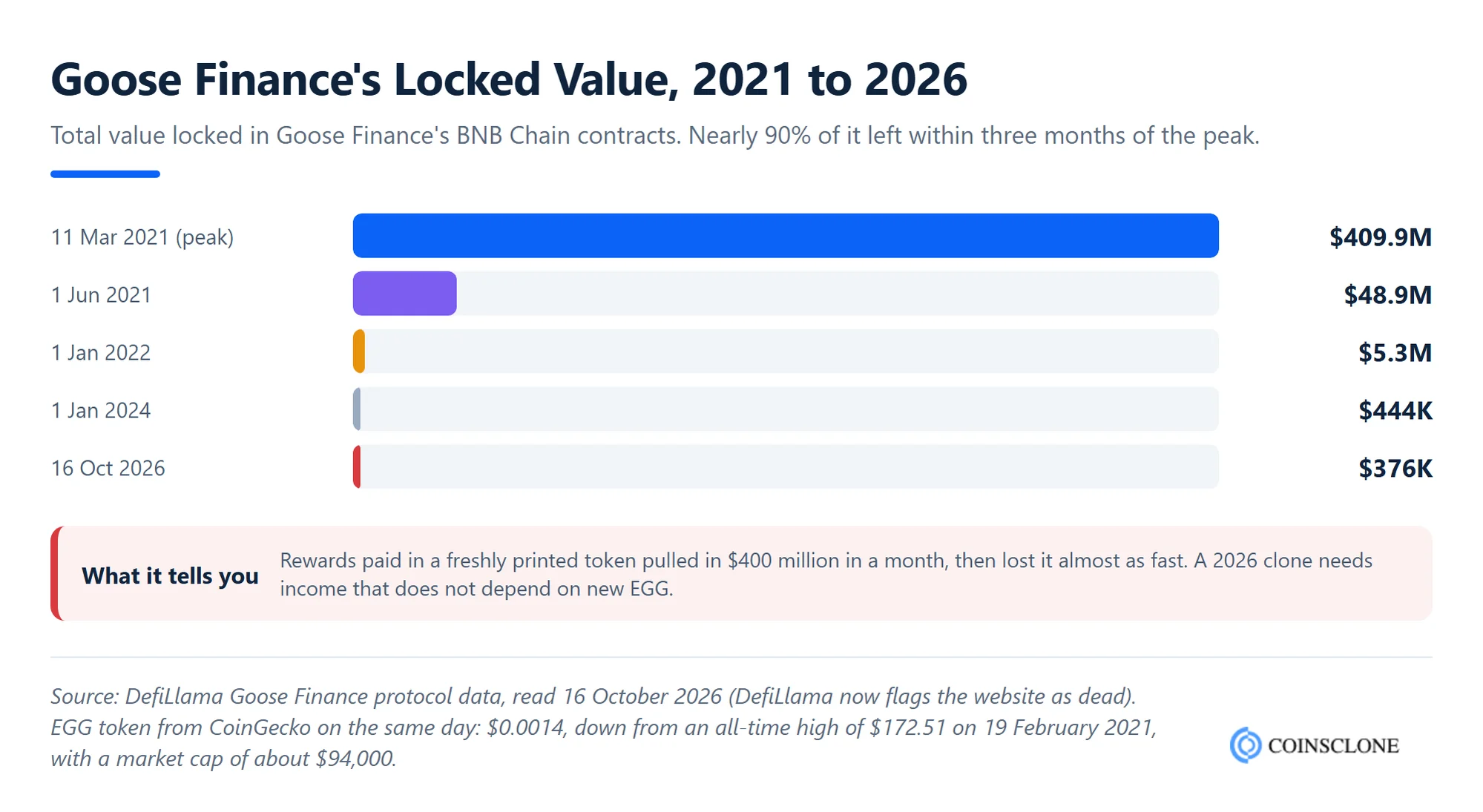
- Goose Finance’s real status: its website is offline and its locked value fell from $409.9 million to about $376,000.
- A worked example of the 4% deposit fee, the lottery burn and the incubator.
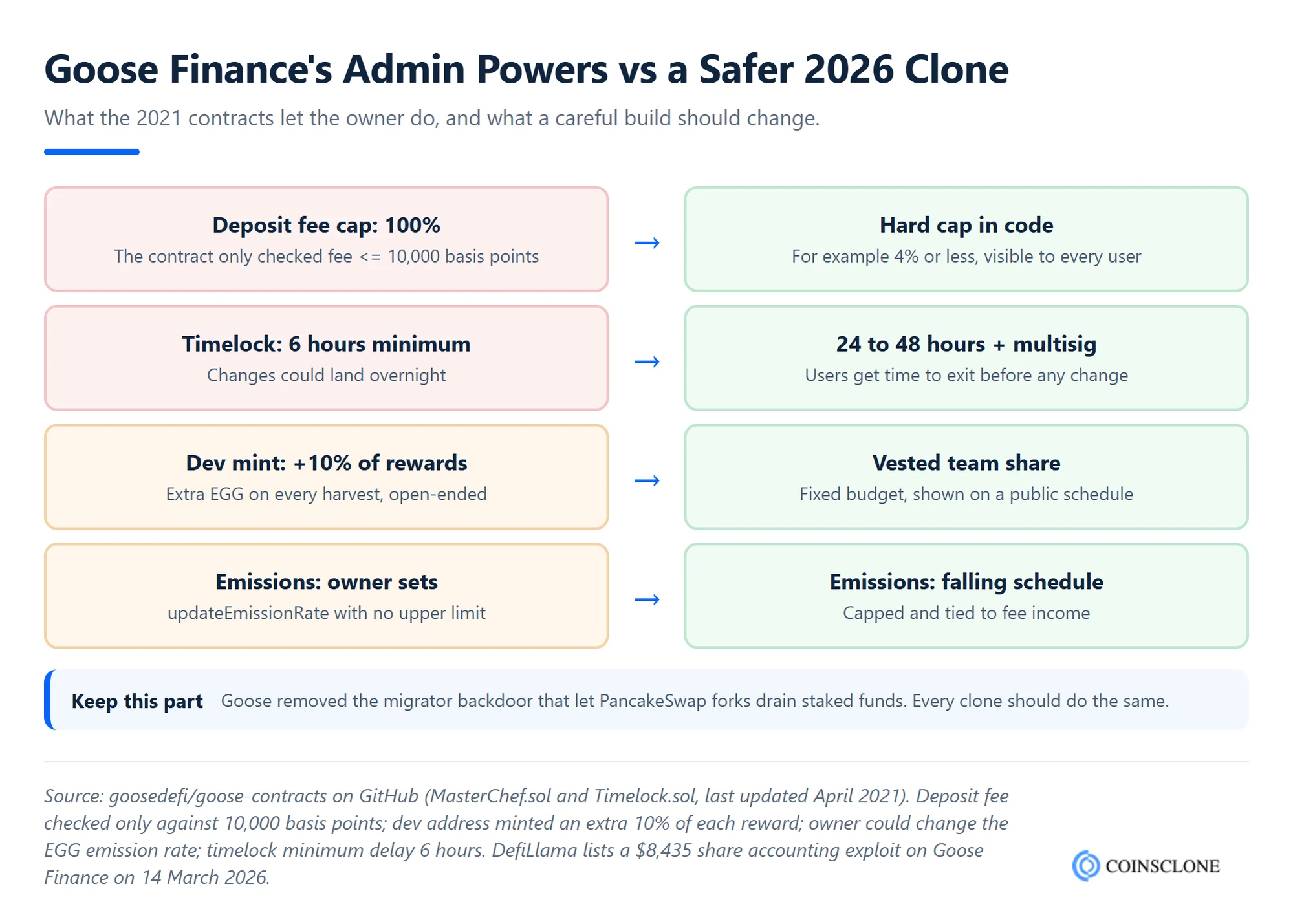
- The four admin powers in the 2021 contracts that a 2026 clone should change.
- Features, wallets and security layers a good clone script should include.
- Launch steps, cost drivers and Coinsclone’s published DEX timelines.
See How Our MVP System Can Launch Your Yield Farming Platform Faster
Goose Finance Clone Script — Secure Yield Farming with Built-In Deflationary Models.
- MVP System : Deploy your Goose Finance-style DeFi farm 90% faster.
- Smart Contracts Ready: Farming, staking, and liquidity pool contracts pre-built.
- Brand & Customization : Your tokens, APRs, and user interface
- Revenue Engine : Earn from farming fees, burns, and liquidity rewards.
Get a free branded demo of your Goose Finance-like yield farm in 48 hours — before you invest a cent.
Book a Free Demo to see how our Goose Finance Clone Script can help you launch your yield farming platform fast.
What Is a Goose Finance Clone Script?
A Goose Finance clone script is pre-built decentralized exchange (DEX) and yield farming software that copies the core features of Goose Finance. It runs on BNB Chain (formerly Binance Smart Chain) and combines token swaps, liquidity pools, farms, single-token staking pools called Nests, a lottery and a native reward token with its own burn rules.
You can shape this white-label software around your brand, your fee model, your token design and your rules. It comes with wallet support, tested smart contracts and an admin panel. As a result, you start from a working base instead of a blank page, which cuts both build time and cost.
You can get this DeFi exchange clone script from Coinsclone. It is open to full customization, from the visuals to the swap and farm logic, and every module is tested by our quality team before launch.
But before you copy Goose Finance, it helps to know how the original did. That shapes which parts are worth keeping.
Is Goose Finance Still Running in 2026?
No. Goose Finance is no longer an active platform. Here is what we found on 16 October 2026:
- The website is offline. goosedefi.com no longer loads, and its address does not resolve. Web archive captures show the site was still up in early 2025.
- Data trackers mark it as dead. DefiLlama’s Goose Finance page flags the website as dead. About $376,000 is still locked in its contracts, mostly old CAKE and BNB deposits, down from a peak of $409.9 million on 11 March 2021.
- The token has collapsed. The EGG token trades at about $0.0014 on CoinGecko, down from an all-time high of $172.51 on 19 February 2021. Its market cap is about $94,000, and daily trading is a few hundred dollars.
- Development stopped. The Goose Finance GitHub repositories were last updated in June 2022, and the contracts in April 2021.
- An old contract was exploited. DefiLlama’s hacks list records a small $8,435 loss on Goose Finance on 14 March 2026, caused by a share accounting flaw.
So why build a Goose Finance clone at all? Because the swap, farm and stake model is still alive. BNB Chain handled about $28 billion of DEX trading in the 30 days to 16 October 2026, according to DefiLlama’s BSC DEX data. What failed was the 2021 recipe of high token rewards with little real income behind them. Your clone should keep the tools users liked and fix the economics that made the original fade.
How Goose Finance Worked
Goose Finance launched on Binance Smart Chain in February 2021. It was a PancakeSwap-style farm with an anonymous team, and its EGG token was nicknamed the “Golden Egg”. Within a month, its locked value passed $400 million, and the team said it had become one of the top three apps on the chain.
Its main products were:
- Farms: Stake LP tokens or single tokens to earn EGG. The farms used PancakeSwap LP tokens, so Goose did not need its own deep swap pools to start.
- Nests: Stake EGG or other single tokens to earn rewards, including partner tokens.
- Lottery: Buy tickets with EGG for a share of the prize pool, which the team called the Omega lottery.
- Layered farming: Every 7 to 14 days, a new “Golden Goose” layer token (GG1, GG2 and so on) launched with its own farms.
- Incubator: A pool where users staked EGG to farm the new layer tokens. Part of every deposit was burned.
- Goose Vault: An auto-compounder that restaked rewards from pools such as CAKE-BNB.
- Goose Dollar: A token backed 1:1 by BUSD, minted for vault users and funded at first with $2 million from the team wallet.
- Collectibles and token offerings: NFT collectibles and initial farm offerings, both carried over from PancakeSwap’s design.
What set Goose Finance apart was its burn rules. According to the team’s Medium post on the incubator and its layered farming details:
- 4% deposit fee: Farm stakes paid a 4% fee. Three quarters of it bought EGG for the lottery pool, and the rest funded the team.
- Lottery burn: 20% of each lottery pool, from fees and ticket sales, was burned.
- Incubator burn: EGG staked in the incubator paid a 20% deposit fee that was burned on the spot, with a cap of 50,000 EGG in the pool.
- Layer farm fees: Layer LP pools had no deposit fee, while single-token layer pools charged 4%.
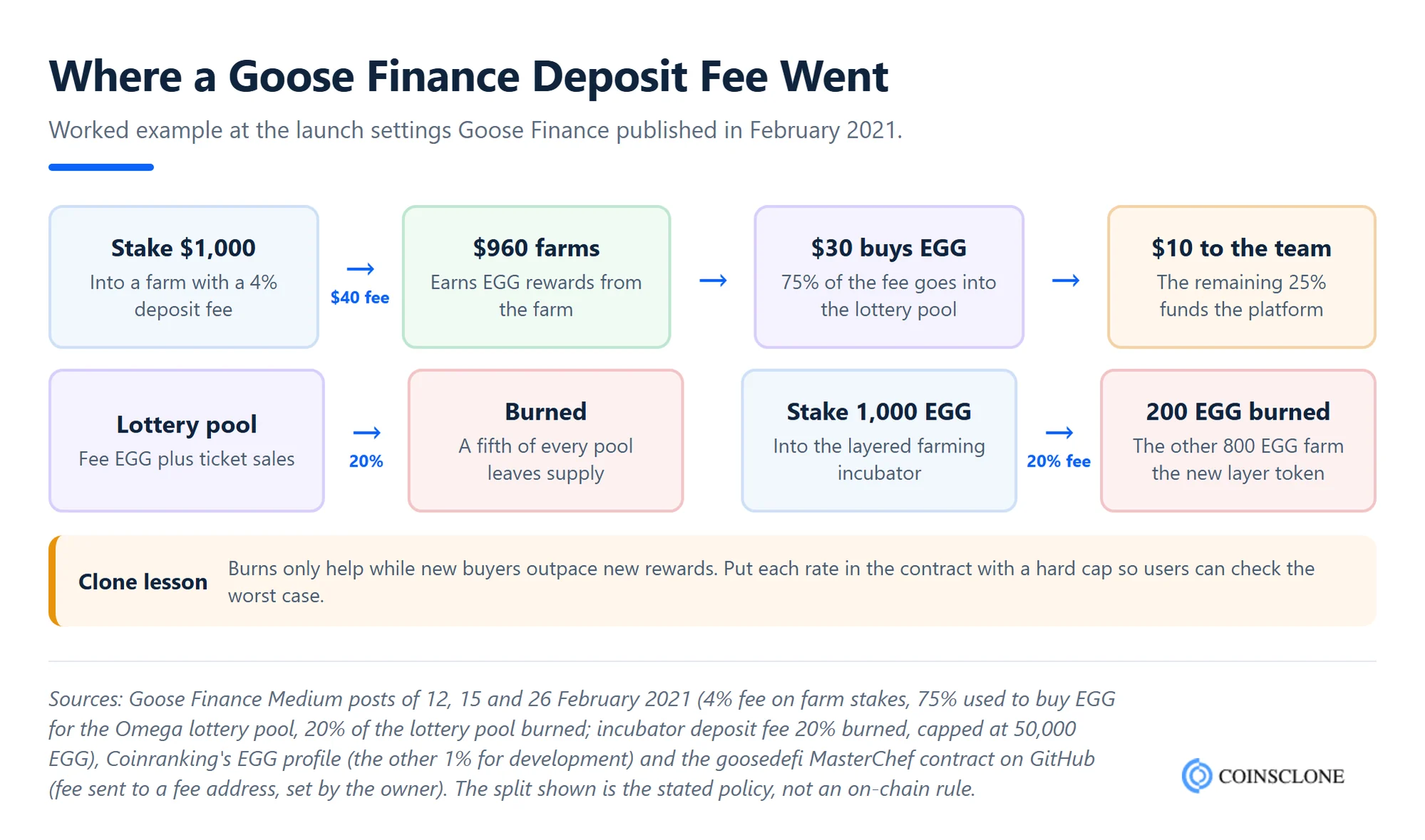
The burns were real. In its first month recap, the team said layered farming had burned over 80,000 EGG. But burns only help while new buyers keep coming. When rewards and the EGG price fell, liquidity left fast. That is the key lesson for anyone building a clone today.
The Migrator Code Goose Removed
Goose Finance’s best idea was about safety, not rewards. Many PancakeSwap forks kept a “migrator” function that let the owner move every staked token to a new contract. Rug pulls such as CroissantSwap used it to drain users in early 2021.
Goose Finance removed the migrator code at launch and put its contracts behind a timelock. Every Goose Finance clone should keep this change.
Why Create a Yield Farm Like Goose Finance?
A DeFi exchange is still one of the most popular DeFi business ideas, and a platform like Goose Finance puts you in one of the busiest parts of DeFi. Users keep moving toward non-custodial trading, liquidity pools and staking for passive income. As a result, a well-run swap and farm platform still has real demand.
Here is why a Goose-style platform is worth building in 2026:
- Proven demand: Swaps on BNB Chain run at about $1 billion a day, and farming still draws liquidity when rewards are backed by real fees.
- Many ways to earn: Charge swap fees, deposit fees, lottery fees, vault fees and launch fees, and give your token real uses.
- Users come back: Farms, Nests, lotteries and new pools give them reasons to return.
- No central control: Trading is non-custodial and open to check on-chain, which builds trust.
- Room to grow: Add vaults, cross-chain swaps, governance or new pool types as your user base grows.
What Works in the Goose Finance Model in 2026
The 2021 yield farm boom left a clear record of what lasts and what does not. Here is what to keep, change and add.
Keep:
- Farms, Nests and a simple swap. Users still want one place to swap, add liquidity and stake.
- No migrator code and a timelock. Users now expect both as a minimum.
- Fee-funded lotteries. A lottery paid from real fees is a cheap way to bring users back each week.
Change:
- Cap every fee in the contract. Goose Finance’s MasterChef contract only checked that a deposit fee was no more than 100%. A clone should set a hard limit, such as 4%, that users can read.
- Use a longer timelock and a multisig. Goose Finance’s minimum delay was 6 hours. A delay of 24 to 48 hours, run by a multisig, gives users time to leave before a change.
- Replace the open-ended dev mint. The contract minted an extra 10% of every reward for the team. A fixed, vested team share is easier to trust.
- Back rewards with fees, not just new tokens. PancakeSwap earned about $15.1 million in fees over the 30 days to 16 October 2026, per DefiLlama. Rewards paid from real income last longer than rewards paid from token printing.
- Drop the new token every two weeks. Layered farming burned EGG, but each new layer token lost value as the next one arrived. One token with a falling, capped emission schedule is easier to support.
- Move beyond classic V2 pools. On BNB Chain, PancakeSwap’s V3 pools handled about $13.3 billion and its Infinity pools about $5.8 billion over the same 30 days. Its classic V2 pools, the kind Goose Finance farms used, handled about $1.4 billion.
Add:
- Fee-sharing vaults, like the Goose Vault, that compound rewards and take a small, capped fee on profit.
- Aggregator listing, so trades routed by DEX aggregators reach your pools.
- Multi-chain pools on chains where your users already hold funds.
For a deeper look at the fee side, see how PancakeSwap makes money. If you want farms and vaults without a full exchange, our DeFi yield farming development service builds them as a standalone product.
Supported Wallets in Our Goose Finance DEX Script
Like the Goose Finance platform, our Goose Finance clone software supports the popular non-custodial wallets for connecting and swapping tokens:
- MetaMask
- Trust Wallet
- TokenPocket
- Math Wallet
- Binance Wallet
- Any wallet that supports WalletConnect
How Does a Goose Finance Clone Script Work?
The Goose Finance clone script follows the same logic as the original. To understand the workflow, you need to know two main functions: swapping and pooling. Let us start with swapping.
Swapping
To swap a token, the user connects a non-custodial crypto wallet (Trust Wallet, MetaMask and others) to the platform. As the owner of the DEX, you can support any wallet you choose.
- Connect and swap: Once the wallet is connected, users can swap BEP-20 tokens instantly, because the platform runs on BNB Chain.
- Pay the fees: Each swap pays a small trading fee taken from the token being sold, which goes to the liquidity providers. Network gas is paid in BNB.
Pooling
- Add liquidity: Our Goose Finance clone script has a pooling system that lets users add liquidity for the pairs they want.
- Earn LP tokens: By adding liquidity, users receive LP (liquidity provider) tokens that show their share of the pool and earn a cut of trading fees.
- Stake LP tokens: Users can then stake those LP tokens in farms to earn the platform’s reward token.
Highlights of Our Goose Finance Clone
- Built on BNB Chain, and ready for other EVM chains
- 100% permissionless trading
- Decentralized token swaps
- Burn rules you set, with hard caps
- Yield farming backed by fee income
White Label Goose Finance Clone Components
Here are the main components available in our Goose Finance clone script:
- Token swap
- Liquidity pools
- Farms
- Nests (single-token staking pools)
- Layered farming and incubator (optional)
- Vaults with auto-compounding
- Bonds
- Lottery
- Collectibles (NFTs)
- Team battle
- Initial farm offering (IFO)
You can switch each component on or off, so you only pay to build and audit what you plan to run.
Features of Our Goose Finance Clone Script
Here are the features you get from our white-label Goose Finance clone script:
- Instant token swaps
- Automated market maker (AMM)
- Price charts
- Clean user interface
- Admin console
- User dashboard
- Add and remove liquidity
- Token staking
- Yield farming
- Multiple wallet support
- Syrup pools
- Lottery
- Transaction history
- Multi-language support
- Dark mode and more
You can adjust all these features to fit your business needs.
Goose Finance Clone Script: Security Features
- No migrator code in the farm contracts
- Timelock and multisig admin controls
- Hard caps on every fee and emission rate
- Smart contract audits (automated and manual)
- Front-running and bot protection
- Liquidity locking
- DDoS protection
- End-to-end SSL encryption
- Ongoing contract monitoring
With these layers in place, you can launch a Goose Finance-style DEX that protects traders, pool funders and stakers.
Security Risks to Plan For
Yield farm forks on BNB Chain have a rough record. DefiLlama’s hacks database lists about 270 incidents on the chain, with about $3.1 billion lost. Three cases show the main risks:
- Uranium Finance (April 2021, $57.2 million): A forked AMM with a small math error in a changed constant. Every edit to forked code needs a fresh audit.
- Spartan Protocol (May 2021, $30.5 million): A flaw in how the pool counted each user’s share let an attacker withdraw more than they put in.
- Goose Finance (March 2026, $8,435): The same kind of share accounting flaw hit an old Goose contract, years after the team had stopped work. Unwatched contracts stay open to attack.
To protect your clone, plan for these steps:
- Audit every change. Do not rely on the original project’s audits once you edit the code.
- Use time-weighted or oracle prices for any reward that depends on a price.
- Cap admin powers in code. Fee, burn and emission settings should have hard limits and run through a timelock.
- Lock or vest team tokens and liquidity so users can check them on-chain.
- Plan for the end. Keep monitoring, and if you ever wind down, close deposits and give users a clear exit.
Our DeFi smart contract development team builds these controls into the base contracts.
See How Our MVP System Can Launch Your Yield Farming Platform Faster
Goose Finance Clone Script — Secure Yield Farming with Built-In Deflationary Models.
- MVP System : Deploy your Goose Finance-style DeFi farm 90% faster.
- Smart Contracts Ready: Farming, staking, and liquidity pool contracts pre-built.
- Brand & Customization : Your tokens, APRs, and user interface
- Revenue Engine : Earn from farming fees, burns, and liquidity rewards.
Get a free branded demo of your Goose Finance-like yield farm in 48 hours — before you invest a cent.
Book a Free Demo to see how our Goose Finance Clone Script can help you launch your yield farming platform fast.
How to Launch a DEX Like Goose Finance: Step by Step
Here is the path most Goose-style projects follow, from idea to launch.
- Pick your niche and chain. Decide who you serve: a token community, a chain with thin DEX liquidity, or users who want simple farming. BNB Chain is the natural home for this model, but any EVM chain works.
- Design the tokenomics. Set supply, emissions, fees and burns. Model what happens when the token price falls by half, not just when it rises.
- Choose the pool design. Classic V2 pools are simple; concentrated liquidity pools earn LPs more fees. Many teams start with V2 and add newer pools later.
- Customize the script. Add your brand, the modules you want, fee caps and admin roles.
- Audit and test. Run unit tests, a public testnet and at least one independent audit.
- Seed liquidity. Fund the first pools and lock that liquidity so users can see it.
- Launch and list. Go live, then get your pools listed on DEX trackers and aggregators.
- Grow with care. Add vaults, a lottery and new chains as volume grows.
With a white-label Goose Finance clone, Coinsclone’s stated launch time is 5 to 7 weeks. A standard build with more custom work takes 10 to 14 weeks.
What Drives the Cost of a Goose Finance Clone?
There is no single price for a Goose Finance clone, because the scope varies a lot. These are the main cost drivers:
- White label or custom build: A white-label base costs far less than custom smart contracts.
- Pool design: V2 pools cost less to build than concentrated liquidity or hook-based pools.
- Number of modules: Each extra product (vaults, layered farming, lottery, NFTs, launchpad) adds build and audit time.
- Audits: Every contract you change needs its own review.
- Chains: Each added chain means more deployment, testing and liquidity.
- Mobile apps: Native Android and iOS apps add design and build work.
For a detailed breakdown on a similar model, read our guide on the cost to build a DEX like PancakeSwap.
Benefits of Using a Goose Finance Clone Script
- Proven chain: The script runs on BNB Chain, with low fees and many active users.
- Faster launch: A white-label build goes live in 5 to 7 weeks instead of months.
- Easy control: The admin panel lets you manage pools, fees, rewards and security settings in one place.
- Full white label: Your brand, your token and your rules.
- Broad token support: Users can swap any BEP-20 token with liquidity.
- Built for DeFi users: Familiar farms and pools help you win users quickly.
- Tested code: Our quality team and blockchain engineers test every module before launch.
- Many wallets: Users connect with the wallets they already have.
- Room to grow: Add new modules and chains whenever you are ready.
You can get all these benefits with a white-label Goose Finance clone from Coinsclone.
Why Choose Coinsclone?
When people search for a trusted Decentralized Exchange Development Company, many end up with Coinsclone. We have been building blockchain products since 2018 and have delivered 350+ platforms for 200+ clients across 20 industries. We build DeFi exchange clone scripts and other top DeFi trending platforms, and our team offers 24/7 support.
If you want to build a DEX on BNB Chain at a fair cost, Coinsclone can help from idea to launch. If you want the same swap and farm model on a larger, multi-product base, our PancakeSwap clone script is the closest match. We also build these popular DeFi exchange clone scripts:
- PancakeSwap Clone Script
- Uniswap Clone Script
- SushiSwap Clone Script
- QuickSwap Clone Script
- SunSwap Clone Script
- PantherSwap Clone Script
- ParaSwap Clone Script
- PooCoin Clone Script
Tell us your needs and get a free live demo now.