

In crypto, liquidity decides whether a market works. When there are few orders on the book, a small trade can move the price a lot, traders pay more and many of them leave. Crypto market making software fixes this by keeping buy and sell orders on the book all day, so every trader has someone to trade with at a fair price.
This guide explains what market making software is, how its quote loop works, the strategies it runs and the features that matter. It also covers the risks, the legal line between market making and wash trading, and what it costs to build, buy or hire one in 2026.
In this guide:
- How a market making bot sets its bid and ask prices, with a worked example
- The six common strategies, from pure market making to cross-exchange hedging
- The features and risk controls to look for before you pick a tool
- Why wash trading features can lead to prison, and how to avoid them
- What it costs to use open source, a bot plan, a custom build or a hired firm
See How Our Market Making Software Can Power Your Exchange Growth!
Crypto Market Making — automated, profitable, and built to scale.
- Plug & Play Bots : Deploy proven liquidity algorithms in minutes.
- Smart Strategies: Fully integrated, zero coding required.
- Exchange Ready : Works with major CEXs & DEXs instantly.
- Profit-Engine: Boost volumes, tighten spreads, and attract traders.
Get a free branded demo of your market making dashboard in 48 hours — no upfront cost.
Book a Free Demo to see how our Crypto Market Making Software can maximize liquidity and revenue in just 8-12 weeks.
What Is Crypto Market Making Software?
Crypto market making is the job of keeping a market liquid by placing both buy and sell orders for a coin or token. A market maker stands ready to buy at one price (the bid) and sell at a slightly higher price (the ask). It earns the gap between the two, called the spread, when both sides fill.
Crypto market making software is the program that does this job automatically. It reads the order book, works out a fair price, posts orders on both sides and keeps moving them as the market changes. People also call it a market making bot or a crypto market making program.
Because the software quotes all the time, traders can buy or sell at once with little slippage. As a result, prices stay steadier, spreads stay tight and the exchange looks healthy to new users. Without market makers, liquidity would be low, prices would jump on small orders and trading would cost more for everyone.
Who Can Be the Crypto Market Maker?
Anyone with capital, an exchange account and the right software can quote a market. In practice, these groups do most of the work:
- Professional trading firms: Firms such as GSR, Wintermute, Flowdesk and Keyrock quote hundreds of pairs on many exchanges with their own money and in-house software.
- Exchanges: Many exchanges run their own market making desk or bot on new pairs, so the book is never empty at launch.
- Token projects: Teams that launch a token often run a bot themselves or hire a firm to keep their token liquid after listing.
- Banks, brokers and funds: Some institutions quote crypto as part of a wider trading desk.
- Individual traders: Retail traders run market making bots on a few pairs to earn the spread with their own funds.
Market making is not risk free. A market maker holds coins between buying and selling, and their value can fall in that time. That is why serious market makers need trading skill, good technology and enough capital to ride out price swings.
Why Exchanges and Token Projects Need Market Making Software
Traders want to trade at once. However, finding a buyer and a seller who want the same coin, at the same price and at the same moment is hard. When they have to wait, trading costs more, liquidity drops and volume falls. In other words, everyone loses.
A market maker fills that gap. It takes the other side of your order even when no other trader is there. It charges a small price for this service through the spread. Since it trades large volumes, each small spread adds up, which pays for the risk it takes.
Here is who gains from it:
- Exchanges: Deep order books bring traders in and keep them there. They also help an exchange win new token listings. If you are planning a trading platform, our guide to crypto liquidity providers explains how to get that depth from day one.
- Token projects: Many exchanges look at liquidity before they list a token. A steady spread and real depth also give holders confidence.
- Traders: Tight spreads and low slippage mean they get prices close to the last trade, even on larger orders.
How Does Crypto Market Making Software Work?
The software runs a loop, many times a second. First, it works out a fair price from the order book and from prices on other exchanges. Next, it places a bid below that price and an ask above it. Then it checks how much of each asset it holds and leans its prices to get back to balance. Finally, it cancels old orders, posts new ones and logs every fill.
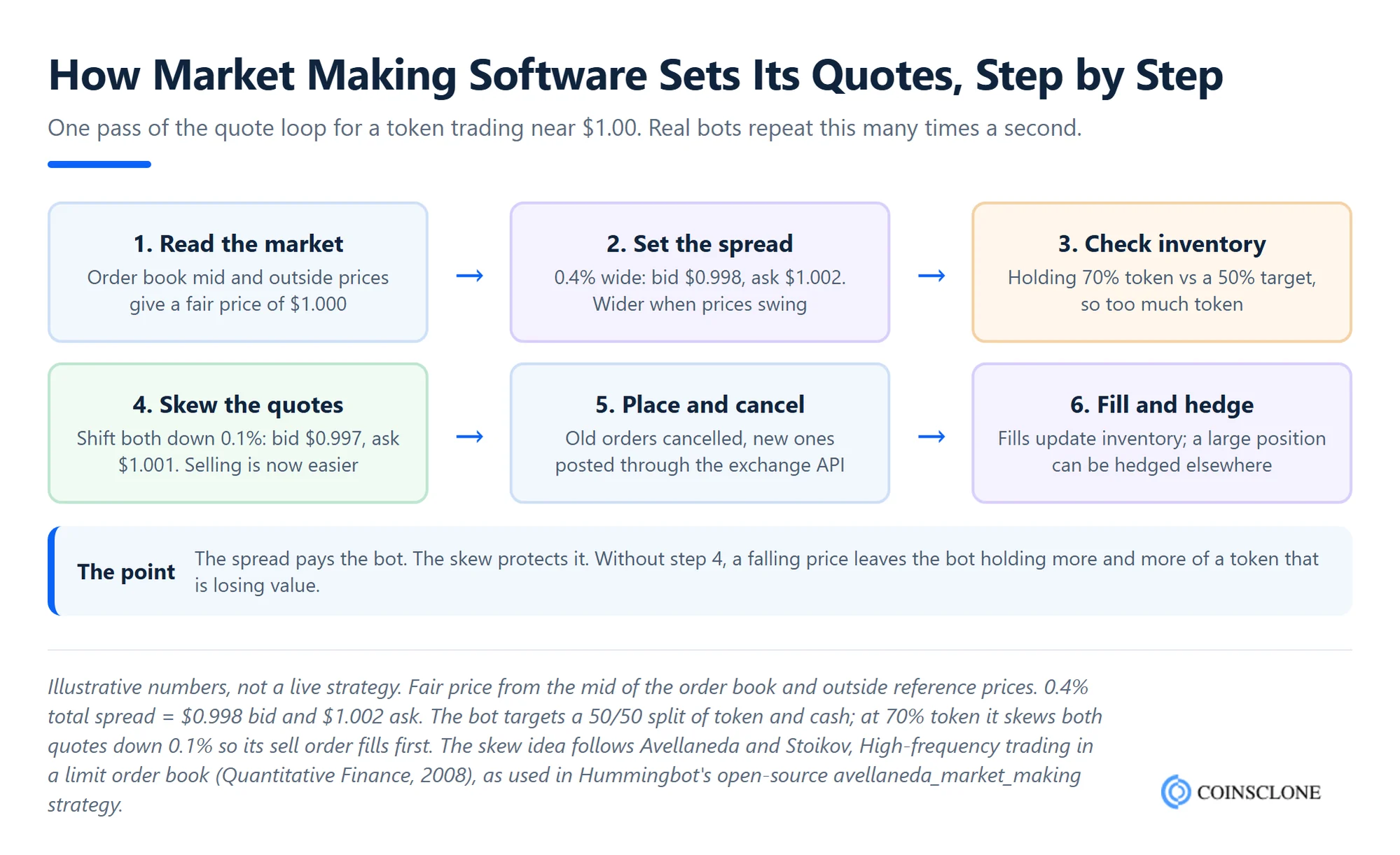
The step that most guides skip is the inventory skew. Say the bot should hold half token and half cash, but a run of sell orders leaves it with 70% token. If it keeps quoting the same prices, it will keep buying a token that is falling. So the software moves both prices down a little. Its ask is now cheaper, so its sell order fills first, and it gets back to balance. This idea comes from the well-known Avellaneda and Stoikov model, and open-source tools such as Hummingbot use it.
Maker Orders and Taker Orders
To see where the money comes from, you need to know the two order types:
- Maker order: A limit order that rests on the book and waits, for example a bid to buy at $0.998 when the token trades near $1. It “makes” liquidity because other traders can trade against it. Market making software places maker orders almost all the time.
- Taker order: An order that fills at once against a resting order, such as a market buy. It “takes” liquidity away from the book.
Take a market where the best bid is $10,000 and the best ask is $10,200. A trader in a hurry places a taker order and buys at $10,200 right away. A patient trader instead places a maker order, for example a bid at $10,050, and waits for a seller. That narrows the spread for everyone. Each trade has a maker on one side and a taker on the other.
Because makers add liquidity, exchanges often charge them less than takers or even pay them. For example, a regular Binance account pays 0.10% on spot trades, but members of the Binance Spot Liquidity Provider Program earn a maker rebate of up to 0.008% when they supply at least 1% of weekly maker volume. Your software should track these fee tiers, since rebates can turn a thin spread into a profit.
Common Market Making Strategies the Software Runs
Good market making software is not one bot. It is a set of strategies you can switch on per pair. These are the ones most tools offer, using the names from Hummingbot’s strategy library:
- Pure market making: Quotes a bid and an ask around the mid price on one pair, on one exchange. Simple and a good fit for new tokens.
- Avellaneda-Stoikov market making: Sets the spread and skew from volatility and inventory, so quotes widen in fast markets and lean toward balance on their own.
- Cross-exchange market making: Quotes on a smaller exchange and hedges each fill on a larger, more liquid one. This cuts inventory risk a lot.
- Spot and perpetual hedging: Holds spot inventory and hedges it with perpetual futures, so price moves hurt less.
- Multi-pair liquidity: Spreads one base or quote token across many pairs to support a whole token ecosystem.
- DEX liquidity: Manages liquidity positions on AMM exchanges such as Uniswap, or runs arbitrage between a DEX and a CEX. Our guide to crypto arbitrage bots covers that side in more depth.
Most exchanges start with pure market making on new pairs. Then they add cross-exchange hedging once volume grows.
Features of the Crypto Market-Making Software
Features decide whether a tool keeps your books deep or quietly loses money. Here is what to look for, and why each one matters:
- The relevant bid and ask orders: Quotes at several price levels, not just one, so the book looks deep and large orders fill smoothly.
- Real-time adjustability: Change spread, order size and levels per pair while the bot runs, without a restart.
- Automated cryptocurrency trading: The full loop runs on its own, from pricing to placing and cancelling orders.
- 24/7 trading: Crypto never closes, so the software must run nonstop, with alerts when it stops quoting.
- Transparent market making: Reports on spread, depth, uptime and profit per pair, so you can prove what the bot did.
- Order book aggregation: Pulls prices from many exchanges to find a fair price that one thin book cannot give.
- Low-latency market-making technology: Fast WebSocket or FIX links so the bot can move its quotes before faster traders pick them off.
- Real-time access to data: Live trades, order books and balances on one dashboard.
- Risk management: Inventory limits, loss limits, a kill switch and checks for stale prices (more on this below).
- Self-trade prevention: Blocks the bot from matching its own orders, which keeps you clear of wash trading.
- Exchange connectors and API key safety: Ready links to major CEXs and DEXs, with keys stored safely and trade-only rights (no withdrawals).
- Backtesting and paper trading: Test a strategy on past or live data before real money is at stake.
If you also want directional or signal-based bots, our guide to cryptocurrency trading bot development explains how those differ from market making.
Risks of Market Making and How the Software Controls Them
Market making earns small amounts many times over. One bad hour can wipe out a month of spread. So the risk engine matters as much as the strategy:
- Inventory risk: The bot ends up holding a coin that keeps falling. Control: inventory targets, skew and hard limits per asset.
- Adverse selection: Better-informed traders hit your quotes just before the price moves. Control: wider spreads when volatility rises and fast quote updates.
- Exchange outages: If an exchange API stops, the bot cannot cancel its orders. Control: stale-data checks that pull all quotes when feeds go quiet.
- Fee drag: On low-volume pairs, fees can be bigger than the spread. Control: fee-aware pricing and maker rebate tracking.
- Flash crashes: On 10 October 2025, about $19 billion of positions were liquidated in one day, and many order books went thin. Control: a kill switch, daily loss limits and circuit breakers per pair.
Market Making vs Wash Trading: Stay on the Right Side of the Rules
Real market making is legal and useful. Wash trading is not. The difference is simple: a market maker trades with real outside traders, while a wash trader trades with itself to fake volume.
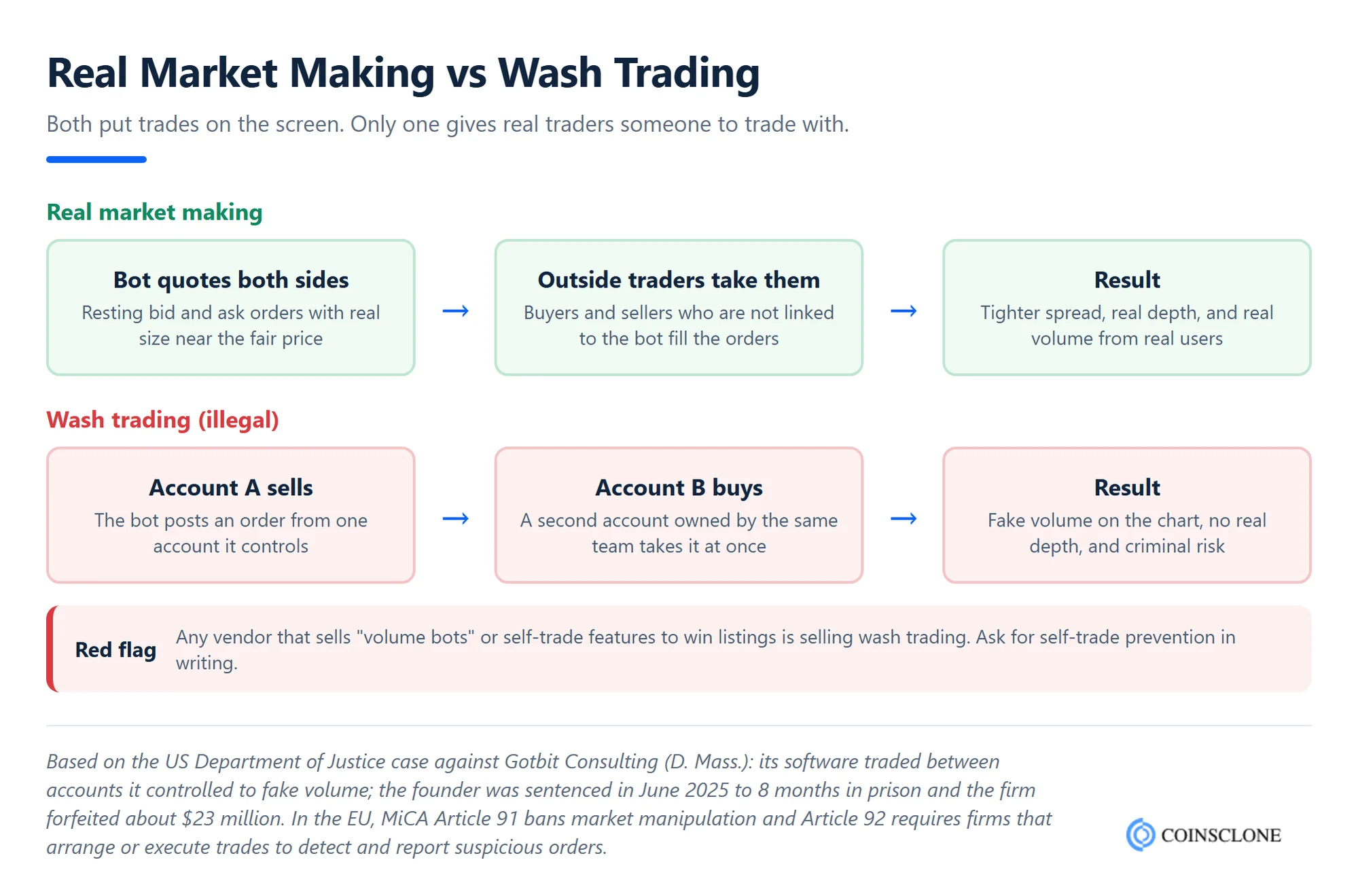
Regulators now act on this. In June 2025, a US court sentenced the founder of market maker Gotbit to 8 months in prison, and the firm forfeited about $23 million. According to the US Department of Justice, Gotbit’s software traded between accounts it controlled to fake volume, and the firm sold that service to help tokens get listed.
In the EU, the Markets in Crypto-Assets Regulation (MiCA) has applied in full since 30 December 2024. Article 91 bans market manipulation, including trades that give a false picture of supply or price. Article 92 requires firms that arrange or execute crypto trades to have systems that spot and report suspicious orders.
So before you buy or build, check three things:
- The software has self-trade prevention turned on by default.
- Every order and fill is logged, so you can show an exchange or regulator what happened.
- The vendor does not sell “volume boost” features. Real volume comes from real traders.
Build, Buy or Hire: What Crypto Market Making Software Costs
There are four ways to get market making in place, and the cost gap between them is huge. Pick the route that fits who you are, not just the price.

- Open source (free): Hummingbot is free under the Apache 2.0 licence and lists 318 exchange connectors. Its users report more than $47 billion in trade volume since January 2025. You still pay for servers, data and a developer’s time.
- Off-the-shelf bot plan (about $12 to $150 a month): Retail platforms such as HaasOnline sell monthly plans from $11.99 to $149.99. These suit traders on a few pairs, but you get little control over speed or risk rules.
- Hired market making firm (about $10,000 to $50,000+ a month): Token projects often pay a retainer, a token loan with a call option, or both. Retainer deals usually add a setup fee. As one public example, GSR’s proposal to Stake DAO asked for a $100,000 setup fee, $20,000 a month and a $1 million BTC and ETH loan, per Spark’s market maker comparison. You do not own the software.
- Custom build (six figures): Exchanges and firms that want to own the code usually build their own. Development firms publicly quote about $120,000 to $350,000 for a mid-tier custom bot, plus yearly running costs for servers, data feeds and upgrades. In return, you own the code, control the risk rules and pay no fee per trade.
For an exchange, the custom route also means the bot can talk straight to your matching engine. That is faster and safer than going through a public API. You can see how this fits into the wider budget in our breakdown of white label crypto exchange cost.
Coinsclone builds crypto market making software as part of its cryptocurrency exchange development work, with liquidity, risk controls and self-trade prevention planned in before launch. A white label exchange with these parts in place usually takes 4 to 6 weeks to deliver.
How to Choose Crypto Market Making Software
Use this checklist when you compare tools or vendors:
- Exchange coverage: Does it connect to every exchange you need, CEX and DEX, through stable APIs?
- Strategy range: Can you run pure market making, inventory skew and cross-exchange hedging, and switch per pair?
- Risk engine: Are there inventory limits, loss limits, stale-data checks and a kill switch?
- Compliance: Is self-trade prevention on by default, and is every order logged?
- Speed: How fast can it cancel and replace quotes when the price moves?
- Reporting: Can you see spread, depth, uptime and profit per pair, every day?
- Ownership and support: Who owns the code and the API keys, and who fixes it at 3 a.m. when an exchange changes its API?
Conclusion
Liquidity is what makes a market worth trading on. It drives volume, wins token listings and keeps prices stable. Crypto market making software provides that liquidity around the clock. It quotes both sides, keeps spreads tight and leans its prices to manage risk.
The best setup depends on who you are. Traders can start with an open-source tool or a bot plan. Token teams often hire a firm. Exchanges usually gain the most from owning their software, with strong risk controls and no wash trading features. We, at Coinsclone, have been building crypto platforms since 2018, with 350+ platforms delivered for 200+ clients across 20 industries. Our team can build market making software that fits your exchange and keeps your books deep from launch day.
Frequently Asked Questions
What is a crypto market making bot?
A crypto market making bot is software that places buy and sell limit orders on both sides of an order book. It earns the spread between the two prices and keeps moving its orders as the market changes. Exchanges, token projects and traders use these bots to keep markets liquid.
How is market making software different from a regular trading bot?
A regular trading bot bets on where the price will go next. Market making software does not try to guess the direction. Instead, it earns the spread by quoting both sides, and it manages the coins it holds to stay close to neutral.
How much capital do I need for crypto market making?
It depends on the pair and the exchange. HaasOnline suggests $5,000 to $10,000 for liquid pairs on major exchanges, and $50,000 or more for serious work across several pairs. Token projects and exchanges usually need far more, because deep books require large orders on both sides.
Is crypto market making legal?
Yes. Quoting real buy and sell orders is legal and useful. Wash trading, where a bot trades with itself to fake volume, is illegal. In the US, the founder of Gotbit went to prison for it in 2025, and in the EU, MiCA bans market manipulation.
Can one market making program run on several exchanges at once?
Yes. Most professional tools connect to many exchanges at the same time. They use one exchange’s prices to set quotes on another and hedge fills where liquidity is deepest. Hummingbot alone lists 318 connectors.
How much can a market making bot earn?
There is no fixed figure. A bot earns the spread plus any maker rebates, minus trading fees and losses on the coins it holds. In calm markets, those small gains add up. In a sharp crash, inventory losses can be larger than months of spread, so risk controls matter more than the spread itself.
Our blogs related to Cryptocurrency Market Making Software
Cryptocurrency Liquidity Provider
See How Our Market Making Software Can Power Your Exchange Growth!
Crypto Market Making — automated, profitable, and built to scale.
- Plug & Play Bots : Deploy proven liquidity algorithms in minutes.
- Smart Strategies: Fully integrated, zero coding required.
- Exchange Ready : Works with major CEXs & DEXs instantly.
- Profit-Engine: Boost volumes, tighten spreads, and attract traders.
Get a free branded demo of your market making dashboard in 48 hours — no upfront cost.
Book a Free Demo to see how our Crypto Market Making Software can maximize liquidity and revenue in just 8-12 weeks.