

Cryptocurrency exchange architecture is the plan behind every trade. It decides how orders reach the matching engine, how balances change, where coins are kept and how the site stays up when the market goes wild. This guide breaks it down from the core to the cloud, layer by layer, in plain words.
You will see the parts each exchange needs, how one order moves through them, and how a safe wallet setup keeps user funds out of reach of hackers. We also compare CEX, DEX and hybrid designs, list a proven tech stack, and show how long each build path takes in 2026.
In this guide:
- The core parts of a crypto exchange, including the ledger most guides skip
- How an order travels from a click to a settled balance, with a flow diagram
- Crypto exchange wallet architecture: hot, warm and cold tiers, sweeps and withdrawal checks
- How CEX, DEX and hybrid designs like Hyperliquid and dYdX differ under the hood
- The tech stack, security rules and launch timelines to plan for
Discover the Power of Next-Gen Cryptocurrency Exchange Architecture!
Build a secure, scalable, and high-performance trading platform — the right way.
- Modular Core : Plug-and-play architecture for faster deployment.
- High Throughput : Handle millions of transactions per second with ease.
- Smart Security: Multi-layered protection for wallets, APIs, and user data.
- Flexible Integrations: Connect liquidity, KYC, and payment systems seamlessly.
See your custom exchange architecture visualized — free, in 48 hours.
Book a Free Demo and discover how to launch a world-class crypto exchange in 8 -12 weeks.
What Is Cryptocurrency Exchange Architecture?
Cryptocurrency exchange architecture is the structure that holds all the parts of a trading platform in place. It is built to make trading crypto safe, smooth and fast. In short, it supports the core jobs of a crypto exchange: running user accounts, running the trading engine, bringing in liquidity and handling trades and transfers.
It also shows how the tech parts work as one so users can trade coins like Bitcoin and Ether. Think of it as the floor plan that keeps the exchange running smoothly, safely and without breaks. The design also includes databases that store user data, trade logs and transfer records. On top of that, a strong safety layer guards the system with encryption, login checks and round-the-clock alerts.
One thing sets an exchange apart from a normal web app. Every number on the screen is real money. A shopping site can show a stale stock count for a second. An exchange cannot show a wrong balance even once. That is why exchanges borrow ideas from banks, such as a strict ledger, and from trading firms, such as matching in memory.
Let’s look at the must-have parts of a crypto exchange next.
Must-Have Components in Crypto Exchange Architecture
These parts form the core system design of a crypto exchange. They keep user actions, trading logic, wallet payouts and safety checks working in step.
The cryptocurrency exchange architecture combines key parts that make the platform easy to use and stable. As we said earlier, how profitable a crypto exchange becomes depends a great deal on these parts and how well they fit. For a clear picture, we have listed the main ones below.
Admin/User Dashboard
The dashboard is where users and admins see the main tools in one place. Users check balances, place orders and track history. Admins watch volumes, set fees, list new pairs and review flagged accounts. In simple words, it is the tool that keeps both traders and owners coming back.
Wallet Integration
Every deposit, withdrawal and trade touches a wallet. Hence, the exchange needs built-in wallets for each coin it lists, plus a way for users to link their own wallets. We explain how exchange wallets are set up in the wallet section below.
Trading Machine
The core part of the exchange is the trading machine, also called the trading engine or matching engine. It holds the order book for each pair, such as BTC/USDT, and matches buy and sell orders by price and then by time. As a result, speed matters here more than anywhere else.
Ledger and Settlement Engine
This is the part most guides skip, and it is the one that keeps the books honest. When the matching engine reports a trade, the ledger moves funds between accounts using double-entry records: every debit has a matching credit. It also takes the trading fee. A good ledger applies each trade just once, even if a message arrives twice. It also checks each day that its totals match the coins held on the blockchain.
Security Protocol
Security tools guard users and their funds at each step. They include cold storage, full encryption, safe handling of user data, two-step login, payout limits and address lists that users approve.
UI/UX Design
The look and feel of the platform is what users notice first. For smooth trading, clean charts, a fast order form and clear receipts matter most. When building a crypto exchange app, a simple mobile-first UI/UX is a must.
Order Book
The order book shows all open buy and sell orders, along with recent trades, in real time. Because of this, traders can see market depth and prices before they place an order.
Liquidity Module
A new exchange starts with an empty order book. This part fixes that by linking to outside crypto liquidity providers or bigger exchanges. It also gives market makers their own fast APIs. As a result, users see tight spreads from day one.
Risk, KYC and Compliance Engine
This engine checks users and transfers before and after each action. It runs ID checks (KYC), screens wallets and transfers for money laundering risk (AML), sets trading and payout limits, and builds reports for the authorities. On margin or futures exchanges, it also checks collateral and closes out risky positions.
Payment Gateway Integration
Like the trading machine, the payment gateway is a key part of a crypto exchange. The more ways users can pay in, such as cards, bank transfers and crypto wallets, the more users the exchange can reach.
API Integration
With APIs, users and partners can link outside tools to trade more smoothly. Trading bots, outside wallets and payment gateways all plug in here. Most exchanges offer a REST API for orders and account data and a WebSocket API for live prices. Larger venues also offer the FIX protocol for professional traders.
These are the key parts of a well-run crypto exchange. Still, the exact mix can vary with the type of exchange. Next, let’s see how these parts work as one when someone places an order.
How an Order Moves Through the Exchange
Following one order from start to end is the easiest way to see how crypto exchange architecture works. Here is what happens in the half-second after a user clicks “Buy”.
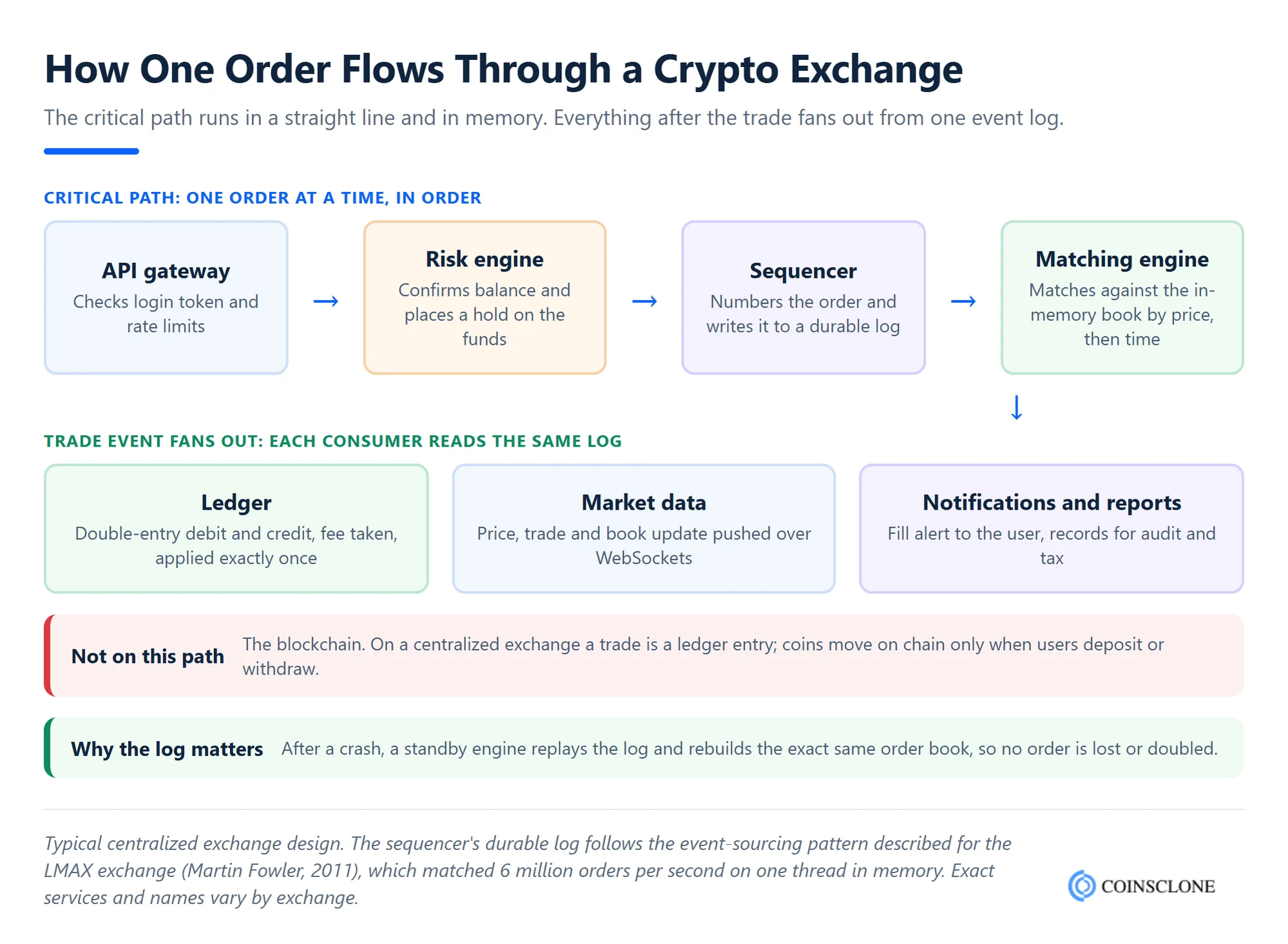
- Request: The app sends the order over HTTPS or WebSocket to the API gateway. The gateway checks the login token and blocks spam with rate limits.
- Pre-trade check: The risk engine confirms the user has enough balance and places a hold on those funds. As a result, the same money cannot be spent twice.
- Sequencing: A sequencer gives each order a number and writes it to a lasting log. This fixed order is what makes the system fair and easy to replay after a crash.
- Matching: The matching engine compares the order with the book in memory. If it crosses a resting order, it creates a trade. If not, the order waits in the book.
- Settlement: The ledger takes the trade event, moves funds between buyer and seller, and takes the fee. Each trade is applied just once.
- Broadcast: The market data service pushes the new price, trade and book update to each user who is online. Then the user gets a fill notice.
Notice that the blockchain is not part of this path at all. On a centralized exchange, trades are just ledger entries. The blockchain only comes in when users deposit or withdraw. That is why a CEX can match orders in microseconds while on-chain trades take seconds.
Architectural Patterns & Technologies Used in Crypto Exchanges
Modern crypto exchanges rely on proven design patterns and real-time tools to handle high trading volumes, fast order matching and safe storage of funds. These patterns define how exchange systems are built, shipped and scaled in real-world use.
Below are the most common patterns and tools in crypto exchange platforms.
Microservices Architecture
Microservices architecture splits a crypto exchange into small services, each in charge of one job, such as user accounts, trading, wallets or compliance.
Why it is used in crypto exchanges:
- Each service can scale on its own
- A fault in one service does not bring down the rest
- It handles high trade volumes
Most large crypto exchanges use microservices to keep speed steady during peak trading.
Event-Driven Systems
An event-driven design lets exchange parts talk to each other through events instead of direct calls.
Common use cases include:
- Trade execution events
- Balance updates
- Order book changes
This pattern makes the system quicker to react and keeps the flood of trading events in order. It also allows event sourcing, where the exchange stores each change as an event. As a result, the full state can be rebuilt at any time by replaying the log.
WebSockets for Real-Time Market Data
WebSockets carry live data between the exchange back end and user apps.
They enable:
- Live price updates
- Real-time order book streams
- Instant trade confirmations
WebSockets are key to fast, smooth trading on a crypto exchange.
Message Queues
Message queues carry messages between the many services in a crypto exchange.
They are used for:
- Processing trade events
- Handling wallet transfers
- Sending notifications and alerts
By keeping services loosely linked, message queues keep the system stable during traffic spikes. Apache Kafka, NATS and RabbitMQ are common choices.
Cloud-Native Deployment
A cloud-native setup lets crypto exchanges run on spread-out cloud servers instead of fixed machines.
Key benefits include:
- Auto-scaling when markets get volatile
- High uptime and spare capacity
- Faster launch in new regions
Most modern exchanges use cloud-native setups to keep trading running at all times. But many keep the matching engine on their own servers, because shared cloud machines can add small, random delays.
Containerization and Orchestration
Containerization packs exchange services into light, portable units that run the same way on any server.
This approach provides:
- Faster release cycles
- Better use of servers
- Simple scaling and recovery
Orchestration tools such as Kubernetes manage service health, scaling and failover on their own.
Typical Tech Stack by Layer
There is no single right stack. Still, most live exchanges land on the same kind of choices for each layer.
| Layer | Common choices | Why |
| Web and mobile apps | React, Next.js, Flutter, Swift, Kotlin | Fast charts and order forms on every device |
| API gateway | Nginx, Envoy, Kong | Auth, rate limits and routing in one place |
| Business services | Go, Java, Node.js, Rust | Strong libraries for accounts, KYC and wallets |
| Matching engine | C++, Rust, Java (low-latency style) | Predictable microsecond speed in memory |
| Messaging | Kafka, NATS, Aeron | Durable, ordered event streams |
| Ledger database | PostgreSQL | Strict transactions for balances |
| Cache and sessions | Redis | Fast reads for prices and sessions |
| Market data history | TimescaleDB, ClickHouse | Candles and trade history at scale |
| Blockchain access | Own nodes plus RPC providers | Deposit tracking and withdrawals per chain |
| Key security | HSMs, MPC, multisig | Signing without exposing private keys |
| Infrastructure | Kubernetes, Terraform, Cloudflare | Scaling, repeatable setups and DDoS protection |
Cryptocurrency Exchange Architecture Diagram (System-Level View)
A cryptocurrency exchange architecture diagram gives a top-down view of how the parts of the platform work as one for safe, real-time crypto trading. Instead of looking at features one at a time, it shows the full structure of a crypto exchange, from the user’s screen to settlement on the blockchain.
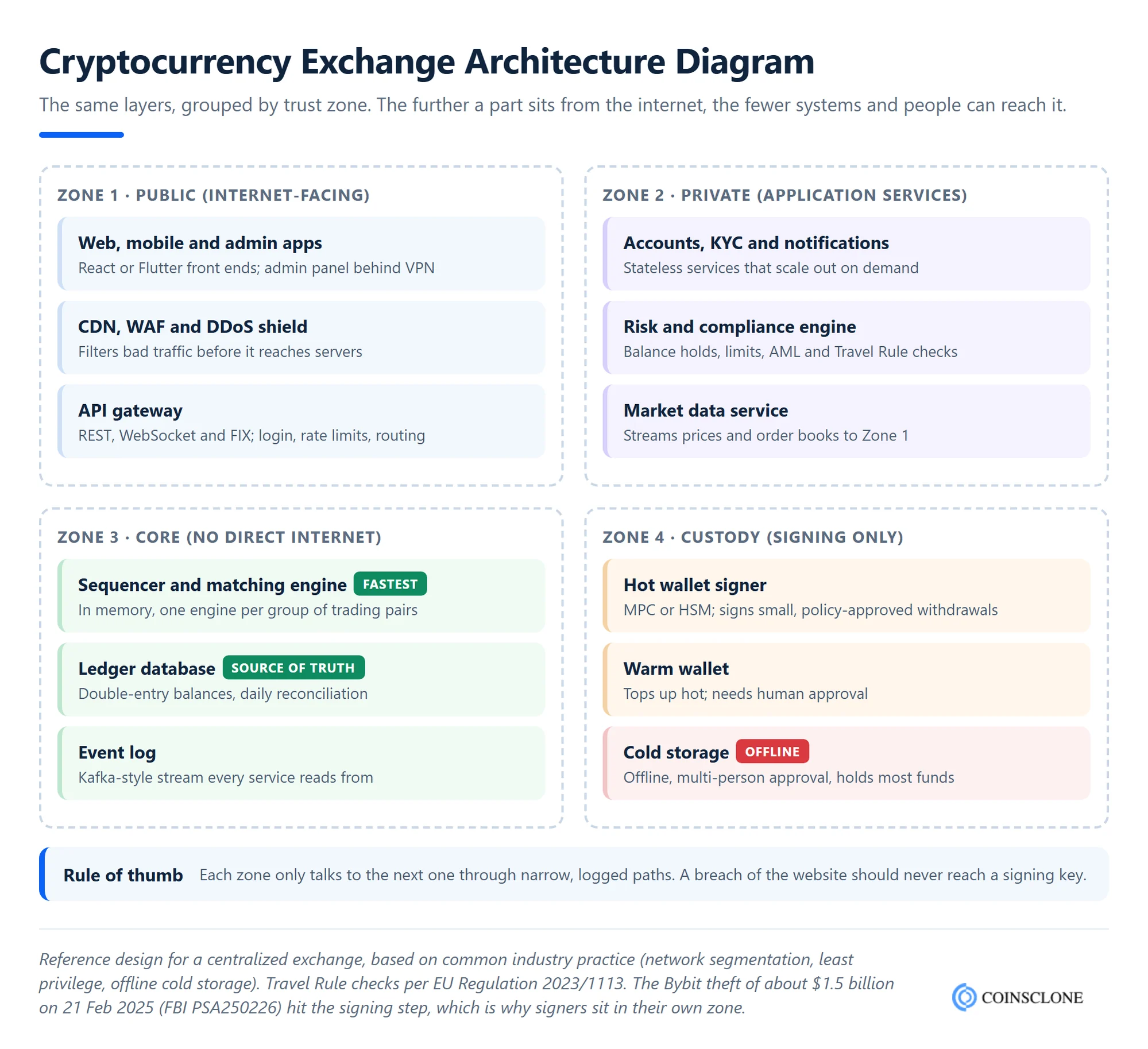
Most modern crypto exchanges follow a layered model, where each layer has one job. This approach helps scaling, safety and speed. It also lets teams upgrade one part without touching the others. The diagram above also shows trust zones: the further a part sits from the internet, the fewer people and systems can reach it.
Below is a breakdown of a standard crypto exchange architecture diagram, layer by layer.
Client Layer
The client layer is the user-facing side of the crypto exchange. This is where traders, admins and API users work with the system.
It typically includes:
- Web-based trading platform
- Mobile apps (iOS and Android)
- Admin dashboard to watch and control the platform
- API access for trading bots and partner apps
The client layer talks to the back end over encrypted APIs and live channels such as WebSockets. Through these, it shows live market updates, order status and account details.
Application Services Layer
The app services layer sits between the user apps and the core exchange logic. It handles user requests and applies business rules before passing them to the right back-end service.
Key jobs of this layer include:
- User login and permissions
- KYC and compliance checks
- Session management
- API request handling
- Alerts (email, SMS, push)
Keeping these services apart from the core trading logic makes the exchange easier to run and more stable.
Trading Engine & Order Matching Layer
The trading engine and order matching layer form the heart of the crypto exchange system design. This layer runs trades quickly and without errors.
Core functions include:
- Keeping the order book
- Matching buy and sell orders by price and then time
- Working out trade prices
- Handling market, limit and stop orders
- Sending real-time trade data to users
This layer is tuned for low delay and high volume, because even tiny delays can hurt trading quality and user trust.
Wallet & Blockchain Layer
The wallet and blockchain layer handles the storage and movement of coins in the exchange. It safely runs both on-chain and off-chain transfers.
This layer typically includes:
- Hot wallets for instant deposits and withdrawals
- Cold wallets for safe long-term storage
- Blockchain nodes or third-party node providers
- Deposit tracking and block checks
It keeps balances right, moves coins safely and links the exchange to many blockchains.
Security & Infrastructure Layer
The security and infrastructure layer is the base that guards the whole exchange and keeps it online.
It covers:
- Multi-factor login and access control
- Data encryption at rest and in transit
- DDoS protection and firewalls
- Fraud checks and live transfer alerts
- Cloud servers, load balancers and auto-scaling
- Logs, audit trails and system health checks
This layer is key to trust, legal rules and staying online when traffic surges.
By joining these layers into one system, the cryptocurrency exchange architecture makes trading safe, fast and ready to grow. A clear diagram helps startups and large firms see how each part fits the bigger system and supports long-term growth.
Crypto Exchange Wallet Architecture
Wallets are where exchanges most often lose money, so they need their own design. Most hacks do not break the matching engine. Instead, they target the keys that sign payouts. A strong crypto exchange wallet architecture limits how much any one key, server or person can move.
Hot, Warm and Cold Wallet Tiers
Most exchanges split funds into three tiers:
- Hot wallet: Online and fully automated. It pays out daily withdrawals, so it holds only a few hours of expected outflows.
- Warm wallet: Partly online, with tighter sign-off rules. It refills the hot wallet on a set schedule.
- Cold wallet: Offline or air-gapped. It holds the bulk of user funds and needs a group of people to sign off on any move.
The idea is simple. If attackers break into the hot wallet, they can only take what is in it, not the whole reserve.
How Deposits and Withdrawals Flow
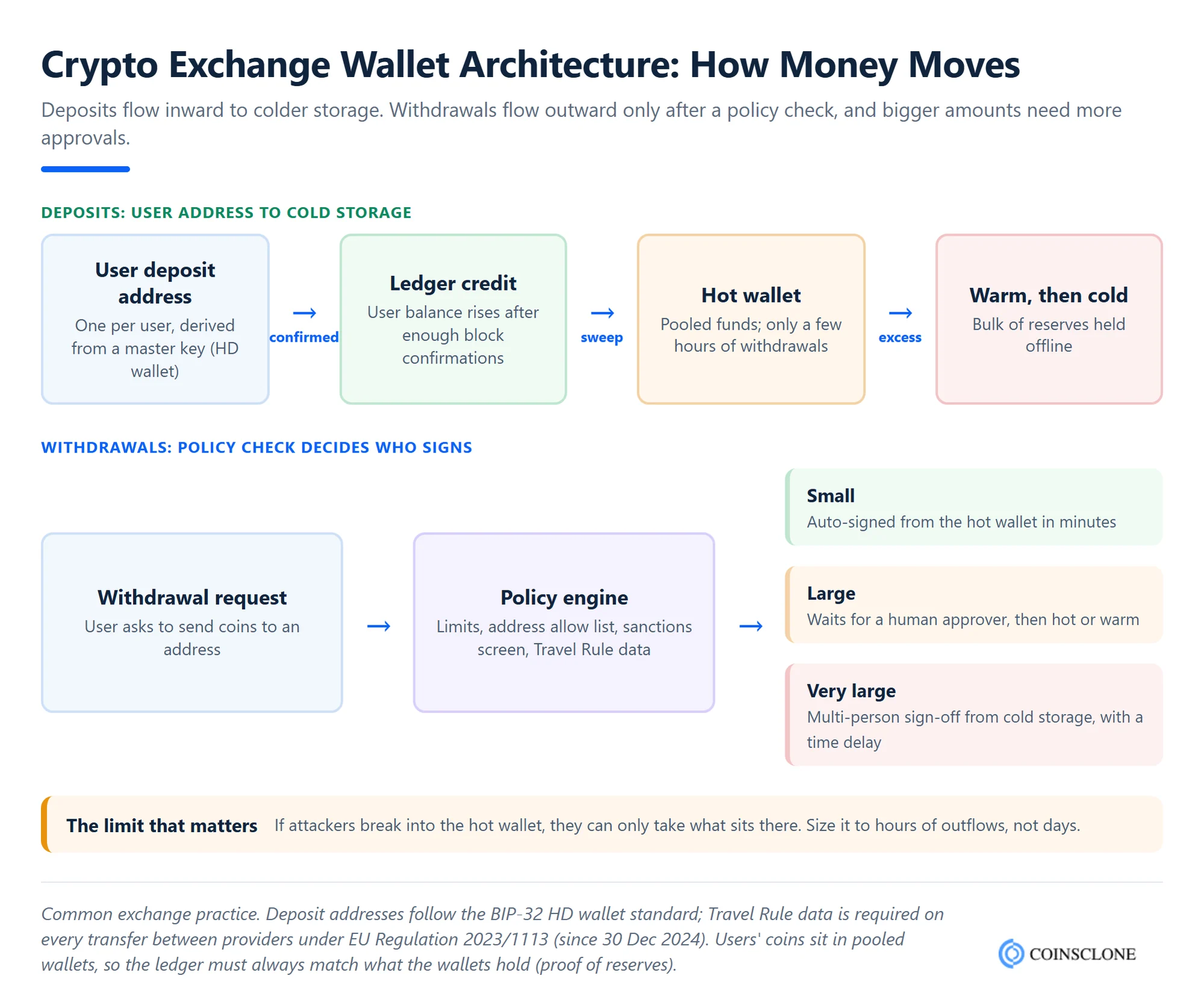
Deposits: Each user gets their own deposit address, most often made from one master key (an HD wallet). A blockchain watcher spots the incoming transfer and waits for enough blocks to confirm it. Then the ledger credits the user. Later, a sweep job gathers funds from many deposit addresses into the hot wallet and sends any excess on to warm or cold storage.
Withdrawals: The user’s request first passes the policy engine. It checks the amount against limits, the address against an allow list and the receiver against sanction lists. Small requests are signed on their own from the hot wallet. Large ones wait for a person to sign off, and very large ones are paid from warm or cold storage.
Note that user funds sit in pooled wallets on the blockchain. Each user’s share lives only in the exchange’s ledger. That is why the ledger must always match what the wallets hold. It is also why many exchanges now publish proof of reserves, a check that user balances are fully backed.
MPC, Multisig or HSM?
There are three common ways to guard signing keys:
- MPC (multi-party computation): The key is split into shares held by other servers or people. They sign as a group, and the full key never sits in one place. If you plan this route, see how MPC wallet development works.
- Multisig: A set number of keys must sign on chain, such as 3 of 5. It is open and easy to audit, but it works in its own way on each chain.
- HSM (hardware security module): Tamper-proof hardware stores the key and signs inside the device. It is the classic choice for banks.
Many exchanges mix them. For instance, they use MPC for hot and warm wallets and HSM-backed multisig for cold storage.
A Lesson From the Bybit Hack
On 21 February 2025, attackers stole about $1.5 billion from Bybit. The FBI linked the theft to North Korea’s “TraderTraitor” group. The keys were not cracked. Instead, the signers approved a transfer from a cold wallet after the signing screen was tampered with.
The lesson for exchange design is clear. Signers must see just what they sign, checked on a second device. Big transfers also need a time delay and an outside check. Cold storage is only as safe as the sign-off process around it. For more ways to harden a platform, read our guide on how to build a non-hackable crypto exchange.
System Design of a Cryptocurrency Exchange Platform
At a high level, the system design of a crypto exchange defines how the parts talk to each other, grow and stay up under heavy trading. A well-designed crypto exchange puts low delay, high uptime, live data and fault isolation first, so trading never stops.
Modern crypto exchanges are most often built as distributed systems. Each part runs on its own while staying in sync with the rest.
Microservices vs Monolithic Architecture
Early-stage platforms may use a monolithic design, where all exchange functions run in one codebase. It is simpler to launch at first. But it gets hard to scale and maintain as trading volume grows.
Most large crypto exchanges adopt microservices, where small services each handle one job, such as:
- User accounts
- Order matching
- Wallets
- Market data
- Compliance and alerts
This design helps scaling, fault isolation and team speed, which suits high-volume trading. A smart middle path is to launch as a “modular monolith” with clean borders between parts, then split out services as volume grows.
Real-Time Data Pipelines
Crypto exchanges rely heavily on real-time data pipelines to send live prices, order book changes and trade receipts.
These pipelines most often use:
- WebSockets for live updates to users
- Event streams so services stay in step
- Stream jobs that spread market data
Fast data flow means traders get correct market data with almost no delay.
Order Matching Latency
Order matching latency is a key speed measure in crypto exchange design. Even small delays can change the price a trader gets and their trust in the platform.
To keep latency low:
- The matching engine runs as its own high-speed service
- The order book lives in memory, not in a database
- Each trading pair is handled by a single thread, so no locks slow it down
- Network hops between services are kept to a minimum
This approach is proven. The LMAX exchange showed back in 2011 that one thread working in memory, backed by an event log, could handle 6 million orders per second. Many crypto matching engines still follow the same idea today.
Horizontal Scalability
A cryptocurrency exchange architecture built to grow must handle traffic spikes during market swings without slowing down.
Horizontal scaling is done by:
- Running stateless services behind load balancers
- Adding servers on their own when demand rises
- Splitting jobs that mostly read from jobs that mostly write
As a result, the exchange can grow smoothly as user numbers rise. The matching engine scales in its own way: instead of copying it, you split trading pairs across a few engines.
Fault Tolerance and System Resilience
Fault tolerance keeps the exchange running even if single parts fail.
Key resilience strategies include:
- Backup services that take over on their own
- Database copies and backups
- Circuit breakers to cut off failing services
- Constant health checks and alerts
As a group, these guard the platform from downtime, data loss and chain-reaction failures. For the matching engine, a standby copy replays the same event log, so it can take over in seconds with the same order book.
Binance-Style Exchange Architecture (Conceptual Overview)
At a high level, top exchanges such as Binance follow a modular, distributed design built for huge trading volumes and users around the world.
Based on public patterns and industry standards, this type of design most often includes:
- A high-speed matching engine kept apart from user-facing services
- Wallet and custody services that run apart, for safety
- Live market data pipelines for price updates
- API gateways that grow with users and partners
- Strong safety and alert layers across all services
This standard approach, used by large exchanges like Binance, focuses on scaling, fault isolation and fast trades, with no single point of failure. If you want a ready-made base with this design, a Binance clone script gives you the same building blocks to rebrand.
A well-planned system design is the base of a strong crypto exchange. It keeps the platform safe, lets it grow smoothly and holds speed steady in fast markets.
Various Types of Cryptocurrency Exchanges and Their Major Components
Crypto exchanges differ in how they handle custody, matching, openness and trading options. Here are the main types and the parts each one is built from.
Centralized Crypto Exchange
On a centralized exchange (CEX), one firm runs the platform, holds user funds and matches trades on its own servers. Users get speed, deep liquidity and easy ways to pay in cash. In return, they trust the owner to keep funds safe, which is why strong custody and audits matter so much.
Some of the best-known centralized crypto exchanges are Binance, Coinbase and Kraken. A CEX is built from a user layer, a core layer with the matching engine and ledger, a wallet layer and a compliance layer.
Decentralized Exchange
Unlike a CEX, a decentralized exchange (DEX) runs trades through smart contracts. With no middleman, users trade straight from their own wallets.
Most DEXs use liquidity pools, where prices come from a formula instead of an order book. Well-known DEXs include Uniswap, PancakeSwap and SushiSwap. The core parts of a DEX are the front end, the smart contract layer, the pool and pricing logic, and the safety layer. There is no central ledger and no custody, since the blockchain itself settles each trade.
Hybrid Exchange
A hybrid crypto exchange mixes CEX speed with DEX self-custody. Most often, it matches orders off chain for speed and settles the results on chain, so users keep control of their funds.
Two well-known designs show how this works. On dYdX v4, validators keep an order book in memory and match orders off chain, then settle the matched trades on chain in the next block. Hyperliquid goes further. Its HyperCore layer runs the full order book on its own blockchain with one-block finality, and its docs claim 200,000 orders per second. The usual parts of hybrid cryptocurrency exchanges are the front end, the trading engine, the blockchain and smart contract layer, wallet links and a compliance check.
Order Book Exchange
An order book exchange shows live buy and sell orders for each coin. The trading engine matches orders between users by price and then by time.
Unlike other types of crypto exchange platforms, the order book model gives clear prices, tighter spreads and pro trading tools. Well-known order book exchanges include Bybit, Coinbase and OKX. They are built with a user panel, an admin panel, wallet payouts, a liquidity link, a database and storage layer, and an API layer.
Atomic Swap Crypto Exchange
Atomic swap exchanges let users trade with each other across two blockchains. Like other DEXs, they work without a middleman. They use Hash Time-Locked Contracts (HTLCs): either both sides of the swap complete, or neither does.
Two live examples are Komodo Wallet (once called AtomicDEX) and Decred’s DCRDEX. The key parts of an atomic swap exchange are the HTLC logic, the user side, the cross-chain message layer, the safety layer and the admin panel.
Peer-To-Peer Crypto Exchanges
On a P2P crypto exchange, users trade crypto with each other. Buyers and sellers set the price, payment method and place, and the platform holds the crypto in escrow until the payment clears.
As a result, users can swap cash and crypto using local ways to pay. Well-known P2P markets include Binance P2P, Bybit P2P, OKX P2P and the open-source Bisq. The core parts of a P2P exchange are the front end, the ad and order matching engine, the escrow system, dispute handling, and the chat and alert layer.
CEX vs DEX vs Hybrid: How the Architecture Differs
| Centralized (CEX) | Decentralized (DEX) | Hybrid | |
| Who holds funds | The exchange | Users, in their own wallets | Users, via smart contracts |
| Where orders match | Exchange servers, in memory | Smart contract pools or on-chain book | Off chain or on a dedicated chain |
| Where trades settle | Internal ledger | Public blockchain | Blockchain, after matching |
| Typical speed | Microseconds | Seconds (one block) | Milliseconds to one block |
| Key risk to design for | Hot wallet and insider attacks | Smart contract bugs | Validator and bridge risks |
| Examples | Binance, Coinbase, Kraken | Uniswap, PancakeSwap | dYdX v4, Hyperliquid |
Each crypto exchange architecture has its own key parts and safety rules. Either way, the front end and back end must both be fast, stable and easy to use. Let’s look at the key features next.
Necessary Features of Crypto Exchanges To Know
Starting a crypto exchange company means building strong front-end and back-end features. The better the features, the more users a startup can win and keep. Here are the key front-end and back-end features of a crypto exchange.
Front-End Features
The user panel is built for fast, safe and responsive trading.
- User Dashboard: The main screen that shows balances, navigation and trading options.
- Account Management: Users submit an ID and other documents, and the platform verifies the account.
- Wallet Option: Each user gets exchange wallets for every coin, and can also link an outside wallet for deposits and withdrawals.
- Payment Gateway: Users need simple ways to pay in and cash out, such as cards, bank transfers and a crypto payment gateway.
- Trading Machine: The trading screen shows live prices, charts, the order book and market depth, so users can trade without hassle.
- Deposit / Withdraw Cryptos: Users can add or take out crypto at any time, within their account limits.
- Security Features: Users guard their accounts with face or fingerprint login, two-step codes, anti-phishing codes and saved payout addresses.
Back-End Features
The front end may be what users see, but the back end is the pillar of the platform’s success. Bugs here can hurt the whole exchange.
- Real-Time Analytics: The admin can watch user actions and trading volume as they happen.
- Revenue Streams: The admin can change trading, listing and withdrawal fees.
- Wallet Management: The admin controls hot, warm and cold wallet balances and sweep rules.
- Security Tools: The admin panel has tools like IP allow lists, AML alerts and fraud checks to keep transfers safe.
- Push Alerts: The admin can send price alerts, listing news and account updates to users.
In short, the front end and the back end are both vital parts of the cryptocurrency exchange architecture.
Security and Compliance Built Into the Architecture
Security and compliance cannot be added at the end. They shape where data lives, who can sign what and which checks run before each transfer. Here is what a 2026 exchange needs to plan for.
- Split trust zones: Keep the public apps, the private trading core and the key signing systems on their own networks. Only narrow, logged paths should link them.
- Least access: No single admin should be able to move funds or change limits alone. Give each role only the access it needs, and ask two people to sign off on risky actions.
- Licensing rules: In the EU, crypto exchanges need a CASP licence under MiCA. ESMA confirmed that the MiCA transition period ended on 1 July 2026, so firms with no licence must stop serving EU users. Your system needs audit trails, client funds kept apart and reports from day one.
- Travel Rule: Since 30 December 2024, the EU Transfer of Funds Regulation requires sender and receiver details on each crypto transfer between providers, with no minimum amount. Hence, the payout flow needs a Travel Rule step.
- Proof of reserves and audits: Regular reserve checks, code audits and hacking tests show users that their funds are fully backed and safe.
If you plan to launch in Europe, our guide to starting a MiCA-compliant crypto exchange covers the licence steps in detail.
How Long It Takes to Build This Architecture
The time to launch depends mostly on how much of the system you build from scratch. Here are the usual timelines Coinsclone works to in 2026:
| Build path | Typical time to launch |
| White label crypto exchange | 4 to 6 weeks |
| White label exchange with fiat rails | 7 to 10 weeks |
| White label exchange with mobile apps | 9 to 13 weeks |
| White label P2P exchange | 4 to 8 weeks |
| Custom P2P exchange | 12 to 16 weeks |
| White label DEX | 5 to 7 weeks |
| Standard DEX build | 10 to 14 weeks |
A ready-made base already includes the matching engine, ledger, wallets and admin panel. So the work goes into branding, chains, liquidity and compliance. A fully custom build of the same design often takes many months longer. For budgets, see our breakdown of the cost to develop a cryptocurrency exchange.
Coinsclone builds this full architecture, from the matching engine and ledger to MPC wallets and compliance checks. You can start from our ready-made centralized exchange script or ask for a fully custom build.
How Crypto Exchange Architecture Could Evolve in the Future
In the coming years, crypto exchange architecture will grow into something close to an operating system for finance. It will also grow faster, smoother and more private.
Multi-Chain Integrations
Exchanges are adding support for many chains and the links between them. As a result, users can move coins across many blockchains from one account, without bridging by hand.
AI-Powered Modules
Crypto exchanges now use AI to make trading easier. For instance, AI helps with fraud checks, smarter support, risk scores and trade insights. But the matching engine itself stays rule-based, because each user must get the same fair treatment.
Hybrid Model Exchanges
In the coming years, we can expect more hybrid exchanges that offer high liquidity (like a CEX) and self-custody (like a DEX). Hyperliquid has already shown that an on-chain order book can be fast enough for active traders.
Quantum-Resistant Security Protocols
Quantum computers could one day break the signing methods that guard today’s wallets. NIST published its first post-quantum encryption standards in August 2024. Smart exchanges now plan for “crypto agility”, so they can swap in new signing methods for wallets, logins and back-office systems without a full rebuild.
Gamified Experiences
Crypto exchange architecture can also support more fun, game-like features that link to NFT marketplaces, the metaverse and Web3 apps. For instance, users might earn badges, join trading contests or trade inside a metaverse-style space.
From strong safety to game-like features, next-gen crypto exchange architecture can power the whole crypto world. To build the best exchange, you need help from a proven crypto exchange builder. Such a team has skilled coders and experts who can deliver a platform with the right back-end and front-end design.
Wrapping Up
We hope you now have a clear view of how architecture shapes a crypto exchange build. As a startup, it is vital to know the cryptocurrency exchange architecture before you build. Also, work with an exchange builder who knows both the front-end and back-end design well.
In that regard, Coinsclone is a leading cryptocurrency exchange development company that offers proven crypto exchange architecture services. Since 2018, we have delivered 350+ platforms for 200+ clients across 20 industries. Our team helps you shape the features, wallet setup and safety tools of your exchange around your business. You can build your exchange from scratch or start from an exchange clone script, and we offer both. If you want to know more, call our team and grab a live demo.
Frequently Asked Questions
What is cryptocurrency exchange architecture?
Cryptocurrency exchange architecture is the tech design of a trading platform. It covers the user apps, API gateway, matching engine, ledger, wallets, liquidity links, compliance checks and the servers they run on. As a whole, these decide how fast orders fill and how safe user funds are.
What are the main components of a crypto exchange?
The main parts are the user and admin dashboards and the matching engine with its order book. Next come the ledger, the wallet system with hot, warm and cold tiers, and the liquidity link. Then there is the KYC/AML and risk engine, payment gateways and the APIs. A safety and server layer guards all of them.
What is a matching engine and how fast should it be?
The matching engine pairs buy and sell orders by price and then by time. Top CEX engines match an order in millionths of a second because they keep the order book in memory. For a new exchange, steady speed under heavy load matters more than record numbers.
Which programming language is best for a crypto exchange?
There is no single best language. Matching engines are usually written in C++, Rust or low-latency Java. Business services often use Go, Java or Node.js, and front ends use React or Flutter. Pick what your team can maintain, and keep the speed-critical parts small.
How do crypto exchanges keep user funds safe?
They keep most funds in offline cold wallets and only a few hours of payouts in hot wallets. Keys are guarded with MPC, multisig or HSMs. Each payout passes a policy engine with limits, allow lists and a human sign-off for large amounts. Regular audits and proof of reserves add one more check.
Should a crypto exchange use microservices or a monolith?
Most large exchanges use microservices so each part can scale and fail on its own. A new exchange can start with a modular monolith with clean borders and split out services as volume grows. Either way, keep the matching engine as its own service.
How is CEX architecture different from DEX architecture?
A CEX holds user funds and matches orders on its own servers, then records trades in an internal ledger. A DEX lets users trade from their own wallets through smart contracts, and each trade settles on the blockchain. Hybrids such as dYdX v4 and Hyperliquid match fast and settle on chain.
How long does it take to build a crypto exchange?
A white label crypto exchange can launch in about 4 to 6 weeks, or 9 to 13 weeks with mobile apps. A fully custom exchange takes many months longer, since each layer, from the matching engine to the wallets, has to be built and tested from scratch.
Discover the Power of Next-Gen Cryptocurrency Exchange Architecture!
Build a secure, scalable, and high-performance trading platform — the right way.
- Modular Core : Plug-and-play architecture for faster deployment.
- High Throughput : Handle millions of transactions per second with ease.
- Smart Security: Multi-layered protection for wallets, APIs, and user data.
- Flexible Integrations: Connect liquidity, KYC, and payment systems seamlessly.
See your custom exchange architecture visualized — free, in 48 hours.
Book a Free Demo and discover how to launch a world-class crypto exchange in 8 – 12 weeks.