
What is the real cost to create a BEP20 token in 2026? It is a question every startup asks before it launches on BNB Smart Chain. The short answer has two parts. Putting the token on the chain costs only cents. Building a token that people trust, with tested code, an audit and a launch plan, costs a few thousand dollars or more.
This guide breaks down both parts with real numbers. We measured the gas that three common BEP20 contracts use, priced them at live network rates on 16 October 2026, and set out what the build, the audit, liquidity, legal work and marketing usually cost. You will also see which build route fits your project and where you can safely save.
In this guide:
- What BEP20 token creation costs, from a no-code token to a custom build
- Measured deployment gas for three token builds, priced in dollars
- A full launch budget, line by line, with ranges from published 2026 guides
- The factors and features that push the price up or down
- Steps, timelines and ways to cut cost without cutting safety
How Much Does It Cost to Create a BEP20 Token?
The cost of creating a BEP20 token ranges from under a dollar of gas for a simple token to $50,000 or more for a custom token with staking, vesting or governance. Most business tokens land between those ends. The final price depends on your features, the audit, your team and your launch plan.
Here is the short answer, based on published 2026 market ranges and our own gas measurements:
| What you are building | Typical cost | Typical time |
| Deploying the token contract on BNB Smart Chain | About $0.02 to $0.08 in gas | Seconds |
| Token from a no-code generator | About 0.19 to 0.44 BNB in service fees ($139 to $322) plus gas | Minutes |
| Standard token from audited templates (no custom logic) | Gas plus a few hundred to a few thousand dollars for setup | Days |
| Basic custom token built by a development team | About $5,000 to $15,000 | 1 to 3 weeks |
| Token with vesting, staking, tax or governance logic | About $15,000 to $50,000+ | Several weeks |
| Security audit (simple to complex) | About $5,000 to $70,000 | 1 to 4 weeks |
Gas measured on BNB Smart Chain on 16 October 2026 at 0.05 gwei, with BNB at $732.12 on CoinGecko. Generator fee from a popular no-code BEP-20 creator, checked the same day. Build and audit ranges match our cost to create a crypto token guide.
The rest of your budget depends on how much liquidity you add, where you list, and how much you spend on legal work and marketing. We explain each line below.
See How Easily You Can Launch Your BEP20 Token — Without Breaking the Bank
BEP20 Token Development — simplified and affordable.
- Fast Deployment: Create and launch your BEP20 token in just a few hours.
- Smart Contract Audit-Ready: Secure, scalable, and optimized for Binance Smart Chain
- Custom Branding: Name, symbol, supply — everything tailored to your project.
- Add-on Utilities: Staking, governance, and liquidity options available.
Curious about the cost to create your BEP20 token?
Get a free cost estimate and demo — see exactly what you’ll get before spending a cent.
Launch your token and start your BSC project confidently — from idea to live token in 24 hours.
What Is a BEP20 Token?
A BEP20 token is a fungible token created by a smart contract on BNB Smart Chain (BSC), the smart contract network of BNB Chain. BEP20 follows the same rules as Ethereum’s ERC20 standard. So BEP20 tokens use the same functions, such as transfer, balanceOf and approve, and work with the same wallets, tools and code libraries.
Two updates matter for anyone budgeting in 2026:
- BEP2 is gone: BEP2 was the token standard of the old BNB Beacon Chain. BNB Chain shut that chain down in its final sunset upgrade on 19 November 2024. Every new token today is a BEP20 token on BSC.
- BSC is now much faster: The Fermi hard fork on 14 January 2026 cut the block time from 0.75 seconds to 0.45 seconds. Our check of the last 20,000 blocks on 16 October 2026 showed an average of 0.45 seconds. Older guides that quote 3 second blocks are out of date.
BSC also has deep markets for new tokens. It held about $5.35 billion in DeFi value on 16 October 2026, the fifth largest of any chain, according to DefiLlama.
How Much Does It Cost to Deploy a BEP20 Token? Gas Fees in 2026
The deployment fee follows one simple formula: gas used x gas price x BNB price. To get real numbers, we compiled three token builds from OpenZeppelin’s audited ERC20 contracts, which work unchanged on BSC. Then we asked a BNB Chain node how much gas each one needs to deploy.
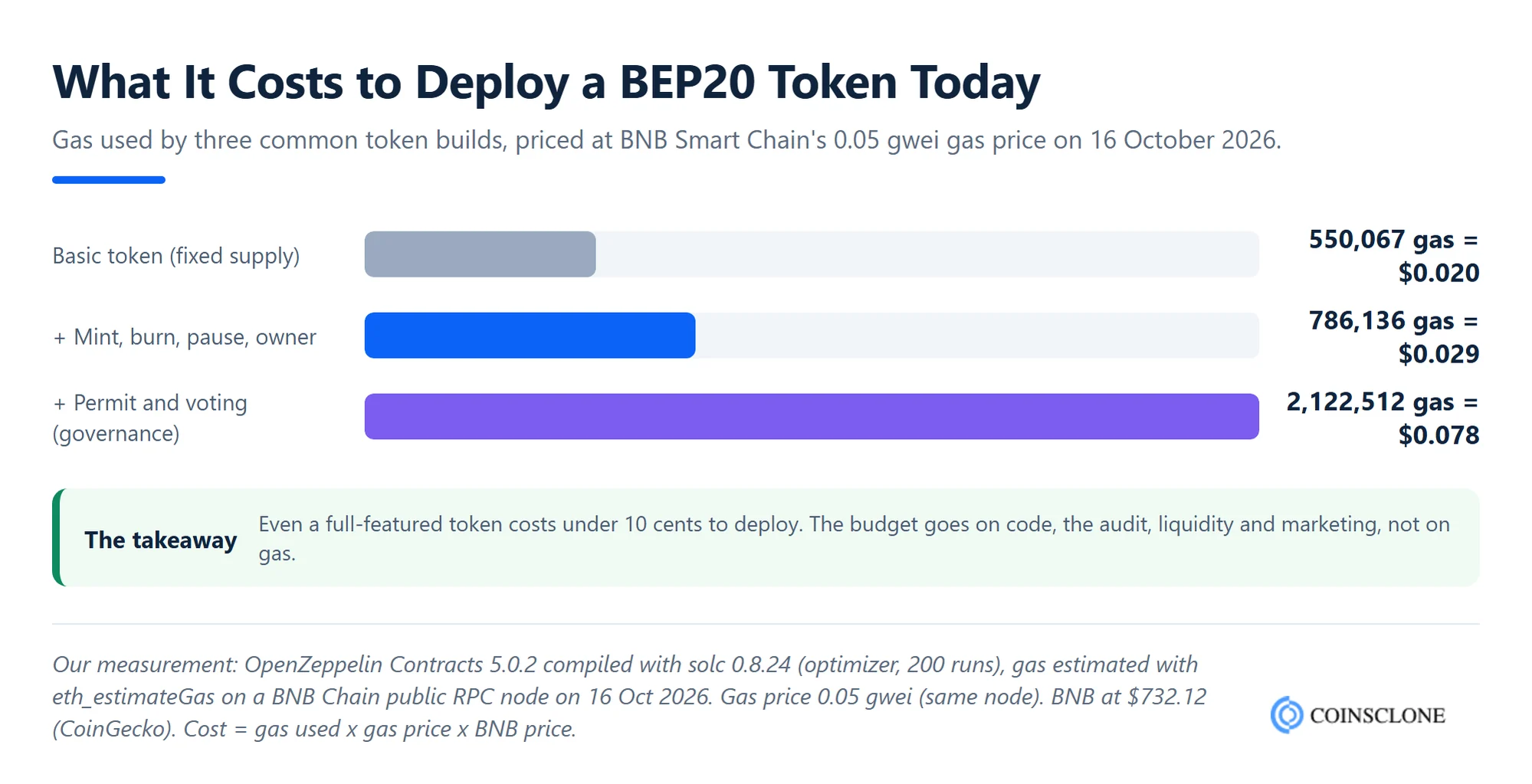
Even a full-featured token with permit signatures and voting costs under 10 cents to deploy. Creating a PancakeSwap pool also costs well under a dollar in gas. The gas price on BSC sat at 0.05 gwei on the BscScan gas tracker and on the node we queried.
Your holders pay tiny fees too. A token transfer uses about 35,000 to 52,000 gas. At 0.05 gwei and $732 per BNB, that is about one to two tenths of a cent. This is why BEP20 suits reward points, in-app currencies and small payments.
BEP20 vs ERC20: Why the Fees Differ
BSC runs the same virtual machine as Ethereum, so the same code uses the same amount of gas on both. The difference comes from the gas price and the price of the coin that pays for it. BSC’s gas price sat at 0.05 gwei in October 2026, while Ethereum’s moves up and down with demand. The build cost is almost the same on both chains. See our guide to create an ERC20 token for the Ethereum side.
What a Full BEP20 Token Launch Really Costs
Gas is the smallest line in any serious token budget. Here is how the other costs compare:
| Cost item | Typical cost | Notes |
| Smart contract development | From a few hundred dollars (template) to $50,000+ (custom) | Grows with every custom feature |
| Tokenomics and white paper | Often part of the build quote | Supply, allocation, vesting and use |
| Security audit | About $5,000 to $15,000 (simple), $15,000 to $70,000 (complex) | Needed for any custom logic |
| Deployment gas | About $0.02 to $0.08 | Measured 16 October 2026 |
| Contract verification on BscScan | Free | Lets buyers read your code |
| PancakeSwap pool gas | Well under $1 | Your liquidity is extra |
| Starting liquidity | Your own capital | Often tens of thousands of dollars |
| Legal review | Quoted per country | Essential before a public sale |
| Listings and marketing | Variable | Often the largest cost after launch |
Audit ranges from published 2026 audit price guides. Gas from our own measurement.
Starting liquidity is capital you put into a PancakeSwap pool, paired with BNB or a stablecoin, so people can trade. Thin liquidity means big price swings on every trade. Many projects also lock their liquidity for a set time to show buyers they will not pull it.
Listings on CoinGecko and CoinMarketCap are free to apply for, but you must meet their rules. Our guide on how to list a token covers each platform’s fees and requirements.
Legal costs depend on where you and your buyers are. A token sold to raise money can count as a security in some countries. In the EU, the MiCA regulation requires a white paper for many public token offers.
Factors Affecting the Cost of Creating BEP20 Tokens
The cost of creating a BEP20 token changes with each of these factors. Knowing them helps you plan a budget before you start, and cut what your business does not need.
- Development Team
- Complexity of Features
- UI/UX Design
- Legal & Jurisdiction Compliance
- Quantity of Crypto tokens
- Token Promotion & Marketing
- Token Testing & Debugging
- Update & Maintenance
Development Team
You can create your BEP20 token with a no-code tool, a freelancer or a crypto token development company. A no-code tool is cheap and fast, but you get preset features only. A freelancer can work for small jobs, yet it is hard to judge their skill, and a flawed contract cannot be edited once it is live.
A development company costs more upfront but brings developers, testers and project managers under one roof. Key cost points include:
- Team size: How many developers and testers your token needs.
- Scalability: Whether the code must support staking or new features later.
- Consulting services: Advice on tokenomics, chain choice and launch plans.
You also get regular updates, guidance and support. You can customize, upgrade and maintain your token with the same team. So, for most business budgets, a leading BEP20 Token Development Company is the best choice. Even after launch, their developers can help you fix any technical issue.
Complexity of Features
The more complex your features, the more it costs to create the BEP20 token. Burning, minting, anti-whale limits, liquidity pool setup, deflationary logic, token recovery and transfer taxes are common BEP20 features. Each one is more code to write, test and audit. Staking, vesting and governance add separate contracts, which is where costs climb the most.
UI/UX Design
The token contract itself has no screen. But most launches need one around it: a landing page, a claim or vesting portal, a staking dashboard or a presale page. Simple pages cost little. Custom dashboards with wallet connections take more design and front-end work.
Your token’s brand matters too. Many users still love meme themes, so some projects build a BEP20 token around one. A strong look helps, but it should sit on clean, tested code.
Legal & Jurisdiction Compliance
When you create a BEP20 token, you must also plan for legal and regulatory rules. Each country has its own rules for selling and sharing tokens. So build and sell the token with your target regions in mind, and budget for a legal review and for paying your taxes on time.
Quantity of Crypto tokens
The size of your supply does not change the gas cost. Minting one million or one billion tokens costs the same to deploy. What costs more is distribution. Airdrops to thousands of wallets, vesting contracts for the team and investors, and liquidity allocations each add code and on-chain transactions.
Token Promotion & Marketing
After you create the BEP20 token, you need people to know about it. This means a team or agency for social media, community, content and email marketing, plus the tools they use. For many projects, marketing is the largest cost after launch.
Token Testing & Debugging
Once the token is built, test it well. Testing finds bugs and errors so they can be fixed before launch. It runs on the BSC testnet, where test BNB is free from the official BNB Chain faucet, plus automated test suites and manual review.
Good testing lets you launch a feature-rich token without hassle and keeps quality high from day one. Custom logic needs more tests, which adds to the cost. Costs and testing depth differ between development companies, so choose wisely.
Update & Maintenance
After a successful launch, your token still needs care. You will monitor the contract, support your community and add contracts for new features such as staking. If your contract is upgradeable, each upgrade needs testing and review. A crypto token development company provides these services for an ongoing fee.
You also have to protect your token and your holders from hacks and scams. Keep admin keys in a multisig wallet and limit owner powers. These steps add some cost, but they protect everything you have built.
Want to explore these features in action? Try our free trial now.
Features that Impact the BEP20 Token Creation Cost
The cost of your BEP20 token also depends on the features you choose and the chain features you rely on. Here is how each one affects your budget:
High Transaction Speed & Low Fees
BEP20 tokens move fast and cheaply. With 0.45 second blocks and transfers that cost a fraction of a cent, users can trade and pay without worrying about fees. This comes from the chain, so you do not pay extra to build it.
Interoperability
BSC runs the Ethereum Virtual Machine, so your token can use the same tools, wallets and audit practices as Ethereum tokens. If you want the token on other chains too, a bridge or a multi-chain launch adds development and audit work, and so adds cost.
Low Carbon Footprint
BSC uses a Proof of Staked Authority model, where a set of staked validators produce blocks. It uses far less energy than Proof of Work chains such as Bitcoin. This does not change your build cost, but it helps if your users care about sustainability.
Smart Contract Functionality
BEP20 tokens use smart contracts to set their rules. Features such as burning, minting and time-locks add code and need skilled developers, which raises the cost. For many projects, that control is worth the price.
Global Level Community & DEX Support
BEP20 tokens can trade on PancakeSwap and many other DEXs on BSC, and most major wallets support them. This does not change your build cost, but it widens your reach and helps liquidity.
Robust Security Features
Security is a must in crypto. Pause controls, blacklists, ownership limits and multisig admin all protect holders, and each needs careful code and testing. Running free static analysis tools such as Slither during development catches common bugs early and makes the manual audit faster.
With these features, BEP20 tokens keep drawing startups and entrepreneurs. You can add more features if your project needs them, but each one adds to the build and audit cost.
No-Code Generator vs Professional BEP20 Token Development
Search for “create BEP20 token” and you will find no-code generators that mint a token in minutes. They are useful for a quick test, but they rarely suit a token that will raise money or hold real value. The decision tree below shows which route fits your token.
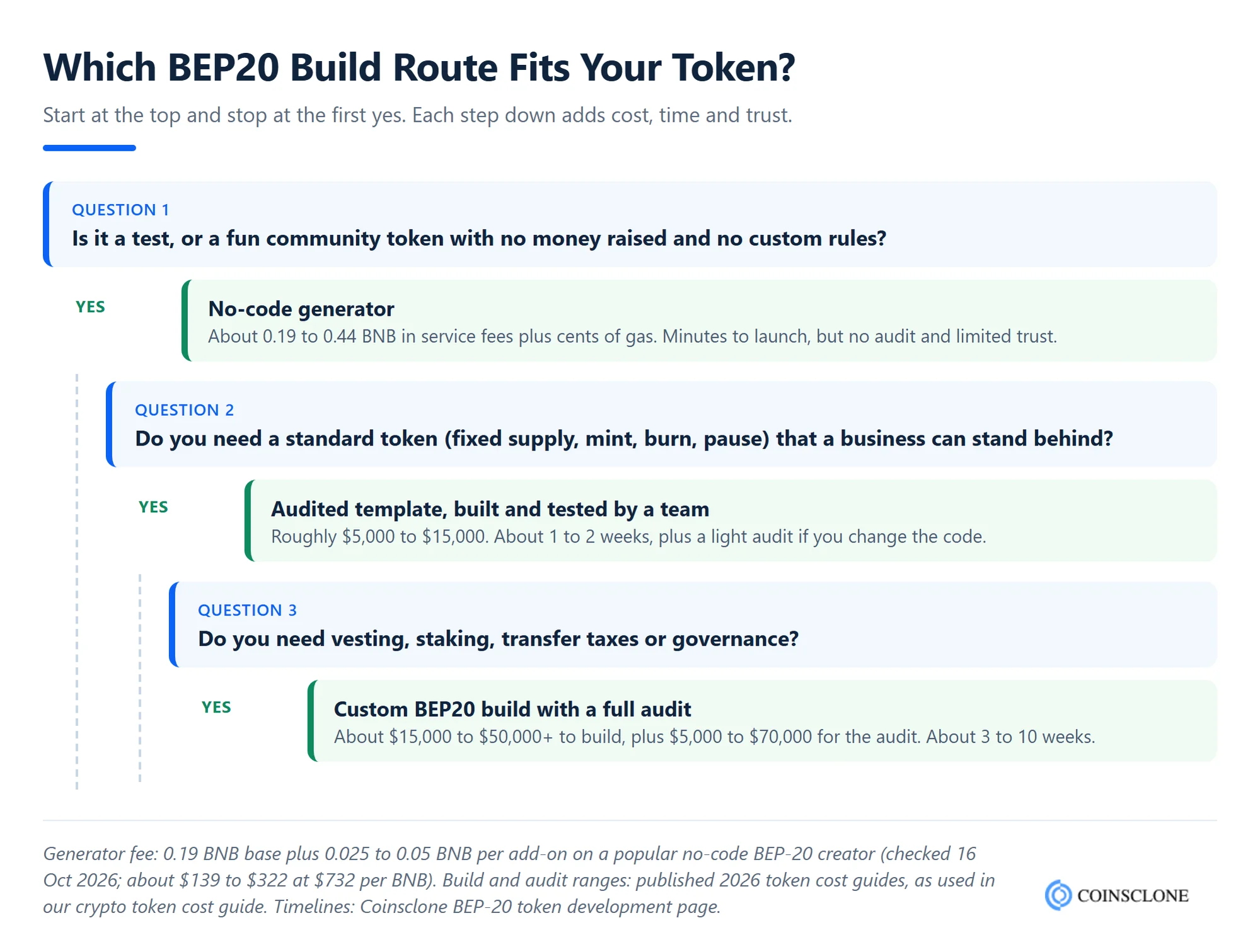
A no-code token still has costs. On one popular generator, the base fee was 0.19 BNB on 16 October 2026, with 0.025 to 0.05 BNB more for each add-on such as burn, mint or anti-whale. That is about $139 to $322, or several thousand times the gas itself. You also get little control over the code, and some tools leave hidden owner powers or fees in the contract. Always check who controls the contract before you use one.
How to Create a BEP20 Token: Steps and What Each Costs
Whether you build in-house or hire a team, a professional launch follows the same steps:
- Define the purpose and tokenomics: Set the supply, allocation, vesting and any taxes. This planning is usually part of the build quote.
- Write the contract on an audited template: OpenZeppelin’s ERC20 code works on BSC as it is. This is the main development cost.
- Test on the BSC testnet: Test BNB is free from the faucet, so this step costs only team time.
- Audit the contract: About $5,000 to $15,000 for a simple token, more for complex logic.
- Deploy to BSC mainnet: About $0.02 to $0.08 in gas at October 2026 prices.
- Verify the source code on BscScan: Free, and it builds trust with buyers.
- Create a PancakeSwap pool: Well under a dollar in gas, plus your liquidity capital.
- Move ownership to a multisig wallet: A few small transactions that protect holders if one key is lost or stolen.
At Coinsclone, a standard BEP20 token takes about 1 to 2 weeks. It takes 3 to 5 weeks with vesting, distribution and liquidity, and 6 to 10 weeks with staking, governance and a full launch package. You can explore our BEP20 token development service for the full scope.
How to Reduce the Cost of Creating a BEP20 Token
You can keep costs down without cutting safety. Here is how:
- Start from audited code: Standard OpenZeppelin contracts are safer and cheaper than code written from scratch.
- Add only the features you need: Every extra feature adds build and audit cost. Check how established tokens in our BEP20 tokens list are designed before you choose.
- Keep owner powers small: Fewer admin functions mean less to audit and more trust from buyers.
- Test on the testnet first: It is free, and a bug found there costs nothing to fix.
- Run automated checks early: Static analysis catches common bugs before the paid audit starts.
- Plan marketing with the build: Know your users and rivals early, so you do not pay for features nobody wants.
Watch out for the mistakes that waste the most money. Skipping the audit because the token was cheap to build can lose far more to an exploit. Launching with no liquidity or lock plan scares holders away. And assuming a cheap chain means fewer legal rules can be costly, because it does not.
Why choose Coinsclone for BEP20 Token Development?
If you want to create your BEP20 token, approach Coinsclone, a leading Crypto Token Development Company with strong experience in token development. We have been building blockchain products since 2018 and have delivered 350+ platforms for 200+ clients across 20 industries.
We have skilled developers, testers, experts and project managers to make the creation process smooth. We help you pick the right features, build on audited code, test on the testnet and plan your launch, so your BEP20 token fits your business budget.
So, without any concern, you can approach our team to create your token. We offer a free demo with a sample version of a BEP20 token.
Your crypto token, your idea! We bring that to life!
Frequently Asked Questions
1. How much does it cost to develop a BEP20 token?
Deploying a BEP20 token costs only about $0.02 to $0.08 in gas. A basic custom token built by a development team usually costs about $5,000 to $15,000. A token with vesting, staking, tax or governance logic costs about $15,000 to $50,000 or more, plus an audit and your starting liquidity.
2. Can I create a BEP20 token for free?
You can practise for free on the BSC testnet, where test BNB comes from the official faucet. On mainnet you always pay a small gas fee, which was only a few cents in October 2026. No-code generators add their own service fee on top, often about 0.19 BNB or more.
3. How much BNB do I need to deploy a BEP20 token?
Very little. At 0.05 gwei, a basic token needs about 0.00003 BNB of gas and a full-featured token about 0.0001 BNB. Keep a small extra amount for verifying the contract, creating a PancakeSwap pool and moving ownership to a multisig wallet.
4. Is BEP20 cheaper than ERC20?
The build cost is about the same, because both run the same code. The running costs differ. The same contract uses the same gas on both chains, but BSC’s gas price is very low (0.05 gwei in October 2026), so deploying and trading a BEP20 token costs cents or less.
5. Do I need a security audit for a BEP20 token?
If your token has any custom logic, yes. Published 2026 ranges put a simple token audit at about $5,000 to $15,000, and complex contracts at $15,000 to $70,000 or more. A plain, unmodified OpenZeppelin token carries little risk, but buyers and exchanges still look for audited code.
6. How long does it take to create a BEP20 token?
Deploying takes seconds. With a professional team, a standard BEP20 token takes about 1 to 2 weeks, 3 to 5 weeks with vesting and liquidity, and 6 to 10 weeks with staking, governance and an audit.
7. How do I list a BEP20 token on PancakeSwap?
You do not need approval. Create a pool that pairs your token with BNB or a stablecoin, add liquidity, and the token becomes tradable. Verify your contract on BscScan and consider locking the liquidity so buyers trust the launch.
8. What is the difference between BEP20 and BEP2?
BEP20 is the token standard of BNB Smart Chain and supports smart contracts. BEP2 was the standard of the old BNB Beacon Chain, which BNB Chain shut down in November 2024. Any new token should use BEP20.
See How Easily You Can Launch Your BEP20 Token — Without Breaking the Bank
BEP20 Token Development — simplified and affordable.
- Fast Deployment: Create and launch your BEP20 token in just a few hours.
- Smart Contract Audit-Ready: Secure, scalable, and optimized for Binance Smart Chain
- Custom Branding: Name, symbol, supply — everything tailored to your project.
- Add-on Utilities: Staking, governance, and liquidity options available.
Curious about the cost to create your BEP20 token?
Get a free cost estimate and demo — see exactly what you’ll get before spending a cent.
Launch your token and start your BSC project confidently — from idea to live token in 24 hours.