

The best DEX on Polygon by volume is Uniswap, which traded about $1.5 billion on Polygon in the 30 days to 25 October 2026. QuickSwap is the main Polygon-native DEX, and an aggregator such as 0x or KyberSwap often gets you the best price on a single swap.
Polygon is still one of the cheapest places to trade crypto on-chain. In late October 2026, a token swap there cost under half a US cent in gas. But the DEX scene has changed a lot. Some once-popular exchanges now see almost no trading, Balancer is closing down, and the busiest venue on the chain is a prediction market. In this guide, we rank the top DEXs on Polygon with live data from DefiLlama, and show what each one does best.
In this guide:
- The 7 best Polygon DEXs, ranked by October 2026 volume and pool size.
- Which Polygon DEX aggregator to use, and what a swap really costs.
- Which old DEXs have closed or gone quiet, such as Balancer.
- How to swap on Polygon, even with no POL for gas.
- What it takes to build your own DEX on Polygon.
See How Our MVP System Can Help You Launch the Best DEX on Polygon Faster
Polygon DEX Development — done right.
- MVP System : Launch your Polygon-based DEX 90% faster with pre-built DeFi modules.
- Seamless Liquidity & Wallets : Integrated with top Polygon tokens and cross-chain swaps — no coding needed.
- Brand & Customization : Your UI, your liquidity pools, your token ecosystem.
- Revenue Engine : Earn from swap fees, liquidity mining, and governance tokens.
Get a free branded Polygon DEX demo in 48 hours — before you invest a cent!
Book a Free Demo to discover how our Polygon DEX Development System can take you from idea to a live decentralized exchange in 8–12 weeks.
7 Best Polygon DEXs in 2026
We ranked these DEXs by 30-day trading volume, the money in their pools, their security record and the features they offer:
- Uniswap
- QuickSwap
- DODO
- WOOFi
- KyberSwap
- SushiSwap
- Curve
Polygon DEX Comparison Table
| DEX | Type | 30-day volume on Polygon | Pool money (TVL) on Polygon | Best for |
| Uniswap | Concentrated liquidity AMM (v3, v4) | $1.51B | $62M | Most pairs, deepest trading |
| QuickSwap | Polygon-native AMM | $367M | $52M | Polygon-native tokens, farming |
| DODO | PMM (oracle-guided pools) | $141M | $1.5M | Low slippage on major pairs |
| WOOFi | sPMM, cross-chain swaps | $63M | $0.4M | Cross-chain swaps |
| KyberSwap | DEX aggregator | $266M routed | n/a | Best price across all DEXs |
| SushiSwap | AMM (v2, v3) | $8.0M | $8.7M | Multi-chain users |
| Curve | StableSwap AMM | $5.7M | $5.3M | Stablecoin swaps |
Source: DefiLlama Polygon DEX data, 30 days to 25 October 2026. Pool money is each DEX’s TVL on Polygon on 25 October 2026.
1. Uniswap
Uniswap is the largest DEX on Polygon by volume, and since October 2026 it also holds the most money in its pools. It runs v2, v3 and v4 there. Its v3 pools let each provider choose a price range, so the same money supports far more trading. Uniswap v4, launched in January 2025, adds “hooks”, small plug-ins that let pools add custom logic such as dynamic fees or limit orders.
Key features
- Fee tiers of 0.01%, 0.05%, 0.30% and 1% on v3, chosen per pool.
- Concentrated liquidity and v4 hooks for custom pool designs.
- The Uniswap web app and wallet route trades across Polygon and 20+ other networks.
- UNI token for governance.
Why it stands out: Uniswap traded about $1.5 billion in 30 days from about $62 million in its pools. That is roughly 24 times its pool size each month, and it hosts the busiest USDT, USDC and POL pools on the chain.
2. QuickSwap
QuickSwap is the DEX that grew up on Polygon. It launched in 2020 as a fork of Uniswap v2 and is still the top Polygon-native DEX, with about $367 million traded in 30 days. The money in its pools fell from about $133 million at the end of September to about $52 million across its v2, v3 and v4 pools by 25 October, so Uniswap now holds more. Its v3 pools use the Algebra engine, which raises fees when prices swing and cuts them when markets are calm. QuickSwap also runs on Base and other EVM chains.
Key features
- Swaps, limit orders and range pools with fees that change with the market.
- Farms that pay extra rewards to liquidity providers.
- Dragon’s Lair: stake QUICK to earn a share of fees.
- Perpetual futures, now on a new engine after its first perps app closed in July 2026.
Why it stands out: It is the first home for many Polygon-native tokens. If a new project on Polygon wants its first pool, QuickSwap is often where it starts.
3. DODO
DODO uses a design called the Proactive Market Maker (PMM). Instead of the fixed curve most AMMs use, PMM pools use a price feed to keep liquidity close to the market price. That means less slippage on large trades with less money in the pool. DODO also runs a cross-chain aggregator (DODO X) and a no-code token and pool creator.
Key features
- PMM pools that need less money for the same depth.
- One-sided deposits, so providers can add just one token.
- DODO X aggregator for same-chain and cross-chain swaps.
- Tools to create tokens and pools without code.
Why it stands out: DODO traded about 92 times its pool size in 30 days. Only WOOFi got more trading out of each dollar in its pools.
4. WOOFi
WOOFi is a DEX that runs on Polygon, Arbitrum, Base and many more chains. Its swaps use a synthetic PMM (sPMM) that prices trades from market maker quotes, which keeps spreads tight on major tokens. WOOFi also offers cross-chain swaps, one-token earn vaults and perps.
Key features
- Tight pricing on major pairs from market maker quotes.
- Cross-chain swaps between 15+ chains in one step.
- Earn vaults that take one token.
- WOO token staking for fee discounts and rewards.
Why it stands out: WOOFi traded about 147 times its small pools in 30 days, the highest turnover in our list. It is a strong choice when you want to move a major token from Polygon to another chain in one step. To see how quote-based pricing works, read how crypto market makers make money.
5. KyberSwap
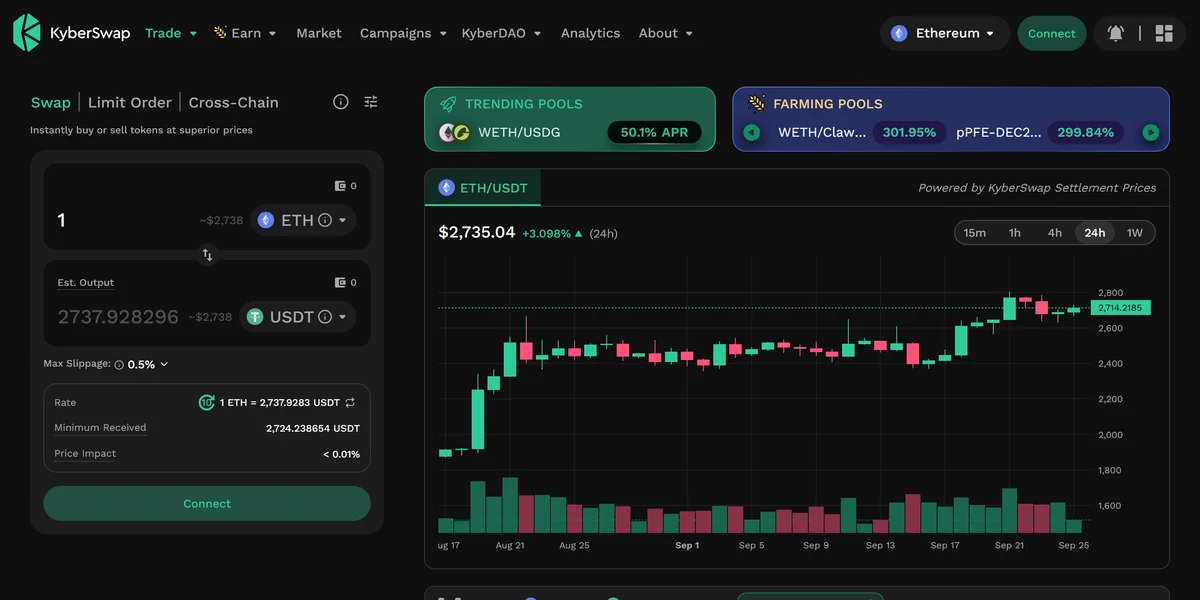
KyberSwap is a DEX router. It does not hold most of the funds itself. Instead, it checks prices across many DEXs and splits your trade to get the best rate. In the last 30 days, it routed about $266 million of trades on Polygon, second only to 0x. KyberSwap closed its own Elastic pools after an exploit in November 2023 and now focuses on routing, limit orders and cross-chain swaps.
Key features
- Best-price routing across DEXs such as Uniswap, QuickSwap and DODO.
- Gasless limit orders.
- Cross-chain swaps.
- Support for many other EVM chains.
Why it stands out: For most traders, an aggregator gets a better price than any single DEX. Other popular aggregators on Polygon include 0x (Matcha), OKX Swap and 1inch. See our list of the best DEX aggregators for more.
6. SushiSwap
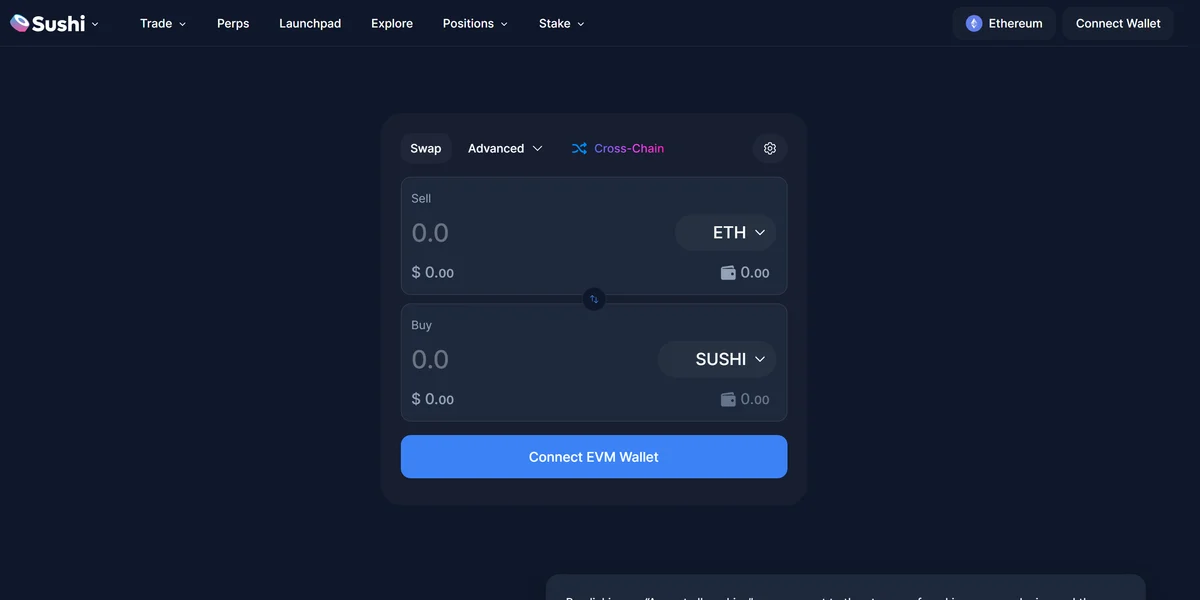
SushiSwap is an AMM on many chains that has been on Polygon since 2021. It runs classic v2 pools and v3 range pools, and adds cross-chain swaps through its own routing. Its volume there is now much smaller than in earlier years, about $8 million a month, but it stays useful for users who trade the same pairs on many chains.
Key features
- Classic and range pools.
- Cross-chain swaps and a built-in aggregator.
- Support for dozens of networks.
- SUSHI token for governance.
Why it stands out: One interface across many chains, which suits users who move between Polygon and other networks.
7. Curve
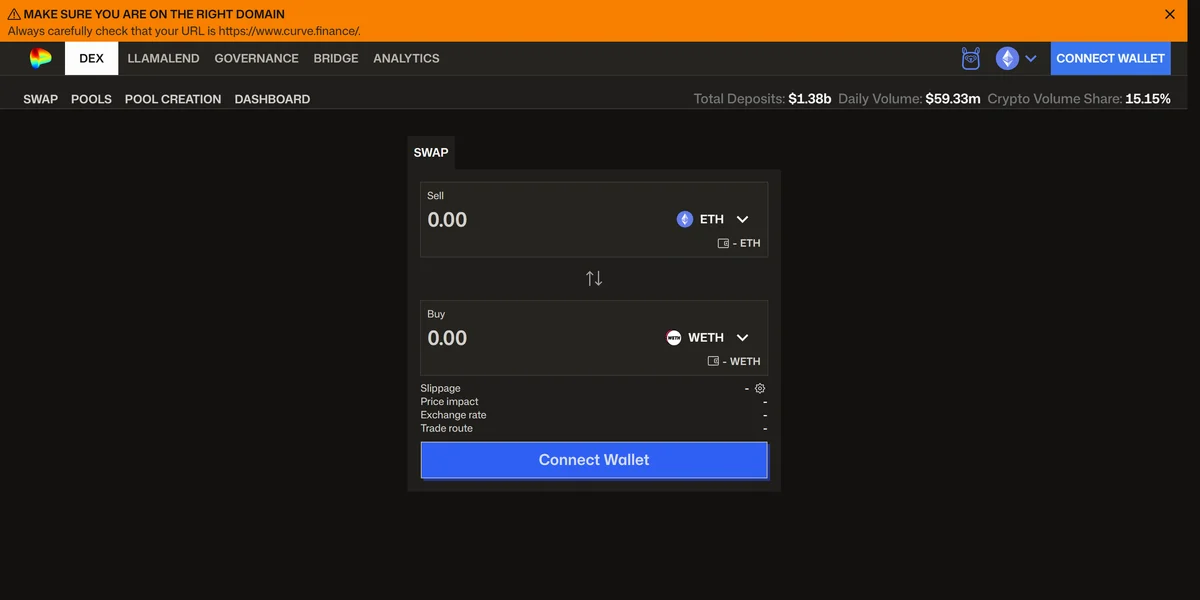
Curve is built for swapping assets that should trade near the same price, such as USDC, USDT and DAI. Its StableSwap curve keeps slippage very low on these trades. On Polygon, it holds about $5.3 million, mostly in stablecoin pools.
Key features
- Very low slippage on stablecoin and pegged-asset swaps.
- Low fees on stable pools.
- CRV rewards for pool providers.
Why it stands out: For stablecoin swaps, Curve’s pool design can beat a general AMM on price. Its Polygon pools are now small, though, so let an aggregator compare it with Uniswap first.
What Happened to Balancer, Dfyn and Other Old Polygon DEXs?
Older lists often include Balancer, Dfyn, ComethSwap, Polycat and Firebird. Today, none of them is a good place to trade:
- Balancer: In November 2025, a hack hit Balancer v2’s stable pools on Polygon and eight other chains, with losses of about $128 million. Balancer Labs closed in March 2026. On 15 September 2026 the team proposed a full wind-down, and BAL holders approved it on 29 September with about 99% support. Pools move to withdrawal-only mode on 30 October 2026. If you still have funds there, take them out.
- Dfyn: Once a Polygon-first DEX, it traded only about $160,000 in the last 30 days. DefiLlama now flags its website as offline.
- ComethSwap: It traded about $20,000 in the same 30 days.
- Polycat and Firebird: DefiLlama flags both websites as offline, and their volume is close to zero.
What About Ramses and Metric?
If you sort DefiLlama’s Polygon list by volume, you will also see two newer names: Ramses and Metric. Together they traded about $1.1 billion in 30 days. But each holds less than $0.5 million in its pools. Volume that high from pools that small usually comes from trading bots and professional flow, not from everyday swaps. We left them out of the ranking until their pools grow.
Best Polygon DEX Aggregators
The best Polygon DEX aggregator by volume is 0x, which routed about $1.3 billion of trades in the 30 days to 25 October 2026. An aggregator does not hold your trade in one pool. It checks many pools at once and splits the order to get you the best price. On Polygon, these routers handled about $2.1 billion of trades in that time. These were the busiest:
| Aggregator | 30-day volume on Polygon | Good to know |
| 0x (Matcha) | $1.32B | Powers swaps inside many wallets and apps |
| KyberSwap | $266M | Gasless limit orders |
| OKX Swap | $179M | Built into the OKX Wallet |
| 1inch | $80M | Fusion mode for gasless, MEV-protected swaps |
| Velora (ex-ParaSwap) | $57M | Intent-based swaps |
Source: DefiLlama Polygon aggregator data, 30 days to 25 October 2026.
Most of this volume still settles in Uniswap, QuickSwap and DODO pools. So the router is where you trade, and the DEX is where the money sits. If you want to run your own router, see our DEX aggregator development service.
Which DEX Aggregator Gives the Best Rates on Polygon?
No single aggregator wins every trade. Rates change from block to block, and each router sees slightly different pools. A Polygon user on Reddit asked this in December 2025, and the top reply pointed to a meta-aggregator. Tools such as LlamaSwap ask several aggregators for a quote at once and show you the best one. For big trades, compare two or three quotes and check the price impact before you confirm.
Polygon DEX Volume: Where Trading Happens
Trading on Polygon sits in fewer places than most lists suggest. Two DEXs, Uniswap and QuickSwap, handle most token swaps. And a prediction market now trades more than any DEX. Polymarket did about $2.3 billion of trades on Polygon in the last 30 days, against about $1.5 billion on Uniswap.
This matters for traders and for builders. Traders get the best prices where the volume is. Builders should know that Polygon is now as much a home for betting markets and payments as for classic token trading. If that is your interest, see how to build a prediction market like Polymarket.
Which Polygon DEX Gets the Most From Its Liquidity?
Most lists rank DEXs by total value locked (TVL). But TVL alone does not tell you how much trading a DEX gets. The chart below divides each DEX’s 30-day volume by the money in its Polygon pools.
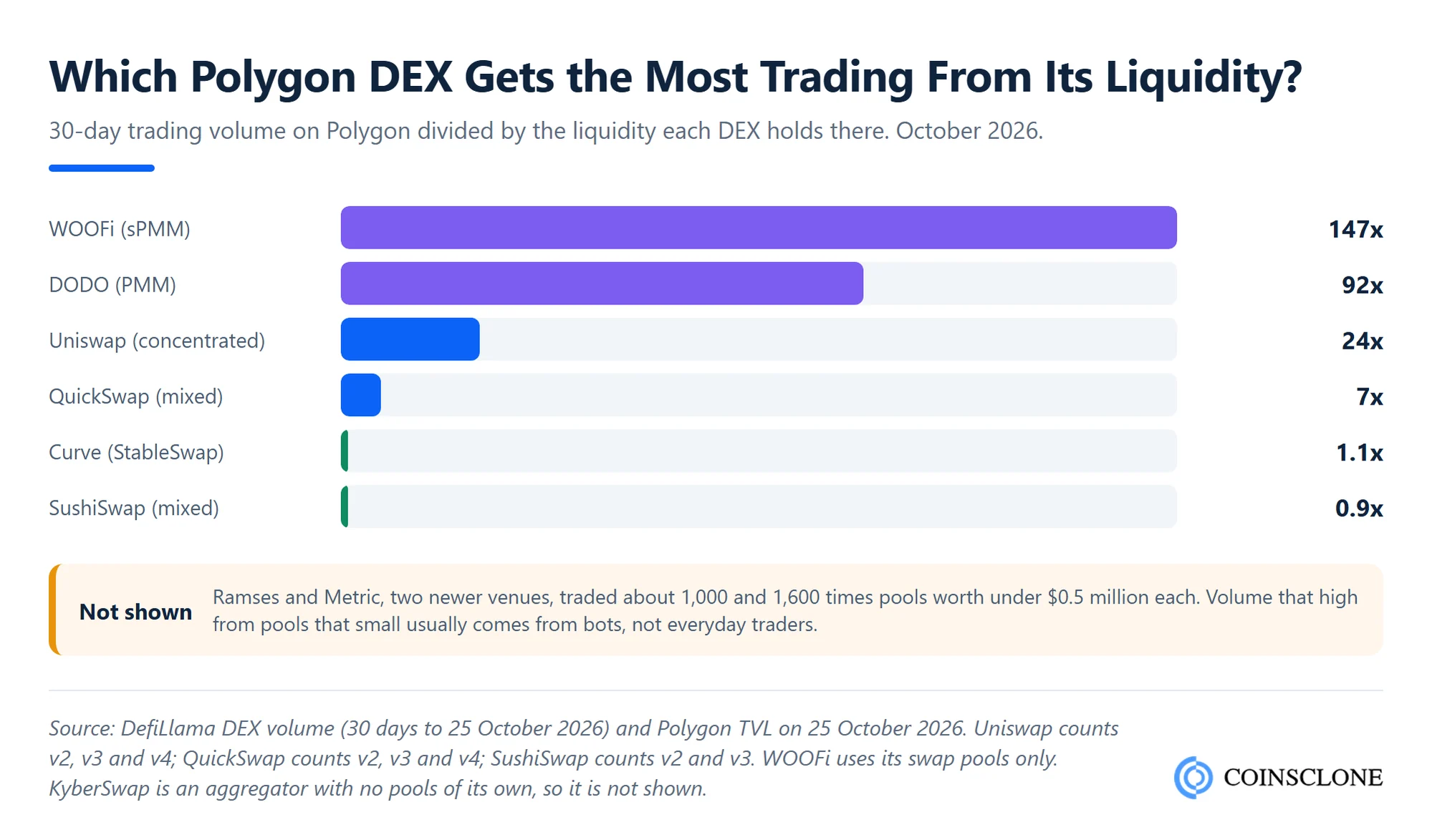
Uniswap now trades about four times more than QuickSwap with only a little more money in its pools. WOOFi and DODO go further, trading 90 to 150 times their small pools each month. The reason is design. Range pools and PMM pools put money where trading happens. For anyone launching a DEX, this is the key lesson: the right pool design can cut the funds you need to raise by a large factor. Our guide on how to create a liquidity pool for a token shows how to set one up.
Polygon DEX Fees: What Does a Swap Cost?
A swap on a Polygon DEX costs two things: a pool fee of 0.01% to 1% of the trade, and a gas fee that is usually well under one cent. Most of the pool fee goes to the people who fund the pool. Some DEXs keep a small share: Uniswap turned on a protocol fee in December 2025, starting with its Ethereum pools. The gas fee goes to the network, paid in POL.
- Pool fee: Each pool sets its own fee. Stablecoin pools sit near 0.01% to 0.05%. Major pairs like POL/USDC often use 0.05% or 0.30%. New or volatile tokens often use 1%.
- Gas fee: On 26 October 2026, gas on Polygon was about 280 gwei with POL at about $0.09. A simple swap cost about $0.004.
- Hidden costs: Slippage and price impact can cost more than both fees on a thin pool. Routers may also add a small fee of their own.
Worked example: A $1,000 swap from USDC to POL in a 0.05% pool costs about $0.50 in pool fees and less than half a cent in gas. The same trade on Ethereum mainnet often costs more in gas alone.
Polygon DEX vs Centralized Exchange
Use a Polygon DEX when you want to keep your own keys and trade tokens that big exchanges do not list. Use a centralized exchange when you need to turn cash into crypto or trade with high leverage.
| Polygon DEX | Centralized exchange | |
| Who holds your funds | You, in your wallet | The exchange |
| Sign-up and KYC | None to swap | Usually required |
| Token choice | Any token with a pool, including fakes | Only listed tokens |
| Fees | Pool fee plus about $0.004 gas | Trading fee plus withdrawal fee |
| Cash in and out | Not built in | Bank and card rails |
| Main risk | Smart contract bugs, fake tokens | Exchange failure or freezes |
Many people use both. They buy POL or USDC on an exchange, withdraw it to Polygon, then trade on a DEX.
How to Swap Tokens on Polygon
Swapping on Polygon takes a few minutes:
- Set up a wallet: Use a wallet that supports Polygon, such as MetaMask, Rabby or Trust Wallet, and add the Polygon network.
- Get POL for gas: Polygon’s gas token is POL, which replaced MATIC in September 2024. You need only a small amount.
- Move funds to Polygon: Withdraw tokens to Polygon from an exchange, or bridge them from Ethereum or another chain.
- Connect to a DEX: Open Uniswap, QuickSwap or an aggregator like KyberSwap, and connect your wallet.
- Check the token address: Copy the contract address from the project’s official site. Fake tokens often use the same name.
- Set slippage and swap: Keep slippage low (0.5% or less for major pairs), review the trade and confirm it in your wallet.
How to Swap on Polygon With No POL for Gas
You can still swap with zero POL by using a gasless swap. With 1inch Fusion mode or CoW Swap, both live on Polygon, a third party pays the gas and takes the cost from the token you sell. You only sign a message, so you need no POL at all.
This is a common problem. Reddit users often end up holding USDT on Polygon with no gas, or USDC sent from Polymarket with 0 POL, and ask strangers to send some. A safer fix is a gasless swap of a few dollars into POL, or a small POL withdrawal from an exchange straight to the Polygon network. Gasless modes often have a minimum trade size, so very small amounts may fail.
Why Build a DEX on Polygon?
Very Low Fees
On 26 October 2026, gas on Polygon was about 280 gwei with POL at about $0.09. A simple swap cost well under half a cent. That makes small, frequent trades practical.
Fast Finality
The Heimdall v2 upgrade in July 2025 cut finality from one or two minutes to about five seconds. The Rio upgrade in October 2025 made it near instant and raised capacity to about 5,000 transactions per second.
Ethereum Compatibility
Polygon PoS is built to work like Ethereum. Ethereum smart contracts, wallets and tools work on it with little or no change, so you can reuse audited DEX code.
Payments and Stablecoins
Polygon now pitches itself as a payments chain, and stablecoins such as USDC and USDT are widely used there. A DEX that serves stablecoin swaps fits this flow.
Connection to Other Chains
Through bridges and Polygon’s AggLayer, a DEX here can reach users and funds on other chains. A cross-chain DEX design lets traders swap between Polygon and other chains in one step.
What to Watch Out For
Polygon held about $735 million in DeFi on 25 October 2026. That is down from about $800 million in September, and far below Ethereum, Base, BNB Chain and Solana. Polygon zkEVM, a separate network, had its sequencer shut down on 1 July 2026. A new DEX on Polygon PoS should plan how to draw in funds from day one. Smart pool designs, farms and router listings all help.
How to Choose the Best DEX on Polygon
- Volume and pool size: More volume and deeper pools mean better prices and less slippage.
- Security record: Check audits, bug bounties and past exploits. Balancer’s case shows that even older, audited code can fail.
- Pool design: Range pools and PMM pools often give better prices than classic pools.
- Token choice: Make sure the DEX lists the tokens you want, with real money in the pools.
- Fees: Compare the pool fee as well as the gas cost.
- Extra features: Limit orders, cross-chain swaps and farming may matter to you.
If you trade often, start with a router. It checks all the main DEXs for you.
Launch Your Own Decentralized Exchange On Polygon With Security & Customizable Features
Cost-effective | White-Label Solutions | Premium Features | Live Demo Available
Build Your Own Polygon DEX: Cost and Timeline
The data shows a clear opportunity. Polygon has cheap, fast trades, but only a few DEXs hold most of the activity. A new DEX can still compete with a smart pool design, good rewards and a clear focus, such as stablecoins, payments or one community.
A DEX on Polygon costs about $10,000 to $50,000 as a white label build and $40,000 to $250,000 or more as a custom build, based on published 2026 agency cost guides. Audits, liquidity and marketing come on top.
Coinsclone is a decentralized exchange development company. Since 2018, we have delivered more than 350 blockchain platforms for over 200 clients across 20 industries. We build DEXs on Polygon with range or PMM pools, farms, staking, limit orders and cross-chain swaps. You can start from a white label decentralized exchange, or from a ready model such as our QuickSwap clone script, Uniswap clone script, SushiSwap clone script or Curve Finance clone script. Our published timeline for a white label DEX on one chain is 5 to 7 weeks, and 10 to 14 weeks for a standard build.
For a wider view, see our guide to the best decentralized exchanges across all chains.
See How Our MVP System Can Help You Launch the Best DEX on Polygon Faster
Polygon DEX Development — done right.
- MVP System : Launch your Polygon-based DEX 90% faster with pre-built DeFi modules.
- Seamless Liquidity & Wallets : Integrated with top Polygon tokens and cross-chain swaps — no coding needed.
- Brand & Customization : Your UI, your liquidity pools, your token ecosystem.
- Revenue Engine : Earn from swap fees, liquidity mining, and governance tokens.
Get a free branded Polygon DEX demo in 48 hours — before you invest a cent!
Book a Free Demo to discover how our Polygon DEX Development System can take you from idea to a live decentralized exchange in 8–12 weeks.
Frequently Asked Questions
What is the best DEX on Polygon?
By volume, Uniswap is the largest DEX on Polygon, with about $1.5 billion traded in the 30 days to 25 October 2026. It also holds the most money in its pools, about $62 million. QuickSwap is the top Polygon-native DEX. For the best price on a single trade, use an aggregator such as 0x, KyberSwap or 1inch.
Which Polygon DEX has the most tokens?
Uniswap and QuickSwap list the widest range of Polygon tokens, because anyone can create a pool on them. An aggregator reaches every token that has a pool on any Polygon DEX. For the widest token choice across all chains, see our list of the best decentralized exchanges.
Where is the best place to swap USDT on Polygon?
Uniswap holds the busiest USDT pools on Polygon in October 2026, including USDC/USDT and POL/USDT. A Polygon user asked this on Reddit in November 2025. Our answer: use an aggregator, which compares Uniswap with QuickSwap, Curve and DODO and picks the cheapest route.
Is Polygon a decentralized network?
Polygon PoS is run by about 100 validators who stake POL, so no single firm runs it. It is less spread out than Ethereum, which has far more validators. DEXs on Polygon let you keep control of your funds and trade through smart contracts.
What is the cheapest way to swap on Polygon?
Use a router to find the best price, and pick a pool with a low fee. A swap on Polygon usually costs less than one cent in gas.
How can I track Polygon DEX volume?
Use DefiLlama for 30-day volume and liquidity by DEX, and DEX Screener for live prices and charts of single Polygon pairs. Both are free.
Is QuickSwap only on Polygon?
No. QuickSwap started on Polygon and is still its main home, but it now also runs on Base and other EVM chains.
Do I need POL to trade on a Polygon DEX?
Usually, yes. You pay gas in POL, which replaced MATIC in 2024. Gasless modes such as 1inch Fusion and CoW Swap let you swap without POL, because the fee is taken from the token you trade.
Is there a perpetual futures DEX on Polygon?
Yes, but perp trading on Polygon is small. QuickSwap offers perps, and Gains Network also runs on Polygon. Most on-chain perp trading now happens on other networks such as Hyperliquid and Arbitrum.
Is there a DEX on Polygon zkEVM?
Polygon zkEVM had its sequencer shut down on 1 July 2026, and DefiLlama shows almost no value left on it. Trade on Polygon PoS instead, where all the DEXs in this list run.
Is Balancer still safe to use on Polygon?
No. BAL holders approved a full wind-down on 29 September 2026, after a $128 million exploit in November 2025. Pools move to withdrawal-only mode on 30 October 2026, so take out any funds left there and do not add more.
Can I build my own DEX on Polygon?
Yes. Polygon PoS is EVM-compatible, so you can deploy audited AMM or PMM contracts, add a frontend, and list with aggregators. A white label DEX on Polygon can go live in 5 to 7 weeks.