
Chainalysis tracked more than 2 million tokens launched in 2024. It flagged 74,037 of them as possible pump and dumps, and in about 94% of those cases the wallet that created the DEX pool pulled the liquidity. That is why buyers now check the pool before they check the chart.
Making the pool is cheap. A standard Raydium pool costs a 0.15 SOL fee, about $16 at the 16 October 2026 SOL price. The hard part is everything around it. This guide shows how to create a liquidity pool for a token: which pool type to pick, how to set the opening price, how much to add, how to handle slippage and snipers, and how to lock or burn the LP so buyers can trust it.
In this guide:
- Your opening price is just a ratio: 10 million tokens plus $50,000 USDC opens at $0.005 a token.
- Size the quote side for real trades: about 100 times your largest normal buy keeps that buy near 1% slippage. The popular “3 to 7 SOL” advice lets a $100 buy move the price about 41%.
- Use a full-range pool for a launch: Uniswap v2, PancakeSwap v2, Raydium CPMM or Meteora DAMM v2.
- Costs are small: 0.15 SOL plus rent on Raydium CPMM (keep about 0.2 SOL in total), or gas on EVM chains.
- Lock or burn the LP at once, and revoke mint and freeze powers, or the lock proves nothing.
How to Create a Liquidity Pool for a Token: The Quick Answer
A liquidity pool holds your token and a “quote” token buyers already own, such as SOL, ETH, BNB or USDC. Traders swap against it, and a formula sets the price. The process:
- Finish the token. Fix the supply, revoke the mint authority (and freeze authority on Solana), or renounce owner powers on EVM chains.
- Pick the DEX and pool type. Go where your buyers trade: Raydium or Meteora on Solana, Uniswap on Ethereum and Base, PancakeSwap on BNB Chain.
- Set the opening price by choosing how much of each token to deposit.
- Set the depth for the biggest buys you expect.
- Create the pool and deposit both sides. You receive LP tokens or a position NFT.
- Lock or burn the LP and post the proof.
- Share the pool address so buyers can check it.
No token yet? Start with how to create a meme coin.
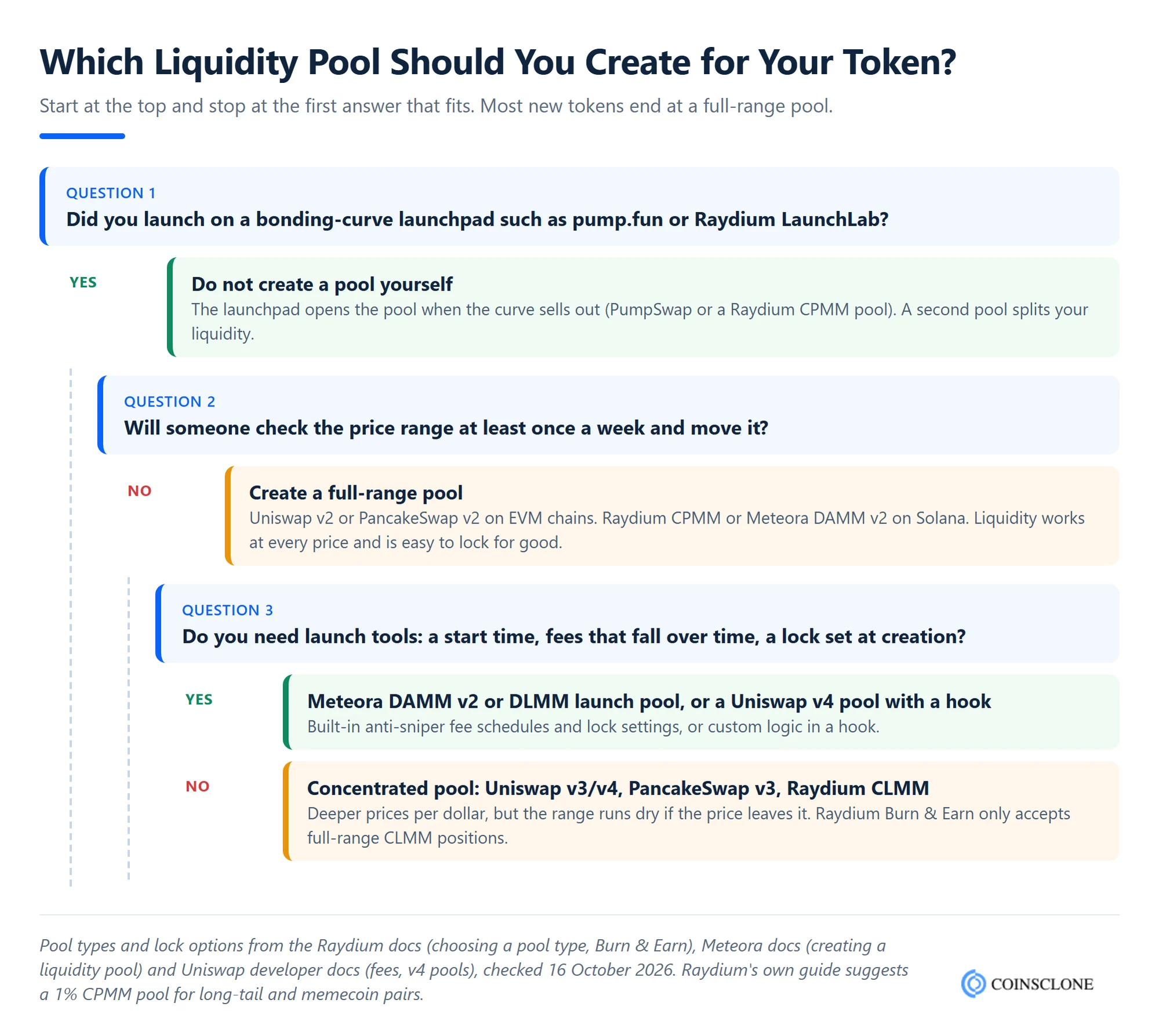
Which Type of Liquidity Pool Should You Create?
The main question is whether your liquidity covers every price or only a range you choose.
Full range. The pool follows x × y = k and works at every price, needs no managing, and is easy to lock for good. Uniswap v2, PancakeSwap v2, Raydium CPMM and Meteora DAMM v2 in compounding mode work this way.
Concentrated. You place liquidity inside a price range, where it trades as if the pool were much deeper. If the price leaves the range, the position stops working. Uniswap v3 and v4, PancakeSwap v3, Raydium CLMM and Meteora DLMM use this model. Raydium says CLMM can earn 4 to 40 times more fees per dollar, but only if someone keeps moving the range.
Launch pools. Meteora’s DAMM v2 and DLMM launch pools add a start time, fees that fall over time to tax snipers, and a lock set at creation. On Uniswap v4, hooks can add custom launch rules.
Launchpad pools. If you launched on pump.fun or Raydium LaunchLab, the platform opens the pool when the bonding curve sells out. Do not add a second pool by hand: two thin pools are worse than one deep pool.
Which DEX to Use and What It Costs
This table uses each DEX’s own docs and live configs, checked on 16 October 2026.
| DEX and pool | Chain | Range | Trading fee | Cost to create | Built-in lock |
| Raydium CPMM | Solana | Full | 0.25% default; 1% for long-tail tokens | 0.15 SOL fee plus rent (about 0.2 SOL in total) | Burn & Earn, permanent |
| Raydium CLMM | Solana | Concentrated | 0.01% to 4% tiers | Rent and network fees | Burn & Earn, full range only |
| Meteora DAMM v2 | Solana | Full or fixed range | Fixed or scheduled | Shown before you sign | “Permanently lock” option |
| Meteora DLMM | Solana | Price bins | Base fee plus dynamic fee | Shown before you sign | Lock period on launch pools |
| Uniswap v2 | Ethereum, Base and others | Full | 0.30% (0.25% to LPs) | Gas | None; use a locker or burn |
| Uniswap v3 / v4 | Ethereum, Base and others | Concentrated | v3: 0.01%, 0.05%, 0.30%, 1%; v4: any | Gas | None; use a locker |
| PancakeSwap v2 / v3 | BNB Chain and others | Full / concentrated | v2: 0.25%; v3: 0.01% to 1% | Gas | None; use a locker or burn |
Sources: Raydium’s live configs and CPMM guide, Uniswap’s fee docs (the v2 split dates from the December 2025 UNIfication vote), and PancakeSwap’s v3 fee tiers.
On Raydium (CPMM)
Open Create Pool, choose Standard AMM (CPMM), paste both mint addresses, pick a fee tier, and enter the price and deposit. You can set a start time: the pool takes deposits at once but rejects swaps until then. Raydium’s pool guide suggests the 1% tier for memecoins and other long-tail pairs.
On Meteora (DAMM v2 or DLMM)
Pick a Standard or Launch pool, then set the fee mode, the start time, and whether to lock your deposit for good. Meteora shows the full cost, rent included, before you sign. It allows only one DLMM pool per pair for each fee and bin step, so check for an existing pool first.
On Uniswap or PancakeSwap
Open the new position page, pick v2 for full range or v3/v4 for a range, choose both tokens and set the starting price. Approve both tokens, then add liquidity. On v2 you get ERC-20 LP tokens; on v3 and v4 you get a position NFT.
How to Set the Initial Price: A Worked Example
The opening price is not a setting. It is the ratio of what you deposit:
Price = quote tokens ÷ your tokens
Take a token with 100,000,000 supply. You put 10,000,000 tokens (10% of supply) and $50,000 USDC into the pool:
- Opening price: $50,000 ÷ 10,000,000 = $0.005 per token
- Fully diluted value: 100,000,000 × $0.005 = $500,000
- Pool value: $100,000, half in each token
Want $0.01 with the same $50,000? Add 5,000,000 tokens instead.
With SOL it works the same way: at $106.18 per SOL on 16 October 2026, $50,000 is about 471 SOL, but your dollar price then moves with SOL. Pair with USDC for a stable starting value, or with SOL if your buyers mostly hold SOL, as Reddit traders advise for Solana memecoins.
Three checks before you sign:
- Decimals. Confirm the UI shows the price you expect. A decimals mix-up can open the pool far from the price you meant.
- Share of supply. Tokens outside the pool can be dumped into it. If the team holds 40% unlocked, a pool lock does not protect buyers.
- Existing market. If the token trades elsewhere, match that price. Raydium warns that arbitrage traders will close any gap at your expense.
How Much Liquidity Should You Add to Your Token?
There is no minimum. The right amount depends on the size of your buyers’ trades. In a full-range pool, a buy of B dollars into a quote side of Q dollars lifts the price by (1 + B/Q)² minus 1, and the buyer pays about B/Q over the starting price on average.
So in the worked pool, with $50,000 on the quote side:
| Single buy | Average slippage | Price after the buy |
| $500 | 1% | +2.0% |
| $1,000 | 2% | +4.0% |
| $5,000 | 10% | +21% |
| $10,000 | 20% | +44% |
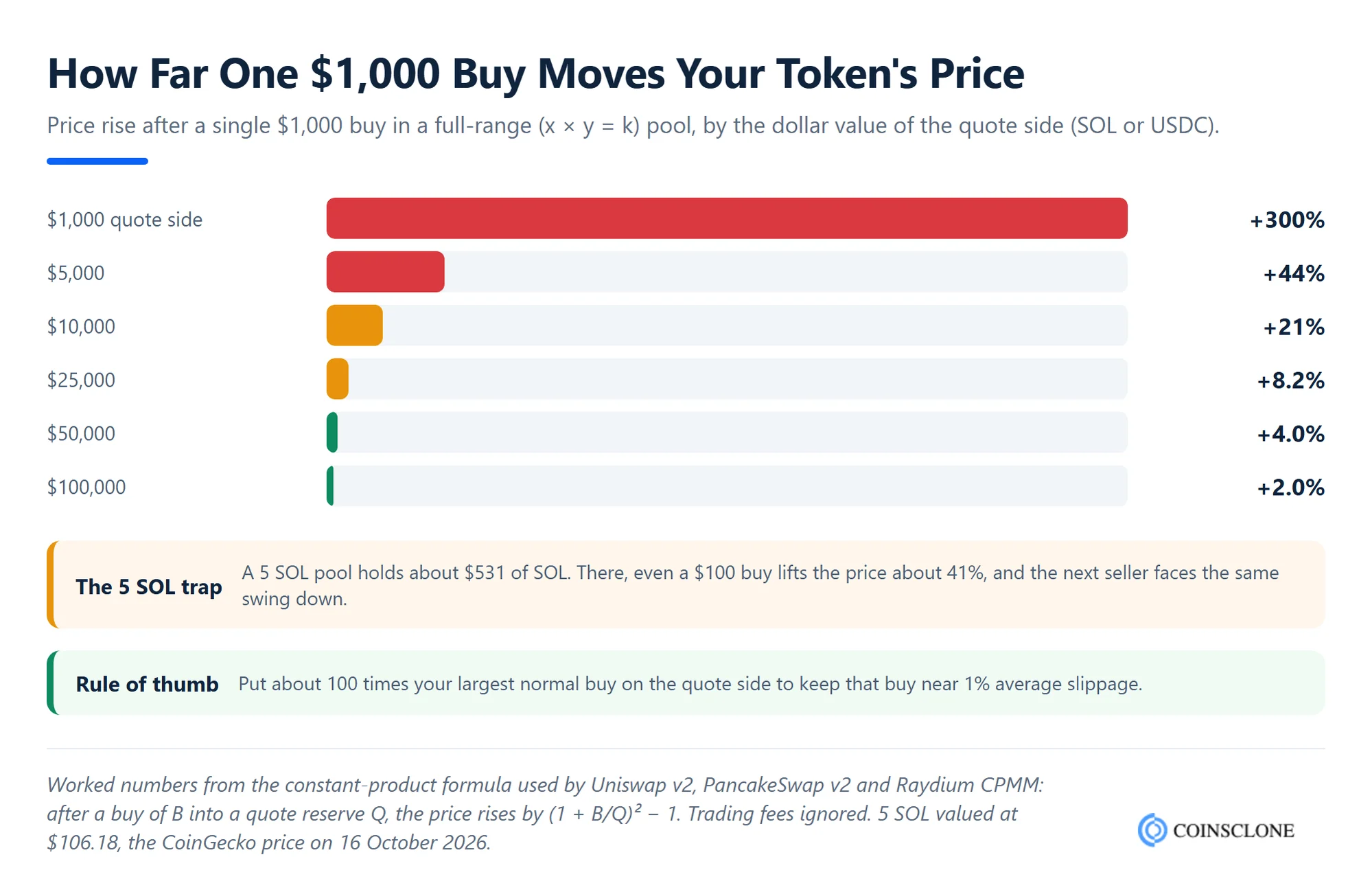
Now compare the Reddit advice. A common answer is “3 to 7 SOL for a solo launch.” At today’s price, 5 SOL is about $531. In that pool, one $100 buy lifts the price about 41%. One holder with $500 can crash it, and bots love it.
A simple way to size the pool:
- Pick your largest normal buy. For a community token it may be $500; for a funded project, $10,000.
- Multiply by 50 to 100 for the quote side. That keeps the buy at 1% to 2% average slippage.
- Add the same value in tokens at your chosen price.
- Check your budget. Buyers can take the quote side out by selling, so only add what you can afford to see leave.
Too little is a real risk. After a presale of about $6.5 million, Pike Finance seeded only $10,000 of liquidity on Base, and the price fell about 90% soon after launch.
Single-sided pools (only your token, placed above the current price in a concentrated pool) need no quote capital. But they give no buy-side support: when holders sell, the price falls straight back.
Slippage, Snipers and Launch Timing
Slippage. Buyers set how far the price may move before a swap fails. In a thin pool they must set it high, which invites sandwich bots. A deeper pool is the real fix. If your token has a transfer tax, buyers also need slippage above the tax, or every swap fails.
Snipers. Bots watch for new pools, buy in the first seconds, then sell to the first real buyers. Ways to slow them:
- Set a start time. Raydium CPMM and Meteora pools can take deposits before trading opens, so you can add and lock liquidity first.
- Use falling fees. Meteora DAMM v2 fee schedules start high and decay, so early snipers pay most.
- Use a hook. A Uniswap v4 hook can add launch rules, but it is custom code and needs an audit.
How to Lock or Burn LP Tokens
When you add liquidity, you get a claim on the pool: LP tokens or a position NFT. Whoever holds it can withdraw the pool. Locking or burning it proves you will not.
- Lock: a locker contract holds your LP until a set date. You keep the fees, and you can move liquidity later. On Uniswap and PancakeSwap, use a locker such as UNCX, Team Finance or PinkLock. UNCX’s docs list lockers for Uniswap v2, v3 and v4 and for Solana. Lockers charge a fee, so check their current price.
- Burn: you send the LP to a dead address, such as 0x000000000000000000000000000000000000dEaD on EVM chains. It is permanent, and on v2 pools the fees go with it.
- Permanent lock with fees (Raydium): Burn & Earn moves your CPMM LP, or a full-range CLMM position, into escrow forever and gives you a Fee Key NFT that keeps collecting fees. It does not work for old AMM v4 pools.
- Permanent lock with fees (Meteora): tick “Permanently lock my liquidity” when you create a DAMM v2 pool, or set a lock period on a DLMM launch pool. Locked liquidity still earns.
- pump.fun: after graduation the PumpSwap pool is owned by the protocol, so the creator cannot pull it.
The trap that makes a lock worthless: a lock covers only the pool. If you can still mint tokens or freeze wallets, or a team wallet holds a big unlocked share, buyers are still exposed. Revoke mint and freeze authority on Solana, renounce owner powers you do not need on EVM chains, and vest team tokens.
How buyers check it. Scanners such as RugCheck and DEXTools show how much of the LP is locked or burned, and who holds the rest. Raydium’s API reports a burn percentage for each pool. Post the lock transaction link so anyone can confirm it on an explorer.
Launch Your Own DEX or Token Launchpad
DEX Development — done right.
- Pool Engine: Full-range and concentrated pools with fee tiers you set.
- Launch Controls: Start times, anti-sniper fee schedules and built-in LP locks.
- Multi-Chain: Solana, BNB Chain, Ethereum and Base support.
- Revenue Engine: Earn from swap fees, creator fees and launch fees.
Get a free branded demo of your DEX before you commit a single dollar.
Book a Free Demo to see how our DEX and launchpad software handles pools, locks and launches.
Impermanent Loss When It Is Your Own Token
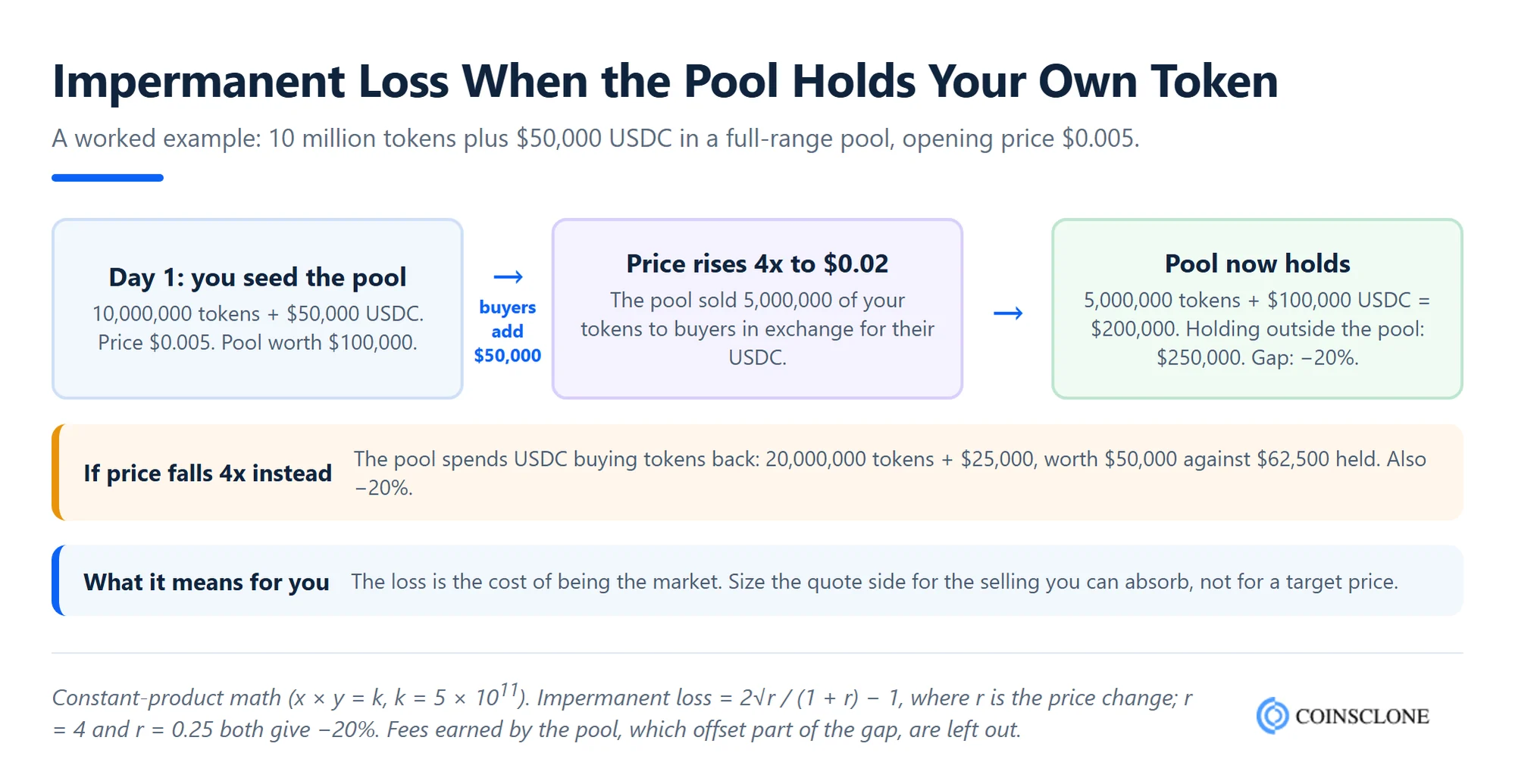
Impermanent loss is the gap between keeping tokens in a pool and simply holding them. For a token team, the pool is your market, so it trades against you by design.
Using the worked pool:
- Price rises 4x to $0.02: buyers add $50,000 net. The pool now holds 5,000,000 tokens and $100,000, worth $200,000. Had you held, you would have $250,000: a 20% gap.
- Price falls 4x to $0.00125: the pool uses your USDC to buy tokens back. It ends with 20,000,000 tokens and $25,000, worth $50,000 against $62,500 held. Again 20%.
So the lesson is not to avoid the pool. Size the quote side for the selling you can absorb. Fees offset part of the gap: at Raydium’s 0.25% tier, LPs keep 0.21% of every trade. For the yield side, see our guide to the best DeFi liquidity pools.
Rules That Apply When You Seed a Pool
Seeding a pool is a normal part of a launch. What you say and do around it is what regulators look at.
- United States: an SEC staff statement on meme coins on 27 February 2025 said typical meme coins are not securities. It is staff-level only and does not cover tokens sold with a promise of profit. Other agencies can still pursue fraud, such as pulling liquidity after hyping a coin.
- European Union: MiCA requires a white paper for public offers unless an exemption fits, such as offers to fewer than 150 people per country or under €1 million over 12 months.
Mistakes That Sink New Liquidity Pools
From the Reddit and Stack Exchange threads:
- Following stale guides. Older Solana guides say to create an OpenBook market first. That was for Raydium’s old AMM v4; CPMM needs no market.
- Locking LP but keeping mint authority. Scanners and listing sites flag it. CoinGecko treats unlocked liquidity as a rug-pull risk, as our guide on how to list a token explains.
- Burning when you may need to migrate. Burned liquidity cannot move to a better pool later.
When One Pool Is Not Enough: Building Your Own DEX or Launchpad
Creating one pool takes an afternoon, and the audit, design and marketing around it cost far more (see our cost to create a crypto token breakdown). Running the venue where thousands of pools live is a different product. Teams that launch tokens often, or want the trading fees, build a DEX or launchpad.
- White label: a ready, audited base with your brand. Published 2026 agency cost guides put a white-label DEX at about $10,000 to $50,000.
- Custom build: your own pool logic, fees and launch rules, at about $40,000 to $250,000+ in the same guides.
Coinsclone has been building DEX and launchpad platforms since 2018, with 350+ platforms delivered for 200+ clients across 20 industries. A white-label DEX takes 5 to 7 weeks and a standard build 10 to 14 weeks. See our Raydium clone script for Solana or our PancakeSwap clone script for BNB Chain and EVM chains.
Before a scoping call, prepare:
- The chains and pool model you want (full range, concentrated, launch pools)
- Your fee model: trading, creator and launch fees
- The lock, burn and anti-sniper rules to build in
- Who holds admin keys, and your audit plan
- Your launch date and budget range
Frequently Asked Questions
How much liquidity do you need to launch a token?
There is no fixed minimum. Put about 50 to 100 times your largest normal buy on the quote side, which keeps that buy at 1% to 2% slippage. A 5 SOL pool (about $531 in October 2026) lets a $100 buy move the price about 41%.
How much does it cost to create a liquidity pool on Raydium?
A Raydium CPMM pool charges a 0.15 SOL creation fee plus rent. Raydium advises keeping about 0.2 SOL in total for rent, token accounts and priority fees. The liquidity you deposit is separate and stays yours unless you lock or burn it.
How do I lock or burn liquidity on Raydium?
Use Burn & Earn. It moves your CPMM LP tokens, or a full-range CLMM position, into escrow for good and gives you a Fee Key NFT that keeps collecting trading fees. On Solana this is the standard way to “burn” LP; old AMM v4 pools are not supported.
How do I lock liquidity on PancakeSwap or Uniswap?
Neither DEX has a built-in lock. Use a locker such as UNCX, Team Finance or PinkLock to lock v2 LP tokens or a v3/v4 position NFT until a set date. You can also burn v2 LP tokens by sending them to a dead address, which is permanent.
Can you remove liquidity from Raydium?
Yes, if you still hold the LP tokens or position NFT, you can withdraw at any time. After Burn & Earn you cannot, which is exactly why buyers trust it.
Can you remove liquidity on pump.fun?
No. When a pump.fun coin graduates, its liquidity moves to a PumpSwap pool owned by the protocol, so the creator cannot pull it. Before graduation, the coin trades on the bonding curve, not in a pool.
How do I lock liquidity on DEX Screener?
You cannot. DEX Screener only displays pools; it does not hold or lock liquidity. Lock on the DEX or with a locker, then share the transaction so buyers can check it with RugCheck or an explorer.
Should I pair my token with SOL or USDC?
Pair with SOL if most of your buyers hold SOL, which is the norm for Solana memecoins. Pair with USDC if you want the dollar price to stay stable when SOL moves. Either way, the opening price is the quote amount divided by the tokens you add.