
In March 2025, Binance removed a market maker from its platform. The firm had sold 66 million MOVE tokens the day after the token listed, with almost no buy orders, and made about $38 million. Binance froze the profit, and the token’s price fell hard.
That story shows both sides of crypto market making. Done well, market makers keep order books deep, so traders can buy and sell without huge price jumps. Done badly, they can drain a new token’s market in a day.
If you run an exchange, launch a token or plan to trade professionally, you need to understand this business. This guide explains how crypto market makers make money, the deals they sign with token projects, what exchanges pay them, a worked example, the red flags, and what it takes to become one.
What Is a Crypto Market Maker?
A crypto market maker is a trading firm that places buy and sell orders on both sides of an order book at the same time. It quotes a price to buy (the bid) and a slightly higher price to sell (the ask). When traders fill those orders, the market maker earns the small gap between them.
Market makers matter because liquidity decides whether a market works. Research firm Kaiko found that in 2023 the top eight exchanges held 91.7% of crypto market depth, and most altcoins trade on thin books. Without market makers, a modest order could move a small token’s price by several percent.
Well-known crypto market makers include Wintermute, GSR, Flowdesk, Jump Crypto, Cumberland (part of DRW) and Amber. Many token projects and exchanges hire them, and some exchanges run their own.
How Do Crypto Market Makers Make Money?
Market makers earn from five main sources.
1. The bid-ask spread. This is the core income. If a market maker buys at $0.999 and sells at $1.001, it earns $0.002 per token when both sides fill. Across millions of trades, small spreads add up.
2. Exchange rebates. Many exchanges pay market makers to post resting orders, through negative maker fees. On Binance’s spot liquidity program, the top tier earns a rebate of 0.008% on maker volume.
3. Retainer fees from token projects. A project pays a monthly fee for the market maker to keep its token liquid on agreed exchanges, with targets for spread and depth.
4. Token loan and option deals. A project lends tokens to the market maker and grants a call option to buy them later at a set price. If the token rises, the market maker profits from the option.
5. Arbitrage and trading. Market makers spot price gaps between exchanges and trade them, and use their flow data to hedge smartly.
What Types of Crypto Market Makers Are There?
Not every market maker works the same way:
- Proprietary trading firms trade their own capital across many exchanges and earn mainly from spreads, rebates and arbitrage.
- Token market makers for hire sign deals with projects to keep a specific token liquid, using retainers or loan and option deals.
- Exchange-run market makers belong to, or work closely with, an exchange to seed liquidity in new or thin markets.
- OTC desks quote large trades privately, away from the public order book, earning a spread on each deal.
- DeFi liquidity providers deposit tokens into automated market maker pools and earn a share of swap fees. Anyone can do this, but it carries price risk. See our list of the best DeFi liquidity pools.
The same firm often plays several roles. Knowing which one you are dealing with tells you how it makes money, and where its interests might clash with yours.
What Do Exchanges Pay Market Makers?
Exchanges want tight spreads and deep books, because that attracts traders. So they pay market makers through maker rebates and lower fees.
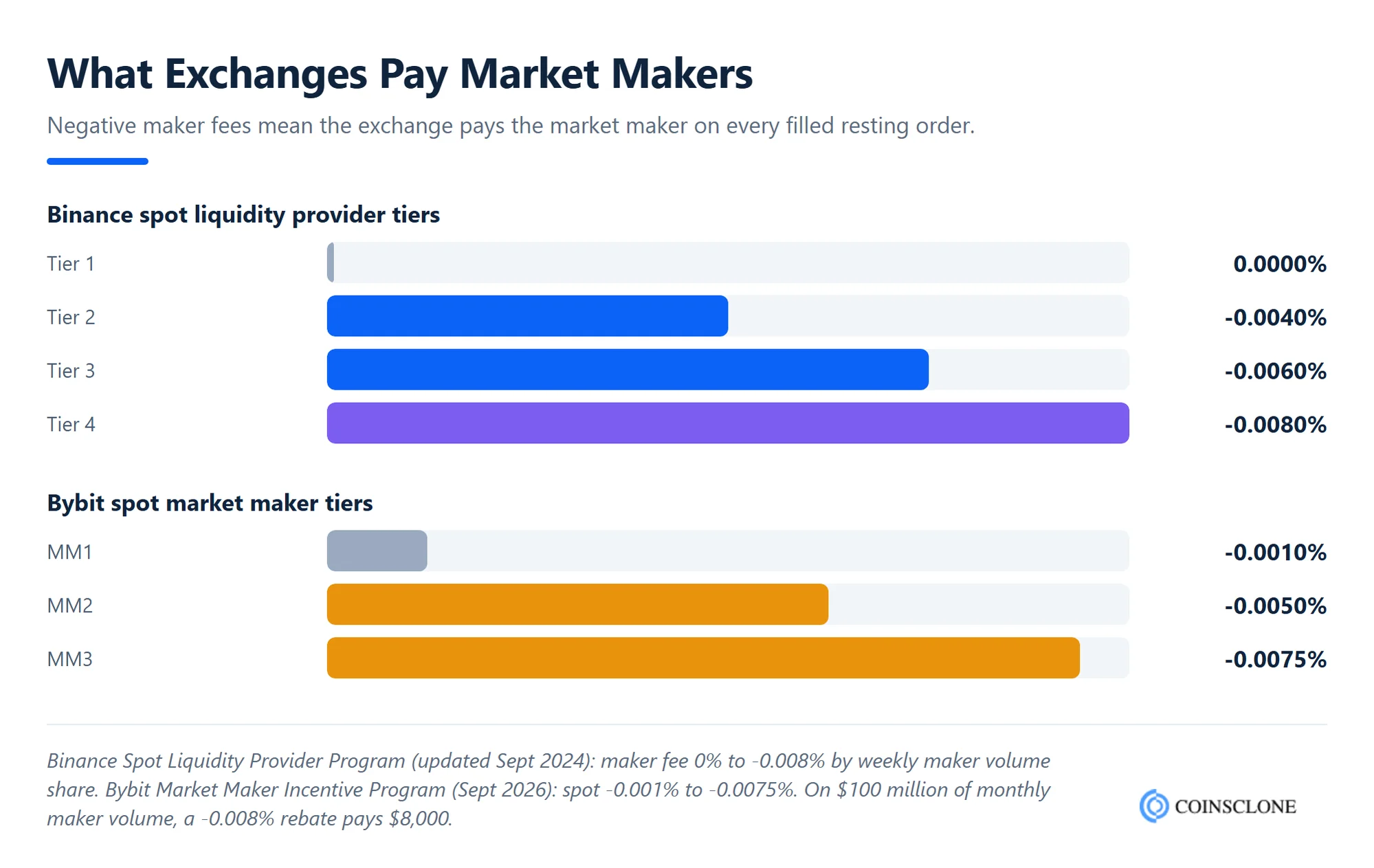
- Binance: its spot liquidity provider program pays from 0% to -0.008% on maker trades, based on each firm’s share of weekly maker volume. Firms that fall below the bar for three weeks in a row are removed.
- Bybit: its market maker incentive program pays spot rebates from -0.001% to -0.0075%, with entry at about $25 million in 30-day volume or a set share of exchange volume.
These rebates look tiny, but they are paid on huge volumes. On $100 million of maker volume a month, a -0.008% rebate pays $8,000, on top of the spread earned.
How Do Token Projects Pay Market Makers?
When a token lists, the project usually hires a market maker. There are two main deal types, as explained by Flowdesk, a market maker itself:
| Retainer model | Loan plus call option model | |
| What the project provides | Tokens and stablecoins, plus a monthly fee | A loan of tokens, sized as a share of supply |
| How the market maker earns | Monthly fee plus trading | The call option and trading gains |
| Who carries the capital risk | The project | The market maker |
| Main risk for the project | Cost, and checking the work | The market maker selling loaned tokens |
The loan model is cheaper in cash but riskier. A market maker holding loaned tokens and an option has a reason to sell if it expects the price to fall. Good contracts set clear targets for spread, depth and uptime, with regular reports. Our guide on how to list a token covers where market making fits in a listing plan.
A Worked Example: One Day of Market Making
Here is a simple, illustrative example of how a market maker earns on one token.
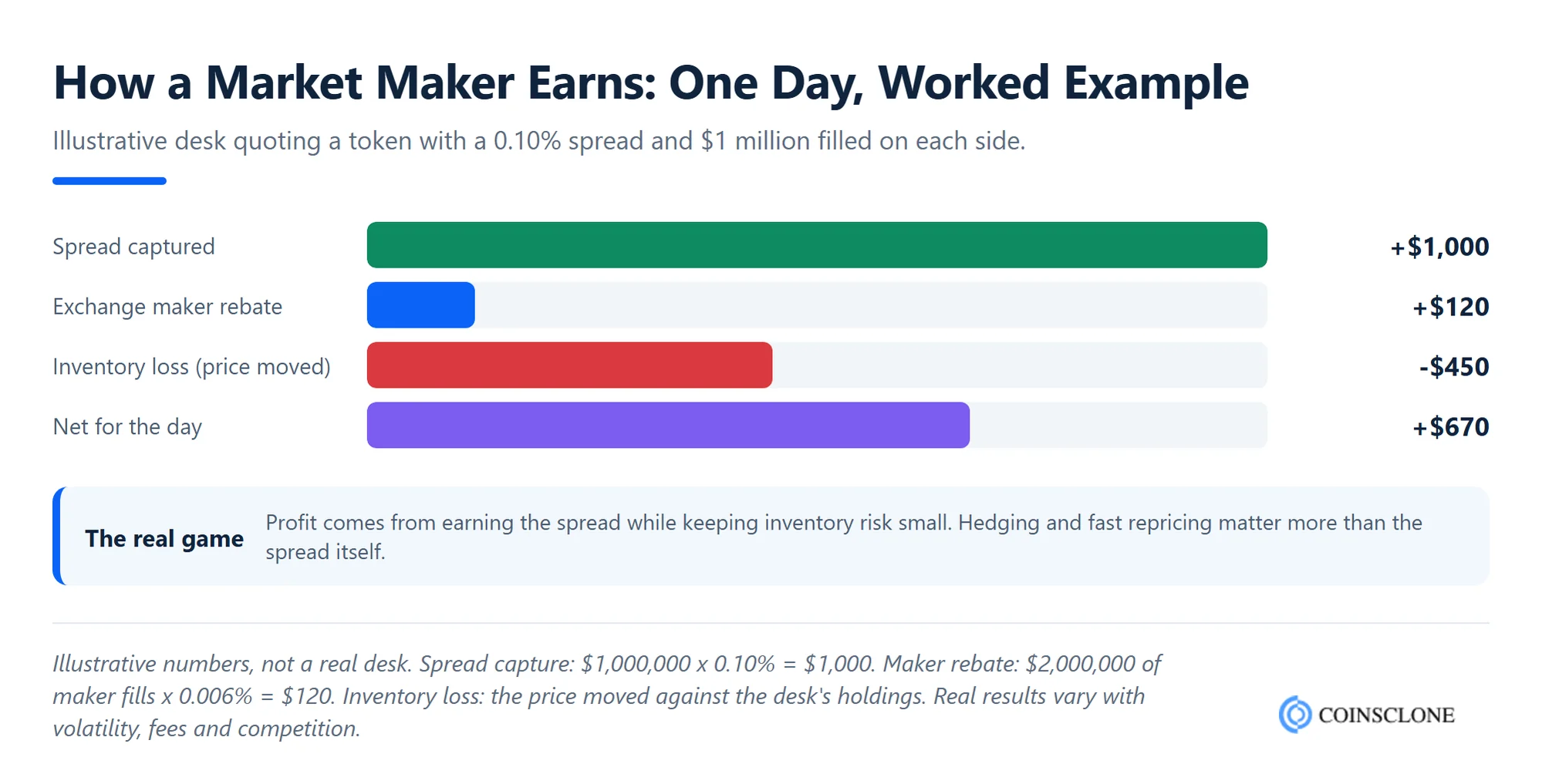
- The desk quotes a 0.10% spread and $1 million is filled on each side: +$1,000 in spread.
- It earns a 0.006% maker rebate on $2 million of fills: +$120.
- The price drifts against the tokens it holds: -$450 in inventory loss.
- Net result for the day: +$670.
The lesson: the spread is only half the story. Profit depends on keeping inventory risk small, by hedging, repricing fast and not holding too much of any one token.
Run Your Own Market Making Operation
Market Making Software Development — done right.
- Market Making Bots: Two-sided quoting with spread, depth and inventory controls.
- Multi-Exchange: Connect centralized exchanges and DEXs from one dashboard.
- Risk Controls: Position limits, kill switches and real-time P&L.
- Reporting: Spread, depth and uptime reports for token projects and exchanges.
Get a free market making software demo — before spending a single dollar.
Book a Free Demo to see how our market making software helps exchanges and token projects stay liquid.
What Are the Red Flags in Crypto Market Making?
The industry has a mixed record. Watch for these warning signs:
- Wash trading: fake volume from trading with yourself. In October 2024, the SEC charged three firms, ZM Quant, Gotbit and CLS Global, in a case built around a token the FBI created as a sting. Gotbit’s founder was later sentenced and the firm was ordered to stop operating.
- Dumping loaned tokens: as in the MOVE case, where a market maker sold heavily right after listing.
- Vague contracts: no targets for spread, depth or uptime, and no reports.
- Unrealistic promises: guaranteed prices or volume. No honest market maker promises a price.
Before signing, ask for references, check the firm’s public record, and require daily reports you can verify on-chain and on the order book.
How to Choose a Market Maker for Your Token
If you are launching a token, use this checklist before you sign:
- Check the record. Ask for references from other projects and search for enforcement actions or public disputes.
- Compare deal models. Price a retainer and a loan plus option deal side by side, including what happens to loaned tokens at the end.
- Set hard targets. Maximum spread, minimum depth within 1% or 2% of the price, and uptime, per exchange.
- Demand daily reports. Spread, depth, volume and inventory, which you can check against the order book.
- Limit the loan. Keep loaned tokens to a share you can afford to see sold, and stagger the release.
- Keep an exit clause. You should be able to end the deal quickly if targets are missed.
Many projects also run a small in-house market making setup alongside the hired firm, so they can see what healthy liquidity looks like.
How to Become a Crypto Market Maker
Market making is a technology business as much as a trading one. You need:
- Capital: enough stablecoins and tokens to quote both sides on every market you cover, with room for losses.
- Software: a quoting engine, risk controls, hedging logic and fast connections to exchange APIs. Open-source tools such as Hummingbot show the basics, and serious desks build their own. Our market making software is built for exchanges and token projects that want this in-house.
- Exchange access: apply to market maker programs. Binance and Bybit both set volume or market-share entry levels.
- Risk management: position limits, kill switches, and real-time profit and loss.
- Legal setup: rules vary. In the EU, ESMA said in 2025 that market making on a trading platform alone does not need a MiCA licence, but dealing directly with clients from your own capital does. In the US, the SEC dropped its appeal over its dealer rule in 2025. Take local legal advice.
- Reporting: token projects expect proof of spread, depth and uptime.
Exchanges and token projects also run their own market making to cut costs and keep control, especially on new listings. For how liquidity works across venues, see our guide to crypto liquidity providers.
Frequently Asked Questions
How do crypto market makers make money?
Mainly from the bid-ask spread, by buying slightly below and selling slightly above the market price. They also earn exchange rebates, retainer fees from token projects, gains from token loan and option deals, and arbitrage.
What is a crypto market maker?
A trading firm that posts buy and sell orders on both sides of an order book, so other traders can trade at stable prices. It earns the small gap between its buy and sell prices.
Is crypto market making profitable?
It can be, but margins are thin and risks are real. Profit depends on volume, spreads, rebates and, above all, avoiding losses when prices move against the tokens a market maker holds.
How much do exchanges pay market makers?
Through maker rebates. Binance’s spot program pays up to 0.008% on maker volume, and Bybit’s pays up to 0.0075%, based on volume and market share.
What is a token loan and call option deal?
A project lends tokens to a market maker and gives it the right to buy them later at a set price. The market maker uses the tokens to provide liquidity and profits if the price rises above the option price.
How do I become a crypto market maker?
You need trading capital, market making software, access to exchange market maker programs, strict risk controls and the right legal setup for your country.
Do crypto market makers need a licence?
It depends. In the EU, ESMA said in 2025 that making markets on a trading platform alone does not need MiCA authorisation, while trading directly with clients does. Rules differ elsewhere.
What are the risks of hiring a market maker?
Wash trading, dumping loaned tokens, vague contracts and fake promises. Ask for references, clear targets for spread and depth, and reports you can verify.