
A cross-chain DEX lets you swap a coin on one blockchain for a coin on another, such as native Bitcoin for ETH, without a central exchange. This guide explains what a cross-chain DEX is, how a cross-chain swap moves value between chains, and who holds your funds at each step.
You will also see which platforms lead in 2026 with real volume data, the main risks, and what it takes to build one. By the end, you will know how these exchanges work, which design suits which use, and what to plan before you build.
In this guide:
- A plain definition, and how a cross-chain DEX differs from a bridge and an aggregator
- The four steps of a cross-chain swap, and the three designs behind them
- The leading cross-chain DEXs by 30-day volume, from October 2026 DefiLlama data
- The real risks, including the $292 million KelpDAO bridge loss of April 2026
- How to build a cross-chain DEX: design choice, steps, time and cost
See How Our MVP System Can Launch Your Cross-Chain DEX Faster
Cross-Chain DEX Development — done right.
- MVP System: Deploy your cross-chain DEX 70–90% faster with pre-built modules.
- Interoperability Layer: Built-in cross-chain bridges, routers & multi-chain swap support.
- Brand & Customization: Your UI, your tokenomics, your swap logic — fully custom.
- Revenue Engine: Earn from cross-chain swaps, liquidity fees, staking, and governance.
Get a free branded demo of your cross-chain DEX in 48 hours — before you invest a cent.
Book a Free Demo to see how our Cross-Chain DEX Script can take you from idea to live multi-chain exchange in just 8–12 weeks.
What Is a Cross-Chain DEX?
A cross-chain decentralized exchange (DEX) is a non-custodial trading platform that swaps assets across different blockchains in one flow. Tools such as messaging layers, bridges, shared pools or atomic swaps move the value safely between chains that cannot talk to each other on their own.
For years, the crypto market was split into islands. A DEX on Ethereum could only trade Ethereum tokens, and a DEX on Solana could only trade Solana tokens. To move between them, users sent funds to a central exchange or used a bridge, then swapped again. That meant more steps, more fees and more chances for things to go wrong.
A cross-chain DEX removes most of those steps. For example, a user can swap native Bitcoin for ETH in a single order. As a result, liquidity from many chains works as one market, and traders reach far more assets. However, these platforms link chains with different security models. So, strong and decentralized cross-chain checks are vital to protect user funds.
Cross-Chain DEX vs Single-Chain DEX vs Bridge vs Aggregator
People often mix these terms up. Here is how they differ:
| Type | What it does | Example | Who holds funds mid-trade |
| Single-chain DEX | Swaps tokens on one blockchain | Uniswap on Ethereum | Smart contracts on that chain |
| Bridge | Moves the same asset to another chain, often as a wrapped token | Wormhole, Stargate | The bridge’s contracts or signers |
| Cross-chain aggregator | Finds the best route across many bridges and DEXs | LI.FI, Jumper, Rango | The bridges and DEXs it routes through |
| Cross-chain DEX | Swaps asset A on chain 1 for asset B on chain 2 in one order | THORChain, Chainflip | Its own vaults, pools or solvers |
In short, a bridge moves an asset, a DEX trades it, and a cross-chain DEX does both in one step. If you want to compare the single-chain side first, our guide to the best decentralized exchanges covers the leaders. Now that the core idea is clear, let’s look at how a swap actually works.
How Does a Cross-Chain DEX Work?
Cross-chain DEXs let users trade between blockchains without a central exchange. They pair smart contracts with a secure way to send messages between chains. Meanwhile, the user still gets the simple swap screen of a normal exchange. Here is the basic flow:
1. Asset Locking
The swap starts when the user sends a token to a smart contract or vault on the source chain. This locks the asset so no one can move or change it during the trade. It also makes sure the right value is released when the swap reaches the target chain.
2. Cross-Chain Communication
Next, the protocol sends a secure, signed message to the target blockchain. The message confirms the amount locked and states what the user wants in return. As a result, both chains stay in sync, and the swap can go ahead without a central party.
3. Verification and Smart Contract Execution
Then, validators, verifier networks or smart contracts on the target chain check the proof that the funds were locked. Once the proof passes, the contract allows the next step. This is the most sensitive step in the whole process, because a forged proof can release funds that were never locked.
4. Asset Swap and Settlement
Finally, the matching asset is released or minted on the target chain and sent straight to the user’s wallet. Both ledgers update, and the cross-chain swap is complete. Depending on the chains and the design, this takes from a few seconds to several minutes. Bitcoin swaps take longest, because Bitcoin blocks arrive about every 10 minutes.
The Three Designs Behind a Cross-Chain Swap
The four steps look the same from the outside. Inside, though, cross-chain DEXs use one of three main designs, and the choice decides speed, cost and risk.
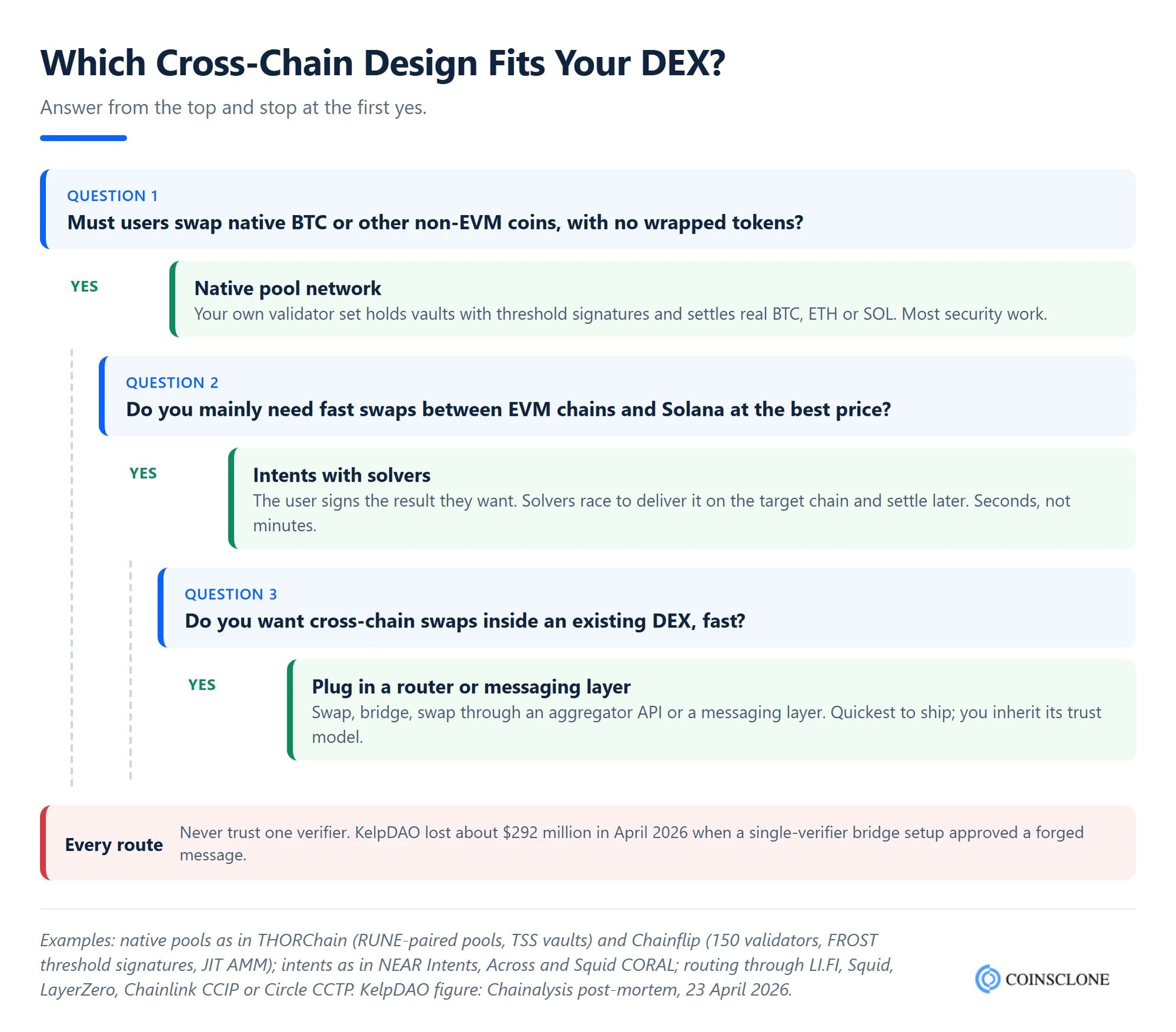
- Native liquidity pools: The DEX runs its own network of validators that hold vaults on each chain with threshold signatures. Users swap real BTC, ETH or SOL with no wrapped tokens. THORChain pairs every asset with its RUNE token in shared pools. Chainflip uses 150 validators, needs 100 of them to sign before funds move, and charges a 0.1% network fee per swap, per its own 2026 guide.
- Intents with solvers: The user signs the result they want, such as “1 ETH on Base for at least X SOL on Solana”. Then, competing solvers fill the order on the target chain from their own funds and settle later. This is the fastest model for EVM chains and Solana. NEAR Intents, Across and Squid’s CORAL engine all work this way.
- Swap, bridge, swap: A router swaps the token into a bridgeable asset, such as USDC, moves it with a bridge or messaging layer, and swaps it again on the target chain. SushiXSwap built its cross-chain swaps this way, using Circle’s CCTP for USDC and other bridges, as Sushi explains. Aggregators like LI.FI also use this model.
A fourth, older design is the atomic swap. It uses hash time-locked contracts (HTLCs), so either both sides of the trade happen or neither does. Atomic swaps are very safe, but they are slow and need a matching trader on the other side. That is why few live platforms rely on them alone today.
Now that you know how the swap works, the benefits make more sense. Let’s see what they are.
Benefits of Cross-Chain DEX
Cross-chain DEXs break down the walls between blockchains. As a result, they bring liquidity and use cases together across the whole DeFi market.
Maximized Liquidity
Cross-chain DEXs gather liquidity from many blockchains, so traders reach deeper pools. This cuts market splits and makes trading smoother. Consequently, users get better prices on large trades and steadier fills.
Expanded Asset Access
Users can trade assets across chains with no need to hop between platforms. This opens up tokens that would otherwise stay locked inside one ecosystem. For example, a Bitcoin holder can move into a Solana token without a central exchange account.
Fewer Steps and Less Slippage
Instead of four or five separate actions, the user signs one order. Smart routing also picks the cheapest path and cuts wasted gas. However, a cross-chain swap still pays fees on both chains plus a protocol or solver fee. So, for small trades on a single chain, a normal DEX is often cheaper.
True Decentralization
Cross-chain DEXs remove the need for a central go-between. Smart contracts and validator networks run every step, and users keep control. This keeps trading open and transparent.
Enhanced Security and User Control
Assets stay in the user’s wallet until the moment of the swap. There is no exchange account to freeze and no deposit to withdraw later. This removes the risk of an exchange going bust with user funds, as some central platforms have done. Still, users take on bridge and contract risk instead, which we cover below.
These are the main benefits. Next, let’s look at how traders and businesses use cross-chain DEXs in the real world.
Key Use Cases of Cross-Chain DEXs
These platforms open up new ways to trade and help the whole crypto ecosystem grow.
Multi-Chain Arbitrage
Traders can act on price gaps between blockchains in real time. This creates chances that were not possible on single-chain DEXs. Cross-chain access also makes arbitrage faster and more precise, which pulls prices closer together across chains. A crypto arbitrage bot can automate this work.
Simple Portfolio Diversification
Users can spread their holdings across blockchains without opening accounts on many exchanges. This makes it easier to explore new ecosystems and tokens at a lower cost.
Accessing Native Liquidity
Cross-chain DEXs let users tap the native liquidity of other chains. This means better prices and faster trades. Native pool designs also remove the need for wrapped or synthetic tokens.
Inter-Chain Gaming and Metaverse Economies
Games and metaverse platforms can use cross-chain swaps to move items and in-game currency between ecosystems. This improves the player experience and supports multi-chain game economies.
Treasury and Payments
DAOs, wallets and payment apps use cross-chain swaps to pay or receive funds on whichever chain the other party uses. For example, a business can accept USDC on Base and pay out USDT on Tron in one flow.
To see how far these use cases have come, it helps to look at the platforms already leading the way.
Ready to break free from single-chain limits? Explore a Cross-Chain DEX for seamless, non-custodial multi-chain trading.
Cost-effective | White-Label Solution | Premium Features | Fully Customizable | Live Demo Available
Examples of Leading Cross-Chain DEXs
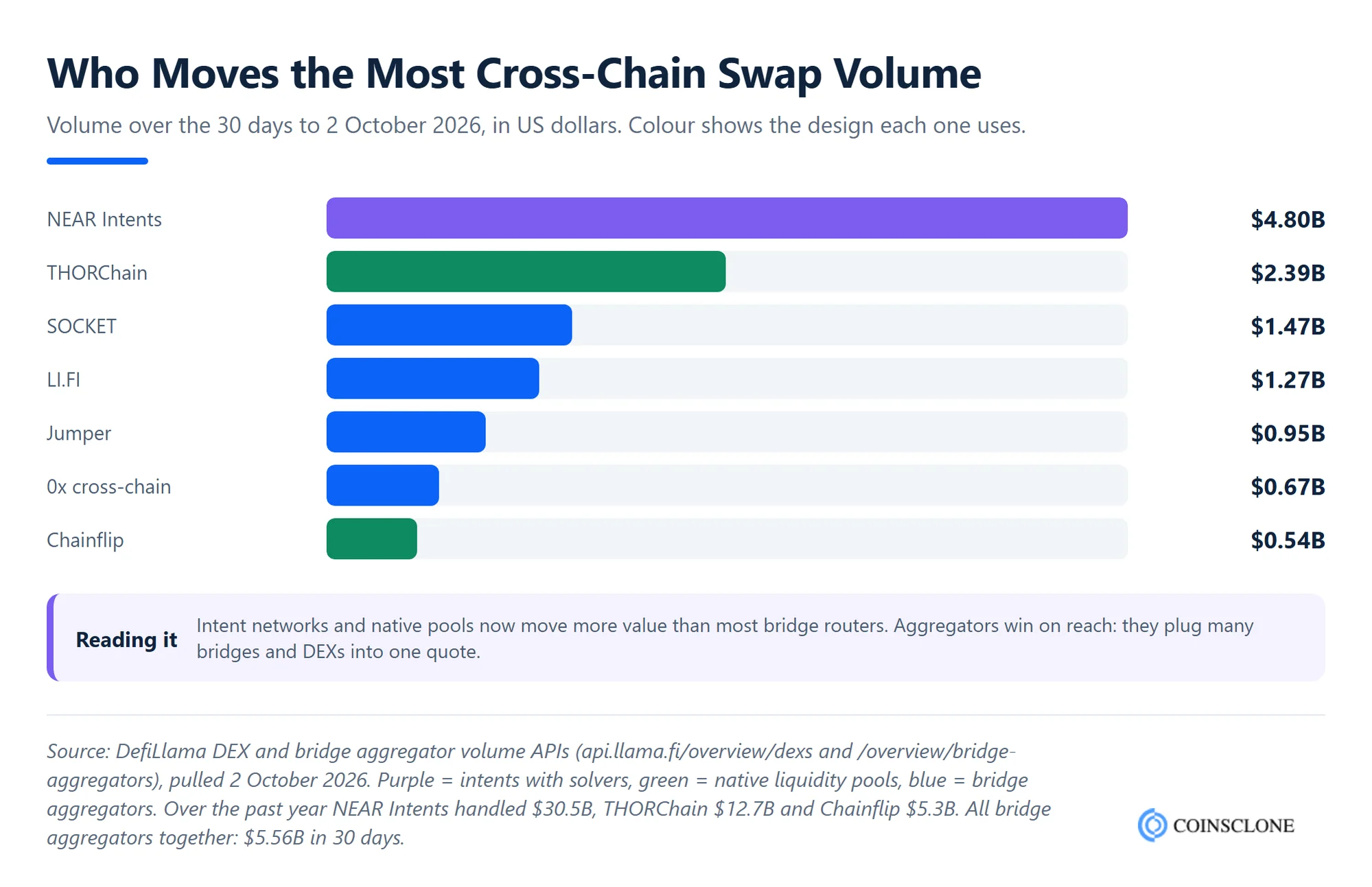
These platforms show the real-world reach of cross-chain DEXs in 2026. The chart below ranks them by swap volume over the last 30 days, with colour showing the design each one uses.
THORChain
THORChain is the best-known cross-chain DEX for native assets. It swaps Layer 1 coins like BTC, ETH and DOGE directly, with no wrapped tokens. Every pool pairs an asset with RUNE, which acts as the settlement asset. Node operators bond RUNE and rotate often, so no single group controls the vaults for long. THORChain handled about $2.39 billion in swaps over the 30 days to 2 October 2026, and $12.7 billion over the past year, per DefiLlama. Apps such as THORSwap give users a front end on top of it.
Chainflip
Chainflip is a newer native swap network built for flows like BTC to ETH or BTC to SOL. It supports Bitcoin, Ethereum, Solana, Arbitrum, Tron, BNB Chain and Polkadot Asset Hub. Rather than fixed pools, it uses a just-in-time AMM, where market makers compete to fill each swap. Chainflip had processed over $6 billion in swaps by February 2026, and about $540 million in the 30 days to 2 October 2026.
NEAR Intents
NEAR Intents is the largest cross-chain swap network by recent volume, at about $4.80 billion in 30 days. Users state the swap they want, and solvers compete to fill it across chains, including Bitcoin, Ethereum and Solana. Many wallets and DEXs now plug it in as a back end.
SushiXSwap (SushiSwap’s Cross-Chain Feature)
SushiXSwap is the cross-chain feature of SushiSwap, launched in 2022 as one of the first cross-chain AMM swaps. It swaps on the source chain, bridges a stable asset and swaps again on the target chain. Users are routed to the best path, and in v2 they can pay fees on the source chain, so they do not need gas on the target chain.
LI.FI, Jumper and Other Aggregators
LI.FI and its app Jumper do not run their own pools. Instead, they compare many bridges and DEXs and pick the best route for each trade. Together they moved over $2.2 billion in 30 days. Many wallets embed them so their users can swap across chains without leaving the app.
Synapse Protocol
Synapse is a cross-chain messaging and bridge network that links more than 20 chains. It often routes value through a stablecoin layer for efficient moves. It uses an optimistic security model, where off-chain actors watch for fraud and can challenge bad messages.
A note on Multichain: older guides, including the first version of this one, listed Multichain as a leading bridge. It stopped operating in July 2023 after about $126 million left its bridge and its CEO was detained. It is a good reminder to check who controls the keys before you trust any bridge.
Seeing how these platforms work raises a deeper question: what makes them run on a technical level? Let’s explore the build.
Technical Implementation of a Cross-Chain DEX
The hard part of a cross-chain DEX is trustless messaging and safe asset transfer between independent blockchains. Here are the main layers.
Blockchain Interoperability Layers
These protocols carry verified messages from one chain to another. As a result, the receiving chain can trust events that happened on the sending chain. Common choices include Cosmos IBC, LayerZero, Wormhole, Axelar, Chainlink CCIP and Circle’s CCTP for USDC. Each has its own trust model, so the choice shapes your security.
Smart Contract Architecture
The contract set usually includes liquidity contracts (AMM pools on each chain), vault or bridge contracts (locking, releasing or minting), and router contracts (finding the best, cheapest path across chains). Intent-based designs add settlement contracts that repay solvers once a fill is proven.
Role of Wrapped Assets and Synthetic Tokens
In bridge-based designs, native assets (such as BTC on Bitcoin) are locked, and a matching token (such as WBTC on Ethereum) is minted on the target chain. This makes the asset usable in that chain’s DeFi apps. However, a wrapped token is only as safe as the bridge behind it. If the bridge is drained, the wrapped token can lose its peg.
Security Mechanisms
The key tool is threshold signatures and MPC vaults, so no single party holds a full key. Teams also use multisig approvals for upgrades, more than one verifier for each message, caps on large withdrawals, and HTLCs for atomic swaps. In addition, every contract needs external audits and a bug bounty before launch.
User Interface and Wallet Interaction
The front end should hide all the cross-chain work. Users connect a wallet such as MetaMask, Phantom or one linked through WalletConnect, see one quote with all fees, and confirm one swap. A good interface also shows live status and a clear refund path if a swap fails. A white label DEX software package can give you this front end and the core contracts ready to brand.
Risks and Limits of Cross-Chain DEXs
Cross-chain DEXs solve real problems, but they also add new risks. Here is what users and builders need to weigh.
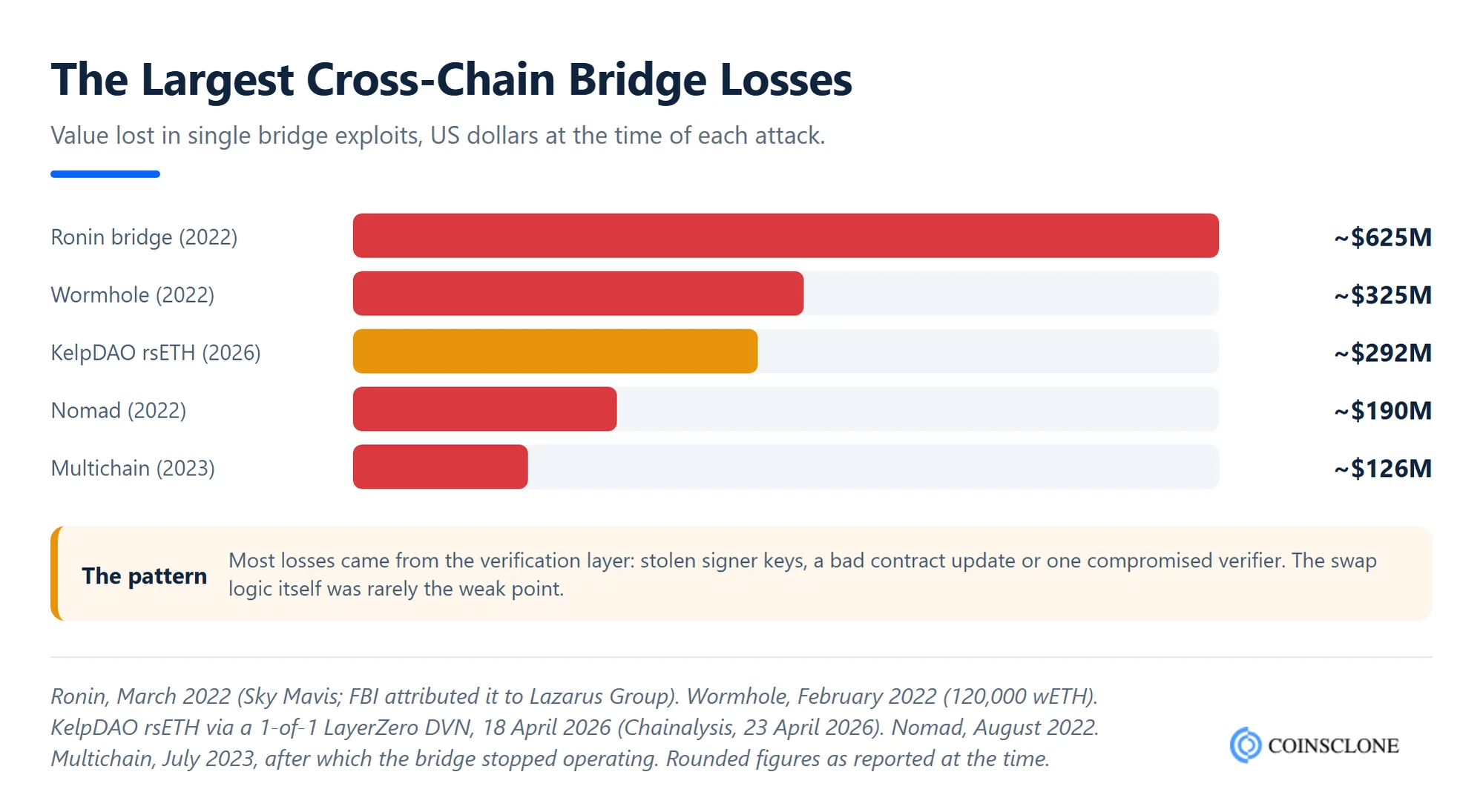
- Bridge and verifier attacks: The link between chains is the biggest target. On 18 April 2026, attackers took about $292 million of rsETH from KelpDAO. They compromised the nodes that fed data to a single LayerZero verifier and tricked it into approving a burn that never happened, as Chainalysis reports. The lesson is simple: never rely on one verifier.
- Smart contract bugs: A flaw in a vault, router or settlement contract can drain pools. Audits lower this risk but do not remove it.
- Wrapped asset risk: If the bridge behind a wrapped token fails, the token can trade far below the real asset.
- Delays and stuck swaps: Congestion or a paused route can hold funds for hours. Good platforms refund failed swaps, but users should check how refunds work.
- Fees on two chains: A cross-chain swap pays gas on both chains plus protocol, solver or bridge fees. Always compare the full quote.
- Compliance: Regulators watch cross-chain swaps closely, since they can hide where funds go. Front-end operators may need sanctions screening and clear terms, depending on where they serve users.
How to Build a Cross-Chain DEX
If you plan to launch your own cross-chain DEX, the first big choice is the design. The decision tree below shows which one fits your goal.
Once you pick the design, the build follows these steps:
- Pick your chains and assets: Start with the chains your users already hold funds on. Two to four chains with deep liquidity beat ten thin ones.
- Choose the messaging layer: Compare trust models, fees and supported chains. Use more than one verifier where the layer allows it.
- Build the contracts: Pools or vaults, routers, settlement and fee logic. Add rate limits and an emergency pause.
- Set up liquidity: Seed your own pools, bring in market makers, or plug in solver networks and aggregators.
- Audit and test: Get at least one external audit, then run a public testnet and a bug bounty.
- Design the app: One quote, one click, live swap status and clear refunds.
- Launch and watch: Start with limits on swap size, then raise them as the system proves itself.
For a deeper look at the steps that apply to any DEX, see our guide on how to create a decentralized exchange.
Time and cost: At Coinsclone, a white label DEX takes about 5 to 7 weeks and a standard build about 10 to 14 weeks. Cross-chain features add time, mainly for messaging setup and audits. Published 2026 market estimates put a custom multi-chain or advanced DEX at $100,000 to $250,000 or more, over 6 to 12 months. On top of that, budget for audits. Most DeFi audits cost $25,000 to $100,000 each, and multi-chain systems often pass $150,000, per Sherlock’s 2026 audit pricing review. Add your own starting liquidity as well.
Coinsclone builds cross-chain DEXs on a tested DEX base, with bridge and router integration and audit-ready contracts. Learn more on our decentralized exchange development page.
How Cross-Chain DEX Development Powers the Future Market
Cross-chain DEXs are more than an upgrade. They fix the split markets that have held Web3 back for years.
- Rise of Multi-Chain Ecosystems: They let capital flow freely between Layer 2s, sidechains and Layer 1s. This makes every chain more useful and puts idle funds to work.
- Moving Users Away From Central Exchanges: They offer a non-custodial, secure way to trade across chains. As a result, users no longer need a central account just to change chains.
- Unifying Split Liquidity: They join pools that were scattered across chains. Users get better prices and less slippage.
- Enterprise and Web3 Apps: They support new business models, such as cross-chain games, payment apps and treasury tools that use assets across many public and private chains.
The trend is clear in the data. Intent networks and native pool DEXs moved billions of dollars in the last month alone. That is why expert-led cross-chain DEX development matters for any team that wants a share of this flow.
Conclusion
Cross-chain DEXs are building the next phase of decentralized trading by removing the walls between blockchains. They let assets move smoothly between networks in one trade. As more users want to move between chains, businesses need partners who can build secure cross-chain exchanges that scale and pass audits.
Coinsclone is a leading decentralized exchange development company. Building since 2018, the team has delivered 350+ platforms for 200+ clients across 20 industries. Its cross-chain DEX development services include:
- Custom DEX builds on a tested base
- Multi-chain support with cross-chain bridges, routers and messaging layers
- Secure smart contracts, built to pass external audits
If you want to build a powerful, next-generation cross-chain DEX, Coinsclone brings the skills, tech stack and end-to-end support to bring your vision to life.
See How Our MVP System Can Launch Your Cross-Chain DEX Faster
Cross-Chain DEX Development — done right.
- MVP System: Deploy your cross-chain DEX 70–90% faster with pre-built modules.
- Interoperability Layer: Built-in cross-chain bridges, routers & multi-chain swap support.
- Brand & Customization: Your UI, your tokenomics, your swap logic — fully custom.
- Revenue Engine: Earn from cross-chain swaps, liquidity fees, staking, and governance.
Get a free branded demo of your cross-chain DEX in 48 hours — before you invest a cent.
Book a Free Demo to see how our Cross-Chain DEX Script can take you from idea to live multi-chain exchange in just 8–12 weeks.
Frequently Asked Questions
What is a cross-chain swap?
A cross-chain swap trades a token on one blockchain for a different token on another, such as BTC on Bitcoin for SOL on Solana. The user signs one order, and the protocol handles locking, messaging and release behind the scenes.
Is THORChain a cross-chain DEX?
Yes. THORChain is a cross-chain DEX that swaps native Layer 1 assets, such as BTC and ETH, with no wrapped tokens. It pairs every asset with RUNE in shared pools, and its node operators secure the vaults on each chain.
Are cross-chain swaps safe?
They are safe enough for daily use on well-audited platforms, but they carry more risk than single-chain swaps. The weak point is usually the bridge or verifier layer, as the KelpDAO loss of April 2026 showed. Use established platforms, check the quote and start with small amounts.
How long does a cross-chain swap take?
Most finish in seconds to a few minutes. Intent-based swaps between EVM chains and Solana are often done in seconds. Swaps that involve Bitcoin take longer, often 10 minutes or more, because the network must confirm the deposit first.
What is the difference between a cross-chain DEX and a bridge?
A bridge moves the same asset to another chain, often as a wrapped token. A cross-chain DEX swaps one asset for a different one across chains in a single order. Many cross-chain DEXs use a bridge or messaging layer inside.
How much does a cross-chain swap cost?
You pay gas on both chains plus a protocol, solver or bridge fee. For example, Chainflip charges a 0.1% network fee per swap, and aggregators add their own fee on top. Always compare the full quote, including slippage, before you confirm.
What is the best cross-chain DEX?
It depends on what you swap. THORChain and Chainflip lead for native Bitcoin swaps. NEAR Intents had the most cross-chain swap volume in the 30 days to 2 October 2026. Aggregators such as LI.FI and Jumper suit users who want many chains and tokens in one place.