
An ICO presale, also called a token presale, is the first round of a token sale. A project sells part of its tokens to early buyers at a lower price before the public sale opens. This guide explains how crypto presales work in 2026, from the whitelist to the day buyers claim their tokens. It also covers the presale formats, where to run one, what it costs, and the new rules in the US and the EU.
You will also see real numbers. We show what past presales raised, what happened to them, and why early buyers often sell on listing day. So whether you plan to run a presale or just want to know how one works, you will leave with a clear plan and a list of risks to avoid.
In this guide:
- What an ICO presale is, and how it differs from the public ICO
- How rounds, pricing models, soft caps, hard caps and vesting work, with a worked example
- Where to run a token presale, what it costs and how long it takes to launch
- What Ethereum, Filecoin, Telegram and Monad raised in their sales, and what went wrong for some
- The 2026 rules in the US and the EU, the risks, and the red flags buyers check before they pay
See How Our MVP System Can Launch Your ICO Presale Faster
ICO Development — done right.
- MVP Token System: Launch your ICO presale 90% faster.
- Smart Contracts & Wallets: Pre-integrated modules, no coding needed.
- Brand &Customization: Your token, your ecosystem, your rules.
- Revenue Engine : Raise funds through token sales, staking, and early investor perks.
See a free demo of your branded utility token in 48 hours — before you invest a cent.
Book a Free Demo to discover how our Utility Token Development Company can take you from concept to live token in just 2–4 weeks.
What Is an ICO Presale (Token Presale)?
An ICO presale, also called a pre-ICO or token presale, is the early fundraising round for a crypto project. Here, tokens go to a small group of early buyers before the public token sale. With this money, startups pay for the build, security audits, marketing and community work that a public sale needs.
The tokens are sold to a set group of early investors at lower prices. Projects also add bonuses to help the token gain traction and trust. Raising funds early helps the team firm up the roadmap and hit its tech goals before the public sale.
In most cases, a buyer does not get a token they can trade right away. Instead, they get a claim on tokens that unlock later, at the token generation event (TGE). This one detail shapes the whole presale, as you will see below.
Where the Presale Sits in a Token Launch
Most token launches today run in a few rounds. Each round has its own price and its own buyers.
- Seed round: A few angel investors or funds buy at the lowest price, usually through a SAFT (a Simple Agreement for Future Tokens) or a token warrant.
- Private round: Larger funds and strategic partners buy at a slightly higher price, with long lock-ups.
- Public presale: Whitelisted fans buy on the project’s own site or on a launchpad.
- Public sale or listing: The token goes on sale to everyone through an ICO, an IDO on a DEX launchpad or an IEO on an exchange, and trading starts.
So the “presale” can mean the private round, the public presale, or both. Either way, it is any sale of tokens before they trade in the open.
How Do Crypto Presales Work?
A crypto presale works in five steps. The project opens a whitelist, buyers pass KYC, they pay from a crypto wallet, the sale closes at its cap or end date, and buyers claim their tokens at the TGE. The goal is to secure early funding and build trust around the project. On the whole, the process is simple for buyers. Let’s take a closer look at each step.
- Sale launch: The project shares its whitepaper, token model and sale terms with its first fans. It also announces the early-buyer rewards and token discounts.
- Joining the whitelist: Buyers sign up for the whitelist and pass KYC checks. This gives them a seat in a small circle before the crowd comes in.
- Token purchase: Buyers connect a crypto wallet and pay in a coin the sale accepts, such as ETH, USDT or USDC. Some sales also take cards or bank transfers.
- Waiting for the launch: The sale ends when it hits its hard cap or its end date. If it misses its soft cap, buyers should get their money back.
- Token claim: At the TGE, buyers claim their tokens on the official claim page. If the sale has a vesting schedule, the tokens unlock bit by bit over time.
That is how an ICO presale helps startups raise capital. With some risk, early buyers can earn more by buying at the presale price. They also get early access to the token before the public.
Soft Cap, Hard Cap and Vesting Explained
Three settings decide how fair a presale feels to buyers.
- Soft cap: The least the project must raise for the sale to go ahead. If the sale falls short, the smart contract should refund buyers.
- Hard cap: The most the project will accept. Once it is reached, the sale closes.
- Vesting: The plan for when tokens unlock. Many presales unlock 10% to 25% at the TGE and release the rest in equal parts over 6 to 24 months. Some add a “cliff” of a few months where nothing unlocks at all. Our guide to token vesting smart contracts shows how to set cliff and linear schedules in code.
Why does vesting matter so much? Because presale buyers often sit on a large paper gain on listing day. The worked example below shows why.
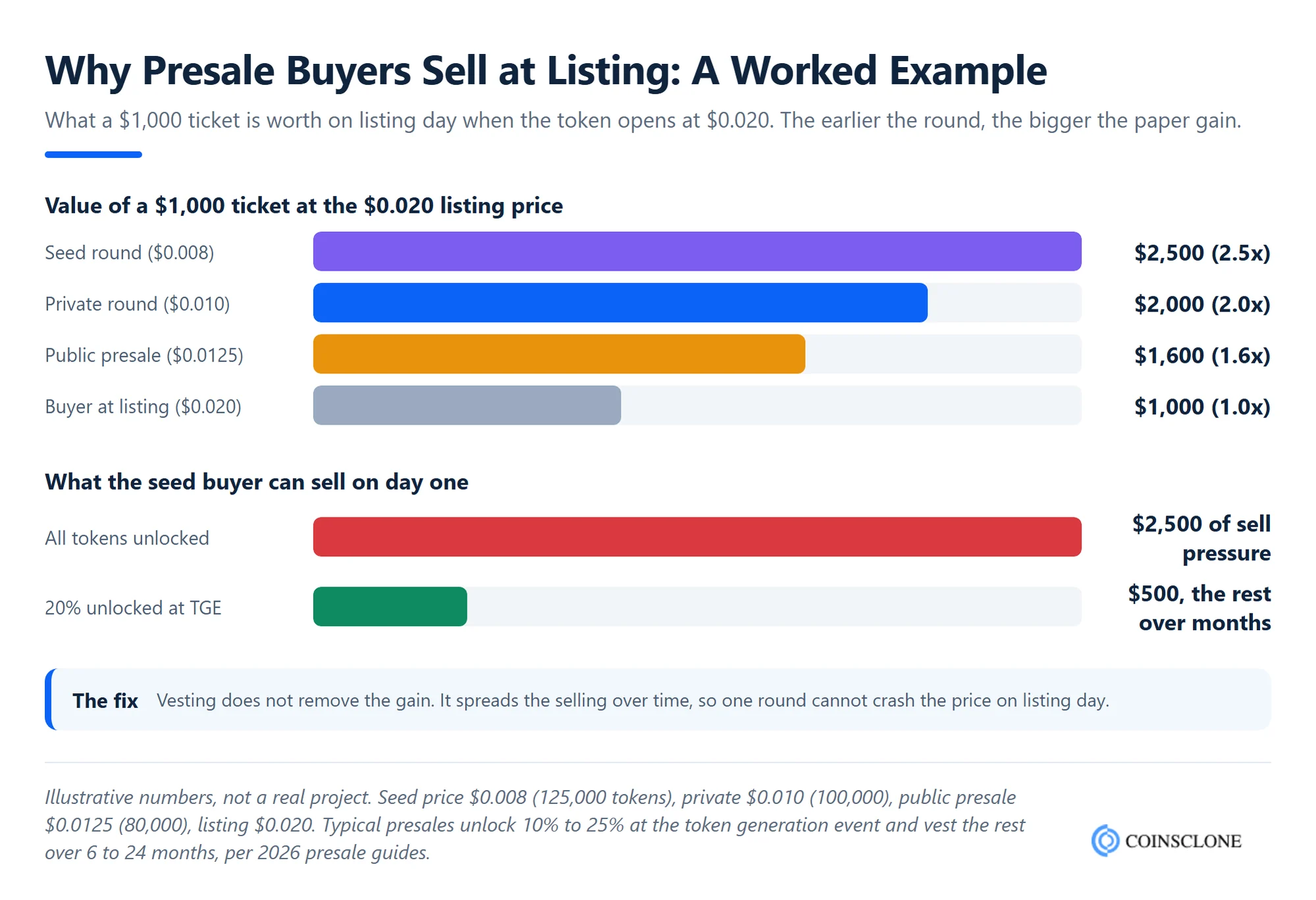
In short, the cheaper the round, the bigger the urge to sell at listing. Good vesting spreads that selling over months, so the price does not crash on day one.
Token Presale Formats and Pricing Models
Presales do not all set the price the same way. The model you pick changes who gets tokens and how fair the sale feels.
- Fixed price: Every buyer pays the same price until the cap fills, often first come, first served. On Solana, the Metaplex Genesis presale works this way: the price is the SOL cap divided by the tokens on offer.
- Stage pricing: The price rises at each stage, so the earliest buyers pay the least. Many website presales use this model to create urgency.
- Auction: Buyers bid, and the sale sets one clearing price that every winner pays. The aim is a sale price closer to what the market will pay once trading starts.
- Lottery or overflow: When demand beats supply, buyers win a slot by lottery. In an overflow sale, everyone deposits, each buyer gets a share, and the excess is refunded.
- Fair launch: There is no presale at all. The token starts trading on a bonding curve or in a liquidity pool, and anyone can buy from the first block.
As a rule, stage pricing raises money fast but invites selling on listing day. Auctions and longer vesting help keep that sell-off smaller.
Benefits of Running an ICO Presale
From early momentum to global investors, a presale is the base for a strong ICO campaign. Here are the key business gains of an ICO presale.
Global Outreach: An ICO presale lets a crypto project reach buyers around the world from day one. As a result, the project gets funds from many regions, not just from one local market. Keep in mind that each country still has its own rules, which we cover below.
Early Fundraising: One of the top gains of the ICO presale is a lump sum of capital before launch. This early money helps the team work without cash pressure. With the presale funds, startups can pay for the build, audits, marketing and exchange listing fees.
Token Buzz: The sale gets the crypto world talking about your token. Early buyers talk about the project and bring others in. In this way, early trust acts as a marketing engine that pushes the token into the spotlight before launch.
Community Building: Strong communities are the backbone of any crypto project, and presales grow them fast. Buyers join the project’s social channels. Airdrops, whitelists and fan reward schemes then keep them active.
Demand Test: A presale shows whether people want the token before you spend on a full launch. If the soft cap fills in hours, you have proof of demand. If it struggles, you can fix the pitch, the price or the token model early.
Wider Token Spread: When many buyers join early, tokens spread across many wallets. This gives the token a broader base of holders before listing. Even so, liquidity only truly starts once the token trades, so plan your exchange listing and liquidity pool with care.
On the whole, an ICO presale is more than an early sale. It is a smart move that boosts funding, reach and global traction, and it lays a strong base for long-term success.
Even today, many people mix up the ICO presale and the ICO token sale. The next section sets out the key differences between the two.
ICO vs Presale: Key Differences
The presale and the public sale sell the same token. But they reach other buyers, at other prices, with other goals. Here is how they compare.
| Factor | ICO Presale | ICO Token Sale |
| Timeline | Happens before the main ICO | Happens after the presale |
| Token price | Usually at a discount or with bonus tokens | Higher than the presale price |
| Funding goal | Early capital for the build, marketing and audits | Large-scale funding and wide token spread |
| Token supply | A small share kept for early backers | A larger share for public buyers |
| Access | Invite-only or whitelist-based | Open to all users, subject to KYC and country limits |
| Marketing focus | Build early trust and traction | Reach the widest audience and drive adoption |
| Buyers | Early investors, funds and venture capital | The general public |
| Lock-up | Often longer vesting and cliffs | Shorter vesting or fully unlocked at TGE |
In short, the presale funds the project and builds trust, while the main sale spreads the token widely.
Is It Better to Buy in a Presale or at Launch?
It depends on the project, because a presale trades a lower price for more risk. Buyers ask this often on Reddit, for example in this r/PresaleCryptoHub thread from March 2025.
A presale buyer pays less, but waits weeks or months with no way to sell, and the token may never list. A buyer at launch pays more, but can see real trading volume, the live contract and whether the team still ships. That is why some users in a 2025 r/solana thread said they now skip presales and wait a week after launch instead.
So presales suit buyers who can check the team, the audit and the vesting, and who can afford to lose the stake. Everyone else is often better off waiting for the listing.
ICO Presale Examples: What Big Token Sales Raised
Past sales show both the promise and the risk of a token presale. Here are five well-known cases.
- Ethereum (2014): Its 42-day sale raised about $18 million in bitcoin. The money funded the Ethereum network, which went live in 2015.
- Filecoin (2017): It raised about $257 million. Of that, $52 million came from a presale to big funds such as Sequoia. The sale used a SAFT and was open only to accredited investors.
- EOS (2017 to 2018): Block.one raised about $4.1 billion in a year-long sale. Later, it paid the SEC a $24 million fine because it never registered the sale.
- Telegram (2018): It raised $1.7 billion from 171 buyers in two private presales. However, the SEC stopped the token launch in court. In 2020, Telegram agreed to return $1.2 billion to buyers and pay an $18.5 million fine.
- Monad (2025): The first sale on Coinbase’s new token sales platform raised about $269 million from 85,820 buyers in November 2025, at $0.025 per token. Demand came late, but the sale still ended about 1.4 times oversubscribed.
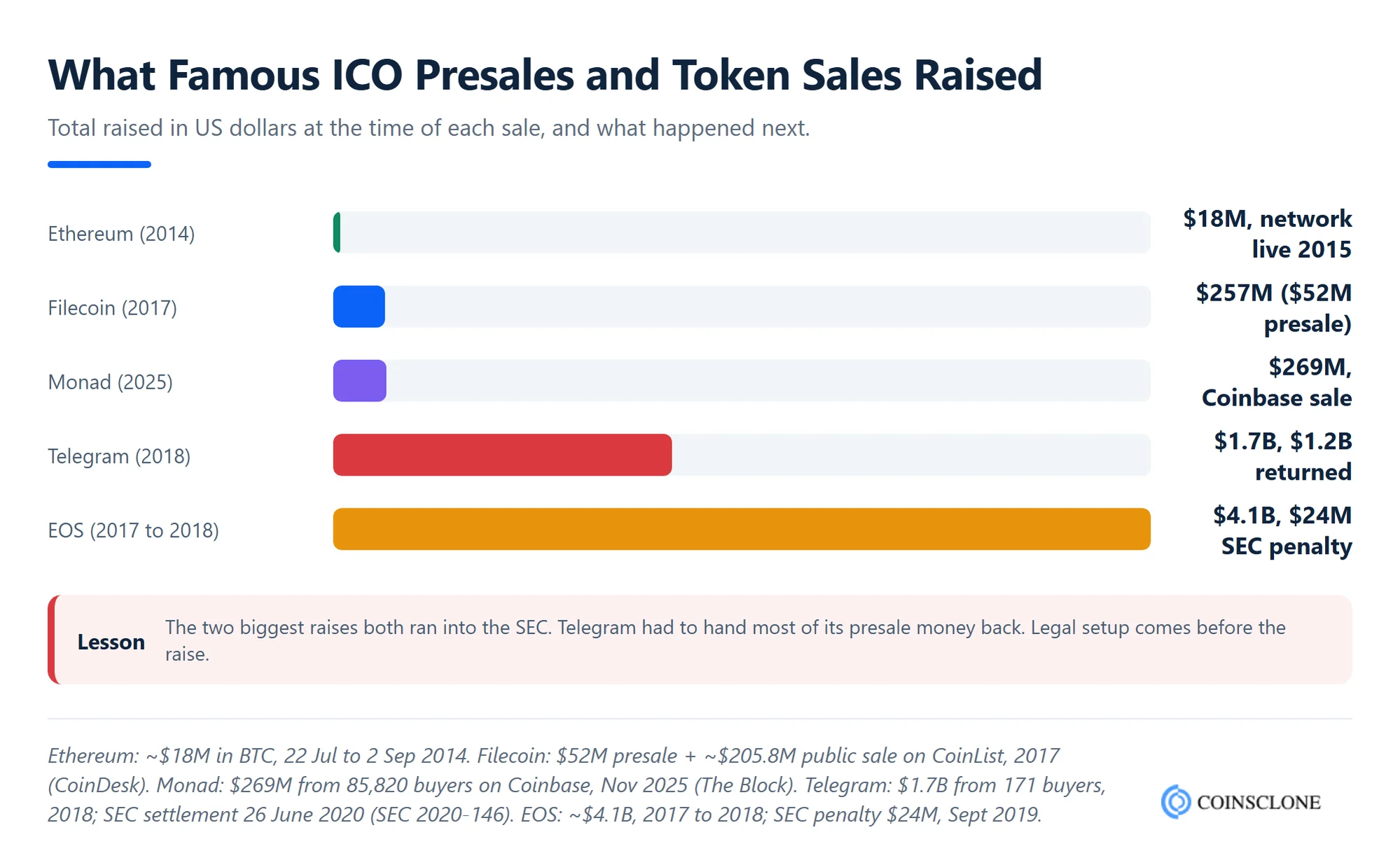
The lesson is clear. A big raise is not the finish line. Telegram raised the most in a presale and still had to give most of it back, because it ignored securities rules. That is why the legal part of your presale matters as much as the tech.
Must-Have Features of a Token Presale Website
At the very least, a token presale website needs a whitelist, KYC, wallet connect, caps, vesting and a claim page. The right features keep token buying and the token launch smooth for both you and your buyers. Here are the key features to build into an ICO presale platform.
- Investor Dashboard: A single panel where buyers track token purchases, bonuses and vesting schedules.
- Whitelist and KYC/AML Checks: Secure whitelisting and identity checks let only approved users join the sale.
- Tiered Pricing: Lower token prices for earlier stages draw in early buyers and build presale momentum.
- Soft Cap and Hard Cap Settings: These two caps set the least and the most the sale will raise, with automatic refunds if the soft cap is missed.
- Wallet Connect: Buyers link a wallet such as MetaMask to pay and claim with ease.
- Multiple Payment Options: Buyers can pay in crypto, by card or by bank transfer, where the law allows.
- Automatic Token Distribution: Tokens reach buyers’ wallets on the claim date without manual work or delays.
- Vesting and Lock-in Tools: These stop instant token dumping by locking tokens for a set time.
- Referral and Bonus Programs: Buyers who invite others earn extra tokens or discounts.
- Whitepaper and Roadmap: A clear ICO whitepaper explains the project’s goals, tech, vision and build plan.
- Clear Tokenomics: The token model shows the token split, supply, use and how funds will be spent, which builds investor trust.
- Community Support Channels: Active Telegram, Discord, X and Reddit channels help startups build trust.
- Strong Security: Code audits, encryption and fraud checks guard the sale site and buyer data.
- Country Blocking: Geofencing keeps out buyers from places where the sale is not allowed.
- Bot and Sniper Guards: Per-wallet limits, whitelist-only windows and short launch delays stop bots from grabbing the sale or the first trades. Here is how to stop snipers on a token launch.
- Reports: Live data on buyers, funds raised, traffic and sign-ups.
With these features in place, the ICO presale dashboard runs smoothly. If you want a ready base, an ICO dashboard script already includes most of them. For a fully custom build, our ICO token sale platform development team builds the sale site, the contracts and the claim flow as one stack.
Is an ICO Presale Legal? 2026 Rules in the US and EU
Launching an ICO presale means following the legal rules where your buyers live. These rules changed a lot in 2025 and 2026, so older advice is often wrong. Here are the key areas to cover before you launch.
Know Your Token Type
First, work out what kind of token you sell. A utility token, a security token and a voting token each fall under their own rules.
In the US, the SEC issued new guidance on 17 March 2026 that sorts crypto assets into types. Coins like bitcoin, collectibles, tools and some stablecoins are not securities. Tokenised shares and bonds are. Still, even a non-security token can be sold as part of an investment contract. In plain terms, a presale that promises profits from the team’s work can still be a securities offering.
New US Rules for Token Sales
On 18 August 2026, the SEC proposed a new rule set called Regulation Crypto Assets. The public comment period closed on 20 October 2026, and the rule is not final yet. Still, it shows where US presales are heading.
- Startup exemption: Raise up to $5 million over a period of up to four years, with public filings and plain-English risk notes.
- Fundraising exemption: Raise up to $20 million (Tier 1) or $75 million (Tier 2) in any 12 months. Both tiers file ongoing reports, and Tier 2 also needs audited financial statements.
- Safe harbor: Once the team has done the work it promised, the token can stop being treated as part of a security.
Until the rule is final, most US sales go only to accredited buyers (people with high income or wealth) under Regulation D, often through a SAFT. Others keep US buyers out.
MiCA Rules in the European Union
In the EU, the Markets in Crypto-Assets Regulation (MiCA) has covered token offers since 30 December 2024. If you offer tokens to the public, you must publish a MiCA white paper and notify your national regulator first. You do not need one if any of these apply:
- You offer tokens to fewer than 150 people per EU country.
- The whole offer is under EUR 1 million over 12 months.
- You sell only to qualified (pro) buyers.
On top of that, retail buyers who buy straight from you get 14 days to cancel and get their money back. This right does not apply if the token already trades on a platform when they buy, and it ends when a time-limited sale closes.
KYC/AML Compliance
Every ICO presale must run KYC and AML checks on buyers. These checks keep out fraud, dirty money and banned buyers.
Country-Based Limits
Some countries still ban ICOs outright. China, for example, has banned them since 2017. Others, like the US and the EU, allow token sales only under their rules. So your presale must state which countries it excludes and back that up with IP blocking and geofencing.
Clear Documentation
A legal ICO presale needs a full whitepaper, sale terms, a privacy page and a token sale deal. These papers set out the risks, buyer rights and what the token does.
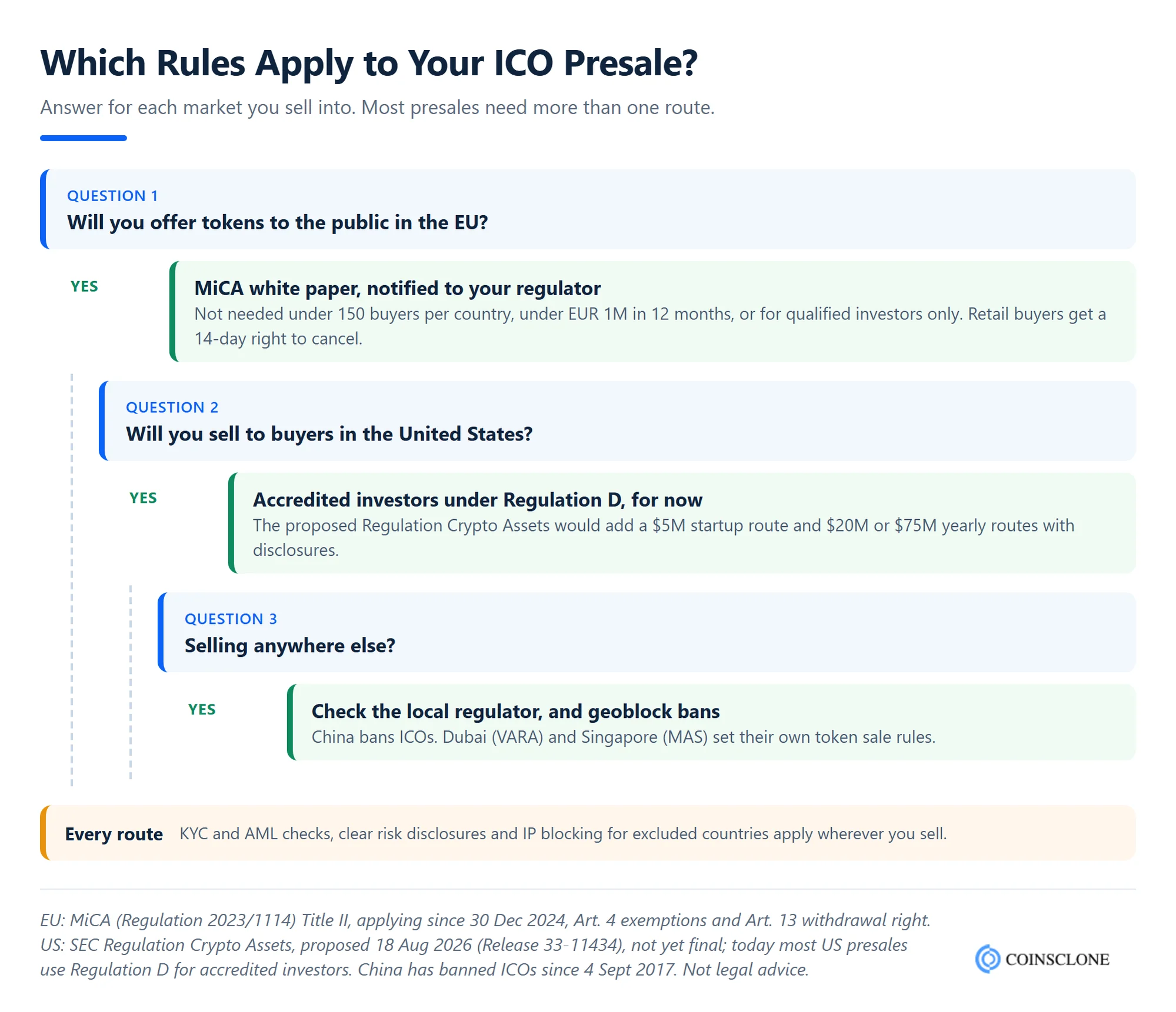
Follow these steps to run your ICO presale without legal trouble. Above all, get advice from a crypto lawyer in each market you sell into.
Are Crypto Presales Safe? Risks and How to Reduce Them
Presales carry real risks, both for founders and for buyers. Knowing them early helps you design a sale that people trust.
- Dumping at listing: Early buyers who paid half the listing price may sell at once. Longer vesting and a cliff for private rounds reduce this.
- Scams and rug pulls: Some teams take the money and vanish. Buyers now look for named teams, audited contracts and locked liquidity before they buy.
- Phishing clones: Scammers copy presale sites and fake claim pages, then buy search ads to rank above the real one. Publish one official link and repeat it in every channel.
- Missing the soft cap: If demand is weak, the sale fails. Set a realistic soft cap and test demand with your community first.
- Legal action: Selling to the wrong buyers can force refunds, as Telegram learned. Plan the legal setup before you take any money.
- Delivery risk: The product may ship late or not at all. A clear roadmap and regular updates keep buyers on board.
Red Flags to Check Before You Join a Presale
Buyers keep asking which warning signs matter most, as in this r/TheCryptoCrew thread on presale red flags from May 2025. The replies point to a few clear checks.
- No vesting or liquidity lock details: If the sale page does not say when tokens unlock and how long liquidity stays locked, walk away.
- A whitepaper with no mechanics: Fluff and memes with no token split, supply or use case is a warning sign.
- No clear job for the token: If you cannot explain what the token does, other buyers cannot either.
- No named team and no audit: A public team and a public smart contract audit are the minimum.
- Paid hype: Many “best presale to buy now” lists and news posts are paid placements. Treat them as ads, not research.
To sum up, trust is the real product of a presale. The more open you are about the team, the token split and the unlock dates, the easier the sale becomes.
How to Launch a Token Presale
To launch a token presale, you first set the token model and pick a legal route. Then you build and audit the sale contract, grow the whitelist, and run the sale and the TGE. Here is that order of work.
- Set the token model: Decide the total supply, each round’s share, the prices and the vesting for each group.
- Check the rules: Choose where you will sell and pick the right legal route for each market.
- Build and audit: Build the sale contract, the dashboard and the claim page, then get the smart contract audited.
- Grow the community: Open your channels, share the whitepaper and fill the whitelist before the sale.
- Run the sale and the TGE: Launch the presale, then plan the claim, the exchange listing and the liquidity on the same timeline.
Where to Run a Token Presale
You have three main options, and each one trades control for reach.
- Your own presale website: You keep full control of the terms, the brand and the buyer data. You also carry the whole build, the audit, the KYC and the marketing.
- A launchpad: Self-serve launchpads let you set up a presale through a form and reach their users. Curated IDO launchpads screen projects and bring a ready crowd, but they take a fee or tokens and set their own rules.
- An exchange token sale: Large exchanges now run curated sales, such as Monad’s 2025 sale on Coinbase covered above. These reach the most buyers but are the hardest to get into.
How Much Does It Cost to Launch a Token Presale?
A small, simple token sale usually starts at about $20,000, and a large multi-chain one can pass $500,000. Here is where the money goes.
- Token contract: About $5,000 to $15,000 for a basic token, and $15,000 to $50,000 or more for complex logic.
- Sale platform: From about $15,000 for a basic build, and $50,000 to $200,000 or more for a custom one.
- Smart contract audit: About $5,000 to $20,000 for a simple ERC-20 token.
- KYC checks: From about $1.35 per buyer, with a monthly minimum.
- Marketing: Often 20% to 40% of the launch budget.
- Legal: Quoted by your lawyer, and higher for public offers in the US or the EU.
How Long Does It Take to Launch a Token Presale?
A white label ICO platform can be ready in about 2 to 4 weeks. A standard token sale takes about 5 to 8 weeks to build, and a sale with several priced rounds takes 9 to 13 weeks. If the sale needs heavy legal work, such as a MiCA white paper or a US exemption filing, plan for 4 to 6 months.
For the full launch path after the presale, read our step-by-step guide on how to start an ICO. You can also check the cost to launch an ICO to budget each stage.
To run a clean ICO presale, you need the right crypto build team at your side. Coinsclone stands out from the crowd and helps you launch an ICO presale with ease.
Why Choose Coinsclone to Launch Your ICO Presale?
Coinsclone is a leading ICO development company and a trusted partner for ICO presales. Since 2018, we have delivered 350+ platforms for 200+ clients across 20 industries. With strong security and a deep grasp of how token sales work, Coinsclone helps you launch your ICO presale faster and safer. Our white-label ICO software comes with built-in rule checks, easy buyer sign-up, secure smart contracts, live dashboards and sale settings shaped to your project.
We build the full sale stack: the whitelist and KYC flow, tiered pricing, soft and hard cap contracts, vesting and claim pages, and a buyer dashboard. If you want to run the sale on your own platform, our team can also build a crypto launchpad for you.
With a proven track record, a clear build process and a skilled tech team, we help you win buyers, grow worldwide and set up a strong public launch. In short, Coinsclone does not just help you run a presale. We help you build trust, raise funds faster and launch a token project that lasts.
Frequently Asked Questions
What is the difference between a pre-ICO and an ICO?
A pre-ICO, or ICO presale, comes first. It sells a small share of tokens to whitelisted or invited buyers at a lower price, often with longer lock-ups. The ICO is the main public sale that follows, at a higher price, for a wider audience.
Are crypto presales safe?
No presale is fully safe. Projects can fail, teams can vanish, and prices often drop when early buyers sell at listing. Buyers lower the risk by checking the team, the smart contract audit, the vesting terms and the official sale link before they pay.
How do you buy presale tokens?
You join the whitelist, pass KYC, connect a crypto wallet and pay in a coin the sale accepts, such as USDT or ETH. Always use the link from the project’s official site or pinned posts, because fake presale sites are common.
What happens after a presale ends?
The project runs its token generation event (TGE). Buyers then claim their tokens on the official claim page. Part of the tokens may unlock at once and the rest over the vesting period. Trading starts when the token lists on an exchange or a DEX.
What is a presale token?
A presale token is a token sold before it trades on any exchange. In most cases, the buyer gets a claim on tokens that unlock at the TGE, not a token they can sell at once.
Where do people find new crypto presales?
Most buyers find presales through launchpads, exchange token sale pages and the project’s own channels. In a 2025 r/solana thread on this question, users named crypto news sites and DefiLlama, while others said they now wait for the launch. Whatever the source, check the official link, the audit and the vesting before you pay.
How long does a crypto presale last?
It depends on the format. A launchpad round or an exchange sale often runs for a few days, and it can close in minutes once the cap fills. A website presale with rising price stages can run for weeks or months.
What are the soft cap and hard cap in a presale?
The soft cap is the least the sale must raise to go ahead. If it is missed, buyers should get a refund. The hard cap is the most the sale will accept, and the sale closes once it is reached.
Is an ICO presale legal?
It depends on where your buyers live. In the EU, public token offers need a MiCA white paper unless an exemption applies. In the US, most sales go only to accredited buyers for now. The SEC’s proposed Regulation Crypto Assets would add new ways to raise up to $75 million a year. China bans ICOs.
See How Our MVP System Can Launch Your ICO Presale Faster
ICO Development — done right.
- MVP Token System: Launch your ICO presale 90% faster.
- Smart Contracts & Wallets: Pre-integrated modules, no coding needed.
- Brand &Customization: Your token, your ecosystem, your rules.
- Revenue Engine :Raise funds through token sales, staking, and early investor perks.
See a free demo of your branded utility token in 48 hours — before you invest a cent.
Book a Free Demo to discover how our Utility Token Development Company can take you from concept to live token in just 2–4 weeks.