
Between 10 July and 21 September 2026, one group pulled at least $18.43 million out of 53 memecoin launches on Robinhood Chain, according to an onchain analyst cited by The Block. Nearly every launch was sniped for 70% or more of supply by bundles of 70 to 200 wallets. The twist is that the launchpad had an anti-sniper tax. The creators simply exempted their own wallets from it.
So if you want to know how to stop snipers on token launch day, the answer is not one setting. It is a set of rules that make the first seconds unprofitable for bots, without hurting real buyers or making your token look like a scam. This guide explains how snipers and bundlers win on each chain, the defenses that work in 2026, the trade-offs, and a step-by-step launch plan.
In this guide:
- Snipers win on speed: the public mempool on Ethereum, Jito bundles on Solana, and the sequencer race on L2s.
- Max-wallet caps alone fail: at a 0.5% cap, a 70-wallet bundle can still take 35% of supply.
- A decaying fee that starts near 99% and hits zero in seconds works, but only if no one is exempt.
- Fair-launch auctions such as Uniswap’s CCA raised $59 million for Aztec from 16,741 bidders with one price per block.
- Owner-adjustable limits and taxes trip honeypot flags in scanners such as GoPlus, so keep anti-bot rules short, fixed and public.
How to Stop Snipers on a Token Launch: The Short Answer
You cannot fully stop snipers. You can make sniping cost more than it pays. In practice, that means five moves:
- Take away the speed edge: buy in the launch transaction, add liquidity privately, or delay trading a few blocks.
- Cap early size: limit how much one wallet can buy for the first minutes.
- Price the first seconds: charge a high early fee that falls to normal fast.
- Sell by auction, not by race: give everyone in a block the same price.
- Watch and publish: track sniper and bundler share on launch day.
Each has a weak spot, so the rest of this guide shows how to combine them.
What Snipers and Bundlers Actually Do
A sniper is a bot that buys a new token in the first block or seconds, before people can react, and then sells into the buyers who follow. A bundler packs the launch and many buys from many wallets into one block, so a single operator ends up with a large share of supply that looks spread out. Risk scanner Webacy rates sniper holdings above 30% and bundler holdings above 20% as high risk, and more than half the supply bought in block 0 as critical.
Founders on Reddit describe the pain well. One pump.fun creator said every launch got bought up by two to four bots, each taking about 5% of supply. The bots then sold together the moment the token bonded, which killed the chart every time, as the r/solana thread tells it.
How a bot gets in first depends on the chain.
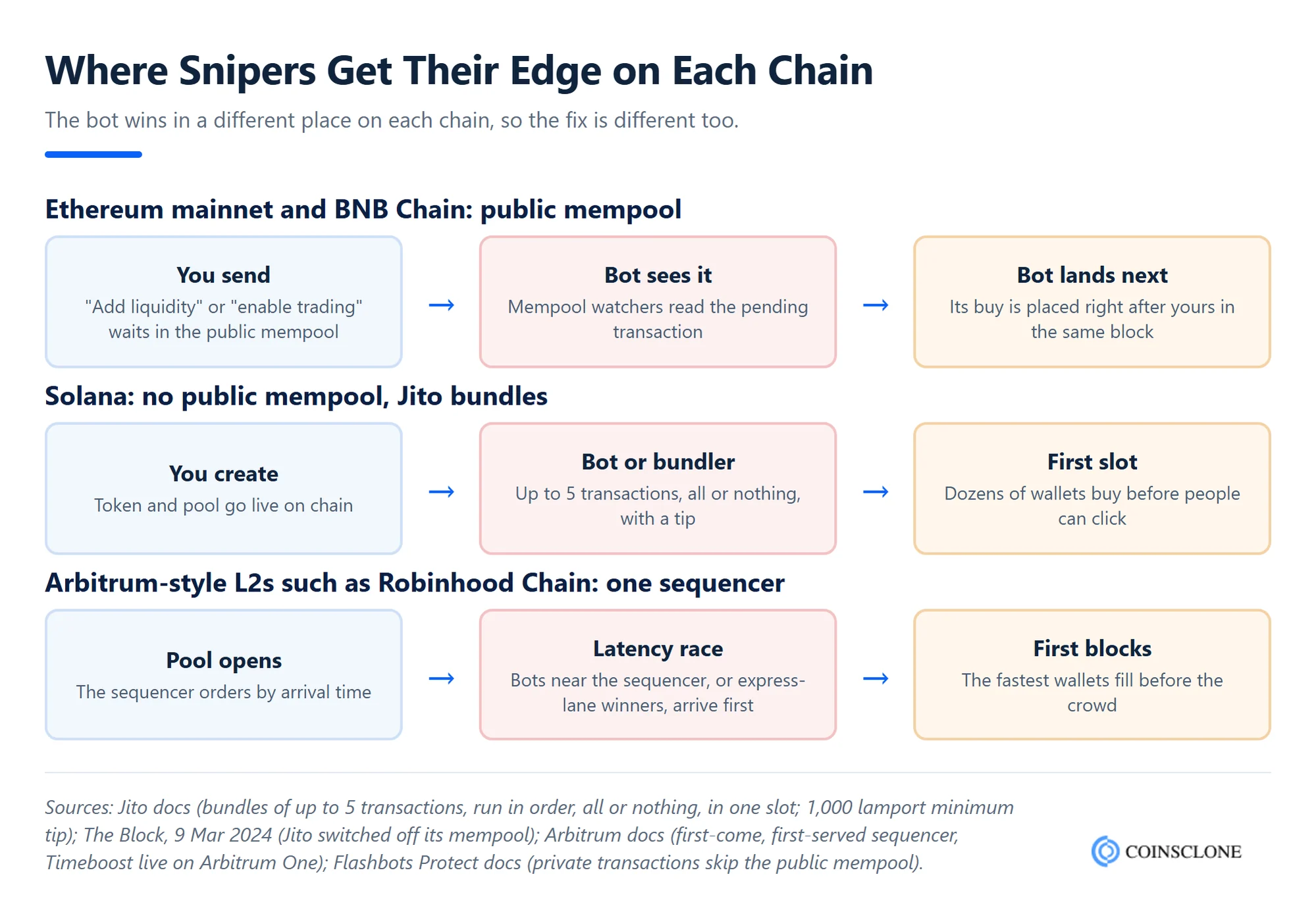
On Ethereum and BNB Chain: the public mempool
On chains with a public mempool, your “add liquidity” or “enable trading” transaction waits in public before it lands. Bots watch for it and place their buy right behind yours, in the same block, at the lowest price on the curve.
On Solana: Jito bundles
Solana has no public mempool, and Jito switched off its own mempool in March 2024 after a wave of sandwich attacks, as The Block reported. The edge now comes from bundles. Per the Jito docs, a bundle holds up to five transactions that run in order, all or nothing, within one slot, for a tip of at least 1,000 lamports. Bundlers use this to create a token and buy from dozens of wallets before anyone else can click.
On L2s like Arbitrum and Robinhood Chain: the sequencer race
Rollups use a sequencer instead of a public mempool. On Arbitrum-based chains, the sequencer orders transactions by arrival time. Arbitrum One also runs Timeboost, a 60-second auction where the winner gets an express lane while others face a 200 millisecond delay. Either way, the race goes to the fastest or highest-paying bots. Robinhood Chain, an Ethereum L2 built on Arbitrum tech, went live on 1 July 2026.
The Robinhood Chain Case: When the Defense Became the Weapon
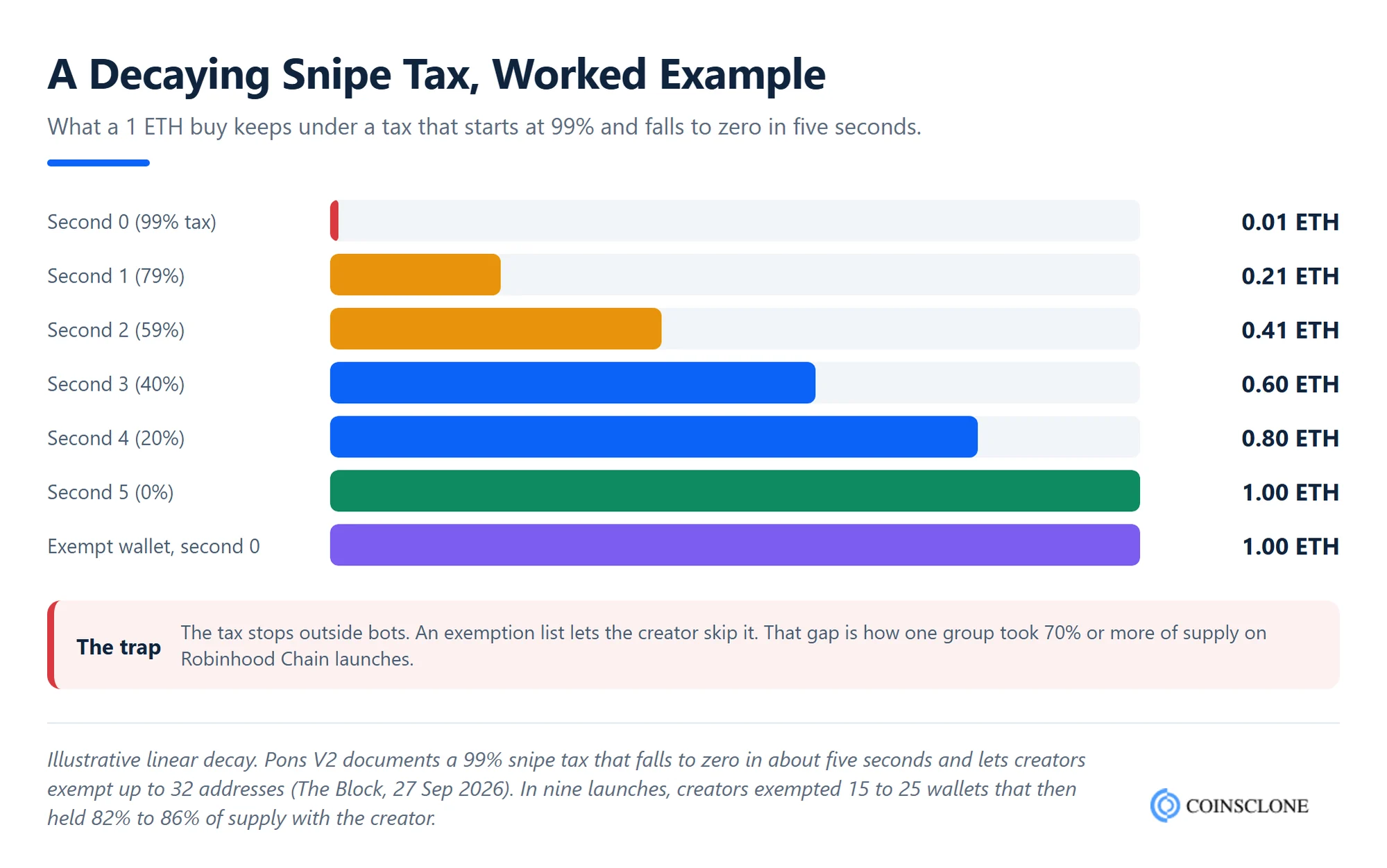
The 2026 case is worth studying because the launchpad did have protection. Pons V2, the launchpad used for most of the tokens, documents a 99% “snipe tax” on early buys that falls to zero in about five seconds. Creators can waive it for up to 32 addresses.
- The exemption was the exploit. In nine launches, the creator’s launch transaction waived the tax for 15 to 25 wallets. One to three blocks later, one transaction bought for all of them.
- Supply ended up in a few hands. The creator and exempt wallets held 82% to 86% of supply in those nine launches.
- Fake launches came first. The group allegedly ran fake copies of hyped tokens to take buyers’ money before posting the real contract address.
The Block confirmed 10 of the launches onchain and one fund flow, but did not replicate the $18.43 million total. Neither Pons nor Robinhood had commented at the time.
The lesson is simple. An anti-sniper rule with a private exemption list is a bundling tool. If anyone can skip the rule, buyers will treat it as a warning sign.
8 Defenses That Work in 2026
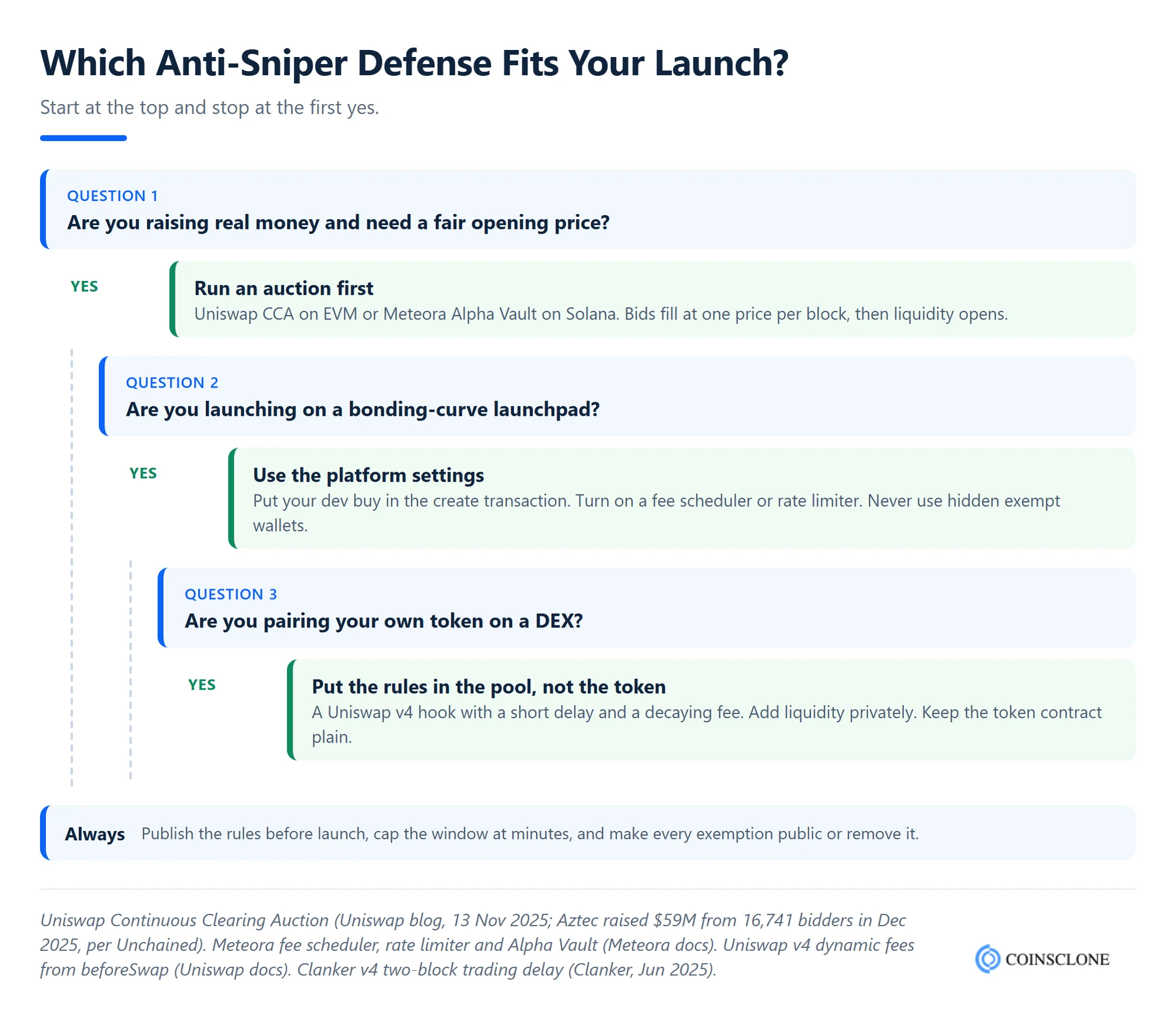
Use more than one. Each defense covers a gap the others leave open.
1. Put your first buy in the launch transaction
On Solana, the creator’s first buy can sit in the same transaction as the token creation. On pump.fun, the initial buy runs in that same transaction, so nobody can get between “create” and “buy”. As one reply in the r/solana thread on dev sniping put it, you will always be the first buyer. On EVM chains, you get the same effect by adding liquidity and making your buy in one contract call. This protects your own buy. It does not stop bots from buying the very next second.
2. Add liquidity privately, and don’t publish the exact minute
On Ethereum, send your liquidity add through a private RPC such as Flashbots Protect, so it skips the public mempool. A failed transaction is also not included, so you don’t pay gas for it. Many teams also share a launch window (“in the next 24 hours”) rather than an exact time, so bots cannot line up on a countdown. Your community may miss the start, so pair this with a fee curve or auction.
3. Delay trading by a few blocks
A short gap between pool creation and the first allowed swap stops same-block sniping. Clanker v4 on Base, for example, adds a two-block delay between deploying a pool and opening it to trading. A delay alone just moves the race to the first open block, so combine it with defense 4 or 5.
4. Cap wallet size and trade size for the first minutes
Max-wallet and max-transaction limits stop one address from buying a big share early. Enforce them in the contract or pool, not just in your website, because bots call the chain directly. Keep the window short and switch it off on a fixed block or time.
The weakness is wallet splitting. Run the numbers: with a 1 billion supply and a 0.5% cap, each wallet can hold 5 million tokens. A 70-wallet bundle can still collect 350 million tokens, or 35% of supply. The Robinhood Chain bundles used 70 to 200 wallets. So caps help against greedy single bots, but bundlers need a price penalty too.
5. Charge a decaying fee on early buys
A high fee that falls over time makes the first seconds expensive. Solana’s Meteora offers two versions in its launch pools:
- Fee scheduler: The fee scheduler starts at a high fee and lowers it each period, either in steps or on a curve. The total fee is capped at 99%.
- Rate limiter: The rate limiter raises the fee as the trade gets bigger, like tax brackets. It also blocks repeat swaps to the same pool in one transaction. It can run for up to 12 hours, and you pick it or the scheduler, not both.
On EVM chains, a pool or token can do the same. The fee should apply to everyone, including the team, and should end on a fixed schedule.
6. Move the rules into a Uniswap v4 hook
Uniswap v4 lets a pool run custom code, called a hook, before and after each swap. A hook can set the fee for every swap from its “beforeSwap” step, per the dynamic fee docs. That means you can build a trading delay, a decaying fee and per-wallet caps into the pool itself, while the token stays a plain ERC-20. Scanners read the token contract, so a clean token is less likely to look like a trap. The cost is custom work and an audit, since a buggy hook can lock or drain the pool.
7. Sell by auction instead of a race
Auctions remove the speed edge. Uniswap’s Continuous Clearing Auction (CCA), announced on 13 November 2025, works like this:
- Buyers set a top price and a total budget.
- Each bid is spread across the rest of the auction’s blocks.
- Every block sets one clearing price, and everyone filled in that block pays it.
- When the auction ends, the money seeds a Uniswap v4 pool at the price found.
Aztec ran the first CCA sale from 2 to 6 December 2025 and raised $59 million from 16,741 participants, per Unchained. Uniswap founder Hayden Adams summed it up as “No sniping, bundling, timing games.” On Solana, Meteora’s Alpha Vault takes deposits first and buys before public trading opens, with pro-rata or first-come modes, per-wallet caps and linear vesting.
Researchers have also proposed hidden-bid (commit-reveal) auctions in a Nethermind paper on ethresear.ch, which found snipers made more than $7.5 million one minute after Virtuals launches.
8. Watch the first hour and publish what you see
Run a holder check right after launch: sniper share, bundler share and block 0 buyers. If numbers cross the Webacy risk levels above, say so in public. Honest stats build more trust than a chart that only looks clean.
Which Anti-Sniper Defense to Use: Comparison
| Defense | Stops | Weak against | Honeypot-flag risk | Best for |
| First buy in launch transaction | Bots buying ahead of you | Bots buying right after | None | Every launch |
| Private liquidity add | Mempool watchers on Ethereum | L2 and Solana speed races | None | EVM mainnet |
| Trading delay (2+ blocks) | Same-block snipes | Race in the first open block | Low if it ends on a fixed block | DEX launches |
| Max wallet and max trade | Single greedy bots | Multi-wallet bundles | High if the owner can change it | Short early window |
| Decaying fee | Early buys of any size | Exempt wallets | High if the owner can change it | Launchpads and pools |
| Uniswap v4 hook | Most of the above, in the pool | Bugs in the hook | Lower, token stays plain | Serious EVM launches |
| Fair-launch auction | Speed and timing games | Low demand | None | Projects raising real money |
The Honeypot-Flag Trade-Off
Here is the trap many founders miss. The same code that stops bots also looks like scam code to token scanners. Traders check tools like GoPlus before they buy, and some DEX front ends show those warnings too.
GoPlus flags, among others:
| GoPlus flag | What it means | Anti-bot feature that trips it |
| is_anti_whale | Limits on trade size or holdings per address | Max wallet or max trade |
| anti_whale_modifiable | Those limits can be changed | Owner can edit the caps |
| trading_cooldown | Minimum time between two trades | Cooldown between buys |
| slippage_modifiable | Owner can change buy or sell tax | Adjustable snipe tax |
| personal_slippage_modifiable | Owner can set a tax per address | Exempt or targeted wallets |
| is_whitelisted / is_blacklisted | Special terms or bans for some addresses | Whitelists, bot blacklists |
| transfer_pausable | Owner can stop trading for all but a few | “Enable trading” switch |
A flag is not a verdict, but it costs you buyers. To keep the protection without the red flags:
- Hard-code the window: write the end block into the contract so no one can extend it.
- No owner dials: no functions that change taxes, caps or lists after launch.
- No private exemptions: team buys go in the launch transaction or a public, vested allocation.
- Keep the token plain: put the rules in the pool or launchpad, and verify the code.
Mistakes That Get Launches Sniped Anyway
- A countdown plus a public liquidity add. You gave bots the exact block to target.
- Website-only limits. Bots skip your front end and call the contract.
- Caps with no price penalty. Bundlers just add wallets, as the 35% example shows.
- Endless anti-bot rules. A tax or cap that never switches off looks like a honeypot.
- Filters that block real users. Test over-tight rules on several wallets and devices.
- Decoy tokens. A fake token with the same name distracts bots but also fools buyers, and the Robinhood Chain group used fake launches to take money. Skip it.
Launch Your Token Without Handing It to Snipers
Anti-Sniper Token and Launchpad Development — done right.
- Pool-Level Rules: Trading delays, decaying launch fees and early wallet caps that end on a fixed block.
- Clean Token Contracts: Plain, verified tokens with no owner dials that trip honeypot flags.
- Fair-Launch Options: Auction-style sales, whitelists and vesting for projects raising real money.
- Launch Monitoring: Bundled-buy and sniping flags so you can see who bought in the first block.
Get a free walkthrough of a launch setup built for your chain and supply.
Book a Free Demo to plan your anti-sniper launch with our team.
Launch-Day Plan: Step by Step
Here is a worked plan for an ERC-20 launching on a Uniswap v4 pool on an L2. The numbers are an example, not a rule. Tune them to your supply and community.
- One week before: Freeze the token as a plain ERC-20 with a fixed supply, here 1 billion. Get the hook audited.
- Hook settings: Trading opens 2 blocks after pool creation. For the first 10 minutes, each wallet can hold at most 0.5% (5 million tokens). The fee starts at 90% and falls to a normal 1% over the first 60 seconds. Nobody is exempt.
- Publish the rules: Post the window, cap, fee curve and verified contract addresses two days ahead.
- Launch window: Announce a window, not a minute. Add liquidity and your own buy in one call, sent privately.
- First hour: Run a holder check at 5, 30 and 60 minutes. Post the sniper and bundler share.
- After the window: The caps and extra fee end on their own. Confirm on chain that they did, and say so.
A 70-wallet bundler under these rules pays a 90% fee in the first second and still can’t pass 35% of supply by waiting. Most bots will move to an easier target. If you are raising real money, swap steps 2 and 4 for an auction such as a CCA or Alpha Vault.
Building It In: Options, Cost and Timeline
Your choice depends on whether you are launching one token or running a platform that launches many.
| Option | What you get | Typical cost | Time |
| Use an existing launchpad | Its built-in fee curve, delay or auction | Platform fees only | Days |
| Custom token plus v4 hook | Your own rules in the pool | Custom token $5,000 to $50,000, plus a $5,000 to $15,000 basic audit, more for complex hooks | Weeks |
| White-label memecoin launchpad | Bonding curve, rate limits, sniper and bundle flags | Closest published range: $10,000 to $50,000 for white-label DEX software | 4 to 6 weeks at Coinsclone |
| Custom launchpad | Your own sale models, tiers and anti-bot rules | Closest published range: $40,000 to $250,000+ for custom DEX builds | 8 to 12 weeks (memecoin) or 10 to 14 weeks (IDO) at Coinsclone |
Costs are market ranges from published 2026 agency cost guides; complex contracts often need audits of $15,000 to $70,000 or more. Timelines come from Coinsclone’s pump.fun-style launchpad and crypto launchpad pages. Bot rules need live traffic to tune, so plan time after launch too.
Rules that apply. In the US, SEC staff said on 27 February 2025 that typical meme coins are not securities. The same statement warned that fraud tied to meme coins may still face action by other federal or state agencies. Secret self-bundling, fake launches and hidden exemptions invite exactly that. If your token has a roadmap or promised returns, get legal advice for each market.
Coinsclone has been building since 2018, with 350+ platforms delivered for 200+ clients across 20 industries. Our token development team builds custom token contracts, and our memecoin launchpad scope includes rate limits plus bundled-buy and sniping flags, tuned on real launch traffic.
Before You Talk to a Developer: What to Prepare
Bring these answers to a scoping call:
- Chain and venue: Solana bonding curve, EVM DEX pool or your own launchpad. This decides which defenses are possible.
- Launch type: a fair-price raise (auction) or an open memecoin launch (fee curve and caps).
- Your numbers: total supply, team share, starting liquidity and the max wallet you accept.
- Exemptions: ideally none, or a plan to make them public.
- Checks: who audits the code, and a GoPlus scan of your test token before launch.
When you compare partners, ask to see a launch they shipped with bot rules on, plus its day-one holder data. If you are still planning the token itself, our guide on how to create a meme coin covers chains and costs, and how to create a crypto launchpad covers the platform side.
Frequently Asked Questions
Can you completely stop sniper bots on a token launch?
No. Fast bots and multi-wallet bundles will always get some supply. You can make sniping unprofitable with a short trading delay, early wallet caps, a decaying fee or an auction, then publish holder stats.
How do I avoid snipers on pump.fun?
Make your dev buy part of the create transaction, which pump.fun does, so nobody buys ahead of you, and don’t announce the exact time. Bots will still buy seconds later, so expect early selling. For stronger rules, launch where you control a fee curve or auction.
Is it possible to get sniped as the dev?
On pump.fun, not on your initial buy. The creation and your first buy run in the same transaction, so no one can get between them. On EVM chains, you get the same effect by adding liquidity and buying in one call, sent through a private RPC.
Should I bundle my own token to beat snipers?
It crowds out bots, but scanners flag bundled supply as high risk and buyers often read it as a planned rug. If the team needs tokens, use a public, vested allocation and say so before launch.
Will adding more liquidity stop snipers?
Not on its own. Deeper liquidity means each buy moves the price less, so snipers make less and do less damage when they sell. Use it with caps or a fee curve.
What is the difference between a sniper and a bundler?
A sniper is a bot that buys a new token in the first block or seconds and sells into later buyers. A bundler packs the launch and many buys from many wallets into one block, often to hide that one party holds most of the supply. Snipers are usually outsiders, while bundlers are often the team.
Will anti-bot features make my token look like a honeypot?
They can. GoPlus flags max-wallet limits, cooldowns, owner-adjustable taxes, whitelists and pause switches. Hard-code a short window that ends on its own, avoid owner controls, and put the rules in the pool instead of the token.
How long should an anti-sniper window last?
The bot rush happens in the first seconds to minutes; one Solana trader noted bots have little effect after about five minutes. A fee that decays over seconds plus wallet caps for 5 to 15 minutes covers most launches. Longer windows raise scam flags.