
On 10 September 2026, Solana set a record: more than 263,000 new tokens created in a single day. Yet CoinGecko tracks only about 21,600 active coins. Almost every token ever made never gets listed anywhere that matters.
Creating a token takes minutes. Getting it listed is the hard part. Each platform has its own gate, its own form and, sometimes, its own fee.
This guide shows how to list a token step by step: on a DEX, on DEX Screener, on CoinGecko and CoinMarketCap, and on exchanges such as Binance, Coinbase and KuCoin. Every fee and rule below comes from the platforms’ own pages, checked on 28 September 2026.
How to List a Token: The Short Answer
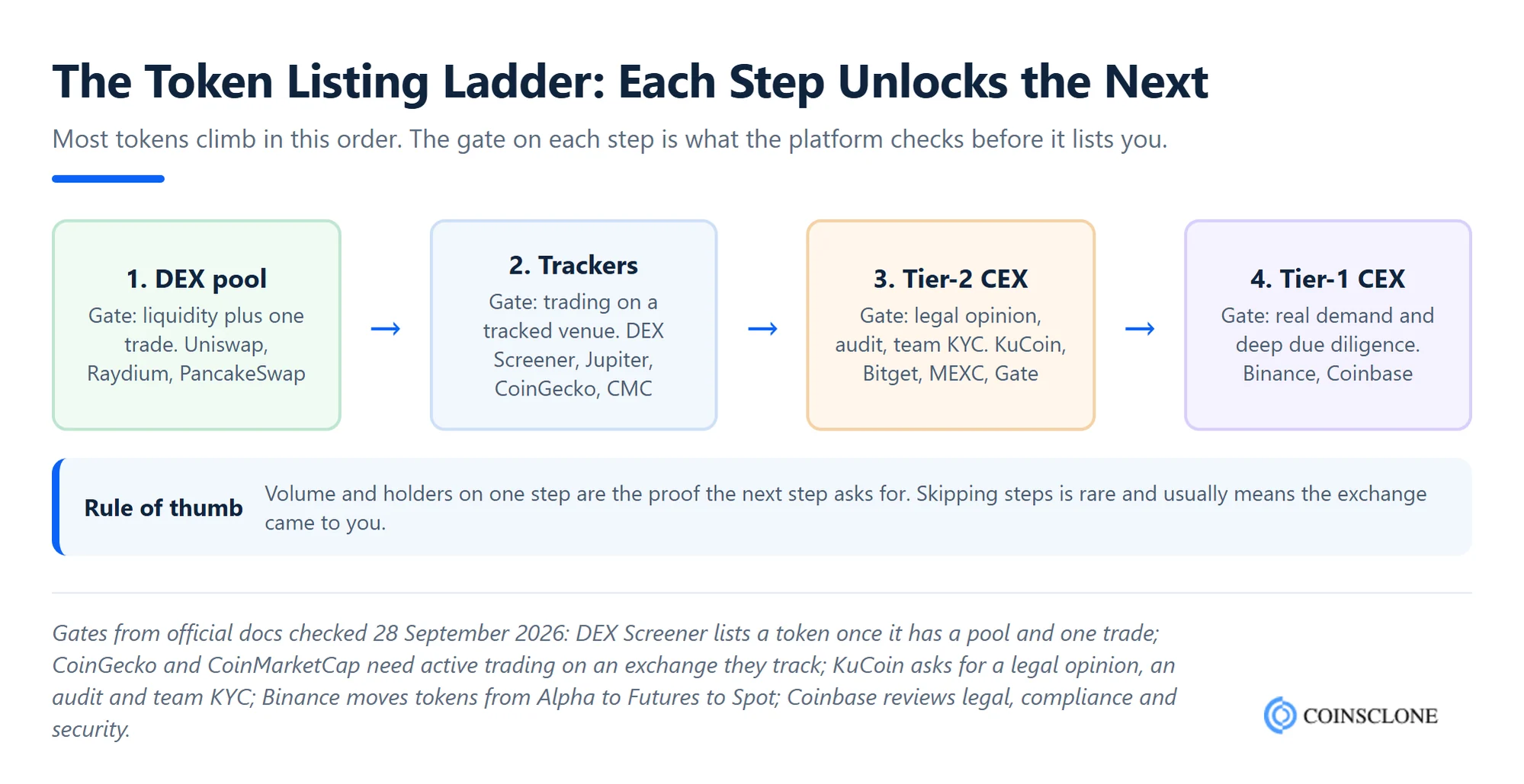
To list a token, you climb a ladder. Each step gives you the proof the next one asks for:
- Add liquidity on a DEX. Create a pool on Uniswap, PancakeSwap or Raydium. This needs no permission.
- Get picked up by trackers. DEX Screener lists your token after its first trade. CoinGecko and CoinMarketCap list it once it trades on a venue they track.
- Apply to tier-2 exchanges. KuCoin, Bitget, MEXC and Gate review applications with legal and technical checks.
- Earn a tier-1 listing. Binance and Coinbase look for real demand, clean code and strong compliance.
The good news: the biggest names do not charge a listing fee. The paid options are mostly fast lanes, not the only way in.
What Do You Need Before You List a Token?
Every platform checks the same basics. Get these ready before you apply anywhere:
- A verified contract. Publish the source code on the block explorer so anyone can read it.
- Clean ownership settings. On Solana, revoke mint and freeze authority if the supply is fixed. On EVM chains, limit or renounce owner powers you do not need.
- Locked liquidity. CoinGecko lists unlocked liquidity as a rug-pull risk and a reason to reject.
- A real website and docs. Team, roadmap, tokenomics and a clear supply breakdown.
- Official social accounts. Linked from your website so platforms can confirm who you are.
- An audit. Optional for trackers, often required by exchanges such as KuCoin.
- A legal opinion. Needed for many centralized exchanges, and useful everywhere.
If you have not built the token yet, start with our guide on how to create a crypto token and the cost to create a crypto token. A contract built with listing in mind saves weeks later. Launching a meme coin instead? Our guide on how to create a meme coin covers pump.fun, Base and BNB Chain routes.
How to List a Token on a DEX
A DEX listing is simply a liquidity pool. Nobody reviews it. Once the pool exists, anyone can trade your token by pasting its contract address.
Uniswap (Ethereum, Base and other EVM chains). Anyone can create a pool. Uniswap pulls token names and logos from CoinGecko, and its help centre says that token info updates after about 48 hours.
PancakeSwap (BNB Chain). Pools are open to all. Traders add your token by address. The team asks projects not to send requests to join its default token list unless it invites them.
Raydium (Solana). Creating a standard CPMM or AMM v4 pool costs a 0.15 SOL protocol fee, plus a little rent. Budget about 0.2 SOL in total. Concentrated liquidity (CLMM) pools have no protocol fee.
Jupiter (Solana). Jupiter routes most Solana swaps, so its verified badge matters. Standard verification is free with no fixed timeline. The express option costs 1,000 JUP and is reviewed in about 24 to 48 hours. Jupiter looks at market cap, holders, liquidity, a unique ticker and social proof.
How much liquidity should you add? There is no official number. But thin pools mean wild price swings, and trackers and exchanges check depth later. Plan liquidity as a budget line, not an afterthought.
How to List a Token on DEX Screener
You do not apply. DEX Screener lists a token automatically once it sits in a liquidity pool and has at least one trade.
What you can pay for is a better page. Enhanced Token Info costs $299 and adds your logo, links, project info and locked wallet settings, so market cap shows correctly. Most orders are done within minutes, and all within 12 hours.
DEX Screener also sells Boosts that raise a token’s visibility for 12 to 24 hours. Prices are not in its docs, Boosts do not guarantee trending, and they are not refundable.
How to List a Token on CoinGecko
CoinGecko is free to apply. The key rule: your token must already trade on an exchange CoinGecko tracks.
The steps:
- Log in and open the CoinGecko request form.
- Choose Active listing (the token trades now) or Preview listing (a launch date is set and public).
- Fill in contract, supply, links and team proof.
- Wait for review. Do not let your community spam CoinGecko asking “when list?”. That can get you disqualified.
Timing and cost. The free Regular Pass takes up to about five days. If nothing happens after two weeks, treat it as a rejection. The paid Fast Pass costs $1,000 per request and guarantees a review within 24 hours. It does not guarantee approval, and it is not refundable.
How to List a Token on CoinMarketCap
CoinMarketCap now tracks more than 52 million assets through DexScan, which picks up DEX tokens on its own. A full listing with a rank still needs a request.
Listing levels:
- Unverified: an automatic DEX page.
- Verified: reviewed by hand, with a unique ID.
- Preview (untracked): shown on the site, but not yet meeting the tracking rules.
- Tracked: fully listed with a rank.
To be tracked, CoinMarketCap’s guidelines ask for a working website and block explorer, and active trading with real volume on at least one tracked exchange. The free route has no set timeline. It can take days or much longer.
The paid route, CMC Priority, costs $5,000 for a coin listing and takes about 24 business hours after payment. No payment buys a better rank, and bribe attempts get a project blacklisted.
How to List a Token on Binance
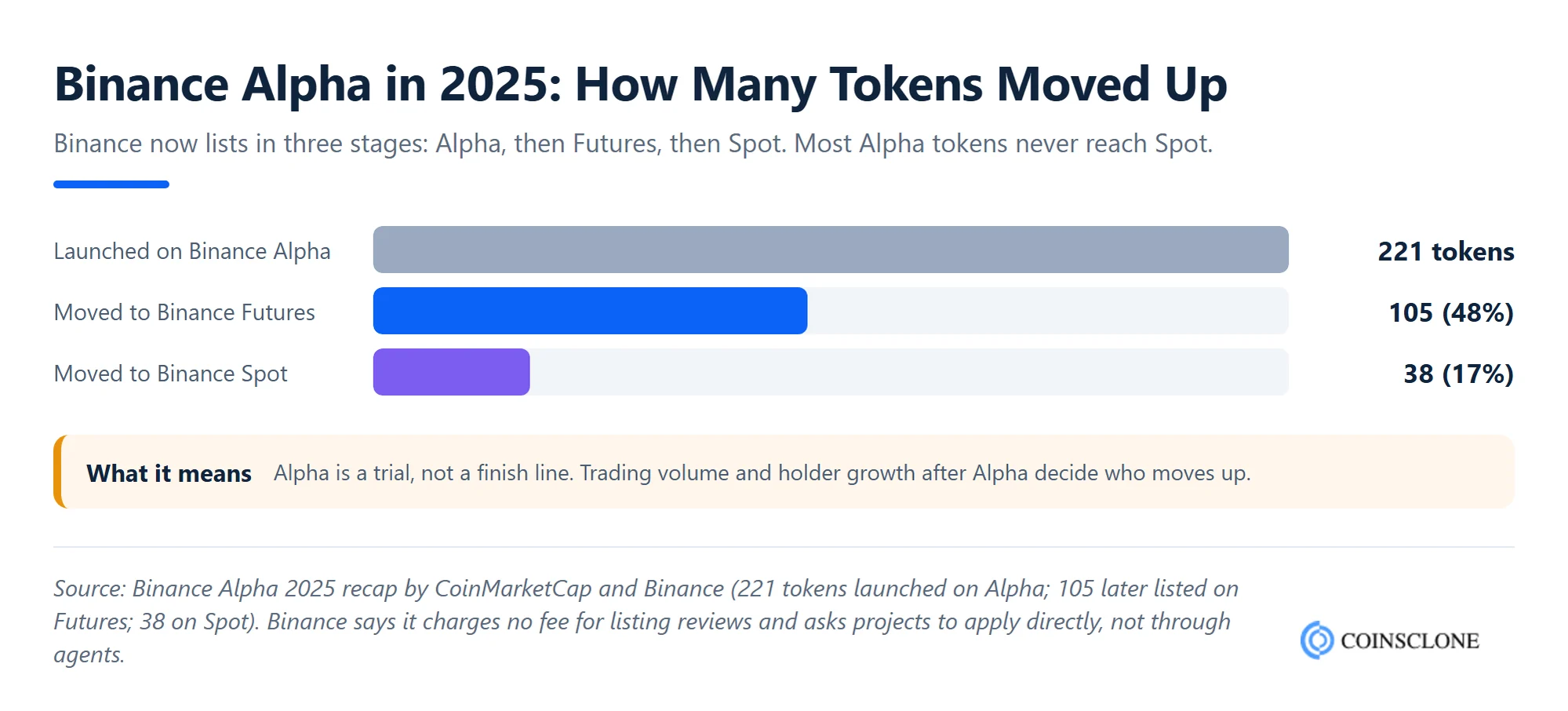
Binance now lists tokens in three stages: Binance Alpha, then Futures, then Spot. Most projects start on Alpha, which works through Binance Wallet, and move up only if trading proves demand.
Is there a fee? Binance says it “does not charge any fee for project evaluations or listing applications”. It also says applications must come from founders or the core team, with KYC, and not from listing agents. It has named blacklisted agents and offers rewards of up to $5 million for tips about fake ones.
There is a nuance. In September 2025 Binance said it charges no “listing fee” but does agree on budgets for airdrops and marketing campaigns with some projects. In late 2024, one venture investor claimed Binance asked a project for 15% of its supply. Binance denied it, and founders such as Justin Sun and Andre Cronje said they paid nothing. Read any deal terms carefully.
How to apply: use the official application page in your Binance account. Expect deep checks on team, code, tokenomics, legal status and trading data.
How to List a Token on Coinbase
Coinbase is clear: “listing assets on Coinbase is free”. There are no application fees and no required marketing fees.
The process: request a review through Coinbase’s listing page, then pass an initial review, due diligence and a decision. Coinbase checks legal, compliance and technical security. It gives priority to tokens with real volume, market cap, holders and liquidity.
A few things to know:
- Tokens on chains Coinbase already supports move faster. These include ERC-20 tokens on Base, Ethereum, Optimism, Arbitrum and Polygon, plus Solana tokens.
- Coinbase does not reply to every request, and it gives no timeline.
- If you are rejected, you must wait at least six months to apply again.
- Base and Solana tokens can become tradable in the Coinbase app through its DEX feature within hours, with no listing at all. That is not a full exchange listing, but it puts your token in front of Coinbase users.
How to List a Token on KuCoin, Bitget, MEXC and Gate
Tier-2 exchanges are often the first centralized listing. Their rules differ:
- KuCoin takes applications only through its AssetsHub. It asks for a legal opinion from a US, UK, EU, Hong Kong or Singapore law firm, a third-party code audit, KYC for at least three core team members, company documents and a whitepaper. First review takes one to two weeks.
- Bitget says it charges no application or review fees. After approval, projects “can choose a listing plan for promotion”.
- MEXC and Gate take requests through their own listing forms.
What about fees? None of these exchanges publish a listing fee. The large figures you see online come from listing agents selling their own services, not from the exchanges. Treat any quote as a negotiation, get it in writing from the exchange itself, and never pay a middleman who claims special access.
How Much Does It Cost to List a Token?
Here are the official costs, checked on 28 September 2026:
| Platform | Official fee | Paid fast lane |
| Uniswap, PancakeSwap | None (gas only) | Not offered |
| Raydium pool | 0.15 SOL + rent | Not offered |
| Jupiter verification | Free | 1,000 JUP express review |
| DEX Screener | Free automatic listing | $299 Enhanced Token Info |
| CoinGecko | Free | $1,000 Fast Pass (review, not approval) |
| CoinMarketCap | Free | $5,000 CMC Priority |
| Binance | No listing fee | None; marketing budgets may be agreed |
| Coinbase | Free | None |
| KuCoin, Bitget, MEXC, Gate | Not published | Promotion plans on some |
The real cost of listing is not the fee. It is the liquidity you lock, the audit and legal work, and the market making that keeps your order book healthy once you are live.
Build a Token That Exchanges Want to List
Crypto Token Development — done right.
- Audited Contracts: ERC-20, BEP-20, SPL and more, with clean supply and ownership settings.
- Listing Ready: Verified contracts, tokenomics docs and metadata that CoinGecko and CMC ask for.
- Liquidity Setup: DEX pool launch, LP locks and market making support.
- Launch Support: Presale, launchpad and exchange listing guidance in one place.
Get a free token launch consultation — before spending a single dollar.
Book a Free Demo to see how we take tokens from contract to first listing.
Do You Need a Market Maker to List a Token?
Centralized exchanges want tight spreads and steady depth. Most projects hire a market maker to provide it. There are two common deals:
- Retainer: you pay a monthly fee, and you supply the tokens and cash. You carry the risk.
- Loan plus option: you lend the market maker tokens and give it the right to buy them later at a set price. You pay less cash up front, but you give up some upside.
Choose carefully. In March 2025, Binance removed a market maker after it made about $38 million by dumping tokens right after a listing. Ask for spread, depth and uptime targets in writing, and check the market maker’s public record. For the tools behind this, see our guide to crypto market making software and how liquidity providers work.
Why Do Token Listings Get Rejected?
The platforms publish their reasons. The common ones:
- Trading only on self-serve venues. CoinGecko wants a real, tracked market.
- Thin website or team info. No proof of who is behind the token.
- Trademark or name clashes. Copying a brand or a ticker is a fast, final rejection.
- Smart contract risk. Hidden mint functions, blacklists or high sell taxes.
- Unlocked liquidity. A clear rug-pull warning sign.
- Spam and duplicates. Many requests, or a community flooding support.
- Low activity. Jupiter and CoinMarketCap both look for real trading and holders.
Fix the cause before you apply again. Coinbase makes you wait six months, and a second rejection elsewhere is harder to reverse.
A 90-Day Plan to Get Your Token Listed
This plan fits most new tokens:
- Days 1 to 14: audit the contract, verify it on the explorer, lock liquidity, publish docs and team info.
- Days 15 to 30: launch the DEX pool, pay for DEX Screener Enhanced Token Info, apply for Jupiter verification if you are on Solana.
- Days 31 to 60: apply to CoinGecko and CoinMarketCap once trading is steady. Build holders and volume.
- Days 61 to 90: prepare a legal opinion and team KYC, then apply to tier-2 exchanges. Sign a market maker with written targets.
Tier-1 exchanges come after that, once your numbers make the case. Our token development team has built tokens on Ethereum, BNB Chain, Solana and more, with listing-ready contracts from day one. For chain-specific builds, see our guides to ERC20 tokens and Solana token development.
Frequently Asked Questions
How do I list my token on CoinGecko?
Your token must trade on an exchange CoinGecko tracks. Then log in, submit the request form as an Active listing, and wait up to about five days. A $1,000 Fast Pass guarantees a review within 24 hours, but not approval.
How much does it cost to list a token on CoinMarketCap?
Applying is free, with no set timeline. CMC Priority costs $5,000 and gives a review in about 24 business hours. No payment affects your rank.
How much does it cost to list a token on Binance?
Binance says it charges no fee for listing reviews or applications. It may agree on airdrop and marketing budgets with some projects, and it warns against paying listing agents.
Is it free to list a token on Coinbase?
Yes. Coinbase states that listing is free, with no application or marketing fees. It reviews legal, compliance and security, and rejected projects must wait six months to reapply.
How do I get my token on DEX Screener?
Create a liquidity pool and make one trade. DEX Screener lists the token on its own. You can pay $299 for Enhanced Token Info to add a logo, links and correct market cap.
How do I list a token on Uniswap or PancakeSwap?
Create a liquidity pool with your token and a paired asset such as ETH, BNB or a stablecoin. No approval is needed. Traders can then add your token by contract address.
Which exchanges list tokens for free?
Coinbase and Binance say they charge no listing fee, and Bitget says it charges no application fee. CoinGecko and CoinMarketCap are free to apply. DEX pools cost only gas and, on Raydium, a 0.15 SOL fee.
Should I pay a listing agent?
Be careful. Binance has blacklisted named agents and asks projects to apply directly. Most exchanges take applications from the core team only, so an agent adds cost without adding access.