
In many countries, P2P trading is still the main way people turn local money into crypto.
To start a P2P crypto exchange, you choose your market and business model, pick an operating model, build or license the platform, add escrow and compliance, then launch with a group of verified merchants who provide liquidity from day one. This guide walks through each of those eight steps in order.
The timing is good. Paxful, one of the largest standalone P2P marketplaces, closed on 1 November 2025, two years after LocalBitcoins shut down. Its users moved to exchange P2P desks such as Binance P2P and Bybit P2P, and many are looking for trusted local platforms. Below you will find the models, steps, costs, challenges and revenue streams you need to plan your own.
How to Start a P2P Crypto Exchange — the Smart Way!
Building your own exchange doesn’t have to take forever. With our MVP Launch System, you can go live 90% faster.
- No Code Setup : Wallets, escrow, and matching engine — ready to go.
- Peer-to-Peer Freedom : Enable direct crypto trading between users — securely.
- Custom Branding : Your name, your design, your market.
- Revenue Ready : Earn from trade fees, ads, and premium features.
Get a free branded P2P exchange demo in just 48 hours — before spending a cent.
Book a Free Demo and see how we can take you from idea to live P2P exchange in just 8-12 weeks.
What Is a P2P Crypto Exchange?
A peer-to-peer (P2P) crypto exchange is a platform where users trade crypto directly with each other. Buyers and sellers agree on a price and a payment method, such as a bank transfer or mobile money, and pay each other directly. The platform does not buy or sell the crypto itself.
To keep trades safe, P2P exchanges use escrow, user ratings and dispute resolution. Users also get more control over prices and payment methods than on a normal exchange. That freedom is why P2P trading stays popular.
How Do P2P Crypto Exchanges Work?
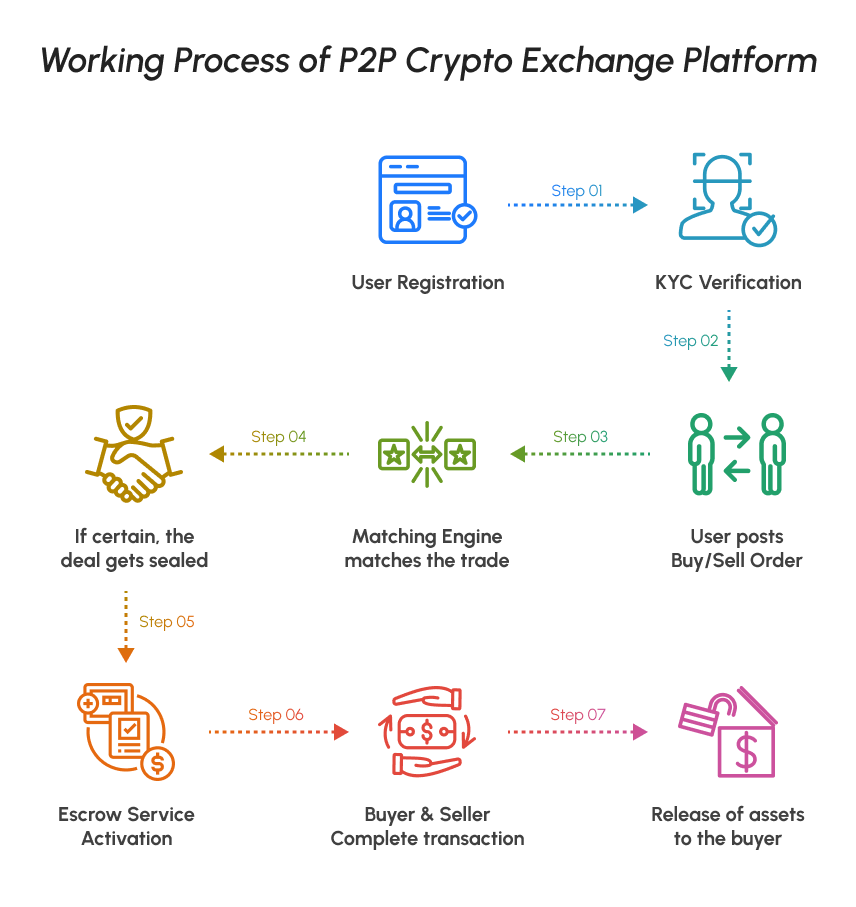
A user signs up and completes KYC, so the platform knows who is trading. Verified users can then post a buy or sell ad, or answer someone else’s ad, with the coin, price, amount and payment method.
When a trade opens, the platform’s escrow locks the seller’s crypto. The buyer pays the seller directly and marks the trade as paid. Once the seller sees the money in their own account, they release the crypto, and escrow sends it to the buyer. If something goes wrong, either side can raise a dispute. This flow is what makes peer-to-peer crypto exchanges safe for strangers to use.
P2P Exchange or Centralized Exchange: Which Should You Start?
Many founders searching for how to create a crypto exchange have not yet chosen between the two. Here is the difference in practice:
| P2P exchange | Centralized exchange | |
| Who sets the price | Users, in their ads | The order book |
| How fiat moves | Directly between users | Through your bank or payment partners |
| Liquidity you need at launch | Verified merchants | Market makers and deep order books |
| Main risk | Payment fraud and disputes | Custody and hot wallet security |
| Typical first market | Regions with limited banking access to exchanges | Regions with strong banking partners |
If you want order books, margin and futures, read our guide on how to start a cryptocurrency exchange. Many platforms start with P2P and add a spot market later.
Types of P2P Crypto Exchanges (Choose Your Model Before You Build)
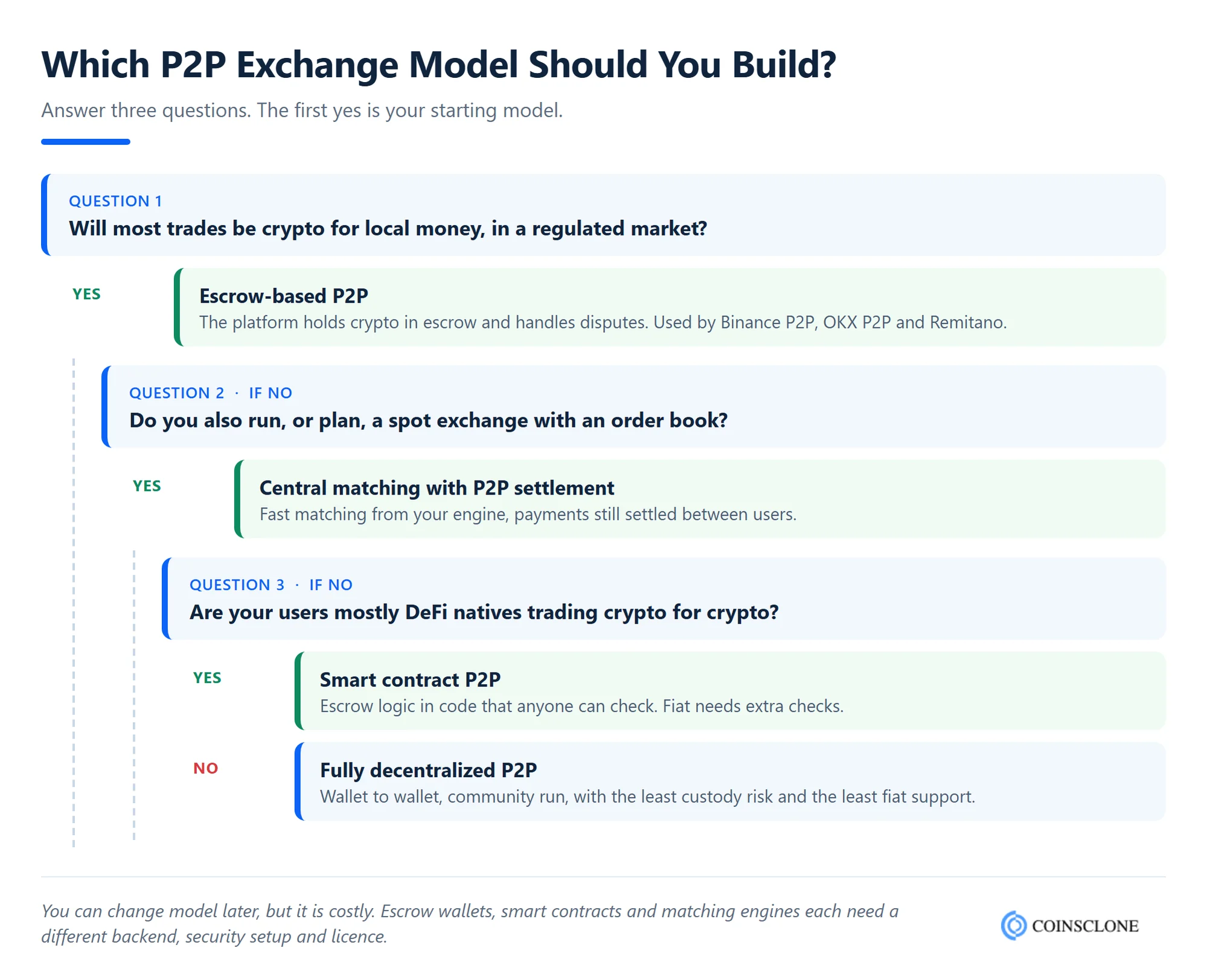
Before you build anything, decide which model your platform will run on. This choice shapes your tech stack, security, compliance and how far you can grow.
1. Escrow-Based P2P Exchanges
This is the most common model, used by Binance P2P, OKX P2P and Remitano. The platform locks the seller’s crypto in an escrow wallet until the buyer pays. Once the seller confirms payment, the crypto is released.
Best for:
- First-time founders
- Platforms focused on fiat-to-crypto trades
- Regions with high fraud risk, where the platform must enforce trust
Strengths:
- More trust between strangers
- Strong dispute handling
- A clear audit trail for regulators
Limitations:
- Needs very strong backend security
- Escrow wallets must be protected at all times
Choose this model if your users rely on the platform to enforce trust.
2. Smart Contract-Based P2P Exchanges
Here, a smart contract replaces the platform’s escrow wallet. The contract locks the crypto and releases it when the agreed conditions are met.
Best for:
- Founders serving DeFi users
- Platforms that value openness and automation
- Token-based or cross-chain projects
Strengths:
- Anyone can check the escrow logic
- No manual escrow handling
- Lower running costs
Limitations:
- Fiat payments need off-chain checks, often called oracles
- A smart contract bug can be costly
- Harder to fit strict regulated markets
Choose this model if your users prefer code-based trust over platform trust.
3. Central Matching With P2P Settlement
In this hybrid model, the platform matches orders centrally for speed, but users still settle the payment with each other. Think of it as exchange speed with P2P settlement.
Best for:
- Platforms expecting high-volume traders
- Real-time pricing
- Exchanges that offer both spot and P2P markets
Strengths:
- Very fast matching
- Easy to add new products
- Built to grow globally
Limitations:
- Needs an advanced matching engine
- More complex compliance
This model gives you the performance of a normal exchange while keeping the P2P payment flow.
4. Fully Decentralized P2P Exchanges
Users trade wallet to wallet with no company controlling custody, matching or settlement. Open protocols replace the platform’s backend.
Best for:
- Web3-native founders
- Community or DAO-run projects
- Markets where privacy matters most
Strengths:
- No custody risk
- Full openness
- Hard to censor
Limitations:
- Hard to fit into regulation
- Few fiat payment options
- Less liquidity than other models
Choose this model if you want a fully user-owned trading network.
Step-by-Step Guide: How to Start a P2P Crypto Exchange
Starting a P2P crypto exchange does not begin with code. It begins with clear decisions about your market, model and rules. These eight steps follow the order that founders and product teams actually use.
Step 1: Define Your Business Model
Your business model decides your revenue, liquidity plan, features, compliance scope and target users. Make these choices before any technical work:
Fee Structure
Decide how your platform earns:
- Trading fee: a percentage or flat fee per trade
- Escrow fee: a charge for holding funds during trades
- Merchant fees: for verified merchants and featured ads
- Withdrawal fees: on crypto leaving the platform
- Premium verification: paid badges or higher limits
Keep fees in line with local rivals, or traders will stay where they are.
Asset Selection
P2P exchanges grow when they support the coins users actually trade. Start with:
- High-demand coins: BTC, ETH, USDT and USDC
- Local currency pairs for your region
- A few extra coins once you have liquidity
More coins mean more compliance and more liquidity to find, so start small.
Target Geography
Everything changes with your region:
- Payment methods
- Local KYC rules
- Banking partners
- Licences
- Liquidity sources
Start where P2P demand is high, such as India, Nigeria, Vietnam, the UAE or Turkey, then grow outward.
Step 2: Choose the Right Architecture
Your architecture decides how well the platform scales and how easily it changes over time.
Modular Design
Keep each core part, such as escrow, disputes, wallets and matching, separate. You can then upgrade one part without taking the platform down.
Scalable Infrastructure
P2P volumes jump in bull markets. Plan for:
- Load balancing
- Auto-scaling servers
- Fast message queues
Microservices
Split the platform into independent services, such as:
- User service
- Trade service
- Payment service
- Wallet service
- Escrow service
- KYC service
This makes problems easier to find, updates faster to ship, and failures easier to contain.
API-First Design
Your platform should offer APIs for:
- Wallet connections
- Fiat payment gateways
- Liquidity providers
- Compliance services
- Merchant apps
An API-first design lets you add partners and apps from day one.
Step 3: Finalize Your Feature Set
Your P2P exchange succeeds when its features lower risk and raise trust. These are the core features; see our P2P crypto exchange script for the full list.
- Ads marketplace or matching engine: connects buyers and sellers
- Escrow management: locks crypto until payment is confirmed
- Wallets: hot, warm and cold storage layers
- Dispute resolution: protects users from fraud
- KYC and AML tools: meet local rules
- Arbitration: human review for complex disputes
Start lean, then add advanced features as liquidity grows.
Step 4: Choose the Right Tech Stack
A serious P2P exchange needs tools built for many users at once and for high uptime.
Backend
- Node.js, Go or Java, for busy, asynchronous workloads.
Frontend
- React or Vue for the web, and React Native for mobile apps.
Blockchain Layer
- Bitcoin, Ethereum, TRON and BNB Chain, the networks most P2P users need for BTC and USDT.
Database
- PostgreSQL for trades and balances, MongoDB for flexible data such as chat logs.
Matching Engine
- C++ or Rust for fast matching, needed only in the hybrid model.
Step 5: Build the Liquidity Layer and Escrow Engine
This is where trust is won or lost.
Liquidity Layer
Without liquidity, your P2P exchange is an empty market. Your options include:
- Verified merchants who post ads all day
- Market makers
- External liquidity providers
- Links to other P2P markets, if your model allows
Escrow Engine
Your escrow flow must be tightly controlled:
- Crypto lock when a trade opens
- Payment confirmation by the seller
- Release rules
- Timeouts that cancel stale trades
- Fraud rules per payment method
- Escalation to arbitration
A secure escrow engine is the backbone of every successful P2P exchange.
Step 6: Compliance, KYC and Regional Rules
P2P exchanges often serve several countries, so compliance must come first, not last.
United States: money services business (MSB) registration with FinCEN, AML programmes and state money transmitter licences.
UAE: licensing through the relevant regulator, such as VARA in Dubai, plus KYC, AML and audits.
European Union: a MiCA licence covers custody, exchange services, AML and reporting across the EU.
India: crypto service providers must register with the Financial Intelligence Unit and follow its AML rules.
Map your compliance needs to your regions before development starts, to avoid costly rebuilds. Paxful’s closure, which it linked to the cost of fixing compliance, shows how expensive late fixes can be.
Step 7: Development, Deployment and Testing
Now you build and test.
- Backend development: core services, wallets, escrow and APIs
- Frontend development: dashboards, trade pages and dispute flows
- Security hardening: penetration tests, transaction monitoring and rate limits
- Testing: functional, load, integration and user acceptance tests
- Deployment: containers with automated release pipelines
Test the escrow and dispute logic hardest, because that is where money is at risk.
Step 8: Launch and Grow
Most founders underestimate this step. Liquidity, not code, decides your success.
Your launch plan should include:
- Merchant onboarding: verified sellers who create liquidity from the first day
- Referral programmes: rewards that bring in new users
- Community: Telegram, Discord and local groups
- Influencer partners: local crypto creators and traders
- Local payment methods: the ways your users already pay
- Step-by-step expansion: win one region, then move to the next
Key Approaches to Start a P2P Crypto Exchange Platform
There are two main ways to build your platform. The right one depends on your budget, timeline and how unique your product must be.
| Approach | Typical timeline | Best for |
| White label P2P platform | 4 to 8 weeks | Testing one market fast |
| Customised P2P script | 8 to 12 weeks | Most startups |
| Custom multi-market build | 12 to 16 weeks | Funded teams and fintechs |
| Fully from scratch | Many months | Large teams with unique needs |
The first three timelines are Coinsclone’s published ranges. Mobile apps with app store review add time.
Developing a P2P Crypto Exchange From Scratch
Here, your team designs and codes every part of the platform, from the interface to the escrow and security. It gives you complete freedom, but it takes the longest and costs the most, and every part must be tested from zero.
Best suited for: businesses with long-term plans, large budgets and time to spare.
White Label P2P Exchange Software
A white label P2P exchange is ready-made software that you brand and customise. It comes with the core features already built and tested, which saves time and lowers risk. You focus on your brand, your markets and your users.
Best suited for: startups that want a balance of speed, cost, security and customisation.
Business Benefits of Starting a P2P Crypto Exchange
A P2P exchange brings several business advantages:
Global Reach
P2P platforms can serve users in many countries, as long as you hold the right licences and support local payments.
Market Opportunity
With Paxful and LocalBitcoins gone, many users are still searching for the best P2P crypto exchange for their region. A trusted local platform can win them.
Many Revenue Streams
You can earn from trading fees, withdrawal fees, merchant fees, premium plans and promotions.
Your Own Community
A safe, well-run exchange builds a loyal community of traders who bring their friends.
Full Control of the Platform
You choose the logo, design, features and rules, so the platform reflects your brand.
Challenges in Creating a P2P Crypto Exchange and How to Overcome Them
Every new P2P exchange faces the same hurdles. Here is how to handle each one.
Regulatory Challenges
Crypto rules change often and differ by country. Getting them wrong can lead to bans, fines or legal action.
Tip: work with crypto-focused lawyers from the start, and secure licences before you launch in each region.
Scaling
As users and trades grow, your servers can struggle.
Tip: use cloud infrastructure that scales automatically, and design the backend for growth from the start.
AML and KYC Friction
KYC and AML checks are required, but long checks frustrate users.
Tip: use trusted third-party KYC providers and tiered limits, so users can start small and verify more as they trade more.
Technical Problems
Downtime, bugs, slow transactions and failed integrations all hurt trust.
Tip: work with an experienced team that tests thoroughly and supports the platform after launch.
Building Trust
New platforms struggle to win trust in a market full of scams.
Tip: be open about your team, security and licences. Show reviews, trade counts and dispute outcomes.
Price Swings
Crypto prices move fast, which can worry traders mid-trade.
Tip: lock the trade price when the trade opens, and let ads follow the market price automatically.
Common Mistakes When Starting a P2P Crypto Exchange
- Launching with no merchants: an empty ad board sends users straight back to Binance P2P. Line up verified merchants before launch.
- One set of rules for every payment method: reversible payments need longer holds and lower limits than instant bank transfers.
- Leaving compliance for later: retrofitting KYC, monitoring and record keeping costs far more than building them in.
- Serving too many countries at once: each country brings its own payments, rules and support needs. Win one first.
- Slow dispute handling: a trade stuck for days loses you both users. Set response times and staff for peak hours.
What Affects the Cost of Starting a P2P Crypto Exchange?
Many factors shape your budget. The biggest are:
- Your build method: white label, customised script or from scratch
- The tech stack
- Security and audits
- Features and payment methods
- Licences and legal work in each region
- The number of countries you serve
- The blockchains you support
- Marketing and merchant incentives
- UI and UX work
- Maintenance and upgrades after launch
- The size and experience of your team
- Your timeline and scaling needs
Start with the essential features, then expand as users and revenue grow. Whichever route you pick, match your budget to your first market, not to every market you might serve later.
Create a 10X Faster Secured P2P Cryptocurrency Exchange
Cost-effective, White-Label Solution, Premium Features, Customizable. Live Demo Available.
How Does a P2P Crypto Exchange Make Money? The Revenue Model
P2P exchanges earn in several ways:
Transaction Fees
The main source of income. A small fixed amount or percentage is charged on each completed trade.
Merchant and Listing Fees
Verified merchants pay for featured ads and badges. Once you have an audience, token projects may also pay to be listed.
Premium Features
Subscription plans can unlock higher limits, lower fees or priority support.
Advertising and Partnerships
Partner promotions, co-marketing and sponsored placements add income.
Referrals
Referrals do not earn money directly, but they bring in new traders, which grows fee revenue.
How do users make money on a P2P market? Merchants earn the spread between the price they buy at and the price they sell at, often by serving local payment methods that others do not. Your fees and tools should make merchants want to trade on your platform.
P2P Exchange Launch Checklist
Use this list before you open to the public:
- Licences or registrations confirmed for every launch market
- KYC, AML screening and transaction monitoring live and tested
- Escrow, timers and dispute flow tested with real payment methods
- Fraud rules set per payment method, with limits for new users
- At least 20 to 50 verified merchants ready with live ads
- Support team, dispute staff and response times in place
- Hot and cold wallet limits set, with an incident plan
- Terms of service, dispute policy and privacy policy published
KPIs to Track After Launch
- Trade completion rate: the share of opened trades that finish. Falling rates signal payment or trust problems.
- Dispute rate and resolution time: keep disputes rare and settle them fast.
- Merchant spread: how far merchant prices sit from the market price. Lower spreads mean a healthier market.
- Active merchants per payment method: thin coverage on a popular method loses users.
- New user conversion: how many sign-ups complete KYC and a first trade.
- Revenue per trade: fees earned against the cost of support and disputes.
To Conclude
Starting a P2P crypto exchange is an ambitious but rewarding project. This guide covered the models, steps, costs, challenges and revenue streams. Success comes down to execution, and that is where the right technology partner makes the difference.
Coinsclone is a leading P2P crypto exchange development company that has delivered more than 350 blockchain platforms for over 200 clients. We build scalable, compliant P2P exchanges and support them after launch, so your idea becomes a working business.
Ideas are easy. Building them is hard. With Coinsclone, you do not have to do it alone.
How to Start a P2P Crypto Exchange — the Smart Way!
Building your own exchange doesn’t have to take forever. With our MVP Launch System, you can go live 90% faster.
- No Code Setup: Wallets, escrow, and matching engine — ready to go.
- Peer-to-Peer Freedom: Enable direct crypto trading between users — securely.
- Custom Branding: Your name, your design, your market.
- Revenue Ready: Earn from trade fees, ads, and premium features.
Get a free branded P2P exchange demo in just 48 hours — before spending a cent.
Book a Free Demo and see how we can take you from idea to live P2P exchange in just 8-12 weeks.
Frequently Asked Questions
How do I start a P2P crypto exchange?
Pick your target market and business model, choose an operating model such as escrow-based, then build or license the platform. Add escrow, KYC and fraud controls, get the licences your market needs, and launch with verified merchants who provide liquidity.
How much does it cost to start a P2P crypto exchange?
It depends on your build method, features, payment methods, licences and the number of countries you serve. A white label platform costs far less than a custom build. Ask a development team for a quote based on your scope.
How long does it take to launch a P2P crypto exchange?
A white label P2P exchange can launch in about 4 to 8 weeks. A customised build takes 8 to 12 weeks, and a custom multi-market platform about 12 to 16 weeks.
Do I need a licence to run a P2P crypto exchange?
In most countries, yes. For example, India requires registration with the Financial Intelligence Unit, the EU requires a MiCA licence, and the US requires MSB registration and state licences.
Which P2P model is best for a new exchange?
The escrow-based model suits most new exchanges. It is proven, easy for users to understand, and gives the platform the control it needs to handle fraud and disputes.
How do P2P crypto exchanges make money?
Mainly from trading fees on completed trades, plus merchant fees, withdrawal fees, premium plans and partnerships.