As of 2025, the growth of crypto has reached new heights, changing the way we make transactions. Because of this growing interest, many startups want to create a crypto token, which has become the best option for entering the crypto space.
Creating a crypto token will help individuals raise funds for their new projects. Moreover, crypto tokens are the major resource to grab innovations both in blockchain and business. Also, by developing a crypto token, one can use it for services, giving access and gaining a high return on investment. Overall, token creation can benefit those looking to raise funds for new projects, enter the crypto space, or represent real-world assets on the blockchain. If you are one of the mentioned, then this blog covers everything.
In this article, let us have an overview of a crypto token and we’ll explore how to create a crypto token in 10 simple steps. Now we shall start with…
See How Our MVP System Can Launch Your Crypto Token Faster
Crypto Token Creation — done right.
- MVP System : Launch your token 90% faster with ready-to-use frameworks.
- Smart Contracts & Wallets : Pre-built, secure, and customizable — no coding needed.
- Brand & Customization : Your token, your logo, your ecosystem.
- Revenue Engine : Earn through token sales, staking, and DeFi integrations.
Get a free branded demo of your token in 48 hours — before you invest a cent.
Book a Free Demo to discover how our Crypto Token Creation platform can take you from idea to live token in just 1–2 weeks.
What is a Crypto token and How Does it Work?
A crypto token is referred to as a digital asset that represents a specific value within the blockchain ecosystem. It is often used to raise funds for new projects on crowdfunding platforms and can also be used as an investment, to store value, or to make purchases. The key difference between coins vs tokens is that coins have their own blockchain, while tokens are created on top of an existing blockchain.
So, coins run on their own network, but tokens are made using smart contracts on another network, which makes tokens easier and faster to create than coins. But tokens leverage the security infrastructure of a parent blockchain.
Crypto tokens use blockchain technology to track who owns them and to help with transactions. When a token is created, a smart contract defines its rules and functions. These rules explain how the token can be sent, used, or exchanged. Also, the transactions are recorded on the blockchain, which provides transparency and security.
People can use tokens for different purposes, such as accessing decentralized applications (dApps), participating in governance, or showing ownership of digital or physical assets. The use cases of a particular token depend on its type. In the next section, we explore the…
Types of Crypto tokens and their purpose
Crypto tokens have become an integral part of the blockchain ecosystem. Also, they represent different forms of digital assets. These tokens are broadly classified into Non-Fungible Tokens(NFTs) and Fungible Tokens. Each has its purpose on the blockchain. Further classifications are…
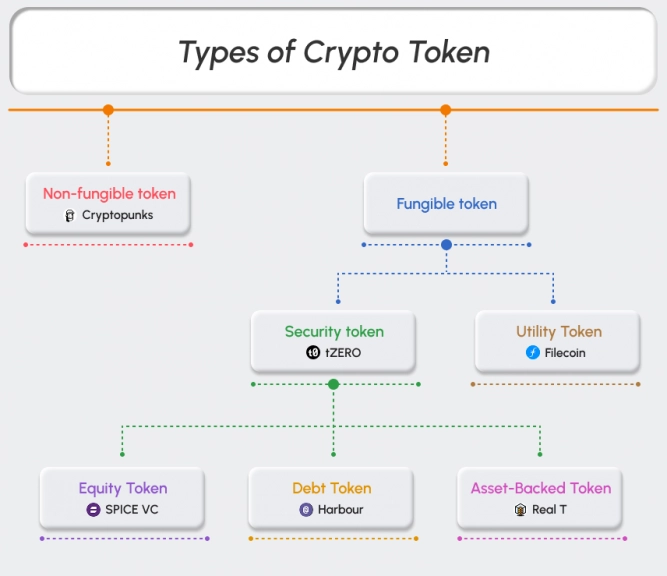
Non-Fungible Tokens (NFTs)
Unique digital assets that embody ownership or proof of authenticity for a particular item, whether digital or physical. They are non-fungible, that is, they cannot be exchanged for one another,
For example, CryptoPunks (a set of 24×24 pixel art images recognized for being among the first digital collectibles).
Fungible Tokens
Tokens that are interchangeable with one another, meaning one unit is identical in value and kind to any other unit of the same token. This is the opposite of an NFT. This is a category, not a specific token, but it encompasses many others like Utility Tokens, Security Tokens. Let’s see that..
Utility Tokens
Users of a utility token are entitled to specific product or service access within a blockchain ecosystem, just like holding a digital key or a voucher. They are mostly used for operational purposes such as paying for transaction charges, accessing exclusive content, or voting for the future development of the project, and therefore, do not indicate ownership.
Examples include FIL (for Filecoin storage) or BAT (for viewing ads in the Brave browser).
Security Tokens
A security token is a virtual coin that signifies the ownership rights in an external, tangible asset or an entity, similar to stocks or bonds. The tokens are subject to compliance with securities law, and the intention is to fundamentally shift financial instruments from being limited to over-the-counter market-trading or private placements into easily traded and fractionally owned assets through blockchain. They can grant holders rights like dividends, profit sharing, or voting power, such as tokenized shares in a venture capital fund.
Equity Token
An Equity Token is a digital share in a company, granting the holder ownership rights similar to traditional stock. These often provide rights like voting on company matters and receiving a share of profits or dividends, if applicable.
For example, SPICE VC tokenizes ownership in a venture capital fund, allowing global, fractional investment into its portfolio companies.
Debt Token
A Debt Token represents a loan or bond, making the holder a creditor who is owed principal repayment plus interest by the issuer. These tokens use smart contracts to automate interest payments and enforce the terms of the underlying debt obligation.
For Example, Platforms like Harbour (or projects utilizing similar structures) issue tokens representing debt instruments for streamlined lending and trading.
Asset-Backed Token
An Asset-Backed Token obtains its pricing from an asset that can be tangible or intangible, which is kept in reserve. The main purpose of the token is to make it possible to own a fractional part of and to get liquidity for assets that are usually considered illiquid. RealT token creates the opportunity for investors to buy virtual stakes in physically owned rental properties.
Now that you know the types and purposes of crypto tokens, the next step is to understand how these tokens come into existence. Let’s move ahead and explore the…
10-Step Process to Create a Crypto Token
The Development steps to create a crypto token offers businesses and individuals a new way to raise funds, incentivize users, or even build decentralized applications. Also, understanding the process of crypto token creation is crucial for ensuring a smooth and successful launch.
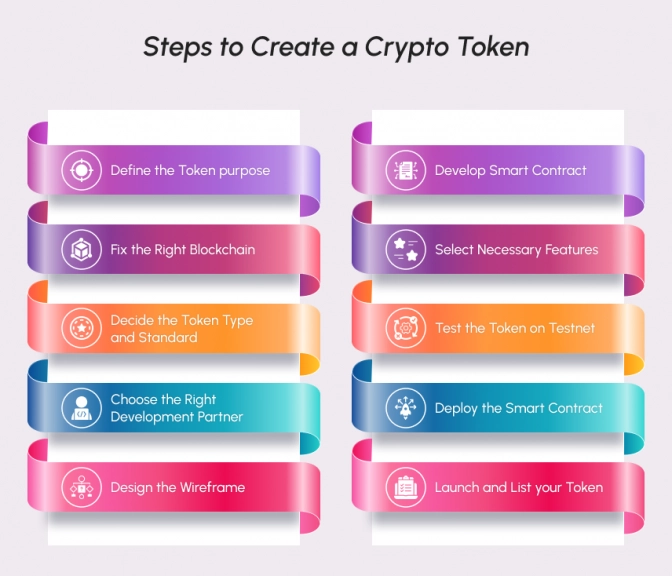
Now, let us have a detailed step-by-step process to help you navigate through this complex journey.
Defining the Token Purpose
Clearly defining the goal of a crypto token is the first stage in its creation. A clear goal guarantees that the token’s features complement your target market and company objectives. A token, that is for Initial Coin Offerings (ICOs) or Initial DEX Offerings (IDOs). For example, ought to be created with investor incentives and ease of distribution in mind. On the other hand, governance tokens ought to include decision-making processes for community involvement, whilst utility tokens ought to emphasize compatibility and usability.
Creating a crypto token thorough tokenomics model is also essential. This entails choosing the distribution plan, token quantity, and holder incentives. Also, the potential and usefulness of the token may be clearly understood by stakeholders by creating a thorough whitepaper that details these features.
Choosing the Right Blockchain
Choosing the right blockchain is essential because it has a direct impact on the token’s functioning, transaction speed, scalability, and security. Despite its high transaction costs, Ethereum is a well-liked option because of its strong ecosystem and smart contract features.
As an alternative, Binance Smart Chain (BSC) is perfect for DeFi projects since it provides quicker and more affordable transactions. Other noteworthy choices are Cardano for its safe architecture, Polygon for lower transaction costs, and Solana for scalability.
Transaction speed, security features, developer community, and future scalability are all important considerations while making this choice. You can choose the blockchain that best suits your technological needs and user requirements by carrying out a full comparison investigation.
Also Read: Top Blockchain Platforms to Create and Launch Your Token
Deciding the Token Type and Standard
To specify its functions and compatibility, the right token type and standard must be chosen. ERC-20 is a widely accepted standard for fungible tokens used in DeFi and utility applications on Ethereum. Usually, NFTs use the ERC-721 standard to represent unique digital assets. ERC-1155 supports both fungible and non-fungible tokens, making it perfect for gaming and multi-asset applications, whereas BEP-20 is the Binance Smart Chain equivalent, providing quick and affordable transactions.
Selecting the appropriate standard will be aided by examining the token’s intended use. Making the ideal choice can be further ensured by speaking with blockchain specialists.
Selecting a Development Partner
The success and durability of your token depend on how you create it. You can choose to work with a crypto token development company, hire a developer on your own, or create the token yourself if you have technical know-how.
Partnering with a development company is the best long-term option, even while hiring a developer or making the token yourself could work for tiny projects. The crypto token development company offers complete solutions that cover design, development, testing, and deployment. To guarantee a safe and seamless token launch, they also provide thorough security checks and quicker development schedules.
It is crucial to assess the experience and portfolio of possible development partners. Selecting a development partner with a track record of successful token development can greatly boost the outcome.
Designing the Wireframe
A wireframe provides a graphic representation of your platform UI and token ecosystem. It assists in outlining the smart contract features, wallet and exchange integration points, and user interface flow.
This procedure can be streamlined by using wireframing software such as Adobe XD or Figma. Working closely with designers and developers guarantees that the wireframe offers a smooth user experience and accurately reflects the project’s needs.
Developing the Smart Contract
Smart contracts are the backbone of any crypto token, defining its rules, conditions, and functionalities. The generation and distribution of tokens, transfer methods, features for minting and burning, and, if appropriate, governance functions are all crucial.
Writing secure and clean code is essential to preventing vulnerabilities. The dependability of the contract can be further increased by adhering to industry best practices and carrying out frequent code reviews. Hiring seasoned blockchain engineers and utilizing frameworks like Hardhat and Truffle improves effective development.
Incorporating Necessary Features
Adding necessary features improvises the functionalities and user experience of the token. Easy access for users is ensured by wallet compatibility with well-known choices like MetaMask and Trust Wallet. Strong security procedures guard against vulnerabilities and hacks. While governance elements let token holders take part in decision-making, staking and incentive systems promote user involvement and token holding.
It is crucial to prioritize features according to project objectives and user needs. Organizing user feedback sessions can guarantee a user-centric approach and assist in identifying extra requirements.
Testing the Token on Testnet
To make sure the token functions effectively and securely, testing is an essential step. While security testing finds and addresses vulnerabilities, functional testing confirms that all token functionalities operate as anticipated. Performance testing evaluates how well the token manages large transaction volumes.
Comprehensive testing involves deploying the token on a Testnet environment and utilizing testing frameworks such as Ganache and Remix. To guarantee a strong and dependable token, any issues must be documented and fixed.
Deploying the Smart Contract
After successful testing, the smart contract is ready for deployment on the chosen blockchain network. This step involves double-checking contract configurations, executing the deployment using tools like Remix or Truffle, and verifying the contract on the blockchain explorer.
Maintaining a backup of the deployed contract is crucial for future reference. Last but not least, keeping stakeholders informed about the deployment keeps them interested and informed about the project’s development.
Launching and Listing Your Token
Making your token accessible to users is the final step. This involves conducting marketing campaigns to attract users and investors, listing the token on popular cryptocurrency exchanges, and engaging with the community to promote adoption.
Partnering with marketing agencies can ensure effective campaigns while submitting applications to exchanges helps increase the token’s visibility and accessibility. Building a strong community around the token fosters loyalty and long-term engagement.
Overall, the steps to create a crypto token involve a careful and structured process from planning and development to deployment and launch. Once the token is successfully launched, the next important part is understanding where and how it can be used. This is where the real value of the token comes into play. Let’s see it..
Applications of Crypto Tokens in Various Industries
Crypto tokens have evolved as more than the simplest digital assets. They are now across many industries, supporting the transactions, digital value representation, and new business models being enabled. With the provision of programmable, verifiable, and transferable units of value, tokens are leading in the new era of how organizations interact and operate in the digital economy.
1. Finance & Banking
Crypto tokens are playing a major role in modern financial infrastructure as they have simplified the flow between users, institutions, and platforms very easy. They are also responsible for the automation of settlements and the provision of fintech services without relying too much on the traditional intermediaries.
- International remittances
- Stable-value digital currencies
- On-chain lending & credit markets
- Digitally represented investment product.
2. Gaming & Metaverse
In virtual environments, tokens function as reward assets and participation units that users can trade or redeem. This allows players to earn actual value through gameplay and engage in evolving digital economies.
- Game reward currencies
- Tradeable in-game items
- Player marketplaces
- Virtual world economy participation
3. Real Estate
Tokens make it easier to divide and represent ownership claims in real estate projects. This allows individuals to invest with smaller amounts and exit positions more smoothly compared to traditional property ownership.
- Split investment units
- Digital proof of property interest
- Simplified buying/selling process
- Lower entry cost for investors
4. Supply Chain & Logistics
Tokens act as digital markers that record where an item has been and who handled it. This reduces manual verification and helps companies identify the origin, handling, and condition of goods accurately.
- Product status updates
- Verified material origins
- Automated logistics tracking
- Supplier validation records
5. Healthcare
Crypto tokens help hospitals and labs manage data-sharing rights with accuracy and accountability. They prevent unauthorized access while enabling faster record verification when needed.
- Medical record access control
- Patient identity authentication
- Lab report verification
- Cross-institution data exchange
6. Entertainment & Media
Tokens allow creators to form direct economic relationships with their audiences. Earnings, access rights, and royalty distribution can be managed transparently through smart contracts.
- Fan access passes
- Creator reward systems
- Usage-based royalty allocation
- Unlocks exclusive content
Presently, tokens are the driving force of digital economies across various sectors. If you’re planning to implement a token in your business, you should hire experienced crypto token developers to ensure a secure and scalable launch. Partnering with a trusted crypto token development company can further streamline the process and ensure successful deployment. Coinsclone is a leading development partner known for its expertise and end-to-end token development services.
Why Create a Crypto Token with Coinsclone?
Crypto Token Development with Coinsclone is an efficient way to enter the blockchain space due to our expertise in blockchain development, customizable token features, and secure smart contract deployment. We offer end-to-end services, including token creation on popular blockchains like Ethereum and Binance Smart Chain, regulatory compliance support, marketing, and ongoing technical maintenance. By using our services, you can save time and development costs while ensuring a secure, scalable, and well-supported token launch tailored to your project needs.
Create Your Crypto Token Now!
Cost-effective. Exclusive Features. Asset Building. Higher Profits!
Frequently Asked Questions
1. How much does it cost to create a crypto token?
The cost to create a crypto token may depend on various factors such as the blockchain network, token standard, features, and security requirements.
2. How long does it take to create and launch a crypto token?
A standard token can be created in a few hours to a few days. However, tokens that require platform integration, utility functions, audits, and marketing may take 1–2 weeks, depending on the project scope.
3. Can I list my crypto token on exchanges after development?
Yes. The token that you have developed can be listed on the decentralized exchanges (DEXs) such as Uniswap and PancakeSwap, as long as it is deployed correctly. Besides, if you have a strong brand and compliance, you can even apply for listing on central exchanges (CEXs).
4. What security measures should I follow when creating a crypto token?
If you want your token to be safe, then conduct smart contract audits as a matter of course, adhere to the use of recognized token standards (like ERC-20 or BEP-20), and empower the multi-signature wallets. In addition, role-based access control and continuous security.
5. What is a smart contract, and why is it important for a crypto token?
A smart contract is a self-executing code that is stored on the blockchain and determines the ways to your token creation, transfer, and supply rules. It makes the system fair, automated, and secure by enforcing the rules without requiring a central authority or manual control.
See How Our MVP System Can Launch Your Crypto Token Faster
Crypto Token Creation — done right.
- MVP System : Launch your token 90% faster with ready-to-use frameworks.
- Smart Contracts & Wallets : Pre-built, secure, and customizable — no coding needed.
- Brand & Customization : Your token, your logo, your ecosystem.
- Revenue Engine : Earn through token sales, staking, and DeFi integrations.
Get a free branded demo of your token in 48 hours — before you invest a cent.
Book a Free Demo to discover how our Crypto Token Creation platform can take you from idea to live token in just 1–2 weeks.