
Many crypto users still think coins and tokens are the same thing. They are not. Both live on a blockchain and both can be bought, sent and traded, but they are built in different ways and they do different jobs. The coin vs token question comes down to one test: does the asset run its own blockchain, or does it ride on someone else’s?
This guide explains that test in plain words, with real 2026 examples from the top of the market. You will learn how to check any asset in a few seconds, why every token needs a coin to move, how regulators now sort the two, and which one makes more sense if you plan to launch your own crypto project.
In this guide:
- The one rule that splits coins from tokens, plus a side-by-side table.
- A quick way to check any crypto using its contract address and fee coin.
- Why you need ETH or TRX in your wallet to send USDT.
- How the SEC, CFTC and EU rules treat coins and tokens in 2026.
- Whether your project should build a coin or a token, and how long each takes.
Understand the Difference: Crypto Coins vs Tokens
Confused between coins and tokens? We make it simple.
- Coins:Built on their own blockchain — like Bitcoin or Ethereum.
- Tokens: Created on existing blockchains — for DeFi, NFTs, and utilities.
- Utility & Use Cases:Learn how tokens fuel ecosystems while coins power networks.
- Development Insight:Know when to launch your own coin or create a token instead.
Get a free consultation on what’s right for your project — coin or token — before you invest a cent.
Book a Free Session and see how our experts can help you choose, create, and launch your crypto project the smart way.
Coin vs Token: The Key Differences
The short answer: a coin is the native asset of its own blockchain, while a token is built on top of a blockchain that already exists. Bitcoin (BTC) is a coin because it runs on the Bitcoin network. Tether (USDT) is a token because it lives inside smart contracts on networks like Tron and Ethereum.
Everything else follows from that rule. A coin pays the fees on its network and rewards the people who secure it. A token borrows that security and those rails, so it is quicker and cheaper to launch. Here is how the two compare at a glance.
| Point | Crypto coin | Crypto token |
| Blockchain | Has its own (Bitcoin, Ethereum, Solana) | Runs on an existing chain |
| How it is made | Created by the protocol through mining or staking rewards | Minted by a smart contract |
| Network fees | Used to pay gas on its own chain | Needs the host chain’s coin to move |
| Security | Secured by its own miners or validators | Relies on the host chain’s security |
| Supply rules | Set in the protocol code | Set in the token’s contract |
| How many per chain | One native coin per chain | Thousands can share one chain |
| Effort to launch | Months or years, plus a validator network | Weeks, using a standard like ERC-20 |
| Examples | BTC, ETH, SOL, XRP, BNB, DOGE | USDT, USDC, LINK, UNI, SHIB |
What Is A Crypto Coin?
A crypto coin is the native currency of its own blockchain. It is created by the network itself, either as a reward for mining (proof of work) or for staking (proof of stake). Coins work without a central bank or middleman, and they are widely used as a medium of exchange.
The coin also keeps its network running. People pay fees in it, and miners or validators earn it for checking transactions. That is why each chain has only one native coin. Common examples are Bitcoin (BTC), Ether (ETH), Solana (SOL), XRP and Dogecoin (DOGE).
Coins come in two flavours. Some exist mainly as money, like Bitcoin. Others power a smart contract platform, like Ether or SOL, where other apps and tokens are built.
What Is A Crypto Token?
Unlike crypto coins, crypto tokens are created on an existing blockchain network. A token is a smart contract that keeps a list of who owns how much. Tokens are built on big chains like Ethereum, Tron, BNB Chain, Polygon and Solana, and that contract handles each transfer.
Each chain has its own token standards. On Ethereum, ERC-20 covers fungible tokens, ERC-721 covers NFTs and ERC-1155 covers both in one contract. BNB Chain uses BEP-20, Tron uses TRC-20 and Solana uses the SPL standard. The standard you pick decides what the token can do and which wallets and exchanges can support it.
Popular examples of crypto tokens are Tether (USDT), USD Coin (USDC), Chainlink (LINK), Uniswap (UNI), Shiba Inu (SHIB) and Pepe (PEPE). Note that a name can mislead you. USD Coin is a token, and Dogecoin is a coin. The name tells you nothing; the blockchain tells you everything.
How to Tell if a Crypto Is a Coin or a Token
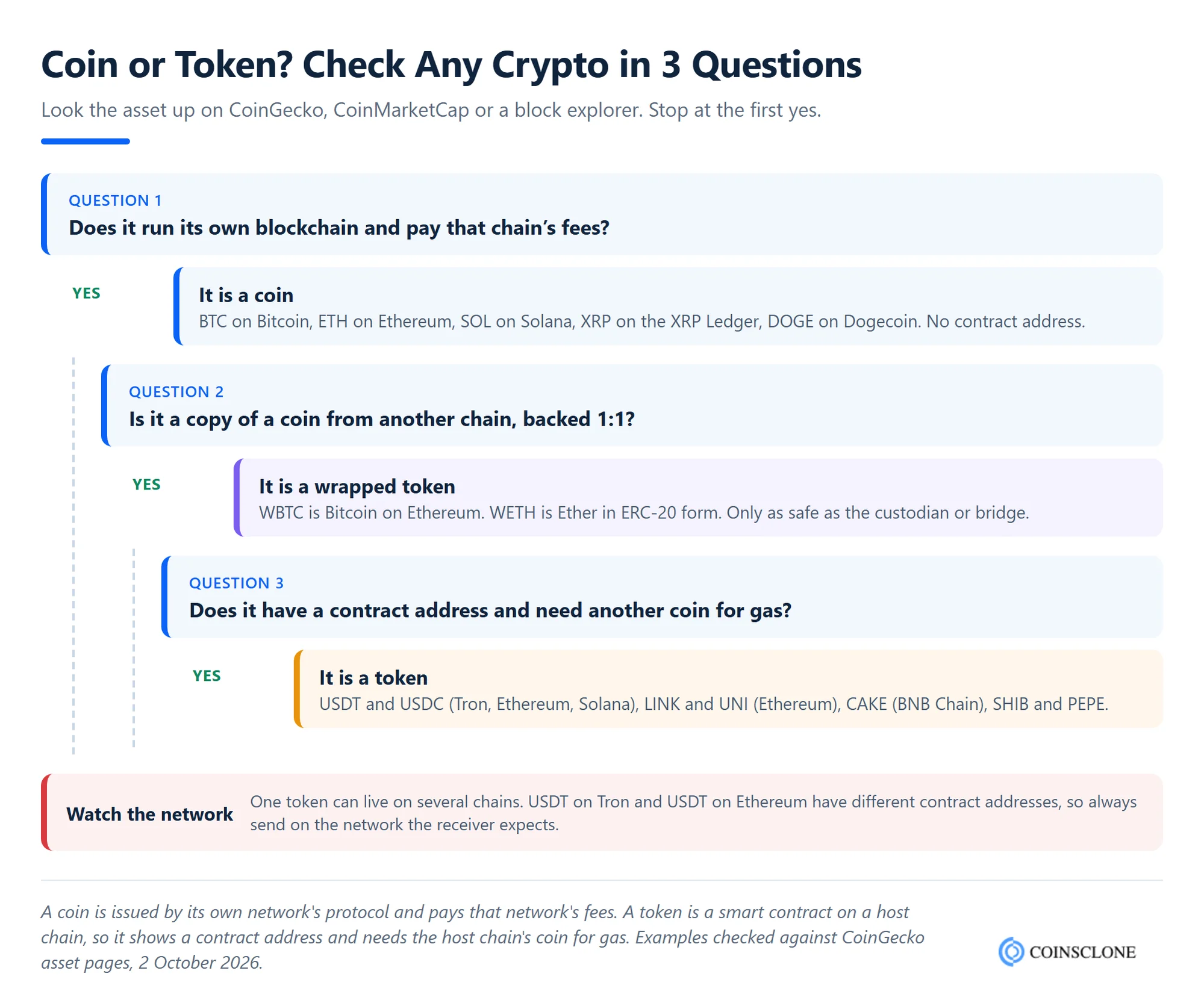
You can check any asset in under a minute. Open its page on CoinGecko or CoinMarketCap, or look it up in a block explorer, and answer three questions.
- Does it run its own blockchain? If the asset pays the fees on its own network, it is a coin. Coins have no contract address on their own chain.
- Is it a copy of a coin from another chain? Then it is a wrapped token. Wrapped Bitcoin (WBTC) lives on Ethereum and is backed 1:1 by real BTC.
- Does it have a contract address and need another coin for fees? Then it is a token. If the page lists contract addresses (for example, on Ethereum or Tron) and you must hold ETH to send it on Ethereum, as with USDT, it is a token.
This check matters before you deposit funds. Many exchanges list the same token on several chains. If you send USDT on Tron to an Ethereum address, the funds can be lost or need a costly recovery. Always match the token, the network and the address.
Why Tokens Need Coins to Move
Here is the practical difference most guides skip. A token cannot pay its own transfer fee. When you send a token, you are really asking the host chain to run the token’s smart contract, and the host chain only takes its own coin as payment.
So if you send USDT on Ethereum, you pay gas in ETH. On Tron you pay with TRX, or with energy and bandwidth that you get by staking TRX. On Solana you pay in SOL. A wallet full of USDT and no ETH is stuck until you top it up.
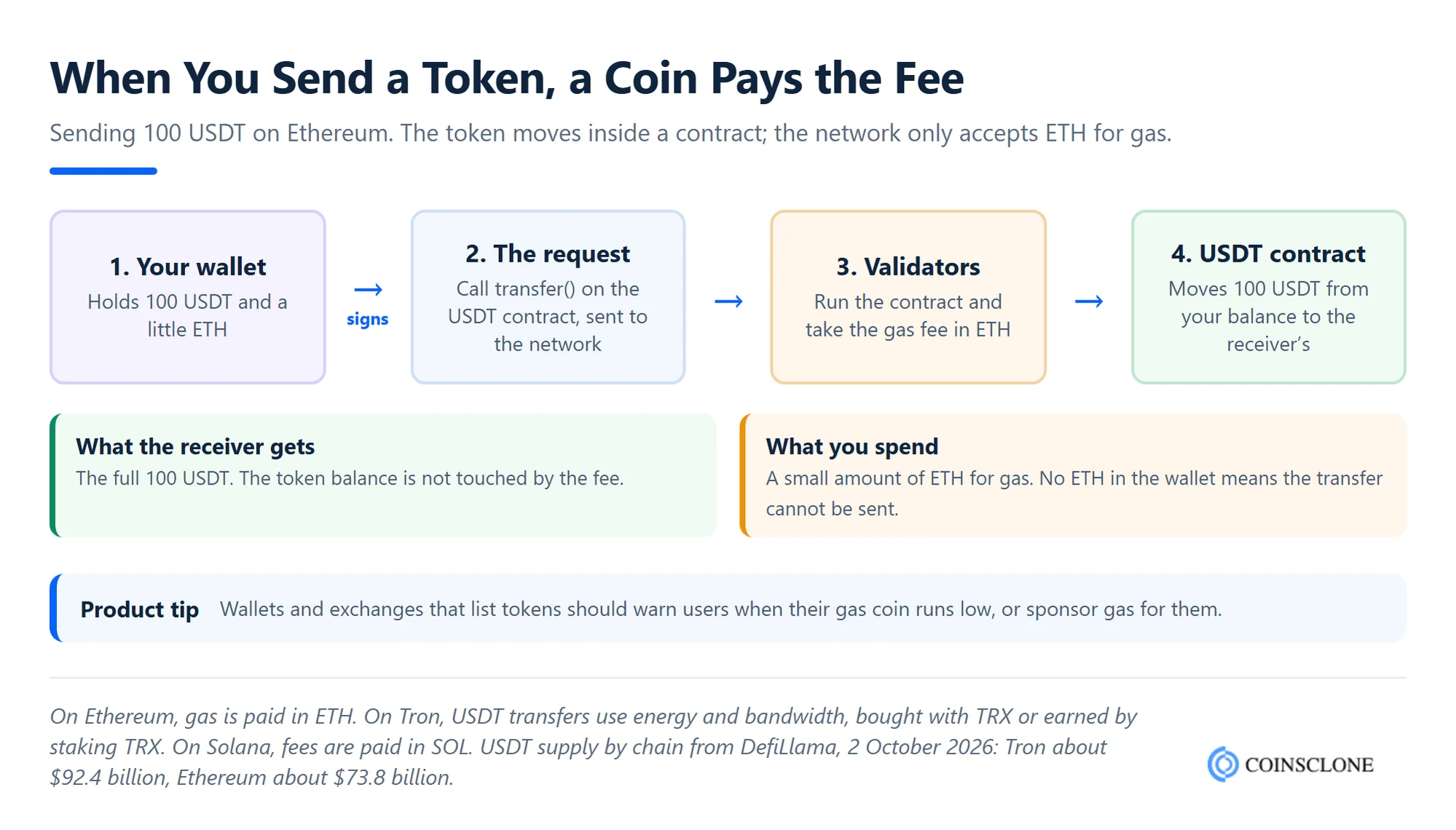
This is also why the choice of chain matters so much for a token. Tron carries about $92 billion of USDT and Ethereum about $74 billion, per DefiLlama’s stablecoin data on 2 October 2026. Users go where fees are low and liquidity is deep. If you are weighing two chains, our ERC20 vs TRC20 comparison breaks down the trade-offs.
Different Types of Crypto Coins and Tokens
Both coins and tokens come in several types, and each type suits a different job. Here are the main ones.
Crypto coins
Crypto coins are built on native blockchains. They fall into three main groups.
Payment coins
Payment coins exist mainly to move and store value. Bitcoin is the best-known example, with a hard cap of 21 million coins. Litecoin and Bitcoin Cash also sit here. Their chains are kept simple on purpose, with few features beyond sending value.
Platform coins
Platform coins power smart contract networks. Ether, SOL, BNB, TRX and ADA all fall into this group. Developers build apps and tokens on these chains, and every action on them burns or spends a little of the native coin as gas. As a result, demand for a platform coin grows with the number of apps and tokens on its chain.
Custom blockchain coins
A custom coin is created from the ground up on a new blockchain built for one business purpose. It comes with its own rules for consensus, rewards and fees. Hyperliquid (HYPE) is a recent example: it runs on a layer 1 chain built for trading. Some custom coins start as forks of an existing chain’s code, which saves time but still needs its own validators.
Crypto tokens
Crypto tokens offer a wide range of business uses, so there are many more types.
Stablecoins
A stablecoin is a token pegged to a reserve asset, usually the US dollar. Despite the word “coin,” nearly all major stablecoins are tokens. Tether (USDT) and USD Coin (USDC) are issued on Ethereum, Tron, Solana and other chains. All stablecoins put together are worth about $313 billion, per DefiLlama. They suit everyday payments, trading and cross-border transfers. You can learn more in our guide to stablecoin development.
Utility tokens
A utility token gives holders access to a product or service, such as paying fees in an app, unlocking features or earning rewards. A utility token does not give you shares or a stake in a firm. They are common in DeFi, gaming and NFT marketplaces.
Governance tokens
Governance tokens let holders vote on how a protocol changes. UNI holders, for instance, vote on changes to Uniswap. Votes can cover upgrades, fees and how a treasury is spent, which is how most DAOs make decisions.
Security tokens and equity tokens
Security tokens stand for an asset that falls under securities law, such as shares, bonds, fund units or property. Equity tokens are a kind of security token that stand for shares in a firm, with rights like votes, dividends and a share of profit. These tokens must follow securities law, so issuers usually add identity checks and transfer rules. Standards such as ERC-3643 and ERC-1400 build those rules into the contract.
Real-world asset (RWA) tokens
RWA tokens bring loans, bonds, gold and property on-chain. They are growing fast. In October 2026, a token for home-equity loans issued by Figure on the Provenance blockchain ranked ninth in the whole crypto market by value, per CoinGecko. Our guide to real world asset tokenization covers how these projects work.
Non-fungible tokens (NFTs)
NFTs are unique tokens. Each one has its own ID, so no two are the same. They are used for digital art, collectibles, game items, tickets and memberships, mostly through the ERC-721 and ERC-1155 standards.
Meme tokens
Meme tokens, like SHIB and PEPE, are community-driven tokens with no built-in utility. They are easy to launch on Ethereum, BNB Chain or Solana, which is why so many appear each day. Dogecoin is the well-known exception: it is a meme coin with its own blockchain.
Crypto Coins vs Crypto Tokens: A Detailed Comparison
The table above gives the quick view. Below, each point is explained in a little more depth.
Ownership and control:
Crypto coins: The coin is part of its chain’s core code. Its holders and validators secure the network and decide on upgrades. Crypto tokens: The token’s team controls its contract, but the host chain controls the rules underneath. If the host chain stalls or forks, every token on it is affected.
Supply:
Crypto coins: Supply follows the protocol. Bitcoin is capped at 21 million, with about 20.09 million in circulation. Ether, SOL and DOGE have no hard cap. Crypto tokens: Supply is whatever the contract says. A team can fix it, mint more, burn some or release it on a vesting schedule.
Creation method:
Crypto coins: New coins are issued by the network as block rewards. Bitcoin uses mining, while Ethereum, Solana and BNB Chain use staking. Crypto tokens: Tokens are minted by a smart contract. Deploying the contract is a single transaction on the host chain.
Quantity on a single blockchain:
Crypto coins: Each blockchain has one native coin. Crypto tokens: One chain can host thousands of tokens. CoinGecko alone tracks 21,765 coins and tokens, and most of them are tokens on chains like Ethereum, BNB Chain and Solana.
Development effort:
Crypto coins: You need a full blockchain, a consensus method, node software, wallets and a group of validators who will run it. Crypto tokens: You need a well-tested, audited contract on a chain that already works. That is far less code and far less risk.
Functionality:
Crypto coins: Coins mainly act as money, pay network fees and secure the chain through staking or mining. Crypto tokens: Tokens can do almost anything a contract allows: payments, voting, access, rewards, ownership or collectibles.
Interoperability:
Crypto coins: A coin is native to one chain. To use it elsewhere, it must be wrapped or bridged. Crypto tokens: A token also lives on one chain at a time, but the same brand can be issued on many chains, as USDT and USDC are.
Wrapped Tokens: When a Coin Travels to Another Chain
A blockchain cannot read another blockchain’s coins directly. So when people want to use BTC in Ethereum apps, a custodian or bridge locks the real BTC and mints a token on Ethereum to match it. That token is Wrapped Bitcoin (WBTC), worth about $9.8 billion in October 2026.
The same trick works the other way. Ether is wrapped as WETH so it can follow the ERC-20 standard inside DeFi apps. In short, a wrapped token is a coin’s twin on another chain, and it is only as safe as the custodian or bridge that holds the original. Bridge hacks have cost users billions over the years, so check who holds the reserves before you trust a wrapped asset.
Can a Token Become a Coin?
Yes. A token can become a coin when its project launches its own blockchain and swaps the old tokens for new native coins. This is called a mainnet swap.
- BNB: Launched in 2017 as an ERC-20 token on Ethereum, then moved to Binance’s own chain in 2019. It is now the coin of BNB Chain.
- TRX: Started as an ERC-20 token and moved to the Tron mainnet in June 2018.
Most projects never make this move, and for good reason. Running a safe chain means paying validators, keeping nodes up and fighting off attacks. Staying a token on a strong chain lets a team spend its time on the product instead.
How Regulators Classify Coins and Tokens in 2026
Here is a point many guides miss: the law does not care whether an asset is a coin or a token. It cares about what the asset gives you and who you depend on for its value.
- United States: On 17 March 2026, the SEC and CFTC issued a joint interpretation with a five-part token taxonomy. It names five groups: digital commodities, collectibles, tools, payment stablecoins and securities. Per SEC Chair Paul Atkins, only the last group, tokenized securities, is a security in itself. The CLARITY Act, which would write market rules into law, passed the House in July 2025 but failed a Senate cloture vote on 15 September 2026.
- Stablecoins: The GENIUS Act, signed in July 2025, sets US rules for payment stablecoins, including 1:1 reserves.
- European Union: MiCA sorts assets into e-money tokens, asset-referenced tokens and other crypto-assets. It has applied in full since 30 December 2024, and the transition period for existing firms ended on 1 July 2026.
So a token is not riskier in law just because it is a token. A coin can be a commodity, and a token can be a stablecoin, a collectible or a security. The rights you attach decide the rules you follow.
Crypto Coins vs Crypto Tokens: Use Cases
Both coins and tokens are core assets in the crypto market, and each carries its own use cases.
Crypto coins
- Network fees: Every action on a chain is paid for in its coin, from token transfers to NFT mints.
- Staking and security: Holders lock coins like ETH and SOL to help secure the chain and earn rewards.
- Store of value: Bitcoin is widely held as long-term savings, including by public companies and spot ETFs.
- Collateral: Coins are used as collateral in DeFi to borrow stablecoins.
- Payments: Coins can pay for goods and services where merchants accept them.
Crypto tokens
- Cross-border payments: Stablecoin tokens settle transfers in minutes, at any hour, across borders.
- Governance and DAO voting: Protocol tokens give holders a vote on upgrades and treasury spending.
- Asset tokenization: Real-world assets like real estate, bonds, loans and commodities are turned into tokens.
- App access and rewards: Utility tokens unlock features, pay in-app fees and reward loyal users.
- Fundraising: Projects sell tokens in presales and launches to fund early growth.
Because both have clear jobs, demand for new coins and tokens keeps rising. Here are the largest ones today.
Popular Crypto Coins and Crypto Tokens of 2026
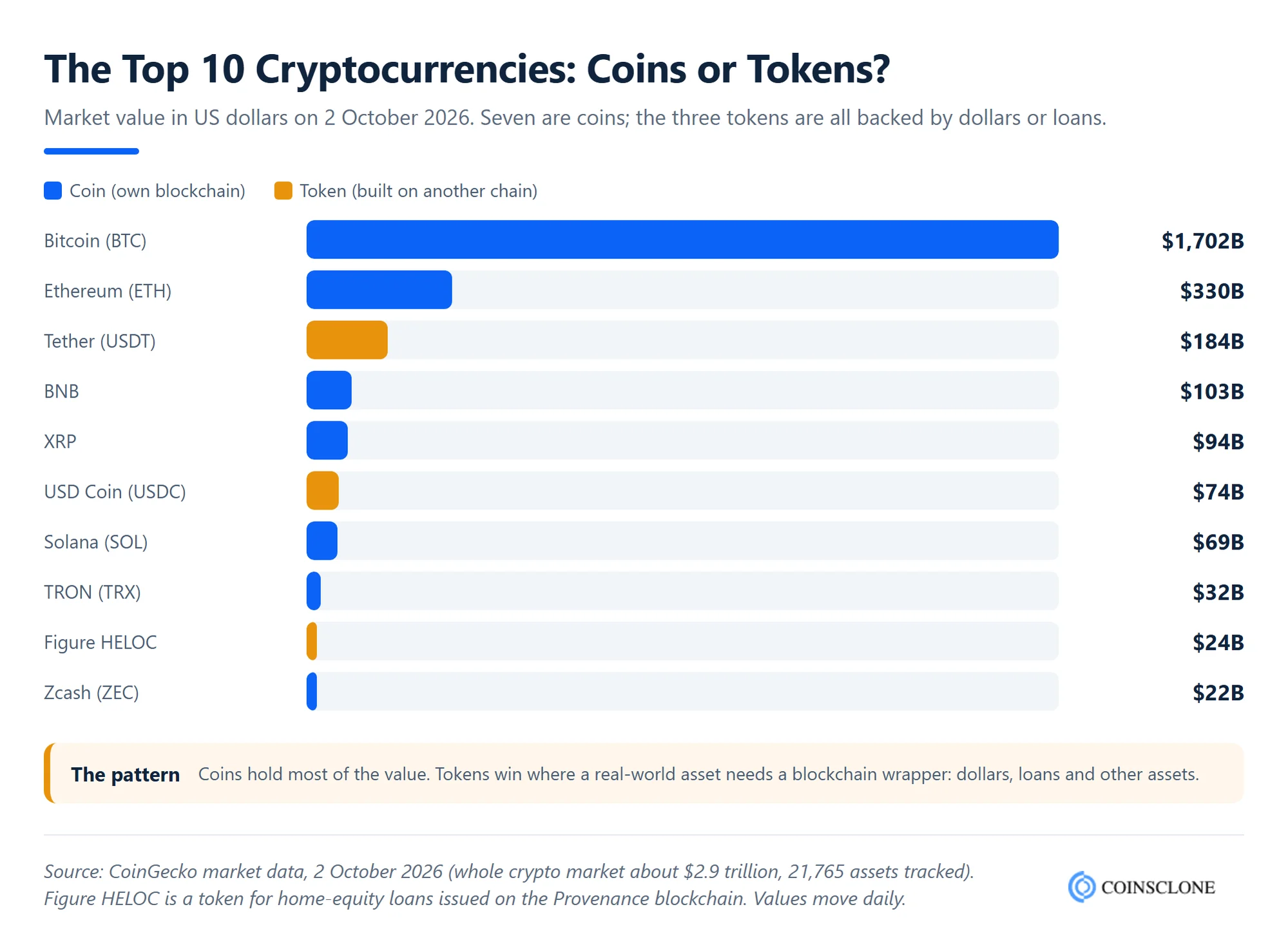
We used CoinGecko market data from 2 October 2026 to pick the top coins and tokens by market value. Figures change daily, so treat them as a snapshot.
Crypto Coins
- Bitcoin (BTC): The first crypto coin and still the largest, with a market value of about $1.70 trillion and 20.09 million coins in circulation.
- Ethereum (ETH): The second-largest coin, worth about $330 billion, with about 122 million ETH in circulation and no hard cap.
- BNB: The native coin of BNB Chain, worth about $103 billion. It started life as an ERC-20 token.
- XRP: The coin of the XRP Ledger, built for fast payments, worth about $94 billion.
Crypto Tokens
- Tether (USDT): The largest token of all, worth about $184 billion. It is a dollar stablecoin issued mainly on Tron and Ethereum.
- USD Coin (USDC): Circle’s dollar stablecoin, worth about $74 billion and issued on many chains.
- Chainlink (LINK): An ERC-20 token, worth about $10.7 billion, that pays for data feeds used by DeFi apps.
- Wrapped Bitcoin (WBTC): An Ethereum token backed 1:1 by BTC, worth about $9.8 billion.
Beyond these, popular tokens include Uniswap (UNI) at about $5.7 billion, Shiba Inu (SHIB) at about $3.4 billion and CAKE, the BEP-20 token of PancakeSwap. Note that seven of the top ten assets are coins, but the three tokens in the top ten, USDT, USDC and the Figure loan token, are all backed by real-world money or loans.
Coin vs Token: Which Should You Create for Your Project?
For most businesses, the answer is a token. A coin only makes sense when you truly need your own chain. Here is how to decide.
- Choose a token if you need a payment, reward, governance, stablecoin or asset token for an app. You get a proven chain, wallet support and exchange listings from day one.
- Choose a coin if your product needs custom block times, fees or consensus that no current chain can give you, and you can fund a validator network.
- Start as a token, move later if you are not sure. BNB and TRX both did this, and a mainnet swap is a well-worn path.
Speed is the other big gap. For a standard token, Coinsclone quotes 1 to 2 weeks for the contract and deployment, 3 to 5 weeks with vesting and distribution, 6 to 10 weeks with staking and governance, and 3 to 5 months for a full multi-chain token stack. A new coin with its own chain takes far longer, mostly because of audits, node software and testing.
Coinsclone builds both. Our crypto token development company team handles ERC-20, BEP-20, TRC-20 and security tokens, and our altcoin development service covers custom coins and blockchains.
Final Words
Crypto coins and tokens may look alike in a wallet, but they work in different ways. A coin runs its own chain and pays its fees. A token rides on that chain and can carry almost any right you design. Knowing the difference helps you send funds safely, read a project correctly and pick the right path for your own launch.
If you plan to launch a token, Coinsclone can help. We have been building crypto products since 2018, with 350+ platforms delivered for 200+ clients across 20 industries. Our team will help you shape the token idea, the supply plan and the smart contract, then take it through audit and launch. Talk to our business team for a scoped plan and timeline.
Frequently Asked Questions
What is the difference between a coin and a token?
A coin is the native asset of its own blockchain, such as BTC on Bitcoin or ETH on Ethereum. A token is built with a smart contract on an existing blockchain, such as USDT on Tron or LINK on Ethereum. Coins pay network fees; tokens need the host chain’s coin to move.
Is Bitcoin a coin or a token?
Bitcoin is a coin. It runs on its own blockchain, it is created through mining, and it pays the fees on the Bitcoin network. Wrapped Bitcoin (WBTC) on Ethereum, by contrast, is a token.
Is Ethereum a coin or a token?
Ether (ETH) is the native coin of the Ethereum blockchain. Thousands of tokens, such as USDT, USDC, LINK and UNI, are built on Ethereum and use ETH to pay their gas fees.
Is USDT a coin or a token?
USDT is a token. Tether issues it through smart contracts on several blockchains, mainly Tron and Ethereum. Despite the word “coin” in the name, nearly all major stablecoins, including USDC, are tokens.
Can a token become a coin?
Yes. A token becomes a coin when its project launches its own blockchain and swaps the old tokens for native coins. BNB moved from Ethereum to its own chain in 2019, and TRX did the same in 2018.
Can I convert crypto coins to crypto tokens?
You can trade a coin for a token on an exchange or a DEX, for example ETH for USDC. You can also wrap a coin, such as BTC into WBTC, to use it on another chain. Always check you are using the right network before you send.
How many crypto coins and tokens are there?
CoinGecko listed 21,765 coins and tokens in October 2026. Most of them are tokens, since thousands can be created on a single chain, while each chain has only one native coin.
Understand the Difference: Crypto Coins vs Tokens
Confused between coins and tokens? We make it simple.
- Coins:Built on their own blockchain — like Bitcoin or Ethereum.
- Tokens: Created on existing blockchains — for DeFi, NFTs, and utilities.
- Utility & Use Cases:Learn how tokens fuel ecosystems while coins power networks.
- Development Insight:Know when to launch your own coin or create a token instead.
Get a free consultation on what’s right for your project — coin or token — before you invest a cent.
Book a Free Session and see how our experts can help you choose, create, and launch your crypto project the smart way.