
DeFi yield farming development is the work of building a platform where people deposit crypto into smart contracts and earn rewards for it. Traders get the liquidity they need, depositors get a share of fees and bonus tokens, and the platform owner earns a cut of every trade or loan. In October 2026, DeFi apps hold about $95 billion in total value locked on DefiLlama, and yield farms are one of the main ways that money gets pulled in.
This guide explains how a yield farming platform works, the types you can build, the features users expect, and how the reward maths decides whether your farm lasts. You will also see what it costs, how long it takes, and the security mistakes that drained over $1 billion from DeFi apps this year.
In this guide:
- What a yield farming platform is, and how it differs from staking
- The five types of yield farms and the smart contracts behind them
- A worked example of fee and token rewards, with APR and APY explained
- Real 2026 hack data, and the controls that would have stopped it
- Market costs, build times and a step-by-step build plan
See How Our MVP System Can Help You Build a Yield Farming Platform Faster
DeFi Yield Farming Development — automate returns with secure contracts.
- MVP System : Launch your DeFi farming protocol 90% faster with audited contracts.
- DeFi-Ready Modules : Staking, liquidity pools, and reward distribution pre-built.
- Brand & Customization : Configure token rewards, APRs, and pools easily.
- Revenue Engine : Earn from farming fees, liquidity spreads, and governance tokens.
Get a free yield farming demo in just 48 hours — before investing a cent!
Book a Free Demo to discover how our DeFi Farming System can launch your platform in 8–12 weeks.
What Is DeFi Yield Farming Development?
DeFi yield farming development is the process of building decentralized apps that let users earn rewards by staking, lending or adding liquidity with their crypto. The platform runs on smart contracts that hold the pools, track each user’s share, and pay out rewards with no middleman. In simple terms, yield farming turns idle crypto into working capital. Users fund trading and lending markets, and in return they earn a yield.
Yield farming took off in June 2020, when Compound began handing out its COMP token to people who lent and borrowed on it. Other apps copied the idea within weeks, and “farming” became the standard way for a new DeFi app to attract its first deposits. Today it is less about wild returns and more about steady liquidity. As a result, the platforms that win are the ones with real fee income, careful token emissions and strong security.
Yield Farming vs Staking
People often mix up the two, but they work in different ways:
- Staking: You lock one token, usually to help secure a blockchain or a protocol. Rewards are fairly steady. For example, ETH staking pays a few percent a year. There is no price risk between two tokens.
- Yield farming: You supply a token pair or lend an asset to an app. Rewards come from trading fees, interest and bonus tokens, so they change every day. Returns can be higher, but you also face impermanent loss and more smart contract risk.
Many platforms offer both. If staking is your main goal, see our guide to DeFi staking platform development.
How Does DeFi Yield Farming Work?
Before you build or join a farm, it helps to know how money moves through it. Here is how yield farming works, step by step.
1. The Platform Sets Up Pools
The platform creates liquidity pools that accept crypto deposits. Each pool supports a set token pair and runs on fixed rules for fees and rewards. These pools let people trade, lend or borrow without a middleman.
2. Users Connect a Wallet and Deposit
Users connect a crypto wallet and deposit tokens into a pool. In return, the platform gives them liquidity provider (LP) tokens. These tokens act as a receipt. They show each user’s share of the pool and decide how much of the rewards they get.
3. Deposits Earn Fees and Rewards
Once the tokens are in, the user is a liquidity provider. Traders or borrowers use their funds, and the user earns trading fees, interest, or reward tokens from the platform.
4. The Yield Moves With Demand
The yield changes all the time. It moves with trading volume, borrowing demand and the total value locked in the pool. Smart contracts work out and pay rewards on their own, so anyone can check them on-chain.
5. Users Harvest and Reinvest
Users can claim, or “harvest”, their rewards at any time. Many put the rewards back into the same pool or a new one. This is called compounding, and it grows returns over time.
6. Users Withdraw When They Choose
To exit, users return their LP tokens and get their share of the pool back. Before they do, they should weigh impermanent loss, price swings and protocol risk.
7. The Platform Earns Its Share
The platform earns from trading fees, borrowing interest and performance fees, and it may mint new tokens as rewards. Together, these keep depositors happy and pay for the platform’s growth.
Types of DeFi Yield Farming Platforms You Can Build
Not every farm looks the same. Before you write a line of code, pick the type that fits your users and your token.
- LP farm on a DEX: Users add a token pair to a swap pool, then stake the LP tokens in a farm to earn extra rewards. PancakeSwap and SushiSwap made this model famous.
- Single-asset staking pool: Users lock one token and earn more of it or a partner token. It is simple and has no impermanent loss, so it suits a project’s own token.
- Lending market: Users supply assets that others borrow, and they earn interest plus bonus tokens. Aave and Compound are the best-known examples.
- Auto-compounding vault: A strategy contract farms on users’ behalf and reinvests rewards for them, then takes a performance fee. Yearn and Beefy work this way.
- Cross-chain farm: Pools live on several blockchains, so users can farm where fees are lowest. It reaches more users, but bridges add risk, as the 2026 hack data below shows.
Many successful platforms mix two or three of these. For example, a DEX may run LP farms and a single-token pool for its own governance token.
How Yield Farming Rewards Are Calculated
Rewards look simple on the front end, yet the maths behind them decides whether your farm survives. Here are the two terms every user checks.
- APR (annual percentage rate): The yearly return without compounding. A 20% APR on $1,000 pays $200 in a year.
- APY (annual percentage yield): The yearly return if rewards are reinvested. With daily compounding, a 20% APR becomes about 22.1% APY.
Most farm rewards have two parts. Fee rewards come from real users paying to trade or borrow. Emission rewards are new tokens the platform mints to attract deposits. Fee rewards are paid by users. Emission rewards are paid by everyone who holds your token, because each new token dilutes the supply.
A Worked Example: Fees vs Token Rewards
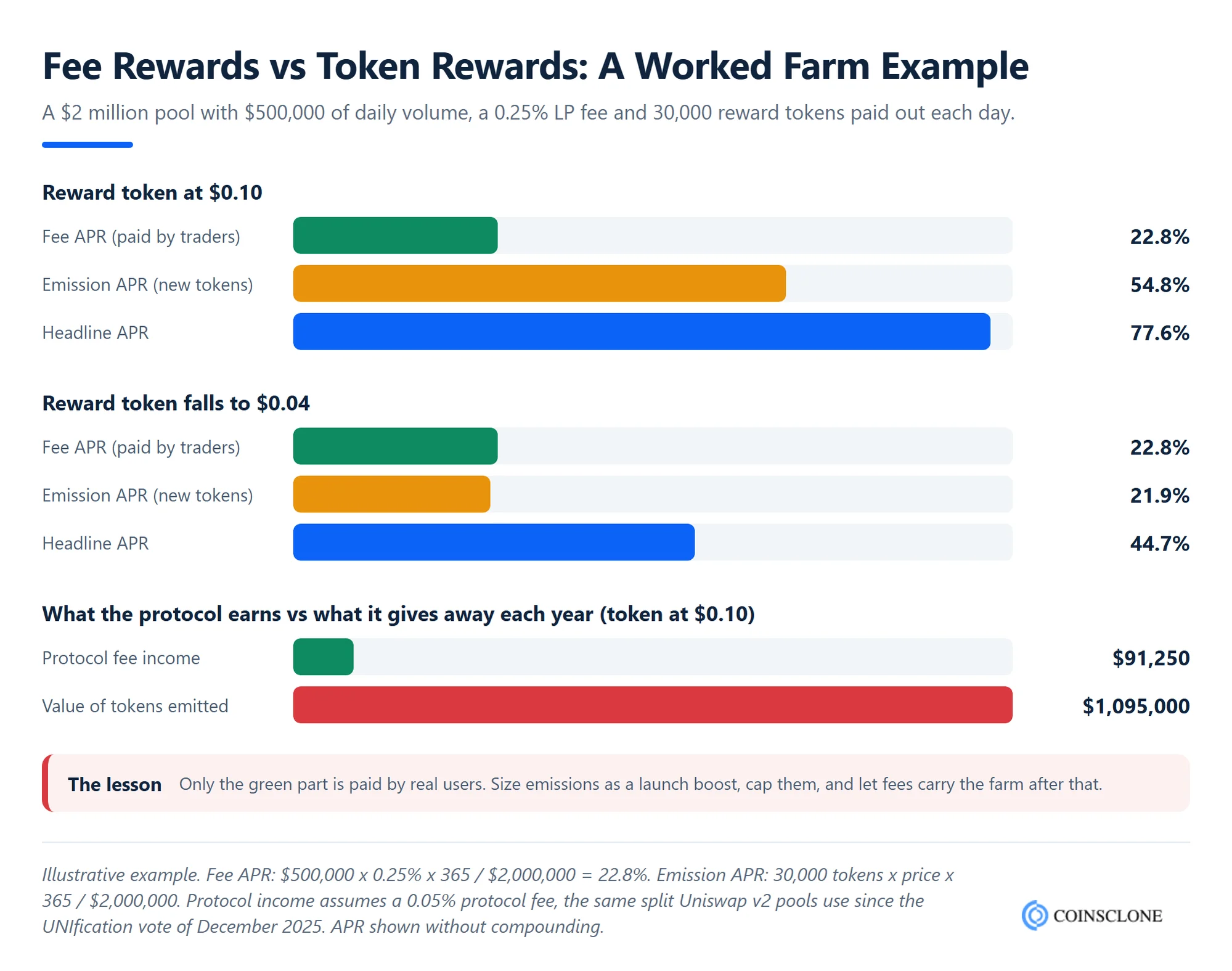
Say you launch a pool with $2 million locked and $500,000 of daily trading volume. LPs earn a 0.25% fee on each trade, and the farm pays 30,000 reward tokens a day.
- Fee APR: $500,000 x 0.25% = $1,250 a day, or $456,250 a year. That is a 22.8% APR on $2 million.
- Emission APR at $0.10 a token: 30,000 x $0.10 = $3,000 a day, or $1.095 million a year. That adds 54.8% APR.
- Headline APR: 77.6%, or about 117% APY with daily compounding.
Now the token price drops to $0.04, as new tokens often do once farmers sell. The fee part stays at 22.8%, but the emission part falls to 21.9%. As a result, the headline APR almost halves to 44.7%. Also, if your platform keeps a 0.05% protocol fee, it earns about $91,000 a year while handing out over $1 million in tokens. That gap is why so many farms fade within months.
Real data tells the same story. On DefiLlama’s yield tracker in October 2026, the 331 stablecoin pools with over $10 million locked paid a median APY of 3.69%, and reward tokens made up only about 15% of that. Smaller volatile pools lean far harder on rewards. Across volatile token pairs with $1 million to $10 million locked, reward tokens made up about 65% of the yield. So plan emissions as a short launch boost, and design fees to carry the farm after that.
Core Features of the DeFi Yield Farming Platform Development
User Features
- Portfolio Manager: A built-in dashboard shows all staked assets, active pools, earnings and yield in one place. Users do not need a separate tracker.
- Loyalty Programs: Custom loyalty plans reward long-term farmers with tiered perks, bonus APYs and access to special pools.
- Pay-out Rewards: This module runs the whole reward process. Rewards are paid daily, weekly or every block, and the system keeps payouts accurate and on time.
- Rewards Calculator: Users can estimate their yield before they stake. They enter the amount, the token and the lock period, and the calculator shows the expected APR and APY.
- Automated Yield Optimization: This feature compounds rewards on its own and moves funds to the best pools. Users earn a strong yield without switching pools by hand.
- Swapping Mechanism: A built-in swap lets users trade tokens to enter or exit a farm in one step, without leaving for an outside DEX.
Admin Features
- Pool Management: Admins can create, change or close farming pools as the market shifts. This keeps the platform competitive.
- Rewarding Systems: Admins control how rewards are made and shared. They can set reward models, assign tokens, run cycles and adjust APY.
- Liquidity Manager: Admins can add, remove or shift funds between pools. This keeps trades smooth and pools in balance.
- Governance Control: Admins manage voting, proposals and DAO rules. Token holders get a voice, and the platform can adapt to new rules.
- User Management: A dashboard shows user profiles, KYC/AML status, access levels and what each user has staked. It helps the team fix issues and onboard users smoothly.
- Analytics & Reporting: Admins see how the platform is doing, from users and pools to fees and risk. Reports help with planning.
Security Features
- Smart Contract Audits: Outside experts review the contracts for bugs, logic flaws and exploit paths before launch. This lowers the risk of reentrancy, flash-loan and rounding attacks.
- Anti-Fraud Tools: Live checks spot fake trades and price tricks. They protect user funds and keep rewards fair.
- End-to-End Encryption: User data, API calls and messages are encrypted in transit and at rest.
- KYC/AML Compliance: Built-in KYC and AML checks verify users and block illegal funds. This is vital if you serve regulated markets.
- Two-Factor Authentication: 2FA asks users to confirm each login with a code from their phone or a fingerprint. It blocks most account takeovers.
- Transaction Monitoring: A live engine watches on-chain moves for odd patterns and dirty money, so the team can act fast.
Smart Contract Architecture of a Yield Farming Platform
The front end is what users see. However, the smart contracts are what you are really building. A typical farm uses five or six contracts, plus a control layer that decides who can change them.
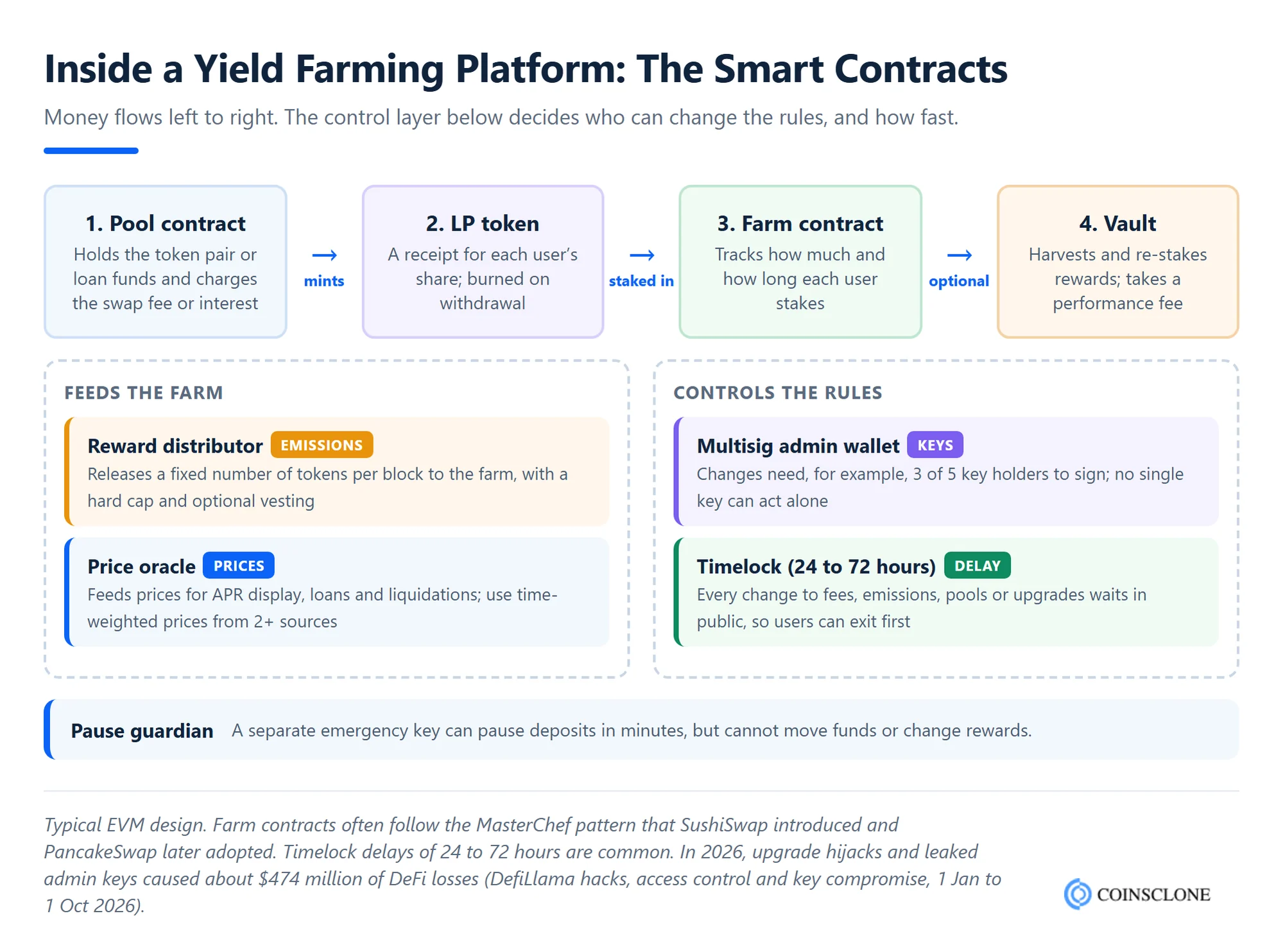
- Pool or lending contract: Holds the deposits and charges the swap fee or interest.
- LP token: Minted on deposit and burned on withdrawal. It proves each user’s share.
- Farm contract: Users stake LP tokens here. It tracks how long and how much each user has staked. Many projects base it on the well-known “MasterChef” design.
- Reward distributor: Releases a fixed number of reward tokens per block or per second, with a hard cap.
- Vault (optional): Compounds rewards for users and takes a small performance fee.
- Oracle: Supplies prices for APR display, lending and liquidations. Use more than one source.
On top of these, admin keys sit in a multisig wallet, and every admin change goes through a timelock of 24 to 72 hours. That delay gives users time to exit if something looks wrong. Our team handles this layer as part of our DeFi smart contract development work.
Add-ons that enhance the DeFi Yield Farming Platform Development
The following add-ons make the platform more flexible, raise returns and give users newer DeFi tools.
- Cross-Chain Compatibility: Users can move assets across several blockchains. This cuts reliance on one chain and opens more yield options.
- Tiered Yielding Pools: Earning levels based on stake size, lock period or loyalty. Long-term users get higher APYs and special pools.
- DeFi Protocol Integration: Connect your farm to big names such as Aave, Curve or Uniswap. This brings in more funds and more ways to earn.
- Advanced Analytics Tools: Real-time charts, profit metrics and risk signals help users make better choices.
- NFT & Token Incentives: Add game-like rewards, such as NFTs or bonus tokens, when users hit farming goals.
- Auto Harvest Engine: Rewards are collected and reinvested on their own, with no manual steps.
Top 5 DeFi Yield Farming Platform Clones We Develop
Several protocols have proven their farming models over many market cycles. Each one has its own rules, tokenomics and reward logic. Here are the leading DeFi yield farming platforms we offer as clone solutions. TVL figures are from DefiLlama on 1 October 2026.
Aave Clone Solution: Aave is the largest DeFi lending app, with about $19.3 billion locked across 23 chains. Users supply assets to earn interest and borrow against them. Coinsclone’s Aave Clone Script lets you build a yield platform with advanced lending features and cross-chain liquidity.
Uniswap Clone: Uniswap is the most widely used DEX, with about $4 billion locked across 46 chains. In December 2025 its token holders voted for a plan that turned on a fee for the protocol. On v2 pools the 0.30% swap fee now splits into 0.25% for LPs and 0.05% for the protocol. Our Uniswap Clone Script helps you launch on a proven AMM model with a revenue split built in.
PancakeSwap Clone Software: PancakeSwap made LP farms popular on BNB Chain and now runs on 12 chains, with about $2.3 billion locked. Its farms let users stake LP tokens for CAKE rewards. Our PancakeSwap Clone Script lets you launch the same kind of farm on BNB Chain and other networks.
Compound Clone Solution: Compound started the yield farming wave in 2020 and still holds about $1.6 billion across 10 chains. It is known for security and a simple money market model. With our Compound Clone Script, you can copy its lending markets, interest model and governance.
Curve Finance Clone Software: Curve focuses on swaps between similar assets, such as stablecoins, with very low slippage. It holds about $1.4 billion, and its vote-locked token model lets holders steer rewards to the pools they choose. Using our Curve Finance Clone Script, you can build a stablecoin-focused farm with strong liquidity incentives.
These clones give you a tested base to start from. Next, let’s look at what a yield farming platform does for your business.
Business Benefits of DeFi Yield Farming Development
Many people think only investors gain from yield farming. In fact, the business behind the platform gains just as much.
- Deep liquidity from day one: Farm rewards pull in deposits fast. More liquidity means lower slippage, which brings more traders and more fees.
- Wider token distribution: Rewards spread your governance token across thousands of real users instead of a few early buyers. This helps decentralize voting.
- User growth and loyalty: Users come for the yield and stay for the tools. Tiered pools and lock-up bonuses keep them active for longer.
- Many ways to earn: Swap fees, loan interest and vault fees all flow to the platform, as the next section shows.
- Room to expand: Once liquidity is in place, you can add lending, launchpads or new chains on top of it.
How a DeFi Yield Farming Platform Makes Money
A yield farming platform can earn from several sources at once. Together, they give the business a steady income that grows with usage. Here are the main income streams:
- Transaction Fee: A share of each swap, such as Uniswap’s 0.05% cut shown above.
- Performance Fee: A cut, often 10% to 20%, of the rewards that vaults earn for users.
- Liquidity Pool Fees: Fees for launching or boosting a new pool, often paid by token projects.
- LP Tokens: The protocol can hold its own liquidity and earn the same fees as other LPs.
- Premium Services: Paid tools, such as deeper charts, faster compounding or custom plans.
- Lending & Borrowing Interest: The spread between what borrowers pay and what lenders earn.
- Cross-Platform Collaborations: Partner pools where other projects pay to reach your users.
With the revenue streams clear, the next step is to plan for risk.
Risks of DeFi Yield Farming and How to Build Around Them
Yield farms hold real money in public code, so attackers study them closely. From 1 January to 1 October 2026, DeFi apps lost about $1.18 billion in 203 hacks, per DefiLlama’s hack tracker. The causes are not always the ones teams expect.
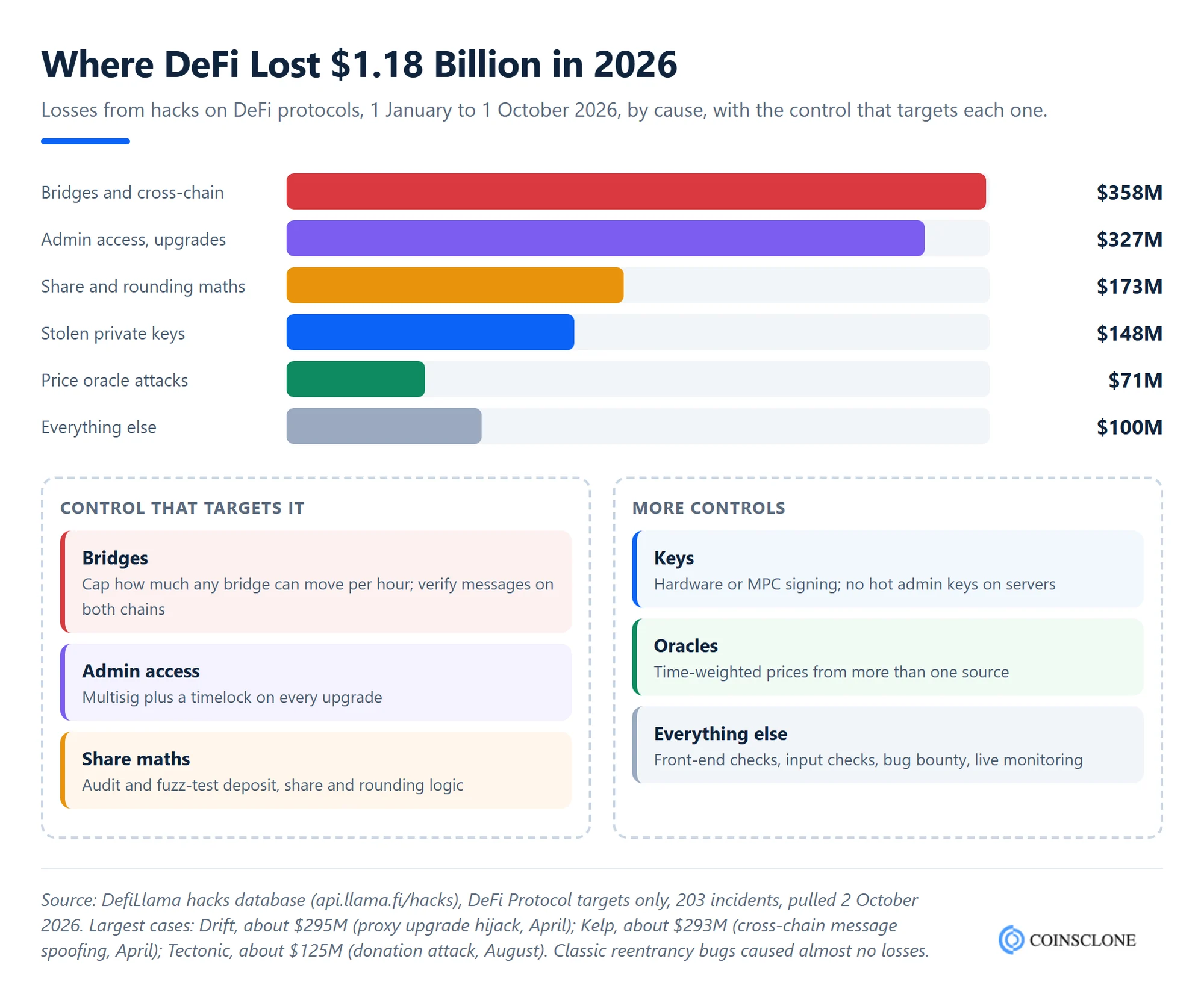
- Bridge and cross-chain flaws: In April 2026, Kelp lost about $293 million when attackers faked cross-chain messages. If you go multi-chain, limit how much any one bridge can move.
- Admin access and upgrade hijacks: Also in April 2026, Drift lost about $295 million through a hijacked contract upgrade. Multisig keys and timelocks are your first defence.
- Share maths bugs: Rounding and “donation” tricks let attackers inflate their share of a pool. Balancer lost about $128 million this way in November 2025. Then, on 15 September 2026, it proposed closing down for good, and BAL holders approved the wind-down on 29 September, with pools set to go withdrawal-only on 30 October. Audits and fuzz tests must target this maths.
- Impermanent loss: When two pooled tokens move apart in price, LPs end up with less value than if they had just held. Stablecoin pools and single-asset pools reduce it.
- Token price collapse: As the worked example shows, if your reward token falls, APR falls with it and farmers leave. Cap emissions and add vesting.
- Price feed attacks: Attackers push a thin market’s price to borrow too much. Use time-weighted prices from more than one source.
In short, an audit is necessary but not enough. Most of this year’s losses came from keys, bridges and upgrades, not from classic code bugs.
How to Choose a Blockchain for Your Yield Farming Platform
The chain you pick shapes your costs, your users and your security. Here is a quick guide:
- Ethereum: The deepest liquidity and most trusted contracts, but gas fees make small deposits costly. Best for large, institutional pools.
- Layer 2 networks such as Arbitrum and Base: They borrow Ethereum’s security, and fees are just a few cents. A strong default for most new farms.
- BNB Chain: Low fees and a large retail user base. PancakeSwap’s home chain.
- Solana: Very fast and cheap, but contracts are written in Rust, so you need a different skill set.
- Polygon and Avalanche: Low-cost EVM chains with active DeFi markets and good tooling.
Most teams launch on one chain, prove the model, then expand. Building on an EVM chain also lets you reuse the same contracts on many networks.
How Much Does It Cost to Develop DeFi Yield Farming?
There is no single price, because a simple staking pool and a multi-chain farm with a DEX are very different builds. As a guide, development firms that publish 2026 price ranges quote:
| Platform type | Typical market cost | Typical time |
| Basic staking or single-pool farm | $25,000 to $60,000 | 8 to 12 weeks |
| LP farm with a built-in DEX | $60,000 to $120,000 | 14 to 18 weeks |
| Multi-chain farm with vaults and governance | $120,000 to $250,000+ | 20 to 28 weeks |
| Standalone smart contract audit | $8,000 to $30,000 | 2 to 4 weeks |
The main factors that move the price are:
- Build route: A white label or clone script costs far less than a custom protocol, because the core contracts are already written and tested.
- Number of chains: Each extra chain adds deploy, testing and bridge work.
- Audits: Plan for at least one outside audit. Complex vaults may need two.
- Features: Auto-compounding, lending, voting and mobile apps each add time.
- Ongoing costs: Hosting, monitoring, bug bounties and upgrades continue after launch.
At Coinsclone, a white label DEX with farming modules can go live in about 5 to 7 weeks, and a standard build takes about 10 to 14 weeks. We quote each project after a short scoping call, so you only pay for the features you need.
Develop a DeFi Platform with Yield Farming Services
Cost-effective, White-Label Solution, Premium Features, Customizable. Live Demo Available.
DeFi Yield Farming Platform Development Process
1. Project Planning
The process begins with your business model, target users, revenue plan and tech needs. Here you set the platform’s scope, feature list, token model and security plan.
2. Tokenomics and Reward Design
Next, model your rewards before you code them. Set the emission rate, the cap, any vesting, and the fee split. Then test the numbers at lower token prices, as in the worked example above.
3. Blockchain Selection
Choose the chain that fits your users, fees and security needs. Weigh speed, transaction costs, community support and how mature its DeFi market is.
4. Regulatory Compliance
Align the platform with the rules in the markets you serve. This can include KYC/AML checks, investor checks and data security standards. Rules differ by country, so get local legal advice.
5. Smart Contract Development
The team writes the core contracts for pools, staking, rewards and governance. Every contract is built with clean logic, low gas use and strong security.
6. Liquidity Setup
Pools are created and seeded with starting liquidity. This step makes sure users can stake and earn from day one.
7. Testing, Audit & Launch
Before launch, the platform goes through unit tests, fuzz tests, an outside audit and a testnet run. After fixes, it is deployed to mainnet with admin keys in a multisig and a timelock in place. A bug bounty and live monitoring then keep watch.
Why Collaborate with Coinsclone for DeFi Yield Farming Development Services?
Coinsclone is a leading DeFi Development Company that has been building crypto products since 2018. We have delivered 350+ platforms for 200+ clients across 20 industries. Our team builds DeFi yield farming platforms from scratch, and we also add yield farming modules to existing DEXs and lending apps.
From planning to launch, we handle the full build: token design, audited contracts, the user app and the admin panel. If anything goes wrong after launch, our support team is ready to help. Book a call with our experts to plan your platform.
Frequently Asked Questions
What is DeFi yield farming?
DeFi yield farming is a way to earn crypto rewards by putting digital assets into decentralized finance apps. Users add liquidity or stake tokens in smart contract pools that power trading or lending. In return, they earn interest, trading fees or reward tokens based on their share.
How does DeFi yield farming work?
DeFi yield farming works through liquidity pools run by smart contracts. Users deposit tokens into these pools, and traders or borrowers use them. The protocol then works out and pays rewards over time. Earnings depend on trading volume, borrowing demand and the reward tokens on offer.
What is DeFi yield farming development?
DeFi yield farming development is the process of building blockchain platforms that let users stake assets, add liquidity and earn automated rewards. It covers smart contracts, liquidity pools, reward logic, user dashboards and an admin panel.
How much does it cost to build a DeFi yield farming platform?
Published 2026 market ranges run from about $25,000 to $60,000 for a basic staking or farm platform, $60,000 to $120,000 with a built-in DEX, and $120,000 to $250,000 or more for a multi-chain platform with vaults and governance. An outside audit adds $8,000 to $30,000. A white label build costs less than a custom one.
How long does it take to develop a yield farming platform?
A white label DEX with farming modules can launch in about 5 to 7 weeks. A standard build takes about 10 to 14 weeks, and a fully custom multi-chain protocol can take five months or more once audits are included.
What is the difference between APR and APY in yield farming?
APR is the yearly return without compounding. APY includes the effect of reinvesting rewards. For example, a 20% APR compounded daily is about 22.1% APY. Farms that auto-compound usually show APY, so check which one a platform displays.
Is DeFi yield farming profitable in 2026?
Yield farming can still be profitable in 2026, but returns are far lower than in 2020. In October 2026, large stablecoin pools paid a median of about 3.7% APY on DefiLlama. Higher yields exist, but they usually depend on reward tokens that can lose value. The best results come from audited protocols with real fee income.
What are the risks of DeFi yield farming?
The main risks are smart contract bugs, admin key or bridge exploits, impermanent loss, reward token price drops and oracle attacks. DeFi apps lost about $1.18 billion to hacks in the first nine months of 2026. Users can cut risk with audited apps, stablecoin pools and smaller deposits.
What is the difference between yield farming and staking?
Staking usually means locking one token to support a network or protocol for fairly steady rewards. Yield farming means adding funds to a DeFi app, where rewards change with trading, loan demand and bonus tokens. Farming can pay more but carries more risk.
Which platform pioneered yield farming?
Compound is widely credited with starting the yield farming wave in June 2020, when it began giving COMP tokens to its lenders and borrowers. Other DeFi apps quickly copied the model.
Why is yield farming important in decentralized finance?
Yield farming provides the liquidity that DEXs and lending apps need to work well. By rewarding users who supply assets, it allows faster trades, better prices and nonstop markets with no central middleman.
See How Our MVP System Can Help You Build a Yield Farming Platform Faster
DeFi Yield Farming Development — automate returns with secure contracts.
- MVP System : Launch your DeFi farming protocol 90% faster with audited contracts.
- DeFi-Ready Modules : Staking, liquidity pools, and reward distribution pre-built.
- Brand & Customization : Configure token rewards, APRs, and pools easily.
- Revenue Engine : Earn from farming fees, liquidity spreads, and governance tokens.
Get a free yield farming demo in just 48 hours — before investing a cent!
Book a Free Demo to discover how our DeFi Farming System can launch your platform in 8–12 weeks.