

A Compound clone script is ready-made software for launching your own DeFi lending app. It is built on the same money market idea that made Compound one of the first big names in DeFi. This guide explains what the script is, how Compound works today, and where the protocol stands in October 2026.
You will also get the build steps, the features to expect, the licence rules for Compound’s code, and the security lessons from protocols that copied it. By the end, you will know if a Compound-style lending app fits your plan and what it takes to launch one safely.
In this guide:
- Compound’s real 2026 numbers: about $1.52 billion locked, and why users moved from v2 to Compound III.
- A worked example of how Compound III sets interest rates, read from its live USDC market.
- Which Compound code you can legally reuse, and what the licence asks of you.
- The bug that cost Compound forks more than $158 million, and how to avoid it.
- Features, build steps, market cost ranges and launch timelines.
See How Our MVP System Can Launch Your DeFi Lending Platform Faster
Compound Clone Script — built for performance & profits.
- MVP System : Launch your Compound-like lending platform 90% faster.
- Smart Contracts Ready : Pre-built for lending, borrowing & yield farming.
- Brand & Customization : Your tokens, your UI, your governance rules.
- Revenue Engine : Earn from lending interests, protocol fees & staking rewards.
Get a free branded DeFi platform demo in just 48 hours — before investing a cent!
Book a Free Demo to discover how our Compound Clone Script can take you from concept to live DeFi platform in 8–12 weeks.
What Is a Compound Clone Script?
A Compound clone script is ready-to-launch software that copies the main tools of Compound: lending and borrowing. Lenders supply crypto to shared pools and earn interest. Borrowers lock collateral and take loans against its value. Smart contracts run every step, so no bank or middleman sits in the middle.
The software comes with self-adjusting rates, wallet login, collateral rules, a liquidation engine and an admin panel. Since the core is built and tested, you can launch a Compound-style lending app in about 8 to 12 weeks, not many months. You can also shape the design, features and supported tokens around your business goals.
Whether you want to create a DeFi lending and borrowing platform or launch a wider DeFi ecosystem, a Compound clone script gives you a tested starting point. Next, let us look at how Compound itself is doing, because that shapes what your clone should copy.
Compound in 2026: Where the Protocol Stands
Compound is still live and still one of the larger lending protocols, but it looks very different from the version most clone pages describe. Here is its status as of 16 October 2026:
- Size: Compound held about $1.52 billion in total value locked, per DefiLlama’s Compound page. That ranks Compound III sixth among DeFi lending protocols by TVL. The whole lending sector held about $52 billion across 655 protocols that DefiLlama tracks.
- Peak: Compound v2 reached $12.31 billion on 9 November 2021, so the brand is now far smaller than at its height.
- Current version: Compound III, also called Comet, launched on Ethereum in August 2022. It now holds about $1.41 billion on 10 chains, such as Ethereum, Base and Arbitrum. About $645 million of that is out on loan.
- Old version wound down: In December 2025, COMP holders passed a v2 wind-down vote that paused new deposits and loans on v2. Users can still repay and withdraw. Only about $107 million is left there.
- Fees: Borrowers paid about $28.6 million in interest over the last 12 months. The protocol kept about $2.79 million of it, per DefiLlama’s fee data.
- What comes next: The Compound Foundation is running a $52 million V4 Program aimed at banks, fintechs and other large users. It relaunched the plan with a new leadership team on 17 August 2026. Its August 2026 update lists an “Institutional Comet” market first, with no launch date yet for V4 itself.
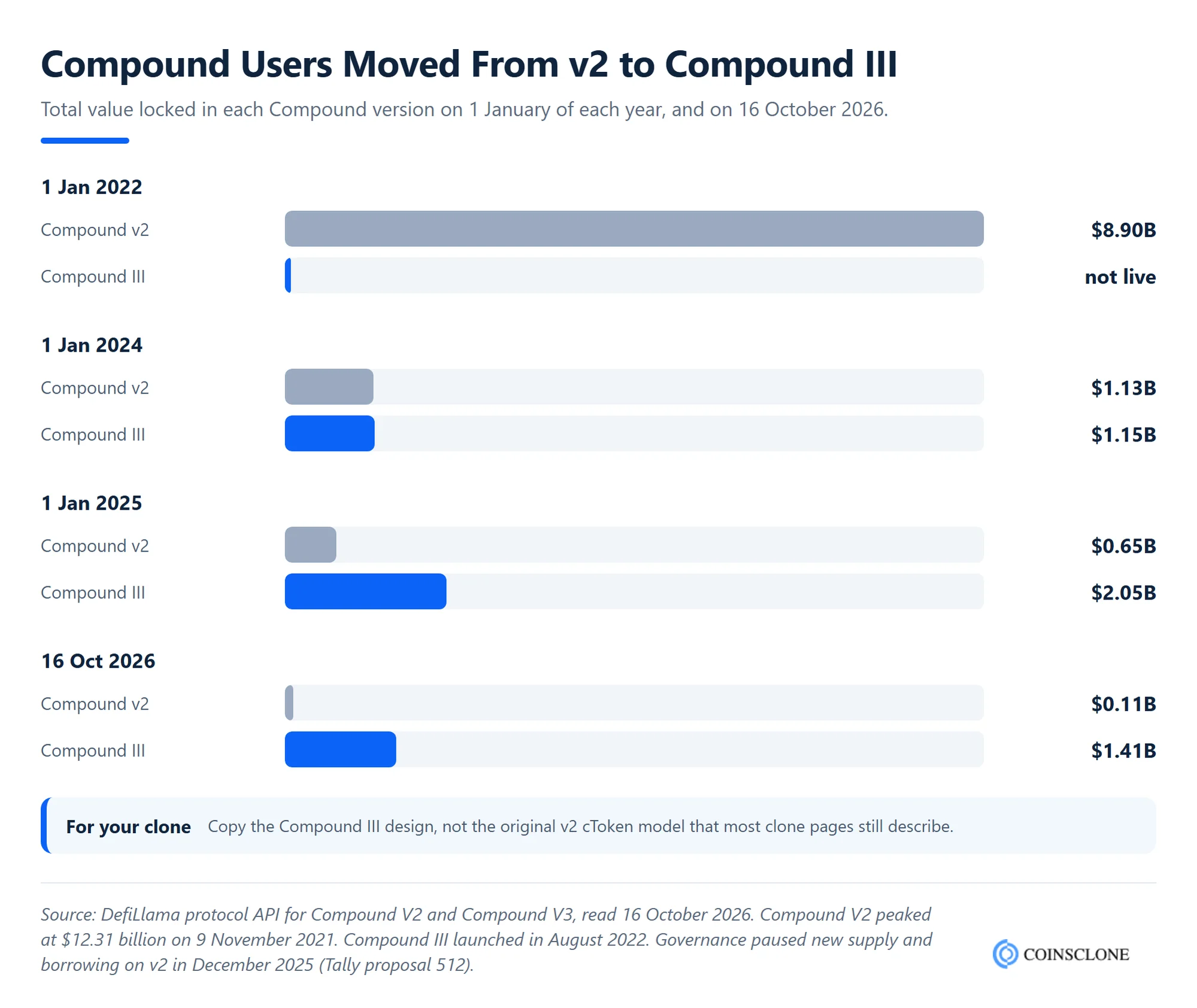
So, is it still worth building a Compound-style platform? Yes, if you copy the right parts. The pooled money market model is proven, and Compound III’s simpler design has kept running for four years. The lesson from the chart is clear: build on the Compound III design, not on the 2019 v2 model that most clone scripts still sell.
Why Create a DeFi Lending Protocol Like Compound?
Building a lending protocol like Compound lets your business enter one of the largest parts of blockchain finance. These platforms change how lending works by making it open, clear and available to anyone with a wallet.
- Proven demand: Lending is one of the biggest DeFi sectors, with about $52 billion locked in October 2026. People already understand how to supply and borrow, so you do not need to teach a new habit.
- Passive income for users: Lenders earn interest on crypto that would sit idle. That gives them a reason to stay with your platform for the long term.
- Open access: Anyone with a wallet can lend or borrow, with no credit checks or paperwork. You can add KYC later if your market or your partners need it.
- Open to check: Smart contracts show every rate, loan and sell-off on-chain. This builds trust, since users can check the rules for themselves.
- Your own model: You choose the tokens, the chains, the fees and the voting rules. You stay in control of how your DeFi ecosystem grows.
A Compound-style app puts your brand inside DeFi and lets users lend, borrow and manage assets without middlemen. With a ready-made Compound clone script, you can launch your DeFi platform faster, since the core features are already built. Now let us see how the software works.
How Does a Compound Clone Software Work?
A Compound clone software rebuilds Compound’s core design and gives your users the same way to lend and borrow. The flow is simple:
- Connect a wallet: Users sign in with a wallet such as MetaMask. No account form is needed unless you add KYC.
- Supply the base asset: Lenders deposit the market’s main coin, such as USDC, and start earning interest right away.
- Add collateral: Borrowers deposit other coins, such as ETH or wBTC, to back their loans.
- Borrow against it: Borrowers take out the base asset, up to a set share of their collateral’s value.
- Rates adjust on their own: Interest rises as more of the pool is borrowed and falls as loans are repaid.
- Liquidation: If collateral loses value and a loan gets too risky, the protocol takes it over.
- Repay and withdraw: Users can repay or withdraw at any time, as long as the pool has free cash.
One Base Asset Per Market
This is the biggest change in Compound III. In v2, every supplied coin could also be borrowed, so risks in one coin spread to the others. Compound III gives each market one borrowable base asset, such as USDC or ETH. According to Compound’s docs, collateral does not earn interest and cannot be lent out. That makes risk easier to follow. Your clone can still run many markets side by side, one per base asset.
How Interest Rates Are Set
Compound III uses two rate curves, one for suppliers and one for borrowers. Both depend on utilization, which is the share of the pool that is out on loan. Each curve has a “kink”. Below it, rates rise slowly. Above it, they jump. The chart below uses the live settings of Compound’s main USDC market on Ethereum.
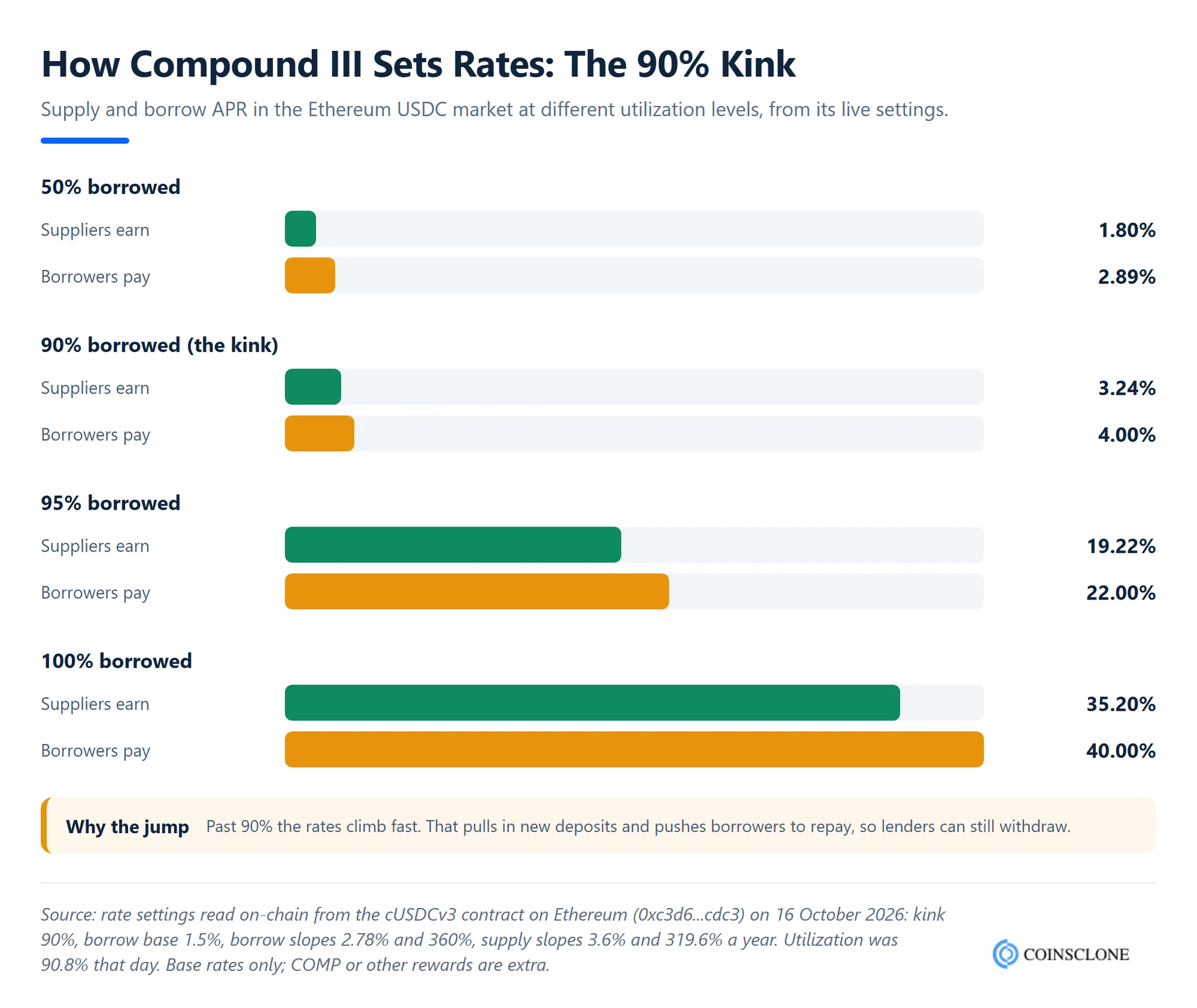
On 16 October 2026, that market was 90.8% borrowed, which put base rates at about 5.9% for suppliers and 7.0% for borrowers. The gap between the two rates is where the protocol earns. In your clone, the admin or governance sets these curves for each market, so tuning them is one of your most important launch tasks.
How Liquidation Works
Each collateral coin has two limits. The borrow limit sets how much a user can take out. A higher liquidation limit sets when a loan becomes unsafe. Once a loan passes that line, anyone can call the protocol’s `absorb` function. The protocol then takes the collateral, clears the debt, and pays the user what is left after a fine, as the liquidation docs explain.
The protocol then sells the seized collateral at a discount through `buyCollateral`, which tops up its reserves. This two-step design means liquidators do not need to repay the loan first, so liquidations still happen when markets move fast. A good clone includes a bot that watches loans and calls these functions on time.
How a Compound-Style Protocol Makes Money
A lending protocol earns from the gap between what borrowers pay and what lenders receive. Here are the main income streams for your clone:
- Rate gap: Part of what each borrower pays goes to the reserves, not to lenders. Compound kept about $2.79 million of $28.6 million in interest over the last year, close to 10%.
- Liquidation discount: When the protocol sells seized collateral below market price, the buyer earns the discount. Part of the penalty paid by the borrower stays in reserves.
- Platform fees: You can add fees for flash loans, fast withdrawals or premium features.
- Token and governance: A governance token can reward early users and give holders a vote on markets, rates and fees. Plan its supply with care, since rewards that are too high attract users who leave when they end.
- Business partners: Compound’s own V4 plan targets fintechs and banks that want a lending back end. Your clone can offer white label lending to partners in the same way.
Features of the Compound Clone Script
A Compound clone script includes a full set of features to run a secure and scalable DeFi lending protocol. It has tools for admins, tools for users, and add-on modules that depend on your business model.
Admin Panel Of Compound Clone Software
- Main dashboard: See live user numbers, total value locked (TVL), earnings and pool use.
- User and wallet tracking: Review wallets, flag risky ones and apply your own rules.
- Asset and market management: Add or remove markets and collateral coins, and set supply caps and limits.
- Interest rate settings: Set the kink and slopes for each market’s supply and borrow curves.
- Full log: Keep a record of every loan, repay and liquidation.
- Platform fees: Set the reserve share, liquidation penalty and any other fees.
- Notifications and alerts: Send platform-wide notices or alerts about loan health and rate changes.
- Contract controls: View live contracts, pause markets in an emergency and roll out upgrades safely.
User Panel Features of Compound Clone Script
- Wallets: Connect through MetaMask, WalletConnect, Coinbase Wallet and other supported wallets.
- Supply and borrow screen: Lend or borrow supported tokens in a few clicks.
- Earnings view: Track the interest you earn and your APR history live.
- Loan health meter: See your borrow limit, how close you are to liquidation and early warning alerts.
- Repayment: Repay loans or withdraw supplied tokens with flexible options.
- Token swaps: Swap tokens on the platform before you supply or borrow.
- Rewards tracking: See the tokens you have earned through liquidity rewards, staking or referrals.
- Full history: View every lend, borrow, repay and withdraw action in one place.
Add-on Modules That Can Be Integrated Into a Compound Clone
- Token governance: Run DAO votes for new markets, rate changes and upgrades.
- Liquidity mining: Reward early lenders and borrowers with your own token or partner tokens.
- More chains: Launch on Ethereum, BNB Chain, Arbitrum, Base and other EVM chains.
- KYC and AML: Add identity checks for markets or users that need them.
- Analytics: Track pool usage, user returns and TVL growth in real time.
- NFT collateral: Accept NFTs as collateral with custom pricing rules.
- Flash loan module: Let developers borrow and repay within one transaction for a small fee.
- Liquidation bot: Watch every loan and trigger liquidations on time, so bad debt does not build up.
With these features, a Compound clone script gives you a secure, flexible and profitable lending platform. Before you pick a code base, though, you need to know what you are allowed to copy.
Can You Fork Compound’s Code? The Licence Question
Many teams plan to copy Compound’s code from GitHub. Check the licence first, because each version has different terms. We read each licence file on 16 October 2026:
| Code base | Licence today | What it means for you |
| Compound v2 (compound-protocol) | BSD 3-Clause | Free to reuse, even in a closed product, if you keep the copyright notice. This is why so many forks exist. |
| Compound III (comet) | Business Source License 1.1, which turned into GPL 2.0 or later by its change date, 31 December 2025 at the latest | You may now use and change it. If you share or sell your changed code, you must release it under the same GPL terms. |
| Compound V4 | Not yet released | Terms unknown. Do not plan a product around it yet. |
Two cautions apply to every route. First, an open licence does not make old code safe, since v2 forks still carry v2’s known bugs, as the next section shows. Second, the licence covers the code, not the Compound name or logo, so your platform needs its own brand. Get legal advice before you launch, especially if you plan to sell or share your modified code.
A white label build avoids most of this, since you get audited code that you are allowed to run under your own brand.
What Went Wrong for Compound Forks
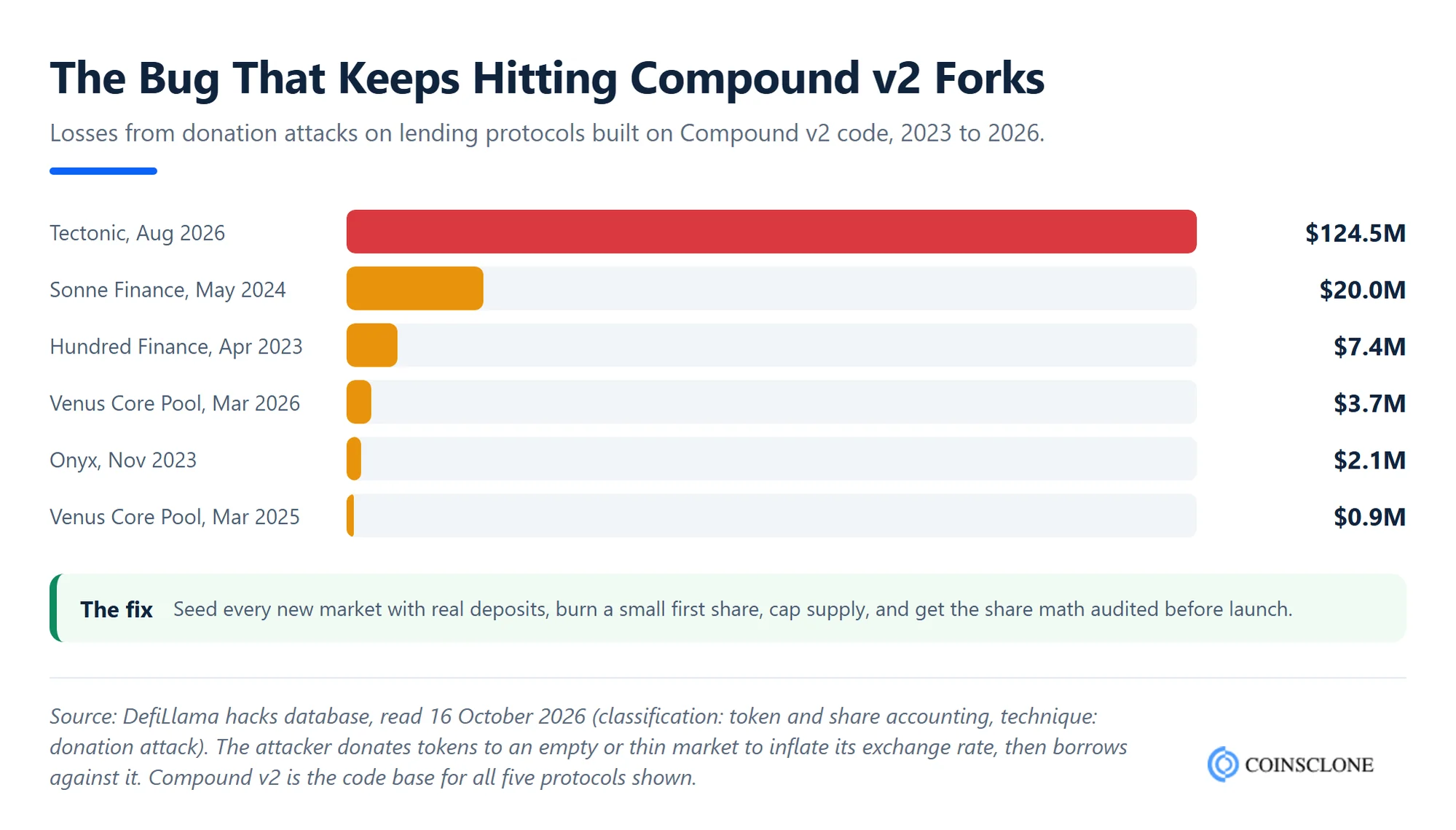
Compound v2 is one of the most copied codes in DeFi. DefiLlama lists 148 lending apps built on it. Together they held about $1.53 billion on 16 October 2026. The results are very uneven. Venus on BNB Chain holds about $1.27 billion, or 83% of the total. Only 6 forks hold more than $10 million, and 136 hold less than $1 million.
Security is the main reason many forks failed. One flaw in v2’s share math keeps coming back. An attacker “donates” tokens to an empty or thin market, which skews its exchange rate, and then borrows far more than they put in.
Other risks to plan for:
- Price feed attacks: Moonwell, another v2-based app, lost about $8.7 million in August 2026. An attacker pushed up a token’s price on a thin market, per DefiLlama’s hacks list.
- Upgrade bugs: Compound itself sent out far too many COMP rewards after a faulty upgrade in September 2021. CoinDesk reported the overpaid rewards on the day it happened.
- Governance capture: In July 2024, a large holder pushed through a proposal to move about $24 million of COMP into a vault he controlled, as CoinDesk reported. Use time locks, vote limits and a guardian who can pause bad proposals.
- Admin keys: Keep upgrade and pause rights in a multi-signature wallet with a time lock, never in one person’s wallet.
The fix is not hard, but it must be planned. Seed every new market with real deposits, cap supply for new coins, use more than one price source, and have the share math audited. Our DeFi smart contract development team builds these checks into every lending launch.
How to Create a Compound-Like DeFi Lending and Borrowing Platform?
Using a Compound clone script is a fast and sensible way to build a lending platform. It cuts the work, time and cost of building from scratch, since the base is ready and you shape it to your business and users.
- Define your project scope and needs
- Pick a trusted DeFi build team
- Customize smart contracts and platform design
- Connect wallets and tokens
- Test and audit everything
- Deploy on the blockchain and launch
1. Define Your Project Scope and Needs
Start with your business goals, target users, supported coins and custom needs. Decide which base assets each market will lend, which coins you will accept as collateral, and which chains you will launch on first.
2. Pick a Trusted DeFi Build Team
Look for a team that has already shipped lending platforms and can show audited code. Make sure they offer post-launch support and regular updates, so your platform stays secure and current.
3. Customize Smart Contracts and Platform Design
Update the smart contracts with your own rules, such as rate curves, collateral limits, supply caps and fees. Then shape the user interface around your brand and your users’ needs.
4. Connect Wallets and Tokens
Add support for wallets such as MetaMask, Trust Wallet and WalletConnect. Make sure the platform supports the token types you need, such as ERC-20 or BEP-20, for deposits, loans and repayments.
5. Test and Audit Everything
Test on testnets, run simulations of price crashes and empty markets, and get at least one outside audit. Safety is the heart of any lending app, and a proper audit is your safety net.
6. Deploy on the Blockchain and Launch
Once testing and audits are done, deploy your contracts on your chosen blockchain, such as Ethereum, BNB Chain or Arbitrum. Set up admin controls, seed the first markets with liquidity and turn on your liquidation bot before you open to the public.
With a clone script, you can launch quickly without losing features. You also spend your time on customization instead of building the basics from the ground up.
Benefits of Compound Clone Scripts
Building a lending protocol with a Compound clone script is a faster, cheaper and safer path than starting from scratch. It lets startups and large firms reach the market quickly while keeping full control of the user experience.
- Faster launch: A clone script lets you launch in weeks instead of months, so you can reach users before your rivals.
- Lower build cost: The core features are already built and tested, so you pay mainly for changes, audits and launch.
- Fully yours: You can change the look, rules, tokens and voting to fit your brand and local laws.
- Tested security: Audit-tested contracts lower the risk from common DeFi attacks, as long as you also audit your own changes.
- Room to grow: A modular design lets you add markets, coins and chains as your user base grows.
A Compound clone script saves time and money and gives you technology that users already trust. The next step is working out your budget.
Cost and Timeline to Build a Compound Clone
The cost depends on your lending model, the number of chains and coins, and how many audits you need. Published 2026 agency cost guides give these market ranges for DeFi lending platforms:
| Build scope | What you get | Typical market cost |
| MVP | One chain, a few markets, pooled lending, basic admin | $80,000 to $120,000 |
| Mid-scale | More markets, governance, analytics, mobile app | $120,000 to $250,000 |
| Enterprise | Multi-chain, institutional or fixed-rate features | $250,000 to $450,000+ |
| Security audits | One or two outside audits of the core contracts | $40,000 to $120,000 |
A custom build with audits usually takes about 20 to 36 weeks. A white label Compound clone is faster and cheaper, since the core is already built and tested. Coinsclone delivers a white label lending platform in about 8 to 12 weeks.
Also budget for running costs after launch. These include price oracle feeds, servers for your liquidation bot and alerts, a bug bounty, and rewards to attract your first lenders. A lending pool with no deposits earns nothing, so planning liquidity is part of the cost. To compare designs before you decide, see our Aave clone script, the other main pooled lending model.
Where Do I Get Compound Clone Software?
Your budget, time and coding skills decide the route. You have three ways to get a Compound clone script: free code, freelancers, or a clone script firm.
Using Open Source Code
You can download Compound’s code from GitHub for free. But you need strong Solidity skills to change, secure and deploy it, and you must follow its licence. You also take on every known bug in that version, as the forks above show. For a team without DeFi security experience, this is the riskiest route.
Hiring Freelancers
Freelancers can build a custom version of Compound at a lower price. But code quality, safety and support vary a lot, and it is hard to judge their code before you launch.
Working With a Clone Script Firm
This is the fastest and safest way to get a Compound clone script. Skilled DeFi exchange clone script providers have built lending and trading platforms before, and they can shape yours to your needs. They develop, audit, deploy and maintain a turnkey platform and stay with you after launch.
The first two routes often fall short on security, updates and growth, and those gaps can sink a lending platform in a crowded market. So, the best way to get a Compound clone script is to work with a skilled DeFi team that offers strong security, steady updates and support after launch.
That is where Coinsclone comes in. We help startups and large firms launch their own DeFi lending apps with our Compound clone script.
Start Your Own Compound-Like DeFi Lending Protocol With A Compound Clone Script
Cost-effective | White-Label Solutions | Premium Features | Fully Customizable | Live Demo Available
Why Choose Coinsclone’s Compound Clone Script?
Coinsclone is a trusted DeFi development company that has been building blockchain products since 2018. We have delivered 350+ platforms for 200+ clients across 20 industries. Our Compound clone script follows the Compound III design, with one base asset per market, tested rate curves and a built-in liquidation bot.
We shape it to your business model, add the markets and chains you need, and help you prepare for outside audits. You also get post-launch technical support and regular updates, so your lending platform stays secure as it grows.
Frequently Asked Questions
How does Compound Finance work?
Lenders supply a coin, such as USDC, to a shared pool and earn interest. Borrowers lock other coins as collateral and borrow from that pool. Rates move with demand: the more of the pool is borrowed, the higher both rates go. If a loan’s collateral falls too far in value, the protocol liquidates it to protect lenders.
Is Compound Finance safe?
Compound has run since 2018, and its current version, Compound III, has been audited by OpenZeppelin and ChainSecurity. It has still had problems, including a faulty rewards upgrade in 2021 and a governance attack in 2024. No DeFi protocol is risk-free, so a clone needs its own audits, a bug bounty and careful limits for each market.
Can I use Compound’s GitHub code to build my platform?
Yes, but read the licence first. Compound v2 code is under the BSD 3-Clause licence, and Compound III moved to GPL 2.0 or later by 31 December 2025. GPL lets you use and change the code, but if you share or sell your changed version, you must release its source under the same terms. Forks of v2 also inherit its known bugs, so an audit is a must.
Is it possible to have KYC and AML compliance on the platform?
Yes. You can add KYC and AML checks to meet the rules in your market, or to serve large firms that must know who they deal with.
Will the platform support many cryptocurrencies?
Yes. The platform can run many markets, each with its own base asset, and accept many ERC-20 or BEP-20 tokens as collateral.
How long will it take to build a DeFi lending and borrowing platform like Compound?
With a white label Compound clone script from Coinsclone, you can launch in about 8 to 12 weeks. The exact time depends on your custom features, the number of chains and the audit schedule. A full custom build usually takes about 20 to 36 weeks.
What is the cost of the Compound clone script?
The cost depends on your features, the level of customization and the blockchains you choose. Published 2026 market ranges run from about $80,000 to $120,000 for an MVP lending platform, with outside audits adding about $40,000 to $120,000. A white label script costs less, since the core is already built. Contact Coinsclone for a quote based on your needs.
Can I add more blockchains after launch?
Yes. Compound III runs separate markets on each chain, and your clone can work the same way. You can start on one chain, then deploy new markets on other EVM chains as demand grows.
See How Our MVP System Can Launch Your DeFi Lending Platform Faster
Compound Clone Script — built for performance & profits.
- MVP System : Launch your Compound-like lending platform 90% faster.
- Smart Contracts Ready : Pre-built for lending, borrowing & yield farming.
- Brand & Customization : Your tokens, your UI, your governance rules.
- Revenue Engine : Earn from lending interests, protocol fees & staking rewards.
Get a free branded DeFi platform demo in just 48 hours — before investing a cent!
Book a Free Demo to discover how our Compound Clone Script can take you from concept to live DeFi platform in 8–12 weeks.