
A crypto wallet is often the first product a crypto business builds. It is how users hold, send and use their coins, and it is the doorway to swaps, staking and payments. Demand keeps growing. Fortune Business Insights values the global crypto wallet market at about $12.2 billion in 2025 and expects it to reach about $98.6 billion by 2034, growing about 27% a year.
So how much does it cost to build a crypto wallet in 2026? The honest answer is that it depends on three choices: who holds the keys, how you build it, and how many chains and features you add. In this guide, we break down real price ranges from across the market, the running costs most estimates leave out, and a rent-or-own comparison with embedded wallet SDKs that few cost guides cover.
If you want the build steps rather than the budget, read our guide on how to create a crypto wallet.
See How Our MVP System Can Build Your Crypto Wallet Faster
Crypto Wallet Development — done right.
- MVP System: Launch your crypto wallet 90% faster.
- Pre-Built Modules: Wallets, tokens, and blockchain features ready—no coding needed.
- Brand & Customization: Your design, your tokens, your rules.
- Affordable Pricing: Transparent crypto wallet development cost with maximum ROI.
Get a free branded demo of your wallet app in 48 hours — before you invest a cent.
Book a Free Demo to discover how our system can deliver a secure crypto wallet at a cost that fits your budget and timeline.
How Much Does Crypto Wallet Development Cost?
Across the market, crypto wallet development costs roughly $15,000 to $50,000 for a basic MVP, $50,000 to $200,000 for a multi-chain wallet with swaps, and $200,000 to $500,000 or more for an enterprise or institutional wallet. Here is how published 2026 estimates compare:
| Wallet level | What it includes | Typical cost | Typical time |
| Basic MVP | One chain, send and receive, balances, basic security | $15,000 to $90,000 | 2 to 4 months |
| Mid-level | Multi-chain, swaps, WalletConnect, NFTs | $50,000 to $200,000 | 4 to 7 months |
| Advanced | MPC keys, DeFi, gas abstraction | $200,000 to $380,000 | 6 to 9 months |
| Enterprise | Institutional custody, compliance, custom infrastructure | $150,000 to $500,000+ | 7 to 14 months |
Sources: Purrweb and 4irelabs crypto wallet cost guides, 2026. Ranges are for a custom build by an agency. The wide gaps come from team location and scope.
These are custom-build figures. A white label wallet or a clone script starts from finished, tested code, so it costs far less and launches much sooner. Coinsclone’s published timelines are 3 to 5 weeks for a white label wallet and 8 to 12 weeks for a basic custom wallet, against the 2 to 4 months most agencies quote for an MVP from scratch.
Which Wallet Build Path Fits Your Business?
Before you price features, decide how you will get your wallet. This one choice changes your budget more than anything else.
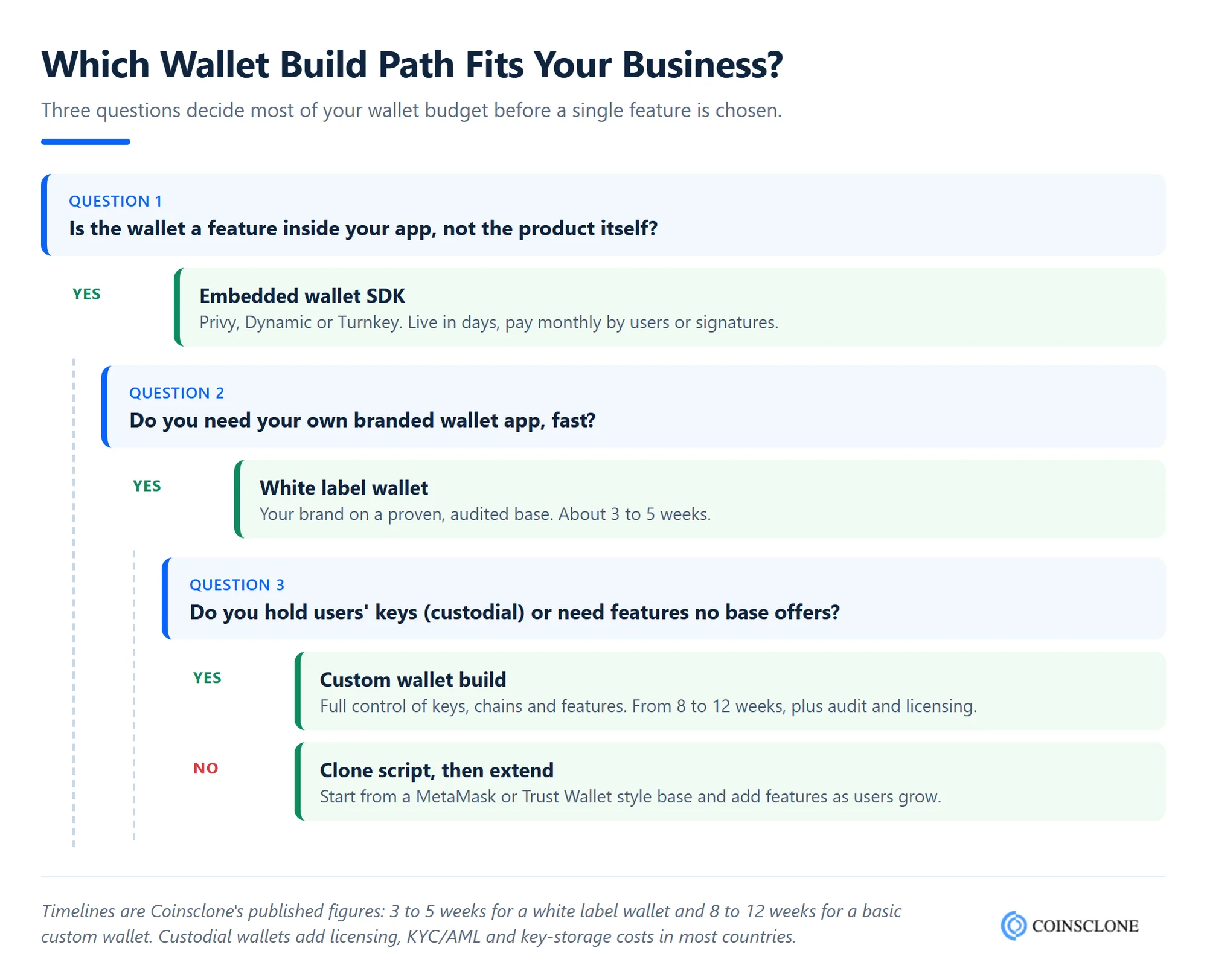
Embedded Wallet SDK
If the wallet is a feature inside your app, such as a game, a marketplace or a loyalty program, you may not need to build one at all. Embedded wallet providers like Privy, Dynamic and Turnkey let users sign in with email or social login and get a wallet in the background. You pay a monthly fee based on users or signatures.
White Label Wallet
A white label crypto wallet is a ready, tested wallet that you brand as your own. You choose the chains, features and design, and launch in weeks. This is the most common path for startups and exchanges that want their own wallet app.
Clone Script
A clone script copies the proven features of a well-known wallet. A MetaMask wallet clone script suits a browser-first Web3 wallet, while a Trust Wallet clone script suits a mobile, multi-chain wallet. You can then add your own features as you grow.
Custom Build
A custom build starts from zero. It gives you full control over key management, chains and features, but it costs the most and takes the longest. It makes sense for custodial wallets, institutional products and wallets with features no existing base offers.
White Label Crypto Wallet Price: Rent or Own?
Many people searching for a white label crypto wallet price are really choosing between two models:
- Own: Pay once for a white label wallet and its customisation. You own the app and pay only for hosting and maintenance after launch.
- Rent: Use an embedded wallet SDK and pay every month. It is cheap to start, but the fee grows with your users.
Here is what renting costs on published self-serve pricing:
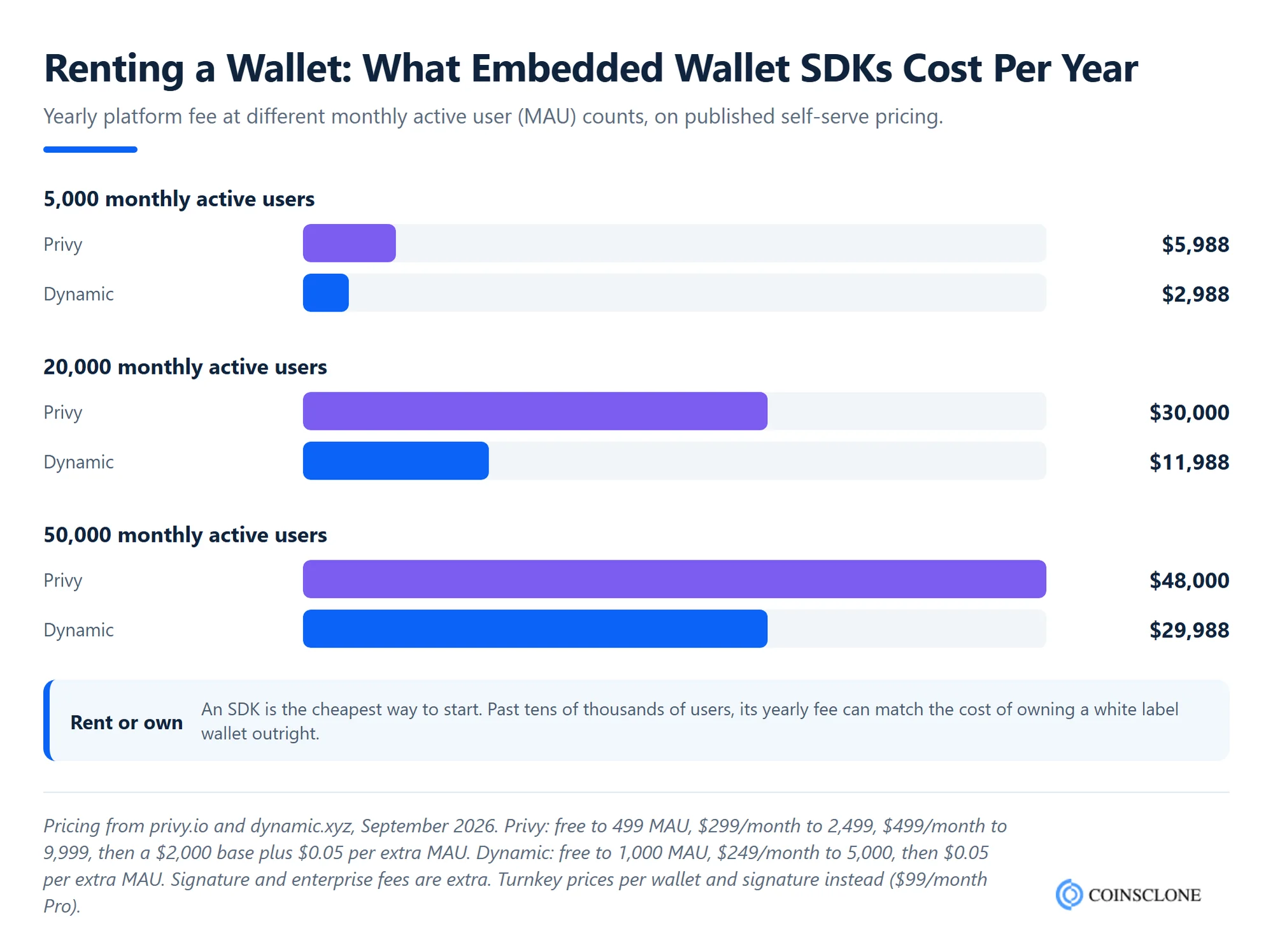
At 5,000 monthly users, an SDK costs about $3,000 to $6,000 a year, which is hard to beat. At 50,000 monthly users, the same SDKs cost about $30,000 to $48,000 a year, and that is before signature or enterprise fees. At that scale, owning a white label wallet often pays for itself within a year or two. You also keep your users, your data and your roadmap.
Factors That Affect Crypto Wallet Development Cost
Custodial or Non-Custodial
This is the biggest cost driver. In a non-custodial wallet, users hold their own keys, so the backend is simpler, but key backup and recovery need careful design. A custodial wallet holds keys for users. That adds secure key storage, monitoring, KYC/AML checks and, in most countries, a licence. Read our guide to custodial vs non-custodial wallets for the trade-offs.
Key Management Technology
A simple seed phrase wallet is the cheapest. Multi-party computation (MPC) splits the key into parts so no single device holds it, which removes the seed phrase but adds real engineering work. Smart contract wallets add features like social recovery and gas sponsorship. See our MPC wallet development guide for more.
Number of Blockchains
Each chain family needs its own integration. Adding more EVM chains, such as Base or Polygon, is fairly cheap once Ethereum works. Adding Bitcoin, Solana or TRON means new code for addresses, signing and fees. A multi-currency wallet costs more to build and to maintain.
Platforms
A browser extension, an iOS app, an Android app and a web app are each separate work. 4irelabs puts native iOS and Android builds at $15,000 to $80,000 each. Cross-platform frameworks such as React Native or Flutter can cut this by sharing most of the code.
Features
Every feature adds cost. Swaps, staking, NFT galleries, fiat on-ramps, DApp browsers and WalletConnect support are the most common add-ons. Start with the features your first users need, and add the rest later.
Security and Audits
Security is not optional in a crypto wallet. Plan for encryption, biometric login, transaction checks and a third-party audit. Purrweb puts a wallet audit at $5,000 to $50,000 or more, and 4irelabs suggests a new audit every 6 to 12 months as the code changes. Our guide to crypto wallet security covers the must-haves.
Compliance and Licensing
Custodial wallets usually need a licence, such as a VASP registration or a CASP licence under MiCA in the EU. KYC/AML integration costs about $10,000 to $30,000 to build, plus about $1 to $3 per identity check, according to Purrweb.
Team Location
Where your team works changes the price for the same scope. Purrweb’s 2026 rates are about $100 to $200 an hour in North America, $70 to $120 in Western Europe, $40 to $80 in Eastern Europe and $20 to $50 in South Asia.
Cost by Wallet Type
Different wallet types need different work. Here is what drives the cost of each:
| Wallet type | Main cost drivers | Relative cost |
| Mobile wallet (iOS and Android) | Two app platforms, secure device storage, biometrics, app store rules | Medium |
| Browser extension wallet | DApp connection, signing pop-ups, phishing protection | Low to medium |
| Web wallet | Secure login, session handling, often custodial | Medium |
| Bitcoin wallet | UTXO handling, address types (SegWit, Taproot), fee estimation | Low to medium |
| NFT wallet | NFT indexing, media display, marketplace links, spam filtering | Medium |
| DeFi wallet | Swaps, staking, DApp browser, transaction simulation | Medium to high |
| MPC or smart contract wallet | Key sharing or account abstraction, recovery, gas sponsorship | High |
| Custodial exchange wallet | Hot and cold storage, monitoring, KYC/AML, licensing | High |
Cost to Build a Wallet Like MetaMask or Trust Wallet
Most founders have a known wallet in mind. A MetaMask-style wallet starts as a browser extension focused on EVM chains and DApp connections, so the first version can be lean. A Trust Wallet-style wallet is mobile-first and multi-chain from day one, so it needs more chain integrations and testing. For full breakdowns, see the cost to build a Web3 wallet like MetaMask and a Web3 wallet like Trust Wallet.
Cost of a DeFi Wallet
A DeFi wallet adds swaps, staking and a DApp browser. The swap feature usually connects to a DEX aggregator, which saves you from building routing yourself. Transaction simulation, which shows users what a transaction will do before they sign, is now expected in serious DeFi wallets and adds engineering time. A white label DeFi wallet is the fastest way to get these features.
Detailed Cost Breakdown: Where the Budget Goes
For a custom wallet build, the budget usually splits like this:
| Development component | Share of budget | What it covers |
| Frontend (app and UI) | 15 to 20% | Screens, flows, design |
| Backend | 20 to 25% | APIs, notifications, price data |
| Blockchain integration | 15 to 20% | Chains, nodes, signing, fees |
| Security | 15 to 25% | Key storage, encryption, audits |
| Testing and QA | 10 to 15% | Device, chain and edge-case testing |
| Deployment | 5 to 10% | Hosting, app store release |
Security can take up to a quarter of the budget. That is money well spent. Cutting it is the most common way wallet projects fail.
Hidden and Ongoing Costs After Launch
The build is only the first bill. Plan for these running costs from day one:
| Ongoing cost | Typical range |
| Maintenance and updates | 15 to 20% of the build cost per year |
| Node and API infrastructure | $500 to $5,000 a month, growing with users |
| Price feed and data APIs | $200 to $1,000 a month |
| Repeat security audits | $15,000 to $40,000+ every 6 to 12 months |
| KYC checks (custodial wallets) | About $1 to $3 per verification |
| App store updates and OS changes | Included in maintenance, but constant |
Sources: Purrweb and 4irelabs, 2026.
4irelabs estimates that a live wallet costs $10,000 to $40,000 a year to run even with no new features. Budget for it, or your wallet will fall behind on security and chain upgrades.
How Long Does It Take to Build a Crypto Wallet?
| Build path | Typical timeline |
| Embedded wallet SDK | Days to a few weeks |
| White label wallet (Coinsclone) | 3 to 5 weeks |
| Basic custom wallet (Coinsclone) | 8 to 12 weeks |
| Custom MVP from scratch (market) | 2 to 4 months |
| Multi-chain wallet from scratch (market) | 4 to 7 months |
| Enterprise wallet (market) | 7 to 14 months |
Add three to six weeks for a third-party audit if your wallet includes new smart contracts or custom key management.
How to Reduce Crypto Wallet Development Cost
- Start with an MVP: Launch send, receive, balances and one or two chains. Add swaps, staking and NFTs once users ask for them.
- Choose non-custodial first: It avoids most licensing and KYC costs.
- Start from proven code: A white label wallet or clone script skips months of work that other teams have already tested.
- Use cross-platform frameworks: Share code between iOS and Android.
- Stick to EVM chains first: One integration then covers many networks.
- Do not skip the audit: A security incident costs far more than an audit.
How Crypto Wallets Make Money
A wallet can earn back its cost in several ways:
- Swap fees: A small fee on in-app token swaps, the biggest earner for most wallets.
- Fiat on-ramp commissions: A share of the fee when users buy crypto with a card.
- Staking commissions: A cut of staking rewards.
- Premium features: Advanced tools, higher limits or support tiers.
- Partner integrations: Listing and referral deals with DApps and exchanges.
Our guide on how crypto wallets make money explains each model with real examples.
Why Choose Coinsclone for Crypto Wallet Development?
Coinsclone is a cryptocurrency wallet development company that has delivered more than 350 blockchain platforms for over 200 clients. We build custodial, non-custodial and MPC wallets for mobile, web and browser extensions, with multi-chain support, swaps, staking, NFTs and fiat on-ramps. You can start from our white label wallet in 3 to 5 weeks, or from a ready model such as our MetaMask or Phantom wallet clone script, and extend it as you grow.
When you compare wallet development partners, ask for live products, audit reports and client references. Check how they handle keys, what support they give after launch, and whether their team has real blockchain experience, not just app experience.
So, Ready to Launch Your Own Crypto Wallet App?
Disclaimer – The cost and time figures in this blog are for information only and are not a quotation. Market ranges come from the published sources named above and vary with project scope. For an accurate estimate for your project, please contact our business team.
See How Our MVP System Can Build Your Crypto Wallet Faster
Crypto Wallet Development — done right.
- MVP System: Launch your crypto wallet 90% faster.
- Pre-Built Modules: Wallets, tokens, and blockchain features ready—no coding needed.
- Brand & Customization: Your design, your tokens, your rules.
- Affordable Pricing: Transparent crypto wallet development cost with maximum ROI.
Get a free branded demo of your wallet app in 48 hours — before you invest a cent.
Book a Free Demo to discover how our system can deliver a secure crypto wallet at a cost that fits your budget and timeline.
Frequently Asked Questions
Is a white label crypto wallet cheaper than an embedded wallet SDK?
At small scale, an SDK is usually cheaper because you pay only a monthly fee. As your users grow, SDK fees rise with every active user, while a white label wallet you own costs mainly hosting and maintenance, so owning often becomes cheaper within one or two years.
Should I build my crypto wallet for iOS, Android or the browser first?
Start where your users are. Mobile apps suit payments and everyday users, while a browser extension suits DeFi and dApp users on desktop. Many teams launch one platform first to control cost, then add the others. Cross-platform frameworks such as React Native let you share most of the code between iOS and Android.
How much does it cost to build a crypto wallet app?
Published 2026 estimates put a basic MVP at about $15,000 to $90,000, a multi-chain wallet with swaps at $50,000 to $200,000, and an enterprise wallet at $150,000 to $500,000 or more. A white label wallet costs much less and launches in weeks.
What is the price of a white label crypto wallet?
It depends on the features, chains and platforms you need. You pay once for the licence and customisation, then only for hosting and maintenance. Coinsclone’s white label wallet launches in 3 to 5 weeks. Contact the team for a quote on your scope.
Is it cheaper to use an embedded wallet SDK?
At first, yes. Privy and Dynamic are free for small user counts and cost a few thousand dollars a year at 5,000 monthly users. At 50,000 monthly users, they cost about $30,000 to $48,000 a year, and owning a white label wallet often becomes cheaper.
Why does a custodial wallet cost more?
You hold users’ keys, so you need secure key storage, monitoring, KYC/AML checks and, in most countries, a licence. These add both build and running costs.
How long does it take to develop a crypto wallet?
A white label wallet takes about 3 to 5 weeks and a basic custom wallet about 8 to 12 weeks with Coinsclone. A custom MVP from scratch usually takes 2 to 4 months across the market, and an enterprise wallet 7 to 14 months.
What are the ongoing costs of a crypto wallet?
Plan for maintenance of 15 to 20% of the build cost per year, node and API infrastructure of $500 to $5,000 a month, and repeat audits. A live wallet can cost $10,000 to $40,000 a year to run even with no new features.
Which features should an MVP crypto wallet include?
Wallet creation and backup, send and receive, balances and history, one or two chains, and strong security such as biometric login. Swaps, staking, NFTs and more chains can come later.
What are the main regulatory hurdles for a crypto wallet?
Non-custodial wallets face fewer rules. Custodial wallets usually need a licence, such as a MiCA CASP licence in the EU, plus KYC/AML checks and data protection compliance. Get local legal advice before launch.