
Multi-currency crypto wallet development is the work of building one app that holds Bitcoin, Ether, stablecoins and other tokens across many blockchains. Users get one balance screen, one backup and one place to send, swap and receive. For startups, that makes a multi-currency wallet one of the most practical ways to enter the crypto market in 2026.
This guide explains how these wallets work under the hood, which chains to support first, the features and tech stack you need, and the steps to build one. It closes with real 2026 cost ranges, launch times, rules to check and the ways wallets make money.
In this guide:
- How one seed phrase can run Bitcoin, Ethereum, Tron and Solana in a single app
- Which blockchains to support first, based on where users hold their stablecoins today
- The custody choice that shapes your security, licences and costs
- An 8-step build plan, 2026 cost ranges and launch timelines
See How Our MVP System Can Launch Your Multicurrency Wallet Faster
Multicurrency Wallet Development — done right.
- MVP System : Launch your multi-crypto wallet 90% faster.
- Pre-Built Modules : Support for multiple cryptocurrencies, tokens, and secure transactions—no coding needed.
- Brand & Customization : Your design, your coins, your rules.
- Revenue Engine : Earn from transaction fees, staking, and integrated token swaps.
Get a free branded demo of your multicurrency wallet in 48 hours — before you invest a cent.
Book a Free Demo to see how our Multicurrency Wallet Development solution can take you from idea to live wallet in just 8–12 weeks.
What Is Multi-Currency Wallet Development?
Multi-currency wallet development means planning, building and launching a crypto wallet that holds many coins and tokens on many blockchains in one app. A multi-currency crypto wallet lets users send, store, receive and swap Bitcoin, Ethereum tokens, stablecoins and more without switching between apps.
Strictly speaking, the coins never sit inside the wallet. They stay on their blockchains. The wallet holds the private keys that prove ownership, and it signs each payment. A good multi-currency wallet hides all of this from the user. The user sees one portfolio, while the app quietly talks to a dozen networks in the background.
The multi-currency wallet acts like a digital bank account for crypto users. It also packs in features like in-app swaps, staking and strong security, so users have fewer reasons to leave. That is why the big names have all moved this way. MetaMask, once an Ethereum-only wallet, now gives each account an EVM address, a Solana address and a Bitcoin address. Native Bitcoin support arrived in December 2025.
The demand is real. Grand View Research values the global crypto wallet market at about $15.5 billion in 2025 and expects it to reach about $100.8 billion by 2033. First, let’s see how such a wallet works. Then we will look at the business case.
How Does a Multi-Currency Wallet Work?
Most guides skip this part, yet it decides your build time and cost. A multi-currency wallet does three jobs for every chain it supports: it creates keys, it reads balances and it signs and sends transactions.
One Seed Phrase, Many Keys
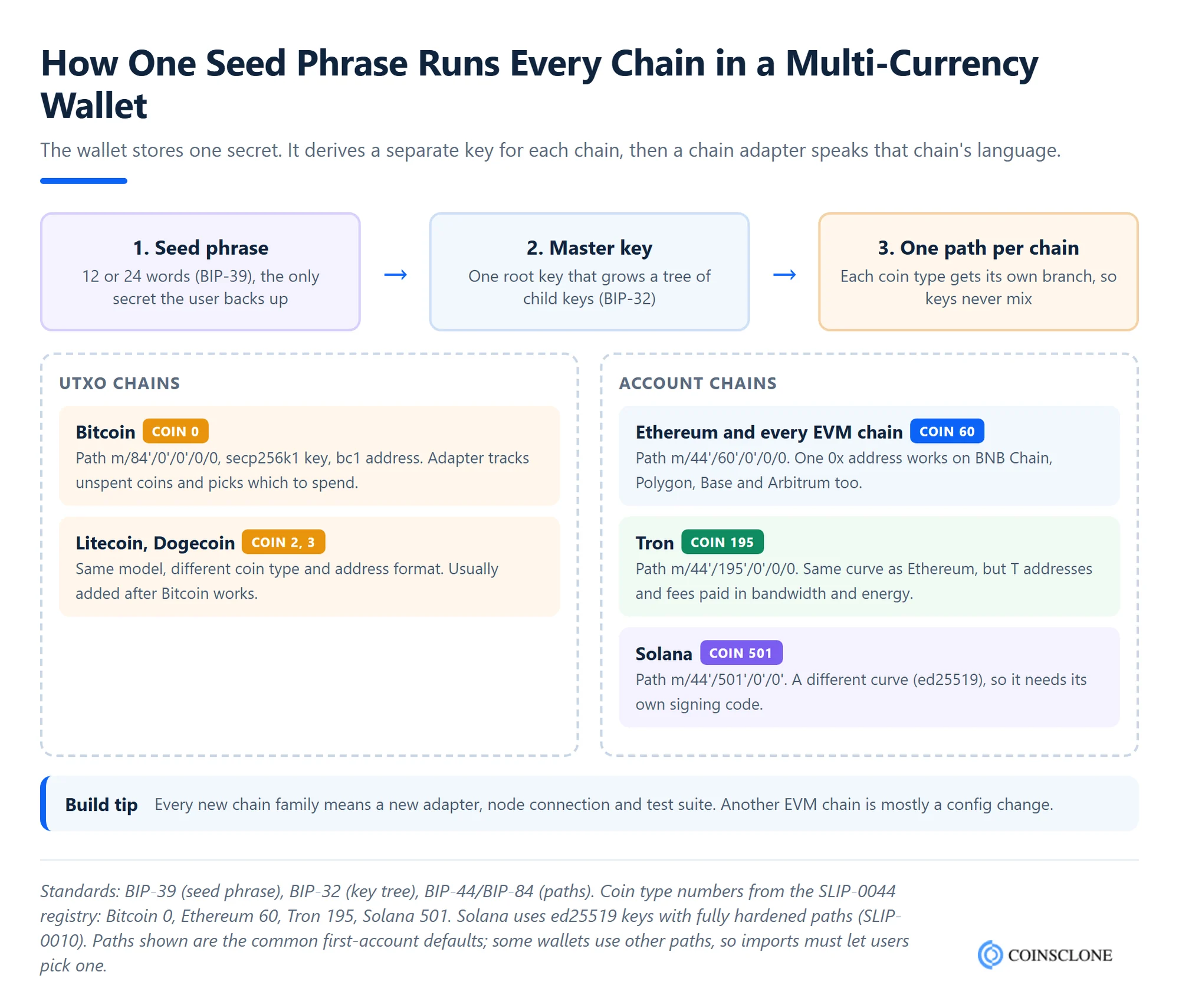
Modern wallets do not store a separate secret for each coin. Instead, they follow the Bitcoin standards BIP-39 for the 12 or 24-word seed phrase and BIP-32/BIP-44 for growing a tree of keys from it. Each blockchain gets its own branch, set by a coin type number in the SLIP-0044 registry. Bitcoin is 0, Ethereum is 60, Tron is 195 and Solana is 501.
So the user backs up one phrase, and the wallet can rebuild every address on every chain from it.
Chain Adapters
Blockchains do not speak the same language. Bitcoin tracks unspent coins (the UTXO model). Ethereum, Tron and Solana track account balances. Solana even uses a different signing curve. So the wallet needs a chain adapter for each chain family. The adapter builds each payment in the right format, sets the fee and signs with the right key.
Here is the good news. EVM chains such as BNB Chain, Polygon, Base and Arbitrum share Ethereum’s address and signing format. Once Ethereum works, adding another EVM chain is mostly a settings change. A new chain family like Solana or Bitcoin needs new code and new tests.
Nodes and Indexers
The wallet reads balances and sends transactions through blockchain nodes. Most teams rent node access from RPC providers rather than running their own. For example, Alchemy offers a free tier of 30 million compute units a month, then charges $0.525 per million. Smart teams keep a backup provider, so the wallet stays up when one network or provider has trouble.
Why Do Businesses Need a Multi-Currency Crypto Wallet?
Multi-currency crypto wallet development gives startups a product that users open every day. Founders who want a crypto business with a clear scope often pick it. Here is why it pays off.
Global Outreach
People in many countries hold different crypto assets and stablecoins. A multi-currency wallet serves all of them in one app. It also makes payments across borders simpler, since users can send a stablecoin instead of changing money through banks.
Where Users Hold Their Money
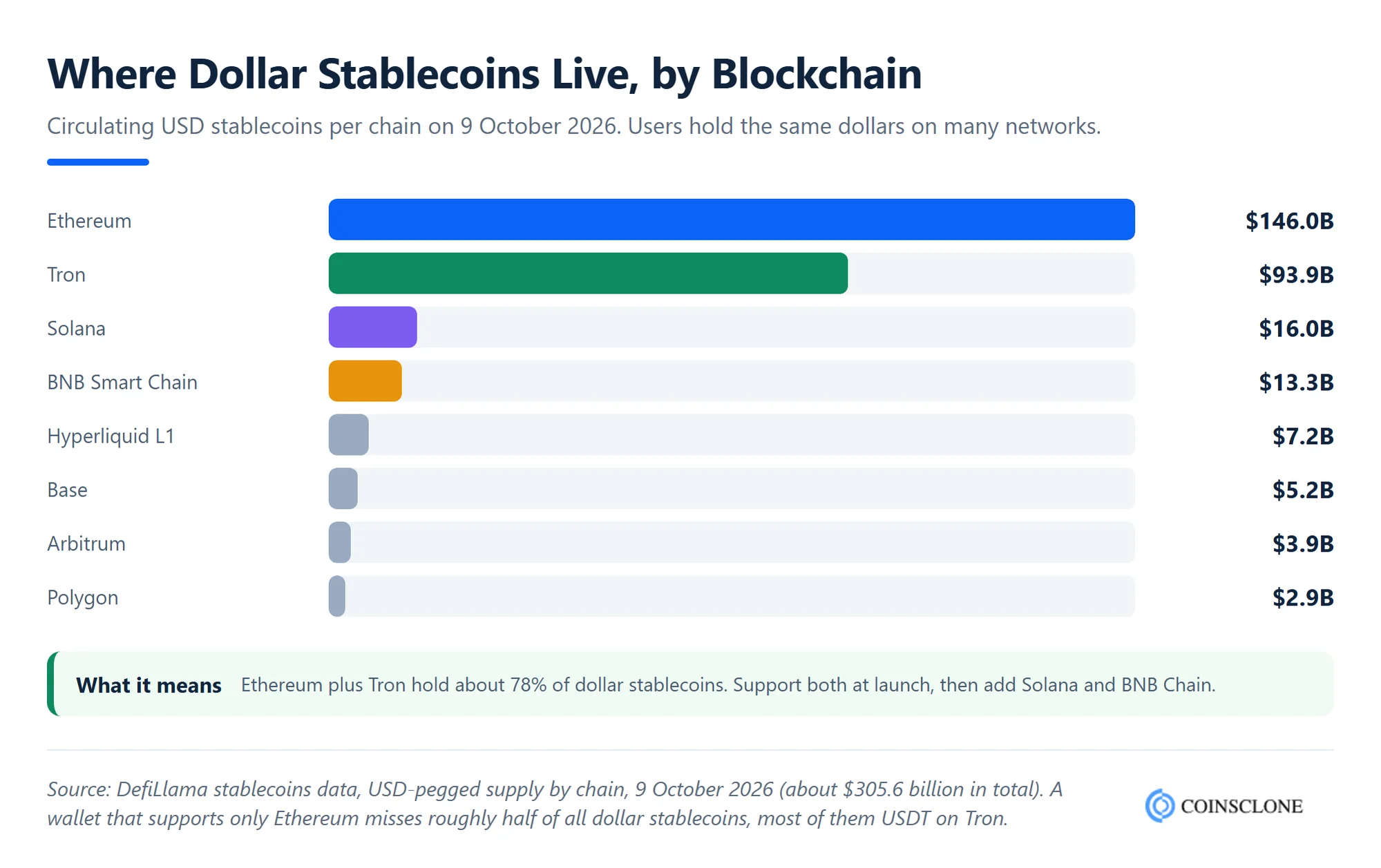
Users do not keep their dollars on one chain. On 9 October 2026, DefiLlama counted about $146 billion of dollar stablecoins on Ethereum and $94 billion on Tron. Solana and BNB Chain were far behind. A wallet that supports only Ethereum misses roughly half of all dollar stablecoins.
Cost-Effective Solution
Compared with an exchange, a wallet is a smaller and cheaper build. A non-custodial wallet does not hold user funds, so it avoids most of the licensing costs that exchanges face. With a white label base, even a new startup can launch in weeks rather than months.
Several Revenue Streams
A wallet can earn from swap fees, staking commissions, on-ramp referral fees and premium features. We cover each one in the revenue section below.
Stronger Security Options
Because a multi-currency wallet holds many assets, it needs strong safety from day one: locked key storage, face or fingerprint unlock, MPC and payment checks. Users get a safer home for all their crypto.
Future-Ready Solution
As Web3, DeFi, tokenized assets and stablecoin payments grow, a wallet that supports many chains is the front door to all of them. It is ready for new networks as they gain users.
In short, a multi-currency wallet is a sound business for startups and founders. Before you plan features, though, you need to make one key choice.
Custodial, Non-Custodial or MPC: Choose the Custody Model First
The custody model decides who controls the private keys. It shapes your security design, your licences and your budget, so make this choice before anything else.
| Model | Who holds the keys | Best for | Licence impact |
| Non-custodial | The user, through a seed phrase or passkey | Web3 and DeFi wallets, global consumer apps | Usually lightest; software providers are often outside money transmission rules |
| Custodial | Your company, in hot and cold storage | Exchanges, payment apps, fintechs with fiat | Heaviest; needs licences, KYC and AML programs |
| MPC | Key shares split between the user, your server and sometimes a backup | Mainstream apps that want no seed phrase | Depends on whether you can move funds alone |
For a deeper look, see our comparison of custodial vs non-custodial wallets. If you want the easy sign-up of a custodial app without holding user funds, read our guide to MPC wallet development.
Which Blockchains and Assets Should You Support?
A common mistake is to launch with 50 chains and test none of them well. Start where your users already are, then grow.
| Chain | Why support it | Build effort |
| Ethereum | Largest stablecoin base, most DeFi apps and tokens | Core build, sets up all EVM support |
| Tron | Huge USDT payment volume, low fees | New adapter; fees work through bandwidth and energy |
| Bitcoin | The asset most users want to hold | New UTXO adapter |
| BNB Chain, Polygon, Base, Arbitrum | Cheap fees, large user bases | Low; reuses the Ethereum adapter |
| Solana | Fast payments, active trading and memecoin users | New adapter with a different signing curve |
Within each chain, support the main tokens: USDT and USDC first, then the native coin and the top tokens your users ask for. Add a custom token import so users can add any ERC-20, TRC-20 or SPL token by contract address.
Tech Stack For a Multi-Currency Crypto Wallet
The right tech stack keeps your wallet safe, fast and ready to grow. Here is what each layer needs.
Languages and App Tools
These build the mobile and web apps that users touch every day.
- Mobile: React Native or Flutter for one shared codebase; Swift (iOS) and Kotlin (Android) for full native apps
- Backend: Node.js, Go or Python
- Smart contracts: Solidity for EVM chains and Rust for Solana
Frameworks & Libraries
These tools speed up wallet app development and connect the app to each chain.
- React.js or Angular for the web wallet and admin panel
- ethers.js, viem or Web3.js for Ethereum and EVM chains
- TronWeb for Tron
- @solana/web3.js for Solana
- bitcoinjs-lib for Bitcoin
- Trust Wallet Core, an open-source library that handles keys and signing for many chains
Blockchain Networks
The wallet connects to each blockchain for transparency, speed and smooth payments. Popular choices are:
- Ethereum
- Bitcoin
- Tron
- BNB Chain
- Polygon
- Solana
- Avalanche
Database Storage
The database stores user settings, saved addresses, cached balances and past payments. Popular tools are:
- PostgreSQL
- MongoDB
- Redis for fast caching of prices and balances
Security Protocols
Security is the backbone of the wallet. It protects both the user app and the admin dashboard.
- Encrypted key storage in the phone’s Secure Enclave or Android Keystore
- Two-step login and face or fingerprint unlock
- SSL/TLS on each link to your servers
- Multi-signature or MPC sign-off for large sends
- IP whitelisting for the admin panel
APIs and Outside Services
APIs connect the wallet to outside services. They power fiat on-ramps, swap routing, real-time price feeds, WalletConnect for dApps, and KYC/AML checks where you need them.
With this stack in place, a startup has a strong base for a smooth wallet experience. Next come the features users will judge you by.
Unique Features Of A Multi-Currency Crypto Wallet
Features make or break a multi-currency crypto wallet. Both the user app and the admin dashboard need the right set for a smooth experience. Here are the common features to include.
- Unified Portfolio: Users see all their coins and tokens on each chain, with one total in their own money.
- Token Swaps: A built-in swap lets users trade one token for another without leaving the app.
- Cross-Chain Bridging: Users can move assets from one chain to another, for example USDT from Tron to Ethereum.
- Live Analytics: The admin can view user activity, new sign-ups and payment volume.
- Help Desk: Users can raise a ticket when a payment or the app goes wrong.
- Push Notifications: Users get instant alerts for price moves, deposits and sent payments.
- QR Code Scanner: Users scan a QR code to pay or to copy an address without typos.
- Automatic Session Out: The wallet locks itself after a set time, so a lost phone does not mean lost funds.
- Transaction History: Users can view and export past payments on each chain.
- Cold Storage: For custodial wallets, most user assets stay offline to guard against online attacks.
- Currency Conversion: Users can buy crypto with fiat and sell it back through on-ramp and off-ramp partners, with fees shown up front.
- DeFi Integration: Users can connect to staking, lending and other dApps through WalletConnect.
How to Develop a Multi-Currency Crypto Wallet?
Building a multi-currency crypto wallet needs a clear plan from first research to post-launch support. Here are the 8 steps we follow.
1. Market Analysis
First, study the market and your target users. Review top wallets like Trust Wallet and MetaMask to learn their strengths and what users complain about. Decide which countries you will serve, because that decides your rules and payment partners.
2. Pick the Team and Who Holds the Keys
Next, choose your custody model and your launch chains. Then build the right team: blockchain coders, app coders, UI/UX designers and QA testers. Most startups hire a crypto wallet development company rather than building a team from scratch.
3. UI/UX Design
The design phase shapes how simple the wallet feels. Plan clear flows for sign-up, backup, sending and swapping. Show network names and fees plainly, so users never send tokens on the wrong chain.
4. Feature Integration
The team builds the core features and the chain adapters, then adds support for each coin and token. Getting these right keeps the wallet useful as users’ needs grow.
5. Smart Contract Development
Smart contracts handle swaps, staking and DeFi links. For smart account wallets, they also handle gas payments in stablecoins and account recovery. Keep contracts small and well-tested.
6. Testing and Audits
Once the wallet is built, test every chain on its test network, then on mainnet with small amounts. Hire an outside security firm to audit the key handling and any smart contracts. Careful testing cuts post-launch issues and builds user trust.
7. Crypto Wallet Launch
After testing, launch the multi-currency crypto wallet on the Google Play Store and Apple App Store, plus a web or browser extension if you plan one. App stores review crypto apps closely, so prepare clear descriptions of what the app does.
8. Post-Launch Support
After launch, keep the wallet fresh with regular updates and user support. Blockchains upgrade often, so chain adapters need updates too. Quick fixes close safety gaps and keep the app smooth.
Security: What Multi-Currency Wallets Must Get Right
Every chain you add is one more place where things can go wrong. That is why security needs its own plan. Chainalysis found that more than $3.4 billion of crypto was stolen in 2025. The largest theft hit Bybit on 21 February 2025, when attackers took about $1.5 billion by tampering with the screen used to approve a wallet transfer.
Build these protections in from the start:
- Key safety: Keep keys encrypted on the device, never on your servers in plain form.
- Clear signing: Show users exactly what they approve, in plain words, before they sign.
- Address checks: Warn users about wrong-network sends and known scam addresses.
- Safe updates: Sign each app and extension update and limit who can publish them.
- Audits: Audit before launch and after every major change.
Our guide to crypto wallet security covers each threat in more detail.
Rules and Compliance to Check
The rules depend on your custody model and the countries you serve.
- United States: under FinCEN’s 2019 guidance, providers of non-custodial wallet software are not money transmitters. Custodial wallets usually are, so they need FinCEN registration, state licences and full AML programs.
- European Union: under MiCA, holding crypto for clients is a licensed service, so custodial wallets need a CASP licence. The EU’s transfer of funds rule has applied since 30 December 2024. It requires CASPs to collect sender and receiver data and to check ownership of self-hosted wallets for transfers over EUR 1,000.
- Fiat features: if you add buying and selling with bank cards, your on-ramp partner usually handles KYC. If you handle fiat yourself, you need the licences.
Always confirm the rules in each country with a local lawyer before launch.
How Do Multi-Currency Wallets Make Money?
A wallet is free for users, so plan your revenue early. The common streams are:
- Swap fees: a small fee on in-app token swaps. For example, MetaMask adds a 0.875% service fee to each swap quote.
- On-ramp referral fees: fiat partners share part of their fee when users buy crypto in your app.
- Staking commissions: a share of the rewards when users stake through the wallet.
- Bridge fees: a small fee when users move assets between chains.
- Premium features: paid plans for advanced tools, higher limits or business accounts.
A multi-currency wallet earns from all of these on every chain it supports. That is one more reason to choose your launch chains carefully.
What Is the Cost of Multi-Currency Crypto Wallet Development?
The cost of multi-currency crypto wallet development depends on four things: how many chains you add, who holds the keys, the features and the team you hire. Published 2026 market estimates put a basic MVP at about $15,000 to $90,000 and a multi-chain wallet with swaps at $50,000 to $200,000.
| Wallet level | What it includes | 2026 market cost | Typical time |
| White label | Ready-made multi-chain wallet with your brand | $10,000 to $80,000 | Weeks |
| Basic MVP | Few chains, send and receive, balances, basic security | $15,000 to $90,000 | 2 to 4 months |
| Mid-level | Multi-chain, swaps, WalletConnect, NFTs | $50,000 to $200,000 | 4 to 7 months |
| Advanced | MPC keys, DeFi, gas abstraction | $200,000 to $380,000 | 6 to 9 months |
| Enterprise | Institutional custody, compliance, custom infrastructure | $150,000 to $500,000+ | 7 to 14 months |
Several factors move the price:
- Number of chain families: each extra chain adds about $5,000 to $20,000, less for EVM chains
- Custody model: wallets that hold user funds, and MPC wallets, cost more than self-custody ones
- Security and audits: outside audits are a must, not an extra
- Team location: hourly rates differ a lot from one region to the next
- Running costs: plan for node access, app store fees and maintenance of about 15% to 25% of the build cost each year
For a full breakdown, read our guide to crypto wallet development cost. If speed matters most, a white label crypto wallet is the fastest path. Coinsclone launches a white label wallet in about 3 to 5 weeks, and a custom wallet takes about 8 to 12 weeks.
The process may look simple, but building a wallet with secure key handling and many chain adapters needs an experienced team. One such team in the crypto industry is Coinsclone.
Why Choose Coinsclone For Multi-Currency Crypto Wallet Development?
Coinsclone is a leading crypto wallet development company with a skilled team of blockchain coders, designers and safety experts. We have been building crypto products since 2018 and have delivered 350+ platforms for 200+ clients across 20 industries.
We help you pick the right custody model, chains, features and safety setup. Our white label wallet launches in 3 to 5 weeks, and a custom wallet takes 8 to 12 weeks. After launch, we stay with you for support, updates and new chains. Partner with our team to launch a multi-currency crypto wallet that users trust.
Frequently Asked Questions
How do multi-currency wallets work?
A multi-currency wallet creates one seed phrase and derives a separate key for each blockchain from it, using the BIP-32, BIP-39 and BIP-44 standards. A chain adapter for each network reads balances, estimates fees and signs payments. The user sees one portfolio and backs up one phrase.
Which cryptocurrencies should a multi-currency wallet support?
Start with Ethereum and Tron. In October 2026, the two held about 78% of all dollar stablecoins. Add Bitcoin, the main EVM chains such as BNB Chain, Polygon, Base and Arbitrum, and Solana. Support USDT and USDC first, then the tokens your users ask for.
How long does it take to develop a multi-currency wallet?
A white label wallet launches in about 3 to 5 weeks with Coinsclone, and a custom wallet takes about 8 to 12 weeks. Larger multi-chain or MPC builds take 4 to 9 months, and enterprise custody wallets 7 to 14 months.
How much does it cost to develop a multi-currency wallet?
Published 2026 market estimates put a basic MVP at about $15,000 to $90,000 and a multi-chain wallet with swaps at $50,000 to $200,000. White label wallets cost about $10,000 to $80,000. Each extra chain family adds about $5,000 to $20,000.
How do wallet providers make money?
Most wallets earn from swap fees, on-ramp referral fees, staking commissions, bridge fees and premium plans. MetaMask, for example, charges a 0.875% service fee on swaps.
What is the difference between custodial and non-custodial wallets?
In a custodial wallet, the company holds the private keys and manages funds for users. In a non-custodial wallet, only the user holds the keys through a seed phrase or passkey. Custodial wallets often need licences and KYC checks. Non-custodial ones mostly do not.
Can users swap one cryptocurrency for another inside the wallet?
Yes. Most multi-currency wallets have a built-in swap that sends trades through DEXs or other trading partners. Many also offer bridging, so users can move a token from one chain to another.
How can I keep my wallet secure and updated after launch?
Audit the wallet before launch and after every major change. Sign every app update, watch for chain upgrades that need adapter changes, and fix reported bugs quickly. A support team and clear user alerts help catch problems early.
See How Our MVP System Can Launch Your Multicurrency Wallet Faster
Multicurrency Wallet Development — done right.
- MVP System : Launch your multi-crypto wallet 90% faster.
- Pre-Built Modules : Support for multiple cryptocurrencies, tokens, and secure transactions—no coding needed.
- Brand & Customization : Your design, your coins, your rules.
- Revenue Engine : Earn from transaction fees, staking, and integrated token swaps.
Get a free branded demo of your multicurrency wallet in 48 hours — before you invest a cent.
Book a Free Demo to see how our Multicurrency Wallet Development solution can take you from idea to live wallet in just 8–12 weeks.