
The cost to build a Web3 wallet like MetaMask in 2026 runs from about $10,000 for a white label launch to $200,000 or more for a custom wallet with a browser extension, a mobile app, swaps and many chains. Where you land depends on three choices: how you build it, which features you ship first, and where your team works. This guide walks through each choice with 2026 figures, so you can set a budget before you talk to any developer.
You will see what each build path costs, what the main features add, and what you pay after launch for nodes, audits and upkeep. We also explain whether you can simply fork MetaMask’s code, what licences a wallet needs, and how a wallet like MetaMask earns its money back, with a source for each number.
In this guide:
- Price ranges for 2026: white label, MVP, MetaMask-level and advanced builds, with timelines.
- The fork question: what MetaMask’s code licence allows, and the 10,000 user limit that catches many founders.
- Feature and running costs: what multi-chain support, swaps, audits, RPC nodes and upkeep add.
- A decision tree: whether to rent, fork, start from a clone script or build from scratch.
- Payback: a worked example of swap fee income at MetaMask’s 0.875% rate.
How Much Does It Cost to Build a Web3 Wallet Like MetaMask?
The total cost depends on how you build the wallet, which features you add, and how much you customise it. Here is how the main build paths compare, based on published 2026 market estimates. These are the same ranges we use across our wallet cost guides.
| Build path | What you get | Typical 2026 cost | Typical timeline |
| White label / clone script | Ready wallet core with your brand, extension and app, standard features | $10,000 to $80,000 | Weeks (Coinsclone: 3 to 5 weeks) |
| Basic MVP from scratch | One chain, send and receive, balances, basic security | $15,000 to $90,000 | 2 to 4 months |
| MetaMask-level wallet | Extension plus mobile app, many chains, swaps, dApp links, NFTs | $50,000 to $200,000 | 4 to 7 months (Coinsclone custom: 8 to 12 weeks) |
| Advanced wallet | MPC keys, smart accounts, gas sponsorship, perps or prediction markets | $200,000 to $380,000 | 6 to 9 months |
| Enterprise or custodial | Institutional custody, compliance, own infrastructure | $150,000 to $500,000+ | 7 to 14 months |
These ranges are wide because a “wallet like MetaMask” can mean a simple Ethereum extension or a full finance app. Your feature list decides which row you sit in.
White Label MetaMask Clone (with Basic Features)
Startups that want to launch fast can start with a White Label MetaMask Clone. It comes with the core features: a browser extension, a mobile app, private key control, send and receive, EVM chain support and dApp links. You add your brand and launch.
It cuts build time and upfront cost because the core is already built and tested. It is also a low-risk way to test the market before you pay for advanced features.
Typical 2026 range: $10,000 to $80,000
White Label MetaMask Clone (with Customised Features)
Many teams start from a white label core and then add their own features: more chains, in-app swaps, staking, MPC key security or a custom design. This keeps the speed of a ready base while giving you a product that looks and works like your own.
Typical 2026 range: about $50,000 to $200,000, depending on how many chains and features you add
From either option, you can keep improving the user interface, security features and wallet APIs after launch.
Development From Scratch
Established firms that want full control can build a crypto wallet like MetaMask from scratch. Here, the team builds every part from the ground up: the extension, the apps, the backend, the chain links and the security layer. It costs more upfront, but you own every line of code.
Typical 2026 range: $70,000 to $500,000, depending on scope; 4 to 9 months for most teams
Coinsclone moves faster than a team starting from zero, because our wallet core, chain modules and security layers are already built. That is why our published timelines are 3 to 5 weeks for a white label crypto wallet and 8 to 12 weeks for a custom wallet.
Can You Just Fork MetaMask’s Code?
Many founders find MetaMask’s code on GitHub and ask the same question: why pay for a build at all? The answer is in the licence.
MetaMask’s browser extension code is public, but it is not free for business use. The licence file in MetaMask’s GitHub repository says ConsenSys owns the code. You may copy and change it only for non-commercial use. That covers personal projects, charities, schools and public bodies. It also covers any copy with no more than 10,000 monthly active users across all versions and platforms. You must also show a clear notice that your app uses MetaMask code.
So a fork works for a test or a small hobby project. But a wallet firm that plans to grow past 10,000 monthly users needs its own deal with ConsenSys, or its own code. The licence also bans using ConsenSys or MetaMask brand marks in a way that confuses users.
This is why most firms take one of three other paths:
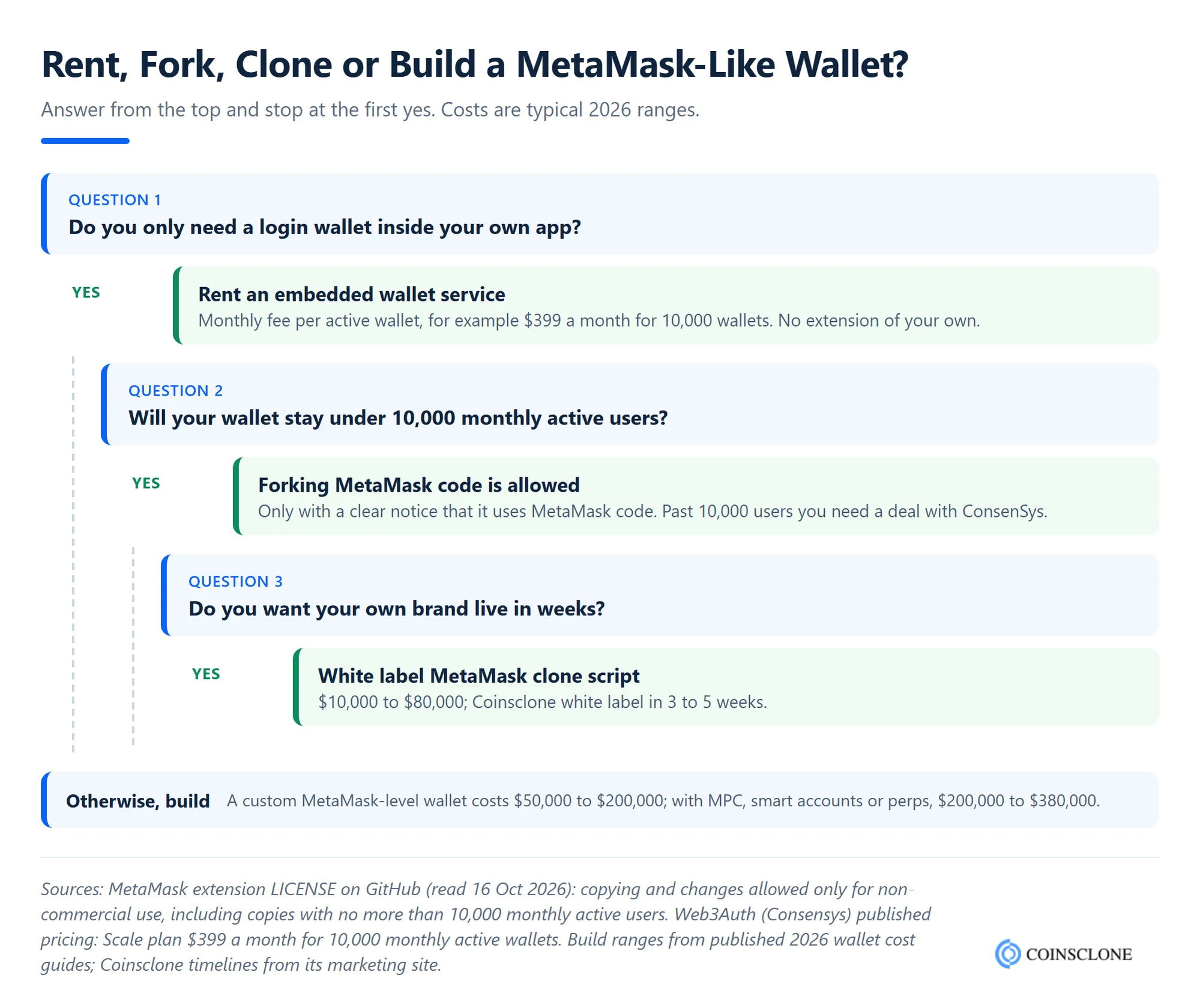
- Rent: If you only need a login wallet inside your own app, embedded wallet services cost a monthly fee. For example, Web3Auth’s published pricing (now part of Consensys) lists a Scale plan at $399 a month for 10,000 monthly active wallets.
- Start from a clone script: You get MetaMask-style features in your own code, with your own brand, in weeks.
- Build from scratch: You get full control, at the highest cost and the longest timeline.
Which Path Fits You?
The decision tree below turns these choices into one answer, based on your users, your deadline and your feature plans.
Why Create a Crypto Wallet Like MetaMask?
As Web3 grows, a wallet like MetaMask has become the front door to blockchain apps. Every DeFi trade, NFT sale and dApp visit starts with a wallet. For startups and founders, that makes a MetaMask-style wallet a strong way into the blockchain market.
Growing Demand for Web3 Wallets
DeFi apps, NFT markets and onchain games all need a safe, easy wallet. Grand View Research values the global crypto wallet market at $15.5 billion in 2025 and expects it to reach $100.8 billion by 2033, growing about 26.6% a year.
MetaMask shows the scale a single wallet can reach. Its website reports more than 100 million downloads across Google Play, the App Store and the Chrome Web Store.
Multiple Revenue Opportunities
A wallet like MetaMask is no longer just a place to store coins. In 2026, MetaMask offers swaps, perps with up to 50x leverage (run on Hyperliquid) and prediction markets. It also offers tokenized stocks and funds, and the MetaMask Card. Each one is a way to earn. Common revenue streams for a MetaMask-like wallet include:
- Token swap and bridge fees
- Perps and prediction market fees
- Staking commissions
- Premium wallet services
- DeFi app links and referral rewards
- Card programmes run with a licensed partner
Multi-Chain Ecosystem
MetaMask first ran only on Ethereum, as a browser add-on. Today it holds assets on many networks, including Bitcoin and Solana as well as Ethereum and other EVM chains. Users expect the same from any new wallet: one place to reach apps on many chains.
This wider reach brings a larger user base and keeps users coming back. It also adds cost, because each chain needs its own work, as the next section shows.
Lower Entry Cost Than Other Crypto Businesses
A non-custodial wallet like MetaMask does not hold user funds. So it avoids much of the licensing, liquidity and custody cost that a crypto exchange must carry. That makes it one of the more affordable ways for a startup to enter Web3, especially when it starts from a ready wallet core.
Key Factors Affecting the Cost of Creating a Crypto Wallet Like MetaMask
Building a Web3 wallet like MetaMask is not a one-size-fits-all project. Several tech and business choices decide the final bill. Let’s look at each one.
Development Team Size
The size and skill of the team play a big role in the cost. A complete wallet project needs several roles, and each one adds weekly cost:
| Team role | What they do |
| Blockchain developers | Chain links, signing, smart contract calls |
| Frontend developers | Browser extension and web screens |
| Mobile developers | Android and iOS apps |
| Backend developers | Price, history and alert services, APIs, admin tools |
| UI/UX designers | Screens, flows and clear signing warnings |
| Security experts | Key storage, threat checks, audit support |
| QA testers | Tests on every browser, phone and chain |
A larger team ships faster but costs more each week. Most firms balance team size against their launch date.
Developers’ Costs by Region
Where your team works changes the bill more than almost anything else. Published 2026 guides put blockchain developer rates at these levels:
| Region | Typical hourly rate |
| US and Western Europe | $80 to $200 |
| Eastern Europe | $50 to $100 |
| India and Southeast Asia | $25 to $60 |
Skill matters as much as location. A senior wallet engineer who has shipped key management code before costs more per hour, yet often less in total, because fewer things need fixing later. Picking the right crypto wallet team helps you control the budget without losing quality.
UI Design and User Experience
In Web3, a clean design is a real edge. Many wallets lose users because screens are confusing or slow. A wallet like MetaMask needs simple screens for balances, tokens, history and, above all, signing.
The design work covers wireframes, prototypes, user tests and screens for both the extension and the apps. The more custom the design, and the more screens you need, the higher the cost.
Technology Stack
The tools you pick shape both the timeline and how well the wallet grows. A typical MetaMask-like wallet uses this stack:
| Layer | Typical tools | What it does |
| Browser extension | TypeScript, React, Chrome Manifest V3 | Injects the wallet into web pages so dApps can connect |
| Mobile app | React Native or Flutter | One code base for Android and iOS |
| Blockchain libraries | ethers.js, viem or web3.js | Builds and signs transactions, reads chain data |
| Backend | Node.js, Go or Python | Prices, history, alerts and swap quotes |
| Database | PostgreSQL or MongoDB | Stores cached chain data and settings, never private keys |
| Node access | Alchemy, Infura or your own nodes | Sends transactions and reads balances |
| dApp links | WalletConnect and standard provider APIs | Links the wallet to DeFi apps on desktop and mobile |
| Smart contracts | Solidity, Rust | Only if you add smart accounts, staking or your own swap router |
| Cloud | AWS or Google Cloud | Hosts the backend, with monthly running costs |
The right stack lets the wallet support many chains, keep keys safe and process payments fast. MetaMask also lets outside developers add features through Snaps, its plug-in system. A plug-in system like this is an advanced feature, not a launch need.
Security Features Integration
Security is the backbone of a wallet that holds people’s money. Every wallet like MetaMask needs at least these:
- Private key encryption
- Seed phrase backup and recovery
- Face or fingerprint login on phones
- Transaction previews and scam warnings
- Phishing site detection
- Hardware wallet support for large holders
Stronger safety costs more, and it needs skilled security staff. MetaMask now offers up to $10,000 of cover on transactions, which shows how much users care about safety. Our guide on crypto wallet security covers the threats in more depth.
Smart Contract & Blockchain Integration
The wallet talks to each blockchain through nodes and, where needed, smart contracts. The key parts are:
- Node connection
- Sending transactions
- Smart contract calls
- Gas fee estimates
- Token support (ERC-20, ERC-721 and others)
EVM chains such as Polygon, BNB Chain and Base share most of the same code, so each one is cheaper to add. Bitcoin and Solana use different keys, address formats and fee models, so they cost more. Published 2026 guides suggest each extra chain adds about $5,000 to $20,000. Plan the first release around the chains your users actually hold.
API Integrations
Because a MetaMask-like wallet is non-custodial, it leans on outside APIs for live data and extra services. These include block explorers, price feeds, token swap aggregators, dApp links and fiat on-ramps for buying crypto with a card. Each API adds setup work and, often, a monthly bill.
Node and RPC Costs
Every balance check and every payment goes through a blockchain node. Most teams rent this access from an RPC provider rather than run their own nodes. For example, Alchemy’s pricing starts with a free tier of 30 million compute units a month, then charges $0.525 per million units on pay as you go. The bill is small at launch but grows with every user and every chain, so build caching in from the start.
Testing and Security Audits
You must test the wallet fully before launch. Since people move real money through it, testing covers:
- Functional testing
- Security testing
- Smart contract audits
- Tests on each browser and phone
- Performance testing
For any smart contracts or key code, add a third-party audit. Published 2026 guides put a wallet security audit at about $5,000 to $50,000 or more, depending on scope.
Ongoing Maintenance & Upgrades
Launch is only the start. Chains upgrade, browsers change their extension rules and new threats appear. The team must watch the wallet around the clock, ship security fixes and keep up with protocol changes.
Published 2026 cost guides put yearly maintenance at about 15% to 25% of the original build cost. On a $100,000 wallet, that is $15,000 to $25,000 a year.
| Factor | What raises the cost | 2026 guide figure |
| Team location | US or Western European team | $80 to $200 an hour vs $25 to $60 in India and Southeast Asia |
| Platforms | Extension plus Android and iOS apps | A second and third front end to build and test |
| Chains | Each chain beyond the first | About $5,000 to $20,000 per chain |
| Security | Secure key storage, biometrics, scam warnings | Biometrics alone about $5,000 to $10,000 |
| Nodes and APIs | More users, more chains, on-ramps | RPC from a free tier up; on-ramp partners add per-trade fees |
| Audits | Smart contracts and key code | About $5,000 to $50,000+ |
| Maintenance | Chain upgrades, browser and OS updates, support | About 15% to 25% of the build cost a year |
On the whole, the cost of a crypto wallet like MetaMask depends on these factors and your business goals. Knowing them helps you build in a cost-efficient, secure and scalable way.
Cost Breakdown Based on Core and Advanced Features
Features drive most of the cost. The figures below show what one published 2026 cost guide says each feature adds on top of a basic single-chain wallet with send, receive and history. For MetaMask’s newer finance features, no public benchmark exists, because the cost depends on the partner you work with.
| Feature | What it does | Added cost (2026) |
| Core features | ||
| Multi-chain support (3+ chains) | Lets users switch between networks in one wallet | $20,000 to $40,000 |
| Private key and seed phrase control | Users own their keys and recovery phrase, with no third party | Part of the base wallet |
| Token swaps | Swap tokens inside the wallet through a DEX aggregator | $15,000 to $30,000 |
| dApp links and WalletConnect | Connect to DeFi apps, NFT markets and games | Usually in MetaMask-level builds |
| Add-on features | ||
| NFT gallery | Store and view NFTs on Ethereum and other chains | $15,000 to $30,000 |
| Staking | Stake from the wallet and earn rewards | $10,000 to $25,000 |
| Fiat on-ramp | Buy crypto with a card through a licensed partner | $10,000 to $20,000 + partner fees |
| Biometric login | Face or fingerprint unlock on mobile | $5,000 to $10,000 |
| Hardware wallet support | Sign with Ledger or Trezor style devices | $20,000 to $40,000 |
| MetaMask-style finance features | ||
| Card programme | A debit card that spends crypto, like the MetaMask Card | Partner programme; fees set by the card issuer |
| Tokenized stocks and funds | Trade real-world assets on chain | Partner setup; depends on the issuer and your market |
| Perps and prediction markets | Trade futures or event outcomes inside the wallet | A link to an outside venue; scope varies |
| Phishing detection | Warns users about bad sites and risky signatures | Often a paid security API plus setup work |
If you plan to launch a wallet like MetaMask, pick the feature set that balances cost, user experience and revenue. You can always add features in later releases. For a deeper look at multi-chain builds, read our guide to multi-currency wallet development.
Cost Analysis Based on Type of Wallet & Integrations
A MetaMask-like wallet can ship as a browser extension, a mobile app, a web wallet or with hardware wallet support. Each type has its own work, and each one you add raises the total.
Browser Extension Wallet
The browser extension is where MetaMask started, and it is still the main way people use DeFi on desktop. The extension can be listed for Chrome, Firefox, Edge and Brave, and it connects straight to dApps.
An extension needs its own build, store reviews and a tight release process. That release process needs strong security controls. In December 2025, a malicious update to Trust Wallet’s browser extension drained about $7 million from users before a fix shipped. Signed builds and staged releases are worth the cost.
Web Wallet
A web wallet lets users view balances, manage tokens and use dApps through a browser page. It shares most of its code with the extension, so it adds less cost. It still needs the same security rules for keys and signing.
Mobile Wallet
The mobile wallet serves users who live on their phones. MetaMask Mobile runs on Android and iOS and includes a dApp browser. Building with React Native or Flutter lets one team ship both apps from one code base, which keeps the cost down. Still, mobile adds its own work: secure key storage on the phone, biometric login and app store reviews.
Hardware-Integrated Wallet
Users who want the highest security keep their keys on a hardware device, away from the internet. Your wallet then shows balances and builds transactions, while the device signs them. Published 2026 guides put hardware wallet support at about $20,000 to $40,000.
Crypto Wallet Licensing & Compliance Cost
Licences can change your budget more than any feature. The key question is simple: can your company move user funds?
For a wallet like MetaMask, where users hold their own keys, the rules are light in the main markets. In the US, FinCEN’s 2019 guidance says providers of non-custodial wallet software are not money transmitters. In the EU, MiCA leaves non-custodial wallet software out of scope.
You will need approval, though, if your wallet offers services like:
- Custody of user assets
- Crypto-to-cash trades that your own firm runs
- Your own built-in exchange
- Payment processing
In those cases, you need a Virtual Asset Service Provider (VASP) licence or the local equal. In the EU, that means a MiCA licence as a crypto-asset service provider (CASP). The grace period for older firms ended on 1 July 2026, so custodians now need full approval. Our guide to custodial vs non-custodial wallets explains the pros and cons.
Licence costs vary widely by country and business model, so get a quote from a local lawyer before you commit. Budget for legal advice, filings, KYC and AML tools, and reporting. Most new wallets avoid much of this cost by staying non-custodial and routing card purchases and swaps through licensed partners.
Crypto Wallet Marketing Cost
Like testing, marketing is a step you cannot skip. Web3 is crowded, and even a well-built wallet needs a plan to win users and trust. The right budget depends on your market and goals, but these channels work best for wallets:
- Brand building: A clear name, look and promise that sets you apart.
- SEO and content: Helpful guides bring in users who are searching for wallet answers.
- Community: Crypto users gather on X, Telegram, Discord and Reddit. An active community drives sign-ups and feedback.
- PR and partnerships: Listings in dApps and news coverage build trust.
- Influencers and referrals: Trusted creators and invite rewards turn early users into a growth channel. Mark every paid post clearly.
A well-planned launch does more than bring users. It also makes your wallet a name people trust.
How to Reduce the Cost of Crypto Wallet Development: Practical Approaches
Like any big investment, a wallet build has costs you can cut with good planning. With the right choices, startups can launch a secure wallet like MetaMask on a tighter budget.
Use Open-Source Frameworks
Many blockchain projects offer open-source tools and SDKs that make wallet work simpler. Trusted libraries such as ethers.js and viem help your team move faster and cut complex work. Check each licence first, as MetaMask’s own extension code shows.
Launch an MVP First
A Minimum Viable Product (MVP) lets you release a wallet with the basics: asset storage, transfers and core security. You then add features based on what users ask for. This cuts the upfront cost a lot.
Use Cross-Platform Development
Instead of building separate apps for each phone system, use a cross-platform tool to build one app that runs on both Android and iOS. This cuts the cost, the build time and the upkeep.
Use Existing Blockchain APIs
Ready node and data providers remove the need to build a complex backend. They handle node management, sending transactions and chain data for you.
Launch on Fewer Chains
Every chain adds work and testing. Start with the networks your users hold most, then add more in later releases.
Work With an Experienced Team
An experienced crypto wallet team cuts the cost of trial and error. They already have the skills, tools and workflows to deliver a secure wallet. As a result, startups can launch a wallet like MetaMask faster.
In short, the cheapest wallet is the one you only build once. Spend on security, speed and user experience first, and you avoid costly rebuilds later.
How To Create a Crypto Wallet Like MetaMask: Step-by-Step Process
Creating a crypto wallet like MetaMask needs a clear plan that joins blockchain work with a simple user interface. Here are the steps:
- Define Wallet Requirements: First, set the wallet’s core purpose and business model. Decide on the chains, token storage, DeFi links, NFT support and whether the wallet will be custodial or not.
- Design the Wallet Architecture: Next, the team plans the technical design. This covers the extension, the apps, the backend, node access and safe key storage.
- Build the Blockchain Integration: Then, developers link the wallet to each chain using Web3 libraries and APIs. Tools like ethers.js handle chain calls and smart contract actions.
- Add Web3 and dApp Connectivity: A wallet like MetaMask must work smoothly with dApps. Here, the team adds the provider that web pages talk to, WalletConnect and smart contract support.
- Test and Audit Security: Before launch, the team runs full tests and a security audit. This checks every screen, the security layers and how transactions are built and signed.
- Deploy and Launch: Finally, the wallet goes live. The team publishes the browser extension, releases the mobile apps and sets up the backend servers.
For a longer walk-through, see our guide on how to create a crypto wallet.
How to Generate Revenue from a MetaMask-Like Crypto Wallet?
A crypto wallet is a business with revenue streams built in. With the right plan, a wallet can pay back its build cost from fees on what users already do. Here are the main streams.
Transaction Fees
Most wallets, MetaMask included, do not charge on a plain send. Users pay only the network’s gas fee. Instead, wallets earn on services such as swaps, bridges and trading, where a small fee is added to each trade.
Token Swap Fees
Swaps are the biggest earner for most wallets. A MetaMask-like wallet links to DEX aggregators and offers swaps inside the app. According to MetaMask’s swaps guide, MetaMask charges a 0.875% fee on each swap, on top of the network fee.
To see the scale, take a wallet where each active user swaps $400 a month. The chart below shows the monthly swap income at MetaMask’s 0.875% rate and at a lower 0.5% rate.
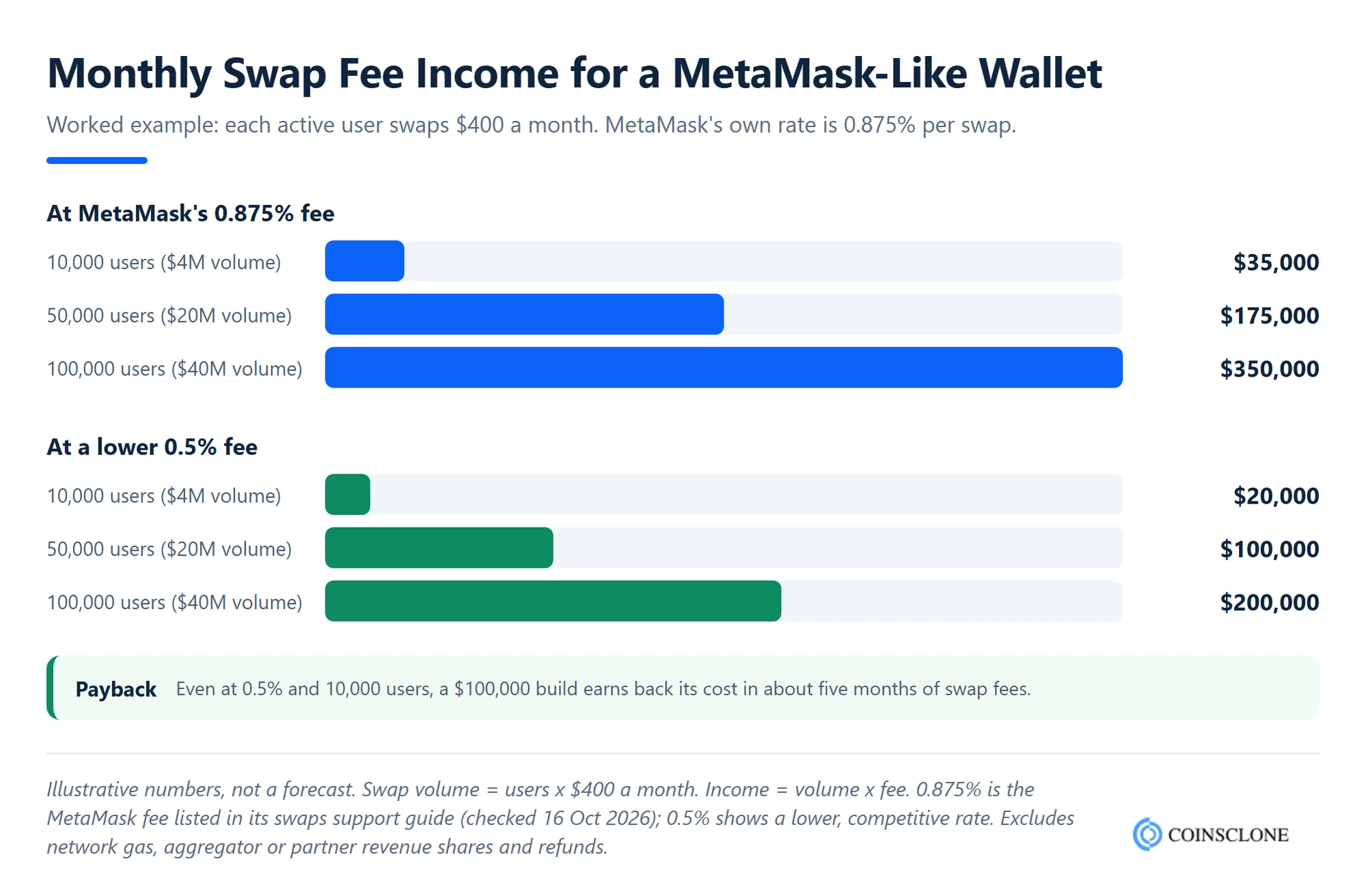
At 10,000 users and a 0.5% fee, the wallet earns about $20,000 a month. At that rate, a $100,000 build pays for itself in well under a year. These are example numbers, not a forecast.
Perps and Prediction Market Fees
In 2026, MetaMask lets users trade perps with up to 50x leverage and bet on prediction markets inside the wallet. The wallet earns a fee on each trade through the outside venue. This is now a fast-growing second stream for wallets.
dApp Integration Partnerships
A wallet is the gateway to DeFi apps, NFT markets and other Web3 services. Partner deals and referral links with these apps bring in commission income.
Premium Wallet Features
Wallets can offer paid extras, such as advanced portfolio tracking, faster transactions or deeper analytics. A subscription for these adds a steady stream of income.
Staking and Cross-Chain Bridge Fees
Wallets can keep a share of the rewards users earn through in-app staking. MetaMask, for example, keeps 15% of rewards in its pooled staking. Wallets that support many chains can also charge a small fee for moving assets between networks.
Token Launch and Ecosystem Services
Some wallets launch their own token. Users can then get fee discounts, staking rewards or a vote in how the wallet grows.
For a deeper look at each model, read our guide on how crypto wallets make money.
Why Choose Coinsclone to Build Your Reliable MetaMask-Like Web3 Wallet?
Coinsclone is a trusted crypto wallet development company. We have been building blockchain products since 2018 and have delivered 350+ platforms for 200+ clients across 20 industries, including wallets, exchanges and payment gateways.
- Ready solutions: A tested, ready-to-launch white label wallet that goes live in 3 to 5 weeks, and custom wallets in 8 to 12 weeks.
- Full scope: Browser extension, Android and iOS apps, multi-chain support, swaps and dApp links under your own brand.
- Security first: Encrypted key storage, scam warnings and MPC wallets for teams that want no single point of failure.
- Compliance help: KYC and AML tools when your business model needs them.
If you want a MetaMask-style product with your own code and brand, our MetaMask clone script is the quickest place to start. Talk to our team about the cost, timeline and plan for your wallet.
Frequently Asked Questions
1. How long does it take to build a crypto wallet like MetaMask?
With Coinsclone, a white label wallet takes about 3 to 5 weeks and a custom wallet about 8 to 12 weeks, because the core modules are already built. A team starting from zero often needs 4 to 9 months for a multi-chain wallet with an extension and mobile apps.
2. What are the essential features of a crypto wallet like MetaMask?
The must-haves are safe private key control, seed phrase backup and support for many chains. Users also expect a browser add-on and phone app, dApp links, token swaps, a payment history and scam warnings.
3. Is a MetaMask clone script a cost-effective solution for startups?
Yes. A MetaMask clone script comes with the core wallet features already built, so it costs less and launches faster than a build from scratch. Startups can then customise it and add features as they grow.
4. Is MetaMask open source?
Not fully, in the business sense. MetaMask’s extension code is public on GitHub. But its licence lets you copy and change it only for non-commercial use, which includes copies with no more than 10,000 monthly active users. A wallet business above that size needs a deal with ConsenSys or its own code.
5. How does MetaMask make money?
MetaMask earns mainly from a 0.875% fee on in-wallet swaps. It also earns from staking, perps and prediction markets, and card and partner programmes. Sending crypto itself carries only the network’s gas fee.
6. How much does it cost to build a crypto wallet?
Published 2026 estimates range from about $10,000 to $80,000 for a white label wallet and $50,000 to $200,000 for a custom multi-chain wallet with swaps and dApp links. Advanced or custodial wallets can pass $500,000. Team location, chain count and security needs matter most.