
Imagine you own a slice of an office tower, a bar of gold or a US Treasury fund, without huge capital or piles of paperwork. That is what real world asset tokenization makes possible. It turns the rights to a real asset into tokens on a blockchain. As a result, those rights can be split, sold and settled in minutes instead of days.
This guide explains how RWA tokenization works, what is really on-chain today, and what it takes to launch a project. You will see live market numbers, the main steps, the risks and the rules that changed in 2026. By the end, you will know whether tokenizing an asset makes sense for your business, and where to start.
In this guide:
- Market size: About $38.5 billion of real assets sat on public blockchains on 1 October 2026, and T-bill funds hold the largest share.
- How it works: A legal wrapper holds the asset, a custodian keeps it safe, and a token records who owns what.
- The process: Five steps take an asset from review to launch. Legal work takes the longest.
- Risks and rules: We cover the new SEC exemption, the EU rules and a real project that went wrong.
- Where to build: Ethereum holds over 40% of the value, but BNB Chain, Solana and Stellar each hold billions too.
See How Our RWA Tokenization Platform Can Launch Your Project Faster
Real World Asset Tokenization — done right.
- MVP Platform:Tokenize real-world assets (real estate, commodities, equity, debt) 90% faster.
- Compliance & Infrastructure: Built-in KYC/AML, smart contracts, custody, and wallet integration — no heavy development required.
- Brand & Customization:Your platform, your asset classes, your tokenomics.
- Revenue Engine:Earn from token issuance, trading fees, fractional ownership, and asset management.
See a free branded demo of your RWA tokenization platform in 48 hours — before you invest a cent.
Book a Free Demo to discover how our RWA Tokenization Solution can take you from concept to live platform in just 2–4 weeks.
What Is Real World Asset Tokenization?
Real world asset tokenization is the process of turning the rights to a real asset into digital tokens on a blockchain. The asset can be a building, gold, a bond, an invoice, a piece of art or a patent. Each token stands for a share of ownership or a claim on the income the asset earns.
The token does not replace the asset. Instead, a legal structure links the two. Often a firm, fund or trust owns the asset, and the token proves your share of it. Contracts, a custodian and audits back each token, so holders know a real asset sits behind it.
Tokens make slow, hard-to-sell holdings easier to trade. They also let people own small pieces of costly assets with fewer middlemen. For buyers, that means a lower entry point, global access, faster deals and lower fees. In short, it bridges classic finance and blockchain.
Two Kinds of On-Chain Assets
Market trackers split on-chain assets into two groups. Distributed assets can move between wallets on public chains, like a fund token you send to another approved holder. Represented assets are records kept on a private ledger, often inside a bank. According to RWA.xyz, represented assets were worth about $415 billion on 1 October 2026, more than ten times the distributed total. Most headline market figures, including the ones in this guide, count only distributed assets.
How RWA Tokens Differ From Crypto Tokens
A native crypto token, such as ETH or SOL, gets its value from its own network. An RWA token gets its value from something off-chain, such as a bond, a gold bar or rent from a building. That link brings legal duties. RWA tokens often need buyer checks, a licensed issuer and regular proof that the asset still exists. Many count as securities, so those laws apply.
The RWA Market in 2026: What Is Actually Tokenized
Talk about property tokens is everywhere, but the money tells a different story. On 1 October 2026, RWA.xyz tracked about $38.55 billion of distributed assets, held by over 5 million wallets. Stablecoins are counted apart, at about $294 billion.
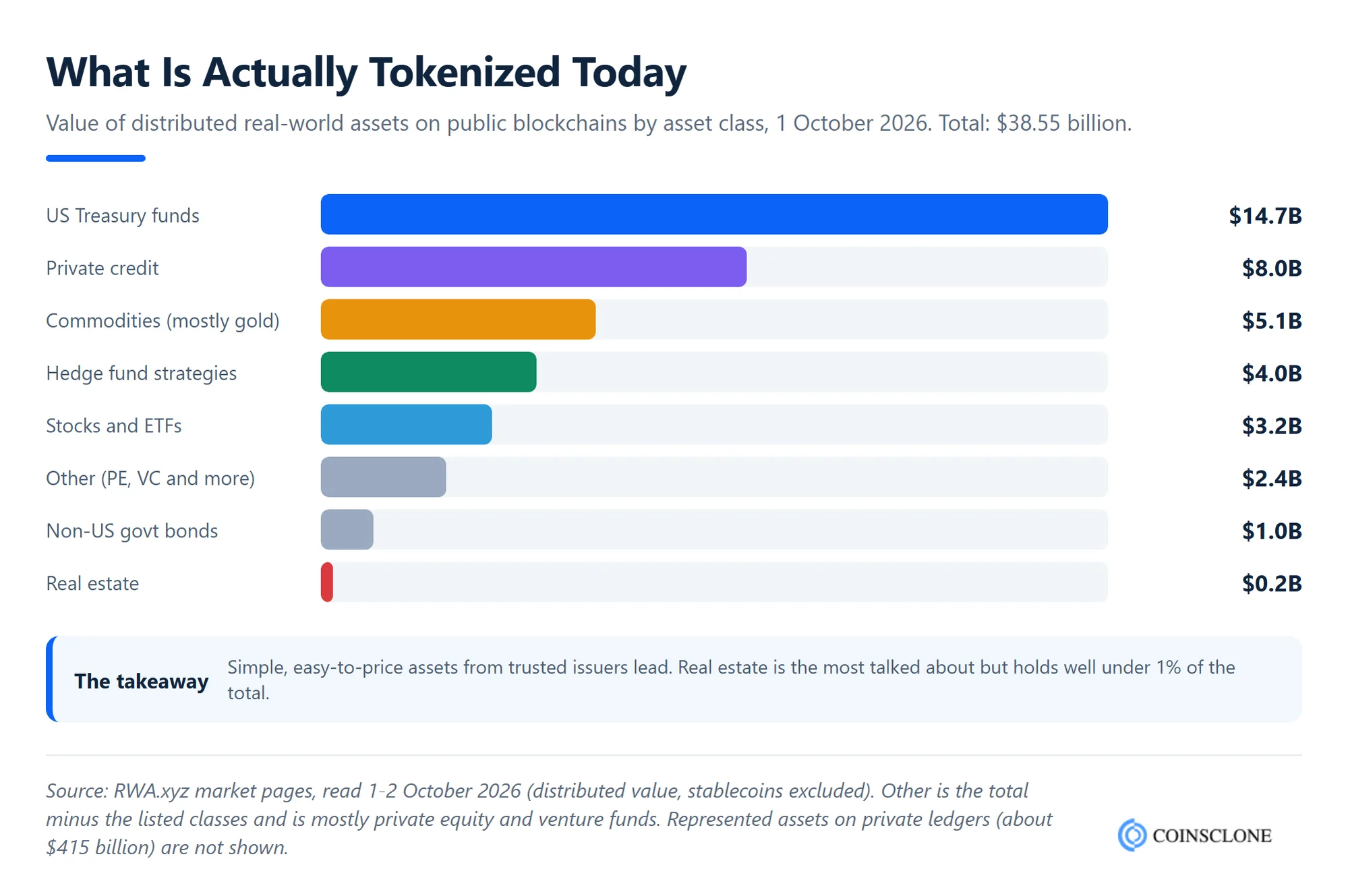
Here is what stands out:
- T-bill funds lead: On-chain US Treasury funds hold about $14.7 billion across 108 funds. Big names like BlackRock, Franklin Templeton, Circle and Ondo issue them.
- Credit is second: Private loans and other credit add about $8 billion. Platforms such as Maple and Centrifuge are among the top issuers.
- Gold leads raw goods: Tether Gold (XAUT) at $2.9 billion and Paxos Gold (PAXG) at $1.8 billion make up most of the $5.1 billion in this group.
- Stocks have the most users: On-chain shares hold only $3.2 billion, yet they have about 4.2 million holders.
- Real estate is still small: Only about $227 million of real estate moves on public chains. Most deals stay on private ledgers.
So the assets that work best today are simple, easy to price and backed by large, trusted firms. That is a useful lesson if you plan your own launch. If you want to issue a fund product, our guide to tokenized Treasuries covers that market in depth.
How RWA Tokenization Works
RWA tokenization works by linking a legal claim on an asset to a token that a smart contract controls. Several parties each do one job. Together, they make sure the token is worth what it claims to be worth.
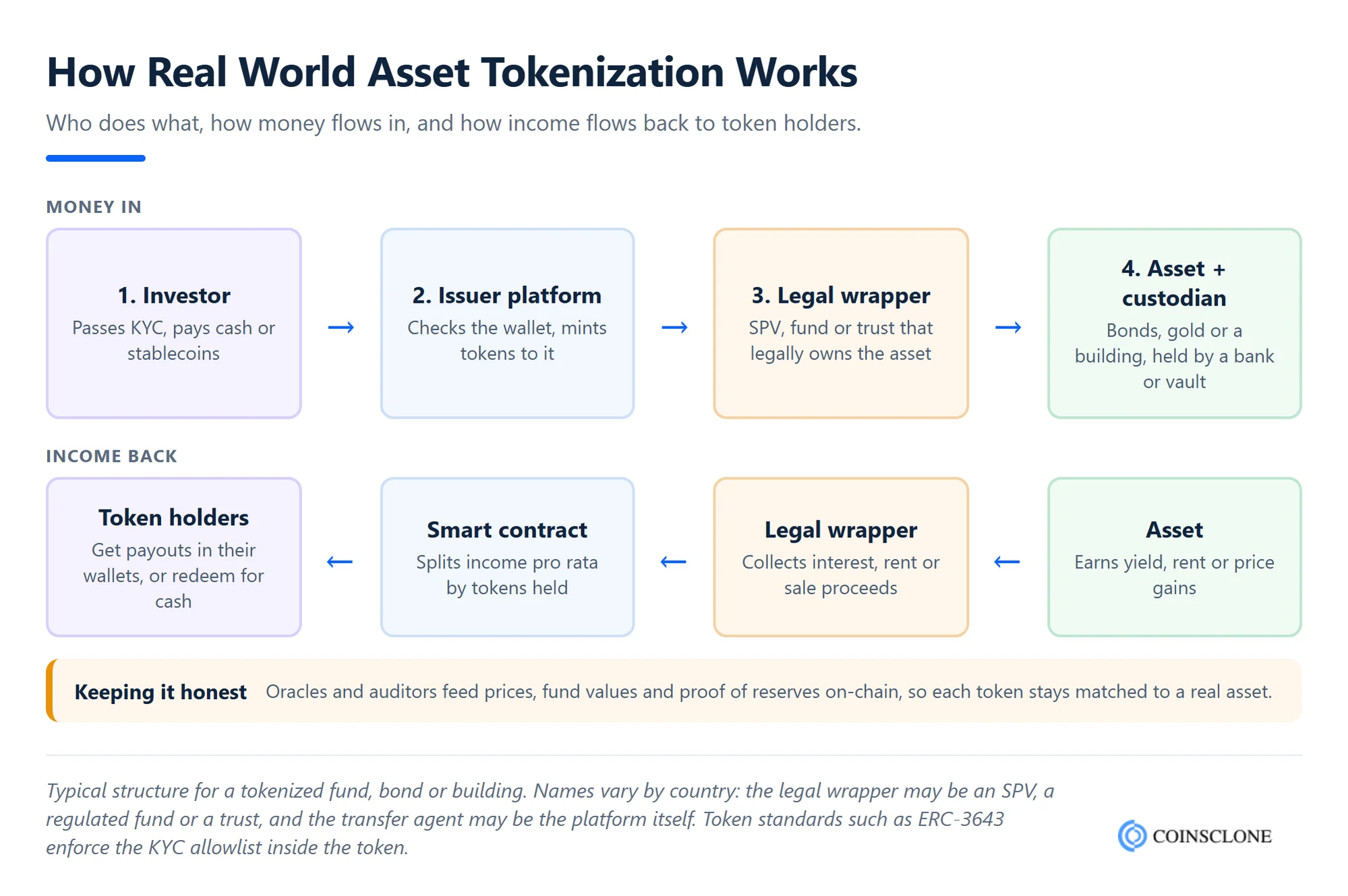
Here are the main parts of a typical setup:
- The asset owner: The person or firm that holds the building, bond, gold or loan book. They want to raise money or make the asset easier to sell.
- The legal wrapper: A special purpose vehicle (SPV), fund or trust that owns the asset. Token holders own shares of this wrapper, which gives them real legal rights.
- The custodian: A bank or trust firm that keeps the asset, or the cash and bonds behind a fund, safe and apart.
- The token and smart contract: The token lives on a blockchain. Its smart contract sets who can hold it, how it moves and how income is paid.
- The ID layer: Only checked buyers can hold most RWA tokens. Their wallets go on an allowlist after KYC and AML checks.
- Data feeds: Oracles bring prices, fund values and proof of reserves on-chain, so the token stays in line with the asset.
- Trading venues: Licensed platforms, approved DeFi pools or the issuer’s own portal let holders buy, sell or redeem tokens.
Token Standards for RWAs
Most RWA tokens use standards built for permissioned transfers rather than a plain ERC-20. ERC-3643 checks each holder’s ID on-chain before any transfer goes through. ERC-1400 adds tools for security tokens, such as forced transfers and linked legal files. Newer standards like ERC-7943 aim to make RWA tokens work across many apps. If you need one of these, see our ERC-3643 token development service.
Types of RWA Tokenization
RWA tokenization is not limited to finance. Almost any asset with real value can be turned into tokens, as long as the law lets you sell shares of it. These are the main types, with the ones that have real volume first.
Financial Assets
Bonds, T-bills, money market funds, shares and private equity can all become tokens. This is the largest group today. It brings faster trades and lets new types of buyers invest.
Debt and Receivables
Invoices, trade finance, credit lines and loans can become tokens. This frees up trapped cash, speeds up funding and gives lenders a clear record of each loan.
Commodities
Gold, silver, oil, metals and farm goods can move on-chain. Each token is backed by stock held in a vault or store. This adds trust, removes storage hassle for buyers, cuts fraud and allows trading around the clock.
Real Estate
Homes, office buildings, land and real estate funds can be split into tokens, so many people can buy shares of one building. Real Estate opens up shared owning and fundraising, and it makes a slow-to-sell asset class easier to trade.
Private Funds and Hedge Funds
Private equity, hedge funds and venture funds can issue tokens for their shares. This lowers the minimum ticket and makes it easier for approved buyers to join or leave.
Art and Collectibles
Fine art, rare items, watches and NFTs backed by real goods can become tokens. As a result, buyers can own part of a high-end item that was once out of reach.
Patents, Rights and Royalties
Patents, copyrights, film rights and royalty streams can become tokens. Creators and firms can then raise money from their IP, while smart contracts share the income in a clear way.
Carbon Credits and Green Assets
Carbon credits, green power credits and other green assets can become tokens. This makes each credit easier to trace and helps stop the same credit from being sold twice.
Roads, Ports and Power Plants
Power plants, toll roads, airports and smart city projects can also become tokens. This lets cities and builders raise money from a wider group of backers.
In short, almost any asset with real-world value can become a token. However, the assets that are simple to price and hold safely are the ones that grow first. Now, let’s look at why firms do it.
Why Tokenize Real-World Assets?
Putting real assets on-chain is more than a tech upgrade. It makes an asset easier to sell, cuts back-office work and lets people worldwide invest. That is why firms, banks and fund managers are moving to it.
Unlock Liquidity
Assets that are hard to sell, such as buildings, art or toll roads, can become tradable tokens. As a result, money moves faster and funding gets easier.
Allow Fractional Ownership
Tokens split an asset into small units. So more people can invest, and the entry barrier drops sharply.
Reach Investors Worldwide
Buyers in many countries can access the same token, subject to local rules. This helps firms raise money from a global pool.
Clear Records and Trust
The blockchain keeps a tamper-proof record of who owns what. Audits and tracking get simpler, which builds trust with buyers.
Faster Deals With Fewer Middlemen
Smart contracts settle trades and pay income on their own. This cuts paperwork, removes some third parties and lowers costs.
Built-In Rules
Transfer limits, buyer checks and lockups can be coded into the token itself. This makes it easier to follow the rules in each trade, not just at sign-up.
Use as Collateral in DeFi
Some RWA tokens, such as T-bill fund tokens, can be pledged to back loans on approved DeFi platforms. Holders keep earning the fund’s yield while they borrow against it.
Overall, tokens help real-world assets reach more people and help firms grow faster. Still, they come with real risks, so let’s cover those next.
Risks and Challenges of RWA Tokenization
Every top guide on this topic warns about risk, and for good reason. A token is only as good as the legal and physical setup behind it. Here are the main risks to plan for:
- Legal risk: If the link between the token and the asset is weak, holders may have no real claim in court. The legal wrapper must be sound in every country you sell to.
- Asset risk: The asset still needs good care. If the firm that runs it fails, the token cannot fix that.
- Trading risk: A token can trade around the clock, but that does not mean buyers will show up. Many RWA tokens rarely trade.
- Smart contract risk: Bugs or weak admin keys can freeze or drain tokens. Audits and tested standards lower this risk.
- Custody risk: The asset, or the cash behind a fund, must be held by a trusted, separate custodian.
- Data risk: Wrong prices or stale reserve data from an oracle can mislead buyers.
- Rule changes: Laws on RWA tokens are still moving, as 2026 has shown in the US and EU.
A Real Example: What Happened to RealT
RealT was once a leading name in US home tokens. It sold tokens for hundreds of rental houses in Detroit. Then, in 2025, the City of Detroit sued the company over code breaches and unsafe homes. In April 2026, a judge approved an outside manager to take control of about 700 of its properties, as Michigan Public reported. The lesson is simple. Tokens move ownership faster, but they do not fix roofs, pay taxes or replace good asset care.
RWA Tokenization Process: Step by Step
The RWA tokenization process follows a clear, rule-based path to turn a real asset into secure blockchain tokens. Here are the steps to tokenize real-world assets.
1. Asset Review and Valuation
First, pick the asset, such as real estate, gold, IP or a bond. Check who owns it, confirm it is real and test market demand. A fair value report shows whether the asset is ready.
2. Legal Structure and Licensing
Next, set up the legal wrapper, such as an SPV or fund, plus custody deals and buyer rights under local law. Decide who can buy, from which countries and under which licence. This step often takes the longest.
3. Token Design (Tokenomics)
Then design how the token works. Set the supply, the price per token, how income is paid, any lockups and how holders can exit. Good token design builds trust and keeps the token in line with the asset.
4. Smart Contract Development and Audit
After that, build the token on a chosen blockchain using a standard such as ERC-3643. The smart contract handles ownership, transfer rules, payouts and investor checks. An outside audit should test it before launch.
5. Platform Launch and Token Issuance
Finally, launch the tokens on an RWA tokenization platform with KYC and AML checks and investor dashboards. Investors can then buy, hold, redeem and, where allowed, trade their asset-backed tokens. After launch, the platform keeps paying income, updating values and filing reports.
Real world asset tokenization turns hard-to-sell assets into secure on-chain holdings. It makes owning simpler, the rules easier to follow and the work faster.
If these steps feel hard to handle alone, you can rely on a skilled partner. Coinsclone helps you put real-world assets on-chain safely, with proven tech, rules support and smooth delivery.
Our Role in RWA Tokenization
As an RWA tokenization service provider, we help firms and asset owners move from old-style asset records to a secure, compliant on-chain setup that can grow with them. Since 2018, Coinsclone has delivered over 350 platforms for more than 200 clients across 20 industries. We guide you on a compliant design and handle the tech build and launch. Our aim is to help you unlock cash, earn buyer trust and build an asset setup that lasts.
- Strategy and launch planning
- Rules support with your legal partners
- Token and system design
- RWA token build
- Tokenization platform build
- Secure custody setup
- Launch support
- Upkeep and upgrades
What We Build for RWA Projects
We build full RWA solutions that turn real and financial assets into tokens. Our work covers both the platform and the token setup, so you can launch with the trust buyers expect.
Asset Tokenization Platform
We build full RWA tokenization platforms that create, manage and sell asset-backed tokens. Each platform has buyer sign-up, built-in KYC and transfer rules, trading tools and a clear asset dashboard, so it stays secure and trusted as it grows.
Asset-Backed Token Development
We create safe, compliant tokens that track the value of real-world assets on a blockchain. Our Asset Backed Token Development covers smart contracts, token standards and links to wallets and trading platforms. This builds trust and ease of use for both buyers and owners.
Now, let’s look at how leading firms already use it.
Real World Examples of RWA Tokenization
RWA tokenization is now real. Major banks, fund managers and firms run live RWA products today. Here are some of the best-known, with values from RWA.xyz as of 1 October 2026.
BlackRock: BUIDL Fund
BlackRock launched its USD Institutional Digital Liquidity Fund (BUIDL) with Securitize in March 2024. The fund holds cash, Treasury bills and repos. Its yield builds up daily and is paid out each month as new tokens. It now holds about $2.2 billion, which shows that big finance is on board.
Franklin Templeton: Benji Funds
In 2021, Franklin Templeton became the first US fund manager to record a registered money market fund’s shares on a public blockchain. Its Benji platform now holds about $2.5 billion in on-chain T-bill funds.
Ondo Finance: Tokenized Treasuries and Stocks
Ondo Finance puts US T-bills and, more recently, US stocks on-chain for buyers outside the US. Its USDY token alone holds about $2.3 billion, and Ondo is the largest issuer of T-bill tokens by value.
Tether Gold and Paxos Gold: Tokenized Gold
XAUT and PAXG each stand for gold held in vaults. Together they hold about $4.7 billion. This makes gold the clearest success story among raw goods.
Siemens: A Bond on the Blockchain
In early 2023, Siemens issued a €60 million bond on the Polygon blockchain. It used Germany’s law for paperless bonds. It was sold without paper certificates or a central clearing house, which showed what tokens can do for company debt.
These live products show that RWA tokenization now delivers real value, not just ideas on paper. More firms will likely add RWA tokens to their growth plans.
RWA Tokenization Rules and Adoption by Country
RWA tokenization is now a global trend. Governments and watchdogs see its power to update capital markets. Yet each country moves at its own speed. Here is where the major markets stand in October 2026. For a deeper country-by-country view, see our list of the top countries to launch RWA tokenization.
United States
The US is the largest market by value, led by T-bill funds. In September 2026, the rules shifted twice. On 15 September, the Senate failed to advance the CLARITY Act, the market structure bill for crypto, in a 49 to 50 vote. Two days later, the SEC issued its Innovation Exemption. This five-year order, with conditions, lets approved venues trade on-chain US stocks through trading pools on public blockchains. In the US, a stock or bond on-chain is still a security, so the same laws apply.
Europe
The EU uses two sets of rules. MiCA covers crypto-assets that are not securities, and its grace period for older firms ended on 1 July 2026. Bonds and shares on-chain stay under the normal laws for stocks and bonds. The DLT Pilot Regime, live since March 2023, lets licensed venues trade and settle them on blockchain. Many European banks now issue bonds and funds as tokens.
Hong Kong
Hong Kong aims to be a regulated hub for digital assets. The HKMA’s Project Ensemble, launched in 2024, tests on-chain deposits and assets with banks. The SFC also allows fund tokens under clear rules.
UAE
The UAE is a fast-rising hub. Dubai’s VARA oversees crypto firms, while the Dubai Land Department started a pilot in 2025 that lets buyers own token shares of homes. Abu Dhabi’s ADGM also has its own crypto rules.
Singapore
Singapore supports tokenization through MAS Project Guardian, which has run trials with global banks since 2022. Banks and fintech firms put bonds, funds and FX on-chain with strong safeguards.
Switzerland
Switzerland’s DLT Act, in force since 2021, gives ledger-based securities full legal standing. Swiss banks and fund firms now issue and hold these tokens under FINMA’s watch.
The impact of RWA tokenization is spreading from Asia to Europe, the Middle East and the US. In each region, clear rules are what turn pilots into live markets.
Sectors That Use RWA Tokens
RWA tokenization is changing many sectors. It allows secure on-chain owning, makes assets simpler to run and builds trust through clear blockchain records.
- Real Estate: Splits buildings into shares, lowers the entry point and makes transfers smooth, with clear records.
- Banking and Finance: Turns bonds, loans and funds into tokens to speed up deals and widen access.
- Supply Chain: Supports trade finance, invoice tokens and asset tracking from end to end.
- Green Power: Turns solar farms, power credits and carbon credits into tokens to grow green funding.
- Art and Collectibles: Lets many people own shares of costly art, rare items and watches.
- Healthcare and Pharma: Turns patents, research rights and lab gear loans into tokens to fund new work.
- Government: Supports on-chain bonds, public works funding and public asset records.
- Farming and Raw Goods: Turns crops, store receipts and trade goods into tokens to make markets work better.
- Construction: Splits funding for large projects so more backers can take part.
- Media and Film: Turns IP, royalties and film rights into tokens so creators earn more of the income.
With shared owning, faster trades and clear records, RWA tokens give firms new ways to raise money and earn trust. Over time, more sectors will likely adopt them.
Next, let’s see which blockchains power these RWA tokens.
Most Popular Blockchains Used for RWA Tokenization
Choosing the right blockchain matters for security, rules, cost and reach. The chart below ranks networks by the value of distributed RWAs they hold, so you can see where issuers actually launch.
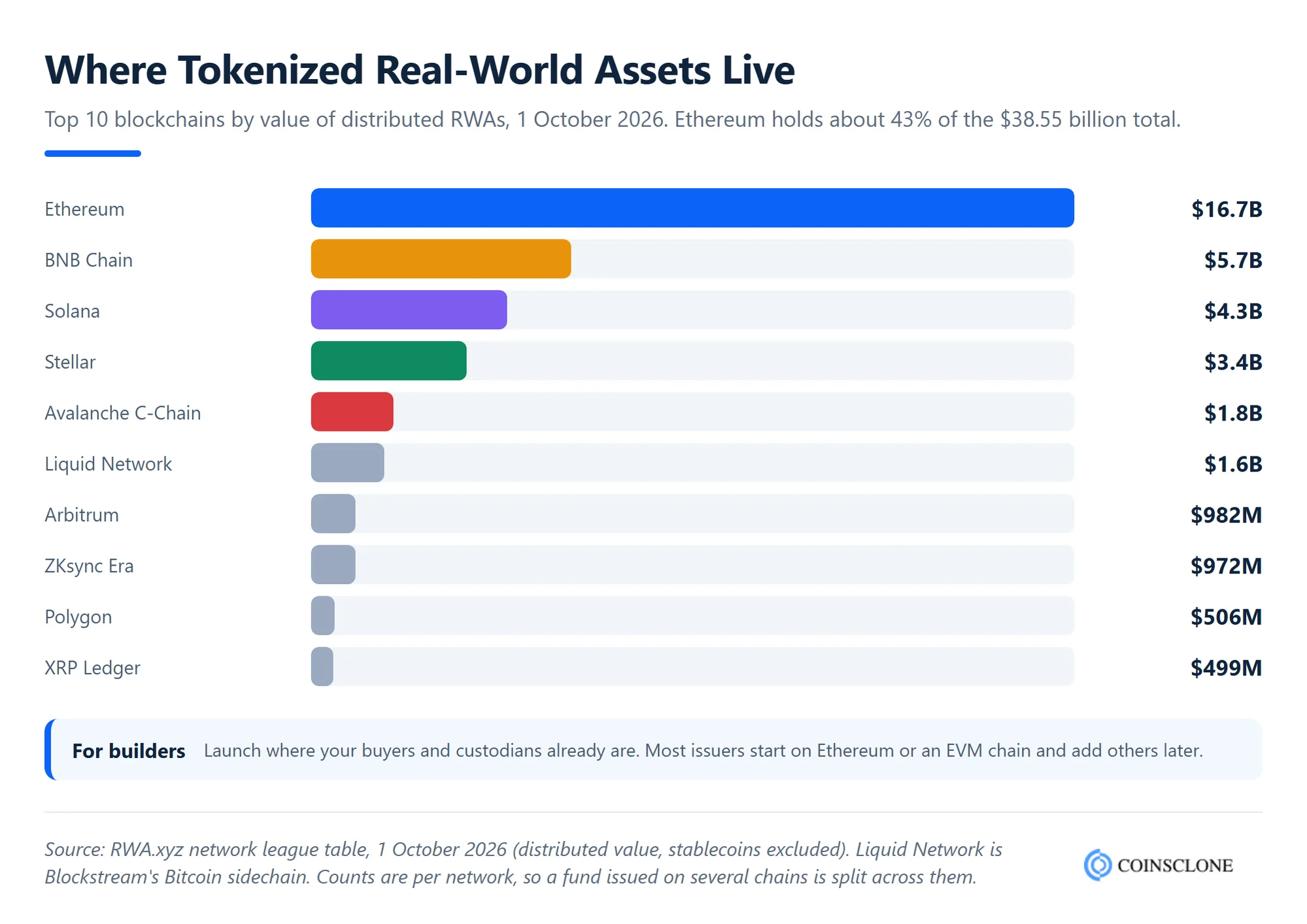
- Ethereum: The leader, with about $16.7 billion in RWAs. It has the deepest pool of tools, tested standards like ERC-3643, and the trust of big issuers such as BlackRock.
- BNB Chain: Second, with about $5.7 billion. Low fees and a large user base attract many token issuers.
- Solana: Holds about $4.3 billion. Fast, cheap trades make it popular for stock and fund tokens.
- Stellar: Holds about $3.4 billion, largely from Franklin Templeton’s Benji funds. It was built for payments and issuing assets.
- Avalanche: Holds about $1.8 billion. Firms can run their own Avalanche L1 chains with custom rules.
- Layer 2 networks: Arbitrum, ZKsync and Polygon each hold between $0.5 billion and $1 billion, with Ethereum security and lower fees.
- Private ledgers: Banks often use closed chains such as Hyperledger Fabric or Canton for represented assets that need privacy and tight access.
Frequently Asked Questions
What real-world assets have been tokenized?
US T-bill funds are the largest group, at about $14.7 billion on public blockchains on 1 October 2026. Private credit follows at about $8 billion, then gold and other raw goods at about $5.1 billion. Stocks, hedge fund plans, non-US state bonds, private equity and real estate make up the rest.
Is XRP tokenizing real-world assets?
XRP is the native coin of the XRP Ledger, and the XRP Ledger does host tokenized assets. RWA.xyz counts about $499 million of distributed RWAs across 24 assets on it as of 1 October 2026. That is much smaller than Ethereum, BNB Chain or Solana.
What are the top RWA platforms?
By value, the top issuers of T-bill tokens are Ondo, Franklin Templeton’s Benji, Circle, Securitize and WisdomTree. Tether and Paxos lead tokenized gold. In credit, STOKR, Maple and Centrifuge are among the largest. Rankings change often, so check a live tracker such as RWA.xyz.
Do you need a licence to tokenize real-world assets?
In most cases, yes. Most RWA tokens count as securities or fund units, so you need an exemption or licence where you sell them. Some countries also require a licensed custodian, transfer agent or trading venue. Rules differ by country, so get legal advice before you launch.
How does secondary trading work for RWA tokens?
Holders can sell tokens on licensed trading venues, approved DeFi pools or the issuer’s own portal. The smart contract checks that the buyer has passed KYC before the transfer goes through. Many funds also let holders redeem tokens with the issuer for cash.
What is the difference between RWA tokens and crypto tokens?
An RWA token draws its value from an off-chain asset, such as a bond, gold or rent, and comes with legal rights to that asset. A native crypto token, such as ETH, draws its value from its own network. RWA tokens often need buyer checks and follow securities rules.
Conclusion
Real world asset tokenization is changing how firms and investors deal with classic assets. It brings easier selling, shared owning, clear records and fast, secure deals. Whether it is real estate, gold, bonds, toll roads or IP, it opens new ways to invest worldwide and run assets well. Even so, the projects that last start with a sound legal setup, a trusted custodian and audited smart contracts.
It also gives firms a chance to upgrade how they work, reach more buyers and build asset systems that can grow. As a trusted Asset Tokenization Platform Development Company, Coinsclone provides full RWA tokenization services. We help firms turn real-world assets into compliant tokens, backed by proven tech and smooth delivery.
See How Our RWA Tokenization Platform Can Launch Your Project Faster
Real World Asset Tokenization — done right.
- MVP Platform:Tokenize real-world assets (real estate, commodities, equity, debt) 90% faster.
- Compliance & Infrastructure: Built-in KYC/AML, smart contracts, custody, and wallet integration — no heavy development required.
- Brand & Customization:Your platform, your asset classes, your tokenomics.
- Revenue Engine:Earn from token issuance, trading fees, fractional ownership, and asset management.
See a free branded demo of your RWA tokenization platform in 48 hours — before you invest a cent.
Book a Free Demo to discover how our RWA Tokenization Solution can take you from concept to live platform in just 2–4 weeks.