
This guide explains cross-chain NFT marketplace development in plain terms. You will learn what a cross-chain NFT platform is, how it differs from a multi-chain one, and how an NFT really moves from one blockchain to another. It also covers the features to build, the tools that link chains, the steps to launch and what the work costs.
Cross-chain is powerful, but it is also where most of the risk sits. In 2026 alone, bridge and cross-chain attacks took about $700 million. So this guide does not stop at the benefits. It shows you which bridge model fits your platform, how to keep it safe and what today’s live platforms teach a new founder.
In this guide:
- What cross-chain NFT marketplace development means, and how it differs from a multi-chain marketplace
- How an NFT moves between chains with lock-and-mint or burn-and-mint, shown step by step
- Which message tool (LayerZero, Chainlink CCIP, Wormhole and more) fits your NFTs
- The 2026 hack data on bridges, and the safety checks that stop the most common attacks
- Build routes, delivery times and current market cost ranges
Build a Powerful Cross-Chain NFT Marketplace Fast
Cross-Chain NFT Marketplace Development — launch your interoperable NFT platform effortlessly.
- Seamless Interoperability: Connect Ethereum, BSC, and more for smooth NFT transfers.
- Cost-Efficient Transactions: Reduce gas fees with optimized multi-chain architecture.
- Liquidity Boost: Expand your audience reach across multiple blockchain ecosystems.
- Smart Integration: Enable multi-wallet access, analytics, and DAO participation.
See a free branded demo of your NFT marketplace in 48 hours — before you invest a cent.
Book a Free Demo to discover how Cross-Chain NFT Marketplace Development can help you launch in just 8–12 weeks.
What Is Cross-Chain NFT Marketplace Development?
Cross-chain NFT marketplace development is the work of building one NFT platform where users can mint, buy, sell and move NFTs across two or more blockchains. The platform is not tied to a single chain. Instead, it links chains such as Ethereum, Base and Solana. Smart contracts and message tools do the linking.
So what does “cross-chain” mean? It means two blockchains can pass messages and value to each other. On their own, blockchains cannot read each other’s records. A cross-chain tool carries a signed message from one chain to another, and the second chain acts on it. For an NFT, that message says “this token left chain A, so create it on chain B.”
For your users, the result is simple. They can trade on the chain they like, pay lower gas where fees are cheaper and reach buyers on other networks. For you, it means more NFTs, more buyers and more fees from one site.
With the idea clear, let’s look at how cross-chain differs from multi-chain.
Difference Between Cross-Chain and Multi-Chain NFT Marketplaces
If you are new to NFTs, the two terms can sound the same. They are not. A multi-chain platform supports a few chains side by side, but each NFT stays on its home chain. A cross-chain platform goes one step further: NFTs, bids or payments can move between chains.
| Point | Multi-chain marketplace | Cross-chain marketplace |
| What it does | Lists NFTs from many chains in one place | Lets NFTs, bids or payments move between chains |
| Where the NFT lives | Always on its home chain | Can be moved, with the home chain as the record |
| What the user does | Switches networks in the wallet to trade | Trades from one chain, the platform handles the rest |
| Buyers per listing | Only buyers on that chain | Buyers on every linked chain |
| Main tools | One set of contracts per chain, plus an indexer | Contracts per chain, plus a message tool or bridge |
| Main risk | Normal contract bugs | Contract bugs plus bridge and message attacks |
| Build effort | Lower | Higher, with extra audits |
| Example | OpenSea lists NFTs on many chains | A collection built on LayerZero ONFT or Chainlink CCIP |
In practice, most sites start multi-chain and add cross-chain moves where users ask for them. That keeps the risky part small.
Next, let’s look at the ways to build one.
Development Methods to Build a Cross-Chain NFT Marketplace
The way you build sets your launch date, your budget and how far you can grow. Pick the method that fits your goals and your team.
1. Developing from Scratch
A fully custom build suits a business that wants full control of its design and code. The team writes your smart contracts, chain links and screens to fit your exact plan. This is the slowest route. A custom multi-chain build usually takes 6 to 11 months.
2. White-Label Cross-Chain NFT Marketplace Solution
A white-label NFT marketplace software is the fastest and lowest-cost way to launch. It comes with the core features, chain links and admin tools built in. You add your brand and business model. A white-label marketplace can go live in 4 to 6 weeks, or 7 to 10 weeks with creator minting.
3. Hiring an NFT Marketplace Developer
Hiring NFT marketplace developers works well if you have a plan or a team but need cross-chain skills. They can take on single parts, such as the bridge link, the smart contracts or speed fixes.
Coinsclone builds on all three routes, from white label to custom cross-chain builds, through its NFT marketplace development service.
With the build route chosen, let’s see how a cross-chain NFT marketplace works in practice.
How Does a Cross-Chain NFT Marketplace Work?
A cross-chain site makes it easy for users to mint, trade and sell NFTs on many chains from one place. Here is the full journey, step by step.
- Wallet Connection: The user connects a wallet such as MetaMask, Phantom or any WalletConnect wallet. One wallet can hold NFTs from several chains.
- Network Detection: The platform reads which chains the wallet uses and shows the collections on those chains.
- Cross-Chain Asset Discovery: An indexer reads NFTs from each linked chain through APIs and nodes, then shows them in one feed.
- Listing NFTs: Artists and collectors list NFTs for sale. The smart contract stores the price and terms, while the metadata stays linked to the token.
- NFT Minting: Creators mint on the chain they choose. The image and details usually sit on IPFS or Arweave, and the token points to them.
- Transaction Signing: Each buy, sale or transfer is signed in the user’s wallet, so no one can move an NFT without the owner’s approval.
- Cross-Chain Messaging: Tools like LayerZero, Chainlink CCIP, Wormhole or Axelar carry a signed message between chains. This is how an NFT, a bid or a payment moves.
- Cross-Chain Order Processing: The platform matches buyers and sellers, locks or burns the NFT on one side and mints it on the other.
- Transaction Finalization: Once the message is checked, the smart contract on the new chain finalizes the trade and records the new owner.
- Post-Transaction Updates: Users see real-time updates, the metadata syncs and the portfolio shows the NFT on its new chain.
How an NFT Moves Between Chains: Lock-and-Mint vs Burn-and-Mint
Step 8 is the heart of the system, and there are two main ways to do it. The choice depends on whether your NFTs are new or already live.
- Burn-and-mint: The NFT is destroyed on the first chain and minted again on the second. Only one copy ever exists, so the supply stays the same on all chains. LayerZero’s ONFT docs call this the default for new NFT sets (its ONFT721 standard).
- Lock-and-mint: The original NFT is locked in a vault contract on its home chain, and a linked copy is minted on the new chain. To go back, the copy is burned and the original is unlocked. This suits NFTs that are already live, because their first contract does not change. LayerZero’s ONFT721 Adapter works this way.
The diagram below follows one NFT through both models.
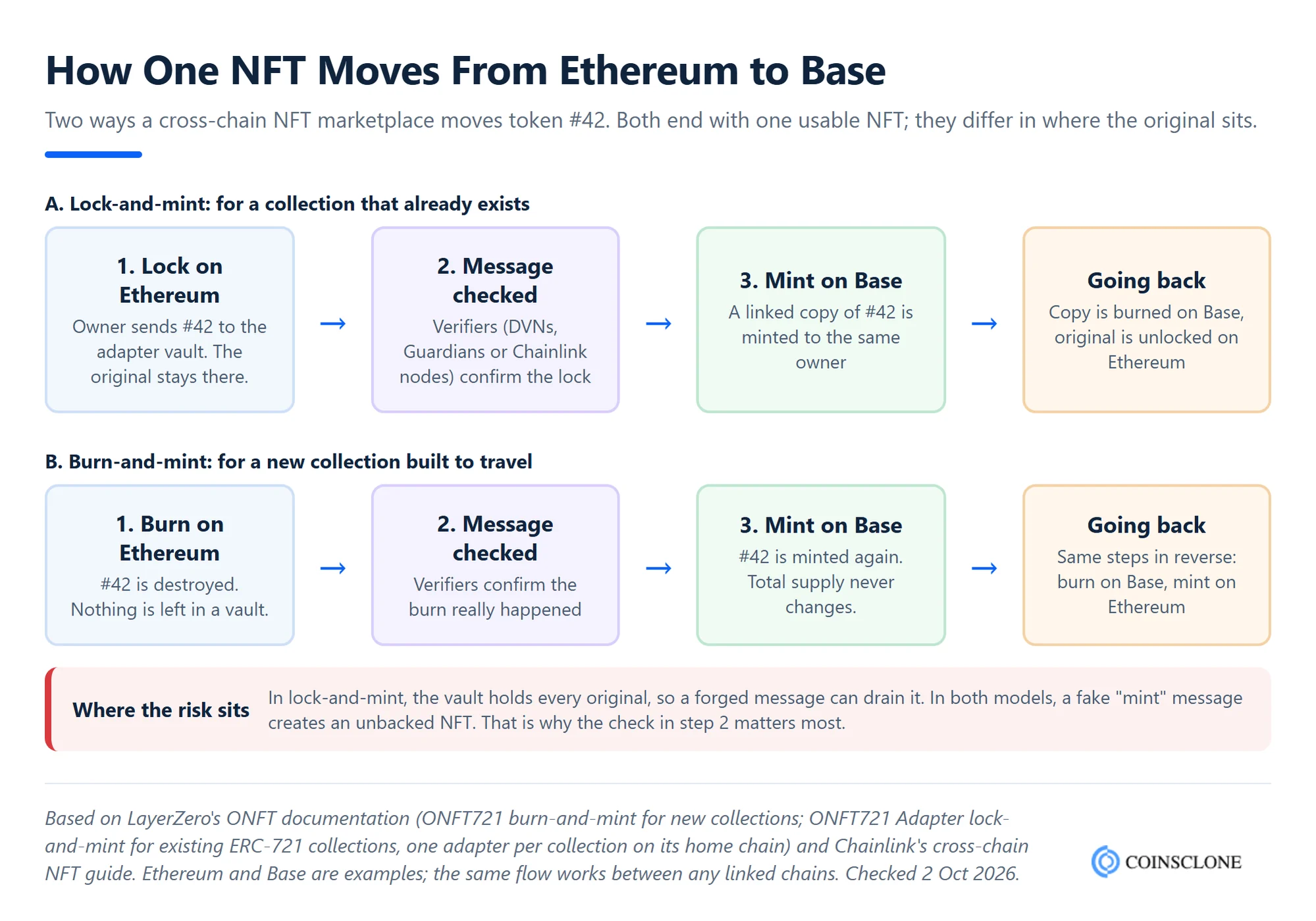
In short, both models give users one NFT that can live on any linked chain. The difference is where the risk sits: in a lock-and-mint setup, the vault holds every original, so it must be guarded with care.
Features We Integrate in Our Cross-Chain NFT Marketplace
The right features make a cross-chain platform easy to use, safe and fast. Here are the must-have features to plan for.
Interoperability Protocols: Link chains through audited message tools, so NFTs and payments move safely.
Multi-Wallet Integration: Support the main wallets on each chain. Users can then manage all their NFTs without juggling apps.
Cross-Chain Minting: Let creators mint on the chain they like, then list the NFT on each linked chain for more reach.
User-Friendly Interface: Hide the chain switching. A good dashboard shows the price, the fee and the time to arrive before the user signs.
Advanced Search and Filtering: Add filters for chain, category, price and rarity, so buyers can find what they want fast.
Secure Payment Gateways: Accept tokens from many chains and, if needed, cards. Some platforms let a buyer pay on one chain for an NFT on another.
Smart Contract Auditing: Run automated checks and an outside audit on every contract, especially the bridge parts, before launch.
Cross-Chain Royalty Distribution: Pay creators their cut on each resale on each chain, not just the home chain.
Analytics and Performance Insights: Show sales, volume and trends on all chains, so users and admins can make better choices.
Governance and DAO Integration: Let the community vote on fees, new chains and upgrades through a DAO.
Together, these features make the site safer and easier for all NFT users. Next, let’s look at the types of marketplaces this model can power.
Our Various Cross-Chain NFT Marketplace Development Services
Cross-chain NFT platforms are not limited to one niche. The same base can power NFTs in many fields, with wider reach and more buyers.
NFT Art Marketplace Development Services
With cross-chain support, NFT Art Marketplace Development lets artists and collectors mint, trade and move digital art across chains. Artists reach more buyers, and their work is not stuck on one network.
NFT Fashion Marketplace Development Services
A cross-chain approach in NFT Fashion Marketplace Development lets brands show digital wearables on many chains. Buyers can move items between metaverse worlds and wallets with ease.
NFT Sports Marketplace Development Services
With a cross-chain base, NFT Sports Marketplace Development supports trading of sports collectibles, moments and fan tokens across chains. Fans can buy on the chain they already use.
NFT Real Estate Marketplace Development Services
In NFT Real Estate Marketplace Development, homes and land as tokens can move across chains. This widens access, supports shared ownership and lets buyers join from anywhere.
NFT Ticketing Marketplace Development Services
A cross-chain setup strengthens NFT Ticketing Marketplace Development with safe ticket minting, resale and checks across chains. It cuts fraud and works with many wallets.
NFT Music Marketplace Development Services
With cross-chain support, NFT music marketplace development helps musicians sell music NFTs on several chains. They can license and earn on each chain, reach fans worldwide and track payouts in the open.
Next, let’s explore why building a cross-chain NFT marketplace makes strong business sense.
Why Create a Cross-Chain NFT Marketplace?
A cross-chain NFT platform opens new ways to grow. Here is why founders choose it.
Enhanced Liquidity and Audience Reach
When NFTs can trade on many chains, more buyers see each listing. For creators, that means more reach and more buyers on each chain. For you, it means more trades and more fees.
Reduced Gas Fees and Transaction Bottlenecks
Users can mint and trade on chains with low fees and fast blocks, such as Base, Polygon or Arbitrum. This cuts trading costs and avoids delays when one network gets busy.
Flexibility for Creators and Collectors
Creators and collectors can pick the chain that suits them best. Some want speed, some want low fees and some want a chain with a strong art or gaming crowd. A cross-chain site serves all of them.
Stronger Security When Built Right
A cross-chain platform does not depend on one network staying up. If one chain is slow or down, users can still trade on others. But bridges add their own risks, so this gain only holds with audited contracts and a careful setup, as we explain later.
Various Revenue Streams
A cross-chain NFT platform offers many ways to earn, because it serves users on many chains at once. Here are the main ones:
- Transaction Fees: Earn a fee on each NFT sale on each linked chain. For scale, OpenSea charges 1% per sale.
- Cross-Chain Transfer Fees: Charge a small fee when users move NFTs between chains.
- NFT Minting Fees: Collect fees when creators mint NFTs on any chain.
- Listing and Promotion Fees: Sell featured spots and promoted collections.
- Creator Royalty Commissions: Take a share of the creator’s cut on resales, where creators agree.
- Premium Features and Subscriptions: Offer paid tools such as pro stats, bulk listing or lower fees.
Our guide to the NFT marketplace revenue model shows how live platforms earn with real figures.
Established Regulation and Compliance Standards
Clear rules build user trust. NFTs can stand for digital or real-world assets on many chains. So your site must follow the laws on ownership, tax and digital payments where you work. For example, the EU’s MiCA rules leave out unique NFTs, but large series or fractions of NFTs can still fall under them.
A clear complaint and dispute process matters too. It helps you:
- Let users report fraud or suspicious activity
- Fix transaction errors across different chains
- Settle ownership or transfer disputes
- Protect users and keep your platform’s good name
- Support the long-term health of your site
With the benefits in mind, let’s look at the tools and protocols that power cross-chain NFT marketplaces.
Key Technologies and Protocols We Use to Launch the Cross-Chain NFT Marketplace
Cross-chain trading rests on a few layers of tech. Each one helps chains talk to each other, so assets can move safely.
1. Blockchain Networks: Each chain has its own strengths. Ethereum has the deepest NFT market. Base, Arbitrum and Polygon offer low fees. BNB Chain has a large user base, and Solana is fast and cheap. Linking a few of them gives you the best of each.
Also Read: Top Blockchains To Create NFT Marketplace Platform
2. Cross-Chain Messaging Protocols and Bridges: These carry signed messages between chains. So an NFT burned or locked on one chain can be minted on another. The main options today:
- LayerZero: Offers the ONFT721 standard for new NFT sets and an adapter for older ones. Messages are checked by DVNs, which are networks of checkers. Its own docs advise live apps to use two or more DVNs run by different teams.
- Chainlink CCIP: Chainlink’s CCIP sends tokens and messages between many chains. Chainlink’s node network checks each message, and its cross-chain NFT guide covers burn-and-mint and lock-and-mint.
- Wormhole: Wormhole Messaging is a broad message layer. A group of Guardian nodes watches each message and signs it before the other chain acts on it.
- Axelar: Offers General Message Passing to link EVM chains and Cosmos chains.
- IBC and XCM: Cosmos chains move NFTs through the IBC NFT transfer standard (ICS-721), and Polkadot chains use XCM messages.
3. Smart Contracts and Token Standards: Smart contracts run listings, bids, sales and transfers. Token standards such as ERC-721 and ERC-1155 keep NFTs the same across EVM chains, while ERC-2981 tells each site the royalty rate. Read more about NFT standards to pick the right one.
For More Insights Read: NFT Smart Contract Development
4. Oracles and Decentralized Storage: Oracles bring outside data, such as prices, onto the chain. Shared storage, such as IPFS or Arweave, keeps NFT images and details safe and the same on each chain.
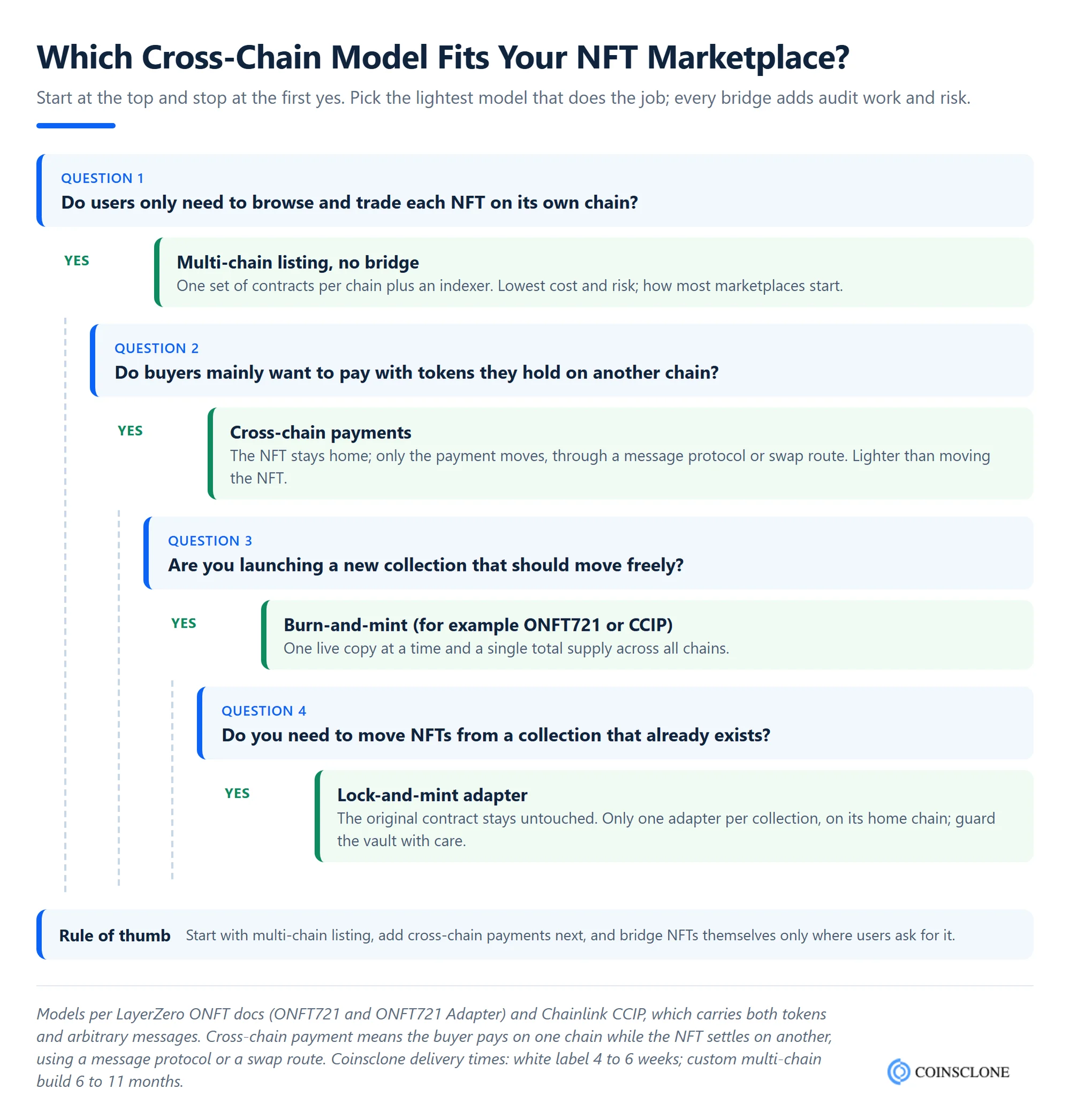
Which Cross-Chain Model Fits Your Marketplace?
Not each site needs a bridge. The decision tree below helps you choose the lightest model that meets your needs.
With the right tools in place, here is how the build itself runs.
How to Build a Cross-Chain NFT Marketplace: Step by Step
Building a cross-chain NFT site follows a clear path. Each step cuts risk before the next one starts.
- Define your niche and chains: Choose your users first, such as art, games, music or tickets. Then pick two or three chains where those users already trade. More chains can come later.
- Choose the cross-chain model: Decide if you need listing on many chains only, burn-and-mint for new NFTs or a lock-and-mint adapter for older ones. Then pick the message tool.
- Design the user flow: Plan screens that hide chain switching. Show the fee, the time to arrive and the target chain before each signature.
- Write the smart contracts: Build the trading, minting, royalty and bridge contracts. Reuse audited code, such as OpenZeppelin and the bridge’s own templates, instead of writing it all from zero.
- Build the back end and indexer: Set up nodes or data APIs for each chain, an indexer for listings and a sync service for metadata and ownership.
- Test and audit: Test on each chain’s testnet, then run an outside audit. Pay extra care to message checks, replay guards and admin keys.
- Launch, monitor and grow: Go live with rate limits and pause controls on the bridge. Watch transfers around the clock, run a bug bounty and add chains as demand grows.
For a broader view of the full process, see our guide on how to build an NFT marketplace.
Challenges and Security Risks of Cross-Chain NFT Marketplaces
Cross-chain features bring real value, but they also bring the biggest risks in Web3. Knowing them early saves money and keeps users’ trust.
Bridge and Messaging Attacks
Bridges hold or create large amounts of value, which makes them a top target. By August 2022, Chainalysis counted about $2 billion stolen in 13 bridge hacks, most of it that year. The largest that year were Ronin ($625 million) and Wormhole ($326 million). The problem has not gone away. In 2026, the DefiLlama hacks database shows bridge and cross-chain attacks as the second-largest source of losses.
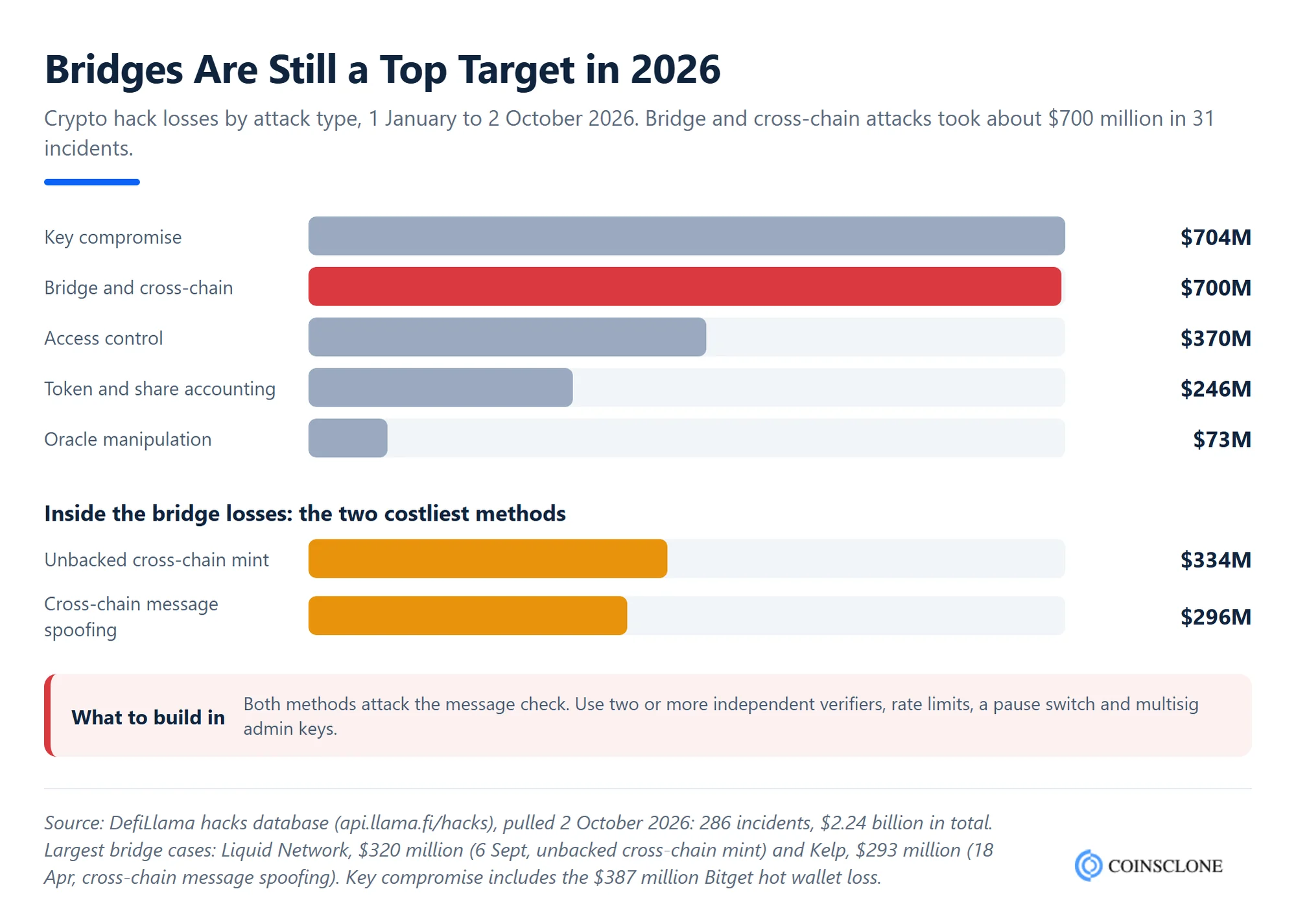
The two most costly bridge methods this year were fake “unbacked” mints and spoofed cross-chain messages. Both strike at the exact steps an NFT bridge uses. So the fixes are clear:
- Use more than one checker: One checker is one point of failure. Require two or more separate teams to approve each message.
- Guard admin keys: Put upgrades and settings behind a multisig and a time delay.
- Set rate limits and a pause switch: Cap how many NFTs or how much value can move per hour, and let a guardian pause the bridge.
- Audit the whole flow: Audit the bridge setup and the links between contracts, not just each contract alone.
Royalties That Break Across Chains
ERC-2981 tells a marketplace what royalty to pay, but payment is voluntary. A copy minted on a new chain may lose the royalty if the new contract or site does not honour it. So carry the royalty data into each chain’s contract, and pay it in your own sale logic.
Metadata and Ownership Sync
If the image or details live on one chain’s server, a moved NFT can show a broken image. Store metadata on IPFS or Arweave so every chain points to the same file. Also, make sure an NFT locked for a move cannot be listed or sold at the same time.
Split Liquidity and Higher Upkeep
Each new chain splits your buyers and adds nodes, audits and support work. Even big players feel this. Magic Eden closed its Bitcoin and EVM marketplaces in March 2026 to focus on Solana. So add chains only where your users really trade.
Rules and Compliance
Rules on NFTs differ by country. Plan KYC for large trades, sanctions checks and tax records early. Get legal advice before you offer split or income-sharing NFTs.
Cross-Chain NFT Marketplaces in 2026: What Live Platforms Show
Many lists of “top cross-chain NFT marketplaces” still name sites that have closed. Here is what the market looks like today, and what each case teaches a new founder.
- OpenSea: The largest general marketplace now lists NFTs on 28 chains and has token swaps built into the same app. It charges a 1% fee per sale. Lesson: cross-chain payments and swaps can matter more to users than moving the NFT itself.
- Magic Eden: Once the leading multi-chain challenger, it closed its Bitcoin and EVM marketplaces in March 2026 and now focuses on Solana. Lesson: each chain has a running cost, so match chains to real demand.
- Binance NFT and Coinbase NFT: Both have closed (Binance NFT shut in July 2026). Lesson: a big brand alone does not keep a marketplace alive; niche focus and fair fees do.
The overall market is smaller than it was. CryptoSlam data shows NFT sales of $5.63 billion in 2025, down 37% from $8.9 billion in 2024. That is why a focused, lean cross-chain platform has a better chance than a copy of a giant. For a full, current list, see our guide to the best NFT marketplaces.
Cost and Timeline of Cross-Chain NFT Marketplace Development
The cost depends on the build route, the number of chains, the bridge tool and the audits. Published 2026 agency cost guides give these market ranges:
| Build type | Typical market cost | Coinsclone delivery time |
| White-label marketplace with multi-chain support | About $10,000 to $30,000 | 4 to 6 weeks (7 to 10 with minting) |
| Mid-tier platform with custom features | About $40,000 to $80,000 | 9 to 13 weeks for a standard build |
| Custom cross-chain platform with bridge links | About $80,000 to $150,000 or more | 6 to 11 months for a custom multi-chain build |
| Large open marketplace on many chains | $150,000 to $500,000 or more | Phased, often beyond 11 months |
Plan for a few extra costs too. Each outside smart contract audit often costs $5,000 to $25,000, and cross-chain parts may need their own review. Upkeep usually runs 15% to 25% of the build cost each year. For a full breakdown, read our guides on NFT marketplace development cost and the cost to create a multi-chain NFT marketplace like OpenSea and Rarible.
With the right tools and budget in place, it becomes clear why many founders turn to Coinsclone for cross-chain NFT development.
Why Choose Coinsclone for Cross-Chain NFT Marketplace Development Services?
Coinsclone is a leading NFT Marketplace Development Company that builds safe, robust cross-chain NFT marketplaces. Since 2018, we have delivered 350+ platforms for 200+ clients across 20 industries. Our team builds platforms that link many chains, so your NFT marketplace can serve a global audience and many kinds of digital assets.
We work with proven cross-chain tools such as LayerZero, Chainlink CCIP, Polkadot and Cosmos to keep asset moves smooth and safe. We also build in audits, rate limits and multisig controls from day one. With Coinsclone, your cross-chain NFT marketplace is built with tested tools and best practices, from a fast white-label launch to a fully custom platform.
Frequently Asked Questions
What is cross-chain NFT marketplace development?
Cross-chain NFT marketplace development is building an NFT platform that supports many blockchains and lets NFTs move between them. It uses smart contracts, message tools and bridges. So users can trade NFTs across chains without using separate sites.
What does cross-chain mean?
Cross-chain means two or more blockchains can share messages and value. Blockchains cannot read each other on their own. So a cross-chain tool carries a checked message from one chain to the next. This lets a token, an NFT or a payment move between networks.
How does a cross-chain NFT marketplace work?
A cross-chain NFT marketplace links many chains through a message layer. When an NFT moves, the original is either locked or burned on the first chain, and a matching NFT is minted on the new chain. Smart contracts keep the owner, the NFT details and the royalty in step during the move.
What is the difference between cross-chain and multi-chain NFT marketplaces?
A multi-chain site lists NFTs from many chains, but each NFT stays on its home chain. A cross-chain site also lets NFTs, bids or payments move between chains. Cross-chain gives users more freedom, but it needs a bridge or message tool and extra audits.
Why is cross-chain support important for NFT marketplaces?
Cross-chain support removes the limits of a single chain. Users can trade with lower fees, more speed and more buyers. It also helps your site win users from many chains, instead of relying on one.
How much does it cost to build a cross-chain NFT marketplace?
Published 2026 agency guides put a white-label marketplace with multi-chain support at about $10,000 to $30,000. A custom cross-chain platform with bridge links often costs $80,000 to $150,000 or more, and a large open marketplace on many chains can pass $500,000. Audits and yearly upkeep come on top.
How long does it take to build a cross-chain NFT marketplace?
A white-label NFT marketplace can launch in 4 to 6 weeks, or 7 to 10 weeks with creator minting. A standard build takes 9 to 13 weeks. A fully custom multi-chain platform usually takes 6 to 11 months, including testing and audits.
Which blockchains can be integrated into a cross-chain NFT marketplace?
Most cross-chain NFT platforms support big chains such as Ethereum, Base, Polygon, BNB Chain, Arbitrum and Solana. The right mix depends on fees, speed, NFT standards and where your users already trade.
Is cross-chain NFT marketplace development secure?
Yes, it can be secure when built correctly. Safety depends on audited smart contracts, two or more separate message checkers, guarded admin keys, rate limits and safe wallet links. Weak bridges are the most common risk, so the design matters as much as the code.
Build a Powerful Cross-Chain NFT Marketplace Fast
Cross-Chain NFT Marketplace Development — launch your interoperable NFT platform effortlessly.
- Seamless Interoperability: Connect Ethereum, BSC, and more for smooth NFT transfers.
- Cost-Efficient Transactions: Reduce gas fees with optimized multi-chain architecture.
- Liquidity Boost: Expand your audience reach across multiple blockchain ecosystems.
- Smart Integration: Enable multi-wallet access, analytics, and DAO participation.
See a free branded demo of your NFT marketplace in 48 hours — before you invest a cent.
Book a Free Demo to discover how Cross-Chain NFT Marketplace Development can help you launch in just 8–12 weeks.