
How much does it cost to build an OTC exchange in 2026? A white label OTC desk costs about $15,000 to $60,000 and can go live in 7 to 10 weeks. A custom OTC platform built from scratch costs about $60,000 to $150,000 or more, and a full institutional platform can pass $300,000. Then add the license, the capital you must hold and the monthly bills, which often cost more than the software itself.
This guide breaks that budget down so you can plan with real numbers. You will see the cost of each build path, what each part of the platform costs, which factors push the price up, what licenses cost in four major markets and what the desk costs to run each month. You will also see a worked year-one budget and how much a desk must trade to break even.
In this guide:
- Cost and time by build path: white label, custom and institutional, side by side.
- Cost by module: the RFQ engine, liquidity, settlement, wallets, compliance and security.
- License and capital costs: official fees from regulators in the US, EU, UK and Dubai.
- Year-one budget and break-even: worked numbers for a real license setup.
- Ways to cut the cost: where to save and where never to save.
See How Our MVP System Cuts the Cost to Build Your OTC Exchange!
OTC Exchange Development — simplified and accelerated.
- MVP System : Reduce your cost to build an OTC exchange by up to 90%.
- Pre-Built Infrastructure : Secure wallets, liquidity bridges, and compliance tools
- Fully Customizable : Your branding, tokens, and trade pairs
- Profit-Ready : Earn from trading fees, listings, and staking from day one
Get a free branded OTC exchange demo in just 48 hours — before spending a cent.
Book a Free Demo to learn how our OTC Exchange MVP can take you from idea to launch in 8 to 12 weeks.
How Much Does It Cost to Build an OTC Exchange?
The cost to build an OTC exchange ranges from about $15,000 for a white label launch to $300,000 or more for an institutional platform. The biggest drivers are not the screens your clients see. They are the settlement model, the number of liquidity partners you connect and the compliance stack your license demands.
Here is how the main build paths compare in 2026:
| Build path | What you get | Typical cost (USD) | Time to launch |
| White label OTC desk | Request for quote (RFQ), manual settlement, client portal, screening | $15,000 to $60,000 | 7 to 10 weeks |
| Desk with automated settlement | Settlement automation, limit engine, hedging tools | $40,000 to $120,000 | 12 to 16 weeks |
| Custom OTC platform | Your own RFQ and pricing engine, escrow or atomic settlement | $60,000 to $150,000+ | 4 to 7 months |
| Institutional OTC platform | Several desks, FIX links, full compliance stack | $150,000 to $300,000+ | 7 to 11 months |
Cost ranges match our crypto exchange development cost guide and published 2026 agency cost guides. Launch times are Coinsclone’s published OTC timelines. Checked October 2026.
So a lean founder can test the market for well under $100,000 in software. A firm that wants to serve funds and banks should plan for a six-figure build and a longer runway.
What Is an OTC Exchange and Why Build One in 2026?
An OTC (over-the-counter) exchange lets clients trade large amounts of crypto directly with a desk, away from the public order book. The client asks for a price, the desk returns one firm quote and the trade settles in private. Because the price is fixed before the trade, a big order does not move the market. In addition, the platform offers multi-currency support, escrow and deep liquidity to keep each deal smooth.
OTC desks serve funds, miners, brokers, payment firms and wealthy traders. Trade sizes are large. For example, Kraken lowered its OTC minimum to $50,000 in March 2025. Your own desk can set any minimum that fits your clients.
Demand is also growing fast. According to the Finery Markets 2025 OTC report, spot OTC volume grew 109% year on year in 2025, while spot volume on the top 20 central exchanges grew only about 9%. Stablecoins made up 78% of OTC trades, up from 26% two years earlier. As a result, a desk that handles stablecoin and fiat pairs well can serve treasuries and payment firms, not just traders.
That growth is why more startups ask what it costs to launch a desk. The rest of this guide answers it part by part.
Cost Breakdown by Development Method
Your build method sets most of the budget and the timeline. Here are the three main routes, so you can see the cost to build an OTC exchange in detail.
Custom Solution
Here, you build the OTC crypto exchange platform from scratch. Your ideas take shape from day one: the blockchain networks, the RFQ engine, the settlement flow and the design. For this route you need developers, designers, testers, a security team and a project lead.
A custom OTC platform takes about 4 to 7 months with escrow or atomic settlement, and 7 to 11 months for a full institutional platform. Costs also tend to run over budget, because every module is new code that needs testing. So a custom build suits funded firms with a unique trading model more than first-time founders.
The average cost to build an OTC exchange from scratch ranges from $60,000 to $150,000 or more, and an institutional platform costs $150,000 to $300,000+.
White Label Solutions
For an easier route, you can buy a white label OTC exchange solution and launch it under your brand. A white label platform already holds the core features, security tools, plugins and admin controls an OTC desk needs. You change the brand, coins, fees, client tiers and design to suit your plan. To compare offers, see our guide to white label crypto exchange cost.
This is the easiest and lowest-risk route, because the code has already run in live markets. You pay mainly for setup, branding and the changes you need.
The average cost to build an OTC exchange with a white label solution is about $15,000 to $60,000, or $40,000 to $120,000 with automated settlement and hedging.
Clone Software Solution
The fastest way to build an OTC exchange at low cost is an OTC exchange clone script. The script copies the proven features, security and workflow of leading OTC desks, such as Kraken OTC or Coinbase Prime, and lets you add your own changes on top.
On our script, a standard OTC desk takes 7 to 10 weeks, and a desk with automated settlement takes 12 to 16 weeks. The price sits in the same range as white label software, because the core is already built.
You can choose the method that fits your budget, your clients and how soon you need to launch.
OTC Exchange Cost by Module
Every OTC platform is built from the same main parts. The table below shows what each part costs when you build it custom. A white label platform includes most of these parts, which is why it costs far less.
| Module | What it does | Typical custom cost (USD) |
| RFQ and pricing engine | Takes quote requests and returns firm prices with your spread | $15,000 to $80,000 |
| Liquidity and hedging links | Pulls live prices and hedges trades with exchanges and partners | $5,000 to $60,000 |
| Settlement, wallets and custody | Moves coins and cash, with hot, warm and cold wallets | $20,000 to $50,000 |
| Client portal and API | Quote screens, trade history, statements and API access | $8,000 to $40,000 |
| Admin and back office | Client tiers, limits, fees, reports and approvals | $10,000 to $25,000 |
| KYC, KYB and AML tools | Checks people and firms, screens wallets and trades | $10,000 to $40,000 |
| Security and audits | 2FA, encryption, withdrawal checks, outside tests | $20,000 to $60,000 |
Ranges from our crypto exchange cost guide and published 2026 agency cost guides for OTC software. Checked October 2026.
The rows add up to more than the lean custom figure for a reason. A lean desk does not build every part itself. It rents KYC checks and custody from providers, connects only one or two liquidity partners and starts with a simple portal. An institutional desk builds most parts in depth, so it lands at the top of each range.
Factors Influencing the Cost to Build an OTC Exchange
Many factors shape the final cost of an OTC exchange platform. By knowing them early, you can cut costs you do not need from the budget. Here are the main ones.
Desk Model: Principal or Agency
First, decide how your desk will earn money. A principal desk takes the other side of each trade and keeps the spread, so it needs inventory tools, hedging links and real-time risk limits. An agency desk only finds the other side for the client and charges a fee, so it needs less risk tooling.
This choice also changes your license. Under the EU’s MiCA rules, a desk that only executes orders for clients needs €50,000 of own funds, while one that swaps crypto for cash or other crypto needs €125,000. A principal desk therefore costs more to build and to license.
Settlement Model
Settlement is the biggest design choice in an OTC desk. Pre-funded trades, where clients send funds before they trade, are the simplest and cheapest to build. Credit lines with daily netting need a limit engine and settlement tracking. Escrow or atomic settlement, where both sides release at once, takes the longest. On Coinsclone’s published timelines, that is the gap between 7 to 10 weeks and 4 to 7 months.
Liquidity Partners
Your desk needs a source of prices and a place to hedge. Each exchange or liquidity partner you connect takes its own API work, testing and reconciliation. One or two partners keep the cost low. Ranking quotes across five or more partners adds tens of thousands of dollars. Our guide to crypto liquidity providers explains how to pick them.
Regulatory Compliance
Each country and region has its own rules for an OTC crypto exchange. Compliance covers licenses, capital, KYC and AML checks, the Travel Rule and regular reports. For most desks, this is the largest cost after the software, and the one most budgets miss. We cover the official fees by country in the next section.
Infrastructure Design
A crypto exchange attracts clients only when it is fast, clear and stable. Your design team works on the brand, layouts, front end, back end and plugins. The front end covers the placement of features, secure login and the quote screens.
On the other side, the back end covers third-party APIs (crypto payment gateway, crypto wallets and more), the escrow system and the dispute process. These parts add cost, and they need skilled developers to keep bugs out. Overall, the depth of your back end has a direct effect on the development cost of the OTC exchange platform.
Tools & Technologies
A strong tech stack and the right tools cut the chances of bugs and outages. Common choices include:
- Back end: Python, Node.js, Java or Go.
- Front end: frameworks like React.js, Angular or Vue.js.
- Web frameworks: Django (Python), Express.js (Node.js) or Spring Boot (Java).
- Live quotes, chat and confirmations: WebSockets, Socket.IO or SignalR.
- Pricing and RFQ engine: Rust, C++ or Go for speed.
- Institutional links: the FIX protocol for funds and brokers.
- Security: OpenSSL and AES encryption for data, OAuth and JWT for logins.
Ask a technical team to check the quality of each choice during the build. Many of these tools are free or open source, which keeps license costs down.
UI/UX Design
The design of the user interface and user experience also affects the cost. It shapes how clients use the platform and how fast they can trade. Key parts include clear navigation, a simple quote screen, mobile support, access for all users, a feedback system and a security-focused design. Template branding costs little, while a fully custom interface costs much more.
Location or Region
When you build an OTC exchange platform, think about the regions you want to serve. The platform has to meet the needs of users in each region, so features and design may need changes. You may also need multi-currency support, more languages and local payment rails.
- Localization: This focuses on users in one region, their trading habits and their needs. Offer local language support, local currency, date and time formats, a local payment gateway and wallet support. Serving a single region keeps the budget lower.
- Internationalization: This focuses on users worldwide. It adds global language support, a modular design, rules that scale across countries and a setup that works with any currency. As a result, a global OTC exchange costs more than a local one and needs a more skilled team.
Where your team works matters too. Clutch reports developer rates of about $25 to $49 an hour in India, Ukraine and the Philippines, $50 to $99 in the US and Poland, and $100 to $149 in Canada, in its pricing data updated in September 2026.
Insurance Cost
Insurance plays a big role for OTC crypto exchanges, because they work in a high-risk space for hacks, scams and cyber attacks. Common policies cover cyber attacks, staff errors, staff theft (a fidelity bond) and the loss of digital assets. Published agency cost guides put a starting policy at about $5,000 to $30,000 a year, and large custody cover costs far more.
Payment Mechanism
To keep deposits and payouts smooth and safe, you add payment rails to the platform. This means third-party payment gateways for local and global transfers. The costs include:
- Setup fees: The payment provider charges a fee to connect.
- Maintenance cost: Ongoing support, updates and upgrades.
- Custom development cost: Special features, flows and security checks you add on top.
These are the main factors behind the cost to build an OTC crypto exchange. With help from experienced developers, you can cut the costs you do not need step by step.
License and Capital Costs for an OTC Exchange
A license lets your desk serve clients legally, open bank accounts and win the trust of funds. It is also where OTC budgets most often go wrong, because the official fee is only a small part of the bill. Here are the official numbers in four major markets, taken from the regulators’ own rules:
| Market | License or registration | Official fee | Capital or other key costs |
| United States | FinCEN money services business (MSB) registration | No fee | AML program, Travel Rule from $3,000, state money transmitter licenses; New York BitLicense costs $5,000 to apply |
| European Union | MiCA crypto-asset service provider (CASP) | Set by each national regulator | Own funds of €50,000 to execute orders for clients, or €125,000 to exchange crypto for cash or crypto |
| United Kingdom | FCA cryptoasset authorisation | £11,260 to deal in or hold crypto | Gateway open 30 Sept 2026 to 28 Feb 2027; the regime starts 25 Oct 2027 |
| Dubai | VARA Broker-Dealer Services license | AED 100,000 (about $27,200) to apply | AED 200,000 (about $54,500) yearly supervision fee; paid-up capital of AED 400,000 to 600,000 |
Sources: FinCEN MSB registration, MiCA Annex IV, the FCA application fees, VARA Schedule 2 and VARA’s capital rules. Checked October 2026.
Timing matters too. MiCA’s transition period ended on 1 July 2026, so desks that serve EU clients now need full CASP approval. In Dubai, the capital floor is AED 400,000 (about $108,900) if you use a VARA-licensed custodian, and AED 600,000 (about $163,400) if you hold client assets yourself.
Beyond the official fee, plan for company setup, legal advice, written rules, a compliance lead and audits. Our crypto license guide explains each step by country.
Running Costs and a Worked Year-One Budget
The build and the license get you to launch. After that, an OTC desk pays monthly bills that many first budgets miss:
- Hosting and infrastructure: about $1,000 to $6,000 a month.
- Compliance tools: KYC and KYB checks, wallet screening and trade monitoring, about $2,000 to $10,000 a month.
- Security monitoring: about $500 to $2,000 a month.
- Maintenance and updates: about 15% to 20% of the build cost each year.
- Liquidity and hedging: exchange fees and partner spreads on every hedge, which grow with volume.
- Staff: traders, a compliance officer and client support, usually your largest cost.
Here is how the first year can look for a desk licensed in Dubai, with the software as the only change between the two cases:
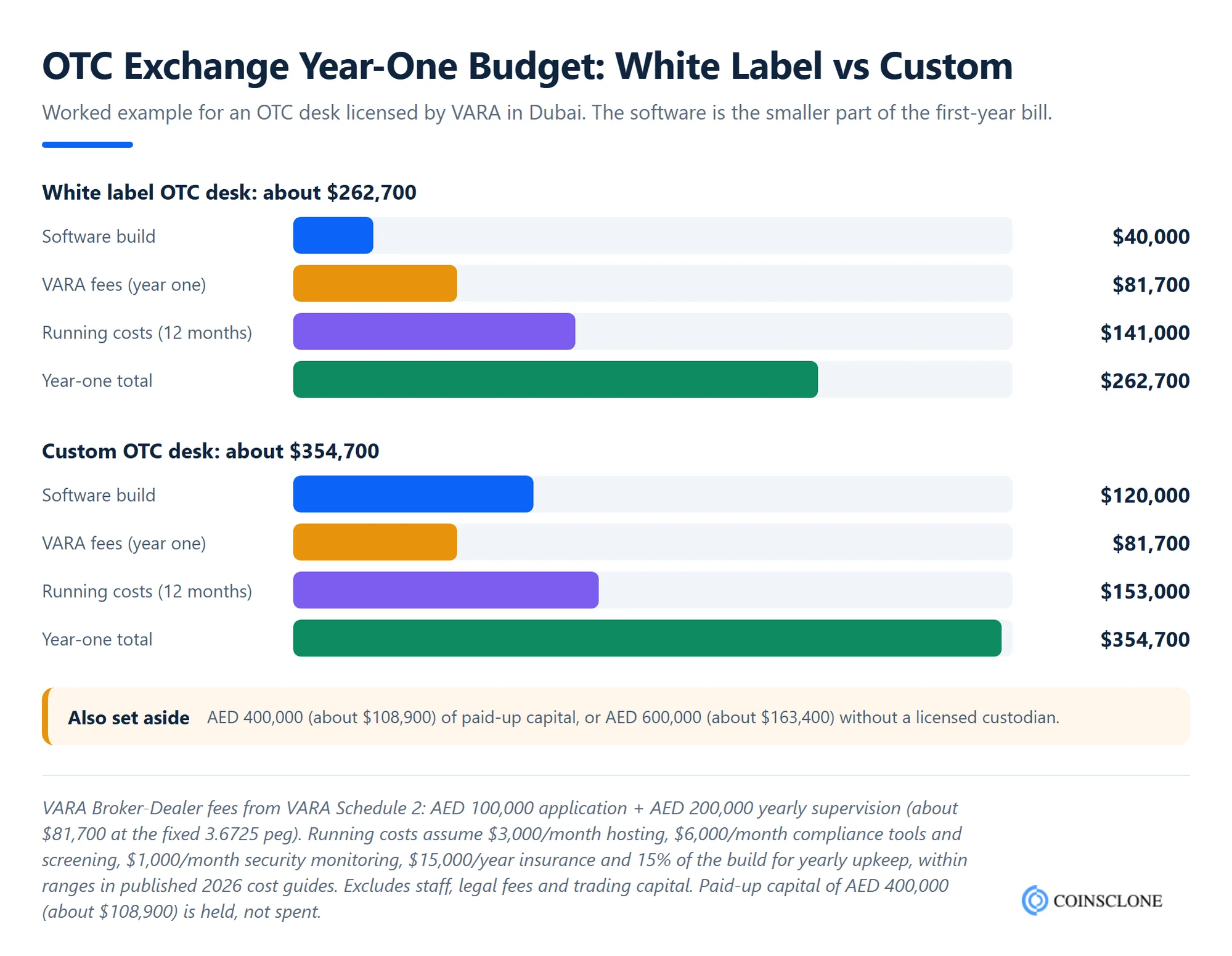
In short, the software is often the smaller part of year one. A white label build saves about $92,000 in this example, and you also go live months sooner.
How Much Must an OTC Desk Trade to Break Even?
Next, compare those monthly costs with what the desk earns. A desk earns a spread or a fee on each trade, so the break-even volume depends on your net margin per trade.
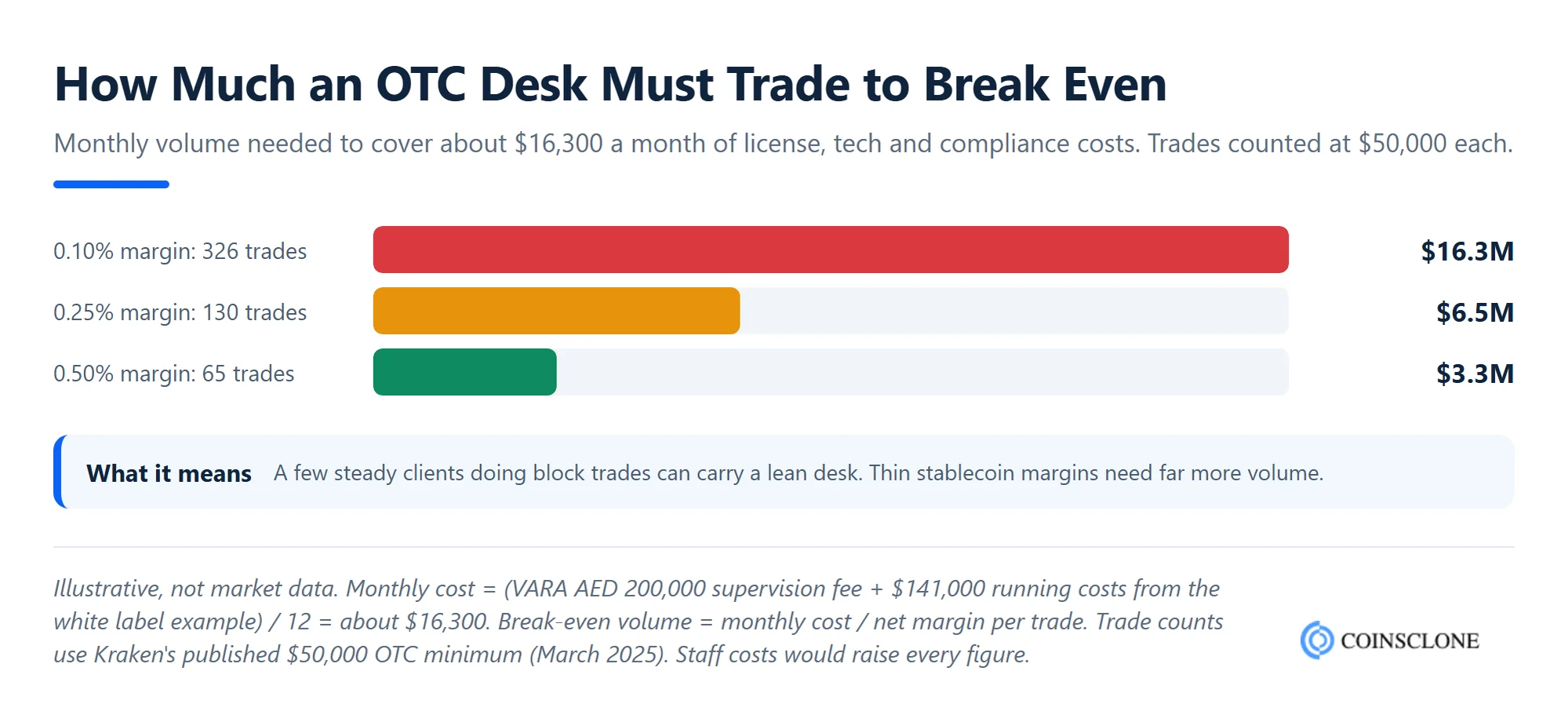
At a 0.25% net margin, the lean desk above needs about $6.5 million of trades a month, or 130 trades of $50,000. A handful of steady clients can reach that. However, stablecoin pairs often trade on thin margins, so a stablecoin-heavy desk needs much more volume.
How to Reduce the Cost to Build an OTC Exchange
You can cut the cost without cutting safety. Here are the moves that work best:
- Start with white label software: It cuts months of build time and gives you tested code from day one.
- Launch pre-funded first: Add credit lines and escrow once you know your clients and their trading habits.
- Connect one or two liquidity partners: Add more when volume justifies the extra work.
- Rent, do not build, KYC and custody: Use proven providers and pay per check or per asset.
- Pick one market first: One license and one region keep legal and design costs low.
- Never trim security: A single breach costs far more than an audit.
To Conclude
Now you know what it costs to build an OTC exchange, from a $15,000 white label desk to a $300,000+ institutional platform, plus the license, capital and monthly costs around it. The next step is to choose a development partner.
Coinsclone is a renowned OTC crypto exchange development company. Since 2018, we have delivered 350+ platforms for 200+ clients across 20 industries. Our team builds OTC desks around your clients, settlement flow and target market, from a white label launch to a full custom platform. Talk to our sales team to get a price estimate, the specs and our services in detail.
See How Our MVP System Cuts the Cost to Build Your OTC Exchange!
OTC Exchange Development — simplified and accelerated.
- MVP System : Reduce your cost to build an OTC exchange by up to 90%.
- Pre-Built Infrastructure : Secure wallets, liquidity bridges, and compliance tools
- Fully Customizable : Your branding, tokens, and trade pairs
- Profit-Ready : Earn from trading fees, listings, and staking from day one
Get a free branded OTC exchange demo in just 48 hours — before spending a cent.
Book a Free Demo to learn how our OTC Exchange MVP can take you from idea to launch in 8 to 12 weeks.
Frequently Asked Questions
How much does it cost to build an OTC crypto exchange?
A white label OTC desk costs about $15,000 to $60,000. A custom OTC platform costs about $60,000 to $150,000 or more, and an institutional platform costs $150,000 to $300,000+. License fees, capital and running costs come on top.
How long does it take to develop an OTC crypto exchange platform?
On Coinsclone’s published timelines, a standard OTC desk takes 7 to 10 weeks. A desk with automated settlement takes 12 to 16 weeks, one with atomic settlement takes 4 to 7 months, and a full institutional platform takes 7 to 11 months.
How does an OTC exchange earn money?
A principal desk earns the spread between the price it quotes and the price it hedges at. An agency desk charges a fee on each trade it arranges. Desks also earn from settlement fees, credit and financing charges, custody fees and API access for large clients.
When does it make sense to choose white label vs custom?
Choose white label when you want to launch in weeks, test a market or keep the first budget under $100,000. Choose custom when your trading model or settlement flow does not fit ready-made software. You also need the budget and time for a build of many months.
What is the cost difference between crypto-only settlement and fiat rails?
Crypto-only settlement is cheaper, because coins move on chain between wallets you already run. Fiat rails add banking partners, payment gateway setup, reconciliation and stricter compliance, which add both build cost and monthly fees. Many desks start with crypto and stablecoin pairs and add fiat later.
How is an OTC exchange different from a normal exchange?
A normal exchange matches many small orders on a public order book, and the price moves as orders fill. An OTC exchange gives each client one firm price for a large trade and settles it in private, so the trade does not move the market. As a result, an OTC platform needs an RFQ engine and settlement tools instead of a fast matching engine.