

Every crypto app hits the same wall. A new user downloads your wallet, game or exchange, and then has no crypto to use in it. If getting money in takes a separate exchange account and a week of waiting, most users leave.
A crypto on-ramp solves that. It lets users buy crypto with a card or bank transfer right inside your app. An off-ramp does the reverse, turning crypto back into money in a bank account. Ramp Network alone serves more than 10 million customers, and Transak says more than 600 platforms use its service.
This guide explains crypto on-ramps and off-ramps for business: how they work, the leading providers and their real fees, the licences involved, how apps earn from them, and when it makes sense to build your own.
What Is a Crypto On-Ramp and Off-Ramp?
A crypto on-ramp converts fiat money into crypto. A user pays with a card, bank transfer, Apple Pay or a local method such as PIX or SEPA, and receives crypto in a wallet.
A crypto off-ramp converts crypto into fiat. A user sends crypto, and the provider pays local currency into their bank account or card.
For businesses, on-ramps and off-ramps usually come as an API or a ready-made widget that you add to your app. The provider handles payments, identity checks, compliance and buying the crypto. You handle the user experience.
How Does a Crypto On-Ramp Work?
A typical on-ramp purchase takes five steps.
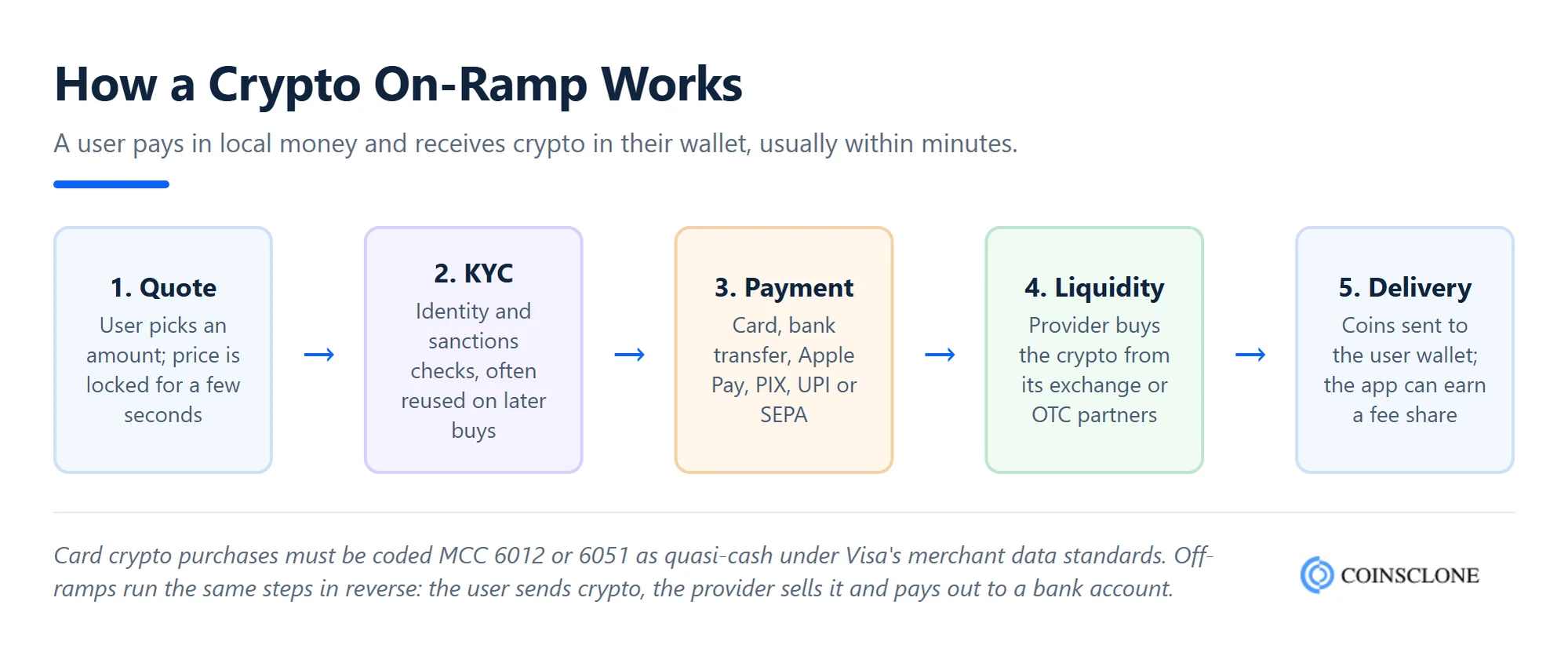
- Quote: the user picks an amount and a coin. The price is locked for a few seconds; Transak locks quotes for 5 to 10 seconds.
- KYC: the provider checks the user’s identity and screens against sanctions lists. Repeat buyers often skip this step.
- Payment: the user pays by card, bank transfer or a local method.
- Liquidity: the provider buys the crypto from exchanges or OTC partners.
- Delivery: the crypto is sent to the user’s wallet, usually within minutes.
Card payments are the most expensive part. Card networks treat crypto purchases as quasi-cash: under Visa’s rules they must be coded as merchant category 6012 or 6051. That brings higher fraud and chargeback risk, which providers price in.
How Does a Crypto Off-Ramp Work?
An off-ramp runs the same steps in reverse:
- Quote: the user chooses how much crypto to sell and sees the fiat amount.
- KYC and bank details: the provider checks identity and confirms the bank account belongs to the user.
- Send crypto: the user sends the coins to an address the provider gives, or approves it in-app.
- Sell: the provider sells the crypto through its liquidity partners.
- Payout: fiat arrives by bank transfer, card payout or a local method. Transak charges 0.99% for off-ramp sales.
Off-ramps matter for businesses as much as for users. Merchants paid in stablecoins, freelancers paid in crypto and exchanges settling with customers all need a reliable way back to the bank. Payout speed and bank acceptance are often harder to get right than the on-ramp.
Which Businesses Need On-Ramps and Off-Ramps?
- Wallets: let users fund a new wallet in one step instead of sending them to an exchange.
- Exchanges and brokers: accept cards and local payment methods alongside bank deposits.
- Web3 games and NFT platforms: let players buy items or tokens without learning crypto first.
- Payment gateways: let merchants cash out stablecoin payments to their bank. See our guide to the stablecoin payment gateway.
- Fintechs and neobanks: add crypto buying and selling next to normal accounts.
- Payroll and payout platforms: send crypto to workers who can cash out locally.
Who Are the Top Crypto On-Ramp Providers?
| Provider | Card fee | Bank fee | Off-ramp | Licences (examples) |
| Transak | 3.99% + $1 | 2% + $1 (wire 0.75% + $9) | 0.99% | FCA registered, FinCEN MSB, ~20 US state licences |
| Ramp Network | Up to 3.9% | Up to 1.40% | Yes | MiCA (Ireland), FCA, FinCEN |
| Coinbase Onramp | 2.5% (credit card) | 0.5% (ACH) | Yes | MiCA (Luxembourg), US licences |
| MoonPay | Not confirmed | Not confirmed | Yes | MiCA (Netherlands), New York BitLicense |
| Banxa | Custom | Custom | Yes | MiCA (Netherlands), AUSTRAC, FINTRAC, FCA |
| Stripe Crypto Onramp | Spread-based | Spread-based | No | Stripe is merchant of record in the US |
| Onramper | Aggregator | Aggregator | Via partners | Routes to 30+ on-ramps |
Fees come from each provider’s own pricing page, checked on 28 September 2026: Transak, Ramp Network and Coinbase Onramp. Spreads and network fees come on top. Coinbase also offers zero-fee USDC purchases to select partners.
How Much Do Crypto On-Ramps Cost Users?
Here is what a user pays in provider fees to buy $500 of crypto, by payment method.
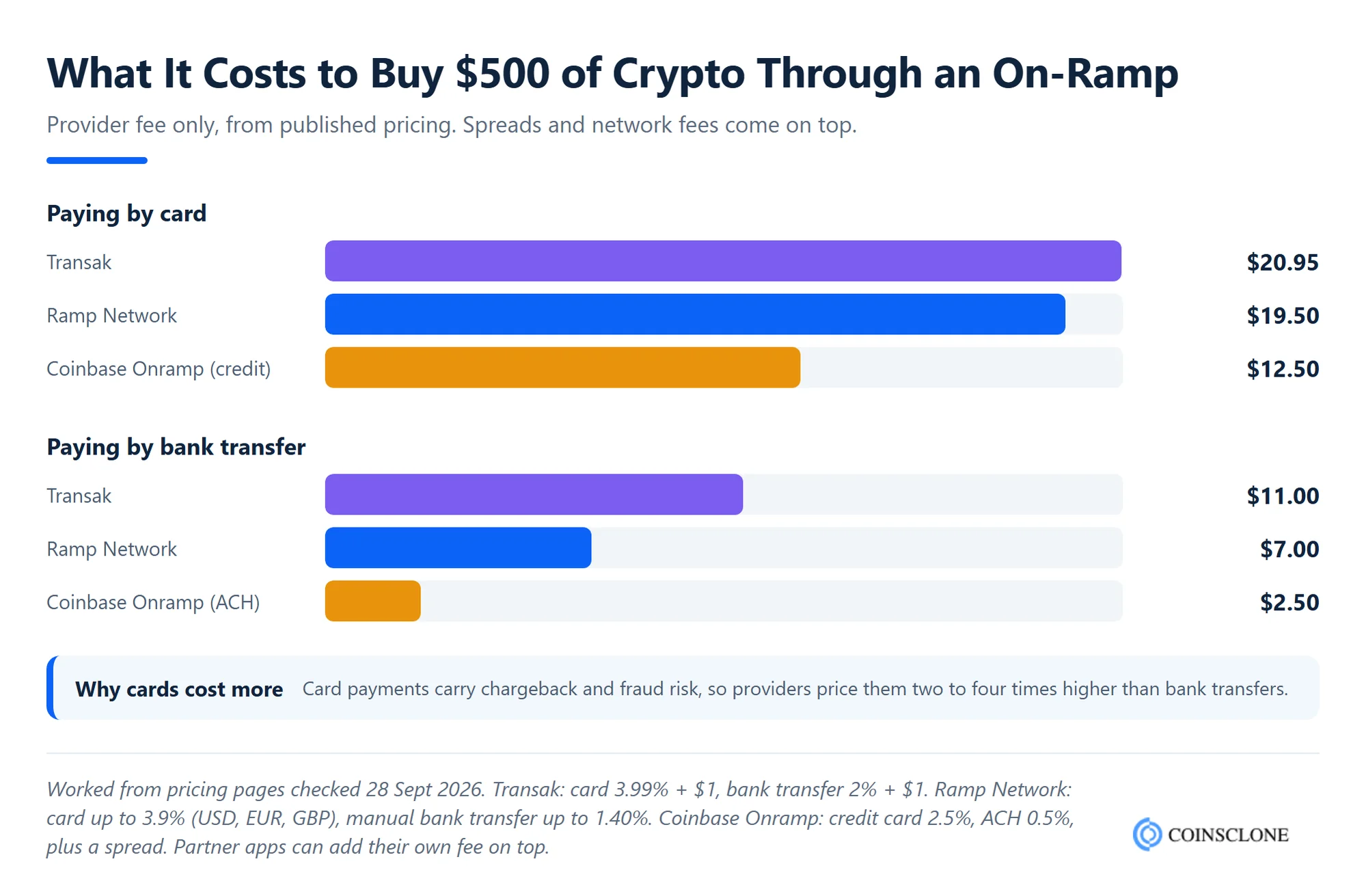
The gap between cards and bank transfers is large. On a $500 purchase, a card can cost $12 to $21 in provider fees, while a bank transfer costs $2.50 to $11. For apps, steering users to bank transfers, or to local methods such as PIX and UPI, improves conversion and cuts cost.
How Do Apps Make Money From On-Ramps?
Integrating an on-ramp can bring in revenue, not just users:
- Partner fees: MoonPay lets partners add their own fee on top, capped at 5% in its dashboard.
- Affiliate share: MoonPay’s affiliate fee typically ranges from 0.5% to 1.25% of volume, paid monthly.
- Aggregator referral income: Onramper earns referral fees from the providers it routes to, and passes deals on to apps.
- Downstream activity: users who fund their wallet in-app go on to trade, stake or spend, which earns more fees.
The best setup balances income with conversion. A high partner fee earns more per purchase but can push users to buy elsewhere.
Add a Crypto On-Ramp and Off-Ramp to Your Platform
Crypto Exchange and Gateway Development — done right.
- Provider Integrations: Connect leading on-ramp APIs, or run your own fiat rails.
- KYC and Risk: Identity checks, fraud screening and transaction limits built in.
- Wallet Delivery: Coins land in your users’ wallets automatically after payment.
- Revenue Engine: Earn from conversion spreads, fees and partner revenue share.
Get a free build-or-integrate consultation — before spending a single dollar.
Book a Free Demo to see how we add fiat in and out to exchanges, wallets and apps.
Should You Integrate an On-Ramp or Build Your Own?
Integrate a provider if:
- You need fiat access quickly.
- Your volume is small or spread across many countries.
- You do not want to hold money transmitter or MiCA licences.
- Fraud and chargebacks are not your core skill.
Build your own fiat rails if:
- You run an exchange, neobank or large wallet with steady volume.
- Provider fees and spreads are a big share of your costs.
- You want control over pricing, payment methods and the user flow.
- You already hold, or plan to get, the licences needed.
Use a hybrid: many platforms integrate one or two providers for coverage, and build direct bank rails for their main markets, where volume justifies it. Aggregators such as Onramper can route each user to the provider with the best price and approval rate in their country.
What Do You Need to Build Your Own On-Ramp?
Building your own on-ramp means running a regulated payments business. You will need:
- Licences: in the US, FinCEN MSB registration plus state money transmitter licences; in the EU, MiCA authorisation, which every provider needs since the transition ended on 1 July 2026; in the UK, FCA registration. See our crypto license guide.
- Banking partners: accounts that accept crypto-related flows. Banxa, for example, works with an FDIC-member US bank.
- A card acquirer: one willing to process quasi-cash crypto purchases, with fraud tools and chargeback handling.
- Liquidity: access to exchanges and OTC desks to buy and sell crypto at good prices.
- Compliance: KYC, sanctions screening, transaction monitoring and the Travel Rule.
- Technology: quotes, payment processing, wallet delivery, reconciliation and reporting.
The technology is the easier part. Our crypto exchange development and payment gateway development teams build the order flow, wallets and admin tools that sit behind a fiat on-ramp.
How to Add a Crypto On-Ramp to Your App in 6 Steps
- Map your users. Which countries, which payment methods and which coins they want.
- Shortlist providers. Compare fees, coverage, approval rates and licences in your key markets.
- Choose widget or API. A hosted widget is fastest; an API keeps users inside your own screens.
- Integrate and test. Test KYC, failed payments, refunds and wallet delivery on every chain you support.
- Set your fee and revenue share. Balance income against conversion.
- Monitor and optimise. Track approval rates by country and method, and add a second provider where one underperforms.
Frequently Asked Questions
What is a crypto on-ramp?
A crypto on-ramp is a service that lets users buy crypto with fiat money, such as by card or bank transfer, and receive it in their wallet. Businesses add it to their apps through an API or widget.
What is the difference between an on-ramp and an off-ramp?
An on-ramp turns fiat into crypto. An off-ramp turns crypto back into fiat and pays it to a bank account or card.
How much do crypto on-ramps charge?
Card purchases usually cost 2.5% to about 4% plus spreads, such as Transak’s 3.99% + $1. Bank transfers are cheaper, from 0.5% with Coinbase Onramp via ACH to 2% + $1 with Transak.
Which crypto on-ramp is best for business?
It depends on your markets. Transak, Ramp Network, MoonPay, Banxa, Coinbase Onramp and Stripe all serve businesses. Aggregators such as Onramper route each user to the best available provider.
Can apps earn money from on-ramps?
Yes. Providers such as MoonPay let partners add their own fee and pay affiliate shares, typically 0.5% to 1.25% of volume.
Do I need a licence to offer an on-ramp?
Not if you integrate a licensed provider, which handles the regulated part. To run your own, you need licences such as US money transmitter licences or EU MiCA authorisation.
Why are card purchases of crypto so expensive?
Card networks treat crypto purchases as quasi-cash, with higher fraud and chargeback risk. Providers charge more to cover those losses.
How long does an on-ramp purchase take?
Card and instant bank payments usually deliver crypto within minutes. Slower bank transfers such as SEPA can take one to three days.