
Community is at the center of every blockchain. Blockchains run because miners and validators keep them going, and that is a group of people with tech skills. At heart, decentralization is about letting users share control of the tech they use. Community-centric NFT marketplace development takes that idea to NFT trading: the people who use the market also help run it.
This guide explains what a community-centric NFT marketplace is, how its voting and shared fund work, and which live sites use the model in 2026. You will also see how to build one, what it costs, and the legal risks most guides skip. By the end, you will know if this model fits your project and what to plan first.
In this guide:
- What a member-run NFT market is, and how it differs from a company-run one
- How an idea becomes a real rule change, step by step
- How a sale is split between seller, creator, the site and a shared fund
- Which sites run this way today, and what changed in 2025 and 2026
- Build steps, costs, time frames and the legal points to settle early
Build a Community-Driven NFT Marketplace
Community-Centric NFT Marketplace Development — designed for engaged users and decentralized projects.
- Governance Features : Empower the community voting, DAOs, and token-holder control.
- Multi-Chain & Wallet Support : Compatible with Ethereum, BSC, and major crypto wallets.
- Engaging Marketplace : Host exclusive drops, auctions, and interactive NFT events.
- Revenue Opportunities : Through listings, trading, and community-driven initiatives.
See a free branded demo of your NFT marketplace in 48 hours — before you invest a cent.
Book a Free Demo to discover how our Community-Centric NFT Marketplace Development can help you launch an interactive, profitable platform in just 8–12 weeks.
What Is Community-Centric NFT Marketplace Development?
Community-centric NFT marketplace development means building an NFT market where users help make the big calls. Members vote on fees, new tools, what gets listed and how shared funds are spent. They often vote with a token or with the NFTs they hold.
Building a community is not like building a business. It is a group of like-minded people working towards a shared goal. So the market needs more than listing and trading tools. It also needs ways for members to talk, share ideas, vote and see where the money goes.
In practice, most sites mix both worlds. A core team still writes the code and runs the servers. But members set the rules that team must follow. The key point is simple: the people who use the market get a real say in how it runs.
What Are NFTs?
To see why NFTs fit this model, compare normal money with crypto. In the real world, stocks, bonds, cash, land, gold and art hold value. Crypto has its own forms.
Bitcoin and Ethereum are often compared to gold and silver. Native coins work as the cash of each blockchain. Crypto tokens are more like shares in a project. NFTs, or non-fungible tokens, are one-of-a-kind items, a bit like signed art.
NFTs can stand for almost anything of value. Want to share the design of a new dress you made? Turn it into an NFT and sell it on an NFT site, with no big fashion brand needed to approve your work. Want to sell sports keepsakes without a middleman? Build an NFT market for them and sell straight to fans. Even a club pass, a concert ticket or a game item can be an NFT.
Also Read : How to Create an NFT Marketplace – A startup Guide
NFT trading is smaller than in 2021, but it is still alive. NFT sales fell 37% to $5.63 billion in 2025, according to CryptoSlam data. Buyers still spent about $183 million on NFTs in the 30 days to 16 October 2026, per CryptoSlam. In a cooler market, loyal users are often what keep a site going. That is just what a member-run market is built to grow.
What Is a DAO?
A DAO, or decentralized autonomous organization, is a group that makes choices through votes stored on a blockchain, not through a single boss. Members agree to act in the group’s best interests, and choices flow from the bottom up.
Smart contracts play a big part in DAOs. They are bits of code that carry out what the vote decides. Say a vote passes. The code may then raise the token supply, burn a set number of spare tokens or pay rewards to current holders. These reward tools can also grow into full NFT loyalty platforms that keep users coming back.
A DAO needs four things to work well:
- Shared control: No single person can change the rules alone.
- Turnout: Members read each plan and vote on it.
- Openness: Votes, plans and fund moves are public on the blockchain.
- A shared goal: People care enough to stay involved.
One point many guides get wrong: a DAO is not a company in law by default. Courts can treat a DAO with no legal shell as a loose partnership, so its active members may share the legal risk. We cover this in the legal section below.
Also Read : A Guide for Starting a DAO Easily!
Community-Run vs Company-Run NFT Markets
A normal NFT market is run by a firm. The firm sets the fees, picks the tools and keeps the profit. A member-run market hands some of that power to its users. Here is how the two compare side by side.
| Area | Company-run | Member-run |
| Who sets fees | The firm | Token or NFT holders vote |
| Where fees go | The firm keeps them | Split between running costs and a shared fund |
| New tools | The product team’s plan | Ideas from members, then a vote |
| Listing rules | The firm’s policy | Member picks or approved shops |
| Openness | Private reports | Votes and fund moves are on-chain |
| Speed of change | Fast | Slower, because votes take days |
| Main risk | Users leave if trust drops | Low turnout, whale control, legal risk |
So neither model wins on every point. Company-run sites move faster. Member-run sites build stronger loyalty and trust, which matters more when trading is slow.
Who Runs NFT Markets This Way Today (October 2026)
Older guides, this one included, called Rarible, OpenSea and SuperRare DAOs. That needs fixing, because the real picture is more mixed. Here is where the best-known names stand, checked in October 2026.
- SuperRare: The best case. Holders of the RARE token vote on site settings and the shared fund, as set out in the SuperRare DAO docs. A seven-person council holds the fund in a 4-of-7 multisig wallet, and it carries out what votes decide. The DAO also approves Spaces, which are art shops run by outside curators. SuperRare takes 15% on first sales of art.
- Rarible: One of the first NFT markets to give users a voting token, RARI, in 2020. A firm called IMPOSSIBLE bought the Rarible brand in 2026, while the RARI token and its voting stay with the RARI Foundation. Rarible added Solana in August 2026.
- Tensor: A Solana trading site. The Tensor Foundation bought the marketplace from Tensor Labs on 21 November 2025, moving it closer to its token holders.
- OpenSea: Still a firm, not a DAO. It has charged a 1% fee since 15 September 2025. In October 2025 it announced a SEA token with half the supply set aside for users, as CoinDesk reported.
- Blur: A warning sign, not a model. Blur said it will retire its blur.io website on 12 November 2026, while its smart contracts stay live, as Unchained reported. A token alone did not keep users once rewards dried up.
Outside NFTs, DeFi shows how far member control can go. UNI holders run Uniswap. In December 2025 they passed the “UNIfication” plan with more than 125 million votes for and 742 against, well above the 40 million quorum, as The Block reported. The vote switched on protocol fees and a 100 million UNI burn. That is the kind of real power a member-run NFT market can give its users.
Brand fan bases run their own markets too. NFT sets such as DeGods, Meta Angels and Wanderers launched their own trading spaces, as Rarible noted in 2022. DeGods even added a “Paperhands tax”: a 33.3% extra fee on anyone listing below the mint or floor price. Only a market its holders control can set a rule like that.
Transform Your NFT Marketplace into a Community Hub!
Key Features of a Community-Centric NFT Marketplace
A member-run market needs all the standard NFT marketplace features, such as minting, listing, auctions, offers and wallet login. On top of those, it needs tools that let members take part. Here are the ones that matter most.
- Voting: Members vote with a token, with the NFTs they hold, or both. On Ethereum, the free OpenZeppelin Governor contracts handle both token votes and NFT votes.
- Idea forum: A place to post ideas, debate them and build support before a formal vote.
- Free polls: Tools like Snapshot let members vote off-chain at no cost. Teams often use them for early “temperature checks”.
- Shared fund: A shared wallet that gets part of every trading fee. A multisig such as Safe means no single person can move the money.
- Creator royalties: A share of each resale goes back to the maker. The ERC-2981 standard tells markets what royalty a maker wants, but each market decides whether to pay it. A member vote can make royalties a firm rule.
- Curation: Members or chosen curators pick what gets listed, or run their own shops, like SuperRare Spaces.
- Token-gated access: Holders of a certain NFT get early drops, lower fees or private rooms.
- Rewards and status: Points or badges for active voters, curators and makers. Rewards should go to real use, not to fake wash trades.
- Many chains and wallets: Ethereum, Polygon, Base, BNB Chain and Solana are common picks. More chains mean more users, but also more code to audit.
How Community Voting Works: From Idea to On-Chain Change
Voting sounds simple, but a good process has a few steps. Each step filters out weak ideas and gives members time to react. Here is the flow most mature DAOs follow.
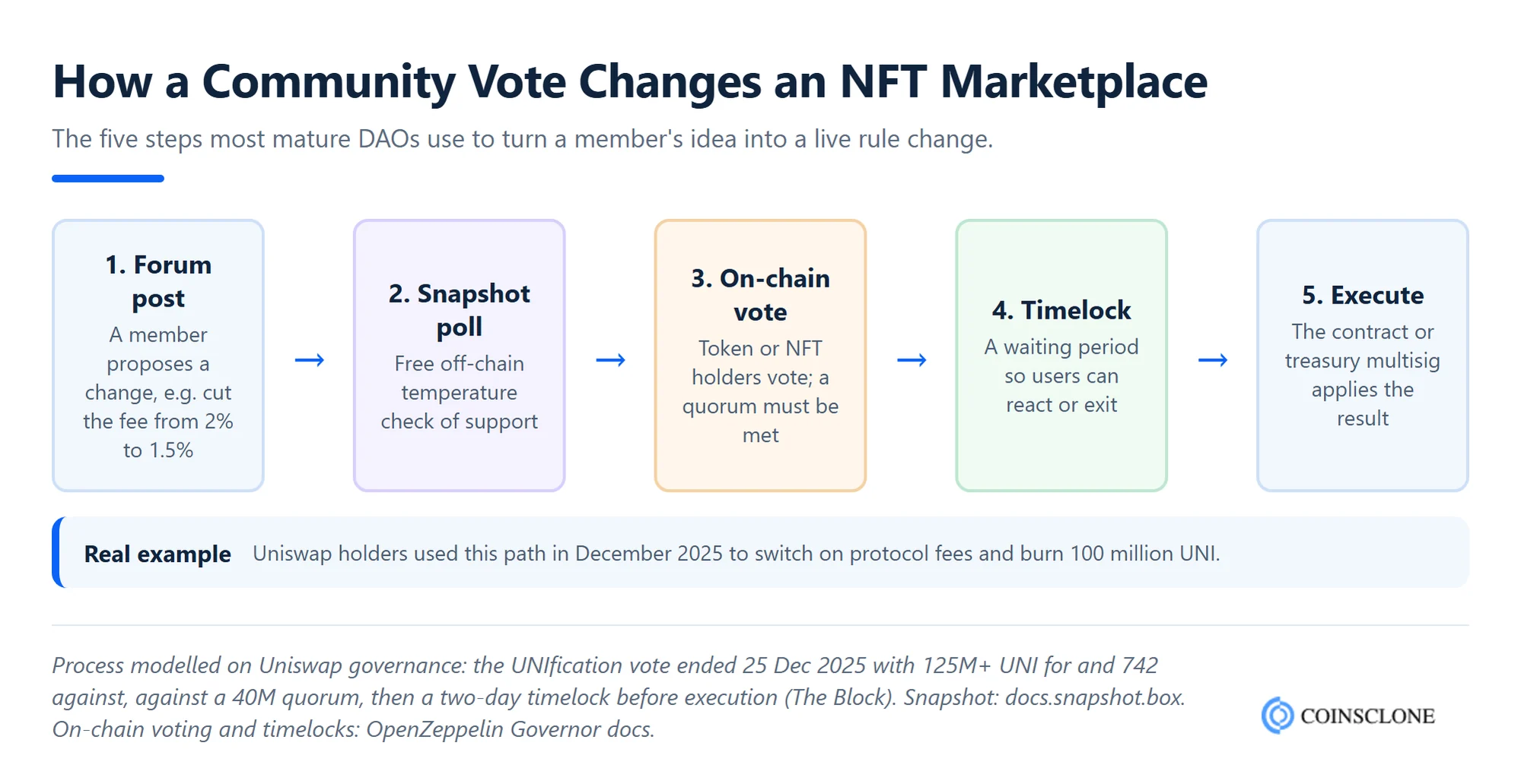
First, a member posts an idea on the forum, such as “cut the trading fee from 2% to 1.5%”. Next, members run a free Snapshot poll to test support. If the idea passes, it goes to a formal on-chain vote with a set quorum, which is the least number of votes needed. After that, a timelock adds a wait before the change goes live. That wait gives users time to leave if they strongly disagree. Last, the smart contract or the fund council carries out the result.
How should votes be counted? There is no single right answer. It depends on what your members already own and how early you are. This decision tree helps you choose.
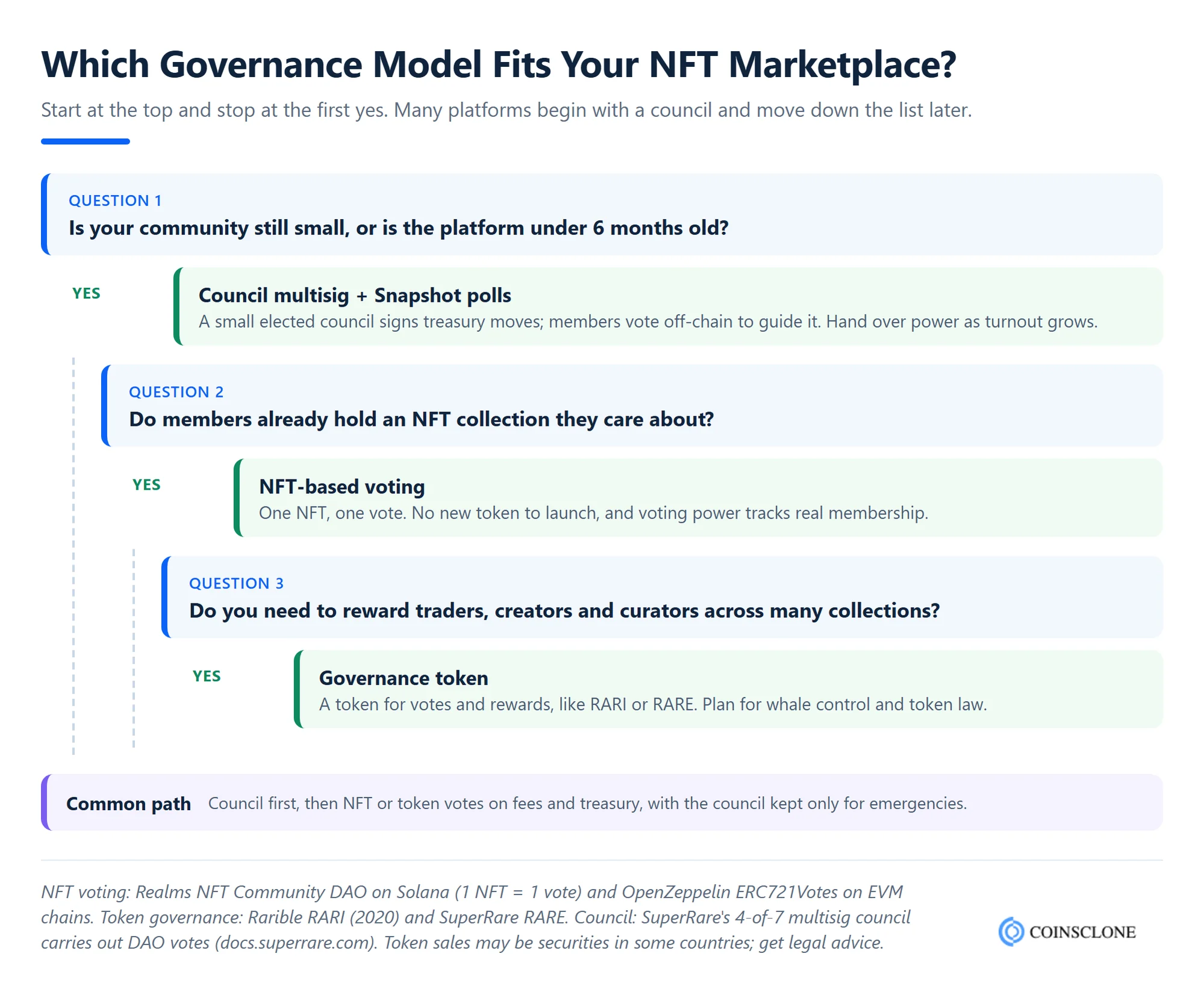
Many sites start with a small council and hand over more power as the user base grows. People call this “progressive decentralization”. It keeps the site safe in the early months, when a few large holders could else push through bad changes.
How a Community-Centric NFT Marketplace Makes Money
A member-run market earns the same way other NFT sites do. The difference is who shares the income. Most of the money comes from a fee on each sale. Common fees today range from OpenSea’s 1% to Magic Eden’s 2% on Solana. Art sites like SuperRare charge more on first sales.
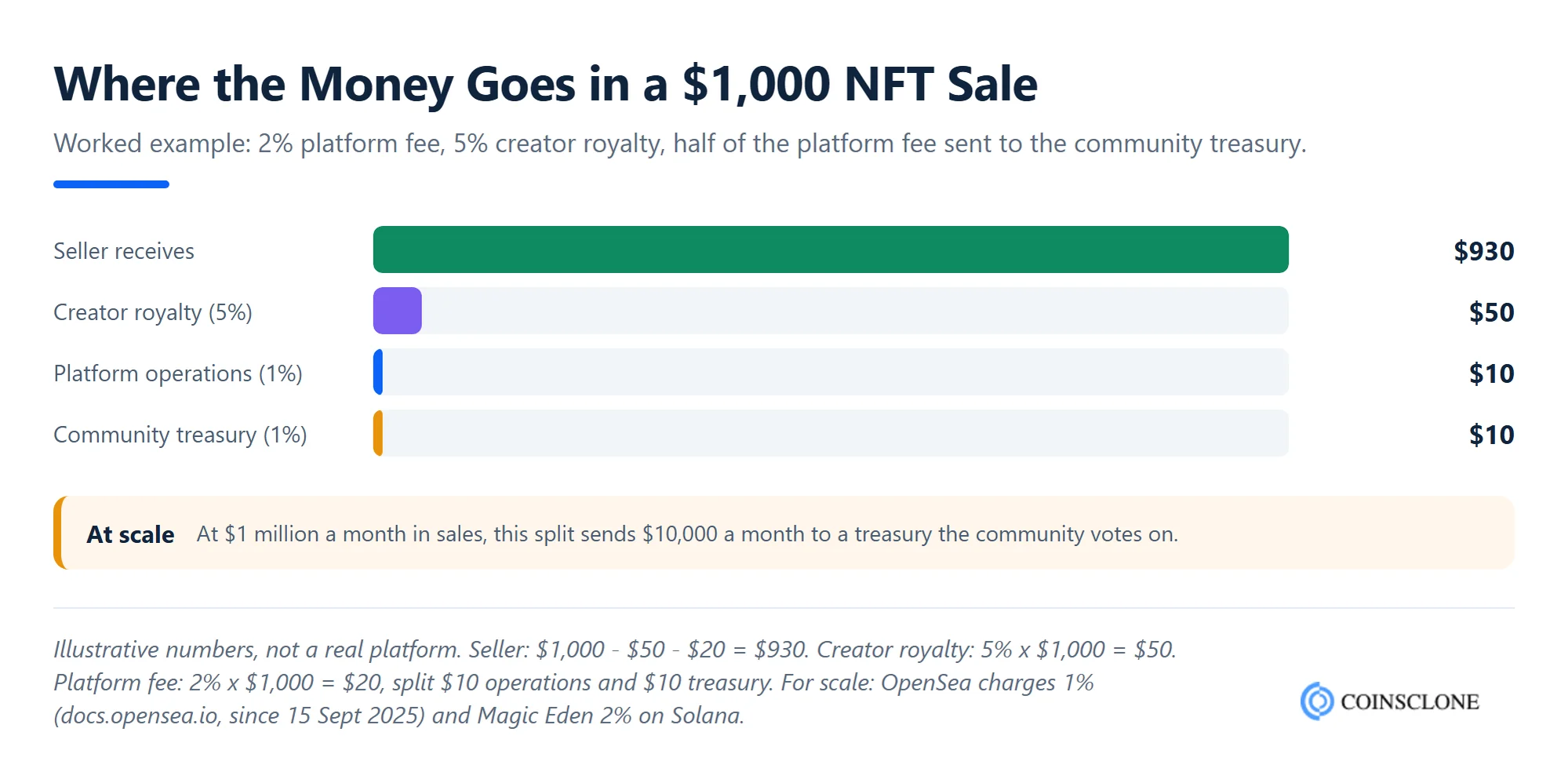
Here is a worked case of a single $1,000 sale. In this case, the site charges 2%, the maker’s royalty is 5% and half of the site fee goes to the shared fund.
Other income can come from:
- First-sale fees: A cut of new drops and mints, often higher than the resale fee.
- Paid spots: NFT sets pay to be shown on the home page or in a curated space.
- Launchpad help: Support for new projects to mint and sell their first set.
- Paid tools: Charts, bulk listing or pro trading screens for active traders.
For a deeper look at fee models, read our guide to the NFT marketplace revenue model.
How to Build a Community-Centric NFT Marketplace
Building this kind of site takes more planning than a normal market, because you design both the software and a way to share power. Here are the main steps.
- Define your members and their goal: Who are they? Artists, gamers, sports fans or a brand’s holders? A clear purpose draws people who share it and keeps votes focused.
- Choose the blockchain: Ethereum is the most tested chain for DAOs. Layer 2 chains like Base and Polygon cut fees for frequent trades. Solana suits fast trading and has its own DAO tools, such as Realms, which supports one-NFT-one-vote setups.
- Pick the voting model: NFT voting, a voting token, or a council that hands over power over time. Use the decision tree above.
- Design fees and the shared fund: Set the trading fee, the royalty rule and the share that goes to the fund. Decide who signs fund payments and how many signers you need.
- Build the smart contracts: Market contracts for listing, buying and auctions, plus voting contracts for ideas, votes and timelocks. Reuse audited open-source code where you can.
- Build the front end and member tools: Wallet login, profiles, an ideas page, a voting page and a public fund dashboard.
- Get a security audit: Voting contracts control money, so an outside audit is a must before launch.
- Set up a legal shell: Talk to a lawyer about the right legal form before the token or fund goes live. See the next section.
- Launch in stages: Start with a council and advice-only polls, then move key settings to on-chain votes as turnout grows.
If you want a faster start, a white label NFT marketplace gives you the trading core ready to go. Then you add the voting layer on top.
Legal and Security Risks to Plan For
Member control brings real gains, but it also brings risks that a company-run site does not face. Plan for these early.
- Members can be held liable: In June 2023, a US court ordered Ooki DAO to pay $643,542 and shut its website after a CFTC case. The court treated the DAO as a “person” that could be sued, as Baker McKenzie explained.
- A DAO can count as a partnership: In November 2024, a US judge ruled that Lido DAO could be treated as a general partnership. So some members might be liable for what it does, as Decrypt reported.
- Legal shells exist: Wyoming offers a DAO LLC and, since 1 July 2024, a Decentralized Unincorporated Nonprofit Association (DUNA). Uniswap’s DAO took up a DUNA plan in 2025. Other places, such as the Marshall Islands, offer their own DAO forms.
- Token rules: A voting token that promises profit could be treated as a security in some countries. Get legal advice before any token sale or airdrop.
- Whale control: If a few wallets hold most of the votes, “community” control is only a label. Vote caps, handing votes to trusted delegates and NFT-based voting can help.
- Vote attacks: An attacker who borrows or buys enough tokens can pass a harmful plan. Timelocks, quorums and voting delays give members time to react.
- Low turnout: Many members never vote. Rewards for voting and short, clear plans keep people involved.
Cost and Timeline to Build a Community-Centric NFT Marketplace
Costs depend on how much you build from scratch, how many chains you support and how deep the voting layer goes. Here are typical market ranges from published 2026 agency cost guides.
| Build type | Typical cost range | What you get |
| White label market | $10,000 to $30,000 | Ready trading core, your brand, basic admin |
| MVP with basic voting | $20,000 to $45,000 | Core market plus Snapshot polls and a multisig fund |
| Mid-tier custom build | $40,000 to $80,000 | On-chain voting, fund dashboard, curation, rewards |
| Large, many chains | $80,000 to $150,000+ | Several chains, custom token design, advanced member tools |
| Smart contract audit | $5,000 to $25,000 | Outside security review, often more for voting code |
As for time, Coinsclone’s NFT marketplace development page lists 4 to 6 weeks for a white label market and 9 to 13 weeks for a standard build. Voting contracts, audits and legal setup add time on top of that. For a full breakdown, see our guide to NFT marketplace development cost.
Why Choose Coinsclone for Community-Centric NFT Marketplace Development?
Central control has shaped business for a long time, and it has its problems. A fully decentralized system is not right for every project either. For most teams, the best answer is a balance: a team that builds and runs the site, and members who set its rules. A community-centric NFT marketplace gives you that balance.
This is where Coinsclone can help. Coinsclone is an NFT Marketplace Development company that has been building blockchain products since 2018, with 350+ platforms delivered for 200+ clients across 20 industries. We build sites that let anyone use the blockchain with no tech skills, and our experts cover every part of the stack.
We also offer White Label NFT Marketplace Software and other Clone Software Solutions to start your NFT market fast, such as the OpenSea clone, Rarible clone and Blur clone, among others. For the voting layer, our DAO token development team can add voting tokens, NFT voting and fund controls to your market. So whether you start from a clone script or a custom build, we help you launch a market your members can truly own.
Build a Community-Driven NFT Marketplace
Community-Centric NFT Marketplace Development — designed for engaged users and decentralized projects.
- Governance Features : Empower the community voting, DAOs, and token-holder control.
- Multi-Chain & Wallet Support : Compatible with Ethereum, BSC, and major crypto wallets.
- Engaging Marketplace : Host exclusive drops, auctions, and interactive NFT events.
- Revenue Opportunities : Through listings, trading, and community-driven initiatives.
See a free branded demo of your NFT marketplace in 48 hours — before you invest a cent.
Book a Free Demo to discover how our Community-Centric NFT Marketplace Development can help you launch an interactive, profitable platform in just 8–12 weeks.
Frequently Asked Questions
What is a community-centric NFT marketplace?
A community-centric NFT marketplace is an NFT market built around its users. Makers, buyers and members take part in voting, curation and events. They often vote with a token or with their NFTs on fees, new tools and how shared funds are spent.
How does a community-centric NFT marketplace work?
Users trade NFTs as on any market, through smart contracts on a blockchain. On top of that, members post ideas, vote on them and watch the results go live through on-chain code or a multisig wallet. Part of each trading fee often flows into a shared fund that members control.
Why are community-focused NFT marketplaces gaining popularity?
They offer more openness, shared ownership and a stronger sense of belonging. NFT sales fell 37% in 2025, per CryptoSlam data. In a cooler market like that, loyal users with a stake in the site are one of the best ways to keep trading alive.
Who can launch a community-centric NFT marketplace?
Artists, Web3 startups, game studios, DAOs, brands with NFT holders and fan clubs can all launch one. It works best when the group already shares a clear interest, such as an art style, a game or a sports team.
How much does community-centric NFT marketplace development cost?
Published 2026 agency cost guides put a white label market at about $10,000 to $30,000 and an MVP with basic voting at $20,000 to $45,000. A custom build with on-chain voting runs about $40,000 to $80,000, and a large build on many chains $80,000 to $150,000 or more. A smart contract audit adds about $5,000 to $25,000.
How long does it take to develop a community-centric NFT marketplace?
Coinsclone lists 4 to 6 weeks for a white label NFT market and 9 to 13 weeks for a standard build. Voting contracts, a security audit and legal setup for the DAO add extra time, so plan for that when you set your launch date.