
On 20 May 2026, Deel switched on stablecoin salary payouts for staff in the US and the euro area. The feature serves its employer of record (EOR) and global payroll clients. Gusto started a beta in January, and Toku says it processes more than $1 billion a year in token payroll. Stablecoin payroll has moved from crypto startups into mainstream HR software.
Yet the questions people ask online are practical ones. How do you withhold tax on a USDC paycheck? Why did a contractor’s bank call about the money? What does it take to add stablecoin payouts to an HR product? This guide answers those questions with the rules by country, the payout design, measured chain fees and a worked payroll run.
In this guide:
- The token changes no tax: US wages paid in USDC still go on a W-2, with income tax withheld and FICA due on the dollar value on payday.
- Wage law is stricter than tax law: US minimum wage and overtime must be paid in cash or a check, and German law says wages are paid in euros. So most firms pay staff in fiat and offer USDC as an opt-in for net pay.
- Chain fees are tiny: on 16 October 2026, a USDC payout cost about $0.001 on Base and $0.01 on Ethereum. A USDT payout on Tron cost about $2.27, or $4.48 to a new address.
- The off-ramp is the real cost: getting workers into local money takes a licensed partner per country, and its fee outweighs gas many times over.
- Ship in stages: start with wallet payouts for workers who ask, then add off-ramps in the two or three countries where demand is real.
What Is Stablecoin Payroll?
Stablecoin payroll means paying staff in a dollar token, most often USDC or USDT, instead of by bank transfer. The money lands in the worker’s crypto wallet in minutes, any day of the week. The worker can hold the dollars, spend them or cash out to a local bank.
In practice, there are three models:
- Wallet payout: the worker gives you a wallet address and you send USDC to it. This is simple for you, but it only suits workers who already use crypto.
- Off-ramp payout: you send stablecoins to a licensed partner, which pays the worker’s local bank in local currency. The worker never touches crypto.
- Hybrid split: you run payroll in fiat as usual and pay all or part of the net amount in USDC at the worker’s request. This is the model Deel and most HR platforms use for employees.
The case is strongest for contractors in slow, costly banking corridors. Payroll and remittances made up about $90 billion of real stablecoin payments in 2025, per a McKinsey and Artemis study. Meanwhile, the World Bank puts the average cost of sending money abroad at 6.36% (Q3 2025).
Who Already Runs Stablecoin Payroll in 2026
The big payroll platforms added stablecoins this year, mostly through payments partners. If you build an HR product, these are the bar your clients will compare you to.
| Platform | What launched | When | Partner and scope |
| Deel | Stablecoin salary payouts | 20 May 2026 | BVNK powers payouts; employees in the US and Eurozone first, free for employees |
| Deel and MoonPay | Payouts to workers’ wallets | Announced 10 Feb 2026 | MoonPay’s Iron unit; up to 40,000 UK and EU firms |
| Gusto | Stablecoin payouts for contractors abroad | Beta from 20 Jan 2026 | zerohash runs the crypto layer |
| Toku | Stablecoin payroll on Polygon | 20 Jan 2026 | Compliance across 100+ countries |
None of them built the money layer alone; each used a licensed partner. And all of them kept tax and payroll math in fiat, changing only the last step.
Stablecoin Payroll Tax and Withholding Rules
Paying in a stablecoin does not change what you owe. Tax follows the dollar or local value of the pay on the day it is paid, so your payroll engine must record that value for every payout.
- United States, employees: under IRS Notice 2014-21, wages paid in virtual currency are wages. You withhold income tax, pay FICA and FUTA, and report the fair market value on Form W-2.
- United States, contractors: crypto paid for services is self-employment income at its value on receipt. For payments made in 2026, a 1099-NEC is needed once a contractor gets $2,000 or more in the year, up from $600, under the One Big Beautiful Bill Act. Non-US contractors give you a W-8BEN instead.
- United Kingdom: HMRC treats tokens paid as earnings as readily convertible assets. The employer must run tax and National Insurance on their value through payroll.
- India: the 2026-27 Budget kept the flat 30% tax on gains from crypto and the 1% tax deducted at source on transfers. Indian contractors who later sell their USDC face both, so most will prefer rupees.
The clean pattern: work out gross pay, deductions and employer taxes in fiat. Pay the tax authorities through normal bank rails. Then deliver only the net pay, or part of it, in stablecoins. This also gives your auditor one familiar ledger.
Can You Pay Employees in USDC? Employment Law by Country
Tax law cares about value. Wage law often cares about the form of money, and it is the stricter of the two.
| Country | Employees | Contractors |
| United States | The FLSA wage rule (29 CFR 531.27) requires the minimum wage and overtime in cash or a negotiable instrument payable at par. Some state wage laws are stricter, so pay that part in dollars | Free to agree on USDC; report on 1099-NEC above $2,000 |
| Germany | Section 107 of the Trade Code says wages are worked out and paid in euros. Benefits in kind are allowed only in the worker’s interest and within the part of pay that can be seized | Free to agree; the invoice should state the currency |
| European Union | Since the ESMA statement of January 2025, EU crypto firms no longer offer stablecoins that lack MiCA approval, which ruled out USDT. Use USDC or the euro coin EURC | Same coin limits apply |
What this means for your product: for staff, make USDC an opt-in for part of net pay, with written consent, and keep minimum wage in fiat. For contractors, put the currency in the contract and the invoice. A founder on r/SaaS who raised in USDC asked what goes on the invoice, and how the books would look to an auditor two years later. A clear contract clause answers both.
Stablecoin Payroll Architecture: What You Build
A payout feature inside an HR or EOR product has six parts. The payroll engine you already have stays in charge of the numbers.
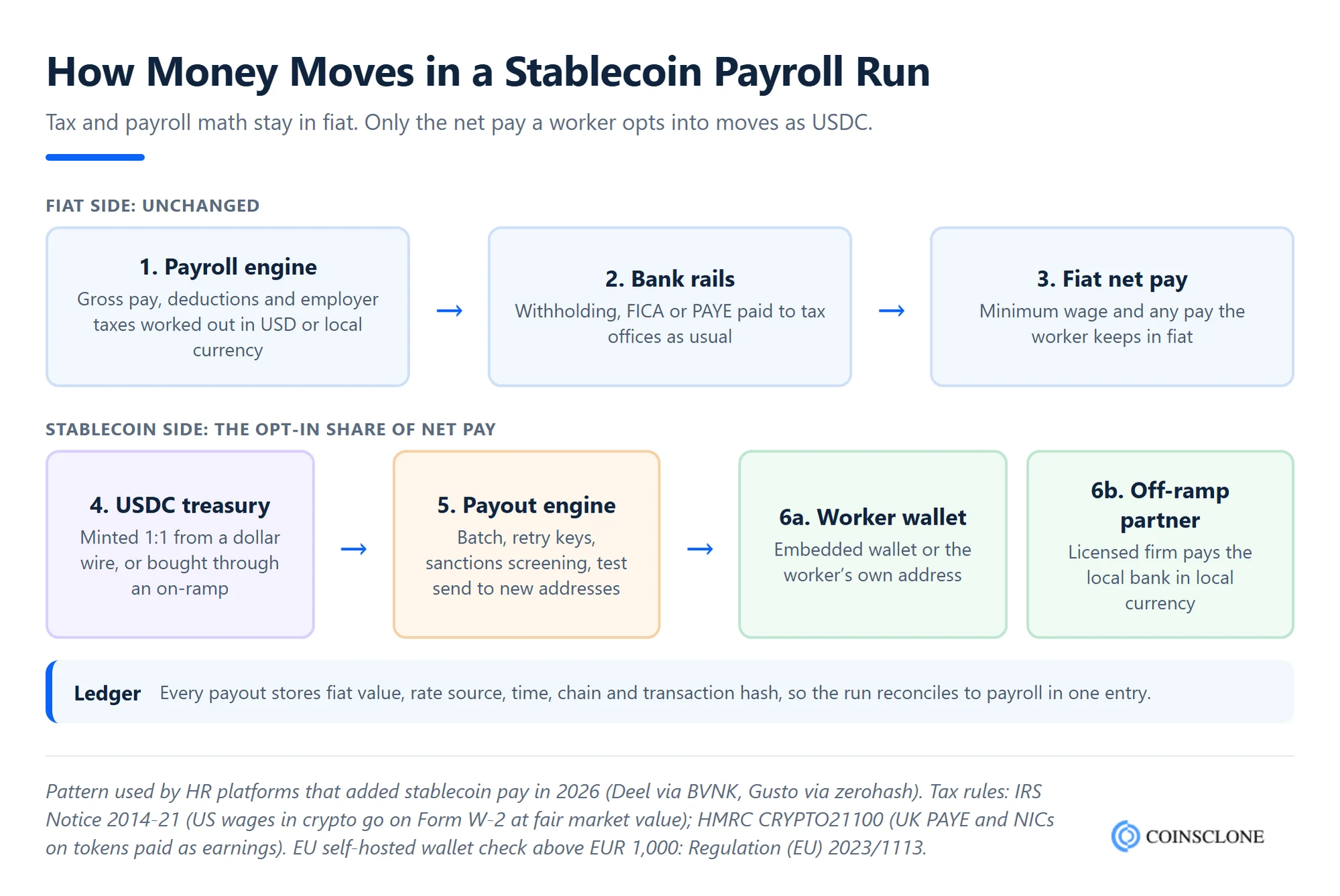
- Treasury funding: hold a USDC float. You can mint it 1:1 from a dollar wire through Circle Mint, buy it on a regulated exchange, or receive it from clients. A crypto on-ramp and off-ramp partner covers this step for most products.
- Payout engine: takes the approved net pay file, splits fiat and stablecoin amounts, and sends batched transfers. Each payout needs an idempotency key so a retry never pays twice.
- Wallet layer: either collect workers’ own addresses or give each worker an embedded wallet. A wallet-as-a-service provider can create one per worker at sign-up, with no seed phrase to lose.
- Address checks: send a tiny test amount to each new address before the first full payout. In the EU, when a crypto firm sends more than EUR 1,000 to a self-hosted wallet, it must also check that the worker owns it.
- Compliance: KYC on workers, sanctions screening on every address, and Travel Rule data when a payout goes to another exchange. The EU has no threshold for this, and the US threshold is $3,000.
- Ledger and records: store the fiat value, rate source, time, chain and transaction hash for every payout. This is what the r/Accounting thread was missing: a record that lines up with payroll without a spreadsheet.
Stablecoin Payroll Chains and Fees: A Worked Example
Chain choice matters less than people think for cost, and more for coverage. We measured the network fee for one stablecoin payout on 16 October 2026, using live gas prices from public nodes.
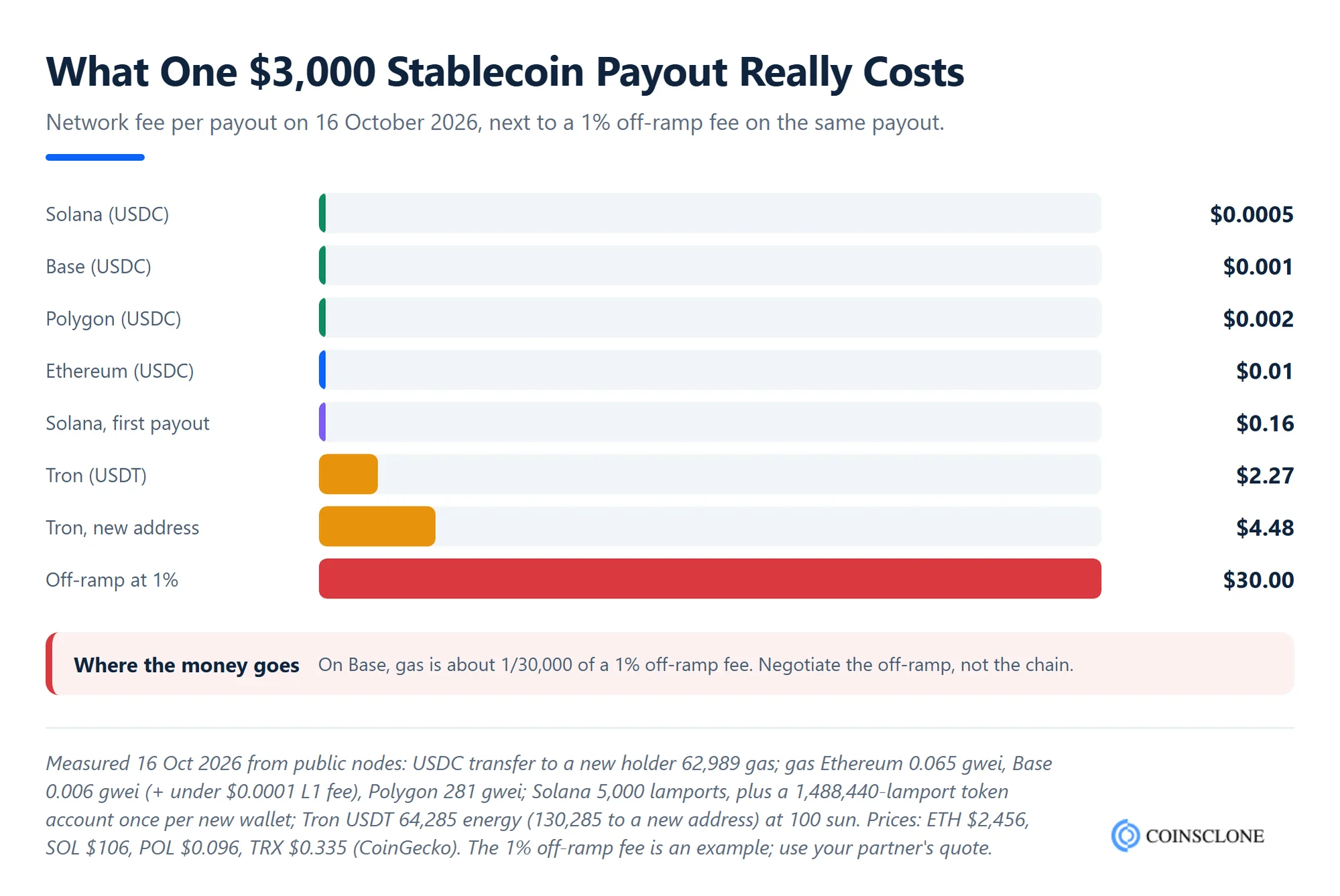
| Chain | Fee per payout | USDC on chain | Watch out for |
| Base | ~$0.001 | $4.40B | Coverage at local off-ramps varies |
| Solana | ~$0.0005, plus ~$0.16 once per new worker | $6.90B | A token account must be opened for each new wallet |
| Polygon | ~$0.002 | $1.63B | Confirm the off-ramp supports native USDC |
| Ethereum | ~$0.01 on 16 Oct; rises in busy markets | $44.73B | Gas spikes during market stress |
| Tron (USDT) | ~$2.27, or ~$4.48 to a new address | USDT: $92.92B | Renting or staking energy cuts this; USDT is out for EU users |
Chain balances come from DefiLlama on 16 October 2026. That day, all stablecoins held about $305.2 billion, and USDC held $72.66 billion.
Worked example: an HR platform pays 40 contractors $3,000 each, or $120,000 a month.
- Network fees: about $0.04 a month on Base, or about $0.40 on Ethereum. Using Tron USDT, the same run costs about $91, and about $179 in the first month while every address is new.
- Off-ramp: if 30 of the 40 cash out to a bank through a partner charging 1% (use your own quote), that is $900 a month, or $30 per worker.
- Total: about $900 a month on Base, against about $990 on Tron, or $1,080 in the first month. On Base, the off-ramp is almost the whole cost.
For contrast, an EOR team on r/fintech said in May 2026 that SWIFT pay in its slow corridors took 3 to 7 days and cost workers 2% to 5%. Check your own wire costs, including fees taken in transit and the FX margin.
The chain lesson: pick one or two chains your off-ramp partners support, use the issuer’s official contract, and never let a worker choose a network you do not support. Funds sent on the wrong network can be hard or even impossible to get back.
Off-Ramps: Getting Workers to Local Money
Most workers who ask for stablecoins want fast dollars, not a crypto wallet. In the r/fintech thread, one commenter said almost all real demand was for the off-ramp version. Another found that demand sat in about 15% of corridors.
That shapes how to roll out:
- Stage 1, wallet payouts: pay USDC to workers who already hold a wallet. It ships in weeks and tests demand.
- Stage 2, two or three corridors: add a licensed off-ramp partner where pull is real. The thread named Argentina, Nigeria and the Philippines. Local rules on crypto and dollar inflows there change often, so check them with the partner first.
- Stage 3, one regulated layer: move on-ramp and off-ramp to one provider if you can. One set of webhooks means one reconciliation, not two.
What to ask an off-ramp partner:
- Which corridors are live today, not “on the roadmap”?
- How long does the last mile to the bank take?
- What happens when a payout fails: retries, alerts, refunds?
- Who carries the FX risk between send and arrival?
- Can the flow sit fully inside your app?
For firm-to-firm transfers, see our guide to stablecoin cross-border payments.
Add Stablecoin Payouts to Your HR or Payroll Product
Stablecoin Payroll Development — done right.
- Batch Payouts: Pay hundreds of workers in USDC or EURC in one approved run.
- Multi-Chain Settlement: Base, Solana, Ethereum, Polygon and Tron, with address checks before the first payout.
- Off-Ramp Links: Plug in licensed partners so workers can cash out to local bank accounts.
- Payroll-Ready Ledger: Fair value, rate source and transaction hash recorded for every payout.
Get a free branded demo of your stablecoin payout module, built around your payroll stack.
Book a Free Demo to see how stablecoin payouts can run inside your product.
Build vs Integrate: Which Route Fits You?
Your route depends on who you are paying and whether payouts are your product or just a cost.
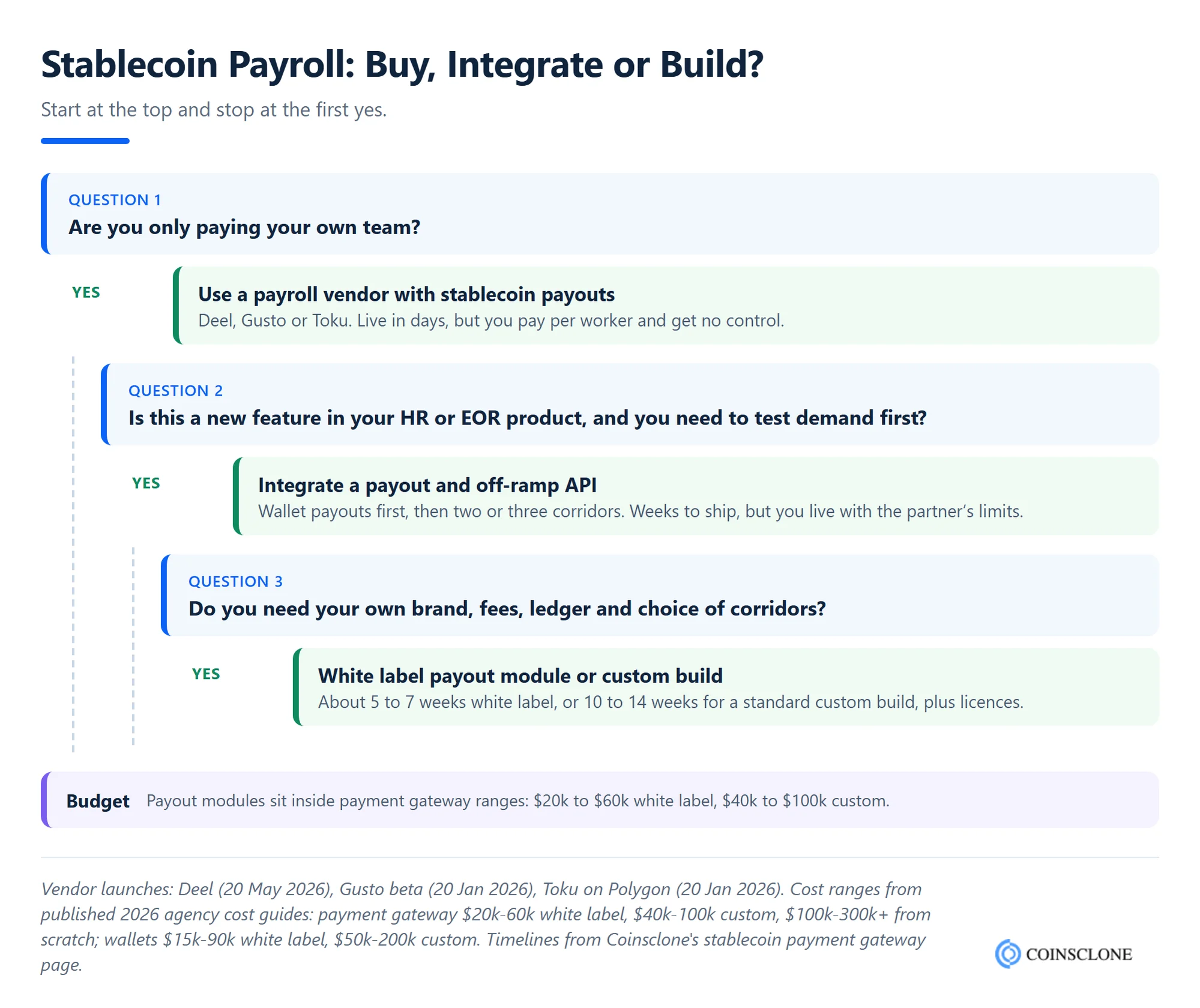
| Route | Best for | Time to live | Trade-off |
| Use a payroll vendor | A company paying its own team | Days | No control, per-worker fees |
| Integrate a payout API | HR apps testing demand | Weeks | Partner’s corridors and branding limits |
| White label payout module | HR, EOR and fintech products | About 5 to 7 weeks | Customisation stays inside the product |
| Custom build | Large platforms with their own licences | About 10 to 14 weeks plus licences | Most cost and upkeep |
On cost, published 2026 agency cost guides put a payment gateway at $20,000 to $60,000 for white label, $40,000 to $100,000 for a custom build and $100,000 to $300,000 or more from scratch. A wallet build runs $15,000 to $90,000 white label, or $50,000 to $200,000 custom. A payout module sits inside those ranges. The final figure turns on chains, corridors and how much of the ledger you build.
Coinsclone builds this into its stablecoin payment gateway. It settles on Tron, Ethereum, Solana, Base and more, and can link off-ramps so workers get local money. It all runs under your brand. Its white label gateway can go live in about 5 to 7 weeks, and a standard custom build in about 10 to 14 weeks.
Risks and Mistakes to Avoid
- Cashing out on a retail exchange, then wiring: the r/SaaS founder did this, and contractors’ banks called them about the money. Use a business off-ramp with clear, labelled transfers.
- No currency in the contract: state whether pay is set in dollars, euros or USDC, and who carries rate risk.
- Depeg risk: in March 2023, $3.3 billion of USDC reserves sat at Silicon Valley Bank, and the coin briefly fell to about $0.87. Keep only a short float and convert on a set schedule.
- Picking an unlicensed coin: under the GENIUS Act, US platforms may not offer coins from issuers without a licence from 18 July 2028. The Act also bars issuers from paying interest to holders.
- Bad bank details: off-ramp payouts fail when local bank formats are typed wrong. Check formats per country at sign-up.
- Lost keys: a worker who loses a self-custody wallet loses the pay. Embedded wallets with recovery remove most of this risk.
How to Launch Stablecoin Payouts: Steps and Partner Checklist
- Measure demand: count workers asking, by country, and how much of their pay they want in stablecoins.
- Get legal sign-off by country: confirm wage rules for employees and contract terms for contractors.
- Choose coin and chains: USDC for most markets, EURC for euro pay, and one or two chains your partners support.
- Pick partners: an on-ramp for funding, an off-ramp per corridor and a wallet provider.
- Build the payout engine and ledger: batching, retries, address tests and fair value records.
- Pilot, then scale: run two pay cycles with 10 to 20 workers, reconcile, then add countries only where volume justifies it.
Before a scoping call, prepare: workers by country, the share who want stablecoins, current wire costs, your payroll system, target chains and any licences you hold. A partner can then scope the build in one or two sessions.
Coinsclone has been building since 2018, with 350+ platforms delivered for 200+ clients across 20 industries. A demo of a working payout flow is a good first step. Planning your own payroll coin instead? Read our guide on how to launch a stablecoin first.
Frequently Asked Questions
Is it legal to pay employees in crypto?
In many countries, yes, but with limits. In the US, minimum wage and overtime must be paid in cash or a check. So USDC can cover only pay above that, and only if the worker agrees. Germany requires wages in euros. Contractors can most often agree to any currency in the contract.
How do I withhold taxes on a stablecoin paycheck?
Work out gross pay and withholding in fiat, at the dollar or local value on payday. Pay the taxes through normal bank rails, then send only net pay in USDC. In the US, the full value still goes on Form W-2.
Can I pay international contractors in USDC without a local bank?
Yes. The contractor needs only a wallet address, and the USDC arrives in minutes. They still owe tax at home on the value received. US companies should collect a W-8BEN from non-US contractors.
Which stablecoin is best for payroll?
USDC is the usual choice. It runs on every major chain, and its issuer, Circle, holds an EU e-money licence, so EU firms can offer it. EURC suits pay set in euros. USDT is common on Tron in emerging markets, but EU crypto firms no longer offer it.
How long does stablecoin payroll take to settle?
The on-chain transfer settles in seconds to a few minutes on Base, Solana, Polygon or Ethereum. If the worker cashes out, the bank leg adds minutes to a few days, by country and partner.
Does Deel offer stablecoin payroll?
Yes. Deel launched stablecoin pay on 20 May 2026 for its EOR and global payroll clients. It covers staff in the US and the euro area first, with more markets planned. It is free for staff, who opt in once.
How do you account for stablecoin payroll?
Record each payout at its fiat value on the payment date, with the rate source, chain and transaction hash. Run payroll in fiat, so USDC is only the way you pay. One ledger entry per run, linked to the hashes, keeps the books ready for audit.
Do stablecoins pay interest?
Not from the issuer in the US or EU. The GENIUS Act bars licensed US issuers from paying holders interest, and MiCA has a similar ban. Some apps offer rewards on top, but a payroll float should not depend on them.