

In August 2026, the head of the OCC, Jonathan Gould, said the agency will have its final GENIUS Act rule out by November. That way it can start to process stablecoin licence requests in the new year. The law itself takes effect by 18 January 2027 at the latest. For any bank, fintech or exchange that wants its own dollar coin, the time to prepare is now.
This guide shows how to launch a stablecoin that meets the GENIUS Act. It covers the licence routes, reserve rules, key dates, tech stack and full cost, plus the EU, Hong Kong, Singapore and the UAE.
In this guide:
- Only licensed issuers may issue a payment stablecoin in the US: a bank unit, an OCC-approved nonbank, a state issuer under $10 billion, or a foreign issuer whose home rules pass a Treasury test.
- Reserves must be at least 1:1 in cash, bank deposits, short T-bills, overnight repo or government money funds. You post them each month, and an accounting firm checks them.
- No yield to holders: issuers cannot pay interest just for holding the coin, and the token must be able to freeze and block transfers.
- Regulators get 120 days to decide on a complete file. Plan 9 to 15 months from kickoff to a licensed launch.
- The build is the small part of the bill. Published 2026 agency cost guides put the software at about $25,000 to $250,000. The OCC has proposed a $5 million capital floor for new issuers.
How to Launch a Stablecoin in 2026: The Short Answer
To launch a stablecoin today, you need three things that work together: a licence, a reserve setup and a platform. Miss one and the coin cannot go live in the US.
- Define the use case: payments, payouts, treasury, card settlement or trading. This sets your chains, partners and volume.
- Pick your licence route: bank unit, OCC nonbank, state issuer or foreign issuer. The route sets your regulator and your capital.
- Set up the issuer company: a US firm (or a licensed foreign one) with a board, a compliance lead and written policies.
- Line up reserve partners: a custody bank, a reserve manager for T-bills and repo, and an audit firm for the monthly checks.
- Build the platform: token contracts, a mint and redeem portal, KYC and sanctions checks, and a reserve ledger.
- File the application: send your business plan, policies, reserve plan and tech details, then answer the regulator’s questions.
- Audit, test and launch: audit the contracts, run a pilot with a few clients, then open minting and add liquidity.
Run steps 4 and 5 while you wait on step 6. That overlap saves the most time.
What the GENIUS Act Requires From a Stablecoin Issuer
The GENIUS Act became law on 18 July 2025. It sets one national rulebook for “payment stablecoins”. These are tokens used to pay or settle, which the issuer must redeem for a fixed amount of money.
Who can issue
Under the Act, only a permitted payment stablecoin issuer may issue one in the US. It must be formed in the US and be one of three types:
- Bank unit: a subsidiary of an insured bank or credit union, approved by that bank’s own regulator.
- Federal issuer: a nonbank, an uninsured national bank or the US branch of a foreign bank, approved by the OCC.
- State issuer: a firm set up and approved under state law.
A fourth path exists for foreign issuers, covered below. Public companies outside finance, such as big tech or retail firms, face an extra bar. They need a unanimous vote of a federal review committee.
Reserves: what can back the coin
Every issuer must hold reserves of at least 1 to 1 against the coins in use. Section 4 of the Act limits them to a short list:
| Allowed reserve asset | Key condition |
| US cash and Federal Reserve balances | None |
| Demand deposits at insured banks | Within FDIC and NCUA limits |
| Treasury bills, notes or bonds | 93 days or less left to run |
| Repo and reverse repo | Overnight, backed by Treasuries |
| Government money market funds | Hold only the assets above |
| Tokenized forms of these assets | Must meet all laws that apply |
The issuer cannot pledge or reuse reserves, except in narrow cases such as meeting redemptions. Corporate bonds, long-dated Treasuries and crypto are out.
Monthly reports and checks
Each month, the issuer posts on its website how many coins are out and what the reserves hold. The report shows the mix, the average term and where each asset is kept. An outside audit firm then checks it every month. The CEO and CFO must also sign it off to the regulator, and a false sign-off is a crime.
Very large issuers, with more than $50 billion in coins, must also publish a yearly audit unless they already report to the SEC.
Redemption, yield and controls
- Redemption: publish a clear redemption policy and all fees in plain words, with 7 days’ notice before any fee change.
- No yield: do not pay holders interest or yield, in cash, tokens or anything else, just for holding or using the coin.
- Freeze and block: have the tech to block, freeze and reject transfers, and follow lawful orders.
- AML and sanctions: run a full anti-money laundering program, with customer ID checks and sanctions screening.
Which GENIUS Act Licence Route Fits You?
Your licence route sets who supervises you, how much capital you hold and how fast you can grow.
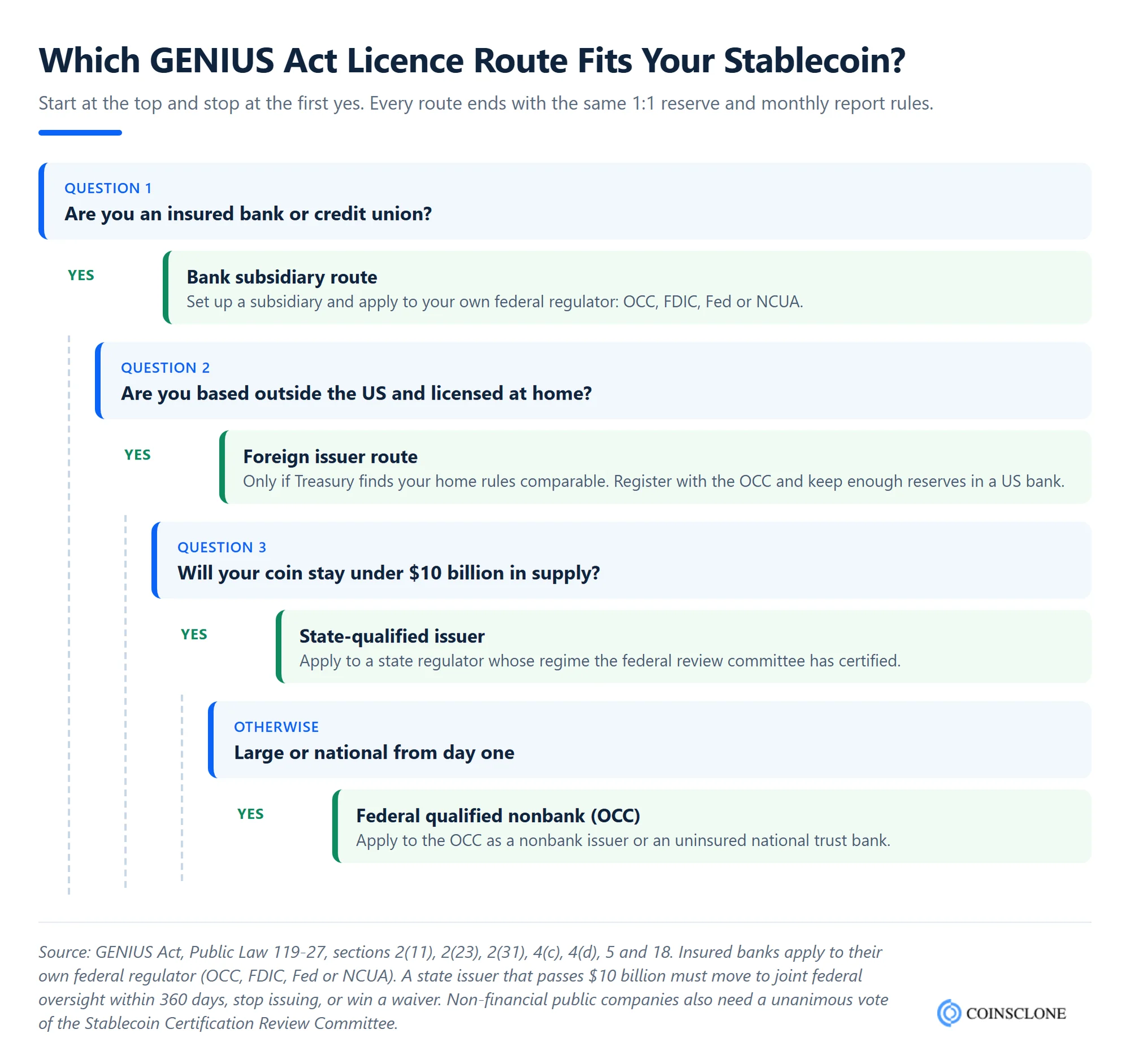
| Route | Who it suits | Regulator | Watch out for |
| Bank unit | Insured banks and credit unions | OCC, FDIC, Fed or NCUA | Parent bank capital rules |
| Federal nonbank | Fintechs, exchanges and payment firms going national | OCC | OCC capital and cash rules from day one |
| State issuer | Smaller issuers that expect under $10 billion | A state with an approved regime | Past $10 billion, move to federal oversight within 360 days or stop issuing |
| Foreign issuer | Issuers from a regime Treasury finds comparable | Home regulator, plus OCC registration | Must keep enough reserves in a US bank |
State route: it only works if the federal committee rules that the state’s regime is “substantially similar” to the federal one. Treasury proposed the test for that on 3 April 2026.
Foreign route: no such findings had been announced as of early October 2026, so this path is not open yet.
For most fintechs and exchanges, the real choice is OCC nonbank or state licence. Pick the state route to start small and close to home. Pick the OCC if you plan to pass $10 billion or serve the whole country from launch.
GENIUS Act Timeline: When Can You Actually Launch?
The Act told regulators to issue final rules by 18 July 2026. That date passed with the rules still in draft.
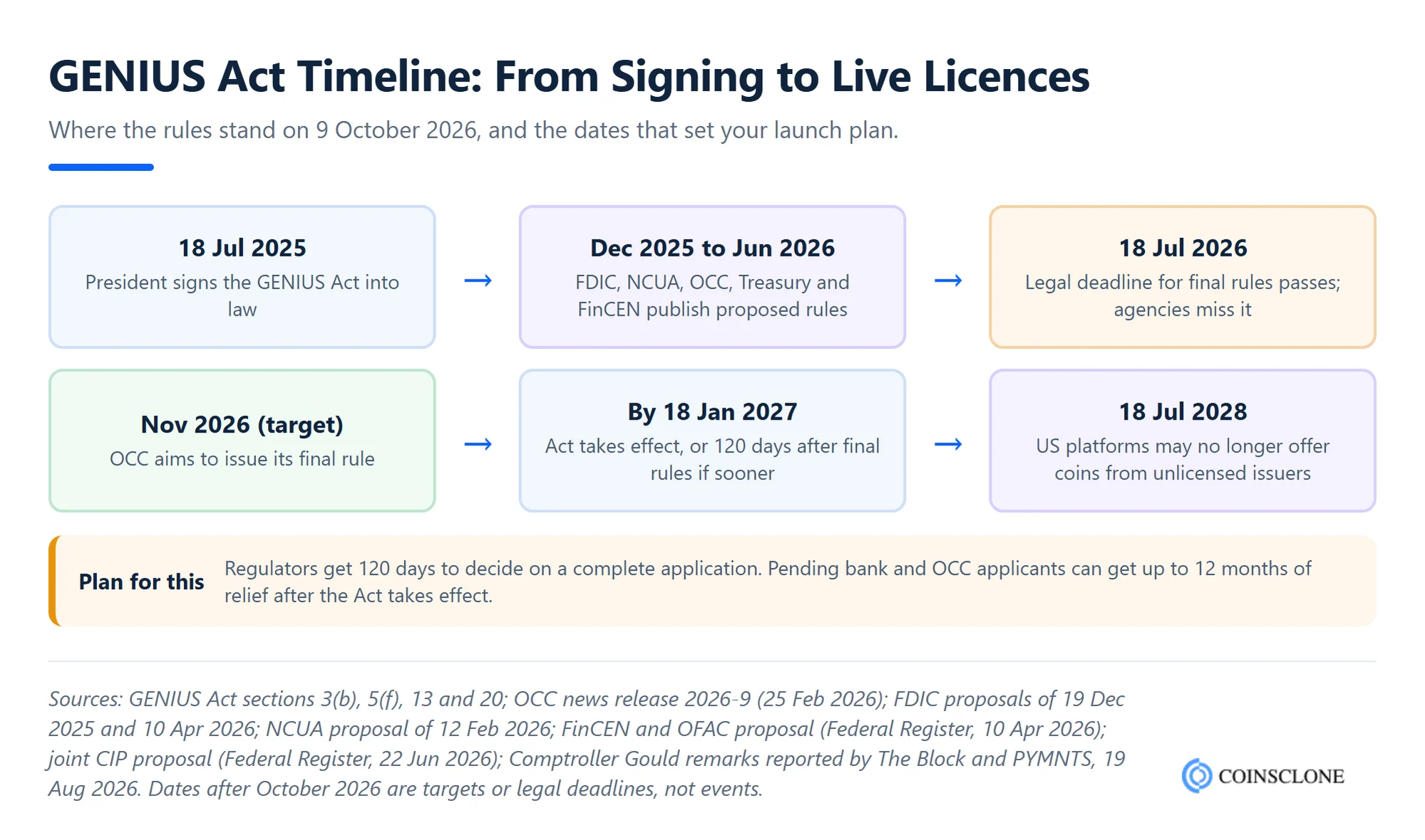
- Draft rules out: the FDIC, the NCUA and the OCC have all published drafts. The OCC released its draft on 25 February 2026.
- AML rules in draft: FinCEN and OFAC proposed AML and sanctions rules in April 2026. Five agencies then proposed a joint customer ID rule in June.
- Final OCC rule: due by November 2026, per Gould.
- Start date: the Act takes effect on 18 January 2027, or 120 days after final rules if that comes first.
- Decision clock: within 30 days, the regulator must say if your file is complete. It then has 120 days to decide.
- Grace period: banks and OCC applicants with a file still pending can get up to 12 months of relief after the start date.
- Hard stop: from 18 July 2028, US platforms may not offer coins from issuers without a licence.
A team that starts in late 2026 can be ready when the doors open. Allow 3 to 4 months to set up the firm and partners, 4 to 6 months for review, and 1 to 2 months for audit and a pilot.
Issuer Structure: The Partners You Need
An issuer is a small, regulated firm at the center of a ring of partners.
| Role | What they do | What the regulator checks |
| Issuer | Mints, redeems, owns the client | Capital, board, policies, staff |
| Custody banks | Hold cash and reserve accounts | Split from company funds, spread across banks |
| Reserve manager | Buys T-bills, runs overnight repo | Term, cash on hand, no reuse |
| Audit firm | Checks the monthly report | Must be a registered firm |
| Compliance tools | KYC, sanctions, monitoring | AML program, freeze power |
| Tech platform | Contracts, portal, ledger, APIs | Security, key control, logs |
Spread reserves across more than one bank. USDC showed why in March 2023. At the time, $3.3 billion of its reserves sat at Silicon Valley Bank, and the coin briefly fell to about $0.87.
Launching Outside the US: MiCA, Hong Kong, Singapore and the UAE
Outside the US, your home rules come first. Here are the main regimes as of October 2026.
| Market | Law | Who can issue | Key numbers |
| EU | MiCA, stablecoin rules live since 30 June 2024 | E-money tokens (EMTs): banks and e-money firms only. Asset-referenced tokens (ARTs): authorised issuers | No interest on either; at least 30% of EMT funds kept as bank deposits |
| Hong Kong | Stablecoins Ordinance, live since 1 August 2025 | HKMA-licensed issuers | HK$25 million paid-up capital for non-banks; first two licences (HSBC and Anchorpoint) on 10 April 2026, from 36 applicants |
| Singapore | MAS stablecoin framework (2023) | Non-bank issuers of SGD or G10 coins above S$5 million | S$1 million or half of yearly running costs, whichever is higher; redeem at par within 5 business days. The draft law was out for comment in September 2026 |
| UAE | CBUAE Payment Token Services Regulation (2024) | Dirham tokens: licensed UAE firms. Foreign-currency tokens: registered issuers | AED 15 million capital to issue dirham tokens |
Each regime has its own reserve and report rules, so build the platform to switch report formats by market. If you also run an exchange in Europe, see our guide to a MiCA-compliant crypto exchange.
The Tech Stack Behind a Compliant Stablecoin
Regulators check that your software can enforce your policies. Here is the daily loop your platform must run.
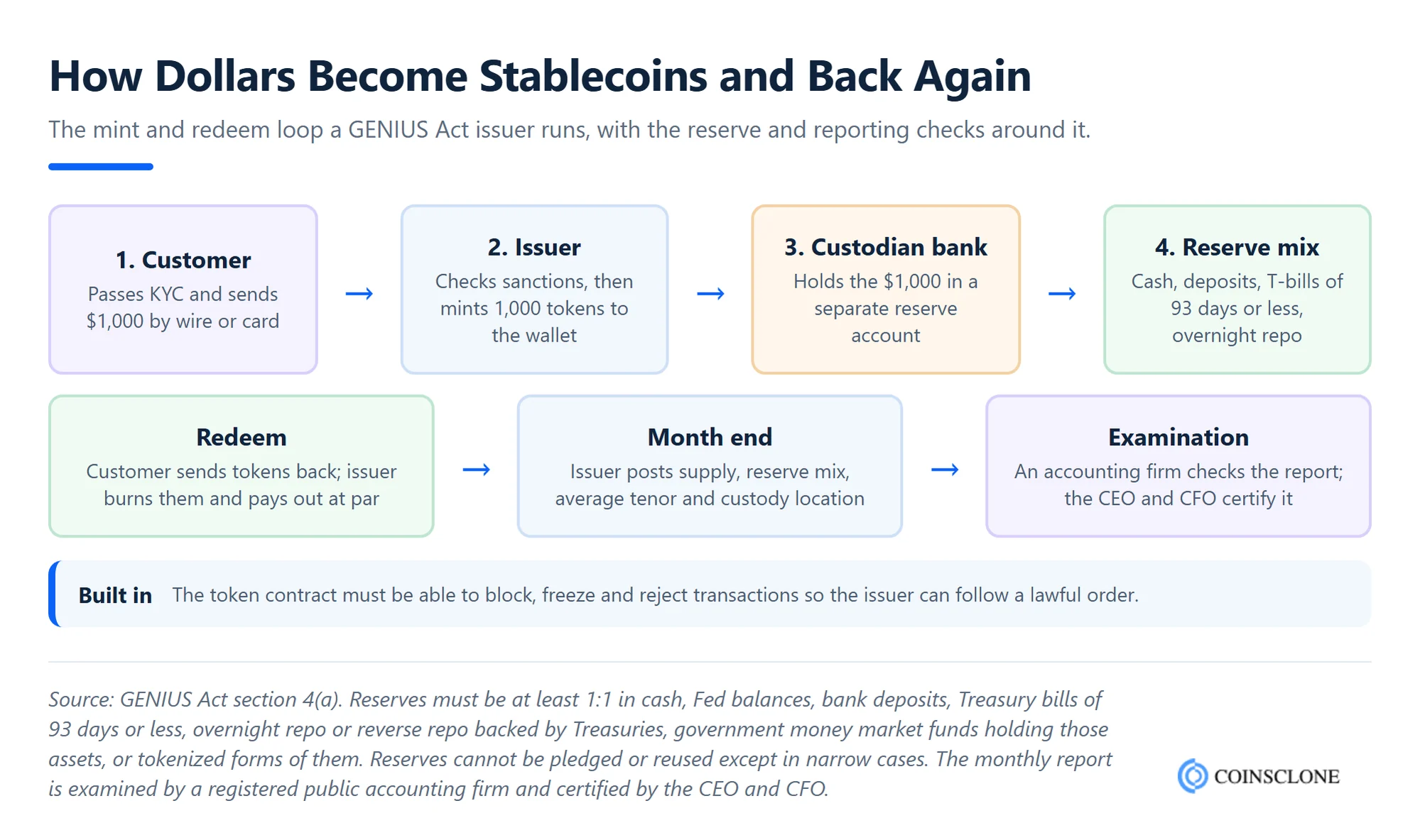
The stack breaks into six layers:
- Token contracts: mint and burn by role, mint caps, pause, freeze and blocklist, with upgrades behind a time lock and multisig.
- Mint and redeem portal: a client portal and API, bank wire funding, quick redemption at par, and fees that match your policy.
- Compliance layer: KYC and KYB, sanctions checks on every mint and redeem, wallet risk scores and alerts.
- Reserve ledger: a daily match of coins out against bank and custody balances, plus the monthly report.
- Key control: MPC or HSM signing for mint keys, with role splits so no single person can mint.
- Multi-chain reach: native issuance on each chain, a burn-and-mint bridge between them, and APIs for exchanges, wallets and stablecoin payment gateways.
If your goal is moving money across borders, our guide to stablecoin cross-border payments shows how payouts plug into this stack.
Coinsclone builds this full platform, from contracts and the mint and redeem portal to the reserve dashboard and compliance hooks. Our stablecoin development services page lists the features and build steps, with a basic build quoted at 6 to 8 weeks plus audit time.
Launch a GENIUS Act-Ready Stablecoin
Stablecoin Development — done right.
- Token contracts: mint and burn roles, mint caps, pause, freeze and blocklist controls, audited before launch.
- Mint and redeem portal: customer and API flows for bank funding, redemption at par and published fees.
- Reserve dashboard: daily match of supply against bank and custody balances, with monthly report exports.
- Compliance hooks: KYC, sanctions screening and transaction monitoring wired into every mint and redeem.
Get a white label stablecoin platform you can brand, extend and take to your regulator.
Book a Free Demo to see the mint, redeem and reserve flows working end to end.
Stablecoin Development Cost: What to Budget in 2026
So what does it really cost? Software is the smaller line. Capital, legal work and running costs are bigger.
| Cost line | Typical range | Basis |
| Platform build | About $25,000 to $250,000 | Published 2026 agency cost guides |
| Build plus licensing and custody setup | About $150,000 to $600,000+ | Published 2026 agency cost guides |
| Smart contract audit | About $10,000 to $40,000+ | Published 2026 agency cost guides |
| Each extra chain | About $20,000 to $60,000 | Published 2026 agency cost guides |
| Starting capital, OCC route | $5 million or the charter amount, if higher, for 3 years | OCC draft, February 2026 |
| Cash backstop, OCC route | 12 months of costs in cash or short T-bills | OCC draft, February 2026 |
| Starting capital elsewhere | HK$25 million, AED 15 million, S$1 million or more | HKMA, CBUAE, MAS |
| Running costs | Monthly audit checks, compliance staff, node and data fees | GENIUS Act, section 4 |
Note that the OCC figures are still a draft, and Gould said the agency changed it after comments. Capital is not spent, but you must raise it before you file.
How does an issuer earn it back? Mostly from interest on reserves, since holders cannot be paid. At an illustrative 4% reserve yield, $100 million in coins earns about $4 million a year before costs. That is why reach matters more than code: a coin no one holds earns nothing.
White Label, Stablecoin-as-a-Service or Your Own Licence?
Not every brand needs to become an issuer. There are three ways to put a coin in front of users.
| Option | How it works | Best for | Trade-off |
| Use an existing coin | Hold and move USDC or similar | Payouts and treasury | No reserve income, no brand |
| Stablecoin-as-a-service | A licensed issuer mints a branded coin for you | Brands that want speed | You share the income and rely on the issuer |
| Your own licence | You are the issuer, on white label or custom software | Banks, large fintechs, exchanges | Most cost and time, but full control and income |
A white label platform suits the third option: your own licence and brand, built on tested contracts and a ready portal.
Risks That Can Sink a Stablecoin Launch
Most failed launches do not fail on code. They fail on one of these:
- One-bank risk: spread cash and keep most reserves in short T-bills and repo.
- Slow payouts: runs start when people doubt they can get out, so test fast redemption under stress.
- Weak key control: a stolen mint key can create coins with no backing. Use mint caps and two-person rules.
- Hidden yield: paying holders just to hold breaks the Act. Get legal sign-off on any rewards plan.
- Rule changes: final rules may differ from the drafts, so make limits and reports settings, not hard code.
How to Choose a Partner and Prepare for a Scoping Call
The right partner shortens your path to a filed application. Ask any partner:
- Track record: what live token and payment platforms have they shipped, and can you see a demo?
- Compliance by design: can the contracts freeze, block and cap mints out of the box? Is there a reserve ledger?
- Security: who audits the contracts, and how are mint keys kept safe?
- Bank links: have they wired real bank APIs, and can they work with more than one custody bank?
- Code ownership: do you get the source code and the right to change it?
Before the call, write a one-page brief: use case, markets, licence route, year-one supply, chains, partners and launch date. A partner can then scope and quote in one or two sessions.
Coinsclone has been building since 2018, with 350+ platforms delivered for 200+ clients across 20 industries. If you plan to become a GENIUS Act issuer, a scoping call is a good first step.
Frequently Asked Questions
Do I need a license to launch a stablecoin in the US?
Yes, for a payment stablecoin. Under the GENIUS Act, only a permitted issuer may issue one: a bank unit, an OCC-approved federal issuer, or a state issuer. Foreign issuers need home rules that Treasury finds comparable, plus OCC registration.
When does the GENIUS Act take effect?
It takes effect on 18 January 2027, or 120 days after regulators issue final rules if that is sooner. The OCC said in August 2026 that it plans to finish its rule by November and process applications in the new year.
How much does it cost to create a stablecoin?
Published 2026 agency cost guides put the platform build at about $25,000 to $250,000, or $150,000 to $600,000 and up with licensing and custody setup. On top of that sits capital. The OCC has proposed at least $5 million for new issuers in their first three years.
How long does it take to launch a stablecoin?
A basic build can take 6 to 8 weeks, plus audit time. A licensed launch takes longer, because regulators have up to 120 days to decide on a complete file. Most issuers should plan 9 to 15 months from kickoff.
What assets can back a GENIUS Act stablecoin?
Cash, Federal Reserve balances, insured bank deposits, Treasury bills with 93 days or less to run, overnight repo backed by Treasuries, and government money funds that hold those assets. Tokenized forms of these also count. Reserves must be at least 1:1 and cannot be reused.
Can stablecoin issuers pay interest to holders?
No. The GENIUS Act bars issuers from paying any interest or yield, in cash, tokens or other value, just for holding or using the coin. MiCA has a similar ban in the EU.
Can a foreign company issue a stablecoin in the US?
Yes, but only through the foreign issuer route. Treasury must find its home rules comparable. It must also register with the OCC, keep enough reserves in a US bank for US clients, and be able to follow lawful US orders.