
In 2025, stablecoin payment volume doubled to about $400 billion, according to Stripe’s annual letter, and around 60% of it was business-to-business. Stripe, PayPal and Shopify now all let merchants accept stablecoins, and the total stablecoin supply passed $313 billion in September 2026.
For payment companies, fintechs and platforms, the math is hard to ignore. Accepting a $100 card payment in the US costs a merchant about $3.20 on standard pricing. Moving $100 of USDC on Base costs a fraction of a cent in network fees.
This guide explains how a stablecoin payment gateway works: the checkout flow, which stablecoins and chains to support, fees compared with cards, the new rules, and what it takes to build or white label your own.
What Is a Stablecoin Payment Gateway?
A stablecoin payment gateway lets businesses accept payments in stablecoins such as USDC and USDT, and settle them either as stablecoins or as local currency. It works like a card payment gateway, but the money moves on a blockchain.
The gateway handles the hard parts:
- Creating a payment request or checkout page.
- Generating a unique deposit address for each payment.
- Watching the blockchain and confirming the payment.
- Screening wallets for sanctions and risk.
- Converting to fiat and paying out to the merchant, if wanted.
- Refunds, reports and accounting exports.
It differs from a general crypto payment gateway in one way: prices stay stable. The customer pays 100 USDC and the merchant receives 100 dollars of value, with no crypto price risk in between.
How Does a Stablecoin Payment Work?
Here is the flow at checkout, as documented by Stripe and similar gateways:
- The customer picks stablecoin payment at checkout.
- The gateway shows the amount, the token (such as USDC) and the network (such as Base or Solana).
- The customer pays from a wallet, by connecting it or scanning a QR code.
- The gateway confirms the payment on-chain. On Base or Solana this takes seconds.
- The merchant is credited, either in stablecoins or converted to local currency.
There are no card chargebacks. Stripe notes that stablecoin payments have no disputes, and refunds go back to the customer’s wallet as stablecoins.
Which Stablecoins and Blockchains Should a Gateway Support?
Stablecoins are spread across many chains, so chain choice decides who can pay you.
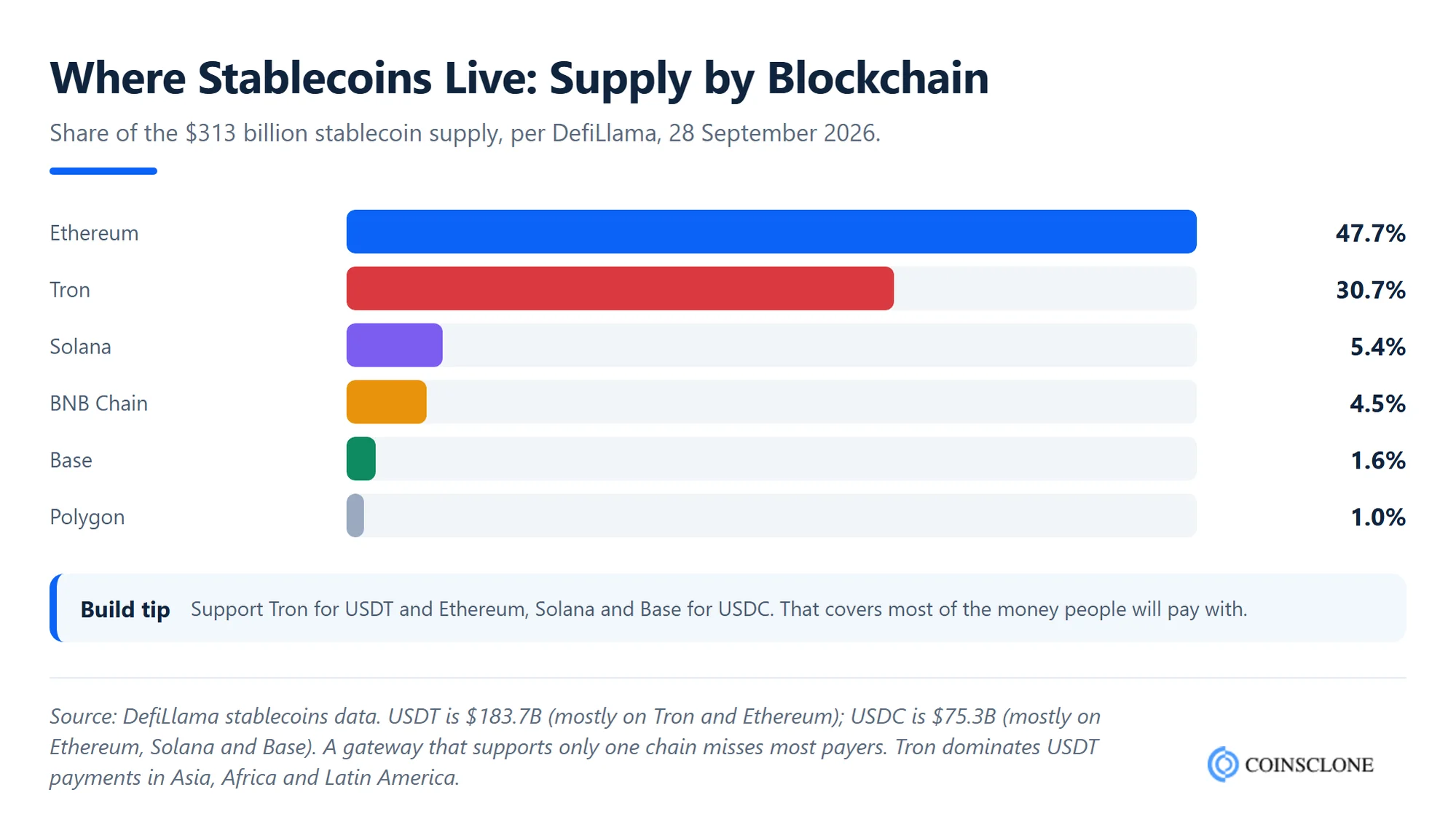
USDT is the largest stablecoin at about $184 billion, mostly on Tron and Ethereum. USDC is about $75 billion, mostly on Ethereum, Solana and Base. Each chain trades speed against cost:
| Chain | Fast confirmation | Typical USDC/USDT transfer cost (28 Sept 2026) |
| Solana | About 8 seconds | About $0.0006 (more if a new token account is needed) |
| Base | About 8 seconds | About $0.001 |
| Polygon | About 8 seconds | About $0.003 |
| Ethereum | About 20 seconds | About $0.03 median |
| Tron (USDT) | About 1 minute to final | Up to about $2 to $4 in burned TRX, or near zero with staked energy |
Confirmation times come from Circle’s developer docs; fees were measured on-chain. A practical starting set is USDC on Base, Solana and Ethereum, plus USDT on Tron for markets where USDT dominates.
Stablecoin Gateway vs Card Processing: What Does It Cost?
Here is what a merchant pays to accept a single $100 payment, by rail.
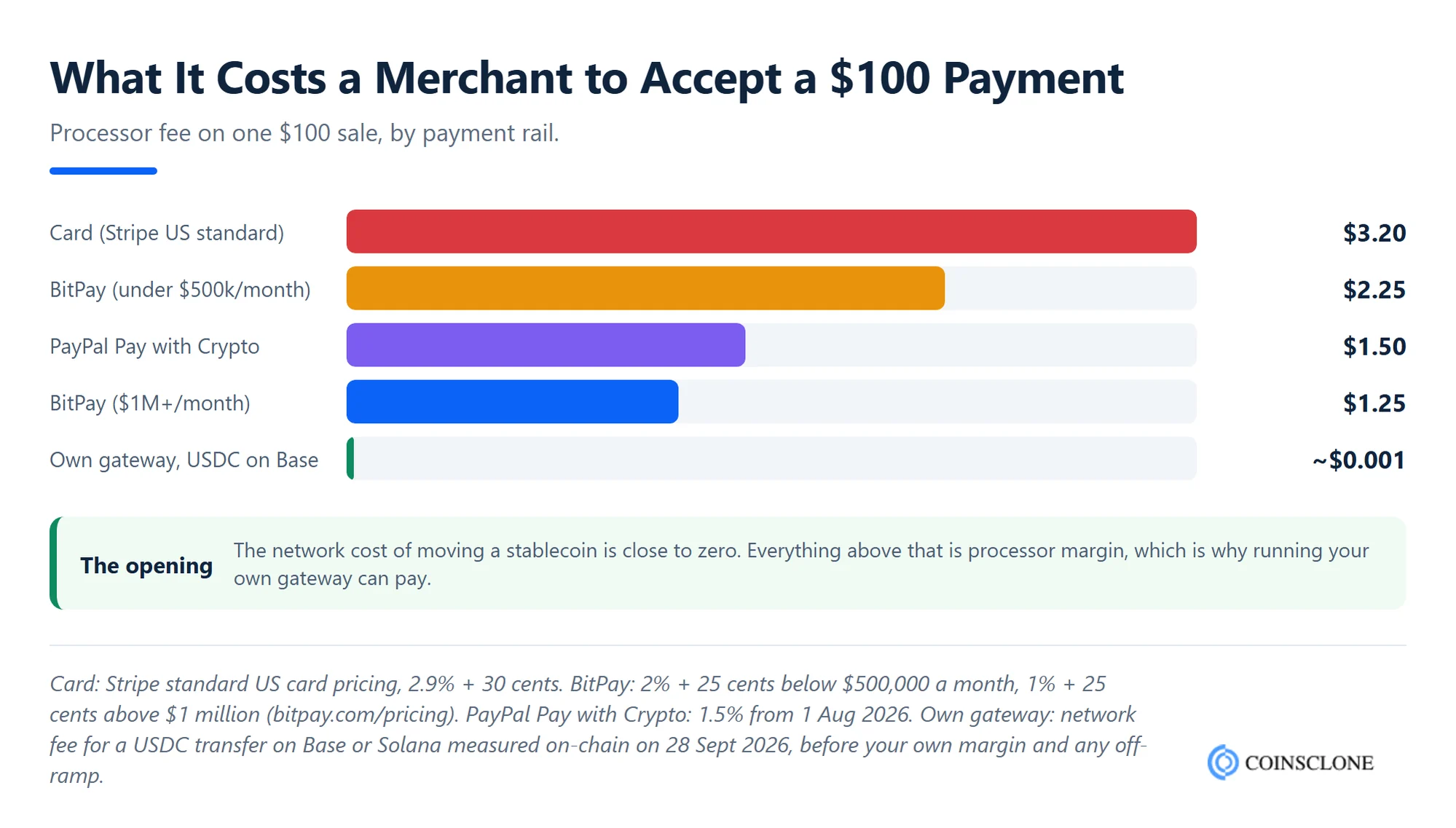
- Cards: about 2.9% + 30 cents on standard US pricing, plus the risk of chargebacks.
- BitPay: 2% + 25 cents below $500,000 a month, falling to 1% + 25 cents above $1 million, per its pricing page.
- PayPal Pay with Crypto: 1.5% from 1 August 2026.
- Your own gateway: the network fee is a fraction of a cent. Everything above that is margin you set yourself.
That gap is the business case. A payment company that runs its own stablecoin gateway can undercut cards, still earn a healthy margin, and settle faster.
What Rules Apply to Stablecoin Payments?
United States. The GENIUS Act, signed on 18 July 2025, sets rules for stablecoin issuers: 1:1 reserves in cash and short-term Treasuries, monthly reserve reports, and no interest paid to holders. It takes effect by 18 January 2027 at the latest. From July 2028, service providers may only offer stablecoins from permitted issuers. Gateways that hold or move customer funds also need money transmitter licences or a partner.
European Union. MiCA only allows compliant stablecoins. After ESMA’s guidance, exchanges such as Binance removed USDT for EEA users in March 2025, while Circle’s USDC has been MiCA-compliant since July 2024. An EU gateway should focus on USDC and euro stablecoins such as EURC.
UAE. Under the Central Bank’s payment token rules, merchants may accept only licensed dirham payment tokens for goods and services. Foreign stablecoins are limited to buying virtual assets.
Hong Kong. The Stablecoins Ordinance took effect in August 2025, and the first issuer licences went to HSBC and Anchorpoint in April 2026.
For licences to run the gateway itself, see our crypto license guide.
Launch Your Own Stablecoin Payment Gateway
Crypto Payment Gateway Development — done right.
- White Label Gateway: USDC and USDT checkout, invoices and payment links, ready to brand.
- Multi-Chain Settlement: Tron, Ethereum, Solana, Base and more, with automatic confirmation.
- Fiat Payouts: Optional off-ramp integrations so merchants settle in local currency.
- Revenue Engine: Earn from transaction fees, conversion spreads and payout fees.
Get a free branded demo of your stablecoin gateway in just 48 hours — before spending a single dollar.
Book a Free Demo to see how our white label gateway can take you from idea to live platform in as little as 5 – 7 weeks.
Who Uses Stablecoin Payment Gateways?
- E-commerce stores selling to buyers abroad, where cards fail often or cost more.
- Marketplaces and platforms that pay out to sellers and freelancers in many countries.
- SaaS and digital services billing global customers, including those without easy card access.
- Payment service providers adding stablecoins as a new payment method for their merchants.
- B2B suppliers and exporters invoicing large amounts where fast settlement matters. See our guide to stablecoin cross-border payments.
- Crypto businesses such as exchanges and wallets that collect fees or subscriptions in stablecoins.
Shopify shows how mainstream this has become. Since June 2025, its merchants in 34 countries can accept USDC on Base through Stripe and Coinbase, and receive local currency by default.
What Are the Risks of Stablecoin Payments?
- Depeg risk: stablecoins can briefly lose their peg. In March 2023, USDC fell to about $0.88 during the Silicon Valley Bank crisis before recovering within days. Gateways that convert to fiat quickly reduce this exposure.
- Wrong network: customers sometimes send the right coin on the wrong chain. Clear checkout screens and address checks prevent most losses.
- Chain issues: congestion or outages can delay confirmations. Supporting several chains keeps payments flowing.
- Compliance: payments from sanctioned or high-risk wallets must be screened and, if needed, blocked.
- Rule changes: stablecoin rules differ by country and keep moving, from the GENIUS Act to MiCA.
Build, White Label or Integrate?
There are three ways to offer stablecoin payments:
- Integrate a provider. Use Stripe, BitPay, PayPal or another processor. Fastest, but you pay their fees and follow their rules on countries and tokens.
- White label a gateway. Launch a ready-made stablecoin gateway under your brand, run it on your own servers and set your own fees. A white label crypto payment gateway can go live in weeks.
- Build from scratch. Full control, but the longest path, with wallets, chain monitoring, compliance and payouts to build and maintain.
For payment service providers, fintechs and platforms with their own merchants, white label is usually the best balance. You keep the margin and the merchant relationship without spending a year on core plumbing.
What Features Does a Stablecoin Payment Gateway Need?
- Checkout options: hosted checkout, payment links, invoices, QR codes and plugins for Shopify and WooCommerce.
- Multi-chain support: USDC and USDT across the main chains, with automatic confirmation.
- Settlement choice: keep stablecoins, or convert to local currency and pay out to a bank.
- Compliance: merchant KYB, wallet screening and Travel Rule support.
- Treasury tools: auto-sweeps to cold storage, balances by chain, and gas management.
- Refunds and reports: partial refunds, statements and accounting exports.
- Merchant dashboard and API: so merchants can track payments and integrate their systems.
Payouts to local currency need fiat rails. Our guide to crypto on-ramps and off-ramps explains the options.
How Much Does It Cost to Build a Stablecoin Payment Gateway?
Cost depends on your path and scope. The main blocks:
- Core gateway: checkout, address generation, chain monitoring and merchant dashboard.
- Chains and tokens: each extra chain adds integration and testing.
- Fiat payouts: off-ramp partners or your own banking rails.
- Compliance: KYB, sanctions screening and Travel Rule integrations.
- Licences: money transmitter licences, MiCA authorisation or a regulated partner.
- Security: audits, key management and monitoring.
A white label gateway cuts the core build from many months to weeks. Our white label gateway can go live in about 5 to 7 weeks, and a standard custom build in about 10 to 14 weeks. For a detailed budget, see our guide to the cost to develop a crypto payment gateway.
Frequently Asked Questions
What is a stablecoin payment gateway?
It is a service that lets businesses accept payments in stablecoins such as USDC and USDT, confirms them on the blockchain, and settles them as stablecoins or local currency.
How does a stablecoin payment work?
The customer chooses stablecoin payment, sends USDC or USDT from a wallet on a supported network, the gateway confirms it on-chain in seconds, and the merchant is credited.
Are stablecoin payments cheaper than cards?
Usually. Card processing costs about 2.9% + 30 cents on standard US pricing. Stablecoin processors charge 1% to 2%, and the raw network fee on chains such as Base or Solana is a fraction of a cent.
Which stablecoins should a gateway accept?
USDC and USDT cover most demand. Support USDC on Ethereum, Solana and Base, and USDT on Tron. In the EU, focus on MiCA-compliant coins such as USDC and EURC.
Do stablecoin payments have chargebacks?
No. Blockchain payments cannot be reversed by the payer’s bank. Refunds are sent back to the customer’s wallet by the merchant.
What is the GENIUS Act?
It is the US stablecoin law signed on 18 July 2025. It requires 1:1 reserves, monthly reserve reports and licensed issuers, and bans paying interest to holders. It takes effect by January 2027.
Can merchants receive local currency instead of stablecoins?
Yes. Most gateways can convert stablecoins to fiat and pay out to a bank account. Stripe, for example, settles stablecoin payments to the merchant’s balance in local currency.
How long does it take to build a stablecoin payment gateway?
A white label gateway can launch in about 5 to 7 weeks. A custom build takes longer, and fiat payouts or licences can add months.