
In June 2025, Stripe bought Privy, a wallet company powering more than 75 million accounts. In October 2025, Fireblocks bought Dynamic, with more than 50 million. That same month, Coinbase made its own embedded wallets generally available. The biggest names in payments and crypto are betting on one idea: wallet-as-a-service.
The idea is simple. Instead of asking users to install a crypto wallet and guard a seed phrase, your app creates a wallet for them in the background, often with just an email or social login. The user gets a wallet in seconds. You never touch the full private key.
This guide explains wallet-as-a-service: how it works, the three main security designs, the top providers and their prices, the custody rules that apply, and when it makes sense to build your own.
What Is Wallet-as-a-Service?
Wallet-as-a-service (WaaS) is a set of APIs and tools that let a business create and manage crypto wallets inside its own app. The provider handles key creation, storage, signing and recovery. The business controls the user experience.
WaaS is used by:
- Consumer apps and games that want users to hold tokens or NFTs without leaving the app.
- Fintechs and neobanks adding stablecoin balances and crypto features.
- Exchanges and brokers that need secure deposit and withdrawal wallets at scale.
- Payment platforms that give merchants and users wallets for stablecoin payments.
You will also see the terms embedded wallets (wallets built into an app, usually for end users) and programmable wallets (wallets controlled by code, often for business operations). Both usually run on WaaS.
How Does Wallet-as-a-Service Work?
A typical WaaS flow looks like this:
- The user signs in with email, phone, a social account or a passkey.
- The provider creates a wallet and protects the key with one of the designs below.
- The app requests actions such as sending tokens or signing a message, through the provider’s API.
- The provider signs after checking the user’s login and your app’s rules.
- The transaction goes on-chain, often with gas paid by the app so the user never needs a native coin.
MPC, Secure Enclaves or Smart Accounts?
Every WaaS provider protects keys with one of three designs, or a mix.
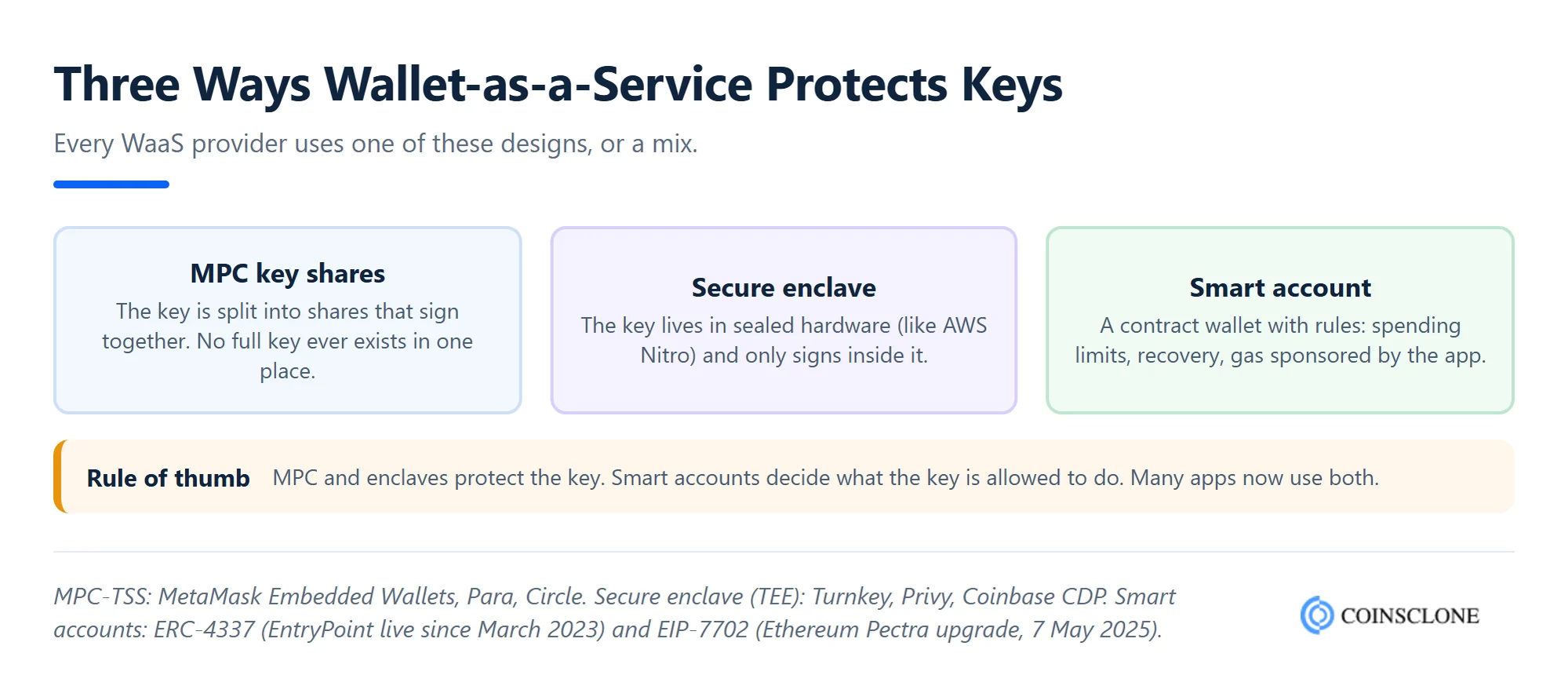
MPC key shares. Multi-party computation splits the key into shares held by different parties or devices. They sign together without ever rebuilding the full key. MetaMask Embedded Wallets, Para and Circle use MPC-based designs.
Secure enclaves. The key lives inside sealed hardware, such as AWS Nitro Enclaves, and signs only there. Turnkey, Privy and Coinbase’s developer platform use this approach.
Smart accounts. Instead of a plain key, the wallet is a smart contract with rules: spending limits, social recovery and gas paid by the app. ERC-4337 made this possible on Ethereum without a network change, and went live in March 2023. EIP-7702, part of Ethereum’s Pectra upgrade on 7 May 2025, lets normal wallets borrow smart account features.
Many apps now combine them: MPC or an enclave to guard the key, and a smart account to set what the key may do. For the build side of MPC, see our guide to MPC wallet development.
Custodial vs Non-Custodial WaaS
This choice matters for both users and regulators.
- Non-custodial (user-controlled): the user must approve each action, and the provider or app cannot move funds alone.
- Custodial (developer-controlled): your business holds or controls the keys and can move funds. Circle describes developer-controlled wallets as ones where “developers sign transactions and custody funds”.
The legal line follows control. In the US, FinCEN’s 2019 guidance treats hosted wallet providers as money transmitters, while users of unhosted wallets are not. In the EU, MiCA says providers of non-custodial wallet software fall outside its scope. If your app can move user funds on its own, plan for a licence. Our crypto license guide explains the options.
Who Are the Top Wallet-as-a-Service Providers?
| Provider | Owner or note | Security design | Published pricing (Sept 2026) |
| Privy | Stripe (since 2025) | Secure enclave + key shares | Free to 499 users; $299 to $499/month; enterprise custom |
| Dynamic | Fireblocks (since 2025) | Embedded wallets | Free to 1,000 users; $249/month + $0.05 per user |
| Turnkey | Independent | Secure enclave | $0.10 per signature after 25 free; plans from $99/month |
| Coinbase CDP | Coinbase | Secure enclave | $0.005 per wallet action; 5,000 free each month |
| MetaMask Embedded Wallets | Consensys (formerly Web3Auth) | MPC | Free to 1,000 wallets; $69 to $399/month |
| Para | Independent (formerly Capsule) | MPC | Free to 1,200 users; $200 to $1,000/month |
| thirdweb | Independent | Smart accounts | $0.015 per user after 1,000 free; plans from $99 |
| Circle Wallets | Circle | MPC | $0.012 to $0.050 per monthly wallet; 1,000 free |
| Fireblocks | Independent | MPC | Essentials $999/month; custom from $36,000/year |
Pricing comes from each provider’s own pricing page and changes often. Check before you sign.
How Much Does Wallet-as-a-Service Cost?
WaaS is priced per user, per wallet or per signature. At small scale it is cheap. Here is what 9,000 monthly active users would cost on published plans.
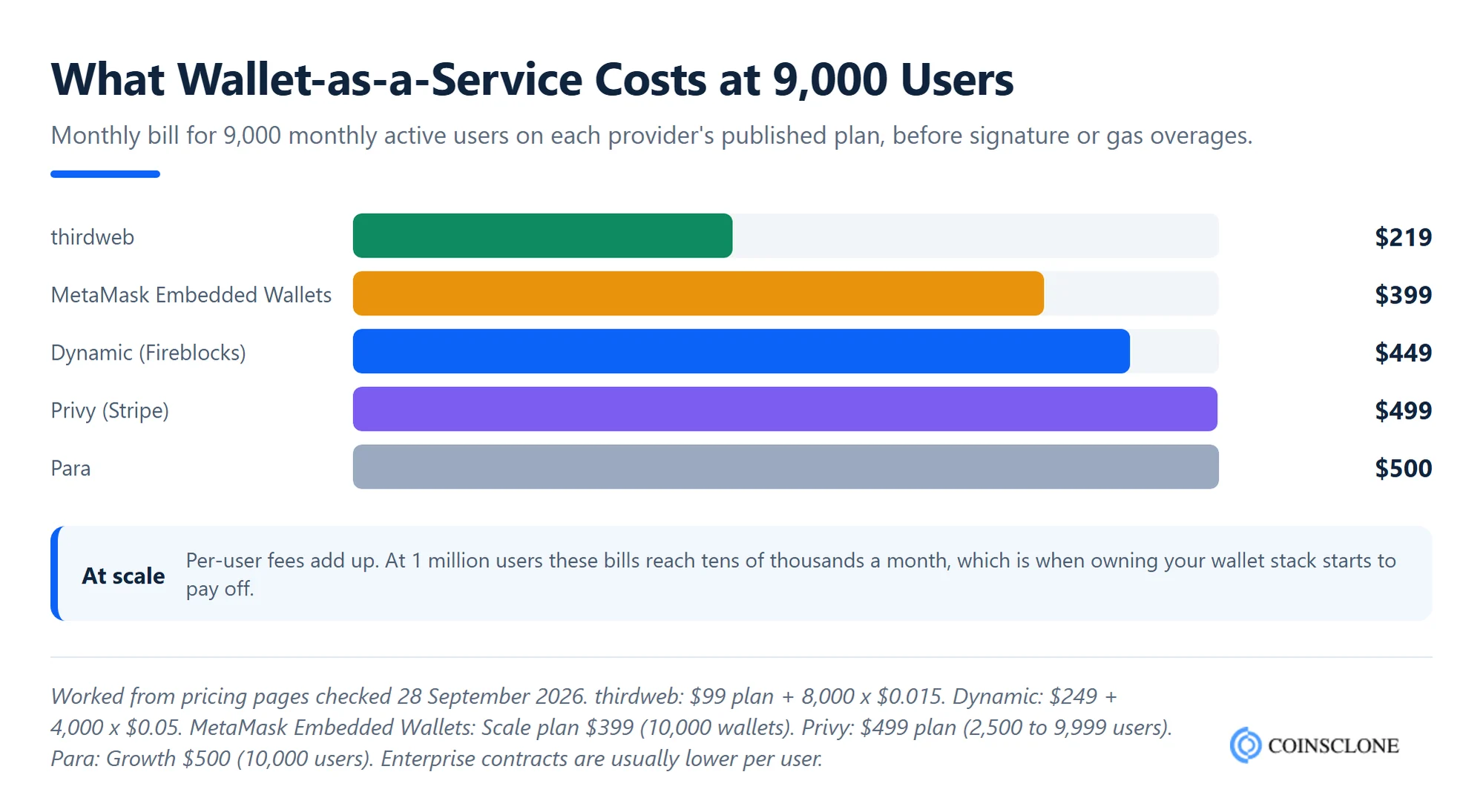
At 9,000 users, most bills land between about $200 and $500 a month. Now scale up. At $0.05 per user, one million monthly users costs $50,000 a month, or $600,000 a year, before signatures and gas. That is the point where many companies look at owning their wallet stack.
Launch Your Own Wallet Infrastructure
Crypto Wallet Development — done right.
- MPC Security: Split-key wallets with no single point of failure.
- Embedded Wallets: Email and social login wallets inside your own app.
- Multi-Chain: EVM chains, Solana, Bitcoin and more from one API.
- Your Brand: White label wallet apps and admin tools you fully own.
Get a free branded wallet demo in just 48 hours — before spending a single dollar.
Book a Free Demo to see how our white label wallet can go live in as little as 3 – 5 weeks.
What Can You Build With Wallet-as-a-Service?
WaaS turns wallets into a feature any app can add. Common uses:
- Stablecoin accounts: a fintech gives each user a USDC balance for savings, payouts or cross-border transfers.
- In-app payments: a marketplace or creator app lets users pay and get paid in stablecoins without leaving the app.
- Games and loyalty: players earn items, points or tokens that live in a wallet they never had to set up.
- Card programs: a wallet balance funds a crypto debit card. See our guide on how to launch a crypto card program.
- Treasury and payouts: a business uses developer-controlled wallets to pay suppliers, staff or users at scale.
- Exchange deposits: an exchange creates a deposit address for every user and sweeps funds into secure storage.
In each case, the user sees a normal app. The wallet works quietly in the background.
How to Add Wallet-as-a-Service to Your App in 6 Steps
- Pick the custody model. User-controlled or developer-controlled, and check what that means for licences.
- Choose chains and assets. Start with the chains your users need, such as Base, Solana or Ethereum, and the stablecoins you will support.
- Choose login methods. Email, phone, social logins or passkeys, plus a recovery path.
- Integrate the SDK. Create wallets at sign-up, show balances and add send and receive screens.
- Add gas sponsorship and limits. Pay gas for users where it makes sense, and set spending limits and alerts.
- Test and monitor. Test recovery, failed transactions and chain outages before launch, then watch costs as you grow.
Should You Buy WaaS or Build Your Own Wallet Stack?
Buy WaaS if:
- You are testing a product and need wallets in days.
- Your user numbers are small or uncertain.
- Wallets are a feature, not your core product.
Build your own if:
- You expect hundreds of thousands of users or more, where per-user fees add up.
- You need full control of keys, data and rules for compliance.
- Wallets are core to your business, as for an exchange, neobank or payment platform.
- You want to avoid being locked to one vendor, whose owner or prices may change.
A middle path is common: start on WaaS, keep your own user and transaction data, and move to your own wallet stack once volume justifies it. A white label crypto wallet can be your starting point for that move.
What Should You Check Before Choosing a WaaS Provider?
- Security design: MPC, enclave or smart account, and third-party audits.
- Custody model: user-controlled or developer-controlled, and what that means for your licences.
- Recovery: how users regain access if they lose a device or login.
- Chains supported: EVM chains, Solana, Bitcoin and any you plan to add.
- Export and exit: whether users can export keys, and how you would migrate away.
- Pricing at scale: the bill at 10 times and 100 times your current users.
- Ownership: Privy, Dynamic and Web3Auth all changed owners in 2025. Ask what happens if yours does.
Frequently Asked Questions
What is wallet-as-a-service?
Wallet-as-a-service is a set of APIs that lets a business create and manage crypto wallets inside its own app. The provider handles keys, signing and recovery, while the business controls the user experience.
What is an embedded wallet?
An embedded wallet is a crypto wallet built into an app, usually created when the user signs in with email or a social account. The user does not need a separate wallet app or seed phrase.
Is wallet-as-a-service custodial?
It can be either. User-controlled wallets need the user to approve each action and are non-custodial. Developer-controlled wallets let the business move funds, which is custodial and may need a licence.
What is the difference between MPC and smart accounts?
MPC protects the private key by splitting it into shares that sign together. A smart account is a contract wallet that sets rules on what can be signed, such as limits and recovery. Many apps use both.
How much does wallet-as-a-service cost?
Published plans range from free tiers to a few hundred dollars a month for about 10,000 users. Per-user fees such as $0.05 can reach $50,000 a month at one million users.
Who are the best wallet-as-a-service providers?
Leading providers in 2026 include Privy (Stripe), Dynamic (Fireblocks), Turnkey, Coinbase Developer Platform, MetaMask Embedded Wallets, Para, thirdweb, Circle Wallets and Fireblocks.
What is EIP-7702?
EIP-7702 is an Ethereum change, live since the Pectra upgrade on 7 May 2025, that lets normal wallets use smart account features such as batched actions and app-paid gas.
Should I build my own wallet infrastructure?
Build when wallets are core to your business, when you expect large user numbers, or when you need full control for compliance. Buy WaaS when you need to launch fast or are still testing demand.