

Only 2.2% of retail business-to-business payments across borders reach the receiver within an hour, according to the Financial Stability Board. Fewer than 4 in 10 arrive within one business day. The average cost of a small business payment is 1.6%.
Stablecoins move differently. A USDC transfer on Solana or Base confirms in seconds, on weekends and holidays, for a fraction of a cent in network fees. That is why stablecoin payment volume doubled in 2025 to about $400 billion, with around 60% of it business-to-business, according to Stripe.
This guide explains how stablecoin payments across borders work for firms: how they settle, what they really cost next to a bank wire, the three ways firms use them, who uses them now, the rules and risks, and how to start.
What Are Stablecoin Cross-Border Payments?
A stablecoin cross-border payment moves value between countries using a stablecoin, such as USDC or USDT, instead of the correspondent banking network.
The sender turns local money into a dollar or euro stablecoin, or pays from stablecoins it already holds. The stablecoin moves on a blockchain to the receiver. The receiver keeps it, or converts it into local currency.
Because the transfer runs on a public blockchain, it does not wait for bank hours, cut-off times or a chain of banks in between. It settles directly between the two wallets.
How Does Stablecoin Settlement Work?
A typical business payment has three legs:
- On-ramp (optional): the sender turns local currency into stablecoins through a bank, exchange or payment provider. Firms that already hold stablecoins skip this.
- Transfer: the stablecoin moves to the receiver’s wallet. On Solana, Base or Polygon this confirms in seconds; on Ethereum in about 20 seconds.
- Off-ramp (optional): the receiver converts stablecoins into local currency and pays it into a bank account, or keeps them for its own payments.
The middle leg is where stablecoins shine. The two ends, turning money in and out, decide most of the real cost.
How Fast Are Cross-Border Business Payments Today?
The G20 wants 75% of cross-border payments credited within an hour by 2027. Retail business payments are far from that target.
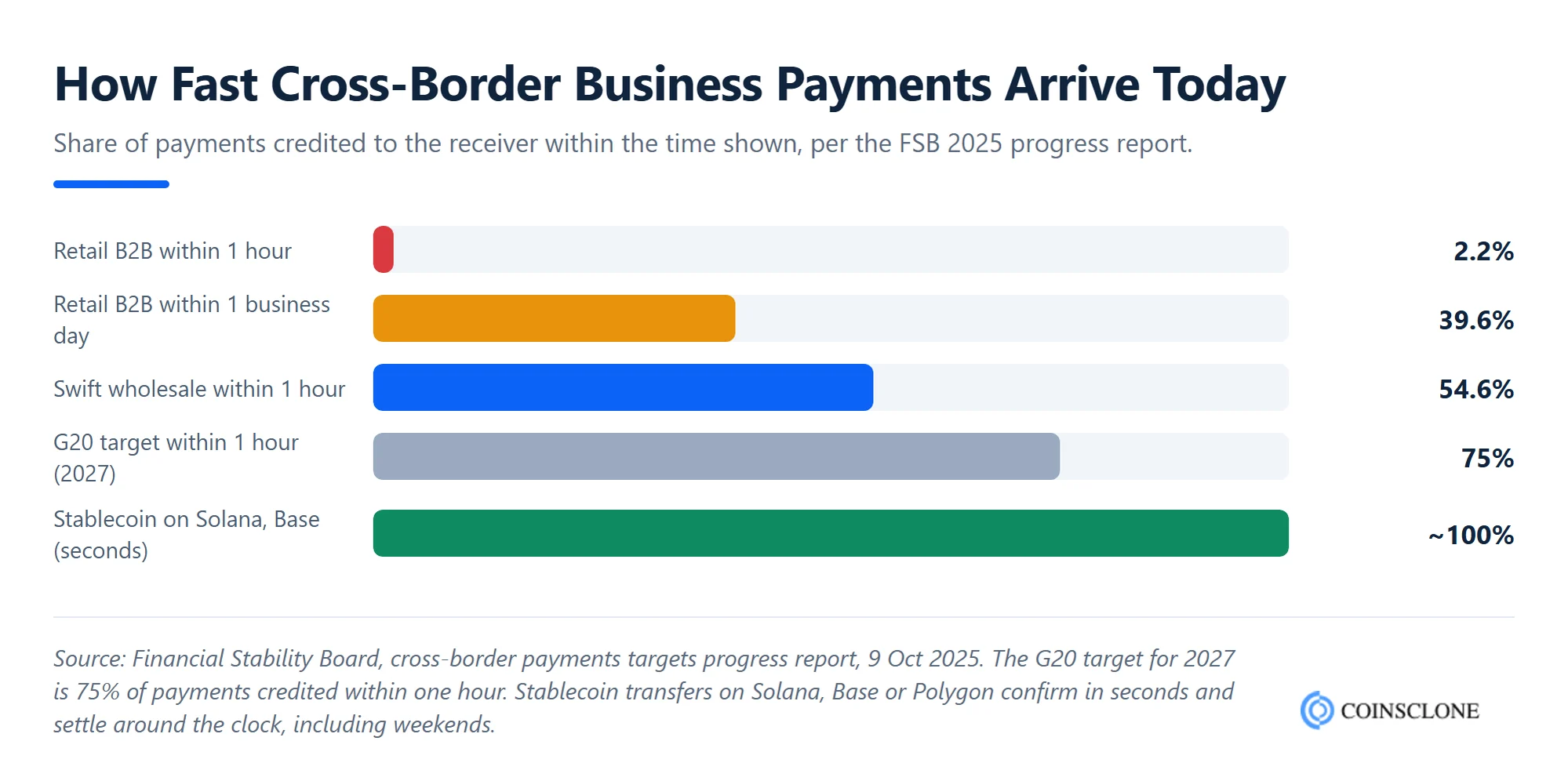
Large bank-to-bank payments over Swift do better, and more than half arrive within an hour. But small firms, which pay through normal bank accounts, often wait days. Stablecoins close that gap, because the transfer itself takes seconds at any hour.
What Does a Stablecoin Cross-Border Payment Really Cost?
Here is an honest comparison for a $50,000 payment.
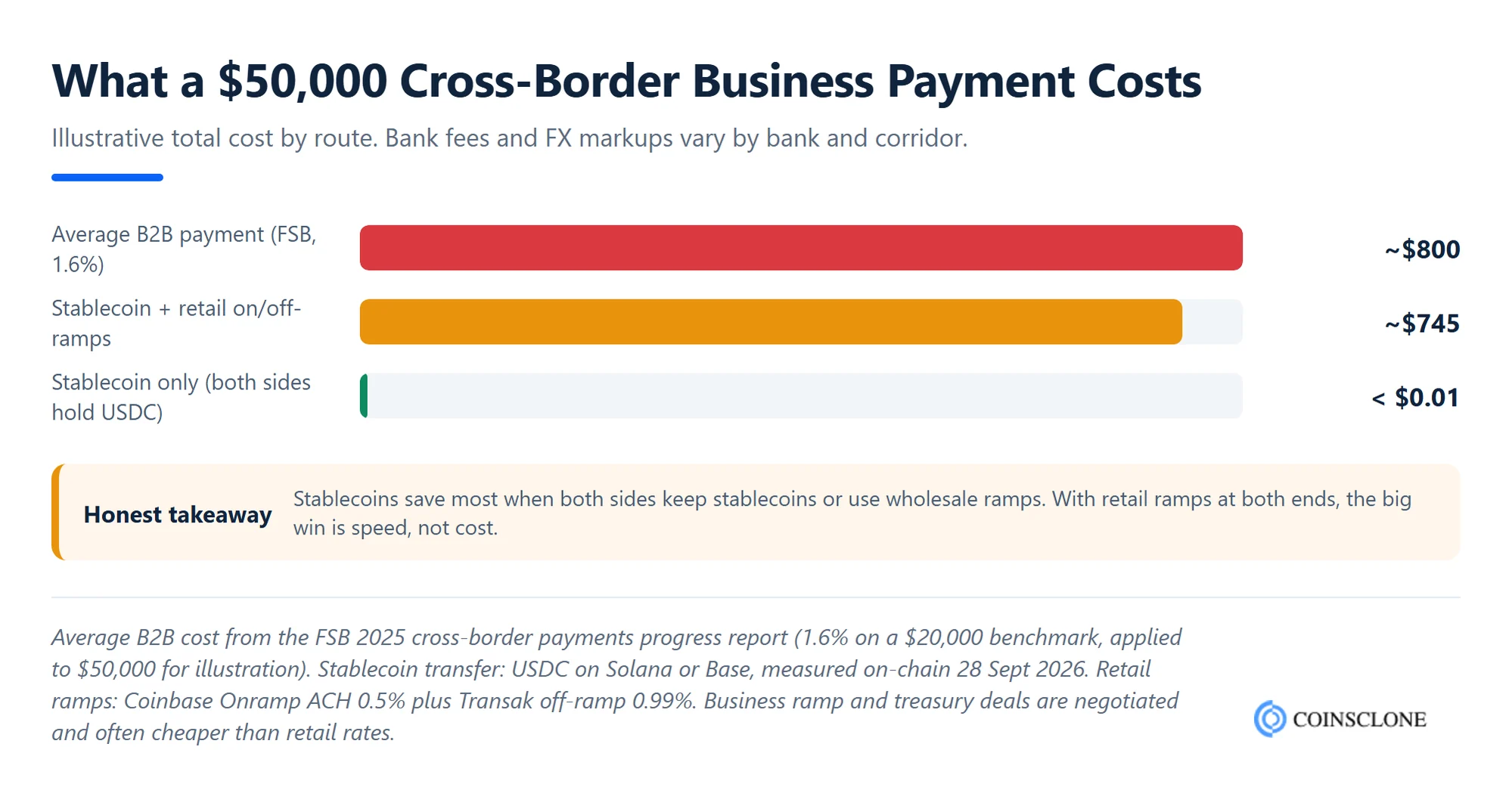
- Bank route: the FSB puts the average small business payment at 1.6% of the amount, about $800 on $50,000. A US bank such as Bank of America charges a $45 wire fee for USD transfers, but foreign-currency wires carry exchange rate markups instead.
- Stablecoin with retail ramps at both ends: 0.5% to buy and about 1% to sell adds up to roughly the same as a bank.
- Stablecoin with no conversion: if both sides keep stablecoins, the network fee is under a cent.
The lesson: stablecoins save the most when at least one side keeps them, or when a firm agrees bulk rates for turning money in and out. With retail ramps at both ends, the main gain is speed and weekend settlement, not cost.
Three Ways Businesses Use Stablecoin Payments
1. Wallet-to-wallet. Both companies hold stablecoin wallets and pay each other directly. Cheapest and fastest, but both sides need wallets, controls and accounting for digital assets. Stripe’s Stablecoin Financial Accounts, launched in May 2025 in 101 countries, let businesses hold USDC and send it across eight networks.
2. Processor in the middle. A payment provider handles wallets, compliance and conversion. The buyer may pay in dollars and the supplier may receive local currency, with stablecoins used only in between. Stripe, PayPal and Shopify use this model for merchants.
3. Your own payment rail. A fintech, payment company or marketplace builds its own stablecoin rail, with wallets, on-ramps and off-ramps in its main corridors. It keeps the margin and controls the experience. This is where a white label crypto payment gateway fits.
A fourth model is on the way: bank deposits turned into tokens. JPMorgan’s JPMD, a dollar deposit token on Base, went live for institutional clients in November 2025. It works like a stablecoin but is a claim on a bank.
Who Is Using Stablecoins for Business Payments?
- Stripe bought Bridge, a stablecoin infrastructure company, in February 2025, and by April 2026 offered stablecoin payouts to 160 countries.
- Circle’s payments network reached about $14.7 billion in annualised volume with 175 financial institutions enrolled, per its Q2 2026 results.
- JPMorgan launched its JPMD deposit token for institutional clients, with B2C2, Coinbase and Mastercard among the first users.
- Shopify merchants in 34 countries can accept USDC through Stripe and Coinbase.
- Artemis research found business-to-business stablecoin payments reached $6.4 billion a month by August 2025, ten times their level in December 2023.
Launch Your Own Stablecoin Payment Rail
Crypto Payment Gateway Development — done right.
- B2B Payments: Invoices, payouts and supplier payments in USDC and USDT.
- Multi-Chain: Low-fee settlement on Solana, Base, Tron and Ethereum.
- Fiat Rails: On-ramp and off-ramp integrations for local currency settlement.
- Compliance Ready: KYB, sanctions screening and Travel Rule support.
Get a free branded demo of your stablecoin payment platform in just 48 hours — before spending a single dollar.
Book a Free Demo to see how our white label gateway can take you from idea to live platform in as little as 5 – 7 weeks.
What Rules Apply to Stablecoin Cross-Border Payments?
- United States: the GENIUS Act, signed in July 2025, sets rules for stablecoin issuers, including 1:1 reserves and monthly disclosures. Payment providers moving customer funds still need money transmitter licences.
- European Union: crypto firms may only offer stablecoins that meet MiCA rules. USDT was removed for EEA users on major exchanges in 2025, so EU flows lean on USDC and euro stablecoins.
- UAE: merchants may accept only licensed dirham payment tokens for goods and services.
- Travel Rule: sender and receiver details must travel with transfers between regulated providers. See our guide to the crypto Travel Rule.
Firms also need to check who they pay, screen against sanctions lists and keep records for auditors and tax offices.
What Are the Risks?
- Depeg risk: in March 2023, USDC briefly fell to about $0.88 when Circle had funds stuck at Silicon Valley Bank, before recovering within days.
- Issuer risk: a stablecoin is only as strong as its reserves and its issuer.
- Off-ramp access: in some countries, turning stablecoins into local currency is hard or restricted.
- Operational mistakes: wrong addresses or wrong networks can mean lost funds. Allow-lists and test payments help.
- Rule differences: a coin allowed in one country may be restricted in another.
Good practice is to hold stablecoins only as long as needed, use regulated issuers, and set clear approval rules for every payment.
Questions to Ask a Stablecoin Payment Provider
Before you pick a provider or partner, get clear answers to these:
- Which corridors do you cover? Check both the sending and the receiving country, and the local payout methods.
- What does a payment really cost? Ask for the full price: on-ramp, transfer, off-ramp and any FX spread, on a real example amount.
- How fast is the payout to a bank? The transfer takes seconds, but the bank payout may not.
- Which stablecoins and chains? Make sure they match what your partners use.
- Who holds the funds? Know whether the provider holds your stablecoins, and what licences cover that.
- How do you handle compliance? KYB, sanctions checks and the Travel Rule should be built in.
- What reports do I get? You need records for accounting, audits and tax.
- What happens if a coin depegs? Ask how fast they convert, and what protections apply.
A provider that answers these clearly, with numbers, is usually one you can trust with real volume.
How to Start Using Stablecoins for Cross-Border Payments
- Pick one corridor. Start with a route where banks are slow or costly, such as payments to suppliers in emerging markets.
- Choose the model. Processor, wallet-to-wallet or your own rail.
- Select stablecoins and chains. USDC on Solana, Base or Ethereum works almost everywhere. USDT on Tron leads in parts of Asia, Africa and Latin America.
- Set up ramps. Line up on-ramps and off-ramps in both countries. Our guide to crypto on-ramps and off-ramps compares providers.
- Build controls. Safe wallets, sign-off rules, checks on who you pay, sanctions checks and bookkeeping.
- Run a pilot. Send real payments with a few trusted partners, then scale.
For payment firms that want to offer this to their own clients, our crypto payment gateway development team builds stablecoin rails with wallets, payouts and compliance built in.
Frequently Asked Questions
How do stablecoin cross-border payments work?
The sender pays in stablecoins, or converts local money into them. The stablecoin moves on a blockchain to the receiver in seconds, and the receiver keeps it or converts it into local currency.
Are stablecoin payments cheaper than SWIFT?
The transfer itself costs under a cent on chains such as Solana and Base. The total cost depends on converting money in and out. When at least one side keeps stablecoins, or gets bulk rates to turn money in and out, it is often much cheaper than the 1.6% average for small business payments.
How fast are stablecoin cross-border payments?
Transfers on Solana, Base or Polygon confirm in seconds, and settle at any hour, including weekends. By contrast, only 2.2% of retail B2B cross-border payments arrive within an hour today.
Which stablecoin is best for business payments?
USDC and USDT are the most used. USDC is MiCA-compliant and common in the US and EU. USDT dominates in many emerging markets, mostly on Tron.
Is it legal for businesses to pay in stablecoins?
In most countries, yes, with conditions. Rules differ: the US has the GENIUS Act, the EU requires MiCA-compliant coins, and the UAE limits which tokens merchants can accept.
What are the risks of stablecoin payments?
Depegs, issuer risk, limited off-ramps in some countries, sending mistakes and changing rules. Holding stablecoins only as long as needed and using regulated issuers reduces the risk.
How much B2B volume runs on stablecoins?
Stripe estimates stablecoin payment volume reached about $400 billion in 2025, with around 60% business-to-business. Artemis measured $6.4 billion a month in B2B stablecoin payments by August 2025.
Can a business build its own stablecoin payment rail?
Yes. With wallets, on-ramps and off-ramps in its main corridors, plus compliance tools, a payment firm or marketplace can run its own stablecoin rail and keep the margin.