
A security token is a digital share, bond or fund unit that lives on a blockchain and follows the same laws as the paper version. Firms sell these tokens through a security token offering, or STO, to raise money in a legal way. If you plan to run one, you need two things to go right: a legal route that fits your raise, and token software that enforces those rules on every transfer. That is where security token offering development services come in.
This guide first answers the plain question of what a security token is, with real examples and their sizes today. Then it shows how an STO works from start to finish, which legal route fits your raise in 2026, and what Coinsclone builds for you, from the token to the investor portal.
In this guide:
- A clear definition of a security token, and how it differs from a utility token and a crypto coin.
- Real security tokens in 2026, such as BlackRock’s BUIDL fund, and how big the market is.
- How an STO moves money and data from issuer to investor, in one diagram.
- Which US and EU rules fit your raise, with the real dollar limits.
- The STO services, script features and build timelines Coinsclone offers.
See How Our STO Development System Can Power Your Next-Gen Investment Platform
Security Token Offering Development — done right.
- MVP System:Launch your compliant STO platform 90% faster.
- Compliance-Ready:Built-in KYC/AML and investor verification modules.
- Tokenization Engine:Tokenize equity, real estate, or funds with ease.
- Investor Dashboard:Real-time analytics, payouts, and asset tracking.
- Revenue Engine:Earn from token sales, listings, and secondary trading.
See a free branded demo of your STO platform in 48 hours — before you invest a cent.
Book a Free Demo to discover how our Security Token Offering Development Services can take you from concept to live platform in just 2–4 weeks.
What Is a Security Token?
A security token is a blockchain token that stands for a share of a firm, a loan, a fund or some other asset, so the law treats it like a stock or bond. The holder gets real rights, such as a share of profits, interest, voting or a claim on the asset. So the issuer must register it with the watchdog or use a legal exemption. Investors must also pass checks before they can buy or sell it.
In the US, the test is the Howey test from a 1946 Supreme Court case. A token is a security when people put in money, into a common venture, and expect profits from the work of others. The SEC’s staff note on tokenized shares and bonds from 28 Jan 2026 made the core point plain: putting a security on a blockchain does not change what it is. The same rules apply on-chain and off-chain.
Think of the paper stock certificate. It was a token of ownership too. A security token does the same job, but the record sits on a ledger that settles in minutes, runs all day, and can split one asset into many small units.
A quick note on the other meaning: in IT, a “security token” is also the key fob or phone app that makes a login code for two-factor sign-in. That is a different thing. This guide covers the finance and crypto meaning.
What Is a Security Token Offering (STO)?
A security token offering is a sale of security tokens to raise money. It looks like a share sale or a bond issue, but the asset is issued as a token. Before launch, the issuer picks a legal route, onboards investors with KYC and AML checks, and mints tokens that only approved wallets can hold. After the sale, the tokens may trade on a licensed platform, such as a security token exchange or an alternative trading system.
STOs grew out of the 2017 and 2018 ICO boom. Many ICO tokens turned out to be stock-like sales with no filing, and the SEC acted. STOs fixed that by following securities law from day one.
Real Examples of Security Tokens in 2026
Security tokens are no longer a test. Big asset managers now run them at scale. The rwa.xyz market dashboard puts real-world assets on public chains at $38.55 billion on 2 Oct 2026, not counting stablecoins, held by more than 5 million wallets. Some of the largest are:
- BlackRock BUIDL: a tokenized US Treasury money fund issued with Securitize, launched in March 2024. About $2.2 billion.
- Circle USYC: a tokenized money market fund at about $2.4 billion.
- Ondo USDY: a tokenized note backed by short-term Treasuries, at about $2.3 billion (not offered to US persons).
- Franklin Templeton BENJI: shares of a US government money fund (FOBXX), recorded on public blockchains since 2021. About $668 million.
- Tokenized stocks: tokens that track listed shares such as Nvidia, now spreading under new SEC relief (see the rules section below).
The lesson for a new issuer is simple. Treasury funds, private credit and real estate lead today, and buyers already know how these tokens work. You can read more in our guides to real world asset tokenization and tokenized treasuries.
Security Token vs Utility Token vs Crypto Coin
People often mix these up, so here is the short version. A crypto coin is money for a network. A utility token is a ticket to use a product. A security token is an investment that carries legal rights.
| Point | Security token | Utility token | Crypto coin |
| What it gives you | Ownership, profit share, interest or a claim on an asset | Access to a product, service or feature | A way to pay and store value on its own network |
| Main law that applies | Securities law (SEC, MiFID II and similar) | Varies; MiCA in the EU | Varies; often commodity or payment rules |
| Who can buy | Checked investors only (KYC, sometimes accredited) | Usually anyone | Anyone |
| Transfers | Restricted by code to approved wallets | Free | Free |
| Typical example | BlackRock BUIDL, tokenized bonds | Exchange or gas tokens | Bitcoin |
The line can blur. A token sold as a “utility” can still be a security if buyers expect profit from the team’s work. That is why legal review comes before any code. If your token truly is a utility token, see our utility token development service instead.
How a Security Token Offering Works
An STO has more moving parts than a normal token sale. Money flows one way, and rules flow through every step. Here is the full path from the issuer to the investor.
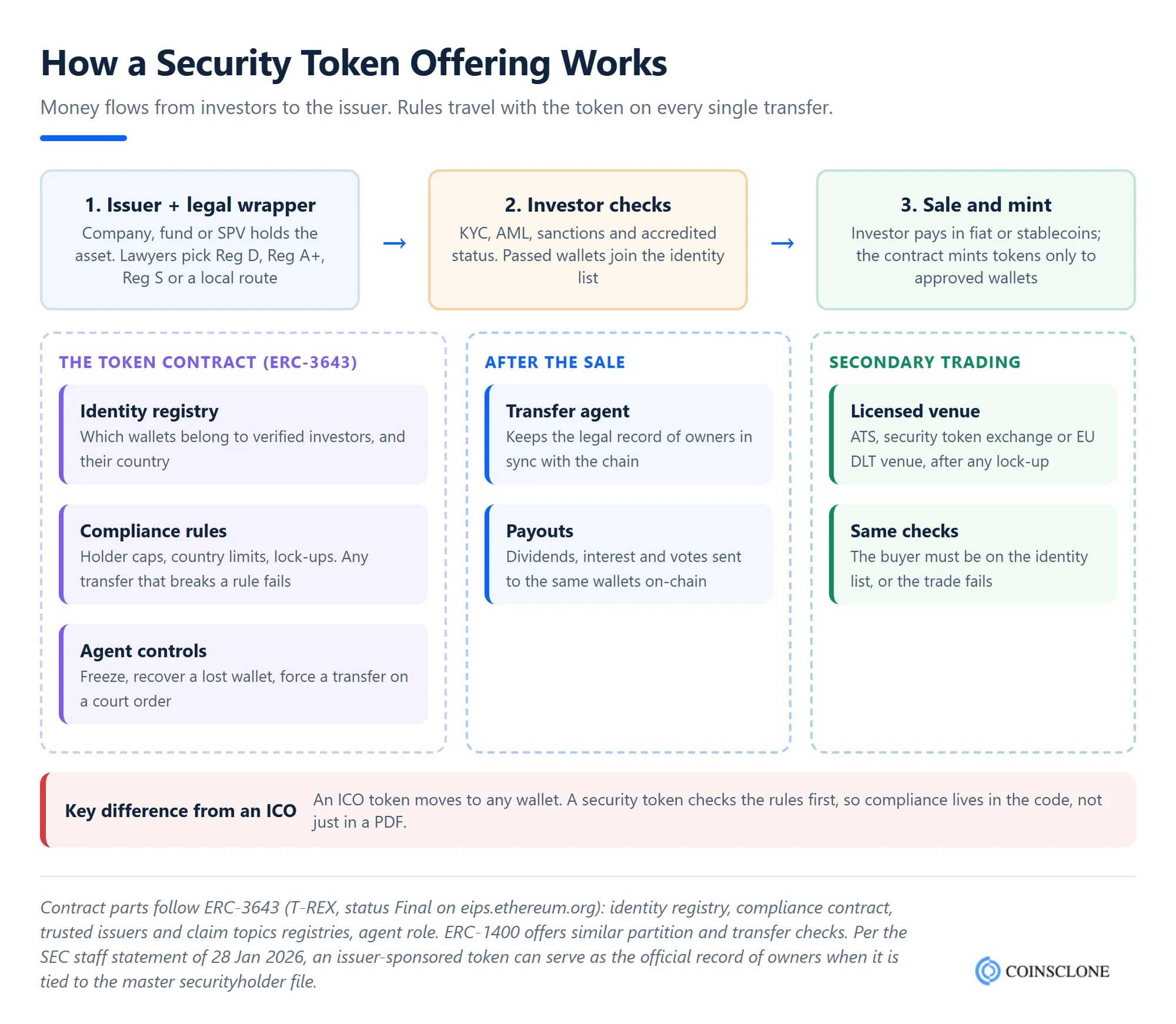
- Set up the asset and legal wrapper: the firm, fund or a special purpose vehicle (SPV) holds the asset. Lawyers pick the legal route and write the sale papers.
- Write the token rules into code: a compliant token contract, often ERC-3643 or ERC-1400, checks every transfer against an identity list and rule set, such as country limits or holding caps.
- Check the buyers: buyers pass KYC, AML and, where needed, wealth checks. Their wallet is then added to the allow list.
- Run the sale: investors pay in fiat or stablecoins, and the contract mints tokens to their wallets. The transfer agent updates the official record of owners.
- Manage the life of the token: pay dividends or interest on-chain, hold votes, handle lost wallets with forced transfers, and file reports.
- Open secondary trading: after any lock-up, tokens can trade on a licensed venue that checks the same rules.
For the full launch checklist, read our guide on how to launch a security token offering platform.
STO Rules in 2026: Which Legal Route Fits Your Raise?
Your legal route decides who can buy, how much you can raise, and when tokens can trade. So pick it first. The chart below walks through the common US routes, and the notes after it cover Europe.
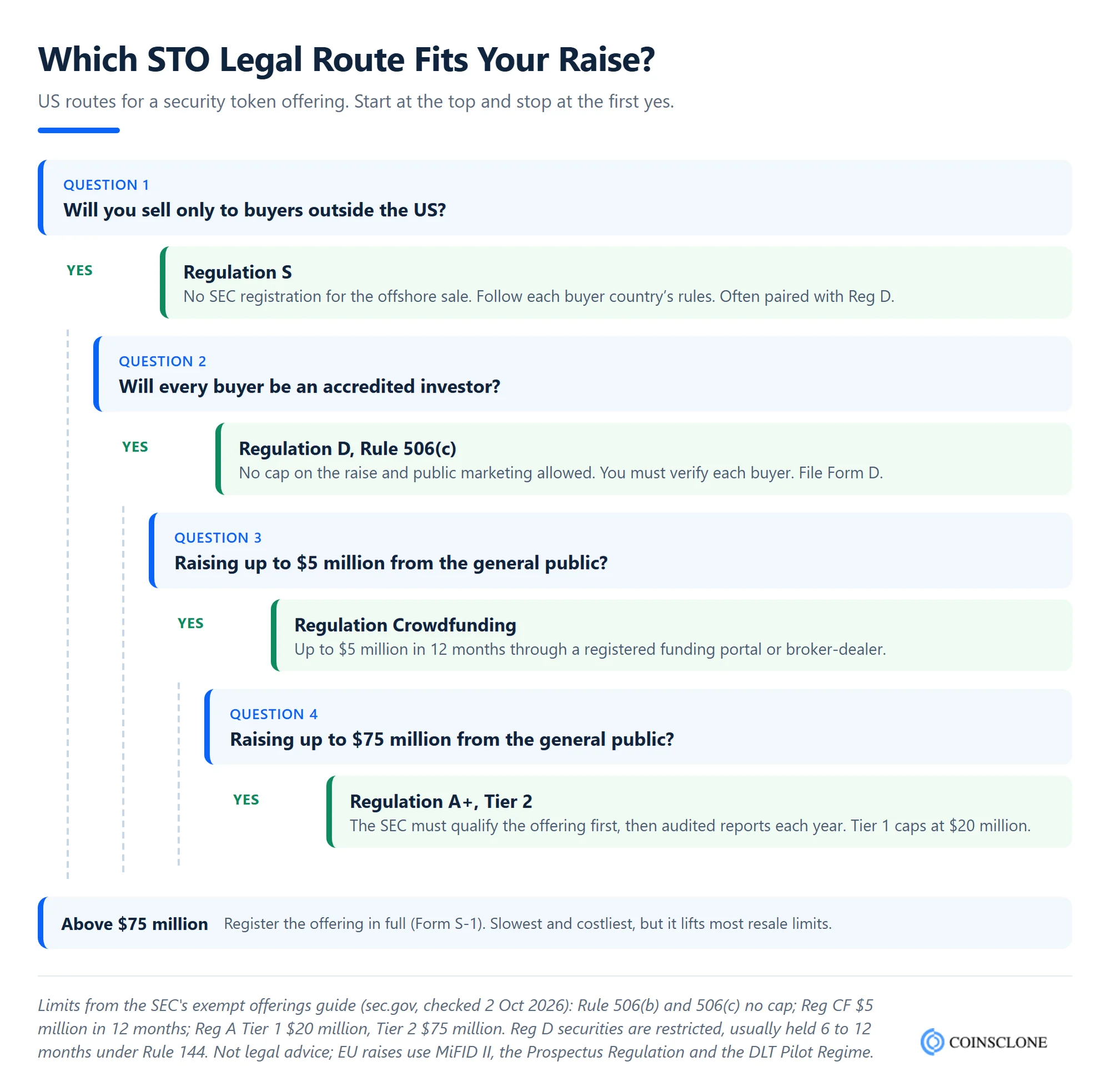
The main US options, per the SEC’s guide to exempt offerings, are:
- Reg D, Rule 506(c): no cap on the raise, but each buyer must be an accredited (high-income or wealthy) investor, and you must check that. You may market the offer in public.
- Reg D, Rule 506(b): no cap and no public ads. Up to 35 savvy buyers who are not accredited may join.
- Reg A (often called Reg A+): up to $20 million a year under Tier 1 and $75 million under Tier 2. Anyone can buy once the SEC clears the sale.
- Reg CF (crowdfunding): up to $5 million a year through a listed funding portal or broker.
- Reg S: for sales made outside the US to non-US buyers. Firms often pair it with Reg D.
- Full registration: an S-1 filing, as for a normal public listing. Costly, but it removes most resale limits.
Tokens sold under Reg D are “restricted,” so buyers usually hold them for six months to a year before resale under Rule 144. Plan your secondary market with that in mind.
What changed in 2026:
- January: SEC staff split on-chain shares into those the issuer puts out and those wrapped by third parties, and said the same rules apply to both.
- September: the SEC gave a five-year waiver that lets approved venues trade on-chain US stocks through pools with set trade caps, as this law firm note explains.
- Still pending: the CLARITY Act, which would split crypto duties between the SEC and the CFTC, passed the House in July 2025 but was not law as of Oct 2026. Security tokens stay with the SEC either way.
In Europe, security tokens count as shares, bonds and the like, so MiFID II and the prospectus rules apply, not MiCA. MiCA itself leaves these assets out in Article 2. The EU DLT Pilot Regime, live since 23 March 2023, lets licensed firms trade and settle tokenized shares and bonds on a blockchain. The UK, Switzerland, Singapore, Hong Kong and the UAE run their own regimes, so plan each target market. Our list of the top countries to launch RWA tokenization compares them.
This section is a general guide, not legal advice. Always work with a securities lawyer in each country where you sell.
Security Token Offering Development Services We Offer
These services cover all you need to create, sell and run security tokens on a blockchain, while meeting the rules above. Coinsclone builds this stack for firms that want to tokenize their assets and raise funds in a compliant way. We have built 350+ platforms for 200+ clients across 20 industries since 2018, and our team works with your lawyers from day one. Here is what we offer.
Asset Token Development
You can turn real assets, such as buildings, gold, art or invoices, into security tokens. Splitting an asset into small units opens it to more investors and can make it easier to sell.
Equity Token Development
A firm can issue its shares as security tokens. The token carries the same rights as the share, such as dividends and votes, while the on-chain record makes cap table updates and transfers faster.
Debt Token Development
We help firms tokenize loans, notes and bonds. The smart contract pays interest and returns the loan on a fixed timetable, so buyers know when they get paid.
Compliant Smart Contract Development
We write and test token contracts on standards built for securities, mainly ERC-3643 and ERC-1400. They hold the allow list, transfer rules, country limits, lock-ups, freezes and forced transfers that regulators expect. Our ERC-3643 token development team handles the identity side end to end.
Buyer Checks and Compliance Tools
We plug in KYC, AML, sanctions and wealth checks, so only cleared wallets can buy or receive tokens. Every check leaves an audit trail for your compliance team.
STO White Paper Creation
We write a clear, full guide to the money, tech and business side of your STO. It sits next to the legal papers your lawyers prepare.
STO Website Development
We design and build a clean, easy STO website that explains the offer and guides buyers to sign up.
Customizable STO Dashboards
We offer custom dashboards for both admins and investors. Admins track raises, buyers and payouts in real time, and buyers see their tokens, payouts and files in one place.
These are the main security token offering services we offer at Coinsclone. If you need just the token, our security token development service covers it. Many firms offer similar services, so what makes Coinsclone stand out? Here is why.
Why Choose Coinsclone for STO Development?
As shown above, an STO has many legal steps to get right. Your token must pass the Howey test review, and your raise must fit a route such as Reg D, Reg A+ or Reg S, or the rules of the country you sell in. So expert support makes a real difference.
In addition, many firms find it hard to fund token creation, a website and marketing all at once. Our answer is an all-in-one solution, the STO script. The STO script is a ready-made platform that holds the core parts of a launch. With it, you get an STO website, a whitepaper and an asset-backed token, ready to tweak. On top of that, the script includes these features.
Stunning Features of our STO Script
Features decide how investors feel about your platform. Clear tools build trust and help you reach more investors. That is why Coinsclone ships a feature-loaded script to every client, with matching admin and user dashboards for real-time tracking. The key features of our STO script are:
Admin Dashboard
- Automated KYC verification
- Whitepaper creation
- Transaction history
- Community management
- Detailed monitoring
- Investors management
- Token listing
User Dashboard
- Real-time statistics
- Current exchange rate
- KYC/AML solutions
- User-friendly interface
- Investors review
- Referral program
- Two-factor authentication
These are the core features that come with our STO script. You also gain several benefits by choosing our STO script.
Benefits of Choosing Our STO Script
Here are the main gains a firm gets from our STO script:
Fast Launch
The script is a ready-made platform, so you can launch an STO website quickly. Our STO script page quotes 2 to 4 weeks from idea to a live platform, against 8 to 12 weeks for a standard custom STO build.
Cost-effective
A script costs less than building from scratch, because the core platform is already built and tested. Your final price depends on design changes, the blockchain, the number of tokens, the countries you target and any extra modules.
High-end Security
The script comes with strong security features built in, such as two-factor login, KYC gates and audited smart contracts. These help block fraud and unauthorized transfers.
Customization
You can change the features, design and token rules to suit your firm, then launch your STO platform the way you want.
No Deep Technical Skills Needed
All the core features come with the script, so your team only needs to decide on changes. You do not need in-house blockchain experts to launch.
Increased Trust
The script ships with core and safety features, so buyers see a solid platform they can rely on. That builds trust in your offering from day one.
On top of these, you get full support from planning to launch.
How Long Does STO Development Take?
Time depends on how much you build and how many countries you sell in. These are the delivery windows Coinsclone publishes for each type of build:
| Build type | Typical timeline | Best for |
| STO script (white label) | 2 to 4 weeks | A fast, single-market raise |
| Standard custom STO | 8 to 12 weeks | One asset, one legal route |
| STO with distributions | 13 to 18 weeks | Dividends or interest paid on-chain |
| Multi-country STO | 5 to 8 months | Raises across several regimes |
| Full issuance platform | 8 to 14 months | Firms that will host many issuers |
Legal work runs in parallel. A Reg D raise can start soon after the papers are ready, while a Reg A+ Tier 2 offering waits for SEC qualification, which often takes months. The main cost drivers are the legal route, the number of countries, payout logic, wallet and custody setup, audits, and how many third-party KYC and payment tools you plug in.
Get Your Security Token Offering Script Now!
Cost-effective, White-Label Solution, Premium Features, Customizable. Live Demo Available.
Frequently Asked Questions
What is a security token in crypto?
A security token is a crypto token that stands for an investment, such as a share, a bond or a stake in a fund or property. It gives the holder legal rights like profit share or interest, so securities laws apply to it. Only checked investors can hold and trade it.
What is an example of a security token?
BlackRock’s BUIDL fund is one of the best-known examples. Each token is a share in a fund that holds US Treasury bills and cash, and it was worth about $2.2 billion in October 2026. Franklin Templeton’s BENJI and bank bonds on-chain are two more.
What are security token offerings?
It is a fundraise where a firm sells security tokens to buyers. It works like a share or bond sale, but the asset is issued on a blockchain. The issuer must register the sale or use an exemption such as Reg D, Reg A+ or Reg S.
What is the difference between a security token and a utility token?
A security token is an investment with legal rights, so securities laws apply. A utility token gives access to a product or service, such as paying fees on a platform. If buyers expect profit from the team’s work, even a “utility” token may count as a security.
Is XRP a security token?
No, not when it trades on exchanges. In July 2023, a US court ruled that XRP sold to the public on exchanges was not an investment contract, though Ripple’s direct sales to big buyers were. The SEC and Ripple dropped their appeals in August 2025, which ended the case.
Do security tokens need SEC approval?
The SEC does not approve tokens. In the US, the issuer must either register the offering or fit an exemption, such as Reg D or Reg CF. Reg A+ offerings do need the SEC to “qualify” them before sales start.
How long does it take to launch an STO?
With a ready-made STO script, the platform can be live in 2 to 4 weeks. A standard custom STO takes about 8 to 12 weeks, and multi-country raises take 5 to 8 months. Legal work, such as offering papers and filings, runs alongside the build.
Wrap Up
A security token brings stocks, bonds, funds and real assets onto a blockchain, with the same buyer safeguards as before. Done right, an STO lets you reach more investors, settle faster and pay out on-chain. Done wrong, it breaks securities law. So the right legal route and a token that enforces it are both a must.
Our STO services cover both the platform and the token, from a ready STO script to a fully custom issuance platform. If you would rather raise funds through a token sale that is not a security, we also offer a first-class ICO script.
Beyond STOs and ICOs, Coinsclone is a trusted crypto launchpad development company and offers clone scripts of popular crypto exchanges like Binance, Coinbase and Kraken. We also build NFT markets, crypto payment gateways, DEXs and more. Our developers are ready to help with any crypto project. Start your STO with Coinsclone and take your business to the next level.
See How Our STO Development System Can Power Your Next-Gen Investment Platform
Security Token Offering Development — done right.
- MVP System:Launch your compliant STO platform 90% faster.
- Compliance-Ready:Built-in KYC/AML and investor verification modules.
- Tokenization Engine:Tokenize equity, real estate, or funds with ease.
- Investor Dashboard:Real-time analytics, payouts, and asset tracking.
- Revenue Engine:Earn from token sales, listings, and secondary trading.
See a free branded demo of your STO platform in 48 hours — before you invest a cent.
Book a Free Demo to discover how our Security Token Offering Development Services can take you from concept to live platform in just 2–4 weeks.