
ERC-3643 token development is the work of building permissioned tokens for real-world assets, such as fund shares, bonds, property and private credit, on the ERC-3643 standard. ERC-3643, first known as T-REX, checks every transfer against an on-chain identity and a set of legal rules before tokens move. It has been a Final Ethereum standard since December 2023, and its backers say more than $32 billion of assets have been tokenized with it.
This guide explains how ERC-3643 works under the hood, where it is used today, and how it compares with ERC-1400 and the newer ERC-7943. It also walks through the build steps, the real 2026 cost and timeline ranges, and the risks to plan for, so you can scope your token before you talk to any team.
In this guide:
- Status check: ERC-3643 is Final, backed by 140+ institutions, and now heading for its own compliance chain, the T-REX Ledger.
- How it works: the token, identity registry, trusted issuers, claim topics and compliance contracts, and the order in which a transfer is checked.
- ERC-3643 vs ERC-1400 vs ERC-7943: a side-by-side table to help you pick a standard.
- Build plan: nine steps from legal setup to post-launch, plus the risks that trip up first-time issuers.
- Cost and time: sourced market ranges, from a white-label launch to a full custom platform.
Launch Compliant RWA Tokens Faster with ERC3643
Real World Asset Tokenization — done right.
- ERC3643 MVP Framework: Launch your compliant RWA token platform up to 90% faster.
- Built-in Compliance: Real estate, funds, equity, debt — fully customizable to your use case.
- Modular Infrastructure: Integrated smart contracts, wallets, and investor management — no heavy coding needed.
- Revenue Engine: Earn via issuance fees, transaction fees, and asset management services.
Get a free branded demo of your RWA token platform in 48 hours — before investing a cent.
Book a Free Demo and discover how our ERC3643 tokenization solution can take you from concept to compliant launch in just 2–4 weeks.
What Is ERC-3643 Token Development?
ERC-3643 is an Ethereum token standard for regulated assets. It keeps the familiar ERC-20 functions, so wallets and explorers can still read the token. On top of that, it adds identity checks, transfer rules and issuer controls, so only approved investors can ever hold the token.
The standard began as the T-REX protocol (Token for Regulated EXchanges), built by the Luxembourg firm Tokeny. Tokeny released the code as open source in 2023, and the non-profit ERC3643 Association now looks after it. Apex Group, a large fund services firm, bought a majority stake in Tokeny in May 2025.
So ERC-3643 token development means more than writing one smart contract. A full build usually covers:
- The token contract: an ERC-20 token with freeze, pause, forced transfer, recovery and batch functions.
- The ID layer: an ONCHAINID contract for each buyer, plus lists that link wallets to those IDs.
- The rule engine: compliance modules that hold country limits, investor caps and lock-up periods.
- The tools around it: an issuer dashboard, buyer sign-up with KYC, and reports for auditors and regulators.
ERC-3643 Status in 2026: Final Standard, Growing Adoption
Here is the plain picture as of 16 October 2026, checked on eips.ethereum.org and the backers’ own announcements.
| Date | Step |
| July 2021 | Proposal created by the Tokeny team |
| September 2023 | ABN AMRO issues a €5 million digital green bond on Polygon with ERC-3643, per Crowdfund Insider |
| 12 December 2023 | Moved to Final on Ethereum |
| March 2025 | DTCC joins the ERC3643 Association and adds ERC-3643 support to its ComposerX tools, per Ledger Insights |
| May 2025 | Apex Group buys a majority stake in Tokeny |
| March 2026 | T-REX Ledger, a compliance chain for ERC-3643 tokens, is unveiled with Polygon, per The Block |
| 7 July 2026 | OpenZeppelin and T-REX Network partner to add ERC-3643 to OpenZeppelin’s audited contracts library |
| Q4 2026 | T-REX Ledger mainnet expected; testnet is live, per Polygon (July 2026) |
So ERC-3643 is not a draft idea. It is the most used Final standard for regulated tokens on EVM chains. Here is what adoption looks like today:
- Assets: the ERC3643 Association says more than $32 billion of assets have been tokenized with it. This is the backers’ own figure.
- Backers: Polygon’s July 2026 case study says 140+ institutions support the standard. Association members include DTCC, Apex Group and Invesco.
- Apex Group: it has committed $100 billion of tokenized assets to the T-REX Ledger by June 2027 and will act as its first on-chain transfer agent.
- OpenZeppelin: a Stellar version is done, and an audited Solidity version is planned. That should make ERC-3643 as easy to import as ERC-20.
For context, tokenized real-world assets on public chains reached $38.55 billion on 2 October 2026, not counting stablecoins, per the rwa.xyz dashboard.
Why ERC-3643 Token Standards Matter for RWAs
As businesses move into real-world asset tokenization, one question comes up early: why use ERC-3643 instead of a plain token? The main reasons are these.
- Limits of ERC-20 and ERC-721: standard tokens move freely between any two wallets. They cannot check who is on either side, so they do not suit regulated assets.
- Need for rule-based tokens: securities need KYC, AML checks and buyer rules. ERC-3643 builds these checks into every transfer instead of relying on a spreadsheet.
- Role of ID: each buyer gets one on-chain ID. Once checked, the same ID works across all ERC-3643 tokens, which cuts repeat KYC.
- Liquidity and split ownership: costly assets can be split into small units, and the rules travel with each unit, so more people can join without breaking the law.
In short, ERC-3643 is more than a token format. It is the rule book and the gatekeeper for a regulated asset on chain.
How ERC-3643 Works: The Contracts Behind Every Token
ERC-3643 splits the job across a small set of linked contracts. Each one has a clear role, and the token calls them before any tokens move.
| Contract | What it does |
| Token | ERC-20 token with mint, burn, freeze, pause, forced transfer, wallet recovery and batch functions |
| Identity Registry | Links each wallet to an investor’s ONCHAINID and country code; answers “is this wallet verified?” |
| Identity Registry Storage | Holds the identity list, so several tokens can share the same approved investors |
| Trusted Issuers Registry | Lists the KYC firms and other parties allowed to sign investor claims |
| Claim Topics Registry | Lists the claims an investor must hold, such as KYC passed or accredited investor |
| Compliance | Holds the rule modules: country limits, holder caps, lock-ups and daily limits |
| Agent role | Names the wallets that may freeze, recover or force transfers on the issuer’s behalf |
How a Transfer Is Checked
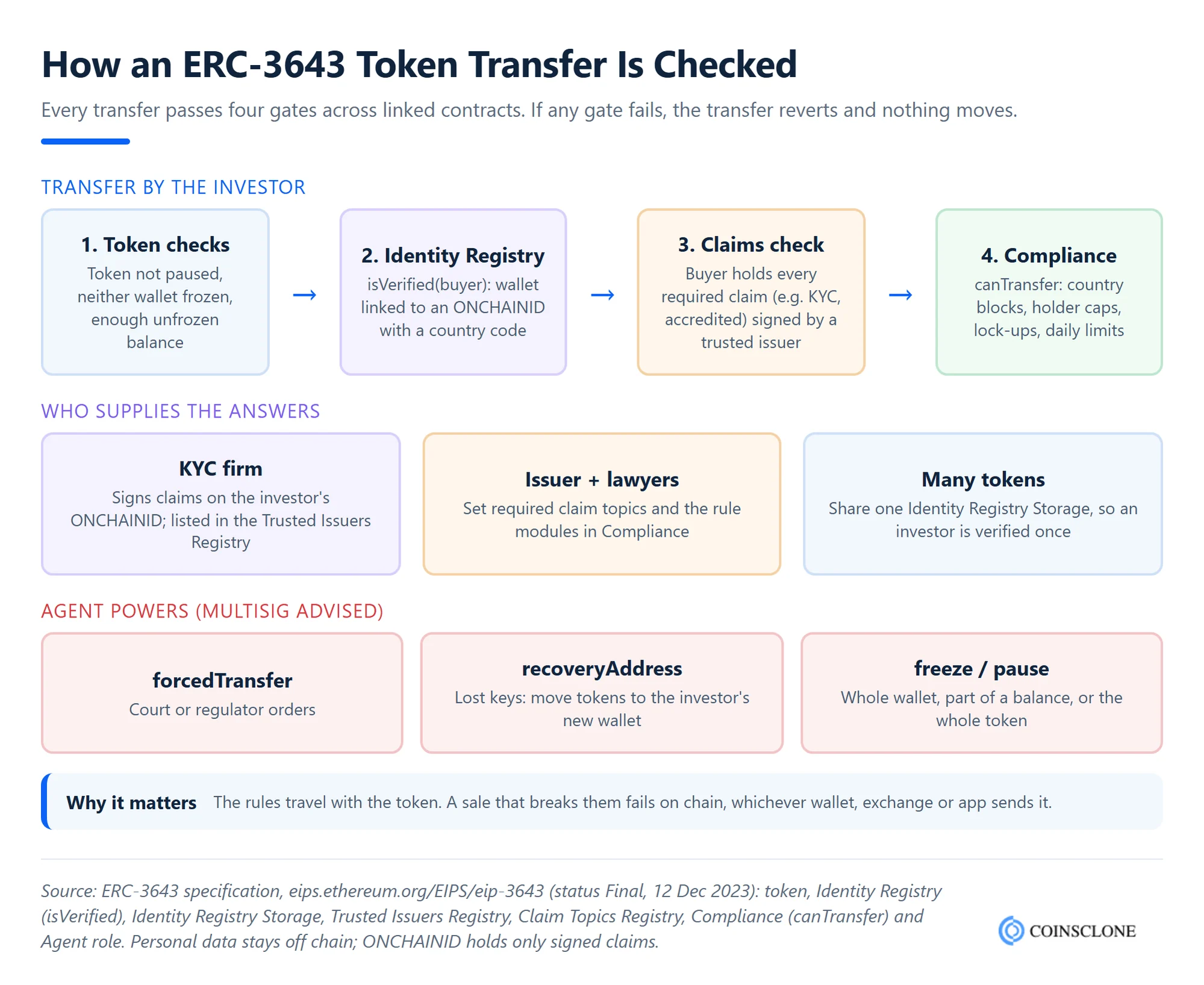
When an investor sends tokens, the contract runs its checks in a set order. First, the token must not be paused, and neither wallet may be frozen. Next, the sender must have enough unfrozen tokens. Then the Identity Registry confirms that the buyer holds valid claims from a trusted issuer. Finally, the Compliance contract checks the transfer against every active rule. If any check fails, the transfer stops and nothing moves.
ONCHAINID and Claims
ONCHAINID is the ID part of the system. Each buyer gets an ID contract that holds signed claims, such as “KYC passed” or “resident of Germany.” A trusted KYC firm signs these claims. However, personal data stays off chain. The chain only holds the proof that a trusted party checked it. As a result, a buyer checked once can buy any ERC-3643 token that accepts the same claims.
Issuer and Agent Powers
Regulated assets need a way to fix problems. So ERC-3643 gives agents a set of controls:
- Forced transfer: move tokens without the holder, for a court order or a regulator’s request.
- Wallet recovery: move an investor’s tokens to a new wallet if they lose their keys.
- Freeze: lock a full wallet or only part of a balance.
- Pause: stop all transfers during a company event, such as a share split, or a hack.
Because these powers are strong, they belong behind a multisig wallet with clear role limits.
Core Features of ERC-3643 for RWA Tokens
Features are what set ERC-3643 apart from other standards. Here are the ones that matter most in a real build.
- On-chain compliance: every transfer is checked against your rules on chain, so a sale that breaks them never goes through.
- One ID, many tokens: ONCHAINID lets a buyer prove KYC once and use that proof across many tokens.
- Plug-in rules: rule modules can be added, changed or removed without a new token.
- EVM chain support: the contracts work on any EVM chain, such as Ethereum, Polygon or Avalanche. Moving tokens between chains still needs a bridge that keeps the identity checks in place.
- Batch actions: mint, send, freeze or recover for many buyers in one go, which saves time and gas.
- Role-based access control: clear rights for the owner, agents and investors, so each party can only do its own job.
- Forced transfer capability: issuers can move tokens when a legal or regulatory order requires it.
Together, these features give issuers control while keeping the token usable in standard wallets.
Security and Compliance Features of ERC-3643 Tokens
Security and rules are not optional when you handle regulated assets. Here is how ERC-3643 covers them.
- KYC/AML integration: only investors with valid claims from a trusted KYC firm can receive the token.
- Country and investor rules: each token can block certain countries, cap the number of holders or limit holdings per investor.
- Auditability: every mint, burn, freeze, recovery and forced transfer leaves an event on chain, which makes reports easy.
- Risk controls: frozen wallets, partial freezes and a pause switch limit damage if something goes wrong.
- Token recovery: lost or stolen tokens can be moved to a verified new wallet for the same investor.
These controls let an issuer act fast while keeping a clear record of every step. Next, let’s see how ERC-3643 compares with other standards.
ERC-3643 vs ERC-1400 vs ERC-7943: Which Standard Should You Choose?
ERC-3643 is not the only option for regulated tokens. Here is how it compares with the two names that come up most often.
| ERC-3643 (T-REX) | ERC-1400 | ERC-7943 (uRWA) | |
| Status | Final since December 2023 | Proposal, never accepted as an EIP | Final since May 2026 |
| Scope | Full framework: token, identity, rules, agent roles | Partitions, documents and transfer checks | Small interface: checks, freezes, forced transfers |
| Identity and KYC | Built in through ONCHAINID | Left to the issuer | Left to the issuer |
| Token types | ERC-20 only | Fungible with partitions | ERC-20, ERC-721, ERC-1155 and ERC-6909 |
| Live use | More than $32 billion tokenized, per its backers | Older security token projects | Early: CMTAT support, OpenZeppelin community code |
| Best fit | Securities issuers who want a complete, tested stack | Teams already running it | Lean RWA tokens, NFTs and DeFi-focused issuers |
In practice, ERC-3643 is the default for most new security tokens, because its identity layer can be reused across many assets. ERC-1400 still works for teams that already run it, and our ERC-1400 token development team supports those projects. ERC-7943 suits one-of-a-kind assets and issuers who bring their own KYC. Our guide to ERC-7943 RWA tokenization covers that standard in depth.
Use Cases of ERC-3643 in RWA Tokenization
ERC-3643 suits any asset where the law decides who may hold it. Here are the most common uses.
Real Estate Fractionation
ERC-3643 lets a property owner split a building into many small shares. As a result, more investors can buy in with small amounts, while the token enforces local property and investment rules. See our guide to tokenization of real estate for the full model.
Shares, Bonds and Funds
Businesses can issue and manage tokenized shares, bonds and fund units with the rules built in. For example, ABN AMRO used ERC-3643 on Polygon for a €5 million digital green bond in 2023. Only approved investors could hold it, and the bank could track and recover tokens if needed.
Startup Cap Tables
Startups can put their cap table on chain, so every share has a clear owner and a clear rule set. This makes funding rounds easier to run and helps the company stay within investor eligibility rules.
Commodities and Rare Items
Gold, art and collectibles can be split into small units that are easy to transfer. ERC-3643 gives proof of ownership and blocks transfers to unverified buyers, which cuts the risk of fraud.
Supply Chain Finance
Invoices and other asset-backed claims can be tokenized for clearer trade finance. With ERC-3643, lenders can track, check and trade these cash flows while staying within the rules.
Sustainable Credits
Carbon credits and other ESG assets can be tokenized with full tracing. In turn, only eligible parties can trade them, which helps prevent double counting and misuse.
These uses lead to clear business gains. Let’s look at the benefits next.
Benefits of Using ERC-3643 for RWA Tokenization
ERC-3643 offers a wide range of benefits to businesses in the RWA space. Here are the main ones.
- Lower cost and less friction: smart contracts handle checks and transfers that used to need several middlemen. That cuts admin work, running costs and legal back-and-forth.
- Safe transfers: only verified investors can hold or receive the token, which protects both the issuer and its investors.
- More liquidity and access: split ownership turns hard-to-sell assets into small units that more people can buy.
- More trust: on-chain rules, ID checks and a clear audit trail give buyers and regulators faith in the asset.
- Built-in compliance: KYC, AML and country rules live inside the token, so a business can grow its platform without rebuilding its checks for each new asset.
- Wide support: as a Final standard with 140+ backing institutions, ERC-3643 is easier to plug into wallets, custodians and trading venues than a custom token.
These advantages make ERC-3643 a strong base for a regulated RWA platform.
Industries We Serve with ERC-3643 RWA Token Development
At Coinsclone, we build ERC-3643 tokens for sectors where assets are costly, regulated or hard to sell.
- Funds and asset managers: money market funds, private equity and private credit, where most tokenized value sits today.
- Banks and capital markets: digital bonds, notes and structured products with investor rules built in.
- Real estate: split ownership of homes, offices and property funds, with country and investor limits.
- Commodities: gold and other metals, where each token stands for a stored, audited amount.
- Trade finance: invoices and receivables that lenders can fund and trade within the rules.
- Energy and carbon: renewable projects and carbon credits that need clear tracing and eligible buyers.
On the whole, this shows how broad the reach of ERC-3643 has become. Yet every project also faces real hurdles, which we cover after the cost section.
ERC-3643 Token Development Cost and Timeline
Knowing the cost before you start can save your budget from surprises. The answer depends on your asset, the number of countries you sell in, the KYC and payment partners you plug in, and how much custom work you need.
Published 2026 agency cost guides put a tokenization MVP at about $40,000 to $70,000 and a full production platform at $100,000 to $250,000, before legal fees. A full custom platform with its own trading venue can pass $250,000 to $500,000. A white-label platform usually lands below a custom MVP, because the tested core already exists.
| Development approach | Typical market cost | Timeline |
| White-label ERC-3643 platform | Below a custom MVP | 2 to 4 weeks |
| Custom MVP (one asset, one market) | $40,000 to $70,000 | 8 to 12 weeks |
| Production platform (several assets and countries) | $100,000 to $250,000 | 6 to 9 months |
| Full custom platform with a trading venue | $250,000 to $500,000+ | 9 to 14 months |
Costs from published 2026 agency cost guides, before legal fees. Timelines combine our published build times with typical market ranges.
What Drives the Cost
- Rule depth: each country, investor type, holder cap and lock-up adds logic and tests.
- ID setup: using an existing ONCHAINID and KYC partner costs less than building a custom claim flow.
- Chain choice: gas on Ethereum mainnet is higher than on Polygon or other layer 2 networks, which matters for frequent transfers.
- Audit: every contract change needs a fresh review, so plan audits as a repeat cost.
- Extras: payouts, investor dashboards, secondary trading and reports.
Also budget for costs outside the software. These include legal work and offer papers, KYC checks per investor, custody of the real asset, and transfer agent or broker fees where your route needs one. For many issuers, the legal work costs as much as the platform.
Key Challenges of Implementing ERC-3643 in RWA Tokenization
Each token standard has pros and cons. ERC-3643 is no different. Here are the main hurdles, along with ways to get past them.
Liquidity Constraints
Only verified investors can hold an ERC-3643 token, so fewer people can trade it. That lowers market activity compared with open tokens.
Fix it by: listing on licensed trading venues, signing up approved buyers early, and planning a clear sales plan with market makers.
Security and Code Risks
ERC-3643 links identity, rules and token logic across several contracts. So even a small mistake in one rule can block every investor or let the wrong one in.
Fix it by: testing each buyer type and country rule, running outside audits after each change, and building on the free T-REX code rather than from scratch.
Central Control and Admin Keys
Agents can freeze, recover and force transfers. If an attacker gets those keys, they can take assets, and some DeFi users see these powers as a trust issue.
Fix it by: putting agent roles behind a multisig wallet or time lock, splitting duties between parties, and sharing clear rules on when the issuer will step in.
Gas Costs and Chain Choice
Each transfer runs several checks across contracts, so it costs more gas than a plain ERC-20 transfer. On Ethereum mainnet, that adds up fast.
Fix it by: launching on a lower-cost EVM network such as Polygon, using batch functions, and keeping only the rule modules you need.
Custody and Trust
ERC-3643 controls how the token behaves. It cannot prove that the real asset exists or that the legal claim behind it is sound.
Fix it by: showing clear proof of the asset, holding it in a legal shell such as a special purpose vehicle, and using licensed custodians.
Changing Laws
Rules differ by country and change over time. A token that is compliant today may need new rules next year.
Fix it by: using rule modules you can update without a new token, working with local lawyers, and checking your rules on a set schedule.
With the right plan, each of these hurdles is manageable.
How to Develop an ERC-3643 RWA Token (Step-by-Step)
At Coinsclone, we follow a structured 9-step method to build an ERC-3643 token. Here is how it goes from idea to launch.
1. Gather Requirements
First, define your asset type, target investors, the countries you will sell in and your business goals. Clear planning keeps the build on track and speeds up launch.
2. Set Up the Legal Structure
Next, work with lawyers to define asset ownership, investor rights and the offer route, such as Reg D or Reg S in the US. The token can only enforce rules that the legal papers have set.
3. Choose the Chain
Then pick the network. Ethereum gives the widest reach, while Polygon and other EVM networks cut gas costs. Check which chains your target custodians and trading venues support.
4. Deploy the Identity Contracts
Set up the three lists: approved IDs, trusted claim signers and required claims. Then connect your KYC partner so it can sign claims for approved buyers.
5. Set Up the Rule Modules
Turn each legal rule into a module: country blocks, holder caps, lock-up periods and daily limits. Because the modules are separate, you can change them later without a new token.
6. Develop and Deploy the Token
Build the ERC-3643 token on the tested T-REX contracts, link it to the identity and compliance contracts, and assign agent roles behind a multisig.
7. Test and Audit
Run unit tests, rule tests for each buyer type, and an outside security audit. Fix every finding before you go live, since a rule bug can freeze a whole investor base.
8. Onboard Investors and Mint Tokens
Check each buyer, add their ID to the list, and mint tokens to approved wallets. Each token must match the ownership and rights set out in the legal papers.
9. Manage After Launch
Finally, handle transfers, payouts, freezes, recoveries and reports for the full life of the asset. Update rule modules when laws or offer terms change.
This is how you create an ERC-3643 token. The process can feel heavy for startups, so working with a skilled RWA tokenization platform development company can save months of trial and error.
The Future Scope of ERC-3643 for RWA Tokenization
As the tokenization market grows, ERC-3643 is getting new tools. Here is where it is heading.
- A shared compliance chain: the T-REX Ledger, built with Polygon CDK, aims to keep investor rules the same across many networks. Its mainnet is expected in Q4 2026.
- Audited code: OpenZeppelin plans to add ERC-3643 to its audited code base, so teams can import it like ERC-20.
- Privacy: T-REX Network chose Zama as the confidentiality layer for the T-REX Ledger in March 2026, so balances and transfers can stay private while still following the rules.
- Beyond EVM: a Stellar version is already complete, which brings the same rules to non-EVM chains.
- More asset types: funds, private credit, IP and carbon credits are all growing use cases, backed by large fund servicers like Apex Group.
In short, ERC-3643 has strong momentum. The key is to pick a build partner who knows both the standard and the rules around it.
Why Choose Coinsclone for ERC-3643 Token Development?
Coinsclone is a blockchain development company that has been building since 2018. We have delivered 350+ platforms for 200+ clients across 20 industries. As an asset tokenization platform development company, we help firms launch safe, rule-ready RWA platforms that can grow over time.
We help you pick the right standard for each asset, map your legal rules into ERC-3643 compliance modules, connect your KYC partner, and launch with audited contracts. Our security token development team then supports you after launch with upgrades, new rule modules and reports.
Whether you are a startup founder or an established firm, talk to our experts to see a demo and plan your ERC-3643 token launch.
Frequently Asked Questions
What is ERC-3643?
ERC-3643, also called T-REX, is a Final Ethereum token standard for regulated assets. It extends ERC-20 with on-chain identity, transfer rules and issuer controls, so only approved investors can hold or receive the token.
What is the difference between ERC-3643 and ERC-1400?
ERC-3643 is a Final Ethereum standard with a built-in ID system (ONCHAINID) and plug-in rules. ERC-1400 is a set of proposals that was never accepted as an official EIP. It adds partitions and document handling but leaves identity to the issuer. Most new security tokens now use ERC-3643.
Is ERC-3643 compatible with DeFi protocols?
Yes, with limits. ERC-3643 tokens keep the ERC-20 functions, so DeFi apps can read them. However, a pool or vault must itself be a verified holder, and every transfer must pass the token’s rules. The ERC3643 Association has released open-source tools to help DeFi apps work with these tokens.
What blockchains support ERC-3643?
ERC-3643 runs on any EVM chain, such as Ethereum, Polygon and Avalanche. OpenZeppelin has also completed a Stellar version, and the T-REX Ledger, built with Polygon CDK, is set to launch on mainnet in Q4 2026.
Can ERC-3643 tokens be bridged?
They can, but the bridge must keep the identity checks in place on the other chain. Otherwise, tokens could reach unverified wallets. The T-REX Ledger aims to solve this by acting as a shared rule layer across networks.
How are sanctions or jurisdiction rules handled?
Each investor’s identity carries a country code and signed claims from trusted KYC firms. The compliance modules then block transfers to restricted countries or sanctioned wallets, and agents can freeze a wallet if a new sanction applies.
How long does it take to deploy an ERC-3643 platform?
A white-label ERC-3643 platform can launch in about 2 to 4 weeks. A custom MVP for one asset and one market usually takes 8 to 12 weeks, and a production platform across several countries can take 6 to 9 months.
Launch Compliant RWA Tokens Faster with ERC3643
Real World Asset Tokenization — done right.
- ERC3643 MVP Framework: Launch your compliant RWA token platform up to 90% faster.
- Built-in Compliance: Real estate, funds, equity, debt — fully customizable to your use case.
- Modular Infrastructure: Integrated smart contracts, wallets, and investor management — no heavy coding needed.
- Revenue Engine: Earn via issuance fees, transaction fees, and asset management services.
Get a free branded demo of your RWA token platform in 48 hours — before investing a cent.
Book a Free Demo and discover how our ERC3643 tokenization solution can take you from concept to compliant launch in just 2–4 weeks.