
A Robinhood clone is ready-made trading software that lets you launch a simple, mobile-first app like Robinhood under your own brand. A white label version goes live in about 4 to 6 weeks and often costs $15,000 to $60,000, with sign-up and KYC, live prices, one-tap trading, wallets and a full admin panel built in. So you skip the long and costly job of building a trading app from scratch, and you still keep the freedom to change the design, features and fees.
This guide explains what the script includes and how Robinhood really works and earns money in 2026. It also covers the licences you need, the steps to launch, what it costs and the problems to plan for. We checked each Robinhood figure against the firm’s own Q2 2026 results, help pages and news posts in October 2026, so you can plan with real numbers.
In this guide:
- What a Robinhood clone script includes for users, admins and security teams
- How Robinhood earned $1.31 billion in one quarter without charging most traders a commission
- Which licences an app like Robinhood needs in the US, the EU, the UK, Canada and India
- How a clone script compares with a white label exchange, a custom build and free GitHub clones
- A clear path to launch, with build costs and timelines from 4 to 13 weeks
See How Our MVP System Can Launch Your Trading App Faster!
Robinhood Clone Script — stock & crypto trading made simple.
- MVP System: Launch your Robinhood-like platform 90% faster.
- Stocks, Crypto & Wallets: Pre-integrated trading modules — no coding required.
- Modern Design & Branding: Your logo, your theme, your assets, your market.
- Revenue Engine: Earn from commissions, premium plans, and asset spreads.
Get a free branded demo of your Robinhood-style trading app in 48 hours — before you spend a cent.
Book a Free Demo and see how our Robinhood Clone Script can take you from concept to live platform in just 8-12 weeks.
What Is a Robinhood Clone Script?
A Robinhood clone script is ready-built trading software that copies the core functions of the Robinhood app. It supports commission-free style trading with quick sign-up, live market data, asset trading, holdings tracking and safe payments. It is built to handle heavy user traffic, simple trading flows and strong security in a modern trading app.
In plain terms, the script gives you four parts in one box:
- Trading app: A clean mobile and web app where users sign up, fund their account and trade in a few taps.
- Trading engine: Matches orders or routes them to liquidity partners, then settles each trade in real time.
- Wallet and custody layer: Holds user funds in hot and cold wallets, with withdrawal checks and limits.
- Admin panel: Lets your team manage users, coins, fees, risk checks and reports from one place.
Because the core is already built and tested, you spend your time on branding, licences and growth instead of basic code. For a wider view of this model, see our guide to crypto exchange clone scripts.
How Robinhood Works and Makes Money in 2026
Before you copy a platform, it helps to know what makes it work. Robinhood started in 2013 and launched its zero-commission stock trading app in 2015. Crypto trading followed in 2018. Today it is a full money app with stocks, options, crypto, prediction markets, banking and a credit card.
The scale is large. Robinhood’s Q2 2026 results show 28.4 million funded customers and $369 billion in total platform assets at the end of June 2026. Total revenue hit a record $1.31 billion for the quarter, up 32% from a year earlier.
So how does an app with no trade commissions earn that much? The answer is that it earns small amounts from many places:
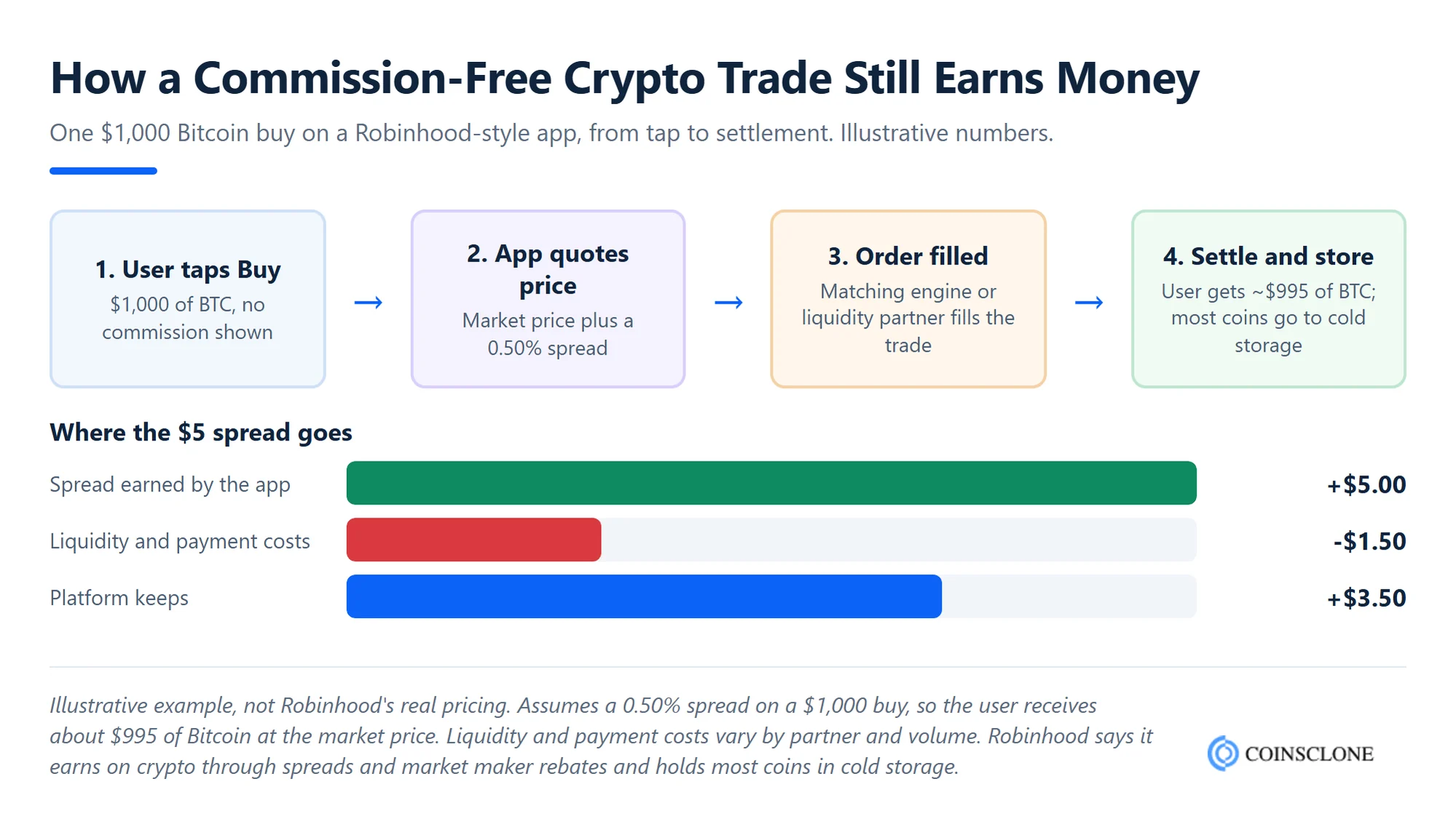
- Spreads and rebates: By default, US crypto orders carry no commission. Instead, Robinhood earns a share of the price spread from the market makers that fill orders.
- Fee tiers: Active traders can switch to exchange routing instead. There, a maker or taker fee of 0% to 0.95% applies, and it falls as 30-day volume rises.
- Interest: It earns interest on user cash and margin loans. This brought in $389 million in Q2 2026.
- Paid plans: Robinhood Gold costs $5 a month and had 4.8 million members.
- Options and event contracts: These are now its fastest-growing trading lines.
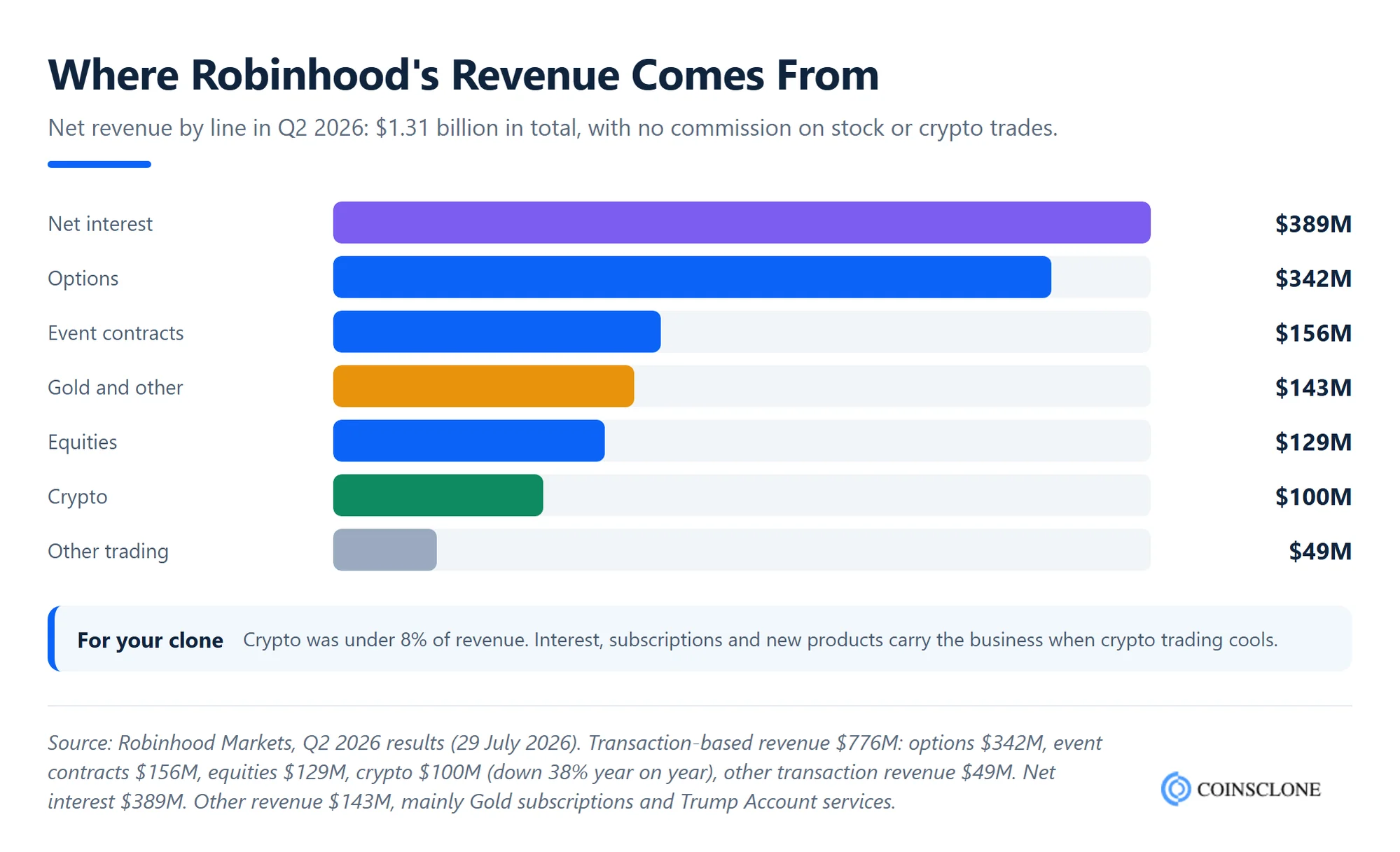
The chart holds a key lesson for your clone. Crypto brought in $100 million in Q2 2026, down 38% from a year earlier, as markets calmed. That is less than 8% of total revenue. Meanwhile, Robinhood’s app handled $18 billion of crypto trades in the quarter, and its Bitstamp exchange handled another $22 billion. In short, crypto volume rises and falls with the market, so a strong trading app adds steady income such as subscriptions, staking and interest.
How Wide Is Robinhood’s Crypto Spread?
Robinhood keeps about $0.95 of every $100 traded through its default market maker routing. Its crypto order routing page gives this rate as of 15 June 2026, and it says the amount sits inside the spread you see. So on a $100 buy with a 0.96% spread, Robinhood keeps $0.95 of the $0.96.
This is why traders on Reddit ask why Robinhood’s crypto spread feels so wide. “No commission” does not mean “no cost”. For your own app, the lesson is simple: show the full price and spread before users confirm a trade. Clear pricing builds trust, and it keeps you on the right side of consumer rules.
Why Should You Launch a Crypto Trading App Like Robinhood?
Launching a Robinhood clone script is a smart move to meet the needs of today’s users, who expect speed, simplicity and control in a single trading app. The Robinhood-style model fits how people trade now and the steady rise of crypto.
Major reasons to launch:
- Simple trading for everyone: Clean screens and guided steps make crypto trading easy for new users, while staying quick for active traders.
- High user engagement and retention: Real-time price tracking, watchlists and instant alerts keep users coming back every day.
- A model that grows: You can add new assets, regions and income streams without a rebuild.
- Proven ease of use: Robinhood showed that speed, clear prices and simple screens build trust. It grew to 28.4 million funded customers with this approach.
From a business view, this model also earns from more than one source. Robinhood now has thirteen business lines that each bring in over $100 million a year. Your app can start with crypto trading and then add new lines, one at a time, as your user base grows.
New Robinhood Features in 2026 Your Clone Can Copy
Robinhood keeps adding products, and several of them show where retail trading is heading. Each one is a feature you can plan into your own app:
- Stock tokens: Since 1 July 2026, new Stock Tokens are open to users in more than 120 countries through the Robinhood Wallet, which users hold themselves. They trade 24/7 on chain, but they are not offered in the US, the UK, Canada, Switzerland or the UAE. In the EU, the first version, now called Classic Stock Tokens, stays in the Robinhood Europe app. Our guide to real world asset tokenization explains how such tokens work.
- Its own blockchain: Robinhood launched the Robinhood Chain mainnet on 1 July 2026. It is an Ethereum Layer 2 built on Arbitrum. Memecoin launchpads took off there within days, as our guide to Robinhood Chain launchpad development shows. Your clone does not need its own chain, but it can list tokens from one.
- AI agent trading: Since May 2026, users can connect an AI agent through Robinhood’s MCP server and let it trade stocks, options and crypto. Nearly 100,000 customers had opened these accounts by late July 2026. In September, the app added its own built-in agents. By default, users must OK each trade by hand.
- Prediction markets: Event contracts earned $156 million in Q2 2026, more than 10 times the year before. Since 4 June 2026, the app sends some event contracts to Rothera. Rothera is a CFTC-licensed exchange and clearing house, run by a joint venture with Susquehanna. Kalshi and ForecastEx still list the rest. See our guide to prediction market platform development.
- Social feed: Robinhood Social opened to US users on 29 Sept 2026. Users share real trades and follow other traders. Still, the firm says it is not a copy trading tool.
- Crypto earning tools: Users can stake ETH, SOL and ADA from $1. Since July, Robinhood Earn has let some US users lend USDG, a dollar token, from their own wallet, at an estimated 7% a year at launch.
- Perpetual futures: Perps are live for users in the EU. The firm plans to add them for US users in the coming months, with up to 10x on BTC and ETH.
You do not need all of these on day one. Still, a modular script lets you switch them on later without pausing live trading.
Robinhood Clone Software Development: Script vs White Label vs Custom Build
A Robinhood clone script is the fastest of the three main build routes, because the simple trading flows are already built. The other two routes are a general white label exchange and a full custom build. Your choice shapes your launch date, your budget and how your app feels to users.
| Aspect | Robinhood Clone Script | General White Label Exchange | Full Custom Build |
| Core purpose | Built for Robinhood-like trading flows | General exchange with order books | Whatever your idea needs |
| Time to launch | 4 to 13 weeks | Similar, plus time to rework screens | 6 to 14 months |
| User experience | Tuned for simple trading and tracking | Often complex for beginners | Fully your own |
| Feature fit | Matches Robinhood-style screens and flows | Needs changes to match | Built from scratch |
| Cost control | Predictable and modular | Costs rise with each change | Highest budget and risk |
| Growth | Add modules step by step | Big changes may need a rebuild | Grows as far as you fund it |
A Robinhood clone script gives you a focused base. White label kits are broader and less suited to simple, app-first trading. A full custom build gives you the most control, but it takes many months and a much larger budget. Our guide to crypto exchange vs crypto brokerage explains a related choice. Robinhood works like a broker, routing orders to market makers instead of running an open order book.
Is a White Label Robinhood Clone the Right Way to Start?
For most first-time founders, yes. A white label clone gets a tested app to market in weeks, so you can check demand before you spend six figures. People on Reddit weigh the same question when they compare white label and no-code exchanges.
Pick custom code only when your core idea cannot run on existing software, such as a new asset class or your own matching engine. Either way, check that you get the source code, the right to change it and a clear support plan.
Robinhood Clone Script vs Free Robinhood Clones on GitHub
Free Robinhood clones on GitHub are mostly student and portfolio projects, not products you can launch. They copy the look of the app, with charts, a watchlist and paper trades. But they lack KYC, real custody, licensed broker or liquidity links, security audits and an admin panel.
So a GitHub clone is useful for learning how a trading screen works. A paid clone script, by contrast, ships the parts that the law and real users need, plus support when something breaks.
Key Features of Our Robinhood Clone Script
Our Robinhood clone software is built to grow and covers the best features of Robinhood, and you can change any of them.
User Features
- Quick sign-up: Simple registration with KYC checks.
- Live prices: Real-time crypto and stock price tracking.
- One-tap trading: Buy, sell and hold digital assets.
- Charts: Live charts with basic tools.
- Watchlist and portfolio: One view of holdings, profit and loss.
- Deposits and withdrawals: Secure crypto and fiat transfers.
- Auto buys: Set buys on a fixed schedule, from small amounts.
- History and alerts: Full trade history and push alerts when prices move.
Admin Features
Admins get their own dashboard with full control over users, transactions, revenue settings, support and the platform’s features.
- Central dashboard for platform control
- User checks and account management
- Asset and trading pair setup
- Fee and income rules
- Trade tracking and reports
- Risk and compliance oversight
- API and third-party service controls
With these features, your trading app is ready to attract users, protect their data and grow ahead of rivals. Next, let’s look at security.
Security Features of Our Robinhood Clone Script
Security is a core layer of the Robinhood clone software, not an add-on. The system encrypts user data and transaction records, which means it turns them into a secure code that outsiders cannot read. Two-factor authentication asks for a second proof of identity, so a stolen password alone cannot open an account.
It also guards its APIs (the links between software systems), blocks fake login pages and flags odd trading. The setup resists DDoS attacks, which flood a platform with fake traffic, and common flaws such as SQL injection and cross-site scripting (XSS).
Custody matters just as much. Robinhood says it keeps most customer coins in cold storage, fully offline, and carries crime insurance against theft. Your clone should do the same. Keep a small hot wallet for daily payouts, hold most funds in cold or multisig wallets, and set payout limits and address allow lists. Built-in KYC and AML tools then help you meet local rules without changing the core system.
Add-On Modules Included in Our Robinhood Clone Software
These add-ons keep users active, add income and make trading better:
- Advanced charting and analytics tools
- Margin trading module
- Staking and passive income features
- Refer-and-earn rewards
- Fiat on-ramp and off-ramp support
- AI-based market insights
- Sync across web and mobile
- In-app announcements and alerts
These add-on modules let you grow step by step without disrupting live trading.
How Does Our Robinhood Clone Script Work?
The Robinhood clone script has a simple, smooth workflow for both users and admins. Here is the path of a typical trade:
- Users sign up, complete KYC and fund their accounts.
- The system pulls live market data and shows a price.
- Orders run through a secure matching engine or go to a liquidity partner.
- Portfolios update in real time after each trade.
- Admins track activity, risk and compliance from one dashboard.
The diagram below follows one trade from tap to settlement. It also shows where a “commission-free” app actually earns its money.
What Tech Stack Does an App Like Robinhood Need?
An app like Robinhood needs six core parts: mobile apps, a real-time price feed, an order engine, a ledger, wallets and compliance tools. Here is what each one does:
- Mobile and web apps: Native or cross-platform apps for iOS and Android, plus a web app, all fed by the same backend.
- Price feed: WebSocket streams that push live prices to every screen in under a second.
- Order engine: A matching engine, or an order router that sends trades to liquidity partners and brokers.
- Ledger: A double-entry ledger that records every cent twice, so balances always match funds held.
- Wallets: Hot, cold and multisig or MPC wallets with withdrawal limits.
- Compliance tools: KYC, AML screening, Travel Rule messages and audit logs, linked through APIs.
Cloud servers that scale on their own sit under all of this, so the app stays up on the busiest days. Coinsclone builds these layers into its crypto exchange app development work for Android and iOS.
What We Deliver
Coinsclone builds ready-to-run apps that are easy to use, safe and made to grow.
Robinhood Clone Trading App (Android + iOS)
Coinsclone’s Robinhood clone trading app gives users a smooth way to buy, sell and track assets. It supports fast order execution, clear portfolio views and real-time market updates. So users trade with confidence while moving easily across devices. You can change the whole design, add local languages, plug in KYC tools and switch on pro trading modules.
White Label Robinhood Clone
The white label version gives you full control over branding, features and integrations. It cuts build effort while still supporting future upgrades. This option suits teams that want a fast launch without losing flexibility or stability. The admin panel gives you control over users, fees, leverage settings and risk tools. In short, it is a good fit for founders who want a quick launch and a distinct brand from day one.
Build Your Crypto & Stocks Exchange like Robinhood
Premium Features, Customizable, Ready to Launch. Live Demo Available.
Benefits of Using Our Robinhood-like Crypto App
Our Robinhood clone script gives you a real head start in the busy world of crypto trading. You save time and cost while keeping the freedom to build a unique platform that can grow and stay compliant.
Rapid Market Entry
The software is fully built and tested. So instead of months of coding, a white label launch takes about 4 to 6 weeks, or 9 to 13 weeks with fiat rails and native mobile apps.
Cost-Effective Development
The clone script keeps costs down because the core is pre-built. You pay mainly for branding, setup and the extra features you choose.
Freedom to Shape Your Brand and Features
You can shape your app’s look and features to fit your target users. This helps your platform stand out from rivals.
Secure Design That Grows With You
The script runs on a solid base built for more users and more trades. Layers of security guard your users’ data and funds as you grow.
Compliance-Ready
Built-in tools for KYC, AML and transaction monitoring help you meet legal rules and build trust with your users.
With Coinsclone’s Robinhood clone script, you start with a solid crypto trading app that can grow. Next, let’s explore how it earns.
Revenue Model of a Robinhood-like Crypto Trading App
A solid revenue model is vital for any trading platform. A Robinhood-like crypto app has many ways to earn, which keeps it growing even when one stream slows down. Here is where revenue can come from.
Trading Fees and Spreads
Charge a small fee or a small spread on each trade. Robinhood shows that you can drop visible commissions and still earn, because a spread is built into the price. It also offers a second, fee-based route for active traders, with crypto fee tiers from 0.95% down to 0% as volume grows. Your app can copy both: a simple spread for new users, and lower volume-based fees for big traders. Even a small margin adds up when trade volume is high.
Subscription Plans
Charge a monthly or yearly fee for extras such as pro charts, a higher rate on cash, faster payouts or lower fees. Robinhood Gold, at $5 a month, had 4.8 million subscribers in mid-2026.
Transaction Fees
Charge small fees on bank deposits, card payments and cash swaps. Note that Robinhood does not charge fees to send or receive crypto, so free transfers are now what users expect.
Staking Commission
Let users stake their crypto on your platform and keep a share of the rewards. This gives you steady income that does not depend on trading volume.
Interest on Margin Trading
Offer margin trading so users can borrow funds to trade. You then earn interest on the borrowed amount.
Listing Fees
Charge crypto projects a fee to list their tokens on your platform. This is a common way for exchanges to earn, but always check each project first to protect your users.
In-App Ads
You can earn from targeted ads, sponsored listings and partner promotions within your app.
Here is a simple worked example. Suppose your app has 20,000 active traders who each trade $1,500 a month, and you earn a 0.5% spread. That is $30 million of monthly volume and about $150,000 a month from spreads. If 1,000 of those users also pay $5 a month for a premium plan, you add $5,000. These numbers are only an example, but they show why mixing several streams matters.
Licences Needed for an App Like Robinhood
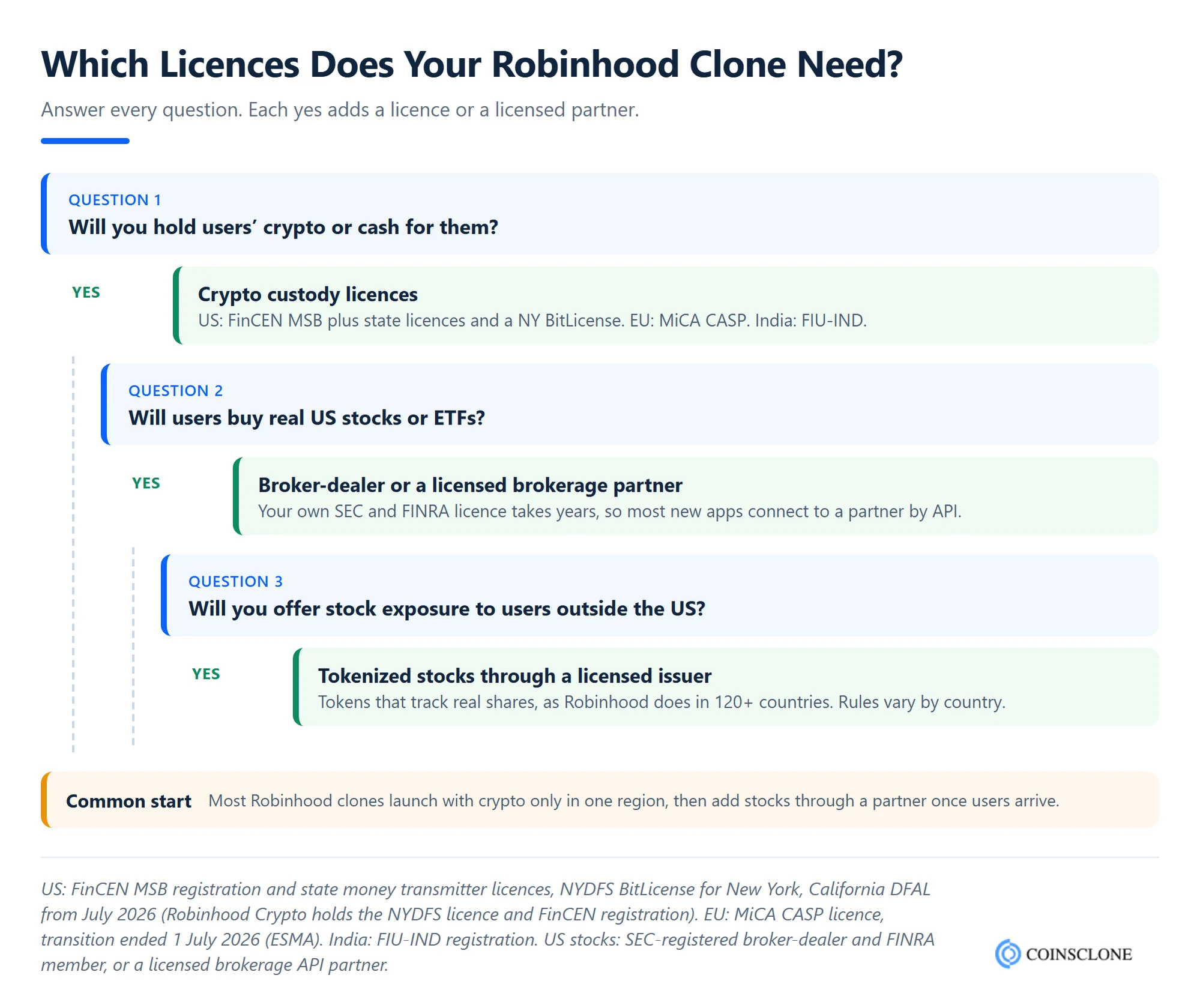
Using a clone script is legal, because the software is original code and does not copy Robinhood’s brand or systems. Running a trading app, however, needs the right licences. What you need depends on two things: the assets you offer and the countries you serve.
Here are the main rules by region:
- United States: Robinhood’s own crypto arm shows the model. It is registered with FinCEN as a money services business, follows state money transfer laws and holds a New York BitLicense. California’s DFAL licence also applies from July 2026.
- European Union: Crypto trading and custody need a MiCA licence. The MiCA transition period ended on 1 July 2026, and one licence lets you serve all 30 EEA countries. Our guide to a MiCA-compliant crypto exchange in the EU covers the steps.
- United Kingdom: Crypto firms must register with the FCA under its anti-money laundering rules before they serve UK users.
- India: Crypto platforms that serve Indian users must register with the FIU-IND and follow its AML rules.
- Canada: Crypto trading apps must sign up with the securities watchdog in each province they serve.
Stocks are a separate case. To offer real shares in the US, you need your own broker-dealer, signed up with the SEC and FINRA. Or you can link to a licensed broker that offers trading through an API, often called brokerage as a service. Most new apps take the partner route, because their own broker-dealer licence takes years.
Can You Launch an App Like Robinhood in India or Europe?
Yes, but the licence depends on the assets. In India, a crypto app registers with FIU-IND, while a stock app must be, or partner with, a SEBI-registered stockbroker. In Europe, MiCA covers crypto, and stocks need an investment firm licence under MiFID II. That is why many founders start with crypto only and add shares later through a licensed partner.
Do You Need a Licence If Your App Never Holds User Funds?
Usually, yes. In most places, the rules look at what your app does, not where the money sits. If your app helps users swap cash or crypto, the law may still treat you as a money sender or a crypto service firm. Founders ask this often on Reddit, for example in this r/fintech thread on apps that never hold client funds.
The same goes for small crypto investing apps. A crypto micro-investing founder on r/fintech asked whether non-custodial wallets avoid money licences. The short answer is no. A non-custodial wallet does not by itself exempt you, most of all once fiat cash moves through your app. Get a legal opinion for each market before launch, and design your custody model around it.
Compliance is not a box to tick once. In 2022, New York’s top finance watchdog fined Robinhood Crypto $30 million for weak money laundering and cyber checks. So build transaction monitoring, Travel Rule data sharing and audit logs into your app from the start.
How to Create an App Like Robinhood, Step by Step
To create an app like Robinhood, pick your market, plan licences, choose a build route, then brand, connect partners, test and launch. With the rules clear, the launch follows this set path:
- Pick your market and assets: Decide which countries you will serve and whether you start with crypto only or add stocks later.
- Plan your licences: Map the licences for each region and start the paperwork early, since approvals often take longer than the build.
- Choose your build route: Pick a white label clone script for speed, or a custom build if your idea needs something new.
- Customize the app: Add your brand, coin list, fee rules, languages and the add-on modules you need.
- Connect partners: Link KYC providers, payment rails, price feeds and crypto liquidity providers so users get fair prices from day one.
- Test and audit: Run load tests, security tests and a full trading test with real users before launch.
- Launch and grow: Go live, track user behavior and add new features such as staking or subscriptions step by step.
If you want a partner for these steps, Coinsclone builds Robinhood-style trading apps on its white label crypto exchange software, with native Android and iOS apps.
How Much Does a Robinhood Clone Cost in 2026?
A white label Robinhood clone costs about $15,000 to $60,000, while a custom app runs from $100,000 to $500,000 or more. The final price depends on your build route, features, security, licences and team. Here are typical 2026 ranges:
| Build route | Typical cost | Time to launch | Best for |
| White label Robinhood clone | $15,000 to $60,000 | 4 to 6 weeks (7 to 10 with fiat rails, 9 to 13 with mobile apps) | Startups that want to test a market fast |
| Custom crypto trading app MVP | $100,000 to $200,000 | 6 to 9 months | Teams with a new trading idea |
| Full custom multi-asset app | $250,000 to $500,000+ | 9 to 14 months | Funded firms that want stocks, crypto and their own engine |
Time to launch for white label comes from Coinsclone’s published delivery times. Cost ranges reflect published 2026 agency cost guides.
On top of the build, plan for running costs. Published 2026 cost guides put hosting, updates and compliance tools at about $5,000 to $20,000 a month for a trading app. The same guides note that KYC, AML and reporting can add 30% to 50% to a basic budget. For a full breakdown, see our guide to the cost to develop a cryptocurrency exchange.
Every project is different, so the best way to get an exact number is to share your plan with us. Our team will send a quote based on your features and target markets.
Challenges of Building an App Like Robinhood, and How to Solve Them
Even a strong trading app can stumble. These are the common problems, along with ways to avoid them:
- Thin liquidity at launch: A new app has no order book of its own. Connect to liquidity providers or market makers so spreads stay tight from the first trade.
- Downtime on busy days: Robinhood’s app went down on 2 March 2020, one of the busiest trading days in years, and users could not trade. Load test for peak days and scale servers automatically.
- Sudden cash calls: In the GameStop rush of 2021, the app had to limit buying in some stocks when its clearing house asked for a much larger deposit. Keep a capital buffer, and know what your clearing and liquidity partners can demand at short notice.
- Changing rules: Laws differ by country and keep changing. Build KYC, AML and reporting into the core, and keep a legal adviser for each market.
- Income swings: Robinhood’s crypto income fell 38% in a year as trading cooled. Add steady streams, such as subscriptions and staking, early on.
- Trust and security: One breach can end a young platform. Use cold storage, multisig wallets, regular audits and clear updates for users.
Why Choose Coinsclone to Create a Crypto Trading App Like Robinhood?
Coinsclone is a trusted cryptocurrency exchange development company that builds safe, well-made trading apps. Since 2018, we have delivered 350+ platforms for 200+ clients across 20 industries. We offer a customizable Robinhood clone script, backed by deep blockchain knowledge. We also help you launch faster, with compliance tools and built-in security to protect your platform and users.
Our OTC Crypto Exchange Development Services help you launch a Robinhood-like crypto trading app with confidence and room to grow. A skilled team makes a big difference. At Coinsclone, we guide you from start to finish and keep supporting you after your app goes live, with expert help and timely updates.
Frequently Asked Questions
What is a Robinhood clone script?
A Robinhood clone script is pre-built trading software that follows the structure of the Robinhood app. It includes user accounts, asset trading, live price tracking, a holdings view and trade history. The script helps you build a trading platform without developing the whole system from scratch.
Is a Robinhood clone script legal to use?
Yes. A Robinhood clone script is legal when it is original software used to run an independent trading platform. It does not use Robinhood’s brand or private systems. Running the platform legally depends on the right licences, such as FinCEN and state licences in the US or a MiCA licence in the EU.
How much does it cost to build an app like Robinhood?
A white label Robinhood clone typically costs $15,000 to $60,000. A custom crypto trading app MVP costs about $100,000 to $200,000, and a full custom multi-asset app costs $250,000 or more. Running costs add about $5,000 to $20,000 a month.
How long does it take to launch a Robinhood clone?
A white label launch takes about 4 to 6 weeks. With fiat payment rails it takes 7 to 10 weeks, and with native mobile apps 9 to 13 weeks. A custom build usually takes 6 to 14 months.
How does Robinhood make money without charging commissions?
Robinhood earns from spreads and market maker rebates, from interest on cash and margin loans, from Gold plans at $5 a month, and from options and event contracts. In Q2 2026, crypto made up only $100 million of its $1.31 billion revenue.
What features are included in a Robinhood clone script?
A Robinhood clone script usually includes sign-up, ID checks, live market data, buying and selling, a holdings view, order tools and admin dashboards. Safety tools such as data encryption, two-step login and trade tracking are part of the core.
Does a Robinhood clone script support real-time trading?
Yes. A Robinhood clone script supports real-time trading by linking live market data with automated trade execution. Users can place, track and complete trades instantly at current prices, depending on the setup and data provider.
Can a Robinhood clone script support stocks as well as crypto?
Yes. A Robinhood clone script can support crypto, stocks, ETFs and other digital assets. For real shares, you need a broker-dealer licence or a licensed brokerage partner. Outside the US, tokenized stocks are another option, as Robinhood’s own Stock Tokens show.
Is there an open-source Robinhood clone on GitHub?
Yes, but GitHub Robinhood clones are learning projects, not launch-ready apps. They show trading screens and paper trades, yet they lack KYC, custody, licensed partners, audits and support. A commercial clone script includes those parts.
How do I create a Robinhood token?
You create a token on Robinhood Chain by deploying a standard ERC-20 contract to chain ID 4663, with gas paid in ETH, or by using a launchpad there. Putting it on the chain does not list it in the Robinhood app. The app team picks what it lists. Our guide on how to create a token on Robinhood Chain walks through each step.
Is a Robinhood clone script good for new traders?
Yes. A Robinhood clone script suits new traders because it keeps screens simple, trade steps clear and holdings easy to see. Easy menus, basic charts and live prices help people trade without deep tech skills.
Can a Robinhood clone script handle high user traffic?
Yes. The script is built to grow, with fast databases, real-time trade handling and parts you can add or swap. Real speed depends on your servers and setup, so test the load before launch.
See How Our MVP System Can Launch Your Trading App Faster!
Robinhood Clone Script — stock & crypto trading made simple.
- MVP System: Launch your Robinhood-like platform 90% faster.
- Stocks, Crypto & Wallets: Pre-integrated trading modules — no coding required.
- Modern Design & Branding: Your logo, your theme, your assets, your market.
- Revenue Engine: Earn from commissions, premium plans, and asset spreads.
Get a free branded demo of your Robinhood-style trading app in 48 hours — before you spend a cent.
Book a Free Demo and see how our Robinhood Clone Script can take you from concept to live platform in just 8-12 Weeks.