
On 2 September 2026, almost 25,000 new tokens went live on Robinhood Chain in a single day, CoinDesk reported. Most were made in the Pons app for a launch fee of about $1. So learning how to create a token on Robinhood Chain is the easy part. Launching one that people trust, and that survives its first hour of trading, is much harder.
This guide is for projects, not quick meme drops. It covers the network settings, the launch routes, a full deploy and verify walkthrough, how much liquidity to add, how snipers drained launches here, and what a launch really costs.
In this guide:
- Network: Robinhood Chain mainnet is chain ID 4663 (testnet 46630). Gas is paid in ETH, and contracts verify on Blockscout.
- Routes: A launchpad gets you live in minutes. Your own audited ERC-20 gives you vesting, a treasury and full control, and takes about 1 to 5 weeks to build.
- Liquidity: In a full-range pool, one $1,000 buy moves the price about 44% in a $10,000 pool, but only about 2% in a $200,000 pool.
- Snipers: An analyst links one operation to $18.4 million taken from 53 launches, by exempting 15 to 25 wallets from fees and grabbing 82% to 86% of supply.
- Listing: Deploying on the chain does not put your token in the Robinhood app. The app team picks what it lists.
How to Create a Token on Robinhood Chain: The Short Answer
To create a token on Robinhood Chain, you deploy a standard ERC-20 contract, just as you would on Ethereum or Arbitrum. Here is the full path:
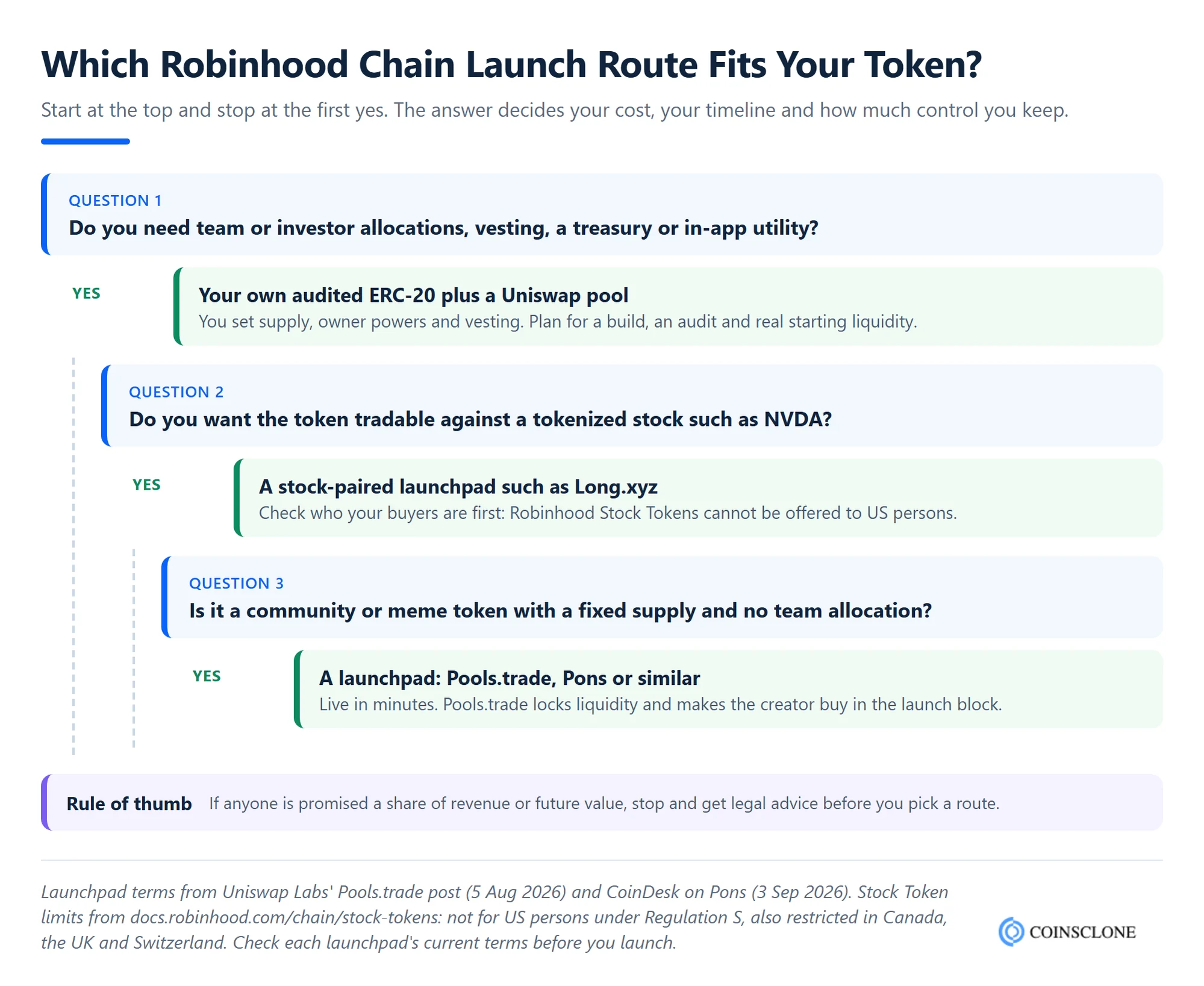
- Pick a route: a launchpad, a stock-paired launchpad, or your own contract.
- Set up a wallet and add Robinhood Chain (chain ID 4663).
- Bridge ETH from Ethereum for gas.
- Write the contract with audited OpenZeppelin code and fix the supply.
- Test on testnet (chain ID 46630) before you touch mainnet.
- Deploy and verify the contract on the Blockscout explorer.
- Add liquidity on Uniswap and lock it.
- Launch with anti-snipe rules, then apply to trackers and listings.
What Is Robinhood Chain?
Robinhood Chain is an open layer 2 network on Ethereum, built with Arbitrum’s tech stack. It went live on 1 July 2026. It was built for tokenized stocks and real-world assets, but memecoins took over its first weeks, as CoinDesk noted. Anyone can deploy a contract on it, with no sign-off needed.
The chain grew fast. The Block reported a record $989 million in daily DEX volume in late August and total value locked of $708 million. By mid-September, TVL was close to $1 billion. Uniswap v2, v3 and v4 are all live on the chain.
Here are the settings you need, taken from Robinhood’s connection guide:
| Setting | Mainnet | Testnet |
| Network name | Robinhood Chain | Robinhood Chain Testnet |
| Chain ID | 4663 | 46630 |
| Gas token | ETH | ETH |
| Public RPC | https://rpc.mainnet.chain.robinhood.com | https://rpc.testnet.chain.robinhood.com |
| Block explorer | robinhoodchain.blockscout.com | explorer.testnet.chain.robinhood.com |
| Built on | Arbitrum (settles to Ethereum) | Arbitrum |
Note: The public RPC endpoints are rate limited and not meant for production, the docs warn. For launch day, use a paid provider such as Alchemy, which the docs name.
Which Launch Route Fits Your Project?
Each route trades speed for control.
| Route | Best for | What you control | Cost to launch | Main risk |
| Launchpad (Pons, Pools.trade) | Community and meme tokens | Name, ticker, image | About $1 on Pons; no launchpad fee on Pools.trade | Fixed template, no vesting or treasury |
| Stock-paired launchpad (Long.xyz) | Tokens traded against a tokenized stock | Name, ticker, the paired stock | Launchpad terms | Stock Token legal limits on who can buy |
| Your own ERC-20 plus a Uniswap pool | Projects with a product, team or investors | Everything: supply, owner powers, vesting | Build, audit and liquidity | You own every mistake |
Launchpads are the fastest path. Uniswap Labs’ Pools.trade, announced on 5 August 2026, mints 1 billion tokens per launch. It offers a four-hour Crowd Launch or an Instant Launch on a bonding curve. The creator must buy in the launch block, and the liquidity is locked forever in a Uniswap v4 pool with a 0.25% LP fee. Launchpads can also vanish: Noxa, the chain’s biggest in July, stopped new launches after a week that earned it about $12 million in fees, CoinDesk reported.
Stock-paired launchpads are unique to this chain. Long.xyz lets a token trade against a tokenized stock such as NVDA instead of ETH. The Block noted that one such token grew from a $1.5 million to a $135 million market cap during August. However, Robinhood Stock Tokens are debt securities issued in Jersey. They cannot be offered to US persons, and offers are also restricted in Canada, the UK and Switzerland.
Your own contract fits when the token has a job: governance, in-app payments, rewards or an investor round. It is the only route with team vesting and a treasury.
For a pure meme token, our guide on how to create a meme coin covers the strategy. The rest of this guide follows the project route.
Step-by-Step: Deploy Your ERC-20 on Robinhood Chain
These steps follow Robinhood’s own deploy guide, which supports Foundry and Hardhat. For ERC-20 basics, see our guide to create an ERC-20 token.
Step 1: Set Up a Wallet and Add the Network
Robinhood Wallet supports the chain out of the box. MetaMask, Rabby and other EVM wallets work too: add a custom network with chain ID 4663, symbol ETH and your RPC URL. Deploy from a fresh wallet, not your personal one.
Step 2: Bridge ETH for Gas
Gas is paid in ETH. The canonical bridge is the Arbitrum bridge portal, and deposits take about 10 minutes. Going back to Ethereum takes about 7 days, plus a final claim on the main chain. Relay, Across, LayerZero and Chainlink CCIP also work.
Fees are low: a fraction of a cent for a normal transfer in July 2026, per CoinDesk. A deploy uses far more gas than a swap, so keep a small buffer of ETH.
Step 3: Write the Contract
Start from OpenZeppelin Contracts, the most widely used audited library. A fixed-supply token is the cleanest design buyers can trust:
// SPDX-License-Identifier: MIT
pragma solidity ^0.8.24;
import {ERC20} from "@openzeppelin/contracts/token/ERC20/ERC20.sol";

contract ProjectToken is ERC20 {
    constructor(address treasury) ERC20("Project Token", "PRJ") {
        _mint(treasury, 1_000_000_000 * 10 ** decimals());
    }
}
Decide these points before you write a line:
- Supply: Fixed, or mintable? A live mint function is the first thing buyers look for.
- Decimals: Use 18, the default for Robinhood’s Stock Tokens and most wallets.
- Owner powers: Pause, blacklist and tax functions scare buyers. If you need them, cap them in code and give them an end date.
- Vesting: Put team and investor tokens in vesting contracts, not plain wallets.
- Fee-on-transfer: Avoid it. Many DEX routers and tools handle it badly.
Step 4: Test on Testnet First
The docs say it plainly: deploy to testnet first. Use chain ID 46630 and the testnet RPC. Rehearse the whole launch there: deploy, verify, create the pool, add liquidity and run test trades.
Step 5: Deploy to Mainnet
With Foundry, the deploy is one command. Keep the private key in an environment variable and never commit it:
forge create src/ProjectToken.sol:ProjectToken \
  --rpc-url $RH_RPC_URL --private-key $PRIVATE_KEY \
  --broadcast --constructor-args 0xYourTreasuryAddress
Step 6: Verify on Blockscout
Verifying publishes your source code, so anyone can read what the contract can do. Tokens with hidden code look like scams. The docs give the Blockscout settings:
forge verify-contract <contract_address> src/ProjectToken.sol:ProjectToken \
  --chain-id 4663 --rpc-url $RH_RPC_URL --guess-constructor-args \
  --verifier blockscout --verifier-url https://robinhoodchain.blockscout.com/api/
Hardhat users run `npx hardhat verify` instead. Then check that the Contract tab on the explorer shows your source.
How to Add Liquidity on Robinhood Chain
A token with no pool cannot be traded. Uniswap v2, v3 and v4 are all live on the chain, so you create a pool there and deposit your token plus a quote asset. Most new tokens pair with WETH. USDG, the chain’s largest stablecoin, is the other common choice.
How much liquidity is enough? It depends on the trades you expect. The chart below works through one $1,000 buy in a full-range pool.
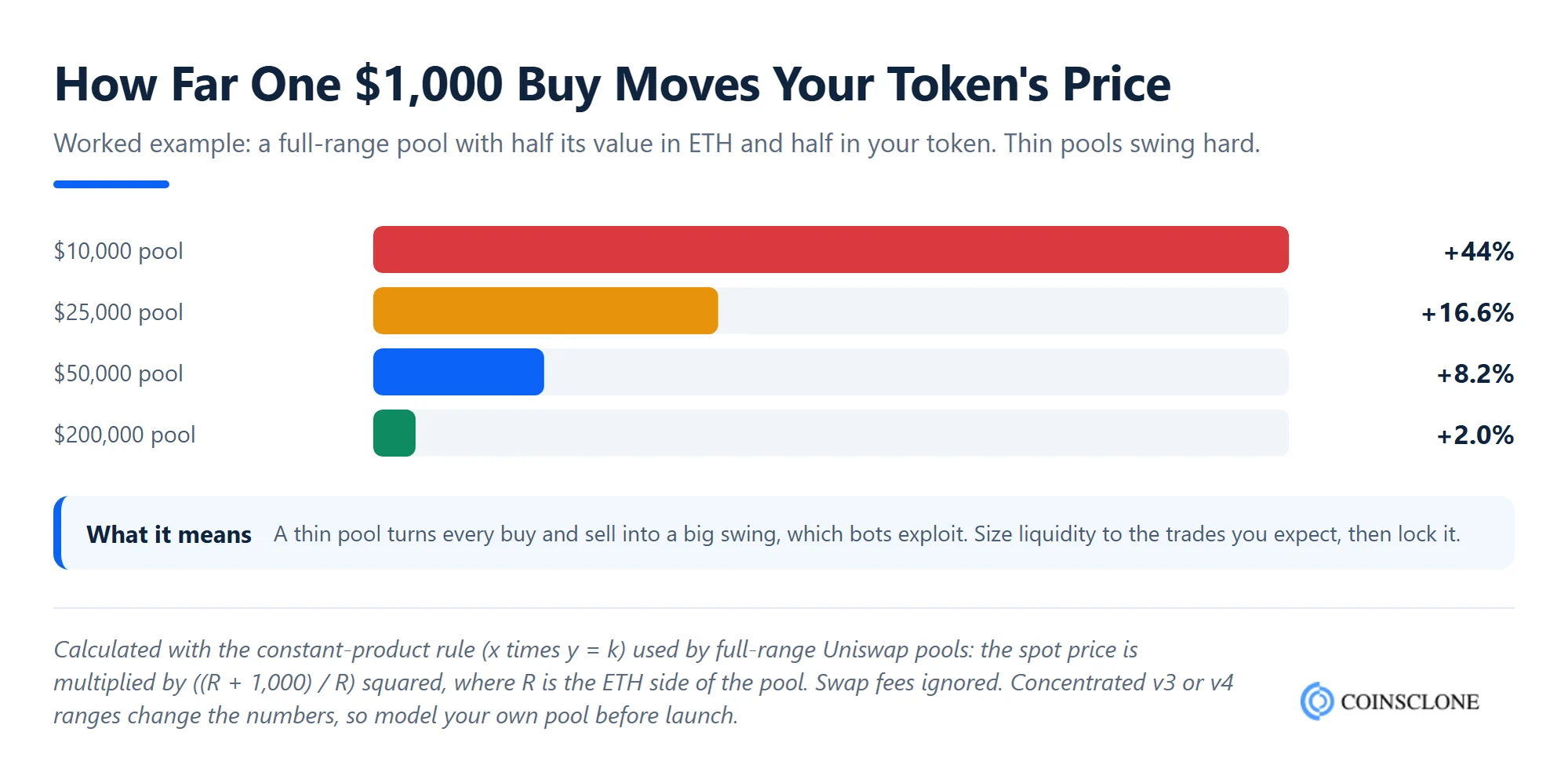
Thin pools invite bots. A 44% jump from one buy lets a bot buy first and sell straight into your community. So size the pool to your expected first-week trades, not to the minimum you can afford.
Next, lock or burn the LP position. Buyers check whether the creator can pull liquidity. Send the LP tokens or position NFT to a time-lock contract, or burn them, and publish the transaction. Launchpads like Pools.trade lock liquidity for you.
Pairing with a stock token? Use only the official addresses on Robinhood’s token contracts page. Anyone can deploy a token that copies a stock’s ticker, so check the address, not the name. Also remember that buyers in your pool are taking on Stock Token exposure, which Robinhood does not offer to US persons.
How to Protect Your Launch From Snipers and Bundlers
Sniping is the biggest threat to a fair launch here. On 27 September 2026, The Block reported an analyst’s claim that one operation took $18.43 million from 53 launches. The Block did not replicate that total, but its own count for one launch, DEED, came to about 199.8 ETH.
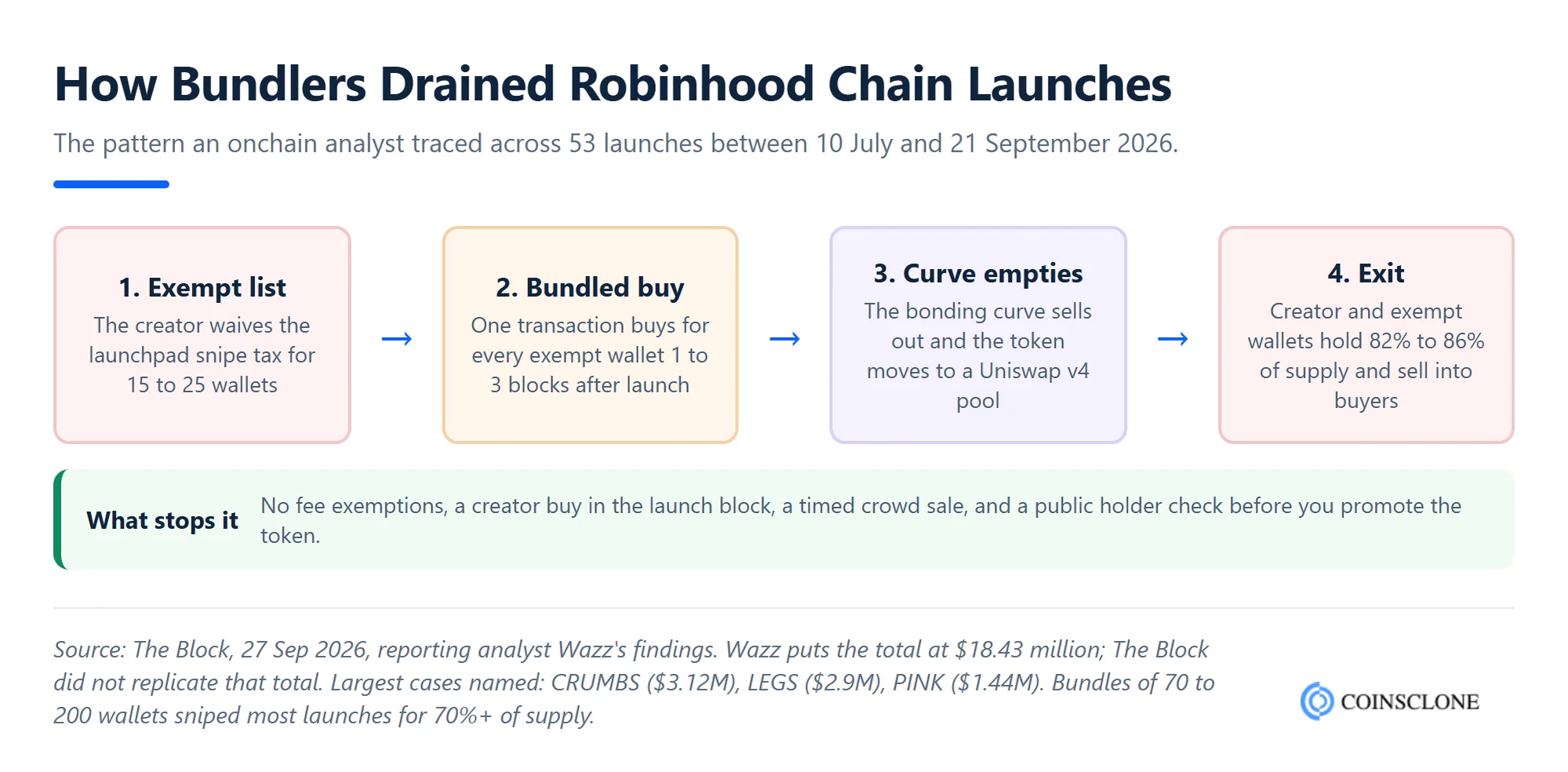
The analyst also found that bundles of 70 to 200 wallets sniped most launches for 70% or more of supply. If your launch looks like that, buyers will assume you are part of it. Here is how to defend it:
- No exemptions: Never exempt wallets from a launchpad’s anti-snipe tax. That was the core of the scheme.
- Same-block creator buy: If you want an allocation, buy it in the launch block in public, as Pools.trade requires.
- Timed crowd sale: A sale window with gradual fills, like Pools.trade’s four-hour Crowd Launch, removes the race to block one.
- Launch-window limits: In your own contract, cap wallet size and trade size for the first minutes, and make the caps switch off on their own.
- Announce last: Publish the contract address only after the pool is live, and only in your official channels.
- Watch for clones: The analyst found fake launches of hyped names before the real one. Pin the real address everywhere.
Launching a Token on Robinhood Chain?
Robinhood Chain Token Development — done right.
- Contract: An ERC-20 built on audited libraries, with the supply, owner powers and vesting your plan needs.
- Testnet first: Full test runs on chain 46630 before anything touches mainnet.
- Launch setup: Blockscout verification, Uniswap pool creation and a liquidity lock plan.
- Fair launch: Launch-window limits and a clean holder map that buyers can check for themselves.
Get a token plan that fits your project, not a generic template.
Book a Free Demo to see how your Robinhood Chain token launch would work.
Safety Signals Buyers Check
Traders run token checkers and the explorer before they buy. Pass these checks before launch day.
| Signal | What buyers look for | How to pass it |
| Verified source | Readable code on Blockscout | Verify on deploy (Step 6) |
| Mint power | No hidden or live mint function | Fixed supply, or mint behind a timelock |
| Owner powers | Renounced owner or a multisig | Move ownership to a multisig, or renounce |
| Liquidity | LP locked or burned | Lock it and post the transaction |
| Holders | No cluster of fresh wallets with most of the supply | No exemptions, team tokens in vesting |
| Taxes | Low, fixed buy and sell fees | No tax, or a hard cap in code |
If the top ten holders are wallets funded in the same minute, buyers walk away. A clean holder map is now part of your marketing.
What a Robinhood Listing Does and Does Not Mean
Many founders assume a token on the chain shows up in the Robinhood app. It does not. The chain runs apart from brokerage accounts, the support page notes. Anyone can deploy, but the app team picks what it lists.
CASHCAT, the chain’s breakout memecoin, reached the app only after its price run, and it has no formal link to the company. Also, app users made up only 1% to 2% of chain transactions, a CoinDesk Research estimate cited by The Block in September 2026. Most buyers will come through Uniswap, trading terminals and other wallets.
Plan your visibility instead. Apply to DEX Screener, CoinGecko and CoinMarketCap once you have a verified contract and live liquidity. Our guide on how to list a token covers each platform’s rules.
Cost and Timeline to Launch a Token on Robinhood Chain
Gas is the smallest cost. The contract, the audit and the starting liquidity make up the real budget. The build ranges below come from published 2026 agency cost guides:
| Item | Launchpad route | Project route |
| Network gas | Included | Small: ordinary transactions cost a fraction of a cent |
| Launch fee | About $1 on Pons; none on Pools.trade | None |
| Contract build | None (template) | $5,000 to $15,000 basic; $15,000 to $50,000+ with vesting, staking or tax logic |
| Security audit | None | $5,000 to $15,000 simple; $15,000 to $70,000 for complex contracts |
| Starting liquidity | Built into the curve | Your capital (see the worked example above) |
| Time to launch | Minutes | 1 to 2 weeks plain; 3 to 5 weeks with vesting; 6 to 10 weeks with staking or governance |
The build timelines in the last row are the ones published on our ERC-20 token development page.
Worked example: a project token with team vesting and a $50,000 starting pool. Budget $15,000 to $50,000 for the vesting contracts, $5,000 to $15,000 for a simple audit, and $50,000 of liquidity, half in ETH. That is $70,000 to $115,000 before marketing. In return, a $1,000 buy moves the price about 8%, not 44%. For a full breakdown by chain, see our guide to the cost to create a crypto token.
Rules and Legal Points to Check
Nobody approves tokens on the chain, so the legal checks are yours. Check these points before launch:
- United States: In February 2025, the SEC’s Division of Corporation Finance said in a staff statement that the meme coins it described are not securities. That view does not cover tokens sold with promises of profit, revenue share or team effort.
- European Union: Under MiCA, a public offer of a crypto-asset usually needs a published white paper. There are exemptions, such as offers to fewer than 150 people per member state or offers under EUR 1 million over 12 months.
- Stock-paired tokens: Robinhood Stock Tokens cannot be offered to US persons and are restricted in Canada, the UK and Switzerland. Geo-block your interface if your token’s main pool holds them.
- Marketing claims: Never promise returns, price targets or an app listing.
How to Choose a Development Partner
If your token has a team, a product or investors, your build partner should do more than deploy a template. Ask:
- Which audited library and version will they use, and which owner powers will remain after launch?
- Will they run a full testnet rehearsal on chain 46630, including the pool and the liquidity lock?
- How will they prevent sniping at launch, and who controls the launch-window limits?
- Who holds the keys during and after deployment?
- Will they verify every contract on Blockscout and hand over the source code?
Before a scoping call, prepare six things: total supply, the allocation table, the vesting plan, your liquidity budget, a target date and the countries your buyers live in.
Coinsclone has been building since 2018 and has delivered 350+ platforms for 200+ clients across 20 industries. Our crypto token development company team builds, tests and verifies ERC-20 tokens on EVM chains such as Ethereum, Base and Arbitrum, and Robinhood Chain runs the same contract code and tools.
Frequently Asked Questions
How do I create a coin on Robinhood Chain?
You create a token, not a native coin, because ETH is the chain’s gas currency. Deploy an ERC-20 contract with Foundry or Hardhat to chain ID 4663, or use a launchpad such as Pools.trade or Pons. Then verify the contract on Blockscout and add liquidity on Uniswap so people can trade it.
Can I create a meme coin on Robinhood Chain?
Yes. Launchpads such as Pons, Pools.trade and Long.xyz let anyone launch a meme token in minutes, and Pons charged a launch fee of about $1 in September 2026. Pools.trade locks liquidity for you and makes the creator buy in the launch block, which limits snipers.
How do I deploy on Robinhood Chain?
Use Foundry or Hardhat, the two tools in the official docs. Use chain ID 4663 for mainnet or 46630 for testnet, and fund the deployer with ETH. Test on testnet first, then verify the contract on Blockscout.
Is Robinhood Chain EVM compatible?
Yes. It is a layer 2 built on Arbitrum’s stack, and it runs the same code as Ethereum. Solidity contracts, OpenZeppelin code, MetaMask and the usual tools work as they are.
Is Robinhood Chain on MetaMask?
You can add it to MetaMask as a custom network. Use the network name Robinhood Chain, chain ID 4663, currency symbol ETH and the RPC URL https://rpc.mainnet.chain.robinhood.com. Robinhood Wallet supports the chain with no setup.
What is the gas token on Robinhood Chain?
ETH is the gas token. Each transaction pays a small fee to run on the chain plus a fee to post its data to Ethereum, and wallets show both as one number. A normal transfer cost a fraction of a cent in July 2026, per CoinDesk.
How do I bridge to Robinhood Chain?
The canonical route is the Arbitrum bridge portal, which moves ETH and ERC-20 tokens from Ethereum in about 10 minutes. Robinhood’s docs also list Relay, Across, LayerZero (Stargate) and Chainlink CCIP. Withdrawals back to Ethereum through the canonical bridge take about 7 days.
Will my token be listed on the Robinhood app?
Not by default. Anyone can deploy on the chain, but the app team picks what it lists. CASHCAT reached the app only after its price run, so plan for buyers through Uniswap, trackers and other wallets.