
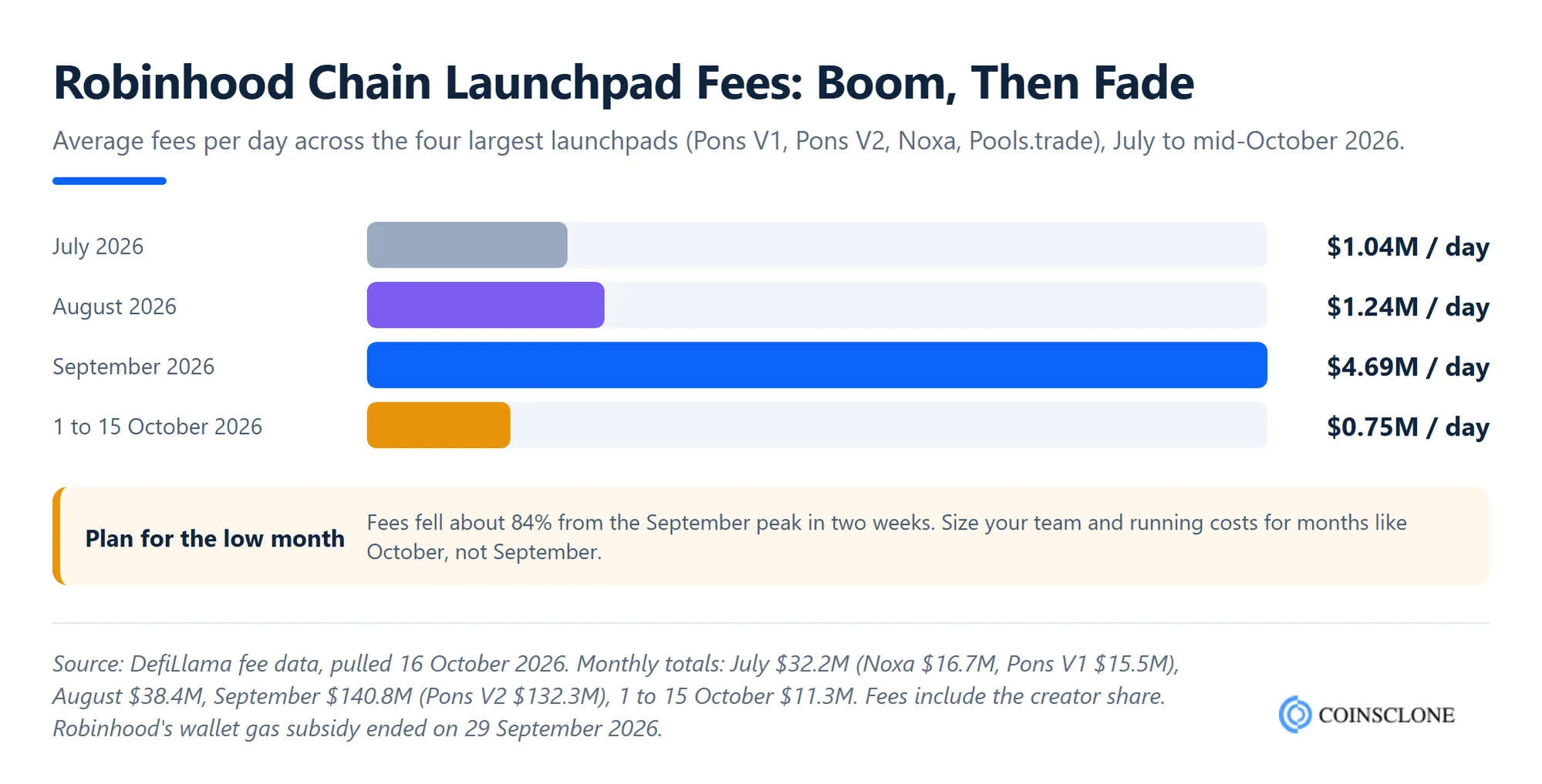
In September 2026, one app on Robinhood Chain took in more fees than most blockchains. Pons V2, the chain’s largest token launchpad, collected $132.3 million in fees that month, about $4.4 million a day, according to DefiLlama’s Pons V2 data. In the first half of October it averaged about $0.7 million a day. The boom was real, and so was the fade.
That swing is why a Robinhood Chain token launchpad needs careful design. The chain is three and a half months old, two early launchpads have already stopped, and one rug ring drained millions through the biggest. This guide is for teams who want to run a launchpad. It covers launch models, fee splits, anti-sniper design, graduation to a DEX, the rules and the cost.
In this guide:
- Robinhood Chain is an Ethereum layer 2 built on Arbitrum (chain ID 4663, ETH for gas). Contracts deploy unchanged, but `block.number`, transaction order and randomness work differently.
- Pons V1 and V2 took 94% of all launchpad fees on the chain in the 30 days to 16 October 2026. Their base model is a 1% trade fee split 70/30 between creator and platform.
- A snipe tax alone did not protect buyers. One ring took $18.43 million from 53 launches using tax-exempt wallets and bundles of 70 to 200 wallets.
- A bonding-curve launchpad takes 4 to 6 weeks white label or 8 to 12 weeks custom at Coinsclone. Agency cost guides put white label at $20,000 to $50,000.
- Free gas ended on 29 September 2026 and trading slowed. Plan your fees for normal months, not peak weeks.
What Is a Robinhood Chain Token Launchpad?
A Robinhood Chain token launchpad is an app that lets anyone create a token on Robinhood Chain and start trading it at once. The creator picks a name, ticker and image, and the contracts do the rest. Early trades run on a bonding curve or a fresh pool. Once a token “graduates”, its liquidity is locked in a Uniswap pool for good. The launchpad earns a share of every trade.
Robinhood launched the chain’s mainnet on 1 July 2026. It was built for tokenized stocks, but memecoins took over within days. By 16 October 2026, DefiLlama showed about $1.05 billion of locked value on the chain and about $37 billion of DEX volume over the past 30 days.
Here is who runs launches there today:
| Launchpad | Model | Fees | Status, October 2026 |
| Pons V1 | Direct to a locked Uniswap v3 pool | 1% per trade, 70% creator, 30% Pons | Live |
| Pons V2 | Bonding curve, then a locked Uniswap v4 pool | Hook fee plus optional creator tax | Live, launches limited to approved wallets |
| Pools.trade (Uniswap) | Instant or “crowd” launch into locked v4 pools | No platform fee; 0.25% LP fee | Live since 5 August 2026 |
| LONG.xyz | Time-based launch on Uniswap v4, often paired with Stock Tokens | Not published | Live |
| Noxa | Bonding curve | Now 100% to creators | Stopped new launches on 11 July |
| Vlad.fun | Memecoin launchpad | n/a | Halted in mid-July |
Sources: the Pons V1 docs, Pons V2 docs and Decrypt’s Pools.trade report.
Two shutdowns shaped the market. CoinDesk reported that Noxa earned nearly $12 million in fees in one week, then stopped new launches on 11 July over low-quality tokens. Days later, Vlad.fun halted after finding a “serious internal integrity issue” tied to team members. Buyers judge a launchpad on trust as much as features.
Robinhood Chain Basics Every Launchpad Builder Must Know
Robinhood Chain feels like Ethereum to a developer, but a few quirks change how launch contracts must work. These come from Robinhood’s chain docs:
| Fact | Detail | What it means for your launchpad |
| Stack | Ethereum layer 2 on the Arbitrum Dedicated Blockchains framework | Hardhat, Foundry, viem and Uniswap code work as is |
| Network | Chain ID 4663 (testnet 46630), ETH for gas | No chain token to buy; users only need ETH |
| Transaction order | First come, first served at the sequencer | Bots cannot pay for priority, so they race on speed instead |
| `block.number` | Returns an estimate of the Ethereum block number | Use `arbBlockNumber()` or timestamps for launch windows |
| Randomness | `block.prevrandao` is a constant | Use Chainlink VRF for any lottery or random allocation |
| Sanctions | The sequencer drops transactions tied to sanctioned addresses | Helpful, but you still need wallet screening in your app |
| Contract size | Up to 96 KB, against 24 KB on Ethereum | Room for a richer factory or hook in one contract |
Two more points matter. The public RPC endpoints are rate-limited, so a launchpad feed needs a paid node provider such as Alchemy. And Robinhood paid gas for its wallet users only until 29 September 2026, so your users now pay their own fees.
Four Launch Models and Which One to Build
Every Robinhood Chain launchpad uses one of four models. The right one depends on how hard you want to fight bots and how fast tokens should trade.
- Bonding curve, then graduation: The full supply sits in a curve contract and the price rises as people buy. When the curve sells out, the liquidity moves to a locked DEX pool. Pons V2 and hood.fun work this way.
- Direct to pool: The token goes straight into a locked Uniswap pool at launch, as on Pons V1. It is simple and cheap to audit, but snipers face no curve at all.
- Time-based launch: LONG.xyz runs launches on a Uniswap v4 hook over a set time window, according to Mobula’s integration notes. Price discovery is spread over time, so a single fast buy matters less.
- Crowd launch: Pools.trade offers a “crowd launch” next to its instant launch. Decrypt describes it as built to resist bundling, where insiders grab supply at the open.
Stock Token pairs are the one twist only this chain offers. Instead of ETH, a launch can pair a memecoin against a Robinhood Stock Token such as NVDA. The Block reported that stock-paired memecoins made up about a quarter of stock-linked volume in August. One token’s NVDA pool held about $3.3 million, more than three times its WETH pool. They also bring legal limits, covered below.
Fee Design: How Robinhood Chain Launchpads Make Money
Most launchpads here share a fee on every trade with the creator. That share is your growth engine, because creators promote tokens that pay them. Here is how a $1,000 buy splits under the two main models:
- Pons V1 style (1% fee): $10 in fees. The creator gets $7 and the platform gets $3. Pons then sends 80% of its share, $2.40, to buy back and burn its PONS token, and keeps $0.60 for running costs.
- Pools.trade style (0.25% LP fee): $2.50 in fees. The creator gets $0.50 and $2.00 goes back into the locked pool. The platform takes nothing.
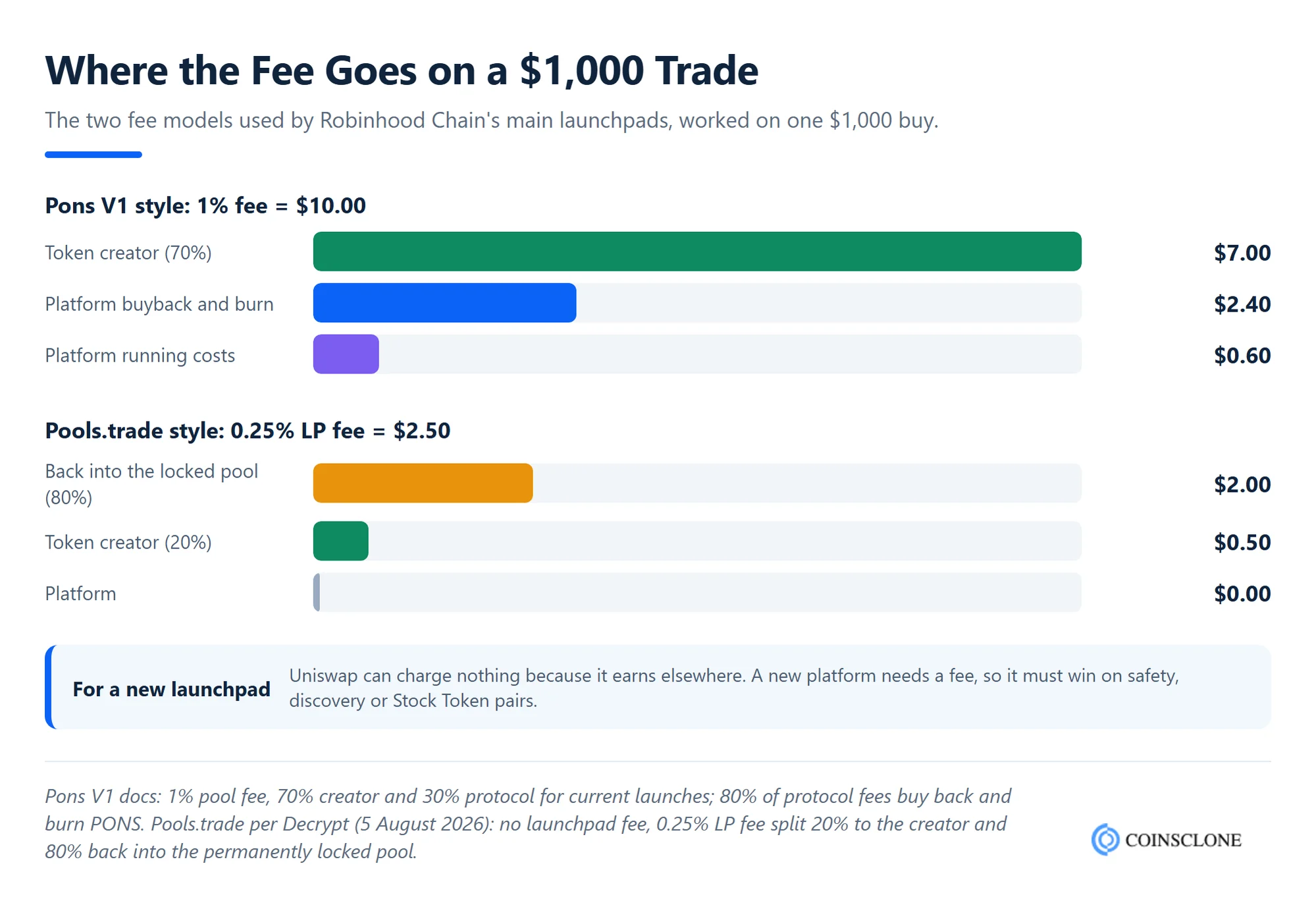
Pools.trade can charge nothing because Uniswap earns elsewhere. A new launchpad cannot, so compete on safer launches, better discovery or Stock Token pairs.
A worked example: say your launchpad handles $40 million of trades a month at a 1% fee, and you keep 30%. That is $400,000 in fees and $120,000 a month for the platform. If volume drops 80%, as it did for Pons V2 between September and early October, you keep $24,000. Size your team and running costs for the low month.
Other fee lines include a launch fee per token (Pons V1 charges 0.0005 ETH, which also cuts spam), a creator tax that you should always cap and show, a graduation fee, and paid boosts or data feeds.
How to Stop Snipers and Bundlers on Your Launchpad
Snipers buy in the first seconds and sell into real buyers. Bundlers use dozens of wallets so caps miss them.
Pons V2 uses a snipe tax: a 99% buy tax that falls to zero over the first five seconds. It is about 25% at one second and 3% at two seconds. The launch wallet and fee wallet are exempt, and creators can name up to 32 more exempt wallets.
That exempt list became the weak point. In September, analyst Wazz traced $18.43 million taken from 53 launches to one group, as The Block reported. Here is how it worked:
- The creator exempted 15 to 25 wallets from the snipe tax.
- One to three blocks after launch, one transaction bought for all of them and emptied the curve, leaving insiders with 82% to 86% of supply.
- In one launch, funded wallets began selling one second after launch, and the creator also took 69 ETH in creator fees.
- The group also ran fake launches of hyped names before the real contract.
So build these controls in from day one:
- Limit exemptions: allow one creator buy at launch and nothing else, as Pons V1 does on its launch block. If you allow exempt wallets, show each one on the token page.
- Cap buys over time, not blocks: apply wallet and buy caps for the first minutes. Count them by timestamp or `arbBlockNumber()`, never `block.number`.
- Detect funding clusters: your indexer should trace which wallets were funded from the same source and show a “bundled supply” share on every token page.
- Hold creator fees for a while: pay creator fees after a delay, so a rug cannot cash out fees in the same hour.
- Use batch pricing for big launches: a crowd or time-based launch, where early buys clear at one price, removes the speed race.
- Verify official tokens: mark the real contract and warn on copied names and tickers.
Because the sequencer is first come, first served, bots cannot outbid buyers on gas. They win on speed and spam instead, so rate-limit your API as well.
Graduation to a DEX: Curves, Pools and Locking
Graduation is when a token leaves the curve and starts trading on Uniswap. Most of the money sits here, so it needs the most care.
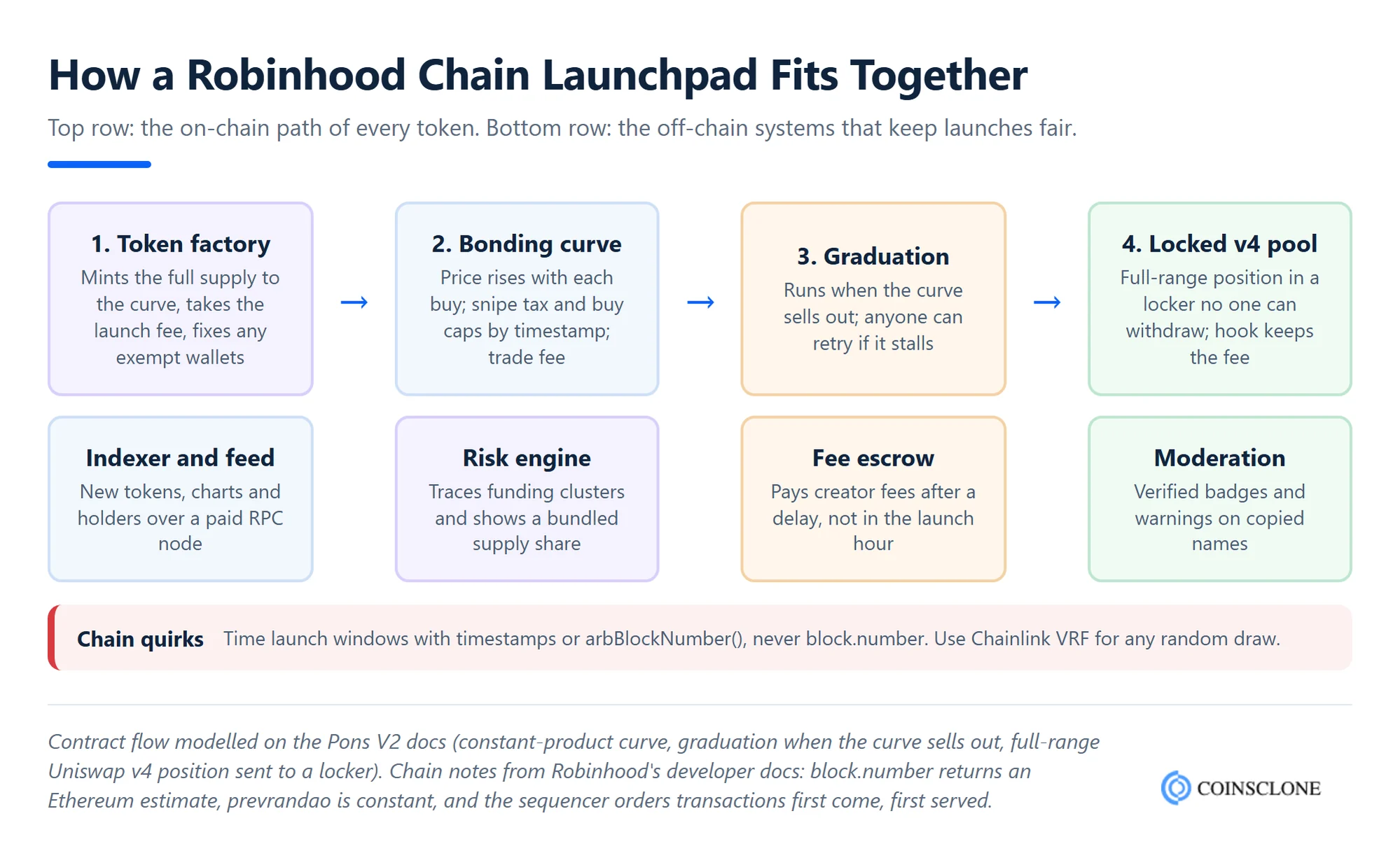
Pons V2’s design is a good model:
- Curve math: a constant-product curve with a “phantom” reserve that sets the opening price. The full supply is minted to the curve, so no hidden team wallet exists.
- Trigger: graduation runs when the curve sells out, inside the buy that finishes it. If it stalls, anyone can call the graduation function.
- Locking: one full-range Uniswap v4 position goes to a locker that nobody can withdraw from, not even Pons or the creator.
Locking stops a creator from pulling the pool. It does not stop insiders from buying cheap and selling later, so you still need the controls above.
Stock Token pairs need extra work. Stock Tokens are standard ERC-20s with 18 decimals that do not rebase. Corporate actions such as splits change a `uiMultiplier()` value instead, and the Chainlink price already includes it, per Robinhood’s Stock Token docs. Your charts must use the right figure, or a stock split will look like a crash. Fees on these pools can also arrive partly in Stock Tokens, so plan how your treasury holds them.
Step-by-Step: How to Build and Launch Your Launchpad
- Pick the model and fee split: curve or direct pool, ETH or Stock Token pairs, and your share of fees.
- Write the contracts: token factory, curve, graduation logic, Uniswap v4 hook, locker and fee escrow. Keep admin keys in a multisig.
- Test on testnet (chain ID 46630): run bot and bundle attacks against your own launches.
- Get an outside audit: the curve and locker hold buyer funds around the clock. Pons says its V2 contracts are unaudited; do not copy that gap.
- Build the indexer and feed: new tokens, live charts, holder lists and bundle flags. Use a paid RPC provider.
- Add moderation: verified badges, name checks, report buttons and staff who watch launches.
- Launch in stages: start with approved creators, tune bot rules on real traffic, then open to all. Pons V2 itself limits launches to approved wallets today.
Launch Your Own Token Launchpad on Robinhood Chain
Robinhood Chain Launchpad Development — done right.
- Bonding Curves: Constant-product curves with graduation into locked Uniswap pools.
- Fee Engine: Trade fees, creator shares and fee escrow set the way you choose.
- Bot Protection: Snipe windows, buy caps and bundle flags built into every launch.
- Stock Token Pairs: Price feeds, multipliers and region blocks for stock-paired launches.
Get a branded launchpad demo with full source code ownership.
Book a Free Demo to see how your Robinhood Chain launchpad would work.
Coinsclone builds bonding-curve launchpads through its Pump.fun clone script, and vetted-sale platforms through its crypto launchpad development service. Both can be set up for Robinhood Chain, since it runs standard EVM code.
Rules That Apply to a Robinhood Chain Launchpad
Get legal advice in each country you serve. These are the main points in 2026:
- US view on memecoins: in a February 2025 staff statement, the SEC’s Corporation Finance staff said the memecoins it described are not securities. Fraud is still pursued, and tokens that only pose as memecoins are not covered.
- Stock Tokens are securities: Robinhood issues them through Robinhood Assets (Jersey) Limited as tokenized debt securities. They are not offered to US persons and are restricted in Canada, the UK, Switzerland and the UAE. If you offer Stock Token pairs, block those regions and get counsel.
- Sanctions: the sequencer filters sanctioned addresses, but still screen wallets in your app.
- EU users: MiCA rules on crypto offers and service providers may apply to how you run and market the launchpad.
- Brand use: do not imply that Robinhood backs your launchpad. Follow the chain’s brand guidelines and state that you are independent.
Cost and Timeline to Build a Robinhood Chain Launchpad
Coinsclone’s Pump.fun clone script page publishes these build times for a bonding-curve launchpad:
| Scope | Timeline | What it includes |
| White label launchpad | 4 to 6 weeks | Your brand, standard curve, one chain |
| Standard custom launchpad | 8 to 12 weeks | Custom curve, graduation, disclosure layer, audit |
| Launchpad with full tooling | 3 to 5 months | Advanced analytics, detection systems, mobile web, APIs |
| Multi-chain platform | 5 to 9 months | Several chains, cross-chain discovery, creator programs |
On cost, published 2026 agency cost guides put a white label launchpad at roughly $20,000 to $50,000 and a custom build at $100,000 to $300,000. Audits are a large share. Sherlock’s 2026 audit pricing guide puts mid-level DeFi code at $40,000 to $100,000, with each re-audit round adding $5,000 to $20,000.
The biggest cost drivers are custom hook logic, which costs more to build and audit than a standard curve, bundle detection, Stock Token support with feeds and region blocks, and running costs: paid RPC, indexer servers, moderators and a re-audit after each upgrade.
How to Choose a Development Partner
Before a scoping call, prepare four things: your launch model, your fee split, the regions you will serve and your safety rules. Also be clear on why creators would leave Pons for you. Then ask any partner:
- Have you shipped a bonding-curve launchpad, and can I see it live?
- How do you handle snipers and bundlers beyond a snipe tax?
- Who audits the curve, hook and locker, and is a re-audit included?
- Do I own the full source code and the admin keys?
- How will you handle Stock Token feeds, multipliers and region blocks?
Coinsclone has been building since 2018 and has delivered 350+ platforms for 200+ clients across 20 industries. For the wider process, see how to create a crypto launchpad. For a vetted IDO track, see our BSCPad clone script, and for your own AMM, the Uniswap clone script.
Frequently Asked Questions
What is the biggest launchpad on Robinhood Chain?
Pons is the biggest. Its V1 and V2 versions took about 94% of launchpad fees on the chain in the 30 days to 16 October 2026, per DefiLlama. Pools.trade and LONG.xyz are its best-known rivals.
Is Robinhood Chain on Arbitrum?
Robinhood Chain is its own Ethereum layer 2, not an app on Arbitrum One. It is built with Offchain Labs’ Arbitrum technology, which Robinhood’s docs call the Arbitrum Dedicated Blockchains framework. It uses ETH for gas and settles to Ethereum.
What happened to Noxa on Robinhood Chain?
Noxa was the chain’s first large launchpad and earned nearly $12 million in fees in one week. It stopped new launches on 11 July 2026, citing low-quality tokens, and later sent all trading fees to creators.
How do Robinhood Chain launchpads make money?
They charge a fee on every trade and share it with the token creator. Pons V1 charges 1% and keeps 30% of it, while Pools.trade charges no platform fee. Some add launch fees or paid tools.
What is a bonding curve launchpad?
A bonding curve launchpad sells a new token from a contract whose price rises as more tokens are bought. When the curve sells out or hits a target, its funds and remaining tokens move into a locked DEX pool. This is called graduation.
What is the Robinhood Chain chain ID?
The mainnet chain ID is 4663 and the testnet chain ID is 46630. Both use ETH as the gas token.
How much volume do Robinhood Chain launchpads do?
It swings fast. Launchpad fees peaked at about $4.7 million a day in September 2026, then fell to about $0.75 million a day in the first half of October. Check DefiLlama for live figures.
How much does it cost to build a token launchpad?
Published 2026 agency cost guides put a white label launchpad at about $20,000 to $50,000 and a custom build at $100,000 to $300,000. An outside audit often adds $40,000 to $100,000.